Home / Application Guide
TOPIC ARCHIVE
Ceramic application guide articles connecting components to real service conditions: furnaces, laboratories, chemical processing, energy equipment, and industrial systems. For engineers validating whether a ceramic product fits their operating environment.
Materials, product forms, and capabilities in one PDF.
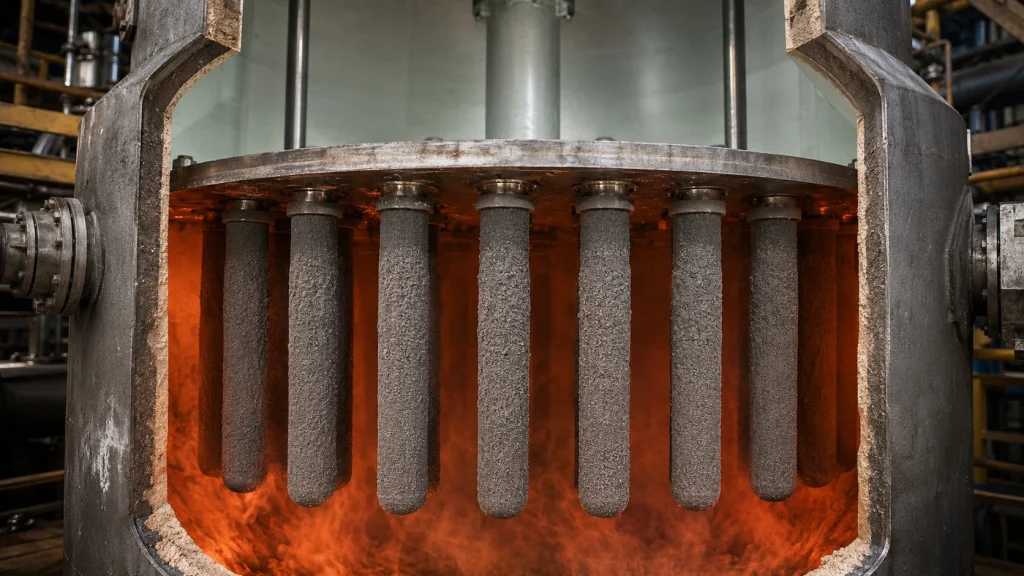
SiC tubes are a strong choice in FGD heat exchangers when the unit must transfer heat in a sulfuric-acid-dew-point-risk environment
In automotive lambda sensors, zirconia is the core ceramic because it acts as the solid electrolyte that allows oxygen ions
BN crucibles are a strong choice in precious metal recovery laboratories when the step is clean melting, holding, or remelting
Measurement-point classification, route selection boundary, and operating-specification guidance for process engineers evaluating ceramic thermowell and protection-tube routes in cracking furnaces
Component role mapping, material selection boundary, and RFQ specification guidance for process engineers evaluating ceramic tube routes in degassing units
The title needs one correction before it can be defended: BN ceramic is often the low-contamination interface choice for metal
Alumina crucibles appear frequently in laboratory environments that handle platinum, palladium, and rhodium, but that does not mean they belong
Silver and copper can both be melted in graphite, clay-graphite, or alumina crucibles without difficulty. That is exactly what makes
Choosing a protection tube for molten aluminum temperature measurement looks straightforward until the next tube fails before the expected replacement
Sourcing alumina tubes for a solar cell diffusion furnace is a question about position before it is a question about
Engineers investigating aluminum alloy casting inclusions usually encounter two kinds of advice that do not quite connect. Foundry literature emphasizes
The container question for rare-earth oxide calcination is rarely a question about temperature alone. A 1500°C-rated alumina crucible can comfortably
High-performance engineering systems often fail at the material–component interface; therefore, advanced ceramics increasingly define reliability limits in real industrial equipment.
Material Safety Behavior of Zirconia Sintering Crucible High-temperature zirconia crucibles may appear inert; however, hidden material interactions can compromise furnace
Unstable zirconia sintering results often originate from unnoticed crucible quality variation; consequently, surface defects, contamination, and dimensional drift accumulate until
Poor sintering consistency often originates not from furnace failure, but from improper crucible use that silently distorts thermal balance and
Poor sintering outcomes often originate before firing begins; consequently, unnoticed incompatibility between crucible and furnace quietly undermines dimensional accuracy, surface
Instability in melting and casting rarely originates from peak temperature alone; instead, it emerges when thermal loads, phase behavior, and
Alumina Ceramic Parts often fail quietly; meanwhile, thermal gradients, voltage stress, and corrosive vapors accumulate until downtime becomes unavoidable. Consequently,
Alumina Ceramic Parts often fail quietly before a machine alarms. Consequently, unchecked wear, contamination, and drift accumulate until throughput or
Alumina Ceramic Parts are frequently introduced into precision systems only after metals begin to compromise dimensional integrity, measurement repeatability, or
Black Alumina Ceramic is increasingly specified when chemical processing equipment faces thermal instability, corrosive attack, and electrical leakage, which collectively
Industrial optical assemblies often fail electrically before they fail mechanically. Consequently, Black Alumina Ceramic becomes a decisive insulating material when
Black Alumina Ceramic components are frequently introduced only after conventional materials begin to limit precision, stability, or service life. As
Send your drawing, material requirement, dimensions, quantity, and working conditions — our engineering team reviews manufacturability before quotation.

WhatsApp us
The more details you provide, the faster we can quote.
*We respond within 24 hours. All inquiries are confidential.