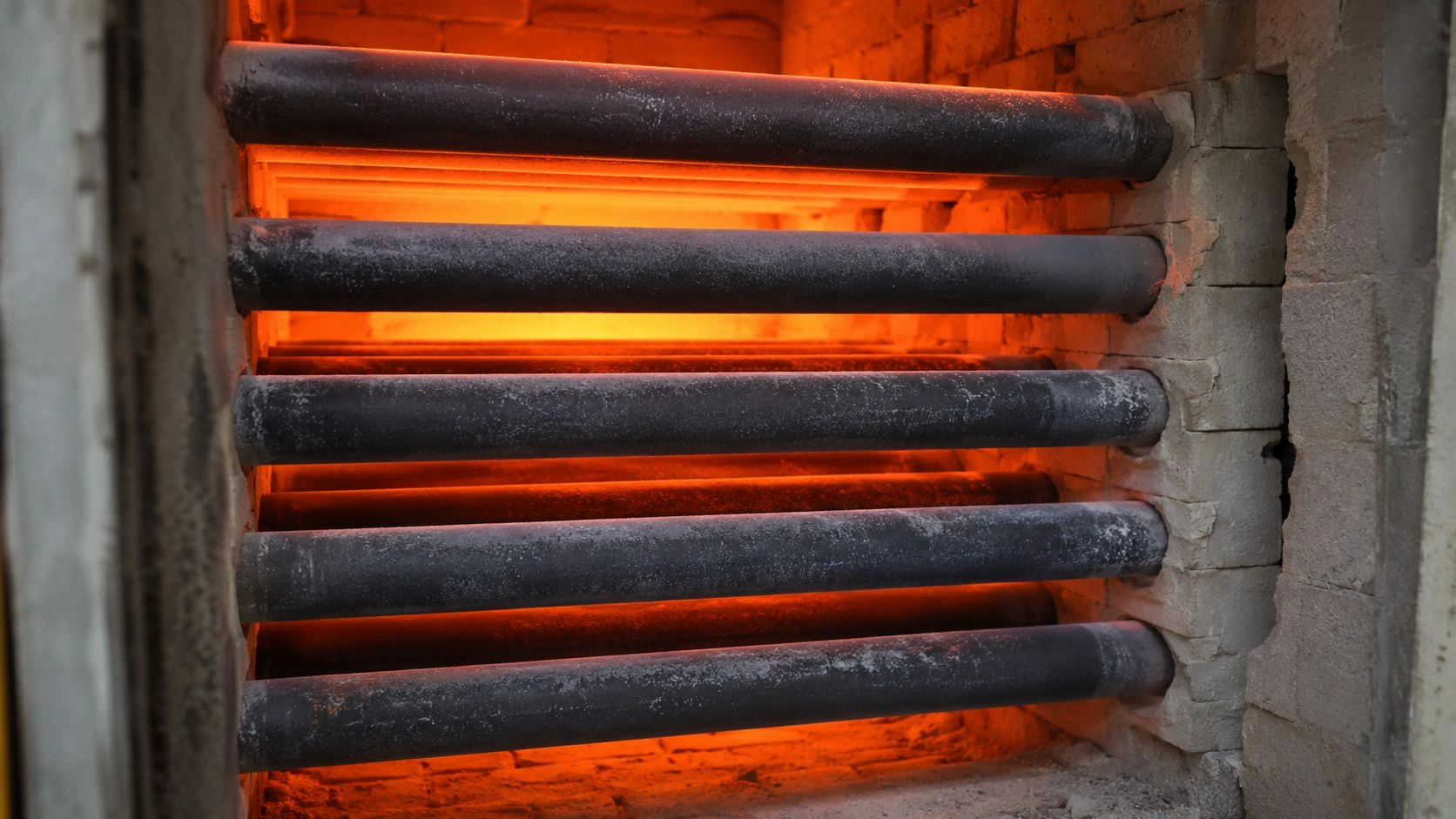
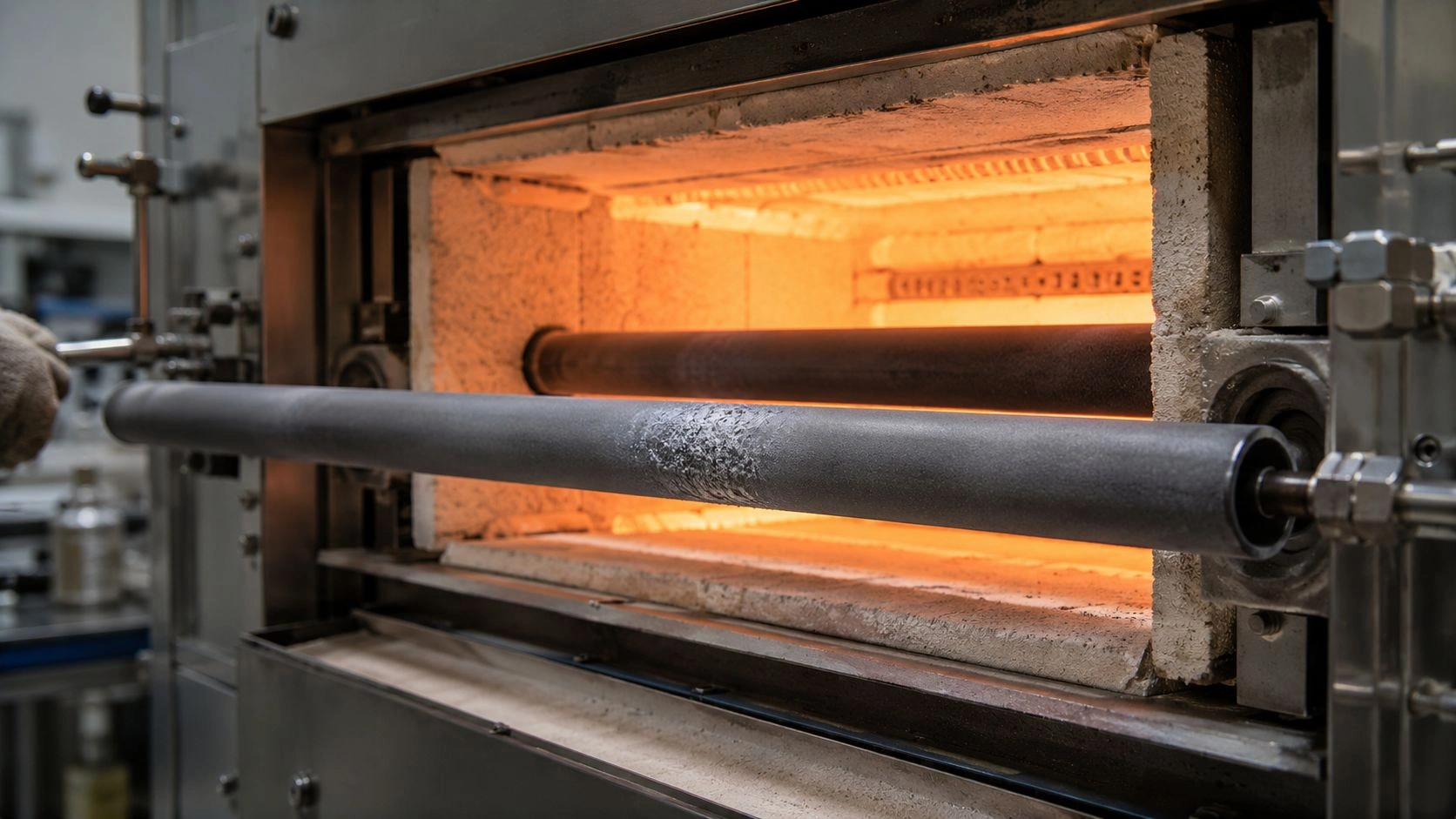
SiC heat exchanger tubes are used in sulfuric acid production when the exchanger must combine strong acid corrosion resistance, high thermal conductivity, thermal shock resistance, and clean heat transfer in aggressive acid or acid-vapor service. They are most relevant for sulfuric acid cooling, dilution heat removal, acid concentration, corrosive vapor condensation, and selected high-temperature sulfuric acid decomposition systems. The tube material is only one part of the design — acid concentration, temperature, SO₃ and H₂SO₄ mist, water content, flow velocity, fouling tendency, tubesheet material, seal design, and thermal stress together decide whether SiC is the right solution for the specific plant zone.
That service-zone-first framing is the engineering basis for this guide.
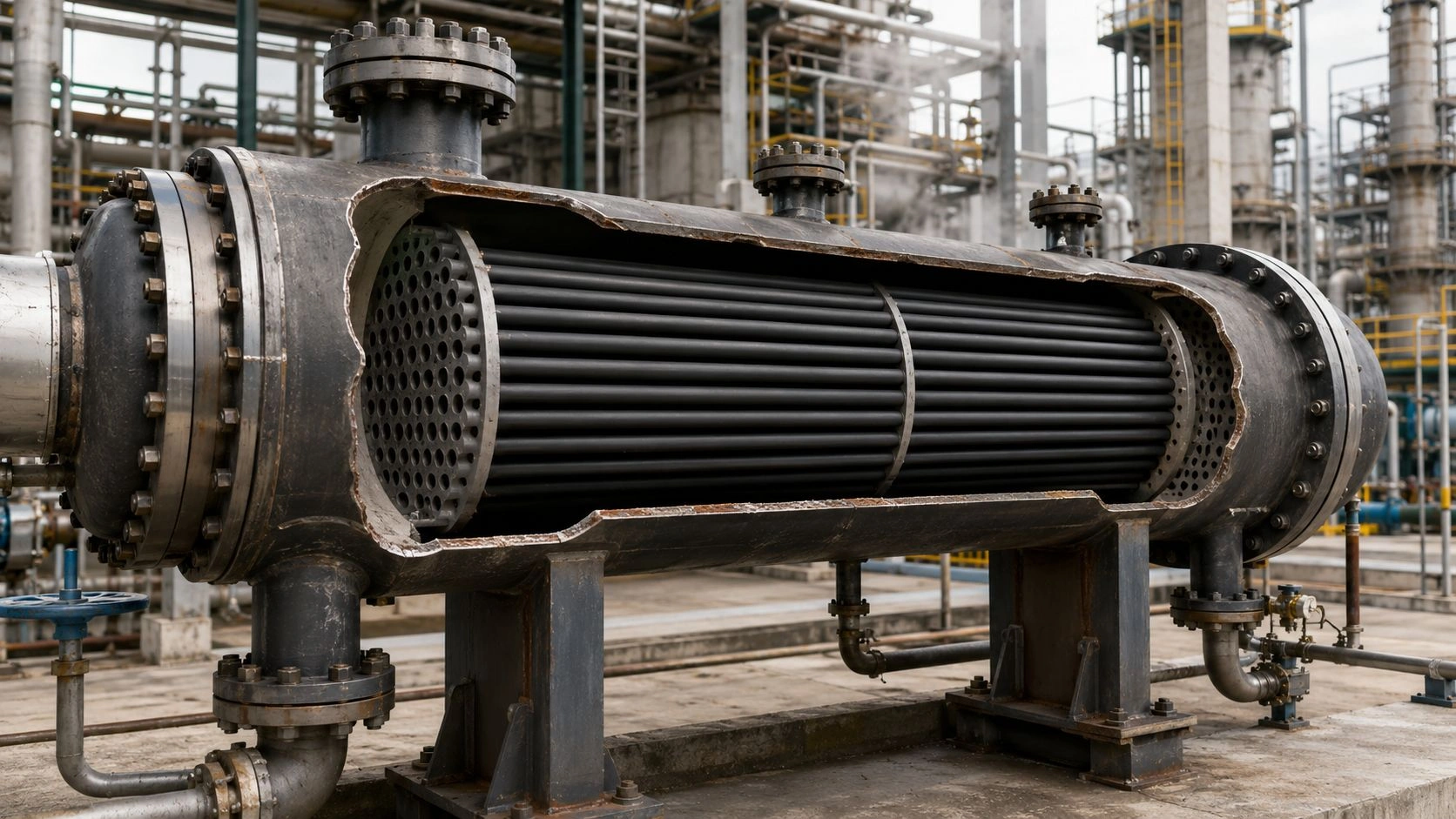
SiC heat exchanger tubes in sulfuric acid production combine corrosion resistance and thermal conductivity in aggressive acid service — but the right fit depends on service zone, acid concentration, SO₃ content, fouling, tubesheet design, and thermal cycling.
This article is part of ADCERAX's coverage of silicon carbide tubes for high-temperature, chemical-resistance, and process applications, which includes SSiC grades for corrosion-resistant heat-exchange, furnace, and chemical-process tube service.
Where SiC tubes fit in sulfuric acid production
Sulfuric acid plants are not one process — they are a sequence of zones with fundamentally different heat-exchanger duties, and the relevance of SiC tube material changes from zone to zone.
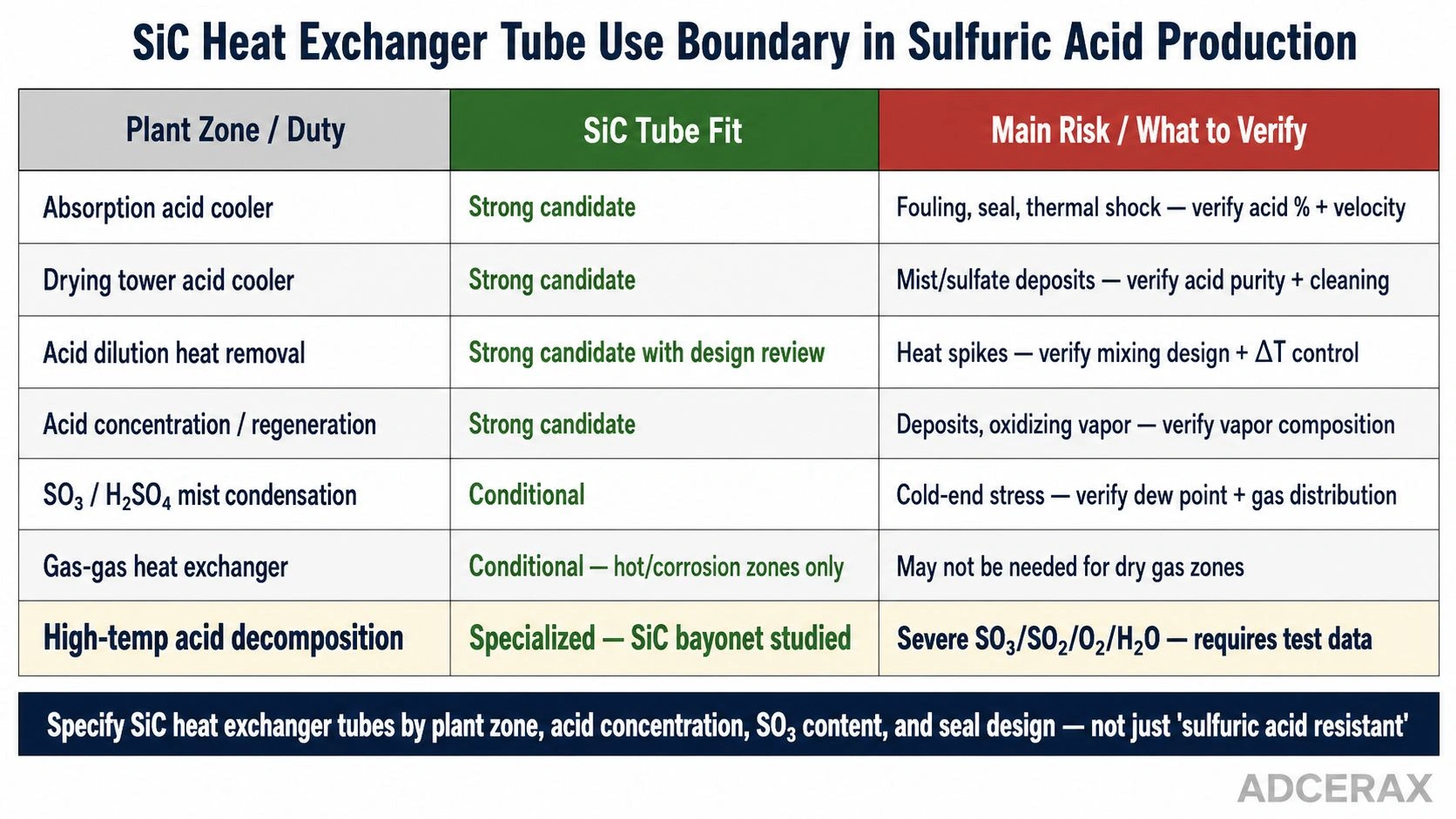
The SiC Tube Use Boundary in Sulfuric Acid Production table below maps the main plant zones to SiC fit:
| Plant zone/duty | SiC tube fit | Main advantage | Main risk | What to verify |
|---|---|---|---|---|
| Absorption acid cooler | Strong candidate | Corrosion + heat transfer | Fouling, seal leakage, thermal shock | Acid %, temperature, flow velocity |
| Drying tower acid cooler | Strong candidate | Handles hot concentrated acid | Mist/solids/sulfate deposits | Acid purity and cleaning cycle |
| Acid dilution heat removal | Strong candidate with design review | Resists acid and removes heat | Exothermic heat spikes | Mixing design and ΔT control |
| Acid concentration/regeneration | Strong candidate | Corrosive acid vapor/liquid resistance | Deposits and oxidizing vapor | Vapor composition and fouling |
| SO₃/H₂SO₄ mist condensation | Conditional | Corrosion-resistant condensation surface | Cold-end condensation stress | Dew point and gas distribution |
| Gas-gas heat exchanger in contact plant | Conditional | High-temp/corrosion areas only | May not be needed for dry gas zones | Gas composition and condensation risk |
| High-temp sulfuric acid decomposition | Specialized | High-temperature corrosion resistance | Severe SO₃/SO₂/O₂/H₂O environment | Thermal stress and test data |
Acid coolers in absorption and drying circuits. These are the most common and direct application for SiC heat exchanger tubes in sulfuric acid plants. Strong acid at elevated temperature — typically 93–98% H₂SO₄ at temperatures ranging from 50°C to above 100°C depending on the plant configuration — contacts the tube wall. The tube must remove heat efficiently while resisting acid corrosion over a long service campaign. Shell-and-tube heat exchangers are widely used in gas-gas heat transfer in sulfuric acid plants, and the same exchanger architecture — SiC tubes inside a shell — is the standard format for acid-side cooling duties.
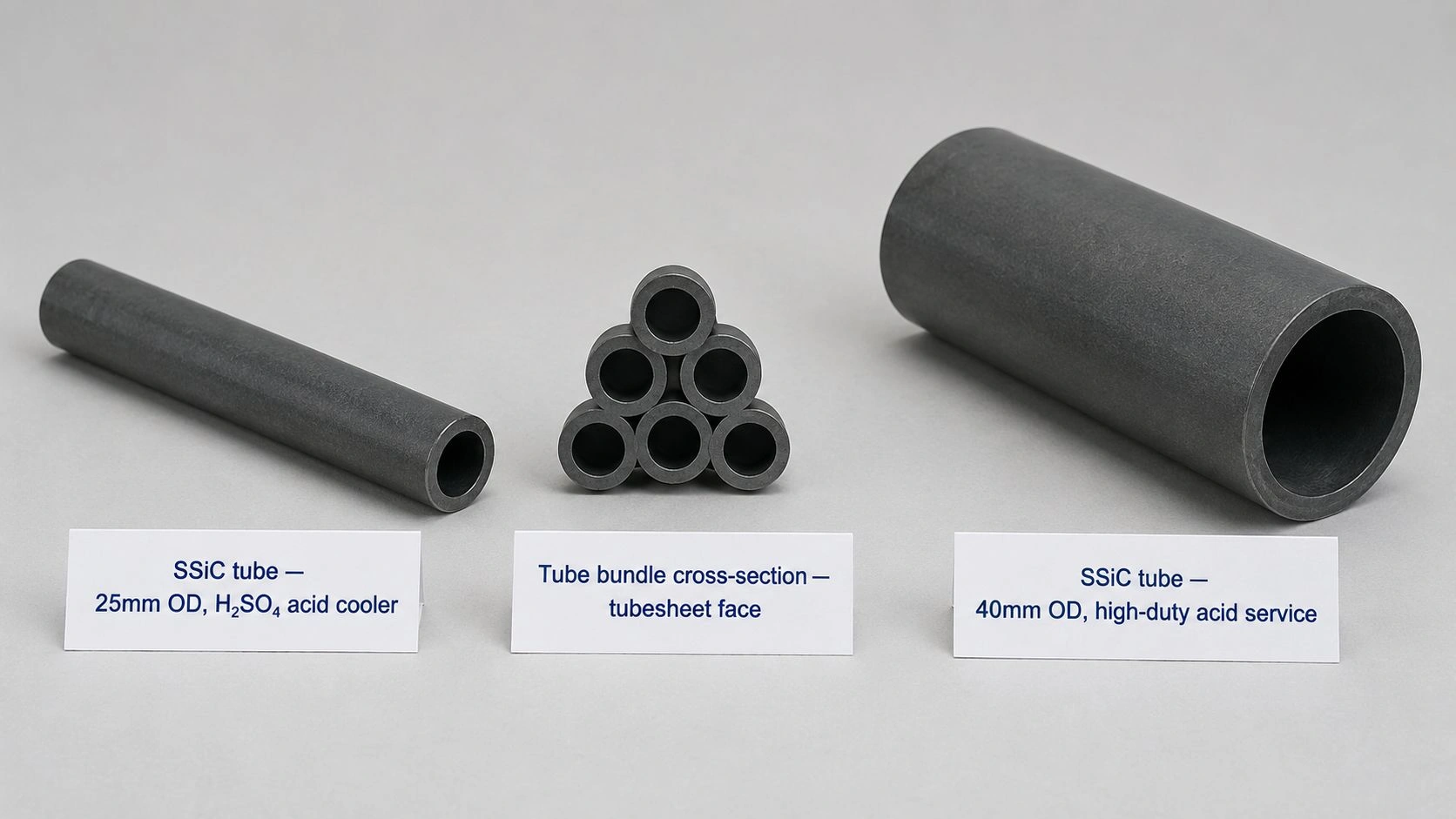
Acid dilution heat removal. When concentrated acid is diluted with water, significant exothermic heat is released. The heat exchanger handling this duty sees acid chemistry that changes from concentrated to intermediate concentration, with localized temperature spikes near the mixing point. SiC's combination of chemical resistance and thermal conductivity is relevant here, but the design must control the temperature gradient at the mixing interface to avoid thermal shock.
High-temperature sulfuric acid decomposition. This is the most specialized and technically demanding SiC heat exchanger application. In the decomposition reaction — used in sulfur-iodine thermochemical hydrogen production cycles and other high-temperature acid applications — sulfuric acid decomposes to SO₃, SO₂, O₂, and H₂O at temperatures exceeding 800°C. The resulting environment combines highly oxidizing decomposition products with the acidic liquid phase. SiC bayonet heat exchanger concepts have been specifically studied for this duty, with published work noting that SiC helps prevent sulfuric-acid corrosion at the high temperatures required for thermal decomposition.
Why SiC is attractive for sulfuric acid heat transfer
After mapping the service zones where SiC is relevant, the material-property argument for SiC over the alternatives becomes more precise.
[CITE: Published sulfuric acid heat-transfer materials guidance from a specialty heat-exchanger manufacturer describes alpha-sintered SiC heat-exchanger tubing as a premium material for sulfuric acid service, with no fillers or free silicon, and corrosion-resistant across sulfuric-acid concentrations — and Mersen's SiC shell-and-tube heat exchanger product positions SiC tube bundles inside a shell as delivering universal corrosion resistance against acids, alkalis, and oxidizing media, with heat transfer through the SiC tube wall separating the two process fluids, confirming that SiC's heat-exchanger value proposition in sulfuric acid service is the combination of chemical inertness and thermal conductivity in a single structural material, not corrosion resistance alone.]
Corrosion resistance in concentrated and mixed acid service. Sulfuric acid at high concentration is strongly oxidizing — it can passivate some metals but aggressively attacks others, and its behavior changes significantly with temperature and water content. SiC's chemical resistance in concentrated acid at elevated temperature provides a material-property advantage over metals that require strict concentration-temperature windows to avoid corrosion. The absence of free silicon in pressureless sintered alpha-SiC grades removes a potential preferential corrosion site that would be present in reaction-bonded grades.
High thermal conductivity compared with lined systems. Fluoropolymer-lined heat exchangers are corrosion-resistant, but the polymer lining — typically 2–5 mm thick — has low thermal conductivity (around 0.25 W/m·K for PTFE vs approximately 120 W/m·K for dense SiC). This means a lined system requires significantly more heat-transfer area for the same thermal duty. SiC provides the corrosion barrier and the heat-transfer wall in one material, without the thermal resistance of a thick polymer lining.
Resistance to oxidizing media and acid vapor condensation. Many sulfuric acid plant streams contain SO₃ — either dissolved in the acid or as vapor in the gas phase. SO₃ is aggressively oxidizing, attacking many metals and organic polymer materials. SiC is resistant to oxidizing media at temperatures below its oxidation threshold in air (typically above 900°C for dense grades), making it suitable for hot acid with dissolved SO₃ without the selective attack that SO₃ causes on some alloys.
Low contamination and no resin impregnation. Graphite heat exchangers typically require resin impregnation to reduce permeability to gas and liquid diffusion. The resin can limit operating temperature, can degrade in strongly oxidizing media, and in some pure-process services may introduce contamination. SiC's dense sintered structure provides low permeability without resin, which is relevant for high-purity acid production or processes where product quality is sensitive to trace organics.
SiC vs graphite, alloy, and fluoropolymer-lined heat exchangers
After understanding SiC's material advantages, the comparison with established alternatives helps identify where SiC is the right upgrade and where conventional materials remain adequate.
The SiC vs Alternative Heat Exchanger Materials table maps the main options:
| Material route | Best-fit use | Main advantage | Main limitation |
|---|---|---|---|
| Sintered SiC tubes | Hot/concentrated/mixed acid, oxidizing corrosion | Corrosion resistance + heat transfer | Brittle; seal and thermal shock design matter |
| Graphite tubes/blocks | Many corrosive acid services | Good thermal conductivity and established use | Impregnation, oxidation, permeability, pressure limits |
| Alloy steel/nickel alloy | Gas-gas or controlled acid service | Toughness, code pressure design | Corrosion allowance/SCC/pitting risk |
| Titanium/zirconium | Specific acid concentration-temperature windows | Corrosion resistance in selected media | Cost and strict concentration/temperature limits |
| Fluoropolymer-lined exchanger | Lower-temperature aggressive liquids | Strong corrosion barrier | Lower thermal conductivity and temperature limits |
| Glass-lined/enamel route | Some acid and clean duties | Corrosion barrier and cleanliness | Thermal shock and mechanical damage |
SiC vs graphite: purity, permeability, oxidation, and resin boundary. Graphite heat exchangers are well-established in sulfuric, hydrochloric, and phosphoric acid service. Published graphite heat-exchanger product descriptions confirm graphite as suited to sulfuric, hydrochloric, phosphoric, and waste acid duties. SiC becomes more attractive than graphite when the service involves strongly oxidizing media that can attack resin impregnation, when the operating temperature is above the resin stability limit, when product purity requires the absence of any resin-derived contamination, or when high heat flux demands favor SiC's higher thermal conductivity and structural integrity.
SiC vs alloys: corrosion allowance vs ceramic inertness. Metal alloys — Hastelloy C-276, duplex stainless, high-silicon iron, and anodically protected steels — are used in specific sulfuric acid concentration-temperature windows. Their advantage is toughness and the ability to handle pressure-code design. Their limitation is that service windows are narrow: outside the concentration or temperature range, rapid corrosion can occur. SiC does not have a similarly sharp concentration or temperature corrosion boundary in most acid service ranges.
SiC vs fluoropolymer-lined systems: heat flux and temperature limits. PTFE, PFA, and PVDF linings provide excellent acid resistance at moderate temperature, but their low thermal conductivity limits the heat-transfer area efficiency. For services requiring compact exchanger geometry, high heat-transfer rates, or temperatures above the polymer's continuous service limit, SiC provides the same corrosion protection with far better thermal performance. The silicon carbide ceramic material page at ADCERAX covers the thermal conductivity, hardness, and chemical resistance properties that differentiate SSiC in corrosive process applications.
The ceramic tubes and pipes range at ADCERAX provides cross-material context for cases where SiC is the correct choice compared with alumina, zirconia, or specialty quartz tubes in corrosive process service.
Do not misdiagnose heat exchanger failure as SiC tube corrosion
When a SiC heat exchanger shows acid leakage, declining heat duty, tube cracks, cold-end damage, or post-cleaning problems, the SiC tube wall is one possible failure location among several — and often not the first to fail.
Tube corrosion vs tubesheet and seal leakage. The most common leakage path in SiC heat exchanger assemblies is not through the SiC tube wall but through the tubesheet-to-tube joint, the O-ring or gasket, or the shell-to-tubesheet connection. Published SiC shell-and-tube exchanger design documentation specifically highlights the tube-to-tubesheet sealing system as a critical design element — confirming that the sealing architecture determines corrosion performance at the joint, independently of the SiC tube body. If a SiC exchanger leaks acid, the first inspection point is the seal, not the tube wall.
Fouling and sulfate deposits vs material degradation. A decline in heat-transfer duty in a SiC exchanger is most commonly caused by sulfate salt deposits, entrained solids, particulate matter, or polymerized impurities on the tube surface — not by a change in SiC thermal conductivity. Published sulfuric acid plant exchanger guidance highlights flow-distribution control as part of managing temperature and deposition in the acid circuit. Cleaning the tube surface or improving flow distribution restores heat duty without any material change.
Thermal shock from acid dilution heat spikes. If SiC tubes crack in an acid dilution or mixing service, the cause is typically a local temperature spike at the mixing point — where concentrated acid contacts water — creating a steep thermal gradient across the tube wall. This is a thermal-shock event, not a chemical attack event. SiC's thermal shock resistance is better than many ceramics because of its high thermal conductivity, but a sufficiently large temperature differential applied rapidly can still initiate a crack. Controlling the mixing geometry and the temperature profile at the acid inlet protects the SiC tube from this mode.
SO₃ and H₂SO₄ mist condensation at cold-end surfaces. In sulfuric acid absorption and tail-gas systems, acid mist and SO₃ can condense on cooler surfaces. NORAM's split-flow exchanger design description for sulfuric acid plants explicitly links tube and tubesheet temperature control to mitigating condensation and thermal stress — confirming that cold-end temperature management is a process design requirement, not just a material-selection question. If the tube-end surfaces fall below the acid dew point, condensate accumulates and the corrosion mechanism at the cold end may differ from the main tube-body service.
The Failure Diagnosis Matrix below maps observed exchanger problems to better diagnostic questions:
| Observed problem | Common assumption | Better diagnostic question |
|---|---|---|
| Acid leak | SiC tube corroded | Did the tubesheet, gasket, O-ring, or seal fail? |
| Heat duty drops | SiC lost conductivity | Are sulfate deposits, fouling, or flow maldistribution present? |
| Tube cracks | SiC unsuitable for sulfuric acid | Was there thermal shock, dry-out/re-wet, or mechanical stress? |
| Cold-end damage | Material quality issue | Was acid mist condensation or dew point corrosion controlled? |
| Rapid fouling | SiC surface problem | Are solids, impurities, polymerized organics, or sulfate salts present? |
| Post-cleaning leaks | Tube corrosion | Did cleaning pressure, tools, or chemical shock damage seals or tubes? |
| Shell-side corrosion | SiC tube issue | Is corrosive medium reaching non-SiC shell or tubesheet materials? |
Diagnosis should be based on leak location, surface deposit analysis, temperature profile review, and flow-distribution assessment before any tube material change is specified.
RFQ checklist for SiC heat exchanger tubes in sulfuric acid production
A complete RFQ for SiC heat exchanger tubes in sulfuric acid service must provide both the process chemistry and the mechanical design context — without both, the supplier cannot confirm whether the SiC grade, tube geometry, tubesheet material, and seal design are appropriate for the specific plant zone.
[CITE: Engineering guidance on SiC heat exchanger tube specification for sulfuric acid production confirms the complete RFQ sequence: service zone in the acid plant, acid concentration and water percentage with SO₃ content, inlet and outlet temperatures with start-up and shutdown thermal profile, gas/liquid/mist/two-phase condition, normal and maximum flow rate with allowable pressure drop, fouling chemistry including sulfates/solids/organics/metal ions, SiC grade confirmation (pressureless sintered alpha-SiC/SSiC, no free silicon), tube OD/ID/wall/length/tube count/pitch and straightness, tubesheet material and O-ring/gasket/compression seal design, cleaning method with pressure and chemical limits, and validation including corrosion exposure test, thermal cycling, leak test, and fouling trial — because acid concentration, temperature, SO₃, and seal design together determine whether the SiC heat exchanger assembly will perform reliably, and a supplier who receives only "SiC tubes for H₂SO₄ service" cannot confirm grade, tubesheet compatibility, or thermal stress risk without the remaining process context.]
| RFQ field | Why it matters | Recommended wording |
|---|---|---|
| Service zone | Defines process boundary | "Absorption cooler/drying acid/dilution/regeneration/decomposition" |
| Acid concentration | Primary corrosion and heat-release driver | "H₂SO₄ wt%, water %, SO₃ content" |
| Temperature | Controls corrosion and thermal stress | "Inlet/outlet, peak, start-up, shutdown temperatures" |
| Phase condition | Gas, liquid, mist, or two-phase behaves differently | "Liquid acid/acid vapor/mist/two-phase" |
| Flow rate/velocity | Controls heat transfer and erosion | "Normal/max flow, allowable ΔP" |
| Fouling chemistry | Controls cleaning and duty loss | "Sulfates, solids, organics, metal ions, acid mist" |
| SiC grade | Controls corrosion and purity | "Pressureless sintered alpha-SiC/SSiC, no free silicon if required" |
| Tube geometry | Controls heat transfer and manufacturability | "OD, ID, wall, length, tube count, pitch, straightness" |
| Seal/tubesheet | Often the weak point | "Tubesheet material, O-ring/gasket, compression design" |
| Cleaning method | Can damage tubes/seals | "CIP, flushing, acid wash, mechanical cleaning, pressure limits" |
| Validation | Confirms real duty fit | "Corrosion exposure, thermal cycling, leak test, fouling trial" |
RFQ fields are the minimum for a SiC sulfuric acid heat exchanger tube inquiry; add SO₃ vapor pressure, condensation dew point, and shell-side fluid for complete process boundary definition.
For critical acid plant services — high-temperature absorption acid cooling, acid concentration with oxidizing vapors, or high-temperature decomposition — a pilot-scale or process-specific corrosion exposure test, combined with thermal cycling and fouling evaluation, provides more reliable qualification than extrapolating from general SiC corrosion resistance data.
Evaluating SiC heat exchanger tubes for sulfuric acid production? Share your acid concentration, temperature profile, SO₃ and water content, phase condition, flow rate, heat duty, fouling tendency, cleaning method, tube drawing, tubesheet design, seal material, and failure history. ADCERAX can review whether SSiC tubes, graphite, alloy, or another corrosion-resistant heat exchanger route fits the sulfuric acid plant zone; turnaround depends on inquiry complexity — no commitment required at this stage.
Frequently Asked Questions
Why are SiC tubes used in sulfuric acid heat exchangers?
SiC tubes are used because they combine corrosion resistance in concentrated and mixed acid service with high thermal conductivity — providing both the corrosion barrier and the heat-transfer wall in one material. Published SiC shell-and-tube heat exchanger product descriptions position SiC tube bundles for acids, alkalis, oxidizing media, and ultra-corrosive fluids, with heat transfer through the SiC tube wall separating the two process streams.
Can SiC resist concentrated sulfuric acid?
Dense sintered alpha-SiC (SSiC) grades without free silicon are widely used in concentrated sulfuric acid heat-transfer service. Published materials guidance from specialty heat-exchanger manufacturers describes alpha-sintered SiC tubing as free of fillers and free silicon and corrosion-resistant across sulfuric acid concentrations. Real performance still depends on temperature, impurities, SO₃ content, water activity, velocity, seal design, and thermal cycling.
Is SiC better than graphite for sulfuric acid heat exchangers?
SiC can be more suitable than graphite when the service involves strongly oxidizing media that can attack resin impregnation, temperatures above resin stability limits, product purity requirements that exclude resin-derived contamination, or high heat-flux demands that favor SiC's higher thermal conductivity. Graphite remains well-established and often more economical in many conventional sulfuric acid services where these specific conditions are not present.
What usually fails first in a SiC sulfuric acid heat exchanger?
The first failure point is more often the seal, tubesheet joint, O-ring, or gasket than the SiC tube body itself. Published SiC shell-and-tube exchanger design documentation highlights the tube-to-tubesheet sealing system as a critical design element, confirming that sealing architecture determines joint-level corrosion performance independently of the SiC tube material.
Can SiC tubes be used in high-temperature sulfuric acid decomposition?
SiC has been studied specifically for high-temperature sulfuric acid decomposition heat exchangers. Published research describes SiC bayonet heat exchanger designs for sulfuric acid decomposition in which SiC prevents acid corrosion at the high temperatures required for thermal decomposition, while also noting that the decomposition gas environment — containing SO₃, SO₂, O₂, and H₂O — is aggressively oxidizing and requires careful material validation.
What information should I send to a supplier for SiC acid heat exchanger tubes?
Send the sulfuric acid plant zone, acid concentration and water content, SO₃ content, inlet and outlet temperatures with start-up and shutdown profile, phase condition, flow rate and allowable pressure drop, fouling chemistry including sulfates and entrained solids, SiC grade preference (pressureless sintered alpha-SiC, no free silicon), tube OD/ID/wall/length/tube count, tubesheet material and seal design, cleaning method with pressure and chemical limits, and validation requirements including corrosion exposure test, thermal cycling, and leak test.