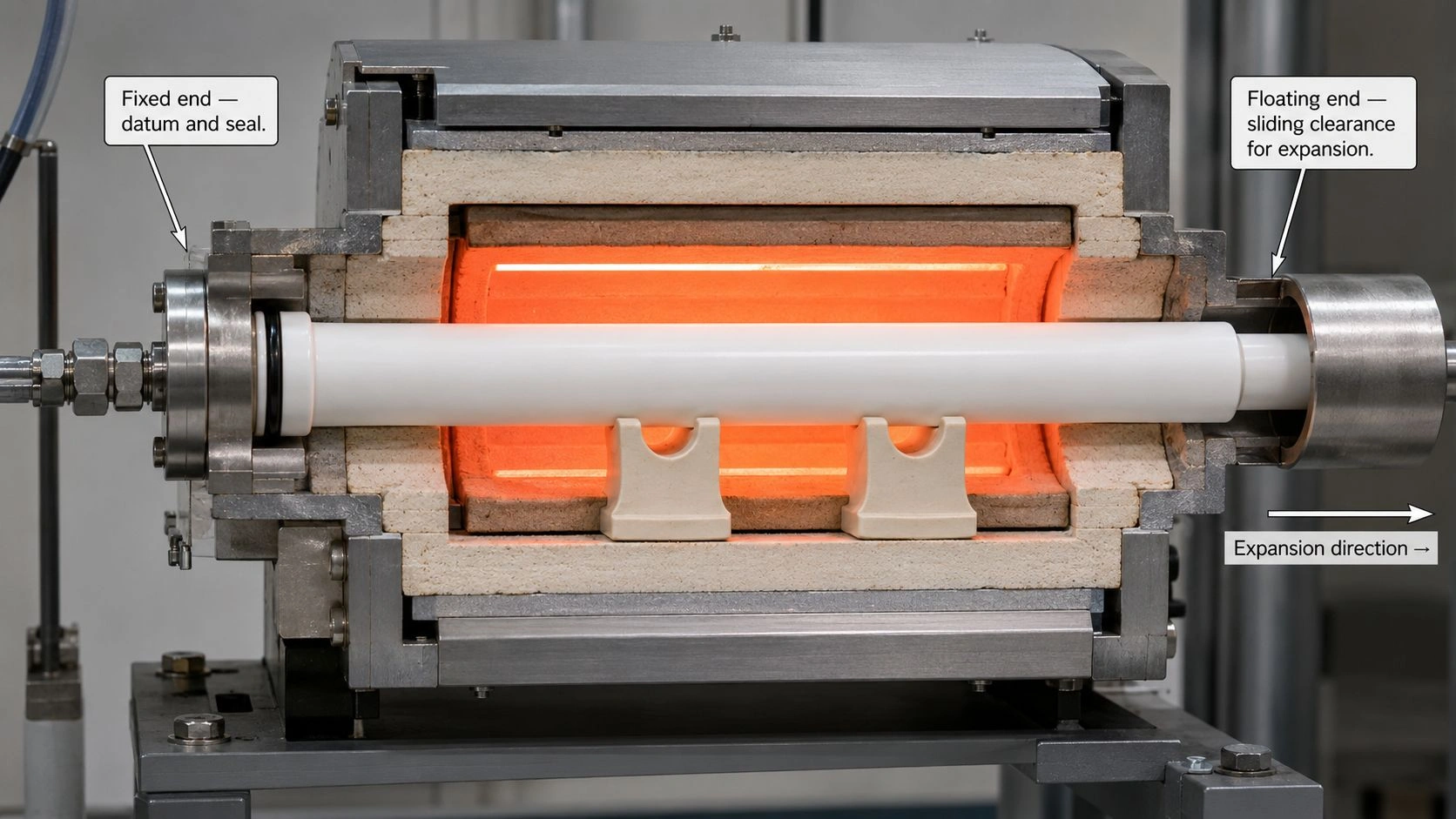
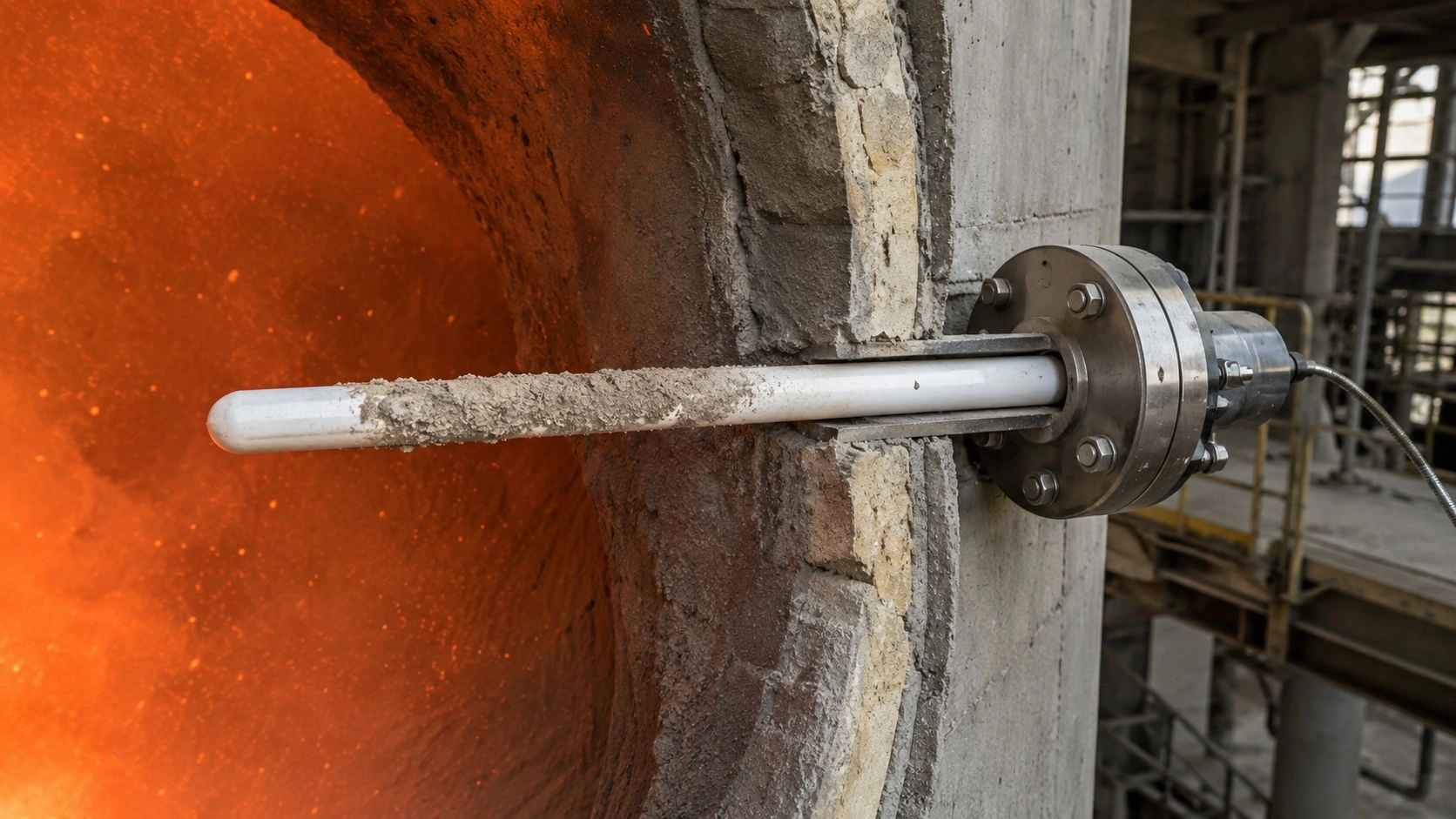
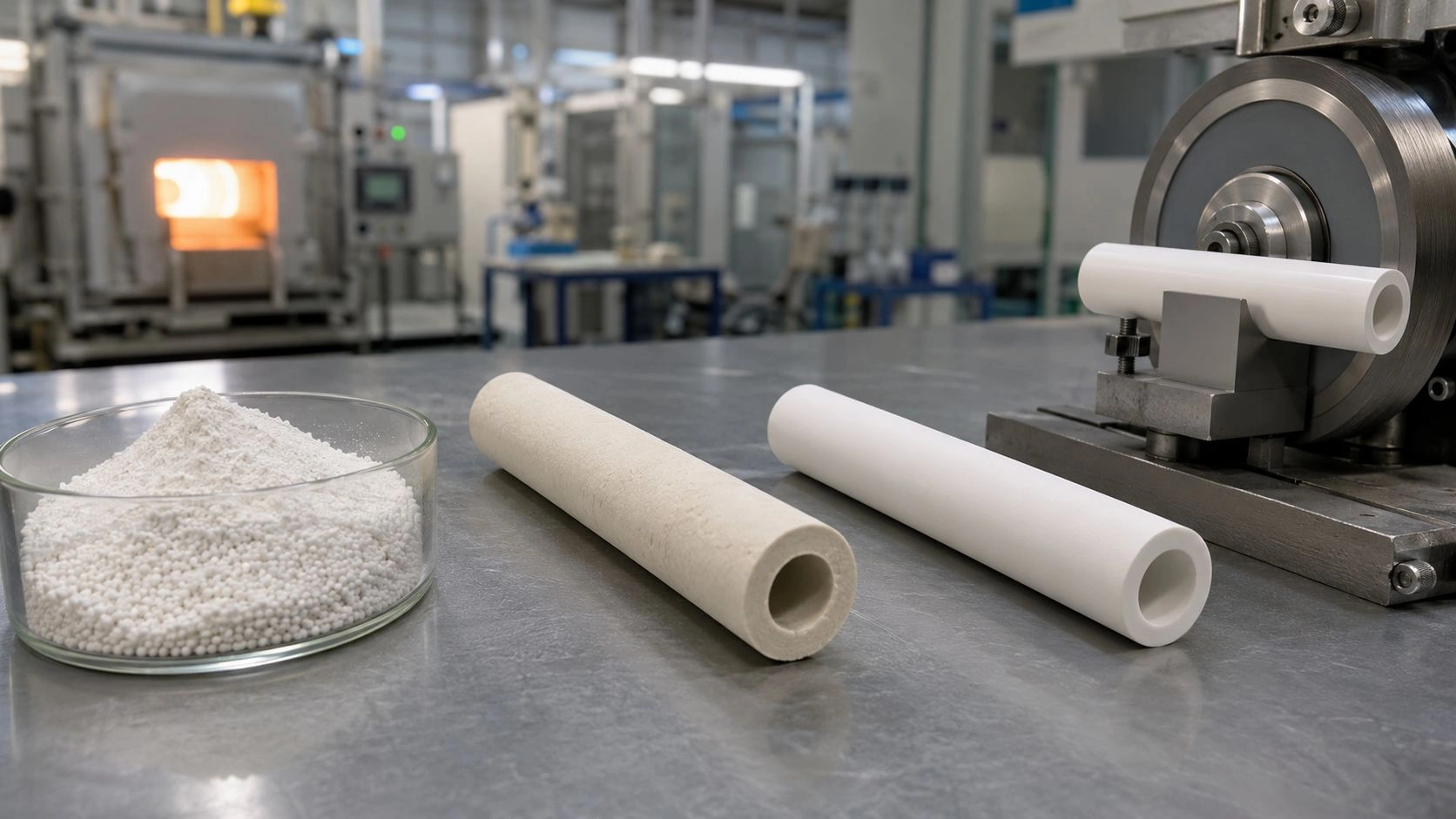
An RFQ preparation guide for procurement managers and equipment engineers — covering the minimum information package for a ceramic electrode tube quote, which dimensions and tolerances are critical, what material and operating conditions must be included, when drawings, samples, or photos are sufficient for production, and what to verify before placing a repeat order.
A custom ceramic electrode tube RFQ should include a part drawing or sample reference, tube shape, OD/ID or width/height, wall thickness, length, bore details, tolerances, material grade, operating temperature, electrical insulation requirement, atmosphere or process exposure, quantity, delivery expectation, inspection requirements, and packing needs. If no drawing exists, send clear photographs with scale, old samples, holder dimensions, visible damage or failure marks, and the equipment application — so the supplier can identify missing CTQ dimensions before quoting.
3-minute decision: Complete drawing with CTQ tolerances marked → request a production-ready quote. Old sample plus measured CTQs → reverse-engineer, then freeze a drawing before any repeat order. Photos only → treat any number as preliminary; add a sample or measured sketch before production release. For catalog forms, bore layouts, and alumina grades, use the alumina ceramic tubes product page — this article only lists what an electrode-tube RFQ must contain.
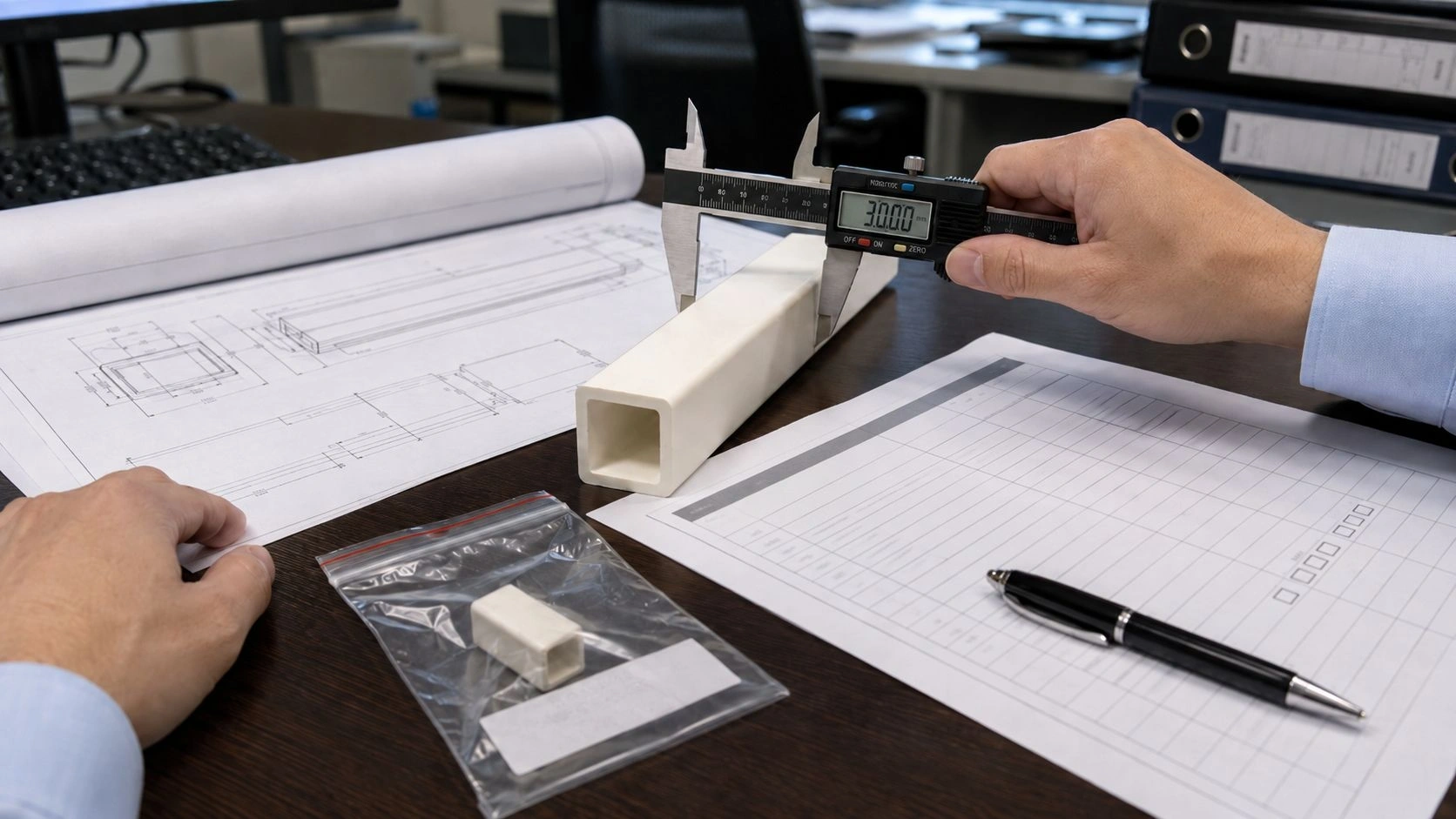
Clear drawings, measured samples, and visible reference dimensions help suppliers identify missing RFQ information before custom ceramic electrode tube quotation.
The Minimum RFQ Package for a Custom Ceramic Electrode Tube
A ceramic electrode tube quote requires answers to five questions before a supplier can respond with a realistic price, lead time, and feasibility confirmation.
What is the tube geometry? Provide a drawing, sample, or measured sketch. For round tubes, include OD, ID or bore diameter, and wall thickness. For square or rectangular tubes, include outer side dimensions or width/height, bore dimensions, and wall thickness on each side. Add total length, usable active length if different, bore count, end geometry, chamfers, holes, slots, grooves, and reference or active face identification.
What material or material function is required? State the material family if known — alumina, steatite, zirconia, mullite, or metallized alumina. If the material is unknown, state the function: electrical insulator, corona discharge electrode, igniter sleeve, conductor guide, or high-temperature support. Both the material and the function affect the supplier's grade recommendation and process route.
Where will it be installed? Describe the electrode assembly, holder geometry, conductor type, and how the tube fits into the station. Existing ceramic tube buying guidance confirms that configuration, bore count, and holder-related geometry are standard quote inputs alongside OD, ID, length, and tolerance.
What operating conditions will it see? Include temperature, voltage or discharge exposure, atmosphere, cleaning method, thermal cycling frequency, and any mechanical load. These conditions determine whether a general-purpose or high-performance material grade is appropriate.
How many pieces are needed? Separate prototype quantity from first production batch from annual usage estimate. The quantity affects whether the supplier can use standard tooling, custom tooling, or a prototype-first approach.
ADCERAX's custom ceramic tubes product line supports drawing-based manufacturing for custom electrode tube shapes in alumina, zirconia, silicon carbide, and other advanced ceramic materials.
Dimensions, Tolerances, and CTQ Features That Affect Quoting
An effective RFQ separates the nominal geometry from the features that are critical to quality — the dimensions that determine whether the tube fits, insulates, aligns, or seats correctly in the electrode assembly.
Nominal geometry describes the overall shape: cross-section form, bore size, wall thickness, length, end features, holes, slots, and surface finish. These are required for feasibility and pricing.
CTQ dimensions are the features that directly control assembly and function. They commonly include:
- ID or bore position relative to the outer reference face
- Wall thickness consistency across all sides (especially for square and rectangular forms)
- Straightness — maximum bow over the tube length
- End-face squareness — perpendicularity of the end face to the tube axis
- Reference face designation for square tubes — which flat face seats against the holder
- Active face designation — which face orients toward the discharge gap or ground surface
- Edge condition in seating zones or high-voltage paths — no-chip requirements
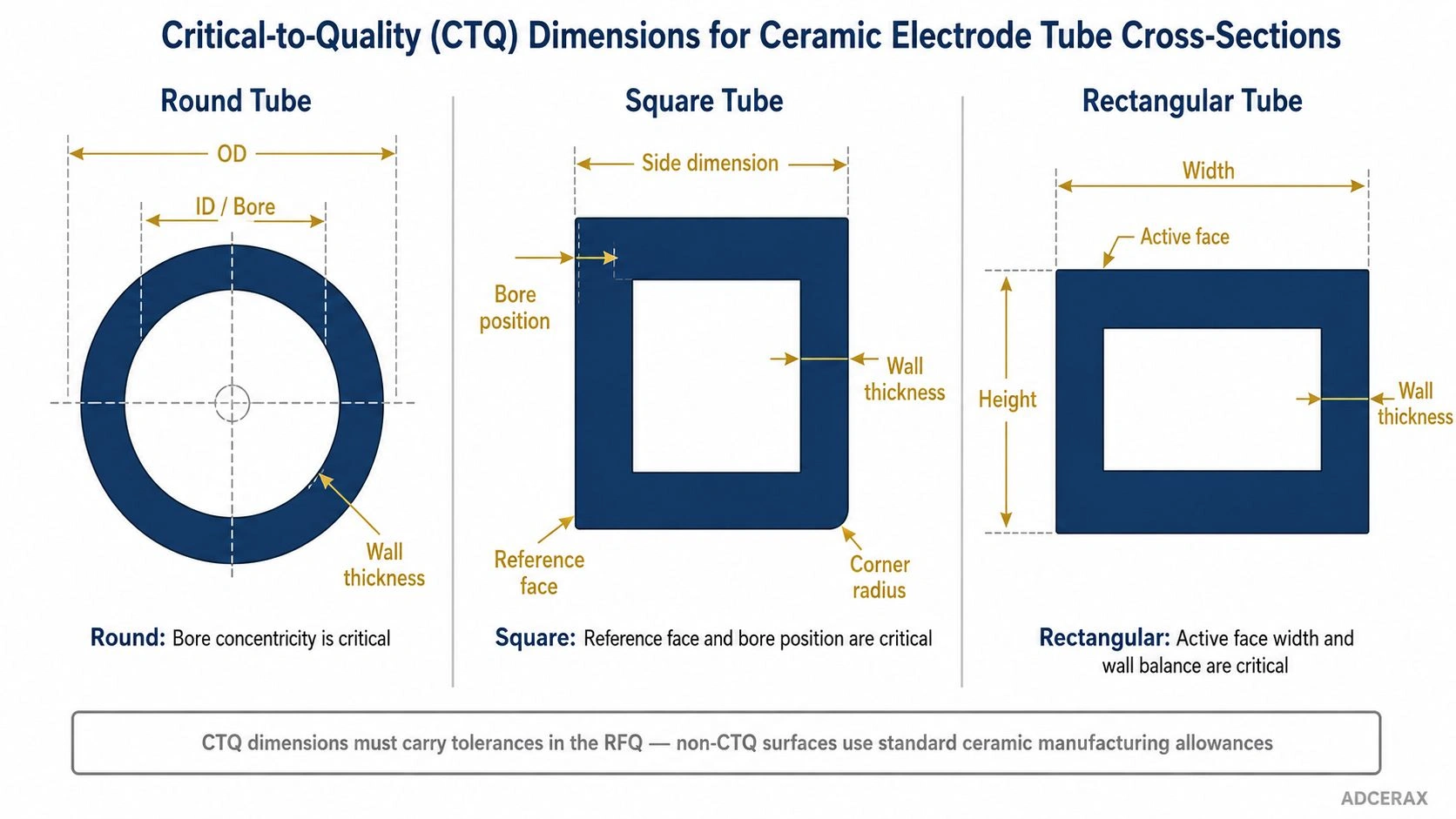
Different ceramic electrode tube cross-sections require different CTQ controls, including bore concentricity, reference face position, wall balance, active face width, and corner radius.
Tolerance should match the function, not be copied from metal-part drawings. Tight post-fire ceramic tolerances typically require diamond grinding, lapping, or additional inspection. These add cost and lead time. Mark CTQ dimensions with a tolerance; leave non-functional surfaces with standard ceramic manufacturing allowances.
For square or rectangular electrode-station tubes, ADCERAX's square alumina tubes page covers electrode, structural, and custom slot assemblies — send bore count, bore diameter, pitch, and which face is the active/reference face with the RFQ.
The following table maps each RFQ field to the information required and why it matters.
| RFQ Field | What to Provide | Why It Matters | Positive Acceptance Direction |
|---|---|---|---|
| Drawing or reference | 2D drawing, 3D file, sample, or scaled photos | Defines quotation confidence level | Drawing preferred; sample acceptable for reverse engineering |
| Tube geometry | Cross-section, bore, wall thickness, length | Controls fit and manufacturability | CTQ dimensions marked clearly with tolerances |
| End features | Chamfers, end face, holes, slots, grooves, reference face | Controls seating, function, and orientation | Reference face and active face identified |
| Straightness | Maximum bow over full tube length | Controls assembly alignment | Inspection method stated |
| Material | Grade or material function | Controls process route, grade selection, and surface capability | Function stated when material grade is unknown |
| Operating conditions | Temperature, voltage, discharge, atmosphere, cleaning | Controls material grade and surface review | Conditions tied to actual application |
| Quantity | Prototype, first batch, annual usage | Controls tooling decision and pricing route | Prototype and repeat volume listed separately |
| Verification | Inspection plan, pilot sample, material confirmation | Controls approval risk | CTQ inspection items defined |
| Packing | Edge protection, long-part support, padded separation | Controls shipping damage | Packing plan requested before order |
Values indicative; verify per applicable ASTM/IEC standards with supplier-specific test data.
Material, Electrical, Thermal, and Process Conditions to Include
A ceramic electrode tube is selected for more than its cross-section. The material grade, surface finish, and process capability all depend on the operating conditions the tube will face in service.
Material family. State the material family if known — alumina (96%, 99%, 99.5%, 99.7%), steatite, mullite, zirconia, or metallized alumina. If the material is not known, describe the function: high-voltage insulator, corona discharge electrode tube, spark or igniter sleeve, conductor guide, or high-temperature furnace support. The supplier can then recommend the appropriate grade based on the function.
Electrical insulation and discharge exposure. For electrode tubes in corona treater stations or high-voltage assemblies, state whether the tube is the primary dielectric barrier, a secondary insulator, or a conductor guide. Include the approximate voltage, discharge type, and whether the active discharge face is one specific surface of the tube or a general surface. IEC 60672-2 applies to ceramic and glass-ceramic materials for electrical insulation and confirms that test-piece material data are only a guide when finished components differ in size and shape — meaning the supplier needs geometry and service conditions, not only a material name.
Temperature and atmosphere. State the continuous operating temperature, any peak or cycling temperature, the furnace or station atmosphere, and whether the tube will be exposed to corrosive vapors, cleaning solvents, or moisture during maintenance.
Thermal cycling and mechanical load. If the tube heats and cools repeatedly, state the cycle frequency and temperature range. If the tube carries a mechanical load — supporting a conductor, being clamped by a holder, or contacting a seating surface under load — describe the load type and contact geometry.
ADCERAX's electrical ceramics application page covers alumina-based electrical ceramic components for insulation and high-voltage isolation roles, supporting grade review based on operating conditions.
Drawing, Sample, or Photo: What Is Enough for Supplier Review?
The evidence quality in the RFQ determines what the supplier can do — and what they cannot safely commit to without additional information.
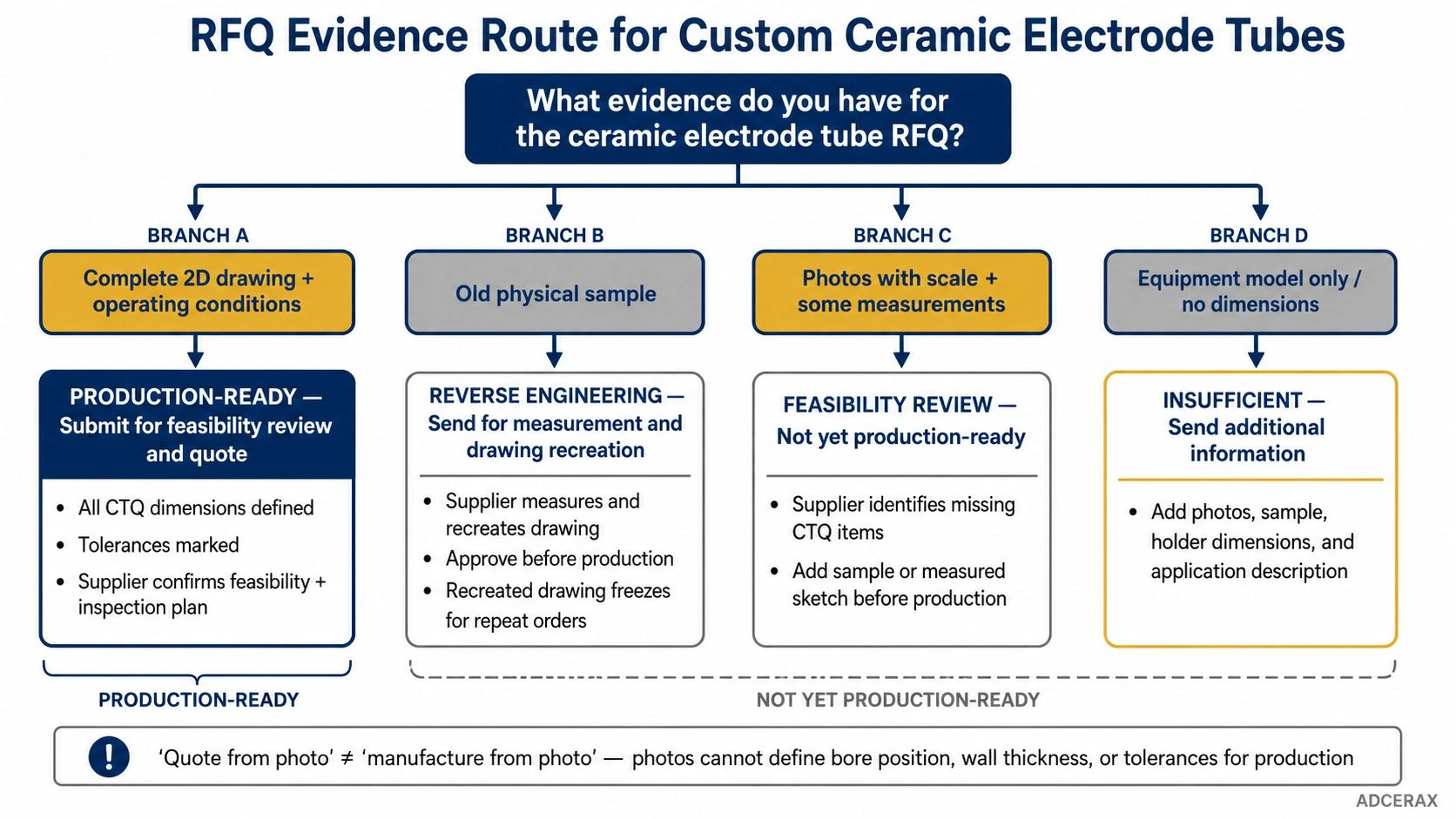
RFQ evidence quality determines whether a ceramic electrode tube request is production-ready, suitable for reverse engineering, or still missing CTQ information before quotation.
A complete drawing is the best input for production. It defines all dimensions, tolerances, material, datum references, and inspection requirements. A quote against a complete drawing can be treated as production-ready once feasibility is confirmed.
An old physical sample enables reverse engineering. The supplier can measure critical dimensions, identify the cross-section, bore position, wall thickness, reference face, and end geometry. A sample-based RFQ can lead to production — but a controlled drawing should be recreated and approved before repeat orders, because the sample itself may have dimensional variation from the original specification.
Photographs support feasibility review, not production specification. Photos can confirm whether the tube is round, square, rectangular, or metallized, and can show visible damage, cracks, or tracking marks. Photos with a scale reference and accompanying measurements can support a rough feasibility assessment and help the supplier identify likely questions before a formal quote. But photographs cannot reliably define bore position, wall thickness consistency, straightness, end-face squareness, or the tolerance range needed for fit-critical assembly.
The most common RFQ mistake is treating "quote from photo" as equivalent to "manufacture from photo." A quote from a photograph may arrive quickly, but the resulting production part will contain assumptions wherever the photo could not provide a clear measurement. For high-voltage electrode assemblies, those assumptions can affect insulation clearance, holder fit, and discharge face orientation.
The following matrix maps RFQ input quality to what the supplier can and cannot do.
| RFQ Input Quality | Supplier Can Do | Supplier Cannot Safely Do | Recommended Next Step |
|---|---|---|---|
| Complete drawing + conditions | Quote with feasibility review | Guarantee service life without validation | Request quote + inspection plan |
| Old sample + measured dimensions | Reverse-engineer critical features | Assume hidden material or process details | Recreate drawing before repeat order |
| Photos with scale and measurements | Feasibility and shape review | Final CTQ production | Send sample or measured sketch |
| Equipment model reference only | Identify possible application context | Confirm custom geometry | Add photos, sample, and holder dimensions |
| Material name only | Start material discussion | Confirm fit or insulation path | Add drawing, conditions, and CTQ dimensions |
For metallized electrode tubes with ceramic-to-metal bonding or vacuum sealing requirements, ADCERAX's metallized ceramic components page covers metallization-compatible alumina grades, bonding processes, and documentation requirements that must be added to the RFQ.
Final RFQ Checklist: Inspection, Packing, Pilot Sample, and Repeat Orders
The final RFQ package should ask the supplier to confirm the items below before order release — and before a repeat production quantity is approved.
Ask the supplier to confirm:
- Manufacturability of the specified cross-section, bore, and wall thickness
- Material grade that will be supplied — name, alumina content, and relevant properties
- Forming route — extrusion, pressing, or casting — and whether grinding or machining is required for CTQ features
- Achievable dimensional tolerances for CTQ features including bore position, wall thickness, straightness, and end-face squareness
- Surface finish capability by area — as-fired, ground, lapped, or polished
- Inspection method and sampling plan for CTQ dimensions
- Whether a pilot sample is required before repeat production
- Packing method — edge protection, padded separation, and long-part support for tubes that could chip or bow during transport
Before repeat order, verify:
- Dimensional compliance for all marked CTQ features
- Material confirmation against the specified grade
- Surface and edge condition in seating zones and near active discharge paths
- Bore clearance with the actual conductor if this is a fit-critical assembly
- Straightness for long tubes where bow would affect air gap or holder insertion
- Packing condition on arrival — inspect for edge damage introduced during shipping
ASTM C1239 covers reporting uniaxial strength data and Weibull distribution parameters for brittle advanced ceramics — reinforcing that ceramic reliability in high-voltage or high-stress applications should be managed through controlled inspection and sample approval rather than assumed from material name or grade alone.
After the pilot sample is approved, freeze the drawing, inspection baseline, material grade, and packing method before releasing the production quantity.
Ready to request a quote for a custom ceramic electrode tube? Send the tube shape, drawing or clear photos with measurements, material grade or application function, operating temperature, electrical insulation requirement, quantity, and whether a pilot sample is needed. ADCERAX engineers review feasibility, confirm material grade, and return RFQ requirements and lead-time guidance — no order commitment required at this stage.
Frequently Asked Questions
Is a custom ceramic electrode tube the same as a vacuum-coating ceramic electrode / HV feedthrough?
No. This RFQ guide is for ceramic electrode tubes — round, square, or rectangular insulator/discharge tubes specified by OD/ID or width/height, wall, bore, length, and CTQs. A vacuum-coating HV ceramic electrode or flange feedthrough is a different component family (conductor + ceramic seal geometry). Do not paste feedthrough flange callouts into an electrode-tube RFQ, and do not treat an electrode-tube drawing as a feedthrough quote package.
What is the most important information for a custom ceramic electrode tube RFQ?
The most important information is the tube's function in the assembly, a drawing or measured sample reference, cross-section dimensions, bore, wall thickness, length, material or material function, operating temperature, electrical insulation requirement, quantity, and inspection expectations. A supplier can quote with fewer items, but the result will include more assumptions that add risk to the production outcome.
Can I request a quote without a drawing?
Yes, but the quote will be preliminary rather than production-ready. Send old samples, scaled photographs with written measurements, holder dimensions, and application details. For repeat production, a recreated and approved drawing is required because photographs cannot reliably define bore position, wall thickness, straightness, or fit-critical tolerances.
Should I specify the alumina grade in the RFQ?
Specify the grade if it is known, but also state the operating function. For electrode tubes, temperature, voltage, discharge exposure, cleaning method, and atmosphere can matter as much as the grade percentage. If the grade is unknown, describing the function lets the supplier recommend an appropriate starting point.
What tolerances should be included in the RFQ?
Include tolerances only where they affect fit, electrical clearance, seating, or electrode alignment. Mark CTQ dimensions — ID, wall thickness, bore position, end-face squareness, straightness, and reference face — with explicit tolerances. Leave non-functional ceramic surfaces at standard manufacturing allowances to avoid unnecessary grinding cost and lead time.
What should be verified before approving repeat production?
Verify dimensional compliance for all CTQ features, material grade confirmation, surface and edge condition in seating and discharge zones, bore clearance with the conductor, and packing method on arrival. Freeze the approved drawing and inspection baseline before releasing the production quantity.