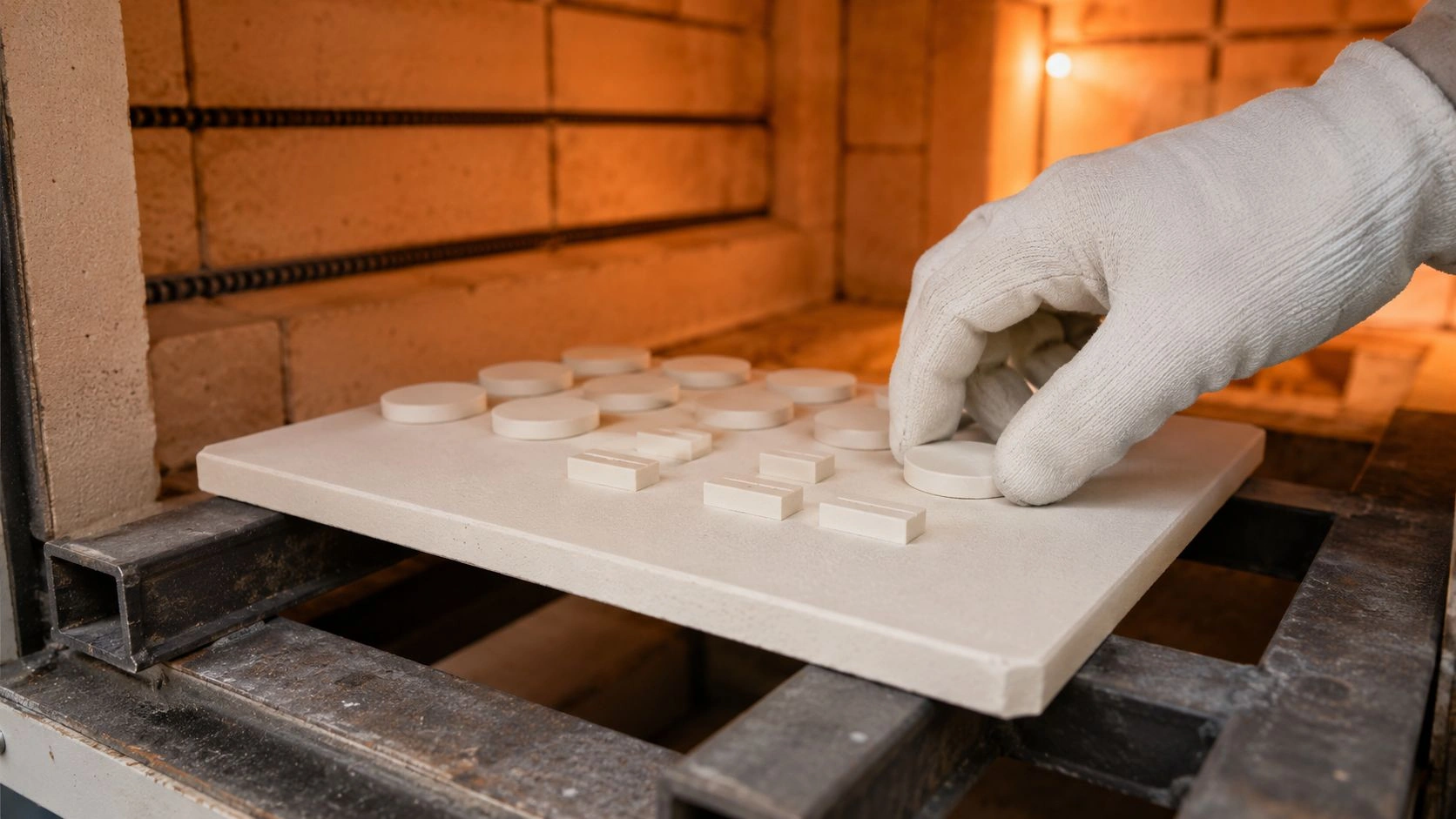
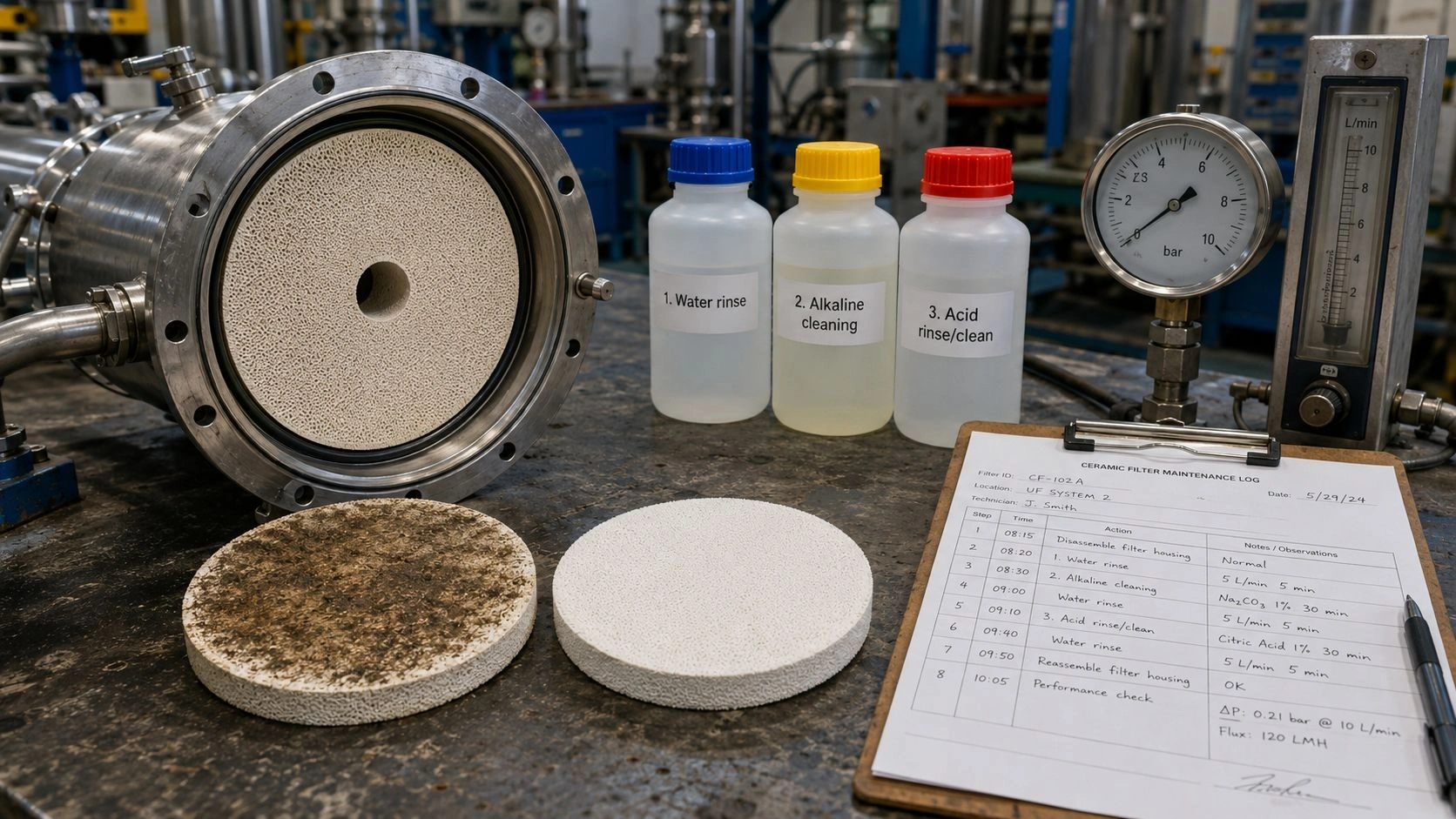
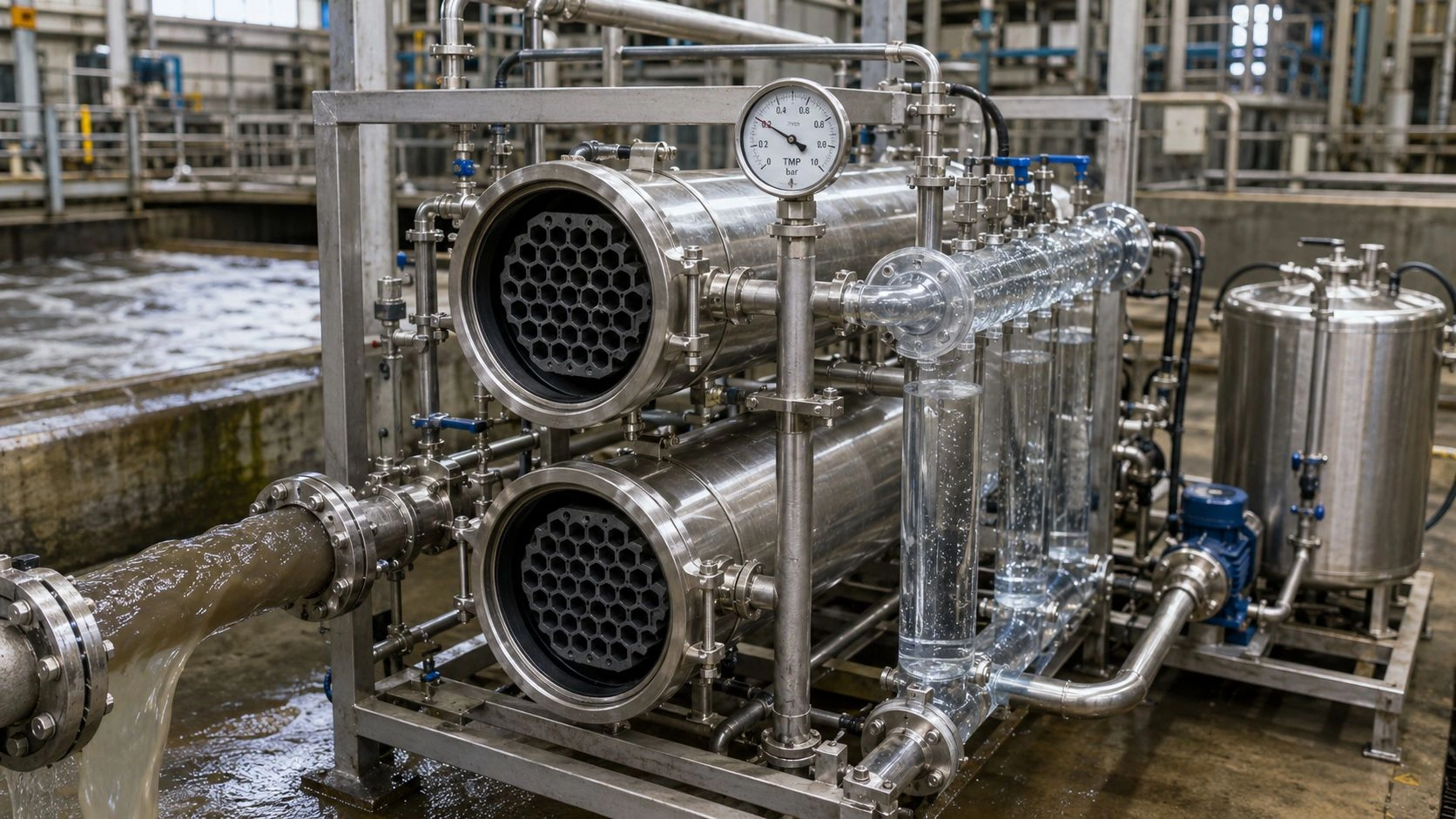
Alumina tubes are widely used in hydrogen reduction furnaces as process tubes, thermocouple protection tubes, and gas guides. Service life in H2 duty is rarely limited by the max-temperature label alone. Wet hydrogen dew point, silica-bearing secondary phases, gas-tight density and open porosity, seal and support restraint, and cold-gas thermal shock usually dominate. Metal hot-zone hardware can corrode or shed contamination under reducing atmospheres; dense alumina offers an electrically insulating, chemically quieter surface when atmosphere and geometry are specified together. For this H2 duty, start screening at 99.7% dense alumina (99.5% may sit beside for milder forming-gas liners). Cleaner, ultra-low-impurity asks may step toward a higher-purity dense class after impurity and leak requirements are stated. Confirm named catalog grades and closed-end geometries on the alumina tube grade catalog for hydrogen furnace review.
3-Minute Decision: Alumina Tube in H2 Reduction Furnace?
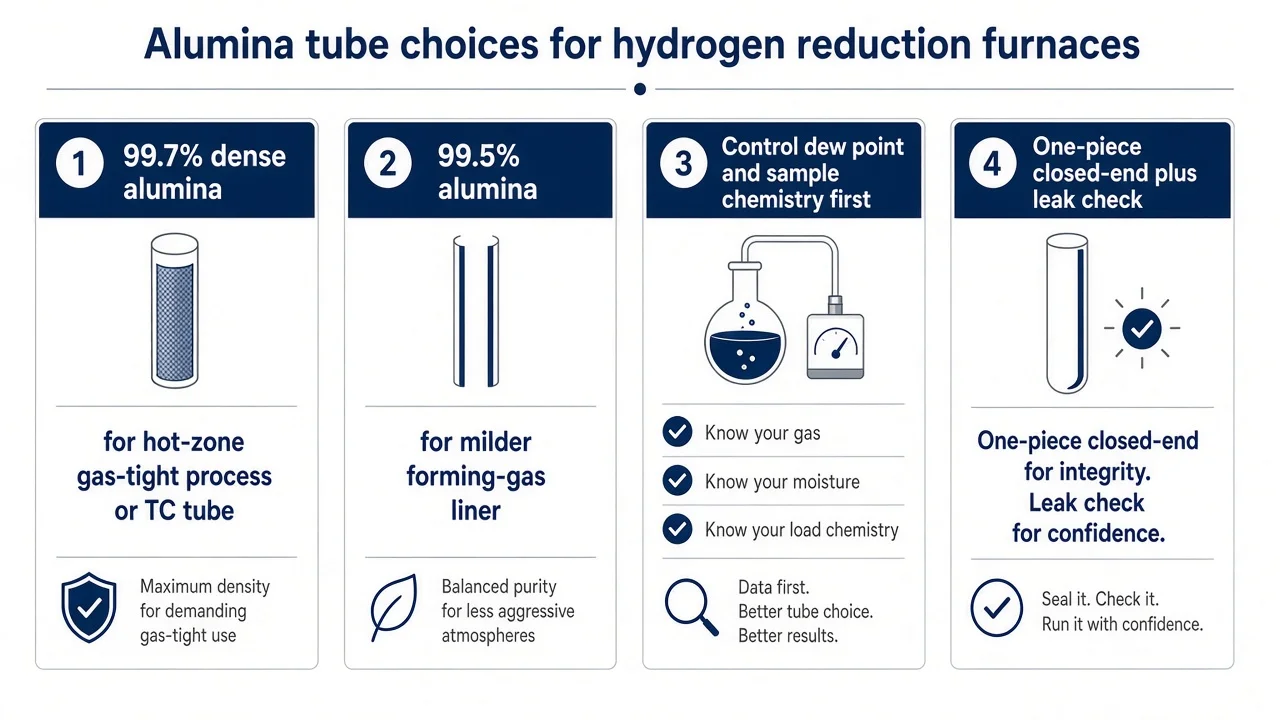
- Dry-controlled H2 (or H2/inert), hot-zone gas-tight process tube or TC protection. For this H2 duty, start screening at 99.7% dense alumina. Extremely cleanliness-sensitive duty may step to a higher-purity dense class after impurity and leak requirements are stated.
- Mid-temperature forming-gas (H2/N2) liner. 99.5% dense alumina may sit beside the 99.7% screen. Confirm density, open porosity, and leak-check intent before locking purity.
- Wet hydrogen, unknown dew point, or alkali/halogen-volatile samples. Control atmosphere and support first. Do not buy highest purity as a substitute for moisture control or soft restraint.
- Need atmosphere isolation. Prefer one-piece closed-end geometry plus a documented leak check. Engineering preference over fused or bonded closures; ask for the seal and inspection method on the RFQ.
- Purity alone never "repairs" flange-restraint cracks or cold-gas longitudinal cracks. Fix constraint, ramp, and purge practice before another purity step-up.
H2 Duty Risks (Qualitative)
Reducing atmospheres change what alumina must tolerate. The risks below are general engineering considerations. They are not ADCERAX service-life certificates, reduction-rate guarantees, or fixed dew-point / temperature limits.
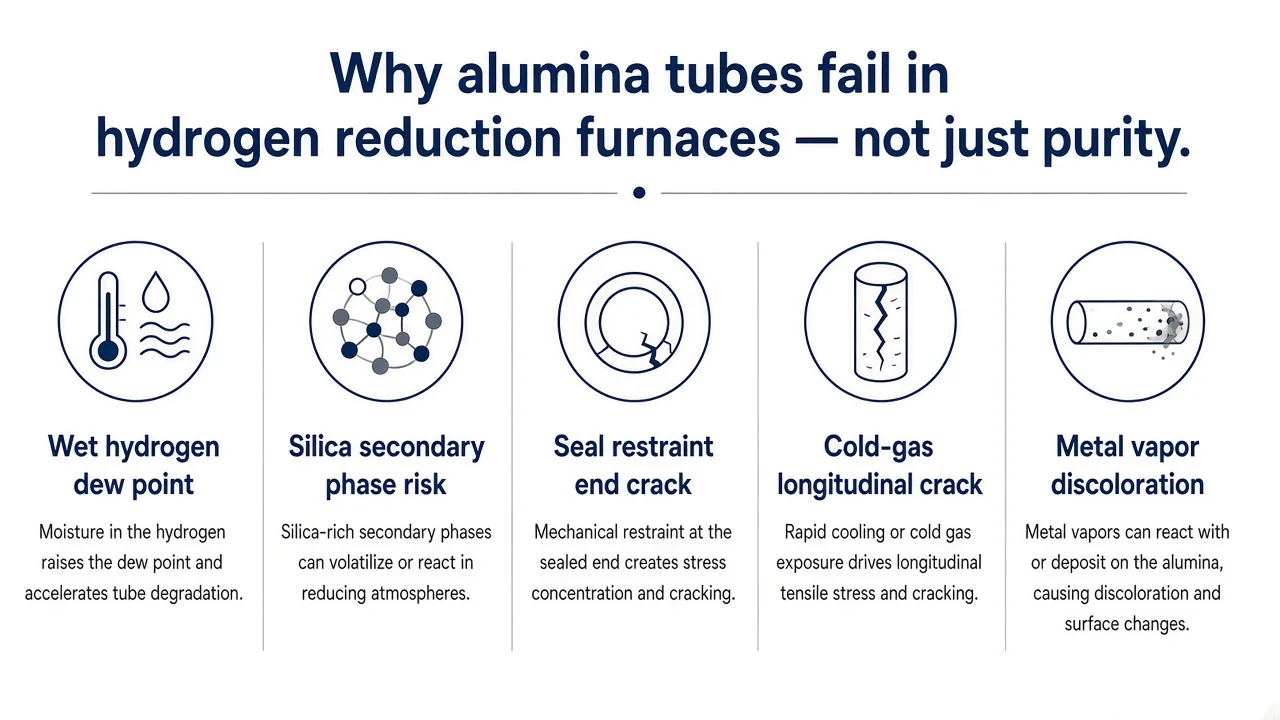
- Dew point and moisture sources. Hydrogen reduction potential tracks water and oxygen activity in the gas. Uncontrolled dew point, wet purge lines, or moisture held in insulation can shift surface chemistry and secondary-phase behavior long before the tube reaches any selection ceiling. Specify and control dew point; do not treat a purity label as a moisture fix.
- Silica-bearing and mullite secondary phases. Impurity phases in alumina are more sensitive in hot reducing atmospheres than in clean oxidizing duty. Prefer purity and impurity asks that match contamination tolerance.
- CO/H2 carbon deposition. Carbon-bearing gas mixes can deposit soot or carburize nearby metals. Deposits bridge seals, lock floating clearances, and contaminate samples. Ask for sample chemistry and carbon sources on the RFQ; alumina purity does not erase process carbon.
- Metal vapor and volatile species. Alkali, halogen, and metal vapors discolor or attack surfaces and seals. Discoloration alone is not proof that alumina was "reduced by H2." Capture sample chemistry and deposit appearance before changing purity.
- Seal and support restraint. Flanges, hard collars, and non-sliding saddles turn thermal growth into end cracks and ring cracks. Soften clamp-up and allow designed clearance. Purity upgrades do not unlock a mechanically locked tube.
- Ramp, purge, and cold-gas shock. Fast ramps into a cold purge or sudden cold-gas injection drive longitudinal cracks that look like material defects. Review ramp, purge temperature, and gas introduction together with wall thickness.
Within broader industrial furnace ceramics practice, hydrogen duty is treated as an atmosphere-plus-geometry system. Assess atmosphere, contamination path, wall, and thermal cycle before chasing the highest purity label.
Treat dew point, impurity-phase sensitivity, and seal restraint as co-equal selection inputs. A dry, well-purged furnace with soft end hardware often runs longer on 99.7% dense alumina than a wet, hard-clamped furnace does on any cleaner purity. Blank H2 pre-runs and documented leak checks are RFQ options that reduce early surprises; they are not automatic ADCERAX deliverables unless agreed on the order.
Purity Screen and Geometry
Use purity as an initial screen, then confirm named catalog grades and full property tables on the alumina tubes product page linked above.
Practical H2 screen:
- 99.7% dense alumina - default start for dry-controlled hot-zone gas-tight process tubes and thermocouple protection.
- 99.5% dense alumina - may sit beside for milder mid-temperature forming-gas liners after density / open porosity / leak-check intent are confirmed.
- Higher-purity dense class - only when ultra-low impurity or extreme cleanliness is a stated process ask.
- 99% or 95% class - cold-end fixtures / non-critical insulation when temperature and load allow; not a default hot-zone gas-tight substitute.
Long-term selection ceilings on supplier data sheets support purity comparison. They are not hydrogen service-life ratings under load, span, dew point, or seal restraint. Atmosphere must be assessed before treating the highest purity as automatically suitable. Straightness for dense high-purity furnace tubes is commonly 1 mm/m against the drawing datum where applicable. Density and water-absorption selection limits support screening; they are not a stand-alone permeation formula. Specify dense / gas-tight intent by tube function.
Geometry by function:
- Process / work tube: open or closed ends per furnace layout; prioritize gas-tight wall and sealable ends.
- Thermocouple protection: prefer one-piece closed-end when atmosphere isolation matters; document leak-check method.
- Gas guide / spacer: match bore and length to flow path; still state dew point and sample chemistry if the guide sits in the hot zone.
One-piece closed-end construction is preferred over fused or bonded closures when long-term gas tightness under thermal cycling matters. Ask the supplier how the closed end is formed and how leak integrity is verified.
State tube function on every line item so purity and geometry are not mixed across roles. Cold fixtures are not interchangeable with hot-zone gas-tight process tubes just because both are "alumina."
Where a production line uses multi-material ceramic tubes, assess atmosphere compatibility and geometry requirements separately for each material and tube function.
Do Not Misdiagnose Every H2 Furnace Failure as Alumina Incompatibility
| Signature | Likely driver | First fix |
|---|---|---|
| Crack at flange / seal face | Axial or radial restraint; hard clamp-up | Soften seal; add designed clearance; fix one end, float the other where length allows |
| Longitudinal crack after purge | Cold-gas shock or steep gradient | Warm purge practice; slower ramp; review wall and gas entry |
| Ring crack at saddle | Point load / non-sliding support | Widen contact; allow axial slide |
| Surface discoloration / deposit | Metal vapor, carbon, or sample volatiles | Map sample chemistry and deposits before changing purity |
| Slow leak without crack | Open porosity / density / end closure quality | Specify density, open porosity, and leak check; prefer one-piece closed end |
Stepping from 99.5% to 99.7% dense alumina (or to a cleaner higher-purity class) without fixing dew point, restraint, or purge rarely stops these failures. For short lab sensor wells, assess geometry and installation requirements separately.
When replacing a failed tube, photograph the crack or deposit in place, mark distance from the seal face and nearest support, and note purge timing relative to the failure. That package usually identifies dew-point, restraint, or cold-gas drivers faster than another purity step.
RFQ Checklist for Hydrogen Reduction Furnace Tubes
Send atmosphere context with geometry. A bare "OD x ID x L alumina tube" line is not enough to confirm dew-point tolerance, gas tightness, or seal design. Use the key information for quoting alumina tubes checklist and add the hydrogen-service fields below.
Dimensional ranges for engineering review: OD/ID 2-120 mm; length 10-3500 mm; wall 0.5-20 mm; tolerances up to +/-0.05 mm where the drawing and process allow. These ranges do not guarantee availability for every OD x wall x length combination. Thin-wall long tubes and long cantilevers need section, straightness, firing, and packaging review.
- H2% and carrier gas (inert balance, forming gas ratio)
- Dew point / moisture / O2 control intent (state targets as process data, not as an ADCERAX warranty)
- Continuous / peak temperature, ramp and cooldown, cycle count
- Tube function: process / TC protection / gas guide / spacer
- Preferred purity screen: for this H2 duty, start screening at 99.7% dense alumina (99.5% may sit beside for milder forming-gas liners). Confirm named catalog grades in the RFQ.
- SiO2 / impurity limit ask if contamination-sensitive
- Density / open porosity / gas-tight or leak-check requirement
- OD / ID / wall / length / open or closed end / multi-bore
- Support spacing, seal type, and expansion clearance intent
- Sample chemistry (alkali, halogen, volatile metals, carbon sources)
- Whether a blank H2 pre-run or leak check is required before production loads
- Drawing or existing-part photos; failure location map if replacing a cracked tube
The typical inquiry response window is 24 h; this is not a promise of a completed quotation within 24 h. Prototypes and custom parts follow agreed lead times after drawing review.
State whether the tube must remain gas-tight under continuous H2, intermittent forming gas, or only during peak soaks. Continuous hot-zone isolation usually pushes density, closed-end quality, and leak-check language harder than a short forming-gas soak in a lined chamber. Align the validation ask (blank pre-run, pressure decay, helium sniff, or visual only) with that duty so the quote and the acceptance test tell the same story.
Frequently Asked Questions
Can alumina tubes be used in hydrogen reduction furnaces?
Yes, when atmosphere, density/gas tightness, geometry, and seals are specified together. Dense alumina process tubes and closed-end thermocouple protection tubes are common in dry-controlled H2 and forming-gas duty. Success depends on dew-point control and mechanical restraint as much as on purity label.
Which purity should the H2 screen start from?
For this H2 duty, start screening at 99.7% dense alumina (99.5% may sit beside for milder forming-gas liners). Cleaner, ultra-low-impurity asks may step to a higher-purity dense class. Confirm named catalog grades on the product catalog linked in the opening.
Does a higher purity grade fix wet-hydrogen or seal-crack failures?
Usually no. Wet hydrogen and unknown dew point require atmosphere control first. Flange-restraint and cold-gas cracks are mechanical and thermal-shock problems. Change purity after the process and hardware drivers are addressed, not instead of them.
Why prefer one-piece closed-end tubes for atmosphere isolation?
One-piece closed ends avoid a fused or bonded joint that can become a leak path under cycling. Pair the geometry with a documented leak check.
Are selection ceilings the same as H2 service life?
No. Long-term selection ceilings on supplier data sheets support purity screening. They do not certify hours of life under a given dew point, span, seal load, or sample chemistry. Atmosphere must be assessed before treating the highest purity as automatically suitable.