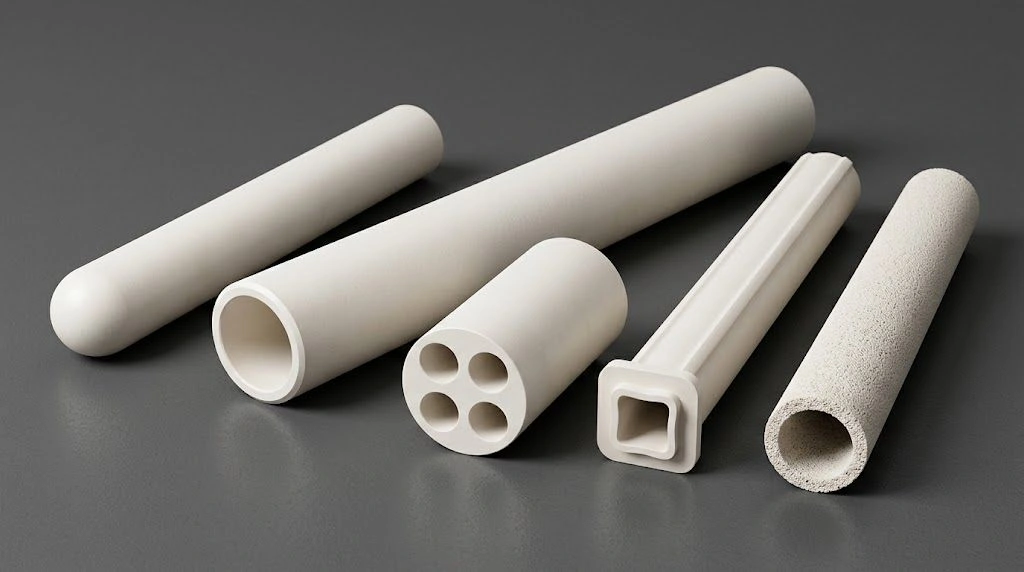
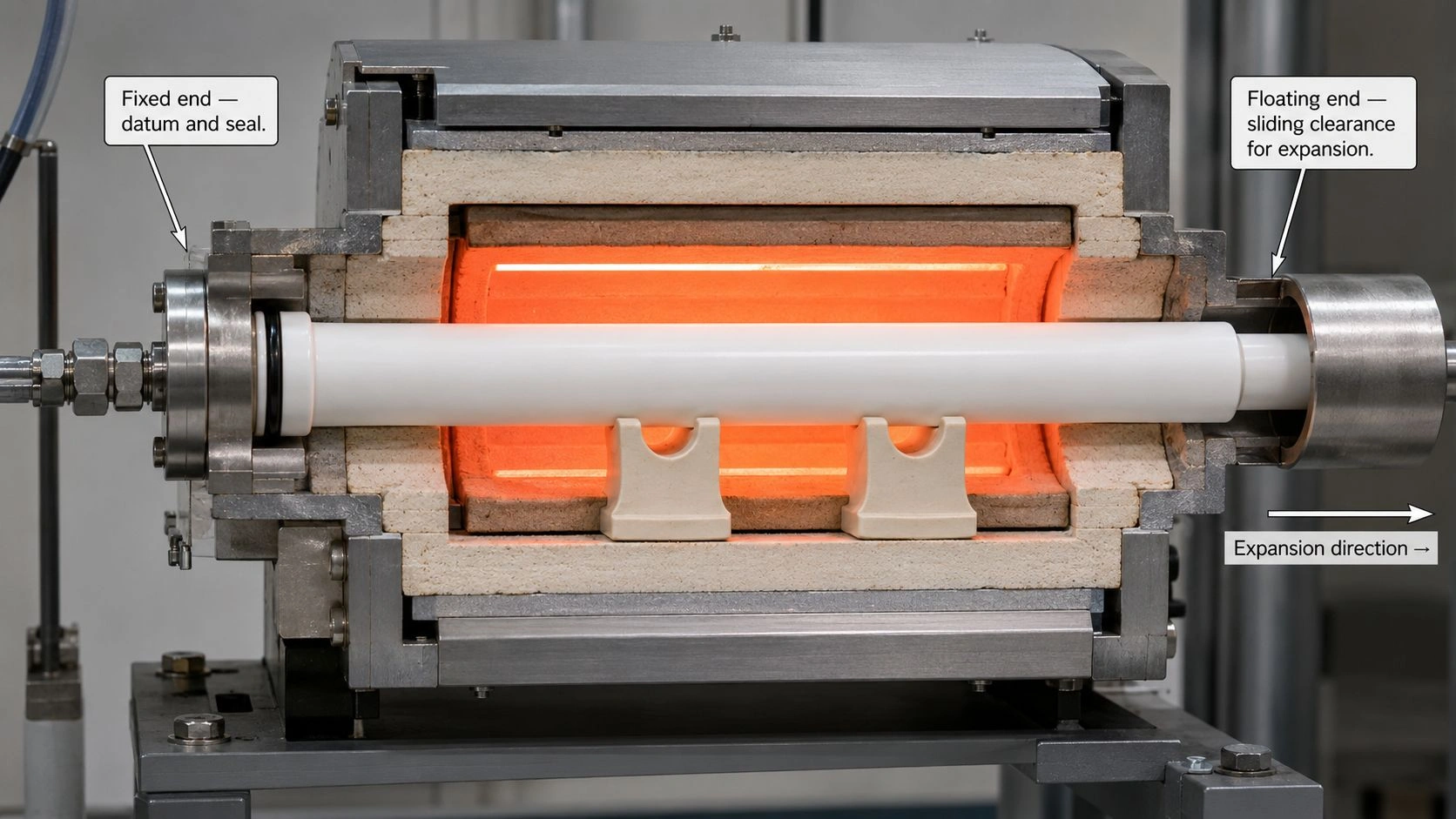
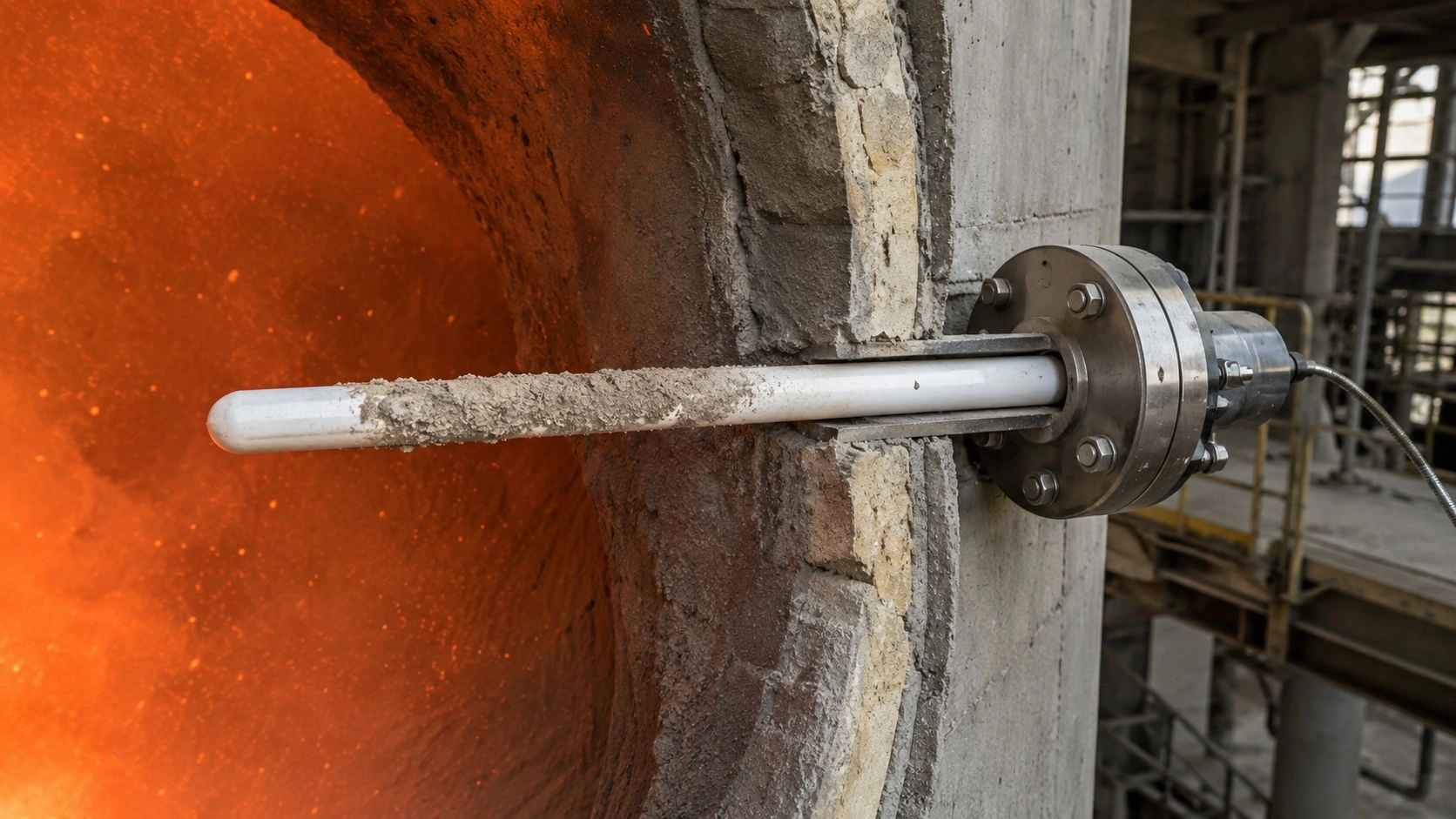
CIP does not compete with isostatic pressing — CIP means cold isostatic pressing, one type of isostatic pressing used before sintering. For alumina tubes, CIP mainly improves green density uniformity by applying pressure from all directions, which helps reduce radial and axial density gradients before firing. Higher and more uniform green density can support more predictable sintering shrinkage, lower open porosity, and better dimensional stability — but final fired density still depends on powder quality, binder removal, sintering schedule, wall thickness, and post-machining.
That clarification matters before any supplier comparison or RFQ specification, because a buyer who asks whether an alumina tube is "isostatic pressed" without distinguishing CIP from uniaxial pressing, and without asking for fired density and porosity data, may accept or reject tubes based on a process label rather than a measurable outcome.
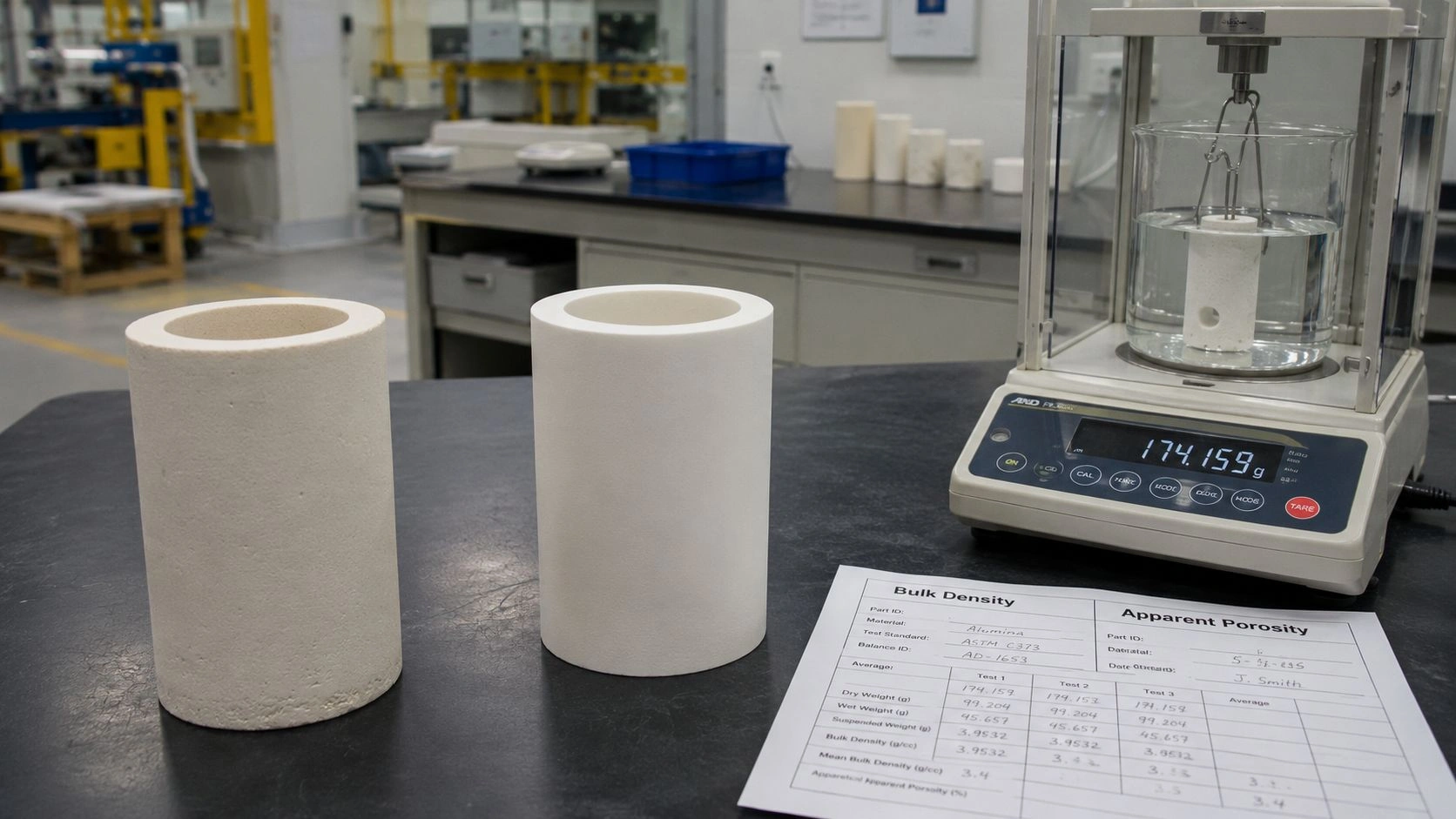
Cold isostatic pressing improves green density uniformity in alumina tubes by applying fluid pressure from all directions — but final fired density verification requires bulk density and apparent porosity measurements, not process labels.
For alumina tube RFQs, CIP is cold isostatic pressing (one type of isostatic pressing). Specify fired bulk density, apparent porosity, and sectional checks — and state grade on the data sheet (typical screening grades: 95 / 99.00 / 99.50 / 99.70 / 99.90% Al₂O₃) — rather than accepting a process label alone. Product geometry and density-controlled grades for custom tubes are summarized on the alumina tubes page when you are ready to route dimensions into an RFQ.
CIP is a type of isostatic pressing, not the opposite
The most important terminological correction for this topic is that CIP and isostatic pressing are not two different things. CIP is cold isostatic pressing — it is one method within the isostatic pressing family, distinguished from hot isostatic pressing (HIP) by the temperature and mechanism of densification. Understanding this resolves a common buyer confusion and clarifies which comparisons are actually engineering-relevant.
The Forming Routes table below places CIP in context with the other main routes used for alumina tube production:
| Route | What it means | Density effect | Tube design boundary |
|---|---|---|---|
| Uniaxial dry pressing | Powder pressed from one main direction in rigid tooling | Can create density gradients from wall friction and pressure direction | Best for simple shapes; not optimal for long tubes |
| CIP | Cold isostatic pressing in flexible mold before sintering | Improves green density uniformity and shrinkage predictability | Useful for thick, long, large, or complex tube blanks |
| HIP | Hot isostatic pressing after or during densification | Reduces residual porosity in selected advanced ceramic systems | More specialized and costly; not typical for ordinary industrial tubes (screening note) |
| Extrusion | Powder/binder body pushed through a die | Efficient for continuous tubular forms | Density depends on batch, die, drying, and firing control |
| Slip casting | Ceramic slurry cast into porous mold | Useful for hollow shapes | Density depends on slurry solids, casting time, and drying |
Values indicative; verify forming route, density, and porosity using supplier-specific data and agreed ASTM/ISO methods.
For alumina tubes, the practically relevant comparison is usually CIP versus uniaxial dry pressing or extrusion — not CIP versus the abstract concept of isostatic pressing. CIP applies fluid pressure uniformly around a flexible mold, helping the powder compact more evenly than single-direction tooling can achieve. That compaction difference becomes most important in tube geometries where wall friction, mandrel contact, and axial pressure gradients would otherwise create density variation.
CIP vs HIP: green forming vs final densification
CIP is a green-body forming step that happens before sintering. HIP is a post-sintering or concurrent densification step that uses high gas pressure at elevated temperature to reduce residual porosity. For typical industrial alumina tubes — thermocouple protection tubes, furnace tubes, insulating tubes — CIP is the relevant green-forming question. HIP is a more specialized post-processing step used when residual porosity must be reduced beyond what sintering alone achieves, and it is not the default choice for standard alumina tube production.
Why buyers often mean "CIP vs uniaxial pressing"
When engineers ask whether a tube is "isostatic pressed," they are usually asking whether the supplier used flexible-mold isostatic compaction to achieve better green density uniformity, compared with a uniaxial die-pressing route where pressure gradient and tooling friction limit radial uniformity. That is the correct engineering question — and the RFQ should ask it explicitly along with requests for density data, not just for a process description.
How CIP changes green density, fired density, and porosity
CIP improves alumina tube density by reducing the density gradient in the green body before firing. In uniaxial pressing, wall friction and single-axis compaction pressure can create non-uniform particle packing, especially in tall tube sections or thick walls where the ratio of tube height to die clearance increases the friction effect. In CIP, fluid pressure transmits uniformly around the flexible mold, compacting the powder more evenly through the tube wall and along the tube length.
In practice, CIP means fluid pressure in a flexible mold that improves green density uniformity — including for large height-to-diameter blanks — so sintering shrinkage and open porosity become more predictable. Fired density still depends on powder quality, binder removal, and the sintering schedule; CIP does not by itself guarantee a higher fired bulk density.
After sintering, the more uniform green body can produce more consistent dimensional contraction, lower local density variation, and lower apparent porosity. But CIP does not act alone: powder particle-size distribution, binder formulation, binder removal, sintering temperature, soak time, furnace loading geometry, and post-machining all affect the final fired density independently. A CIP-formed green body that was fired at insufficient temperature will still show elevated porosity. A well-sintered uniaxial-pressed tube may show lower density variation than a CIP tube from a different supplier with a poorly optimized binder burnout.
Green density: the hidden variable before sintering
Fired-density specifications are the correct purchasing requirement, but green density variation is what CIP addresses. The connection is that non-uniform green density produces non-uniform sintering shrinkage — one region of the tube contracts slightly more than another, creating residual stress, ovality, straightness drift, or local porosity variation. CIP reduces that gradient at its source.
Fired density: why CIP helps but does not act alone
A complete density specification for alumina tubes requires: alumina grade, target bulk density after firing, maximum apparent porosity, test method, and whether data must come from the actual tube or a companion coupon. None of those can be satisfied by specifying "CIP formed" without additional measurement data. When a screening range is useful for grade selection, typical bulk density on alumina data sheets is about 3.75–3.94 g/cm³ by grade — screening only, not tube PO acceptance and not a CIP guarantee.
Apparent porosity and water absorption as verification metrics
For fired ceramic and refractory products, apparent porosity and water absorption are the standard verification metrics for open-pore content. ASTM C373 defines these measurements for fired ceramic whiteware products, including bulk density, apparent porosity, and apparent specific gravity. ASTM C20 applies to burned refractory brick and shapes. Agree the method on the RFQ — C373 and C20 may both be listed depending on whether the tube is treated as a precision ceramic part or a refractory-style product. TDS planning also references ISO 18754 for density/porosity method selection; that is a planning side-note, not a sole contractual method. Water-absorption limits on grade data sheets are screening aids only — not tube PO acceptance by themselves.
Do not misdiagnose every density problem as a pressing problem
Not every low-density or warped alumina tube indicates a CIP-versus-uniaxial-pressing failure. The Density Problems table below maps six common observed issues to their likely forming causes and non-forming causes to check:
| Observed issue | Possible forming cause | Non-forming cause to check | Verification method |
|---|---|---|---|
| Low average bulk density | Low green density or poor compaction | Under-sintering or powder particle issue | ASTM C373 / C20 density test |
| High apparent porosity | Poor particle packing in green body | Binder burnout problem or sintering schedule | Porosity + water absorption data |
| Ovality after firing | Non-uniform green density | Uneven furnace support or machining | Dimensional map along tube length |
| Local cracking | Density gradient or pressing flaw | Thermal shock, handling, or machining damage | Cross-section inspection |
| Straightness drift | Uneven shrinkage during firing | Furnace loading or long unsupported firing | Straightness measurement per drawing |
| Gas permeation concern | Residual open porosity | Wrong material grade or test method applied | Leak or porosity test as specified |
Root-cause diagnosis requires forming history, sintering records, and sectional density data — not visual inspection alone.
Three specific misdiagnoses appear most often:
Powder and binder problems that mimic forming defects. A poorly granulated powder with wide particle-size distribution, hard agglomerates, or uneven binder distribution produces non-uniform compaction regardless of whether CIP or uniaxial pressing is used. If binder burnout is incomplete, organics remain in the green body and create porosity during sintering. Neither of these failures is a pressing problem — they are upstream material problems.
Sintering under-densification vs green-density gradient. A tube that shows high porosity after firing may have been compacted correctly but fired at insufficient temperature or without an adequate soak. Conversely, a tube with good average density may still have local density variation if mandrel contact, fill, or wall-thickness control was inconsistent. Separating these requires sintering records and sectional density data.
Average density vs local density variation. A single bulk density measurement from a coupon cut from one location in a tube can show acceptable density while a different section of the same tube has higher porosity. For long tubes or tubes with complex geometry, sectional measurements at the tube ends and midpoint provide better process information than a single average value.
Which alumina tube geometries benefit most from CIP
CIP is most useful when the tube geometry creates conditions where uniaxial or extrusion-based forming would introduce the highest risk of density variation.
For broader tube design and specification context beyond density acceptance, see the alumina ceramic tube selection guide — useful when high-temperature duty still needs density and porosity verification beyond a catalog line.
Thick-wall and large-OD tubes benefit from CIP because increasing wall thickness and outer diameter create larger ratios of compacted volume to mandrel surface area. The fluid pressure in CIP distributes more uniformly through thick walls than a single-axis die load, reducing the risk of a density gradient between the inner and outer tube surface.
Long tubes with tight straightness requirements benefit from CIP because axial density variation in a long green body translates to differential sintering shrinkage along the length, producing straightness drift or bow after firing. More uniform axial green density reduces the magnitude of that differential.
Multi-bore and closed-end tubes have complex internal geometry that makes uniform compaction more difficult for rigid-tooling forming routes. CIP's flexible mold conforms more naturally to complex mandrel shapes, making it a practical choice for tubes with non-cylindrical bores or sealed ends.
When extrusion may still be the better route. CIP has a trade-off: the flexible mold can improve density uniformity, but it produces lower dimensional precision in the green body than rigid tooling. For thin-walled, small-diameter tubes produced in large quantities at a stable process, extrusion can be an excellent route that does not require CIP's more elaborate setup. Published ceramic processing texts note that surfaces formed against rigid tooling can hold better tolerance than flexible-mold surfaces, and that flexible-mold surfaces may show greater tolerances and poorer surface quality. The choice between CIP and extrusion should be made by the supplier based on tube geometry and production volume, with the buyer specifying the required fired-state outcome data.
RFQ checklist for alumina tube density verification
The RFQ Fields table below captures the minimum specification language for density control and verification:
| RFQ field | Why it matters | Recommended wording |
|---|---|---|
| Forming route | Prevents vague "isostatic" claim | "State whether tube is extruded, dry pressed, or CIP formed" |
| Alumina grade | Sets density expectation | "State grade on data sheet / RFQ (typical screening: 95 / 99.00 / 99.50 / 99.70 / 99.90% Al₂O₃)" |
| Target bulk density | Creates measurable acceptance | "Provide fired bulk density range and test method" |
| Apparent porosity | Indicates open-pore content | "Report apparent porosity per ASTM C373 or C20" |
| Sectional testing | Detects local variation | "Measure at end, middle, and opposite end for long tubes" |
| Machining stage | Affects final tolerance | "State green machining or fired machining route" |
| Shrinkage control | Explains dimensional stability | "Confirm expected sintering shrinkage and tolerance allowance" |
| Witness coupon | Supports QA, but not enough alone | "Coupon data must be linked to same batch and firing" |
The most important principle is to specify outcome data rather than process labels: fired bulk density, apparent porosity (per the agreed ASTM C373 or C20 method), sectional measurements, and forming-route disclosure. The same CIP process can produce variable results depending on powder, binder burnout, and sintering — and a well-controlled extrusion route can match CIP results for specific tube geometries.
State the alumina grade on the data sheet or RFQ (typical screening grades: 95 / 99.00 / 99.50 / 99.70 / 99.90% Al₂O₃) and disclose the forming route with density and porosity data from the agreed test standard. For non-standard OD/ID/wall/length plus density and porosity acceptance fields, use custom ceramic manufacturing services alongside the alumina tubes product page when routing the inquiry.
Specifying alumina tubes with density and porosity requirements? Send the tube drawing plus forming-route disclosure, alumina grade, OD × ID × wall × length, operating temperature, straightness tolerance, fired bulk density range and method, apparent porosity limit, sectional check plan, and whether data come from a coupon or the actual tube. A complete RFQ package lets suppliers compare CIP, extrusion, or other routes on measurable outcomes — not on process labels alone.
Related reading
- How alumina tubes are made — powder to final product — When you need the full powder-to-tube forming route — extrusion, pressing, and firing steps beside density acceptance checks.
- Alumina tube expansion joint design for long tubes — When long alumina tubes need expansion-joint and straightness design — a length-axis problem after density and shrinkage are under control.
- Precision alumina tubes dimensional tolerances — When the drawing fight is dimensional tolerance after firing — not CIP terminology or porosity verification.
Frequently Asked Questions
Is CIP the same as isostatic pressing?
CIP is one type of isostatic pressing. It stands for cold isostatic pressing, performed at or near room temperature in a flexible mold using fluid pressure. The broader isostatic pressing family also includes hot isostatic pressing (HIP), which uses high gas pressure at elevated temperature to reduce residual porosity in already-sintered or semi-sintered ceramics. For alumina tube production, the relevant question is usually CIP versus uniaxial dry pressing or extrusion, not CIP versus the general concept of isostatic pressing.
Does CIP always produce higher alumina tube density?
No. CIP usually improves green density uniformity by reducing the pressure gradient in the green body, which supports more predictable sintering shrinkage. But final fired density depends on powder quality, particle-size distribution, binder burnout, sintering temperature, soak time, furnace loading, and post-machining. Buyers should verify fired bulk density and apparent porosity data, not just the forming route name.
Why is CIP useful for alumina tubes?
Alumina tubes are hollow, elongated parts where radial and axial density variation during green forming can translate to differential shrinkage during sintering — causing straightness drift, ovality, or local porosity variation. CIP reduces those gradients by compacting the powder uniformly from all directions through the flexible mold, making it useful for thick-wall, large-OD, long, or complex-geometry tube blanks.
Is extrusion worse than CIP for alumina tubes?
Not necessarily. Extrusion can be an excellent route for thin-walled, small-diameter, high-volume alumina tubes where the process is optimized for that geometry. CIP is more attractive when wall thickness, tube length, or geometry complexity make uniform compaction difficult for rigid-tooling or extrusion routes. The correct choice depends on tube geometry, production volume, and the supplier's process capability — and the buyer's focus should be on specifying density outcome data rather than mandating a forming route.
What density standard should be used for alumina tubes?
ASTM C373 is commonly relevant for fired ceramic whiteware-style products and defines water absorption, bulk density, apparent porosity, and apparent specific gravity. ASTM C20 applies to burned refractory shapes and covers the same properties for refractories. Agree the method on the RFQ; ISO 18754 may appear on planning data sheets as a density/porosity method reference but is not treated here as the sole contractual method. For critical alumina tubes, sectional measurements from multiple locations are more informative than a single average value from a coupon — without inventing an unvetted N-point or maximum Δ dens limit.
What should I ask a supplier to prove density uniformity?
Request forming route disclosure, alumina grade and data sheet, fired bulk density value and test method, apparent porosity per ASTM C373 or C20, sectional density data for long tubes measured at ends and midpoint, sintering route and temperature confirmation, green or fired machining stage, and whether the density value comes from the actual tube or a companion coupon. A supplier who can provide these data points has demonstrated process control rather than just naming a forming method.