Select SiC seal rings for chemical pumps when the seal face must resist corrosion, abrasive particles, high temperature, and rapid wear better than carbon, alumina, or metal-based alternatives. Use SSiC when aggressive acids, alkalis, amines, caustics, high-purity fluids, or free-silicon sensitivity make reaction-bonded SiC a compatibility risk. Use SiC-carbon pairing when lubrication and low friction are the primary requirements and the fluid is reasonably clean; use SiC-SiC when abrasive solids dominate and the pumped fluid can maintain a lubricating film. The selection must be based on fluid chemistry, solids content, pressure, speed, temperature, and dry-running risk — not material name alone.
The silicon carbide seal rings at ADCERAX — covering SSiC and RBSiC grades for pumps, compressors, and mixers in high-corrosion and abrasive service, with custom OD from 20 mm to 100 mm, precision-lapped sealing faces, and chemical compatibility confirmation — provide the product context for the selection decisions described in this guide.

Selecting SiC seal rings for chemical pumps requires matching fluid chemistry to grade — SSiC avoids free-silicon limitations in caustics and amines — and matching seal duty to face pairing: SiC-carbon for lubricity, SiC-SiC for abrasive solids.
When should SiC seal rings be selected for chemical pumps?
SiC seal rings belong in chemical pump service when corrosion, abrasive wear, hard particles, high sliding duty, or elevated temperature are the primary drivers of seal failure or short replacement interval.
[CITE: QM Seals' published mechanical seal face material guide confirms that silicon carbide seal faces are widely preferred for chemical pumps because of their combination of chemical and wear resistance — and ADCERAX's published SiC seal ring product documentation positions SiC seal rings for pump, compressor, and mixer service in high-temperature and high-corrosion environments where standard carbon, alumina, or metal-based faces have inadequate service life — establishing that the justification for SiC in chemical pump sealing is specifically the combination of chemical resistance and wear resistance, not hardness alone.]
Corrosive liquids, acids, alkalis, solvents, and oxidizing fluids. When the chemical pump handles strong acids, organic solvents, halogen compounds, oxidizing chemicals, or pH-extreme process fluids, the face material must provide stable resistance without corroding, swelling, or losing the dimensional precision that mechanical sealing depends on. Carbon graphite — the most common counterface pairing with SiC — can corrode or degrade in certain strongly oxidizing or organic solvent environments. SiC provides more consistent chemical stability across a wider range of aggressive process chemicals, which is why it has become the standard hard face in chemical process pump applications.
Abrasive particles, slurry, and high-wear seal faces. When the pumped fluid contains suspended solids, catalyst particles, mineral slurry, crystallizing species, or fine abrasive material, carbon and alumina seal faces wear rapidly under the abrasive particles that penetrate the lubricating film. SiC's hardness — typically above 2000 HV for sintered grades — significantly reduces the rate of face scoring and wear in these conditions. This abrasion resistance is the second major driver for SiC in chemical pump service, alongside corrosion resistance.
How do fluid chemistry, solids, dry-running risk, and temperature change the selection?
After confirming SiC is appropriate for the chemical pump duty, the specific service variables that determine which SiC grade and which face pairing to specify must be audited systematically.
Chemistry first: pH, concentration, oxidizers, caustics, amines, and solvents. The chemical compatibility of both seal faces — and the secondary elastomeric seals and metal hardware — must be evaluated before grade selection. Published seal material guidance from 911Metallurgist confirms that hardness, stiffness, thermal expansion, wear resistance, thermal conductivity, and operating behavior all contribute to seal performance, and that chemistry dictates which material combination is appropriate for the specific process fluid. The grade question for SiC is particularly important when the fluid contains sodium hydroxide, potassium hydroxide, amines, or other alkaline species that can react with free silicon in reaction-bonded SiC grades.
Solids and dry-running: why hard-hard pairing is not always safer. The decision between carbon-SiC pairing and SiC-SiC pairing is often misunderstood. SiC-SiC pairing is not simply ""harder and therefore better"" — it is specifically beneficial when the pumped fluid contains abrasive solids sufficient to rapidly wear a carbon face, and when the fluid can still maintain an adequate lubricating film at the seal interface. Vulcan's published face-material guidance confirms that SiC-SiC pairing is often preferred for lubricating media with high solids content, while tungsten carbide may be preferred in physically demanding applications where impact resilience is the primary requirement. When dry-running risk is significant — pump startup before priming, cavitation events, or loss of seal flush — carbon provides better survival than an all-SiC pairing because carbon's self-lubricating character reduces friction even during brief film interruptions.
Which grade and face pairing should be selected?
After auditing the service conditions, the grade and face pairing decision can be resolved. For chemical pumps, the grade decision starts with free-silicon acceptability.
The SSiC vs RBSiC comparison table maps the key grade variables:
[CITE: Published Fluid Tech mechanical seal material guidance explicitly states that RBSiC (reaction-bonded silicon carbide) contains free silicon in its microstructure and specifically warns against use in caustics, amines, and sodium hydroxide media where the free silicon can be attacked — while confirming that SSiC (sintered silicon carbide) does not contain free silicon and is positioned for broad corrosive service across a wider range of aggressive chemical environments — and MechanicalSeals.net similarly confirms that reaction-bonded SiC is common in general mechanical seal service while alpha/pressureless sintered SiC is specifically recommended for chemical pump applications.]
| Decision variable | SSiC | RBSiC |
|---|---|---|
| Free silicon | Typically none/very low | Contains free silicon in structure |
| Best fit | Strong corrosion, caustics review, high-purity fluids, severe service | General seal service when chemistry allows |
| Chemical boundary | Stronger first check for aggressive chemicals | Avoid or validate in caustics, amines, NaOH service |
| Cost tendency | Higher | Often lower |
| Face performance | Strong wear, corrosion, and lapping potential | Common in mechanical seals; good wear in suitable fluids |
| Main RFQ question | Is dense SSiC required by chemistry and purity? | Is free silicon acceptable in this fluid? |
SSiC vs RBSiC: free silicon is the chemical-service decision point. In most general pump applications, RBSiC provides adequate wear and corrosion resistance, and it is widely used in standard mechanical seals. The upgrade to SSiC is specifically justified when the pumped fluid contains sodium hydroxide, potassium hydroxide, amines, concentrated acids, or other species that can selectively attack the free-silicon phase in RBSiC. The visual presentation may be the same, but the chemical service life can differ substantially. Before specifying RBSiC for a new chemical pump, confirm whether the process chemistry is compatible with its free-silicon content.
The Chemical Pump SiC Seal Ring Selection Matrix maps the service condition routing:
| Pump service condition | Recommended first check | Why | Watch-out |
|---|---|---|---|
| Strong acids/aggressive chemicals | SSiC seal ring | Dense SiC without free-silicon limitation is safer | Verify secondary seals and metal parts |
| Caustics/amines/sodium hydroxide | SSiC over RBSiC | RBSiC free silicon can be a compatibility concern | Confirm supplier grade data |
| Clean chemical liquid | Carbon-SiC pairing | Carbon provides lubricity against hard SiC | Check chemical compatibility of carbon grade |
| Abrasive slurry with lubricating fluid | SiC-SiC pairing | Hard-hard faces resist abrasive wear | Avoid dry running and solids trapping |
| Shock/vibration/impact-heavy service | WC or SiC-WC review | Tungsten carbide may provide higher impact toughness | Check corrosion trade-off |
| Dry-running risk | Carbon-containing pairing | Carbon often tolerates boundary lubrication better | SiC-SiC may overheat if fluid film fails |
| High-purity chemical process | SSiC + clean packaging | Low contamination and stable face geometry matter | Confirm packaging and cleaning requirements |
| Unknown previous failure | Failure analysis before grade change | Root cause may be installation, flush, or pairing | Request failed-face photos |
Values indicative. Verify with seal OEM, pump conditions, supplier-specific SiC grade data, and application testing.

Chemical pump SiC seal ring selection should route by service condition first: SSiC for caustics and aggressive chemistry, SiC-SiC for abrasive lubricating slurry, and carbon-SiC for clean chemical fluids where lubricity matters.
Carbon-SiC vs SiC-SiC vs SiC-WC face pairing. The Face Pairing Matrix maps the main pairing options:
| Face pairing | Best fit | Main advantage | Main limitation |
|---|---|---|---|
| Carbon-SiC | Clean to moderately challenging chemical liquids | Lower friction, good general pairing | Carbon may wear in abrasive slurry |
| SiC-SiC | Abrasive lubricating fluids, solids-bearing chemical pumps | High wear resistance on both faces | Needs reliable fluid film; dry running risk |
| SiC-WC | Shock/impact plus chemical review | Balances SiC corrosion with WC toughness | WC chemistry must be validated |
| Carbon-WC | Physically demanding, less chemically aggressive service | Good toughness and carbon lubricity | Chemical corrosion may limit WC |
| Alumina-carbon | Low-cost, clean, lower-severity duties | Economical | Lower wear/corrosion margin than SiC in harsh service |
Pairing selection depends on fluid, lubricity, abrasion, dry-running risk, and pump speed. Verify with seal OEM.
The silicon carbide mechanical components page at ADCERAX provides the broader context for SiC sealing structures, bearings, and wear components across pump, compressor, and mixer service in aggressive chemical environments. The silicon carbide ceramic material grades page covers the SSiC, RBSiC, and NBSiC grade routing for these applications.

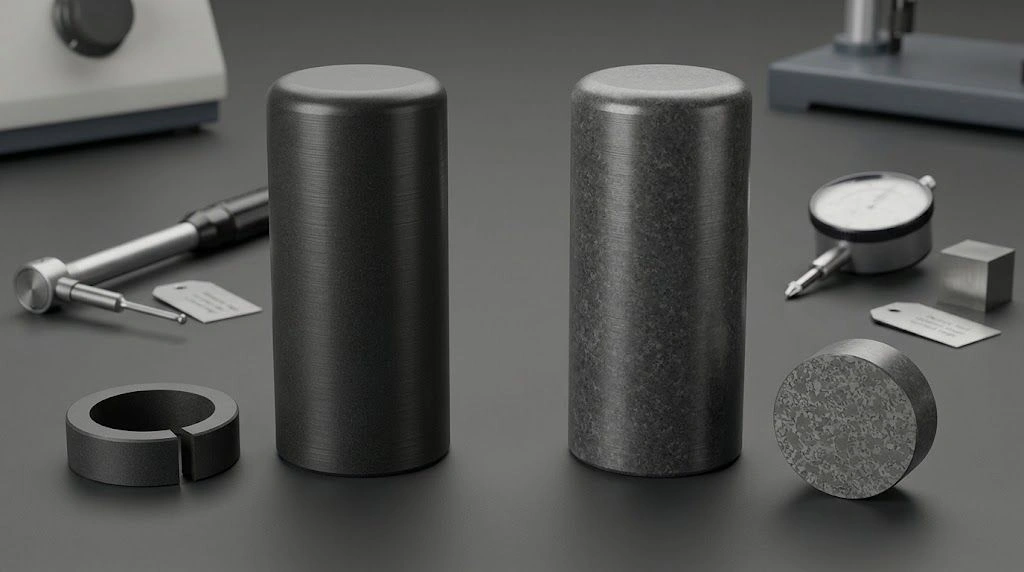
SSiC, RBSiC, and carbon seal rings may look similar in geometry, but their chemical-service role is different: SSiC supports aggressive and caustic service, RBSiC requires free-silicon compatibility review, and carbon remains useful as a clean-fluid counterface.
What failure modes occur when SiC seal rings are mis-specified?
After grade and pairing selection, the early-failure mechanisms specific to chemical pump SiC seal rings must be understood — because many field failures that appear to be material problems are actually system or installation problems.
Dry running, poor lubrication, and trapped solids. SiC seal faces require a fluid film at the interface to dissipate friction heat and prevent direct ceramic-to-ceramic or ceramic-to-carbon contact at the micro-asperity level. When a chemical pump runs without adequate fluid — due to vapor lock, cavitation, pump startup before priming, or loss of seal flush — the SiC face overheats rapidly. The high hardness that makes SiC abrasion-resistant also makes it brittle in thermal shock, and a dry-running event can crack an SiC ring in seconds. Abrasive solids trapped between faces without adequate flush can act as a lapping compound, accelerating face wear and shortening seal life regardless of face hardness.
CTE mismatch, face distortion, secondary seal, and installation stress. 911Metallurgist's seal material selection paper confirms that temperature changes alter fits between metal components and ceramic or carbon seal faces because of their different coefficients of thermal expansion, and that this can cause hang-up, distortion, leakage, or fracture. In chemical pumps where process temperature varies significantly between shutdown and operating conditions, the metal gland, drive mechanism, and SiC ring must be designed and assembled with adequate clearance to allow differential thermal expansion. Over-tightening a split gland, over-preloading a drive pin, or assembling with contamination on the seating face can introduce stress that fractures the SiC ring on first thermal cycle to operating temperature.
The Misdiagnosis Matrix maps common field failures to better diagnostic questions:
| Observed problem | Common wrong diagnosis | Better engineering question |
|---|---|---|
| Seal leaks soon after startup | ""SiC ring is defective"" | Was face flatness, installation load, spring force, or secondary seal correct? |
| Face scoring | ""Need harder SiC only"" | Are abrasive particles trapped without adequate flush or lubrication? |
| Cracked SiC ring | ""SSiC is too brittle"" | Was there thermal shock, impact, over-tight mounting, or holder distortion? |
| Chemical attack signs | ""All SiC is unsuitable"" | Was RBSiC free silicon exposed to incompatible chemistry? |
| Rapid carbon wear | ""Carbon should never be used"" | Is fluid too abrasive, requiring SiC-SiC pairing? |
| High heat/discoloration | ""Pump temperature too high only"" | Did dry running, PV overload, or inadequate fluid film occur? |
Failed seal ring inspection — crack location, wear pattern, chemical residue, and secondary seal condition — provides the diagnostic information needed before any material grade or pairing change.
What RFQ data should be sent for chemical pump SiC seal rings?
A complete SiC seal ring RFQ for chemical pump service must give the supplier enough information to confirm grade suitability, propose geometry, and confirm surface finish capability.
The RFQ should include: pump type and service, seal position (between-bearing or overhung), stationary or rotary ring role, drawing file with all dimensions including OD, ID, thickness, drive slots, spring grooves, face width, and all tolerances, flatness specification, surface finish Ra at the sealing face, parallelism, SiC grade preference with SSiC or RBSiC designation, proposed mating face material, process fluid name and chemical family, pH or concentration range and temperature, solids content and particle size estimate, fluid viscosity, operating pressure, shaft speed, seal flush plan and flush fluid if applicable, dry-running risk assessment, quantity for prototype and production, and inspection method with acceptance criteria.
Ask the supplier to confirm: SSiC or RBSiC material route, density and open porosity, free-silicon status where relevant for the chemical service, Vickers hardness, lapping and flatness capability in light bands or μm, surface finish capability in Ra, dimensional inspection method, and packaging standard for chemical pump components. For replacement projects, provide a photo and description of the failed seal face — showing crack location, wear pattern, chemical staining, and secondary seal condition — so the supplier can confirm whether the grade change or pairing change addresses the actual root cause.
Selecting SiC seal rings for a chemical pump? Share your pump type, seal drawing, process fluid and chemical family, pH or concentration, solids content, temperature, pressure, shaft speed, dry-running risk, current face material, failure mode, and target service life. ADCERAX can review whether SSiC or RBSiC in the required geometry and surface finish will address the failure mode, and propose a grade with material data and dimensional capability confirmation.
Frequently Asked Questions
When should chemical pumps use SiC seal rings?
Use SiC seal rings when corrosion, abrasive wear, hard particles, high temperature, or face scoring are the primary drivers of short seal life. Silicon carbide is widely preferred for chemical pumps specifically because of its combination of chemical resistance and wear resistance, according to published pump mechanical seal guidance.
Is SSiC better than RBSiC for chemical pumps?
SSiC is usually the safer choice for aggressive chemical pump service because it does not contain the free-silicon phase found in RBSiC. Published Fluid Tech mechanical seal material guidance specifically warns against using RBSiC in caustic, amine, and sodium hydroxide service due to free-silicon compatibility concerns. For general pump mechanical seal service with compatible chemistry, RBSiC is practical and widely used.
Should I choose carbon-SiC or SiC-SiC seal faces?
Choose carbon-SiC when lower friction, self-lubricity, and dry-running tolerance are important requirements and the fluid is clean or moderately abrasive. Choose SiC-SiC when the pumped fluid contains significant abrasive solids and the fluid can maintain an adequate lubricating film. Published Vulcan seal-face guidance confirms that SiC-SiC is often preferred for lubricating media with high solids content.
Can SiC seal rings run dry?
SiC seal rings are not a solution for uncontrolled dry running. Without an adequate lubricating film, SiC-SiC contact generates heat rapidly, and thermal fracture can occur in seconds. When dry-running risk is significant, carbon-containing pairings, improved seal flush design, or seal cooling must be part of the solution before face material selection.
Why do SiC seal rings crack in chemical pumps?
Common causes include thermal shock from dry running or rapid temperature change, excessive face load from over-tight installation, drive-pin or holder distortion, vibration or impact from bearing damage, and thermal expansion mismatch between the metal gland and ceramic ring. Published 911Metallurgist seal material analysis confirms that CTE mismatch between metal and ceramic components can cause distortion, hang-up, or fracture under thermal cycling.
What information should be sent for a SiC seal ring RFQ?
Include pump type, seal drawing with OD/ID/thickness/drive features/tolerances, stationary or rotary ring role, SiC grade preference, mating face material, process fluid and chemical family, pH and concentration, solids content and particle size, temperature, pressure, shaft speed, dry-running risk, flush plan, flatness specification, surface finish, and quantity.
"