Choose SSiC for mechanical components exposed to aggressive chemicals, tight sealing faces, high wear, high-load sliding contact, or higher temperature service where free silicon cannot be tolerated. Choose RBSiC when the component needs good wear resistance, thermal shock tolerance, near-net-shape manufacturability, or larger/complex geometry under moderate chemical conditions where residual free silicon is compatible with the process medium. The practical decision is controlled by free silicon tolerance in the operating medium, required density, corrosion boundary, service temperature, surface finish, and component geometry — not by grade name alone.
The silicon carbide ceramics at ADCERAX — covering SSiC, RBSiC, and NBSiC grades for seal faces, pump bushings, shaft sleeves, bearings, valve trim, nozzles, and custom mechanical components — provide the product context for the grade selection decisions described in this guide.
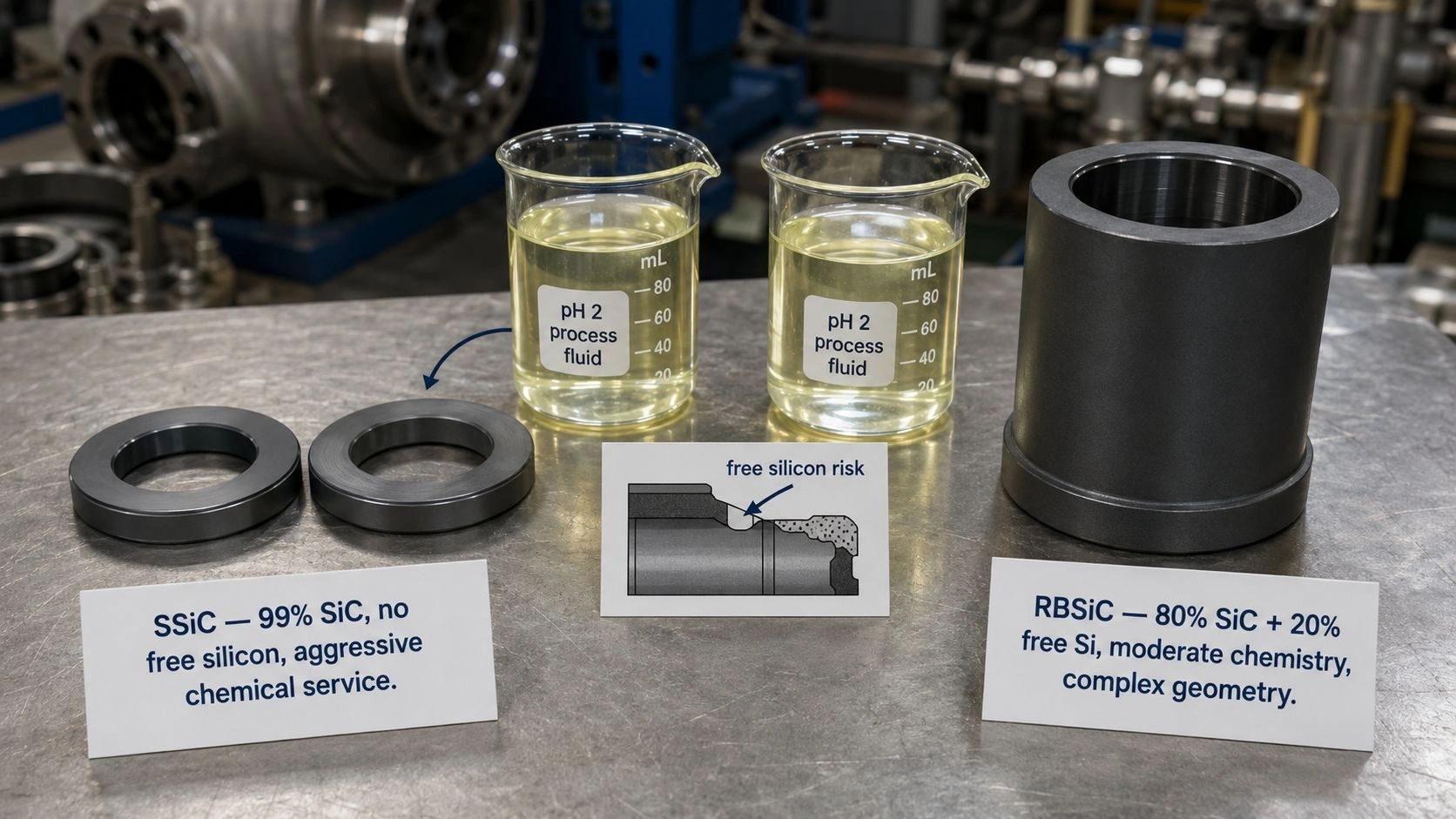
SSiC vs RBSiC selection for mechanical components is controlled by free silicon tolerance in the process medium, sealing duty severity, operating temperature, and component geometry — not by material name; SSiC is preferred for aggressive chemical and severe wear duty; RBSiC can be practical for thermally cycled, complex-geometry, or moderate-chemistry applications where free silicon is compatible.
What is the core difference between SSiC and RBSiC?
SSiC and RBSiC share the same base material — silicon carbide — but differ fundamentally in manufacturing route, resulting microstructure, and the engineering consequences of that microstructure.
SSiC = dense sintered SiC with minimal free silicon. SSiC, pressureless-sintered or direct-sintered silicon carbide, is produced by sintering fine SiC powder with sintering additives under high temperature. The result is a dense, fine-grained SiC body with very high SiC content. ADCERAX's published ceramic-parts grade data lists SSiC at ≥99% SiC content with density in the 3.10–3.15 g/cm³ range, maximum service temperature up to 1600°C, and hardness at approximately 2800 HV. There is no significant free silicon phase in SSiC — the material is essentially single-phase dense SiC throughout the cross-section.
RBSiC = reaction-bonded SiC with residual free silicon. RBSiC, reaction-bonded or reaction-sintered silicon carbide, is manufactured by infiltrating a carbon/SiC preform with molten silicon. The silicon reacts with the carbon to form additional SiC, but unreacted silicon remains in the final material. ADCERAX's ceramic-parts data lists reaction-sintered SiC at approximately 85% SiC and 15% free silicon in one grade formulation, while another RBSiC formulation may show approximately 80% SiC and 20% free Si depending on the manufacturing route. This free silicon phase is distributed throughout the microstructure.
Why free silicon matters in chemical mechanical parts. The free silicon phase is mechanically and physically useful — it reduces dimensional change during manufacture, supports complex near-net-shape forming, and contributes to thermal conductivity — but it has a different chemical resistance profile than SiC itself. Silicon can be attacked by certain chemical media. In aggressive alkaline or acidic environments, the silicon phase may be preferentially dissolved or chemically attacked, compromising the mechanical integrity of the part surface or seal face. This is the fundamental engineering boundary that separates SSiC from RBSiC in aggressive chemical service.
Why manufacturing route affects shape, tolerance, and cost structure. SSiC parts fire with measurable dimensional shrinkage during sintering, which requires pre-compensation in green-body machining or post-fire precision grinding to achieve tight tolerances. RBSiC parts undergo very little net dimensional change during silicon infiltration, which is why complex geometries, larger parts, and near-net-shape designs are often more economical in RBSiC. This practical manufacturing difference is the second major reason for the grade choice in large or geometrically complex mechanical components.
Which grade fits mechanical seals, pump parts, bearings, bushings, valves, and nozzles?
After establishing the material difference, the first-pass grade selection can be made by component duty.
Mechanical seal faces: SSiC first for aggressive fluids and tight sealing duty. For mechanical seal faces — the components that form the precision lapped sealing interface in pumps, compressors, and mixers — SSiC is usually the first grade to evaluate when the process fluid is chemically aggressive, the pH range is wide, the sealing duty is demanding, or the expected service life is long. ADCERAX's SiC seal ring product data lists SSiC with 99% SiC content, 3.10–3.15 g/cm³ density, 2800 HV hardness, high flexural strength, and maximum service temperature up to 1600°C. This combination of density, hardness, and chemical purity provides the surface integrity and long-term stability that precision seal faces require. RBSiC remains a valid choice for mechanical seal faces in fluids where the free silicon content is chemically compatible — and Vulcan Seals confirms that reaction-bonded SiC is an established industrial-standard grade with fine surface finish, strong wear resistance, and thermal shock resistance for a wide range of sealing duties.
Pump bushings and sleeves: choose by media chemistry and sliding contact. In pump wet-end components — shaft bushings, wear sleeves, and thrust washers that operate in direct contact with the process fluid — both SSiC and RBSiC can serve depending on the service medium. For corrosive or pH-variable process fluids, SSiC's absence of free silicon provides a wider chemical safety margin. For more chemically neutral slurries, process water, or mild chemical service, RBSiC can provide adequate chemical resistance alongside good wear resistance and, in larger components, easier manufacturing.
Bearings and wear rings: choose by load, lubrication, and abrasive solids. SiC bearings in magnetic drive pumps and other sealless pump configurations operate submerged in the process fluid, which provides both lubrication and cooling. For oily, abrasive, or chemically complex process fluids, SSiC is generally the more conservative choice. For cleaner, less chemically demanding service, RBSiC can be a practical option.
Valves and nozzles: choose by erosion, geometry, and chemical boundary. Valve trim — seats, discs, and sleeves — and nozzle orifice components see combined erosive and corrosive attack from high-velocity process fluids carrying abrasive particles. For highly corrosive slurries or chemical solutions, SSiC is preferred. For larger nozzle bodies, complex valve geometries, and moderate-chemistry erosive service, RBSiC may be justified on the basis of near-net-shape manufacturing practicality.
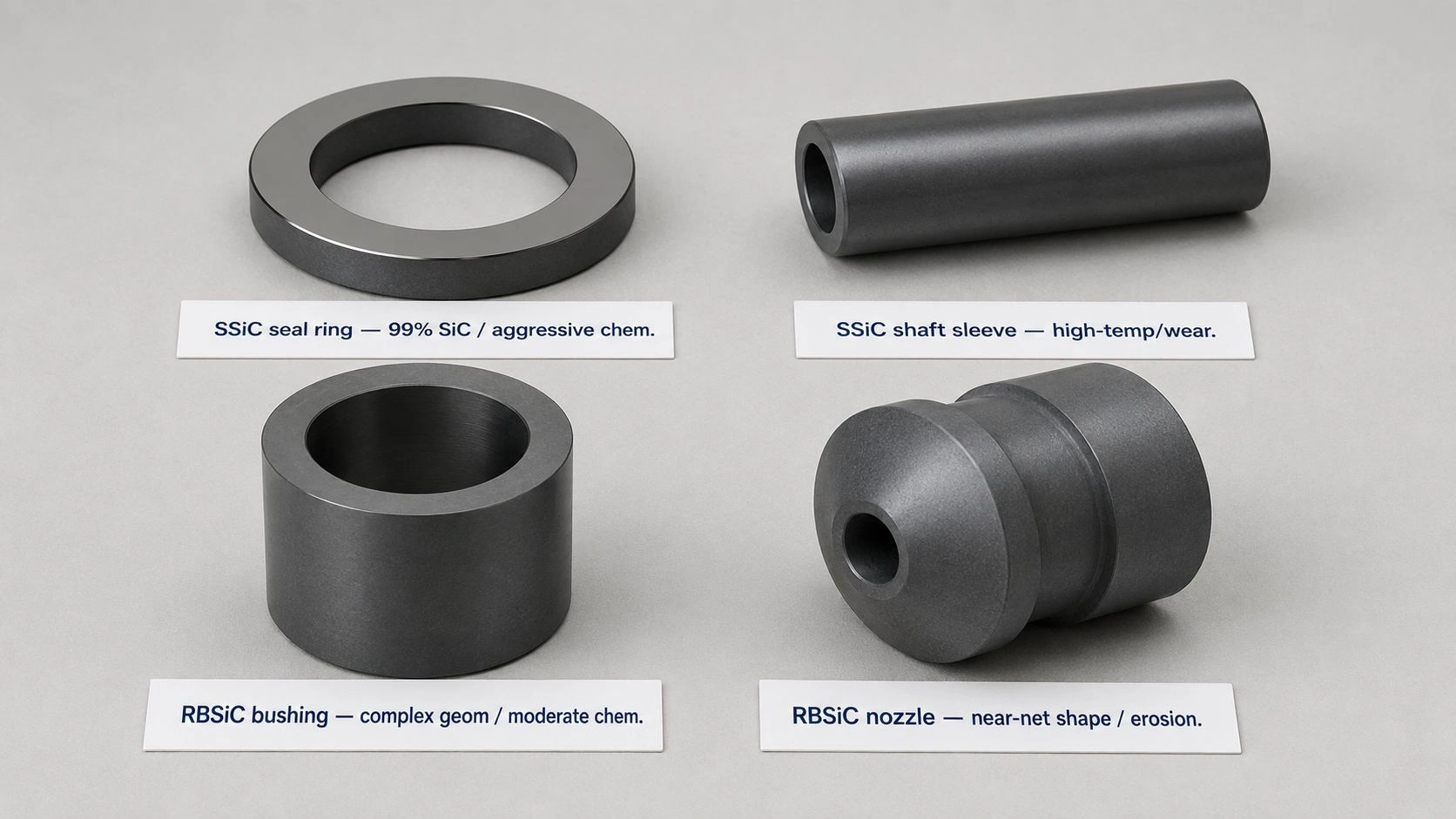
SSiC and RBSiC mechanical components can look similar in finished form, but seal rings, shaft sleeves, bushings, and nozzles should be specified by chemical media, free-silicon tolerance, sealing face requirement, sliding load, erosion mode, geometry, and inspection standard.
The numbered decision rule for quick reference:
- Choose SSiC when strong acids, strong alkalis, aggressive chemicals, tight lapped faces, or high-load sliding contact dominate.
- Choose SSiC when the component requires higher density, higher listed flexural strength, or higher maximum service temperature.
- Choose RBSiC when the component has complex geometry, larger size, or near-net-shape manufacturing value.
- Choose RBSiC when thermal shock resistance and general wear resistance matter, and the chemical medium is compatible with residual free silicon.
- Avoid selecting by grade name alone: confirm media chemistry, pH, temperature, load, speed, lubrication, surface finish, and inspection method.
The Component Grade Selection by Application table maps the first-pass decision:
| Component type | First grade to evaluate | When to consider the other grade | RFQ priority |
|---|---|---|---|
| Mechanical seal face | SSiC | RBSiC if chemistry is compatible and duty is moderate | Flatness, lapping, media chemistry |
| Pump bushing | SSiC | RBSiC for compatible media and larger geometry | Load, speed, lubrication, pH |
| Shaft sleeve | SSiC | RBSiC if thermal shock/geometry dominates | Surface finish, runout, wear mode |
| Bearing component | SSiC | RBSiC for compatible service and complex shape | Load, clearance, mating material |
| Valve trim | SSiC | RBSiC if geometry and media allow | Corrosion, erosion, sealing edge |
| Nozzle | Depends on erosion + chemistry | RBSiC often considered for complex shapes | Media velocity, particles, orifice tolerance |
| Liner/wear insert | Depends on slurry chemistry | RBSiC possible for larger erosion parts | Solids, velocity, pH, mounting method |
The silicon carbide mechanical components page at ADCERAX covers the application routing for SiC mechanical seals, bearings, nozzles, and pump components across SSiC and RBSiC grades. The SiC seal ring page provides the specific grade comparison for seal face applications.
When does RBSiC become risky — or SSiC become necessary?
After the first-pass grade selection, the boundary conditions that can change or restrict the choice must be understood.
Strong acid and strong alkali exposure. The most important boundary for RBSiC in mechanical components is the chemical medium. Mechanical seal engineering literature identifies caustic and strong acid environments as conditions where the free silicon phase in RBSiC can be selectively attacked, weakening the material and contributing to seal performance degradation. INSACO's material-property notes confirm that reaction-bonded SiC has lower hardness and use temperature than direct-sintered SiC, while direct sintered SiC is commonly specified for high-temperature and chemically demanding work. When the process fluid pH is consistently below approximately 2 or above approximately 12, or when the fluid contains strong oxidizers, chlorides in concentration, or reactive organic acids, SSiC is the safer first choice.
High-temperature sliding or sealing contact. At elevated temperatures — above approximately 1000–1200°C depending on the specific RBSiC grade — the free silicon phase may soften, creep, or change its mechanical behavior relative to the SiC matrix. For mechanical components in high-temperature chemical processes, sintering furnace environments, or thermal-cycle-intensive applications, SSiC provides a more consistent high-temperature mechanical profile.
Larger and complex shapes: where RBSiC remains competitive. RBSiC's near-net-shape forming advantage becomes most valuable in large seal faces, complex valve bodies, large nozzle assemblies, or intricate mechanical structures where the cost of post-fire grinding SSiC to tight tolerances becomes significant. When the process chemistry is compatible with free silicon, this manufacturing efficiency can justify RBSiC over SSiC.
The Boundary Matrix maps the key conditions:
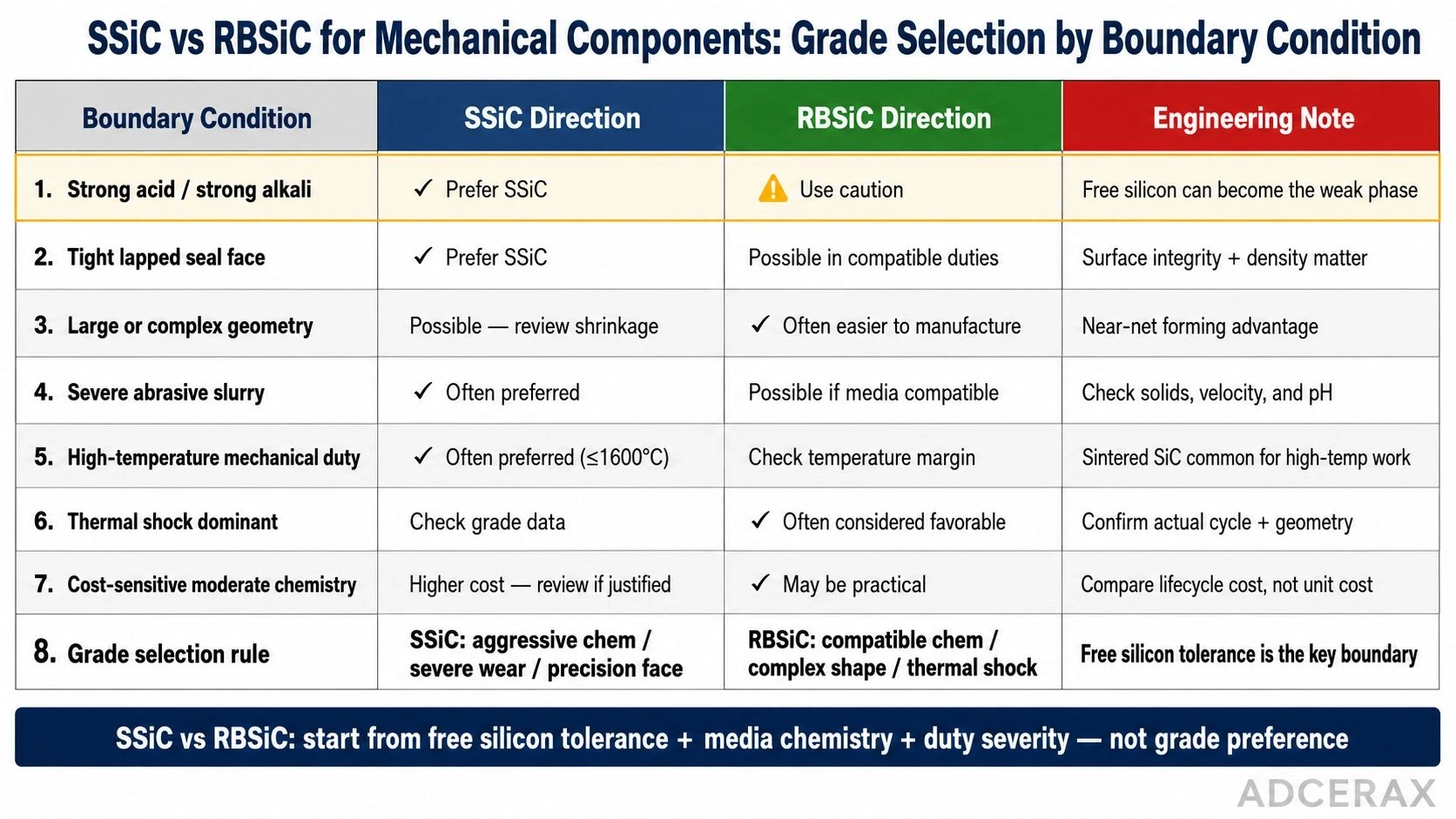
SSiC vs RBSiC grade selection should start from boundary conditions: aggressive chemistry, tight seal faces, severe wear, high-temperature duty, thermal shock, geometry complexity, and cost sensitivity determine whether residual free silicon is acceptable or becomes the limiting phase.
| Boundary condition | SSiC direction | RBSiC direction | Engineering note |
|---|---|---|---|
| Strong acid/strong alkali | Prefer SSiC | Use caution | Free silicon can become the weak phase |
| Tight lapped seal face | Prefer SSiC | Possible in compatible duties | Surface integrity and density matter |
| Large complex geometry | Possible but review shrinkage/tolerance | Often easier to manufacture | Near-net forming can matter |
| Severe abrasive slurry | Often preferred for high wear | Possible for liners/nozzles if media compatible | Check solids, velocity, and pH |
| High-temperature mechanical duty | Often preferred | Check temperature margin | Sintered SiC is common for high-temperature work |
| Thermal shock dominant | Check grade data | Often considered favorable | Confirm actual cycle and geometry |
Values indicative; verify with supplier-specific grade, test data, media chemistry, and drawing review.
The ceramic pump components at ADCERAX covers the wet-end SiC component routing for pump bushings, sleeves, and wear rings in chemical and abrasive slurry service. The ceramic parts and components page provides the detailed SSiC and RBSiC property comparison for custom component review.
Do not misdiagnose grade mismatch as lubrication, lapping, or installation failure
Mechanical component failure is typically multi-cause. Before changing SiC grade, the actual failure mechanism must be correctly identified.
Grade mismatch vs chemical attack. A seal face showing chemical attack — surface roughening, pitting, or progressive material loss at the sealing zone — can come from a wrong-grade selection (free silicon being attacked in RBSiC by an aggressive medium) or from a correct-grade material exposed to a medium outside its specification. The diagnostic difference is whether the attacked phase is the SiC matrix or the silicon phase, which requires surface analysis. When chemical attack is confirmed at a silicon-phase site, the upgrade to SSiC is justified. When attack occurs uniformly on both phases, the issue may be outside both grades' compatibility range.
Grade mismatch vs dry-running damage. Dry running — where the lubricating fluid film breaks down between sliding SiC faces — produces heat, frictional damage, and cracking that can look like material weakness. Changing from RBSiC to SSiC does not prevent dry-running damage if the pump operating conditions allow fluid loss, vapor locking, or cavitation. ADCERAX's SiC seal ring documentation emphasizes that proper fluid film, careful installation, and operating within pump design limits are as important as grade selection for seal longevity.
Grade mismatch vs poor lapping or flatness. Mechanical seal leakage can originate from flatness error, surface roughness mismatch, or improper lapping — problems that affect both SSiC and RBSiC equally and are not resolved by grade upgrade. The correct diagnostic question is whether the sealing faces meet their specified flatness and surface finish tolerances before and after installation.
Grade mismatch vs installation stress. Ceramic components can crack during or after installation from over-tightening, misalignment, holder distortion, or thermal shock during first startup. These failures are installation-design problems rather than material-grade problems. A replacement in the upgraded grade that experiences the same installation conditions will fail the same way.
Why replacement should not copy the old grade blindly. If a component fails in service, the replacement specification should address the identified failure cause, not simply copy the previous part. If chemical attack on free silicon is identified, specify SSiC. If dry-running is identified, address the fluid management and then confirm the grade is appropriate. If lapping quality is identified, address the surface finish specification and inspection protocol.
What to include in an RFQ for SSiC or RBSiC mechanical components
The RFQ Checklist maps the required information for a grade-specific mechanical component specification:
| RFQ item | Why it matters |
|---|---|
| SSiC or RBSiC candidate | Prevents vague ""SiC"" sourcing |
| Fluid chemistry/pH | Determines free-silicon compatibility |
| Solids content and particle size | Controls erosion and abrasion risk |
| Temperature range | Affects grade and thermal margin |
| Sliding speed/load | Controls seal, bearing, and sleeve wear |
| Lubrication condition | Separates material issue from dry-running issue |
| Surface roughness/flatness | Critical for seal faces and sliding contact |
| Drawing and tolerances | Determines manufacturability and inspection |
| Mating material | Controls wear pair compatibility |
| Inspection documents | Confirms density, porosity, grade, dimensions |
A complete RFQ should also include the component type, drawing with all critical dimensions and tolerances, target grade or grade candidates, operating temperature range, fluid or slurry chemistry and pH, solids content and particle size if present, sliding speed and pressure, lubrication state, mating material, required surface finish and flatness, thermal cycling frequency, expected service life, and inspection requirements. For seal faces, specify whether matched lapping, flatness report, and leakage-related tolerances are required. For bushings, sleeves, bearings, and nozzles, define the wear mode, erosion direction, media velocity, mounting method, and edge geometry.
The supplier should confirm material system, SiC content, free silicon content, density, porosity, flexural strength data, chemical compatibility for the stated medium, manufacturability for the specified tolerances, and post-machining inspection scope.
Selecting SSiC or RBSiC for a mechanical component? Share your component type, drawing, fluid chemistry and pH, solids content, operating temperature, sliding speed and load, lubrication state, surface finish requirements, and mating material. ADCERAX can review whether SSiC or RBSiC in the required geometry fits the chemical and mechanical duty, and confirm available material data.
Frequently Asked Questions
What is the main difference between SSiC and RBSiC?
SSiC is sintered silicon carbide with a dense SiC structure and very low free-silicon content. RBSiC is reaction-bonded silicon carbide and typically contains residual free silicon from the infiltration process. ADCERAX's grade data lists SSiC at ≥99% SiC content, while reaction-sintered grades contain free silicon at approximately 15–20% of the final material — and that free silicon phase is the main reason chemical compatibility must be confirmed for each application.
Which is better for mechanical seals: SSiC or RBSiC?
SSiC is usually the first candidate for aggressive fluids, tight lapped faces, high wear, and high-load sealing duty. RBSiC can be suitable for compatible sealing duties where free silicon is not chemically attacked and thermal shock or manufacturing geometry is a significant design concern. Vulcan Seals confirms that reaction-bonded SiC is an established industrial-standard grade with fine surface finish and wear resistance for a range of sealing applications.
Is RBSiC suitable for pump components?
Yes, RBSiC can be suitable for pump bushings, sleeves, and wear components when the fluid chemistry, solids content, load, speed, and temperature are compatible with residual free silicon. INSACO notes that SiC is commonly specified for seal faces and high-performance pump parts, but grade selection should be tied to media chemistry and duty severity rather than assumed from material category alone.
When should SSiC be selected instead of RBSiC?
Select SSiC when the application involves strong chemical exposure, aggressive pH, severe sliding wear, tight sealing surfaces, elevated temperature, or high-load contact duty. INSACO specifically notes that direct-sintered SiC is commonly specified for high-temperature work, and that reaction-bonded SiC has lower hardness and use temperature.
Does free silicon matter in RBSiC?
Yes. Free silicon can become the limiting phase when the process medium can selectively attack silicon rather than SiC. Mechanical seal engineering literature identifies caustics and strong acids as conditions where free silicon attack can degrade RBSiC seal performance.
What data should be requested from a supplier?
Request material system confirmation, SiC content, free silicon content, density, porosity, flexural strength data, maximum service temperature, chemical compatibility data for the stated process medium, dimensional inspection report for critical tolerances, surface roughness and flatness for seal faces, and grade certification.
"