SiC membrane filtration is advantageous for industrial wastewater when the feed contains difficult suspended solids, emulsified oil, colloids, abrasive particles, pH variation, or frequent chemical-cleaning demand that creates unstable operation in polymeric or conventional ceramic membrane systems. SiC's hydrophilic silicon carbide filtration surface supports high water flux, lower fouling tendency, and stronger flux recovery after cleaning. The most relevant applications are not clean-water streams but harsh or variable wastewater feeds where cleanability, membrane uptime, and repeatable separation quality determine system economics more than lowest initial module cost.
The silicon carbide ceramics at ADCERAX — including SiC membrane modules in tubular, flat-sheet, and MBR configurations for industrial wastewater filtration, oil-water separation, and process-water treatment — provide the product context for the application evaluation described in this article.
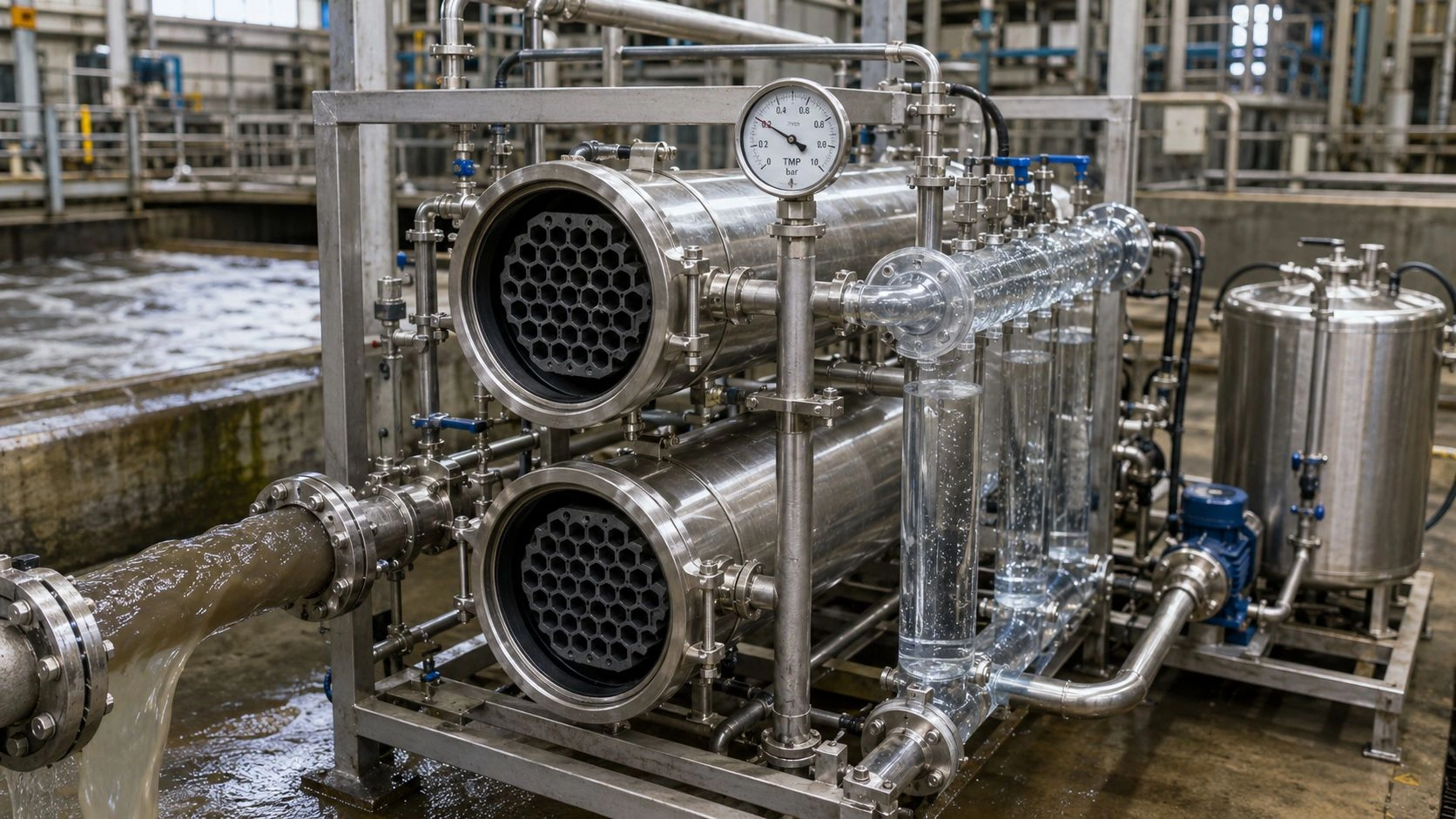
SiC membrane filtration provides advantages in industrial wastewater treatment through high hydrophilicity that reduces oil fouling tendency, ceramic durability that tolerates aggressive chemical cleaning, and stable pore structure that supports repeatable flux recovery under variable industrial feed conditions.
Why SiC membranes are used in industrial wastewater filtration
SiC membranes are selected for industrial wastewater when the combination of ceramic durability and surface hydrophilicity provides better operational stability than polymer-based or conventional oxide-ceramic alternatives can achieve under the same feed and cleaning conditions.
Hydrophilic SiC surface and water flux. Silicon carbide's inherent surface hydrophilicity is the primary material advantage for wastewater filtration. A hydrophilic surface interacts favorably with water molecules, which allows water to preferentially wet the pore walls and membrane face, reducing the ability of hydrophobic foulants — particularly oil droplets and hydrophobic organic matter — to adsorb onto and block the surface. Published review literature on SiC membranes consistently describes the material as highly hydrophilic, with higher water flux and fewer fouling issues compared with polymeric membranes. LiqTech's membrane documentation similarly positions SiC ceramic membranes for higher water flux and fewer fouling problems, attributing these advantages directly to the hydrophilic nature of the silicon carbide surface.
Ceramic structure and cleaning durability. The inorganic ceramic structure of SiC membranes allows them to withstand cleaning conditions that would degrade polymeric membrane materials over time. Strong alkaline cleaning with sodium hydroxide at elevated concentration, acid cleaning to remove mineral scale, and sodium hypochlorite oxidant cleaning for biofouling removal can all be applied more aggressively to SiC than to most polymeric alternatives. This cleaning tolerance is the operational mechanism that translates surface hydrophilicity into practical value: when fouling does accumulate, it can be removed more effectively, restoring a higher fraction of the initial flux with each cleaning cycle.
Low fouling tendency in difficult wastewater feeds. TU Delft research on ceramic membranes for industrial wastewater treatment confirms that SiC membranes show low fouling tendency compared with other ceramic membranes, in addition to the chemical stability, hydrophilicity, and permeability advantages that ceramic membranes generally offer over polymeric alternatives. For industrial wastewater streams that carry variable oil, solids, and chemical loads, this combination of lower initial fouling rate and better cleaning recovery directly translates to longer operating intervals between cleaning events and more stable flux over time.
Stable filtration under changing industrial loads. Industrial wastewater feed conditions are rarely constant. Production schedule changes, batch discharge events, upstream process upsets, and seasonal variations in water chemistry all create the kind of feed variability that challenges membrane systems. SiC membranes' combination of surface properties and structural durability makes them more tolerant of these fluctuations than softer membrane materials whose properties degrade cumulatively under the mechanical and chemical stresses of aggressive cleaning cycles.
When is SiC membrane filtration worth choosing for wastewater?
After establishing the advantage set, the critical engineering question is identifying which industrial wastewater streams actually benefit from those advantages enough to justify the higher capital cost of SiC membrane modules relative to polymeric or alumina alternatives.
Oily wastewater and oil-water separation. When the feed contains emulsified oil, free oil droplets, or mixed oil-solids, SiC membranes are among the most relevant options. Research on oil-in-water emulsion fouling found that SiC-deposited membranes showed low fouling tendency and/or high cleaning efficiency — supporting their potential for oily industrial wastewater. The hydrophilic surface reduces the driving force for oil droplets to adhere to the membrane face, lowering the irreversible fouling fraction that cleaning cannot remove.
High suspended-solids and colloidal wastewater. For secondary wastewater effluent, process water with high turbidity, or streams with fine colloidal particles that conventional clarification cannot fully remove, SiC microfiltration and ultrafiltration membranes provide a stable separation barrier. Published ScienceDirect research on SiC membranes applied to secondary effluent reported high removal of suspended solids and colloidal particles with significant COD reduction — confirming effective performance in the difficult fine-particle range that represents the most challenging separation zone for membrane systems.
Chemically variable or pH-variable streams. Industrial wastewater from chemical manufacturing, metal surface treatment, battery production, and similar processes often involves pH swings between operating batches. SiC's chemical stability across a wide pH range — confirmed by multiple membrane suppliers and research sources — allows the membrane module to tolerate both the feed chemistry and the cleaning chemistry over many operating cycles without the surface degradation that polymeric membranes experience under repeated aggressive cleaning.
MBR upgrades and tertiary polishing. In membrane bioreactor applications where the mixed-liquor suspended solids load is high and biofouling is a persistent challenge, SiC's cleaning tolerance allows more frequent and more aggressive cleaning cycles to maintain flux — which is the limiting performance factor in most MBR configurations. Ovivo's SiC membrane product documentation positions 0.1 µm SiC flat-plate membranes for wastewater applications including suspended solids, oil and grease, heavy metals, and pathogen reduction, confirming the technology's applicability in municipal and industrial MBR contexts.
The numbered decision rule for quick reference:
- Choose SiC membrane filtration when fouling recovery matters more than lowest initial module cost.
- Choose SiC when wastewater contains emulsified oil, fine solids, colloids, or abrasive particles.
- Choose SiC when strong chemical cleaning or repeated backwash is part of normal system operation.
- Choose SiC when polymeric membranes lose flux too quickly under variable industrial loads.
- Choose SiC when stable flux and repeatable regeneration are critical to plant uptime and product quality.
- Do not choose SiC only because it is ""ceramic"" — verify feed chemistry, pore size, module type, TMP, and pilot results.
The Wastewater Conditions Where SiC Membranes Are Most Relevant table maps the main application cases:
| Feed condition | Why SiC helps | Data to collect before RFQ |
|---|---|---|
| Oily wastewater | Hydrophilic SiC can reduce oil-fouling tendency | Oil/grease, droplet size, surfactants |
| High TSS wastewater | Ceramic structure tolerates solids better than many soft membrane systems | TSS, particle size, abrasive content |
| Chemical wastewater | SiC supports wider chemical-cleaning and pH tolerance windows | pH range, cleaning chemicals, oxidants |
| MBR mixed liquor | Low fouling and recoverability support stable submerged operation | MLSS, aeration, flux, TMP |
| Metalworking wastewater | Handles emulsions, colloids, and abrasive residues | COD, oil, particles, coolant chemistry |
| Battery/energy-process wastewater | Useful where solids and chemistry vary by process | Feed variability, pH, conductivity, solids |
How hydrophilicity, fouling resistance, and cleaning recovery create operating value
After identifying best-fit streams, the specific operating mechanisms through which SiC membrane advantages convert to economic value must be understood — because the purchase decision depends on operating cost, not material properties alone.
Hydrophilic surface and oil-fouling reduction. The fouling mechanism for oil-bearing wastewater involves oil droplet adhesion to the membrane surface, followed by coalescence and formation of a persistent oil film that blocks water passage. A more hydrophilic surface creates a thermodynamic barrier to oil adhesion: water preferentially occupies the surface, and oil droplets must displace that water to adsorb — which requires overcoming the hydration energy of the water-surface interface. RSC research on hydrophilic SiC hollow fiber membranes for oil-water emulsion separation confirmed that stronger hydrophilicity produced higher water flux and better anti-fouling performance, with dilute NaOH backwashing achieving approximately 88.3% flux recovery in the reported experiment. This recovery percentage is the number that matters operationally: it determines how much productive flux is retained after each cleaning cycle and over how many cycles the membrane can maintain adequate performance before replacement.
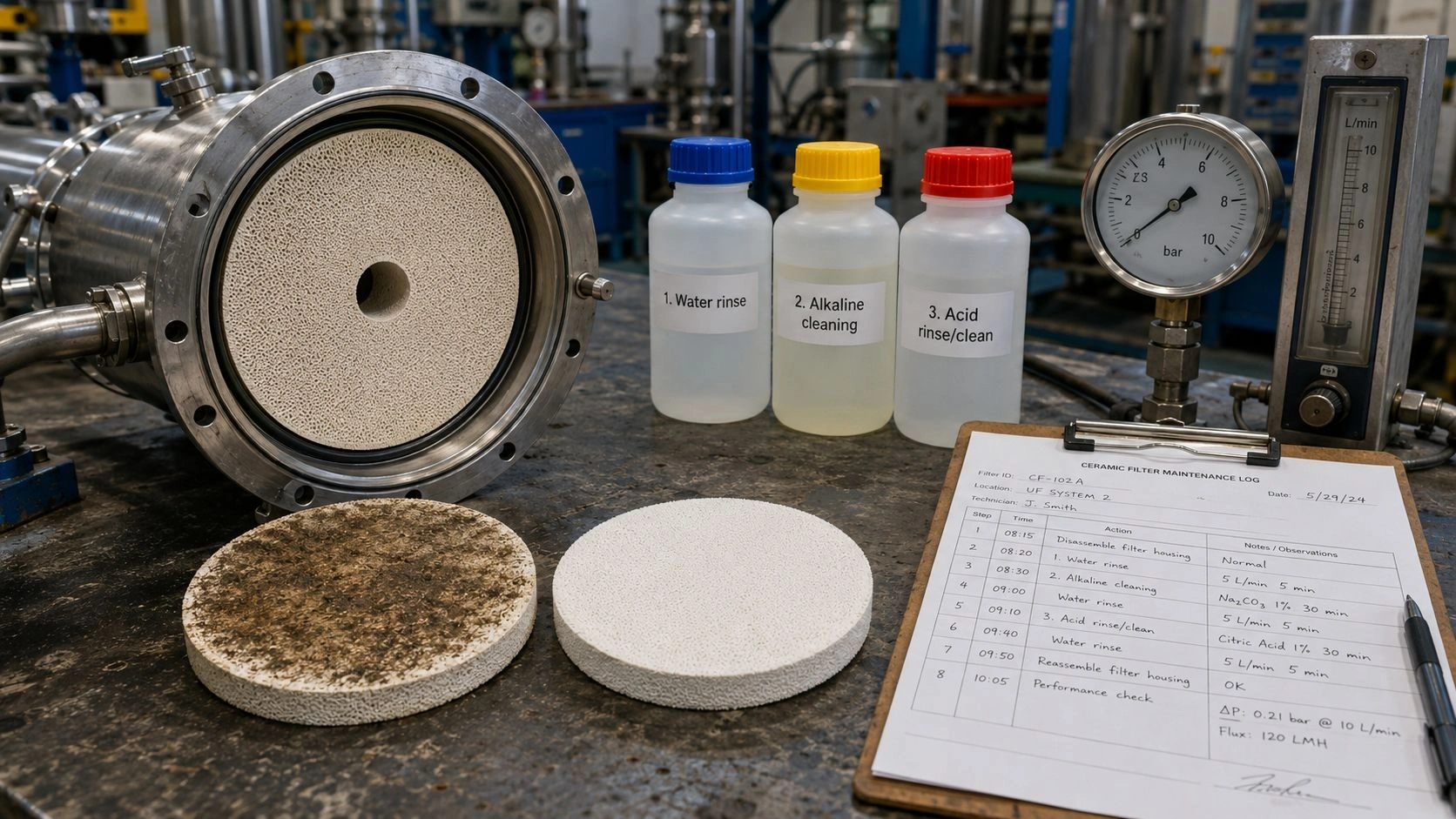
Backwash and chemical cleaning recovery. The fraction of initial flux that is restored by physical backwash, and the fraction that requires chemical cleaning to recover, determines the cleaning frequency and chemical consumption for a membrane system. SiC's tolerance for aggressive cleaning chemistry means that when chemical cleaning is required, the cleaning can be performed at a concentration, pH, and temperature that more completely removes foulants. This is particularly important for biofouling, which builds up slowly and requires oxidant or alkaline cleaning at concentrations that would degrade polymer membranes over time.
TMP stability and flux decline management. Transmembrane pressure is the practical operating metric that determines when cleaning is needed and how well the membrane is performing. A membrane system with lower fouling tendency shows slower TMP rise at constant flux — meaning cleaning intervals are longer and each cleaning restores more flux. For industrial wastewater plants that need to maximize time between shutdowns, this operating characteristic is more economically meaningful than a high initial clean-water flux.
Why cleanability matters more than initial flux. A membrane with lower initial flux but higher flux recovery after cleaning may outperform a higher-initial-flux membrane over a full operating campaign. The correct performance metric for industrial wastewater membranes is not clean-water permeability but sustainable average flux across many fouling and cleaning cycles — which is exactly the metric that SiC's hydrophilicity and chemical cleaning tolerance improve in difficult wastewater service.
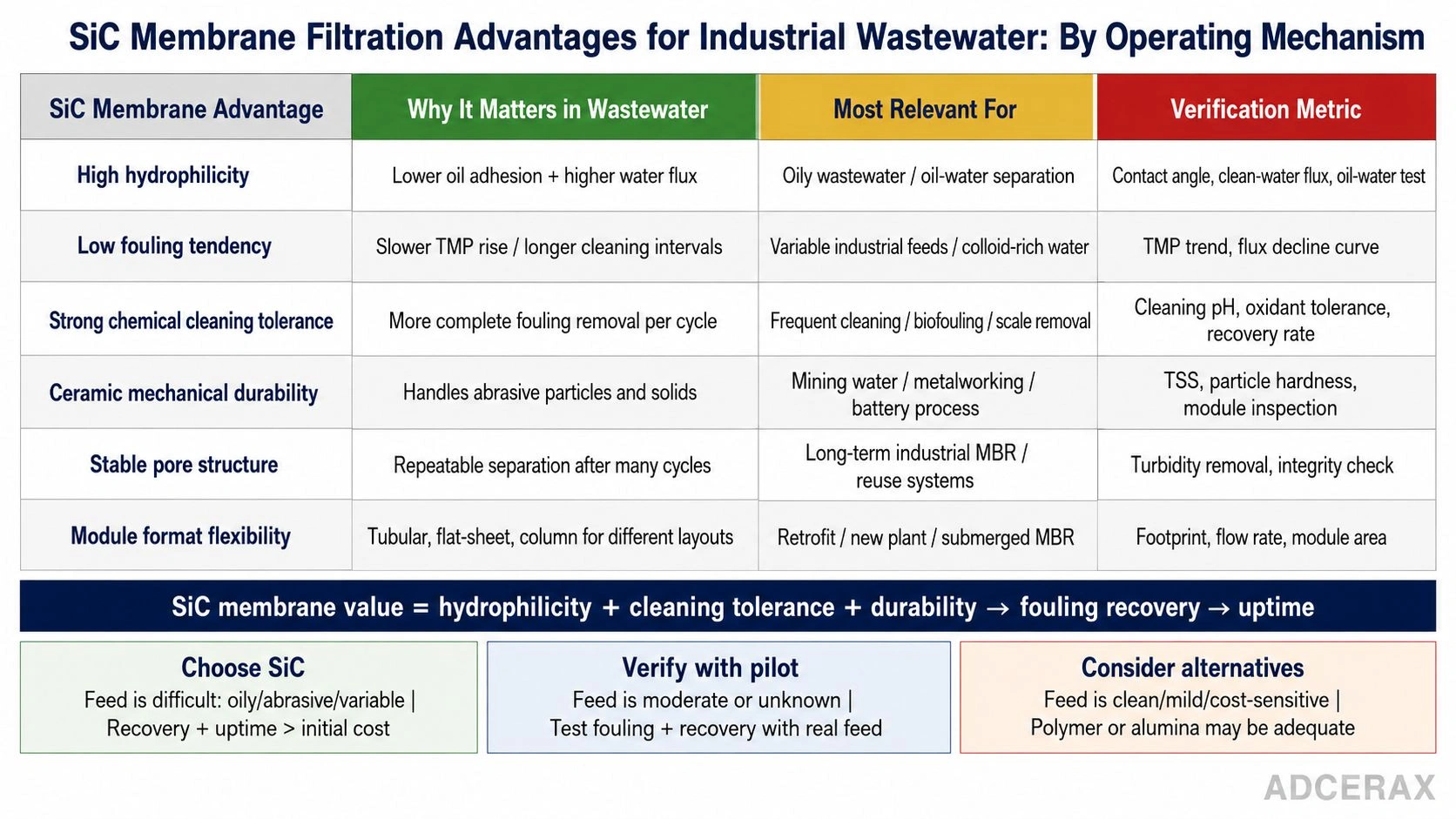
SiC membrane value in industrial wastewater comes from hydrophilicity, cleaning tolerance, ceramic durability, stable pore structure, and module flexibility — the engineering proof should be verified through TMP trend, flux decline, recovery rate, turbidity removal, and pilot operating data.
The SiC Membrane Advantages for Industrial Wastewater summary table maps the advantages to their verification metrics:
| Advantage | Why it matters in industrial wastewater | Verification metric |
|---|---|---|
| High hydrophilicity | Supports higher water flux and lower oil-fouling tendency | Contact angle, clean-water flux, oil-water test |
| Low fouling tendency | Reduces rapid flux decline under difficult feeds | TMP trend, flux decline curve |
| Strong chemical cleaning tolerance | Allows more aggressive recovery cycles than many polymeric membranes | Cleaning pH, oxidant tolerance, recovery rate |
| Ceramic mechanical durability | Helps with abrasive or particle-rich feeds | TSS, particle hardness, module wear inspection |
| Stable pore structure | Supports repeatable separation after cleaning | Pore-size rating, turbidity removal, integrity check |
| Industrial module flexibility | Tubular, flat-sheet, or column formats support different systems | Footprint, flow rate, module area |
The silicon carbide membrane page at ADCERAX covers the tubular SiC membrane and flat-sheet MBR module configurations for industrial wastewater, oil-water separation, and process-water applications. The ceramic membrane page provides the broader ceramic membrane material comparison including alumina, zirconia, and SiC options.
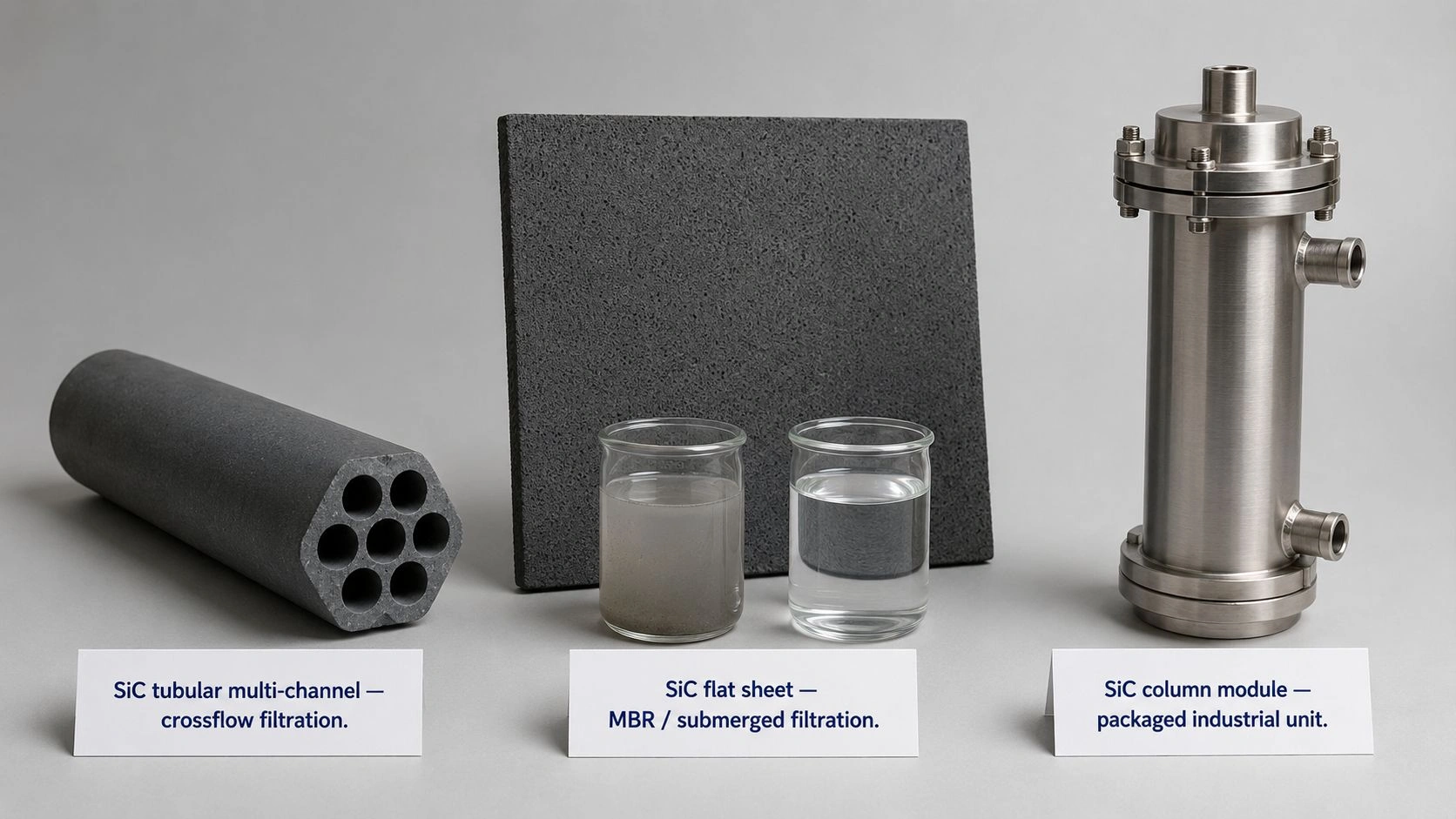
SiC membrane configurations include tubular multi-channel elements for crossflow filtration, flat-sheet membranes for MBR or submerged filtration, and packaged column modules for industrial installations — module format should match flow rate, footprint, solids loading, cleaning strategy, and retrofit constraints.
What SiC membranes cannot fix by themselves
A complete evaluation of SiC membrane advantages for industrial wastewater must include an honest assessment of what the membrane material cannot solve on its own — because over-specifying SiC for a problem that originates in pretreatment, hydraulics, or operating control wastes capital without improving outcomes.
SiC does not replace feed pretreatment. If the wastewater contains large particles, fibrous material, or bulk free oil at high concentration, upstream screening, settling, or coalescing equipment should remove these materials before the membrane stage. A SiC membrane exposed to bulk free-floating oil or large particle loads will foul rapidly regardless of its surface hydrophilicity. The membrane is designed for fine separation, not primary clarification.
SiC does not solve unstable oil chemistry alone. Oil fouling behavior depends strongly on oil droplet size, emulsification stability, and surfactant concentration. When the oil chemistry changes daily — from different cutting fluids, cleaning agents, or batch discharge events — the fouling mechanism changes accordingly. SiC's hydrophilic surface helps reduce adhesion tendency, but it cannot overcome extremely high oil loading or chemically unstable emulsions without appropriate pretreatment and operating-flux control.
SiC does not eliminate scaling control. Mineral scaling from calcium, magnesium, silica, and iron can form on SiC membranes as readily as on other membrane surfaces when the water chemistry and concentration conditions are right. Scaling requires chemistry management — antiscalant dosing, pH adjustment, or acid cleaning — regardless of membrane material. SiC's tolerance for acid cleaning helps with scale removal, but it does not prevent scale formation.
SiC does not make pore-size selection irrelevant. Selecting the correct MF or UF pore size for the target separation is still a critical design decision. A SiC membrane with too large a pore cannot achieve the turbidity or oil reduction target. A membrane with too small a pore may foul more rapidly under high-solids feed regardless of surface chemistry. The pore size must be matched to the particle-size distribution and target permeate quality.
Why pilot testing is necessary for difficult wastewater. The correct diagnostic question when a polymeric membrane system is underperforming is not ""Should we upgrade to SiC?"" but ""Did the old membrane fail because the material was unsuitable for the feed and cleaning, or because pretreatment, hydraulics, operating flux, or cleaning chemistry were not properly controlled?"" A SiC membrane installed without addressing the root cause of the previous failure will show different failure modes but may still underperform relative to expectation.
The porous ceramics and industrial energy equipment ceramics pages at ADCERAX cover adjacent ceramic filtration and process applications for energy-sector wastewater and specialized industrial filtration duty.
What to include in an RFQ or pilot test for SiC membrane wastewater filtration
A SiC membrane evaluation should begin with feed data, not with membrane catalog specifications.
The RFQ/Pilot Test Checklist maps the required information:
| RFQ item | Why it matters |
|---|---|
| Wastewater source | Different industries create different foulants |
| Flow rate and peak flow | Determines module area and hydraulic design |
| pH range | Confirms material and cleaning compatibility |
| TSS/turbidity | Defines solids load and backwash need |
| Oil and grease | Determines fouling risk and pretreatment need |
| COD/organics | Affects fouling and downstream treatment |
| Particle size | Helps choose pore size and module geometry |
| Target permeate quality | Defines separation requirement |
| Flux target | Prevents unrealistic throughput assumptions |
| TMP limit | Protects stable operation |
| Cleaning protocol | Determines recovery and module life |
| Pilot acceptance criteria | Avoids vague ""works well"" evaluation |
For pilot testing, request from the supplier: membrane pore size and surface chemistry, module geometry and effective membrane area, crossflow or submerged operating mode, target flux and TMP operating window, backwash frequency and pressure, chemical cleaning protocol including chemical type, concentration, temperature, and frequency, flux recovery target after each cleaning cycle, and acceptance criteria for the pilot evaluation. The pilot test should run long enough to capture at least three to five complete fouling-and-cleaning cycles with the actual wastewater — including representative peak-load events — not only average or ideal conditions.
Evaluating SiC membranes for industrial wastewater? Share your wastewater source, flow rate, pH range, TSS, oil and grease content, COD, particle size, target permeate quality, flux target, TMP limit, cleaning chemicals, and footprint constraints. ADCERAX can review membrane configuration, confirm flux and pore-size guidance, and propose a pilot-test module for feed-specific evaluation.
Frequently Asked Questions
What are the main advantages of SiC membrane filtration for industrial wastewater?
The main advantages are high hydrophilicity that reduces oil and organic fouling tendency, strong chemical-cleaning tolerance that supports more effective flux recovery, ceramic mechanical durability that handles abrasive and particle-rich feeds, stable pore structure that maintains repeatable separation after cleaning, and module flexibility across tubular, flat-sheet, and MBR configurations. Published review literature confirms that SiC membranes offer higher water fluxes and fewer fouling issues than polymeric membranes in challenging wastewater service.
Are SiC membranes better than polymeric membranes?
SiC membranes can be more suitable when wastewater requires aggressive chemical cleaning, strong fouling recovery, or better tolerance for harsh chemistry and abrasive solids. Polymeric membranes remain appropriate for easier feeds or cost-sensitive systems. The decision should be based on wastewater difficulty, expected cleaning intensity, and lifecycle operation — not on material category alone.
Can SiC membranes remove oil and grease from wastewater?
Yes. SiC membranes are used in oil-water separation and oily wastewater applications. Research on oil-in-water emulsions found low fouling tendency and/or high cleaning efficiency for SiC-deposited membranes, and RSC research on SiC hollow fiber membranes confirmed better anti-fouling performance in oil-water emulsion separation with reported flux recovery after dilute NaOH backwashing.
Why do SiC membranes foul less in oily wastewater?
A primary mechanism is hydrophilicity. More hydrophilic SiC membrane surfaces interact more favorably with water, creating a surface energy barrier to oil droplet adhesion. RSC research specifically reported that stronger hydrophilicity in SiC hollow fiber membranes produced higher water flux and better anti-fouling behavior in oil-water emulsion filtration, confirming that surface wettability is the key mechanism rather than hardness alone.
What pore size is typical for SiC wastewater membranes?
SiC membrane systems are available in both microfiltration and ultrafiltration pore ranges. ADCERAX lists typical nominal pore sizes of 0.02–0.1 µm for SiC membrane configurations, and Ovivo's SiC flat-plate membrane products include 0.1 µm UF-range pore size for MBR and wastewater applications. The correct pore size must be matched to the target separation — particle size distribution, turbidity target, and COD reduction requirements — and confirmed through pilot testing with actual feed.
"