A function-first selection framework for engineers specifying alumina plate thickness by load, span, thermal cycle, flatness, and operating condition — not by maximum available size.
Thickness is the alumina plate specification that most frequently causes problems when it is chosen by instinct rather than engineering logic. A plate that is too thin deflects under load, distorts under uneven support, or chips at edges in handling. A plate that is too thick increases thermal mass, concentrates through-thickness temperature gradients during rapid heating, raises grinding cost, and creates flatness control problems at large area. ADCERAX alumina ceramic plates are available from 0.1 mm thin sheets to 50 mm heavy-duty plates in custom formats up to 1000 × 1000 mm — but that range is only useful if the starting thickness is matched to the actual application requirement. This article builds a five-step decision chain from function to RFQ, covering the trade-offs that determine whether a thin, medium, or thick alumina plate is the right engineering answer.
Choose alumina plate thickness by matching the plate's function, unsupported span, load type, temperature gradient, thermal cycle, flatness requirement, and machining tolerance — not by selecting the thickest available plate. Thin alumina sheets fit electrical insulation, substrate barriers, and low-load separation under compact space constraints. Medium plates in the 3–10 mm range fit general fixtures, wear pads, laboratory supports, and equipment covers. Thick plates in the 10–30 mm range fit setter plates, furnace boards, wear liners, and mechanically loaded supports, but may require reduced heating ramp rates to control through-thickness thermal gradient.
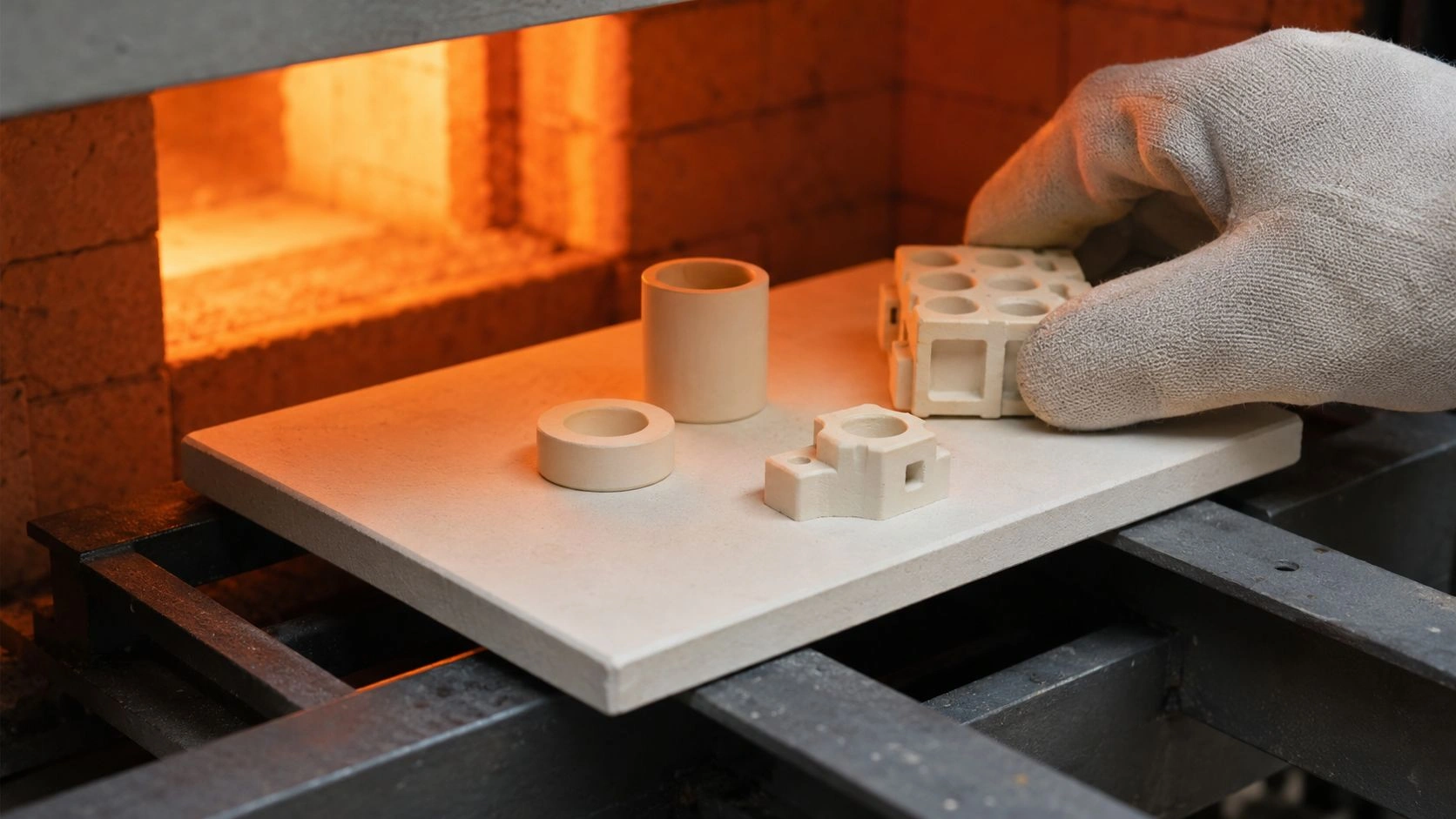
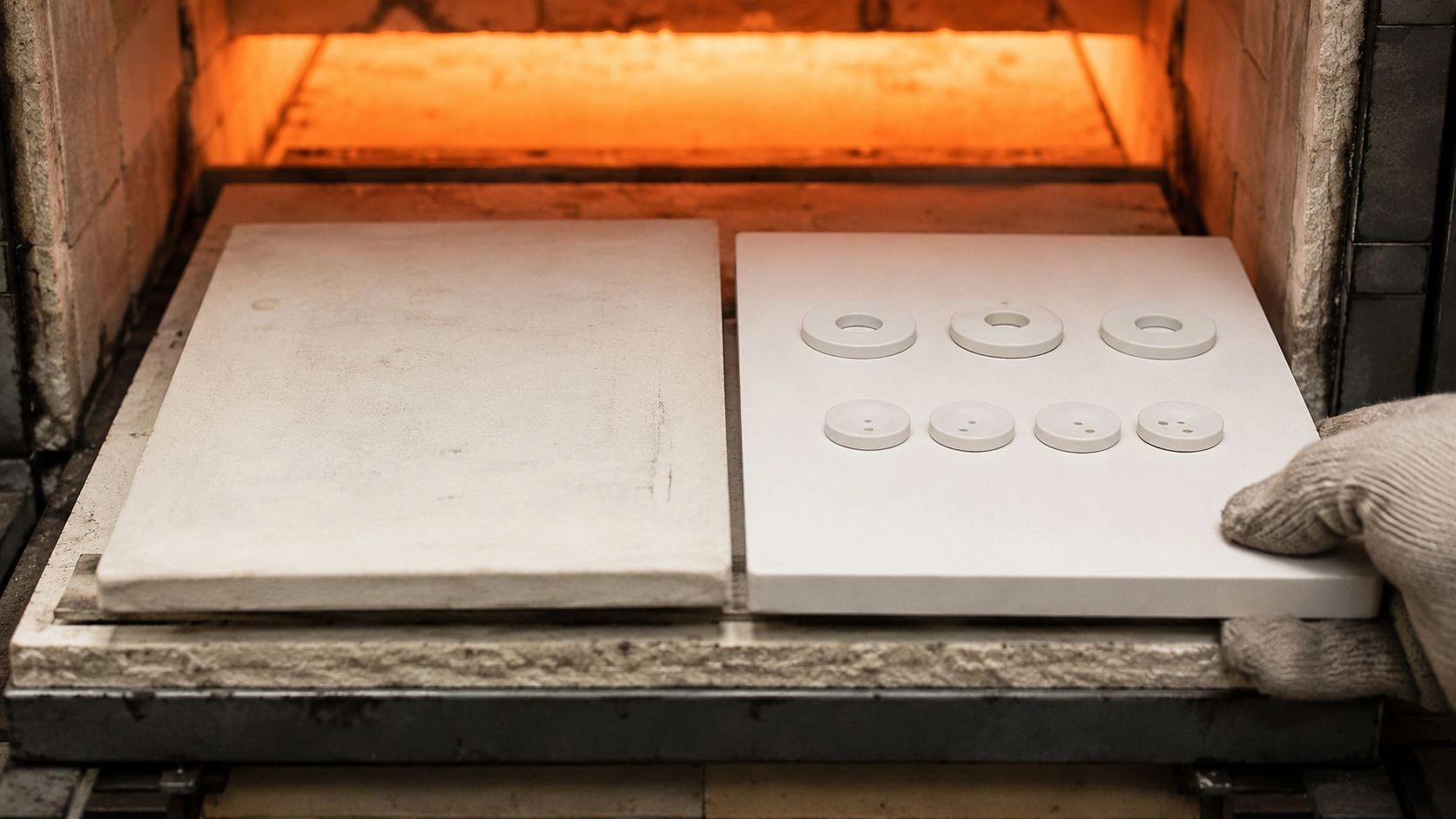
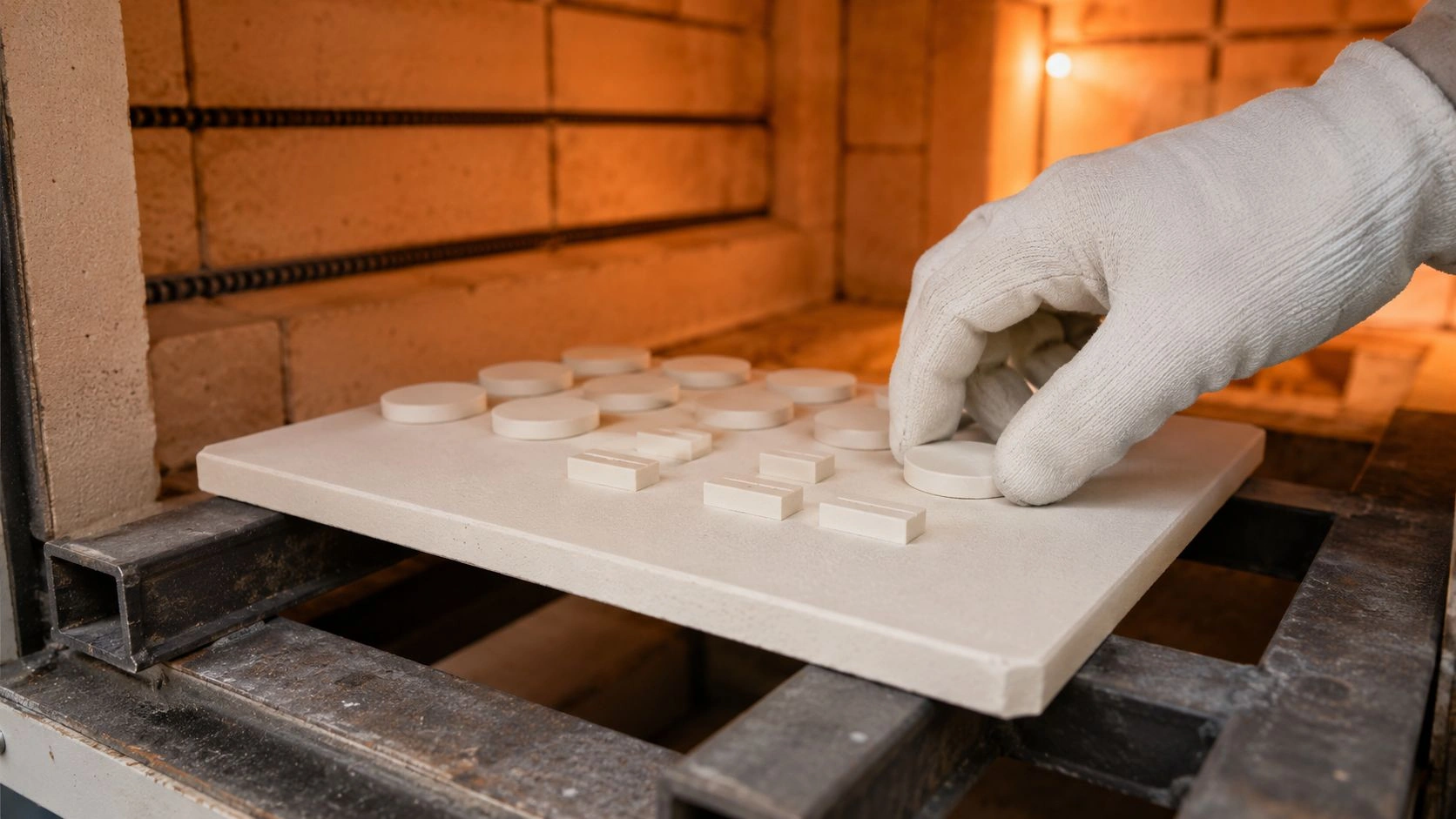
Setter plates and furnace boards represent the upper end of the alumina plate thickness range — where load capacity and thermal stability matter more than minimizing thermal mass.
Do Not Choose Alumina Plate Thickness by ""Thicker Is Safer""
The first correction most engineers need when specifying alumina plate thickness is that thicker is not automatically safer. A thicker plate does provide more bending stiffness, more wear allowance, and more mechanical margin under compression — but it also creates a larger thermal mass, a steeper through-thickness temperature gradient during heating, higher grinding cost, and increased flatness control difficulty at large formats. ADCERAX's alumina plate in high-temperature heating systems article identifies this trade-off precisely: thicker alumina plates increase structural stiffness and load capacity, but intensify through-thickness thermal gradients during rapid heating, and beyond roughly 15–20 mm, allowable ramp rates often need to decrease unless the heating schedule compensates. Thin plates respond thermally faster and occupy less axial space, but they are more sensitive to unsupported span, point loading, handling damage, and flatness deviation. The correct thickness is the thinnest plate that safely meets load, temperature, support, flatness, and lifetime requirements for the specific operating condition.
Thickness raises stiffness but amplifies thermal gradient
Ceramic thermal-shock behavior is geometry-dependent. A thin alumina plate under rapid heating equalizes its through-thickness temperature more quickly than a thick one, which reduces the transient stress difference between surface and core. Recent thermal-shock literature confirms that plate thickness and restraint conditions both affect the critical temperature difference that initiates cracking under thermal cycling. This is why furnace engineers working with setter plates and kiln furniture boards often use the minimum thickness that safely carries the load at temperature — not the maximum available stock. Adding thickness beyond what the load and span require shifts the dominant failure risk from mechanical to thermal.
Thin plates are not inherently fragile
Thin alumina plates — including sub-millimetre sheets down to 0.05 mm — are routinely used in precision insulation and substrate roles where they are well-supported and not exposed to point loading. Their limitation is not absolute strength but structural sensitivity to unsupported span, contact geometry, and edge condition. A 0.5 mm alumina sheet well-supported across its full area will outlast a 3 mm plate installed with point contact at its corners. Thickness specification must therefore be reviewed together with support layout and contact design, not assigned in isolation.
The practical rule
In practice, if a thin or medium plate meets the load, span, and temperature requirement in a correctly designed mounting, the thick plate adds cost and thermal risk without adding reliability. Thickness decisions made without a defined support layout and load path are a common source of over-specification, unnecessary rework, and thermal cracking in commissioning.
Start With the Thickness Range Your Application Requires
The most direct path to a first-pass thickness is function. What the plate does in service determines the starting range; engineering conditions narrow it. ADCERAX's alumina ceramic plates product range spans from ultra-thin insulation sheets at 0.1 mm to heavy-duty support formats at 50 mm, with standard in-stock formats and custom grinding available across the full range. ADCERAX's alumina sheet page separately lists precision thin sheets down to 0.05 mm with tolerance options including ±0.05 mm for high-precision insulation and ±0.20 mm for general wear liners and support pads. Five functional zones cover most alumina plate applications encountered in engineering specification work.
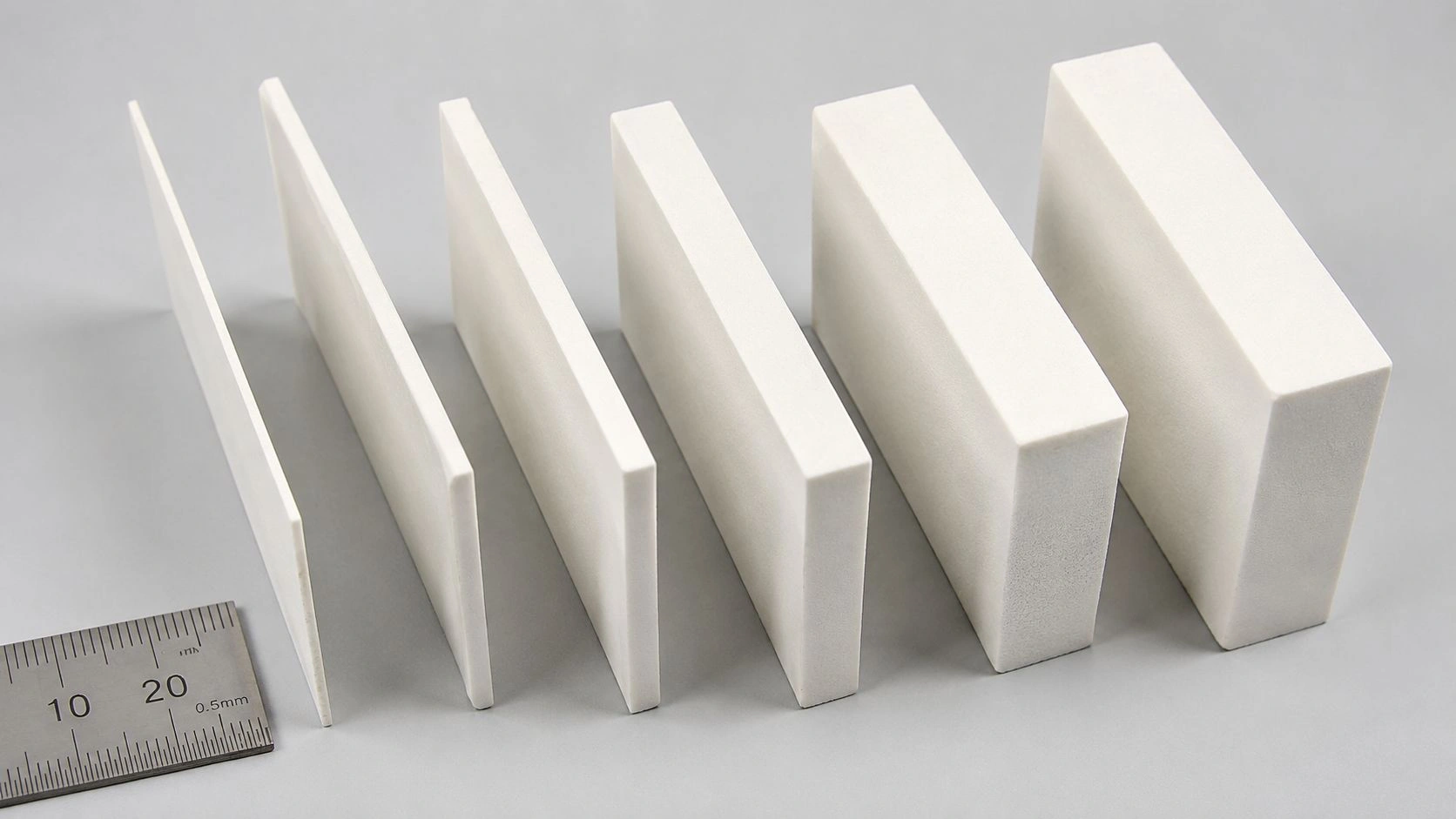
Alumina plate thickness spans more than two orders of magnitude — from sub-millimetre insulation sheets to heavy industrial support plates — and each zone serves a distinct engineering function.
0.05–0.5 mm: precision insulation sheets and substrate barriers
At this thickness, alumina plate functions primarily as an electrical insulation layer, thermal barrier, surface separator, or thin substrate. Mechanical load is minimal or zero. The governing requirements are dielectric performance, flatness, and thickness tolerance, not bending strength. High-purity grades — 99% or 99.5% Al₂O₃ — are more commonly specified in this zone for contamination control and dielectric consistency. The critical RFQ inputs are voltage class or dielectric requirement, thickness tolerance, flatness, and surface finish, along with any precision hole or edge requirement.
0.5–3 mm: insulation plates, covers, and light-duty barriers
This range covers the majority of general-purpose insulation plates, equipment covers, small spacers, and precision electrical barriers. Plates in this zone are routinely ground to close tolerance on both surfaces and used in assemblies where space is constrained. The controlling failure modes shift from dielectric breakdown to edge chipping and handling damage, which means edge chamfer specification and careful support design begin to matter. Both 96% and 99% Al₂O₃ grades are practical in this range depending on whether temperature or contamination drives the purity requirement.
3–10 mm: general fixtures, wear pads, and equipment supports
The majority of industrial alumina plates fall in this zone. Plates at 3–10 mm are stiff enough to carry moderate loads without additional span management, grind cleanly to standard tolerances, and handle routine installation without excessive fragility. Setter plates for lower-temperature firing operations, wear pads in light abrasion contact, laboratory support plates, and equipment fixturing are typical applications. The governing design check is unsupported span versus plate thickness ratio — a 5 mm plate spanning 200 mm under a distributed load behaves very differently from the same plate spanning 50 mm with full perimeter support.
10–20 mm: setter plates, furnace boards, and load-bearing supports
At this thickness, load-bearing capacity and repeat thermal-cycle reliability dominate the selection. Setter plates for batch kiln operations, furnace support boards, and structural support plates in high-temperature equipment are designed in this zone. Alumina at 96–99% Al₂O₃ carries compressive loads above 2,000 MPa in standard property tables, but the practical constraint in this zone is tensile stress from bending, point contact, and thermal gradient — all of which require attention to support layout, load distribution, edge radius, and ramp rate. Specifying ramp rate as a parameter in the RFQ, alongside load and support layout, allows the supplier to confirm whether thickness is adequate or whether the heating schedule needs adjustment.
20–50 mm: heavy-duty wear liners and industrial support plates
ADCERAX's heavy industrial alumina plate format addresses applications where impact exposure, severe abrasion, extended service life, and large contact area dominate. At this thickness, machining time and grinding cost increase significantly, and the flatness of large plates depends on careful specification of parallelism and surface finish tolerance. Edge chamfer or radius becomes more important at heavy plate thickness because sharp corners concentrate stress under mechanical loading and thermal cycling.
Six-step thickness selection guide
- Choose thin alumina sheets (0.05–0.5 mm) when electrical insulation or surface separation is the function and mechanical load is minimal.
- Choose 1–3 mm plates for insulation barriers, covers, spacers, and light-duty electrical and thermal applications.
- Choose 3–10 mm plates for general industrial fixtures, wear pads, laboratory supports, and moderate-load equipment parts.
- Choose 10–20 mm plates for setter plates, furnace support boards, and load-bearing structures under controlled thermal cycles.
- Choose 20 mm+ plates only when wear allowance, impact resistance, or area-load requirements justify the added thermal mass and machining cost.
- Review ramp rate, support layout, edge design, and flatness specification whenever thickness exceeds 10 mm or plate area exceeds 200 × 200 mm.
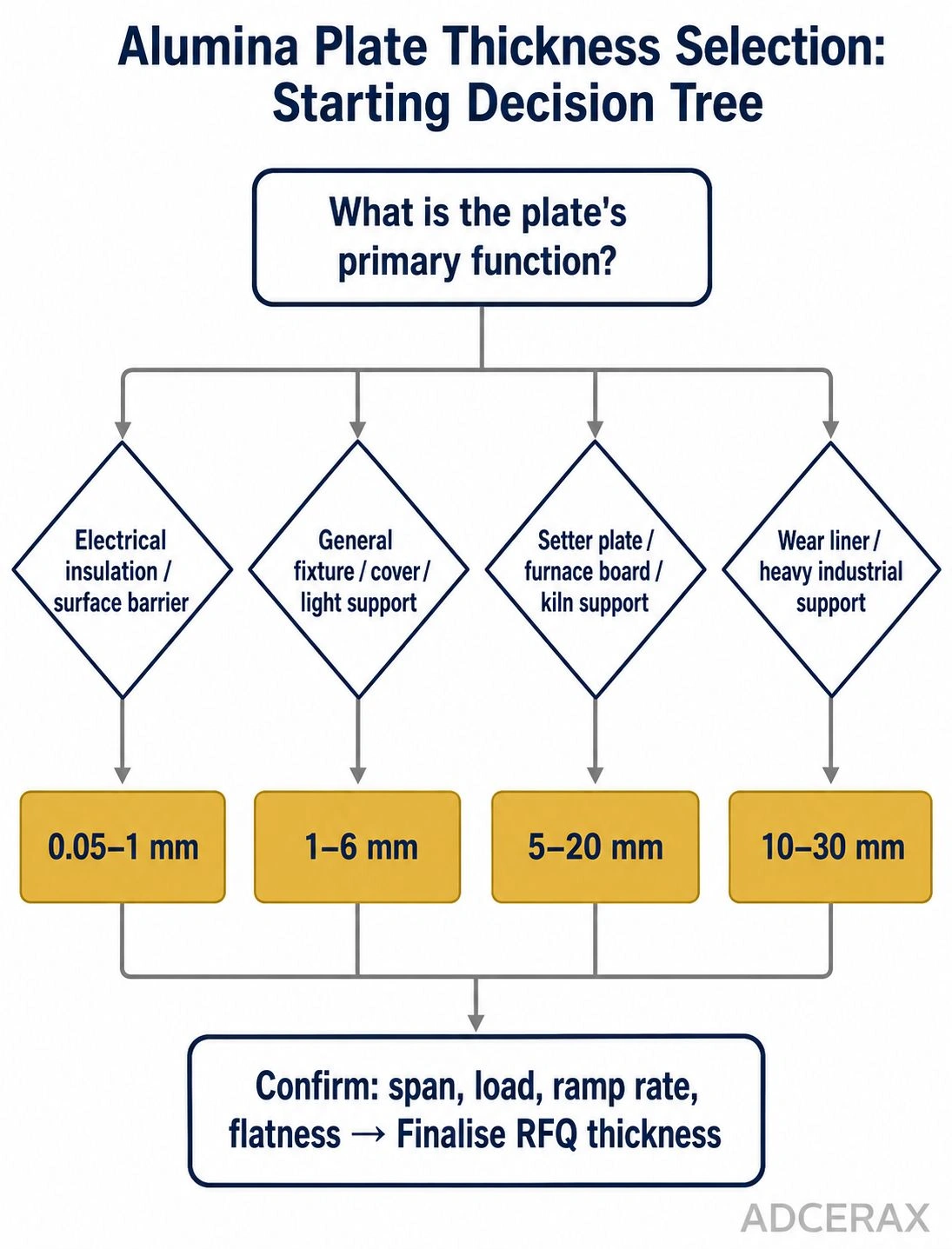
Alumina plate thickness selection starts with function — insulation, fixture, setter, wear liner, or heavy support — and is refined by span, load, and thermal cycle before reaching an RFQ-ready specification.
How Load, Span, Thermal Shock, Flatness, and Tolerance Adjust the Starting Thickness
A starting thickness range identifies the functional zone. Five engineering variables then determine whether to stay in that zone, increase thickness, add support, or redesign the contact condition. This is the section of the specification process most frequently skipped — and most frequently responsible for cracking during commissioning, flatness deviation after installation, or thermal cycling failure in early service. Alumina performs well under compressive load and abrasion, but it is brittle under tensile stress concentration, which means the engineering variables below are not secondary refinements but primary reliability checks.
Choosing alumina plate thickness without specifying the support layout is the structural equivalent of calculating beam deflection without knowing the span. The unsupported length is the parameter that most directly determines whether a selected thickness is safe or undersized — and it is the parameter most commonly absent from first-draft RFQs submitted for ceramic plate quotation.
Unsupported span: the controlling variable most often missed
Span governs bending stress more directly than load magnitude in many alumina plate applications. A 6 mm plate supported continuously on its perimeter carries a significantly higher distributed load than the same plate supported only at four corners. Alumina's flexural strength — measured by standardized testing per ASTM C1161 — gives a material-level ceiling, but the actual safe load is determined by the stress at the section with the largest bending moment, which depends on the support geometry. For long or wide plates, the first design check should be whether a thicker plate or a tighter support grid resolves the deflection risk more efficiently.
Load type: distributed, point, clamp, and impact loads behave differently
Distributed load across a well-supported alumina plate is accommodated by relatively thin sections. Point load, edge clamp stress, or impact introduces stress concentration at the contact zone that alumina cannot redistribute plastically. Engineering experience in thermal process equipment and furnace fixture specification reviews indicates that brittle ceramic failures at mounting points are disproportionately caused by small contact areas and inadequate chamfer design rather than by material-grade limitations. A practical specification check for any clamped or contact-loaded alumina plate is to confirm that the contact stress, bearing surface area, and edge radius are defined before the thickness is finalised.
Thermal shock: why ramp rate and thickness interact
Thermal shock resistance in ceramics depends on the thermal gradient generated across the section during heating or cooling. Thicker sections take longer to reach temperature equilibrium, producing a higher transient stress between the hot surface and the cooler core. For alumina plates used in furnace or kiln service, this means the allowable ramp rate decreases as thickness increases. Ceramic Solutions notes that reducing plate thickness can improve the critical thermal-shock temperature difference, providing a secondary validation that thinner is often better when thermal cycling frequency is high. ASTM C1525 provides a standard test framework for evaluating thermal shock resistance, and its parameters — temperature differential and cycle count — translate directly to ramp rate and operating schedule in service. The practical implication is that a thick setter plate running a rapid thermal cycle may need a slower firing schedule, not a thicker plate.
Flatness: the tolerance that often controls thickness choice for precision applications
Large thin alumina plates can be difficult to hold flat during grinding and may exhibit spring-back or residual warp after sintering. Very thick plates may require extended grinding time and careful parallelism control to reach a specified flatness value across a large surface area. Edgetech property tables list alumina plate flatness and surface finish capabilities, and the combination of area, thickness, and flatness tolerance determines whether standard stock grinding or custom lapping is required. For precision flat plates used in semiconductor processing, battery manufacturing, or instrumentation base plates, the flatness specification often drives the minimum usable thickness as much as the load does.
The following table consolidates these variables into an engineering decision reference
Values indicative; verify against supplier-specific grade, drawing, support condition, and application testing.
| Application Condition | Thickness Direction | Engineering Reason | Key RFQ Input |
|---|---|---|---|
| Electrical insulation, minimal load | Thinner (0.05–1 mm) | Thermal response and space saving | Voltage class, tolerance, surface finish |
| Large unsupported span | Thicker or add support points | Reduces bending stress | Span, load magnitude, support layout |
| Point load or clamp contact | Thicker or redesign contact area | Limits local stress concentration | Contact area, bearing pad design, edge radius |
| High-frequency thermal cycling | Avoid unnecessary thickness | Thinner sections equalize temperature faster | Ramp rate, cycle count, temperature range |
| Setter plate / furnace board | 5–20 mm, application-specific | Balances load, span, and thermal cycle | Load, firing schedule, support conditions |
| Heavy wear liner / industrial plate | 10–30 mm | Wear allowance and impact margin | Abrasion rate, impact severity, backing |
| Precision ground flat plate | Thickness depends on flatness | Grinding stability and parallelism control | Flatness, parallelism, tolerance class |
| Large-format structural plate | Thickness depends on span and deflection limit | Area-load interaction governs bending | Area, support grid, allowed deflection |
Values indicative; verify with supplier-specific grade data, support geometry, thermal cycling conditions, and applicable standards including ASTM C1161 (flexural strength) and ASTM C1525 (thermal shock).
Avoid These Alumina Plate Thickness Selection Mistakes
The most common thickness selection error is specifying the heaviest available plate because it appears more conservative. In thermal process service this logic reverses: excessive thickness concentrates gradient stress during heating and may require a slower ramp rate that the production schedule does not allow. ADCERAX's heavy industrial alumina plate resource identifies compressive strength above 2,000 MPa and flexural strength in the 250–400 MPa range as typical engineering values for thick alumina plates, while also emphasising that tensile stress at mounting points and edge-radius control are the actual reliability factors in service — a reminder that bulk strength numbers do not substitute for contact and mounting design. CoorsTek's alumina material characterisation and Edgetech's alumina plate property data both confirm that alumina performs well in compression but requires careful design at tension-loaded edges and interfaces.
Mistake 1: choosing maximum thickness as a safety margin
Thickness beyond what the load and span require adds grinding cost, increases thermal mass, and concentrates gradient stress during heating. An engineering specification review for industrial furnace setter plates consistently shows that the plates most prone to thermal-cycle cracking are over-thickness parts installed in applications that were originally designed for a thinner format — often because a procurement decision substituted the only available stock thickness.
Mistake 2: ignoring unsupported span
A 5 mm plate spanning 300 mm with four-corner support carries a fraction of the bending load of the same plate with full-perimeter support. Span is the most frequently absent parameter in first-draft ceramic plate RFQs, and it is the parameter that most directly determines whether a selected thickness will survive under load. Span should be specified in the RFQ, not inferred from the plate's outside dimensions.
Mistake 3: using thickness to compensate for poor mounting design
Point contact, sharp bearing edges, misaligned mounting surfaces, and over-torqued fasteners cause stress concentration that thickness alone cannot resolve. Alumina does not yield plastically to redistribute stress — every load path must be designed explicitly. Increasing thickness from 10 mm to 15 mm on a plate that fails at a clamping point does not solve the problem; redesigning the clamp pad area does.
Mistake 4: applying tight tolerance across the entire plate surface
A thickness tolerance of ±0.05 mm applied to a 300 × 300 mm plate requires precision lapping and significantly raises cost and lead time. Tight tolerance is appropriate for the functional contact surfaces of precision insulation plates and substrate-type applications. For furnace boards, setter plates, and wear liners, ±0.20 mm or ±0.30 mm is usually adequate and reduces manufacturing risk. Specifying tolerance by zone — tighter on the contact face, looser on the non-critical back surface — allows the supplier to optimise the grinding sequence without over-engineering the part.
Mistake 5: copying a previous thickness without checking the new application condition
A thickness that worked reliably in a batch kiln at a 3°C/min ramp rate may crack in a continuous furnace running at 8°C/min with the same nominal load. Process changes, equipment changes, and production-rate increases frequently change the effective thermal and mechanical load on an alumina plate without triggering a formal material review. When an alumina plate that previously performed well begins cracking after a process change, the root cause is almost always a change in ramp rate, support condition, or load path — not a change in material quality.
What to Include in an RFQ for Alumina Plate Thickness
A supplier-ready alumina plate specification gives the manufacturer enough information to confirm material route, grade, grinding sequence, tolerance class, and service suitability in one round. For thickness-critical applications, the RFQ must go beyond the three dimensions. ADCERAX's alumina ceramic material routing and industrial ceramic plates comparison page both confirm that plate selection involves purity grade, flatness class, and application function — not only length, width, and thickness.
The following checklist covers the fields that most frequently require clarification in ceramic plate procurement.
- Plate function: insulation barrier, fixture, setter plate, wear liner, furnace board, or structural support — determines which failure mode governs thickness adequacy.
- Dimensions: length × width × target thickness; for custom formats, provide the maximum area and any area constraint.
- Thickness tolerance: specify per surface zone where possible — tight on functional face, standard on back face.
- Flatness: overall flatness value and reference surface; distinguish seating flatness from surface finish.
- Alumina purity: 96%, 99%, 99.5%, or 99.7% Al₂O₃; specify if contamination control, dielectric class, or service temperature drives the grade.
- Operating temperature: continuous service temperature and peak temperature; note whether oxidising, reducing, or vacuum atmosphere.
- Thermal cycle: ramp rate in °C per minute, dwell temperature, cooling rate, and cycle frequency.
- Load and span: load magnitude, load type (distributed, point, or line contact), and unsupported span or support layout.
- Surface finish: Ra value for functional surfaces; distinguish contact surfaces from structural surfaces.
- Edge geometry: chamfer radius or edge break requirement; critical for plates under bending or impact loading.
- Holes, slots, or features: any machined feature adds crack-initiation risk and must be specified with corner radius.
- Chemical exposure: acid, alkali, solvent, or process atmosphere that contacts the plate surface.
- Expected service life or cycle count: allows the supplier to evaluate whether the specified thickness provides adequate margin.
Specifying only length, width, and thickness without load, span, ramp rate, and flatness is the most consistent reason that alumina plate quotations return at widely different specifications. Two suppliers quoting from the same three-dimension request may propose 6 mm and 15 mm plates for the same application — both technically defensible, neither matched to the engineering requirement.
Conclusion
Alumina plate thickness is an engineering trade-off, not a safety margin to maximise. The correct thickness is the thinnest section that meets load, span, temperature gradient, flatness, and service-life requirements under the actual operating and support conditions. Thin plates fit insulation and substrate roles efficiently; medium plates cover the broad range of industrial fixtures, wear pads, and equipment supports; thick plates deliver the bending stiffness and wear allowance that setter plates and heavy industrial liners require — but at the cost of increased thermal gradient sensitivity and machining complexity.
The selection mistake that most reliably produces early failure is choosing thickness without defining the support layout and ramp rate. Both of those inputs belong on the drawing before the thickness is confirmed, not in a follow-up clarification after the first cracked plate arrives.
Ready to confirm the right alumina plate thickness for your application? Share your plate function, dimensions, load condition, temperature, and ramp rate with ADCERAX's engineering team. We will review your support layout, propose a thickness and grade, and confirm whether standard stock or custom grinding is the right starting point for your RFQ.
FAQ
How thick should an alumina plate be for most industrial applications?
Thickness depends on function, unsupported span, load type, thermal cycle, and flatness requirement. General industrial fixtures and equipment supports typically fall in the 3–10 mm range. Setter plates and furnace boards commonly use 5–20 mm. Heavy wear liners and structural support plates may extend to 20–30 mm. Thin insulation sheets operate reliably at 0.5–3 mm when support and load conditions are controlled. There is no universal correct thickness without specifying the operating condition.
How does alumina plate thickness affect thermal shock resistance?
Thicker plates generate steeper through-thickness temperature gradients during rapid heating or cooling, which increases transient tensile stress at the surface and core. Thinner plates equalise temperature faster and generally tolerate higher ramp rates. ASTM C1525 is the standard framework for evaluating ceramic thermal shock resistance; its critical temperature differential parameter translates directly to ramp rate and cycle frequency in service. For furnace setter plates and kiln boards in high-frequency cycling applications, selecting the minimum thickness that meets the mechanical load requirement is better practice than over-sizing thickness.
What alumina plate thickness is suitable for electrical insulation applications?
Electrical insulation plates typically use 0.5–3 mm thickness for barrier and standoff roles, and sub-0.5 mm sheets for precision substrate-type separators. The governing specification is the dielectric strength or volume resistivity class required at the operating temperature and voltage. High-purity grades — 99% or 99.5% Al₂O₃ — are more commonly specified in precision insulation applications for consistency and contamination control. Thickness tolerance and flatness are usually tighter requirements than bulk thickness in this application zone.
What is the most common alumina plate thickness selection mistake?
Choosing the thickest available plate as a safety margin is the most frequent error. In thermal process service, excessive thickness intensifies through-thickness temperature gradients and may require slower ramp rates to prevent cracking. The second most common mistake is specifying thickness without defining unsupported span and support layout — the two inputs that most directly determine whether a selected thickness is structurally adequate. Both errors are correctable by treating thickness as one variable in a support-and-loading system, not as an independent safety factor.
What dimensions and tolerances should be specified for custom alumina plates?
A complete specification includes length, width, and thickness with per-zone tolerance (tight on functional surfaces, standard on non-critical surfaces), overall flatness, surface finish Ra, edge chamfer or radius, any machined holes or slots with corner radii, alumina purity grade, and operating temperature. Thickness tolerance of ±0.05 mm requires precision lapping and is appropriate for insulation and substrate applications. General wear liners and furnace boards typically use ±0.20–0.30 mm, which allows standard surface grinding. Flatness specification should reference the seating surface explicitly, not apply a single flatness value to both faces unless both faces are functional contact surfaces."