A grade-selection framework for engineers specifying alumina plate purity by application risk, operating temperature, insulation requirement, contamination sensitivity, and verification need — not by percentage alone.
The instinct to specify the highest available alumina purity is understandable but frequently wrong. A 99.7% alumina plate carries tighter impurity control, higher density, and better high-temperature stability than a 96% plate — but it also costs more, may require longer lead time, demands material certificate documentation, and provides no measurable benefit when the application's actual risk is moderate-temperature insulation or general wear resistance. The more consequential error runs in the other direction: specifying 96% alumina for a contamination-sensitive setter plate or a high-cycle thermal fixture, where impurity-phase reactions at the surface become the rate-limiting factor in plate service life. ADCERAX supplies alumina ceramic plates in 96%, 99%, 99.5%, and 99.7% Al₂O₃ for a range of industrial insulation, wear, and high-temperature applications. This article builds the engineering decision chain that maps each grade to the conditions that actually justify it.
Choose 96% alumina plates for general industrial insulation, wear resistance, fixtures, and support plates where requirements are moderate and contamination risk is low. Choose 99% alumina plates when higher temperature stability, better electrical performance, greater chemical stability, or cleaner service conditions are required. Choose 99.7% alumina plates for high-temperature, contamination-sensitive, precision, or repeated thermal-cycle applications where impurity control and stable high-temperature performance matter more than the cost of over-specification.
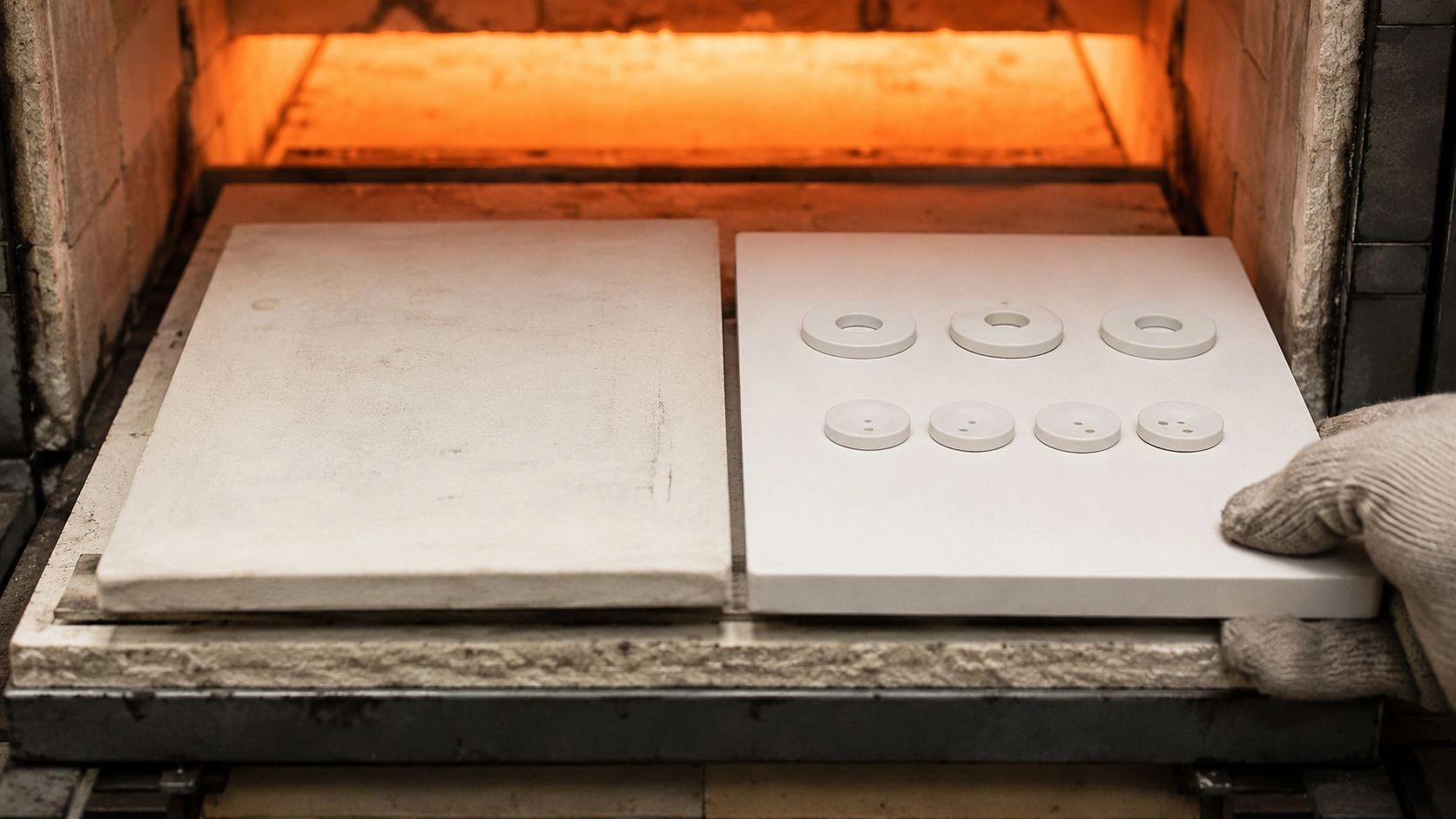
The grade decision is driven by what the plate's operating condition actually demands — contamination-sensitive firing, precision electrical insulation, and repeated high-temperature cycling each define a measurable purity requirement that should appear in the specification before the purchase order.
What Changes When Alumina Plate Purity Increases From 96% to 99% to 99.7%?
The difference between 96%, 99%, and 99.7% alumina plates is not simply a higher number on a certificate. Higher purity means a lower proportion of sintering additives, glass-phase binders, and impurity oxides — primarily silicates, magnesia, and calcia — that remain in the fired microstructure. That reduction in secondary-phase content affects high-temperature mechanical stability, dielectric consistency, chemical surface reactivity, and contamination transfer in ways that are measurable in service but invisible in a room-temperature inspection. ADCERAX describes alumina ceramics as available from 96% to 99.9% purity, with higher-density and higher-purity grades used where wear resistance, dimensional accuracy, and thermal stability are more demanding. The practical direction, confirmed across supplier data, is that increasing purity generally improves high-temperature strength retention, dielectric strength, volume resistivity, and surface chemical cleanliness — but at the cost of narrower grade availability, tighter specification control, and higher unit cost.
Impurity phase: the mechanism behind the grade difference
A 96% Al₂O₃ plate contains roughly 4% of secondary phases — glassy silicate binders and sintering aids — distributed at grain boundaries. At moderate temperatures these phases are stable and contribute to the plate's practical machinability and cost efficiency. At higher temperatures, or in contact with reactive atmospheres or sensitive fired materials, these boundary phases can soften, volatilise, or react with the product surface. A 99% or 99.7% plate reduces this glass-phase fraction substantially, narrowing the window for surface reactivity. IQS Directory's alumina ceramic overview confirms that grade formulation — whether 96%, 99%, or 99.9% — influences final physical properties including mechanical strength, wear resistance, electrical insulation, and thermal conductivity, with the interaction between grade and processing route determining actual service properties.
Density, microstructure, and high-temperature behaviour
Higher purity alumina plates are typically denser, with a finer and more uniform grain structure. Supplier property tables — including Stanford Advanced Materials' comparison data — show the characteristic direction: density, flexural strength, hardness, dielectric strength, and continuous-use temperature ceiling generally increase from 96% through 99.5%/99.9%. These are indicative supplier-reported trends, not certified universal guarantees, and actual values depend on the specific sintering route and forming method. The engineering implication for plate selection is that 99% and 99.7% grades provide more thermal and electrical margin than 96%, which gives them a larger safety buffer in applications where the operating condition approaches the grade's performance ceiling.
Why higher purity is not automatically better
The glass phase that higher purity eliminates is also what makes 96% alumina more forgiving in machining, more broadly available from stock, and lower in cost per unit area. In applications where surface cleanliness is not a risk, where operating temperature is well within the 96% grade's capability, and where dielectric performance does not approach the grade boundary, the glass phase does not cause problems. Specifying 99.7% alumina for a general equipment spacer or low-temperature insulation plate adds certificate burden, narrows the supplier pool, and provides measurable benefit only if the application can actually detect the difference.
Which Grade Should You Choose: 96%, 99%, or 99.7% Alumina Plate?
Grade selection follows application risk, not purity ranking. ADCERAX's alumina ceramic plates product range supports all four grades — 96%, 99%, 99.5%, and 99.7% Al₂O₃ — and the choice between them should be traceable to a specific operating condition that the lower grade cannot reliably meet. A grade decision that cannot be explained in terms of temperature, insulation margin, contamination risk, or documentation requirement is a candidate for over-specification review. Ceramic PCB material guidance independently confirms that 96% alumina suits standard applications and higher-purity grades serve higher-performance needs, with the explicit note that higher purity is not necessarily better — the key is matching grade to application requirements.
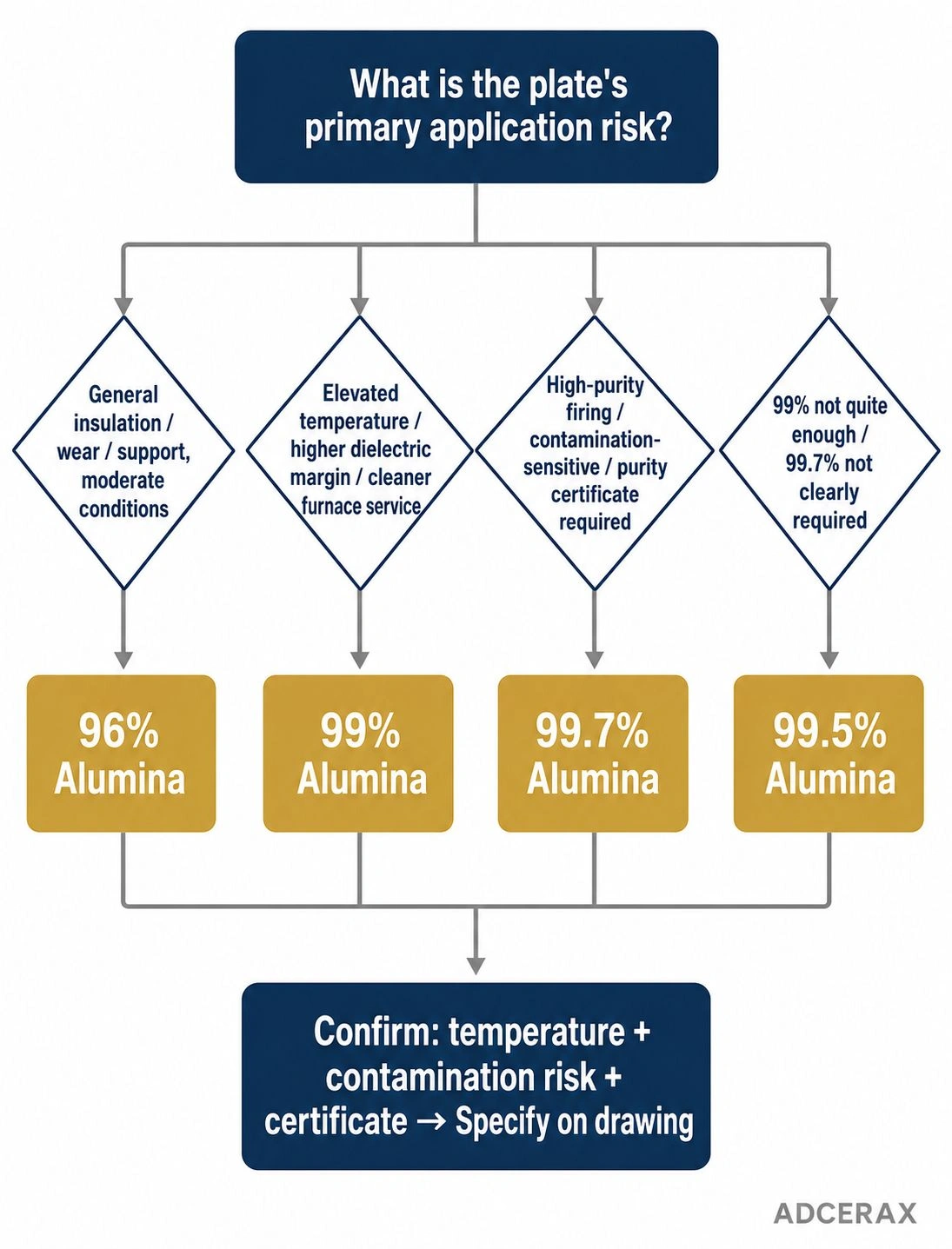
Grade selection should follow the application's measurable operating risk — not the assumption that a higher percentage is always safer.
Choose 96% alumina for general industrial plates
A 96% Al₂O₃ plate is the practical starting point for most general industrial insulation, wear resistance, structural support, fixture, and spacer applications. It provides good dielectric performance at moderate temperatures, reliable abrasion resistance, practical chemical stability against most industrial media, and broad availability in standard and custom plate formats. The conditions that make 96% inadequate are elevated temperature service that approaches its performance ceiling, contamination-sensitive firing contact, demanding dielectric environments, or documentation requirements that specify impurity limits the 96% grade cannot guarantee in the material certificate.
Choose 99% alumina for elevated-temperature and cleaner service
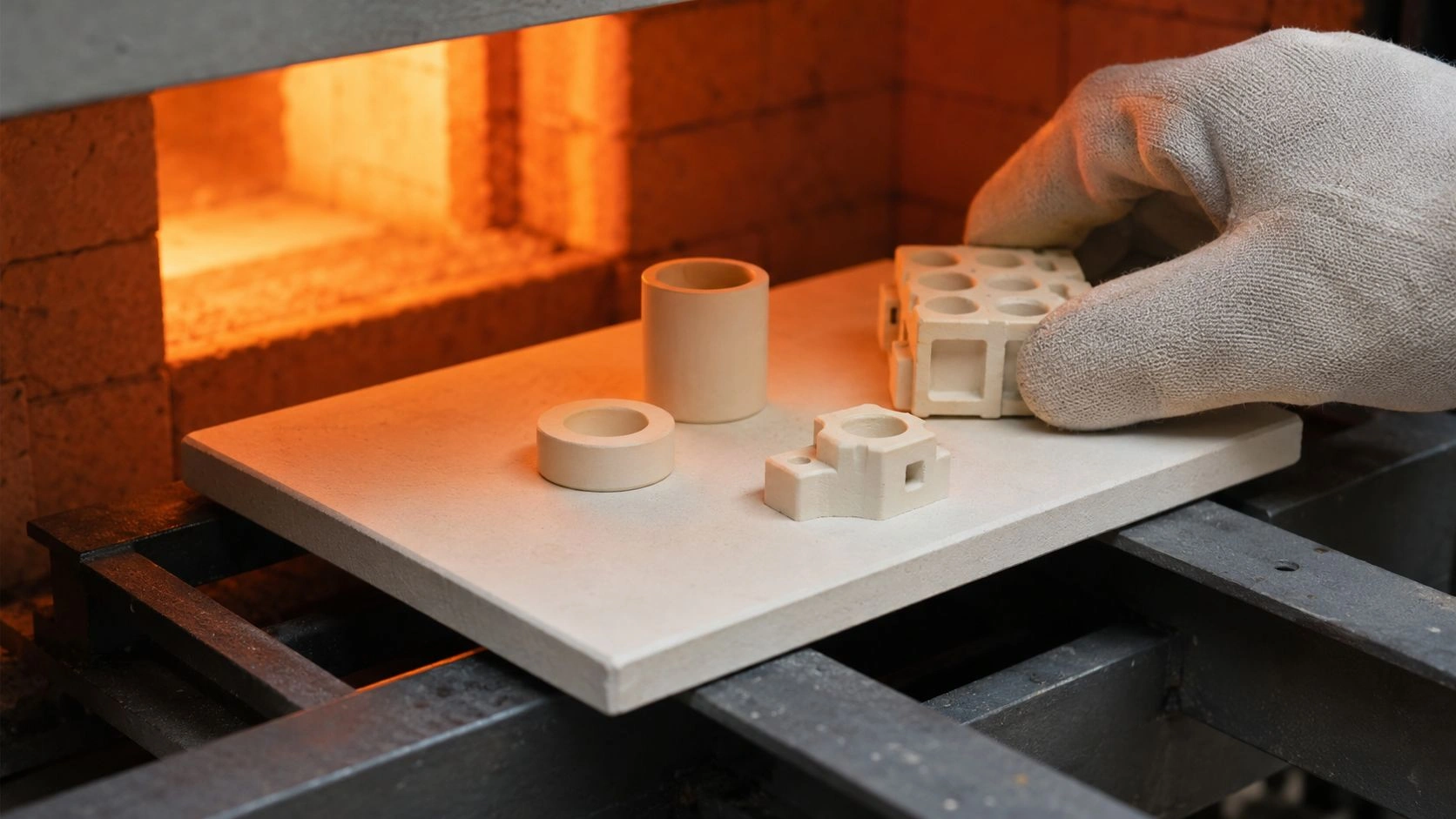
A 99% Al₂O₃ plate is the appropriate step when the application requires more dielectric consistency than 96% reliably provides, higher thermal stability, cleaner surface behaviour in furnace or firing contact, or a moderate reduction in contamination risk relative to 96%. The glass-phase reduction at 99% extends the practical high-temperature service window meaningfully and reduces the probability of surface reactivity in sensitive firing environments without reaching the full specification commitment required for 99.7%. In practice, 99% alumina covers a broad set of industrial furnace supports, higher-grade insulation plates, precision fixtures, and chemical-service plates where 96% is known to be marginal.
Choose 99.7% alumina for high-purity and thermal-cycle-intensive applications
A 99.7% Al₂O₃ plate is justified when impurity transfer to the fired product or process is unacceptable, when the plate operates at sustained high temperature across many cycles, or when the specification requires purity documentation that only a high-purity certificate can satisfy. The ADCERAX high-purity alumina ceramic range covers these roles with the tightest impurity control in the product family. Advanced Ceramic Materials' high-purity alumina plate product notes describe alumina plates up to 99.8% purity as serving high-temperature resistance, chemical resistance, electrical insulation, and hardness/wear resistance in demanding industrial applications.
When 99.5% is the practical intermediate
The 99.5% grade sits between 99% and 99.7% and covers applications where 99% does not quite satisfy a purity or documentation requirement but full 99.7% specification is not clearly necessary. It is a relevant intermediate for precision insulation plates, contamination-sensitive setter plates in lower-severity firing conditions, and applications where the impurity ceiling in the certificate is the governing customer requirement rather than a measured service outcome.
Six-step grade selection guide
- Choose 96% alumina plates for general insulation, wear liners, fixtures, spacers, and support plates where contamination risk and temperature demands are moderate.
- Choose 99% alumina plates when higher temperature stability, dielectric consistency, or cleaner service contact is a measurable requirement.
- Choose 99.7% alumina plates when impurity transfer, surface reactivity, or purity documentation is a defined risk or customer requirement.
- Consider 99.5% when 99% is not quite adequate but 99.7% is not clearly required and an intermediate purity certificate satisfies the specification.
- Do not upgrade grade unless there is a specific operating reason — confirm the measurable condition that the lower grade cannot meet.
- Request a material certificate with purity verification when grade accuracy matters for acceptance or traceability.
How Temperature, Insulation, Wear, Chemical Exposure, and Contamination Risk Change the Decision
The grade decision resolves to a different answer depending on which property governs the failure risk. This is the section where the selection matrix matters most — because the same plate geometry in five different applications may justify five different grade answers. The framework is consistent: identify the dominant risk, confirm whether the lower grade's performance ceiling is above or below that risk, and choose accordingly. CoorsTek describes alumina as one of the most commonly used technical ceramics because of its broadly useful property profile — a characterisation that captures 96% alumina's industrial utility, while the same source's high-purity grades reflect the narrower applications where that broader profile is insufficient.
The error pattern that most reliably produces repeated premature plate failure in contamination-sensitive applications is specifying 96% alumina because it was sufficient in the previous application — without checking whether the new firing temperature, atmosphere, or fired material chemistry has moved the operating condition across the purity boundary. A process change that increases peak temperature by 100°C or shifts the atmosphere from oxidising to mildly reducing can convert a 96% plate from adequate to marginal in the same physical position.
The following table summarises the application-by-application grade guidance. Values are indicative; verify against supplier-specific grade data, actual operating conditions, and applicable test standards including ASTM C1161 for flexural strength and ASTM C1327 for hardness.
| Property / Application | 96% Alumina Plate | 99% Alumina Plate | 99.7% Alumina Plate |
|---|---|---|---|
| Best-fit role | General insulation, wear, support, spacer | Higher-temp insulation, cleaner furnace, precision fixture | High-purity firing, high-temp cycle, contamination-critical |
| Electrical insulation | Good for many industrial uses; moderate dielectric margin | Better margin; stronger fit for high-voltage or high-frequency | Strongest fit when leakage, contamination, or cleanliness is strict |
| High-temperature stability | Practical up to moderate industrial temperatures | Wider thermal margin; glass phase reduced | Best retention at sustained high temperature; fewest impurity-phase effects |
| Wear resistance | Good industrial wear plate performance | Grade-appropriate where chemistry/temp also matters | Applied when wear plus purity/thermal stability must both be met |
| Chemical stability | Moderate; glass-phase boundaries may be reactive with aggressive media | Lower glass-phase reactivity; wider chemical window | Lowest impurity-phase reactivity across the three grades |
| Contamination risk in firing | Use only if accepted by process chemistry | Reduces risk materially relative to 96% | Preferred when impurity transfer to fired product is unacceptable |
| Material certificate burden | COA routine; purity report straightforward | COA + purity specification; tighter control | Full purity certificate + batch traceability; XRF or ICP verification if required |
| Over-specification risk | Low | Moderate — specify only when 96% is confirmed inadequate | High if no measurable operating reason exists |
Values indicative; verify with supplier-specific grade data, sintering route, and applicable standards including ASTM C1161 (flexural strength) and ASTM C1327 (hardness). Supplier-reported property trends show characteristic improvements from 96% to 99.7%, but actual values depend on forming method and processing route.
Temperature: where the grade boundary is most consequential
The impurity phases in 96% alumina are stable at moderate temperatures but can soften and become mobile at sustained high temperatures. The transition is not abrupt, but above approximately 1400–1500°C in continuous service, the glass-phase boundary behaviour in 96% alumina begins to affect mechanical and surface stability in ways that 99% and 99.7% grades avoid. For plates used in high-temperature sintering, repeated batch firing, or sustained furnace support roles approaching this range, the grade upgrade from 96% to 99% or 99.7% is a thermal stability choice, not a purity preference.
Electrical insulation: dielectric margin and frequency sensitivity
For precision insulation plates, high-voltage standoffs, and dielectric substrates, the relevant property is volume resistivity and dielectric strength at operating temperature. Stanford Advanced Materials' grade comparison data shows that higher-purity grades generally deliver higher dielectric strength and volume resistivity values. At moderate temperatures and standard industrial voltages, 96% alumina's dielectric performance is adequate for most applications. At elevated temperatures, high-frequency environments, or where leakage current specifications are tight, the margin advantage of 99% or 99.7% alumina becomes measurable and important. The ADCERAX alumina ceramic substrate range for electronic applications confirms that grade selection in substrate applications depends on the specific electrical and thermal performance requirement.
Contamination and firing chemistry
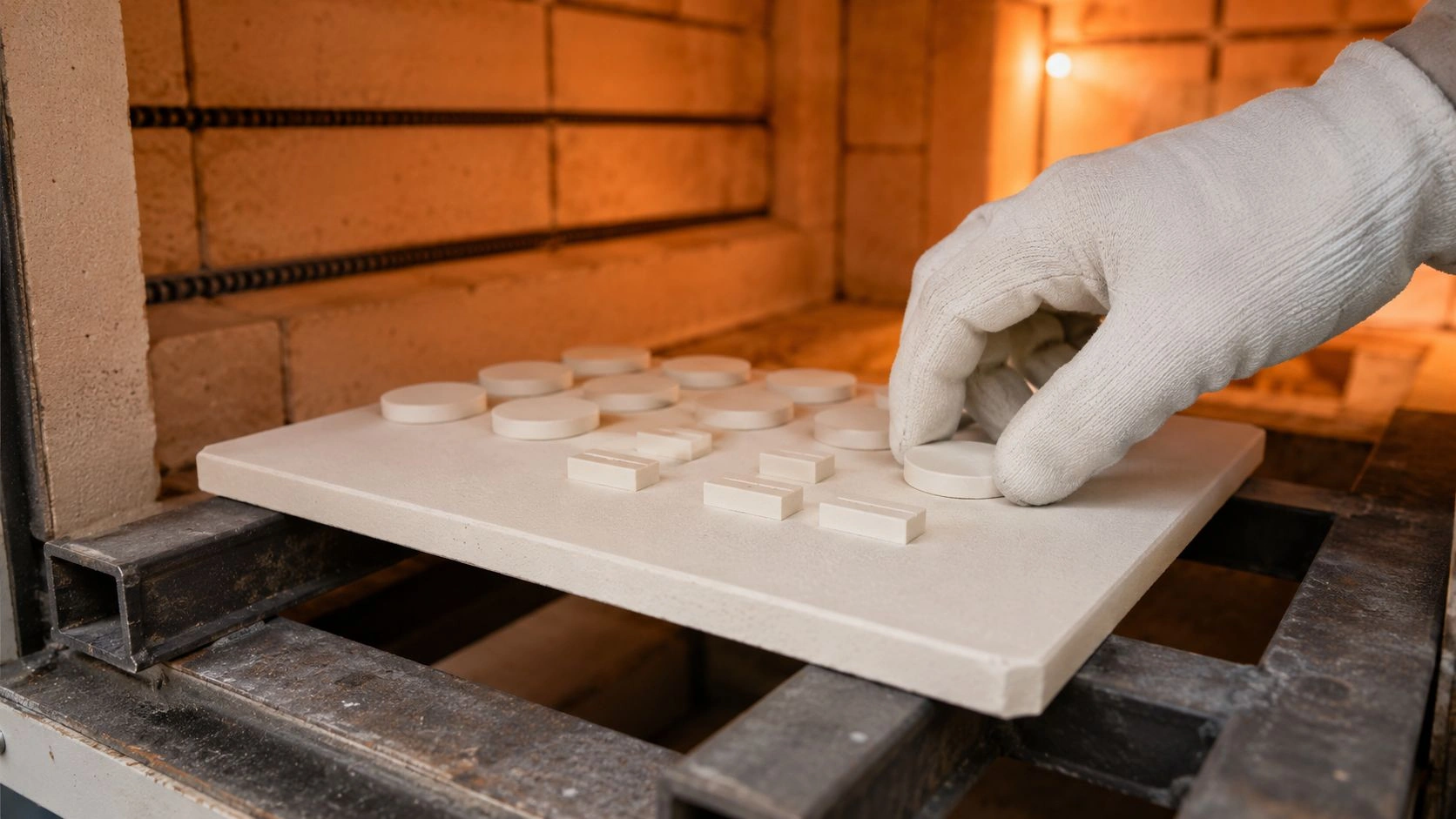
The primary engineering reason to specify 99.7% alumina over 96% in setter plates and furnace support roles is surface chemistry at temperature. When the plate surface contacts a sensitive oxide, electronic ceramic, or powder-metal component during sintering, impurity phases in a lower-purity plate can volatilise, migrate, or react with the fired product surface. For processes where the fired part's electrical, optical, or dielectric properties are determined by surface-layer chemistry, even trace impurity transfer can constitute a quality failure. The ADCERAX alumina plate in high-temperature heating systems resource identifies this contamination pathway as the primary reason high-purity grades are specified in precision thermal process applications.
Wear: where grade is one variable among several
For wear plates and liners, purity grade affects surface hardness and chemical stability at the wear interface, but surface finish, plate thickness, backing support, and abrasive media type govern service life more directly than purity alone. A 96% alumina wear liner with proper thickness, support, and surface finish will outlast a 99.7% plate of inadequate geometry in most abrasive contact applications. The ADCERAX alumina sheet thin-plate range confirms that dimensional and surface specifications are primary inputs for wear and precision insulation applications where grade is a secondary refinement.
Avoid Over-Specifying or Under-Specifying Alumina Plate Grade
The most consistent over-specification pattern is selecting 99.7% alumina because it is the highest available grade, without identifying what operating risk 96% or 99% cannot address. The most consistent under-specification pattern is selecting 96% alumina because it is adequate in most applications — without checking whether the current application's temperature, atmosphere, or fired-product chemistry has crossed the grade's effective operating boundary. Both errors are avoidable with a single diagnostic step: identify the specific condition that drives the grade requirement before writing it into the drawing.
A practical illustration: a 96% alumina plate used as a structural spacer in a batch furnace operating at 1200°C in an oxidising atmosphere will almost certainly outlast its planned replacement interval. The same plate used as a setter plate for an electronic ceramic component sintered at 1450°C may show surface interaction within the first firing campaign. The geometry is the same. The grade requirement is different. The distinction is not the temperature rating printed on the material datasheet — it is the combination of temperature, contact chemistry, and contamination tolerance that the application actually demands.
Mistake 1: treating grade as a safety multiplier
Specifying 99.7% alumina where 96% would suffice adds procurement complexity and certificate burden without improving plate service life in the application. Ceramic PCB grade guidance explicitly states that higher purity is not necessarily better and that grade selection should be matched to measurable application needs, with purity verification available through COA plus XRF or ICP testing if required. The same logic applies to plate selection: the grade is a tool for managing a specific risk, not a default safety margin.
Mistake 2: copying the previous grade without reviewing process changes
Grade adequacy is not static. A process change — higher peak temperature, a shift from oxidising to reducing atmosphere, a new fired material with different surface chemistry, or a tighter contamination specification from the end customer — can move the operating condition across a grade boundary without triggering a formal material review. A material engineering review for alumina setter plates in an advanced ceramics sintering line found that grade-related surface interaction failures were disproportionately concentrated in campaigns where peak temperature had been increased for throughput reasons without adjusting the plate specification. The plate had not changed; the operating condition had.
Mistake 3: treating purity as a substitute for dimensional specification
A 99.7% alumina plate with inadequate flatness, insufficient thickness for the unsupported span, or sharp unmachined edges will fail before its purity advantage matters. Grade controls chemistry and thermal margin; it does not control geometry. A full plate specification combines grade with thickness, flatness, surface finish, edge chamfer, and tolerance zone — and all of those inputs belong on the drawing before the grade is confirmed.
Mistake 4: omitting certificate requirements from the RFQ
When grade accuracy matters for acceptance or traceability, a material certificate request must be explicit in the RFQ. A supplier who quotes alumina plate without a certificate request will typically provide standard documentation. If the application requires purity verification by XRF, ICP, or a specific impurity ceiling on the COA, that requirement must appear in the purchase specification — not as an assumption after delivery.
What to Include in an RFQ for 96%, 99%, or 99.7% Alumina Plates
A supplier-ready alumina plate RFQ specifies the grade, the operating reason for the grade, the dimensional and surface requirements, and the certification need in one document. Separating any of these elements into a follow-up question typically delays quotation and risks a substitution that does not match the engineering intent. Stanford Advanced Materials' quote guidance for alumina plates confirms that purity grade, dimensions and tolerances, surface finish, quantity, and certifications or material test reports are the standard fields that determine quote accuracy.
The following checklist covers the fields that most frequently require clarification in alumina plate procurement.
- Target grade and acceptable range: 96%, 99%, 99.5%, or 99.7% Al₂O₃; state if substitution within a range is acceptable or if the grade is fixed.
- Plate function: insulation, wear liner, setter plate, furnace support, precision fixture, or spacer — the function determines which performance property governs the grade choice.
- Dimensions: length × width × thickness; provide drawing when tolerances are tight or geometry is non-standard.
- Thickness tolerance: specify by surface zone — functional contact face vs non-critical back face.
- Flatness: value and reference surface; required for precision insulation and setter plate applications.
- Surface finish: as-fired, ground, or lapped; specify contact surfaces separately from structural surfaces.
- Edge chamfer or radius: required for thermal-cycle service to reduce chip initiation at edges.
- Operating temperature: continuous service and peak; determines whether the selected grade's thermal stability is adequate.
- Thermal cycle: ramp rate, dwell temperature, cooling rate, and cycle frequency.
- Electrical requirement: dielectric strength class or volume resistivity floor if insulation performance must be verified.
- Chemical exposure: acid, alkali, solvent, or process vapour at operating temperature.
- Contamination sensitivity: state whether impurity transfer to the fired part or process is a measurable quality risk.
- Material certificate: COA with purity statement, XRF or ICP verification if required, batch traceability class, and inspection report format.
- Quantity and repeat-order plan: helps supplier plan batch consistency and material sourcing for the specified grade.
Specifying grade without stating the operating reason is the most reliable way to receive a technically correct quote for the wrong application. Two engineers can write ""99.7% alumina plate, 150 × 100 × 6 mm"" and mean a precision setter for electronic ceramic sintering and a general equipment spacer respectively. The grade specification is identical; the certificate requirement, surface finish, and flatness tolerance are not. Those differences belong in the RFQ.
Conclusion
The 96% vs 99% vs 99.7% alumina plate decision is an application-risk decision, not a purity ranking. Each grade fills a defined role: 96% alumina covers the broad range of general industrial insulation, wear, support, and fixture applications where moderate properties and practical availability matter. A 99% plate extends the thermal margin, electrical consistency, and surface cleanliness where the 96% grade's glass-phase content becomes a measurable limitation. A 99.7% plate is justified when contamination control, sustained high-temperature stability, purity documentation, or precision performance requirements are explicit and traceable to a defined operating condition.
The grade selection inverts when the process changes: a 96% plate that performed reliably for two years in a moderate-temperature fixture may fail in the first campaign after a peak temperature increase or a switch to a contamination-sensitive fired product. The specification should follow the operating condition, not the previous purchase order.
Ready to confirm the right alumina plate grade for your application? Share your plate function, operating temperature, insulation or contamination requirement, and certificate needs with ADCERAX's engineering team. We will identify the correct grade from 96% to 99.7%, confirm dimensional and surface requirements, and specify the appropriate material certificate for your RFQ.
FAQ
What is the main difference between 96%, 99%, and 99.7% alumina plates?
The primary difference is the proportion of impurity phases — glassy silicate binders and sintering additives — that remain in the fired microstructure. Higher purity means fewer secondary-phase grain-boundary inclusions, which generally improves high-temperature stability, dielectric consistency, surface chemical cleanliness, and contamination control. A 96% alumina plate contains roughly 4% secondary phases; a 99.7% plate reduces this fraction to approximately 0.3%. The practical effect of this difference depends on whether the application's temperature, atmosphere, and contact chemistry expose those phases to a failure mode.
Is higher-purity alumina plate always better?
No. Higher purity extends the performance window in temperature stability, electrical margin, and contamination control — but it does not improve service life in applications where those properties are not the limiting factor. A 99.7% alumina plate with inadequate thickness for its unsupported span, insufficient flatness, or wrong surface finish will fail before its purity advantage becomes relevant. Ceramic PCB grade guidance explicitly states that higher purity is not necessarily better and that grade should be matched to measurable application requirements, with purity verification available through COA plus XRF or ICP testing. The correct grade is the lowest purity that reliably meets the application's specific operating demands.
Which alumina plate grade is best for electrical insulation?
Grade selection for electrical insulation depends on the operating voltage, frequency, and temperature. A 96% alumina plate provides good dielectric performance for most general industrial insulation roles at moderate temperatures. A 99% or 99.7% plate delivers better dielectric margin — higher dielectric strength and volume resistivity — for high-voltage, high-frequency, or elevated-temperature environments where the 96% grade's glass-phase content introduces dielectric inconsistency. Stanford Advanced Materials' grade comparison data confirms the characteristic direction of dielectric strength and volume resistivity improvement with increasing purity.
When should engineers choose 99.7% alumina instead of 96%?
Specify 99.7% alumina when any of the following conditions apply: the plate contacts a contamination-sensitive fired material and impurity transfer is a measurable quality risk; the operating temperature is sustained at levels where glass-phase boundary effects in 96% alumina become active; a purity certificate with specific impurity ceilings, batch traceability, or XRF/ICP verification is a customer or process requirement; or the application has previously demonstrated that 96% or 99% alumina produces surface reactivity or dielectric failure that a lower grade cannot resolve. In all other cases, 96% or 99% is the starting evaluation grade.
How do alumina purity grades affect wear resistance and chemical stability?
For wear resistance, purity grade influences surface hardness and the chemical stability of the wear interface, but plate thickness, surface finish, backing support, and abrasive media type govern service life more directly than grade alone. Higher-purity grades offer better chemical stability in reactive or aggressive environments because the glass-phase grain boundary content — more susceptible to acid attack and chemical interaction than the alumina phase itself — is reduced. IQS Directory confirms that grade formulation influences wear resistance and chemical stability, while the practical boundary conditions depend on the specific medium, concentration, temperature, and contact mode. For most abrasive wear applications, 96% alumina is the starting evaluation grade unless chemical exposure, elevated temperature, or contamination risk pushes the specification toward 99% or higher."