Selecting alumina ceramic tubes for furnace, kiln, and sensor duty is a purity × geometry × duty decision — not a catalog-% shopping exercise.
Quote a purity grade with COA, match open/closed/multi-bore geometry to the process, and write continuous/peak temperature, atmosphere, cycle, and support span into the RFQ. Do not shop a 95/99/99.5% menu alone.
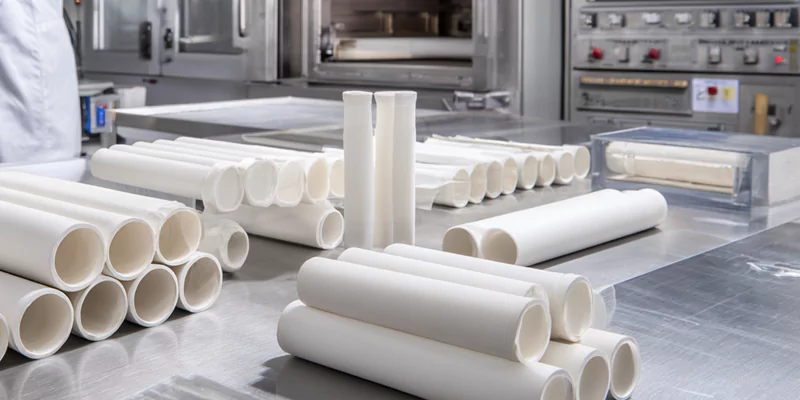
This alumina ceramic tube selection guide maps thermal-shock and creep behavior, purity-class screening, tube geometry, supplier checks, and RFQ fields so engineers can specify tubes without treating catalog ceilings as lot certificates.
Key Factors in Alumina Ceramic Tube Selection for High-Temperature Applications
What Defines an Alumina Ceramic Tube in High-Temperature Engineering?
Alumina tubes are engineered for stability under severe thermal stress. Selection is defined by:
- Purity grade + COA (quote the class; do not shop a % menu alone)
- Microstructure density (porosity is process-dependent; confirm method)
- Grain size (process-dependent; typically fine-grained dense alumina)
- Thermal shock resistance (typical dense-alumina screening; method-dependent)
- Creep resistance under continuous heat and load
- Dimensional drift over long exposure (state allowable drift on the RFQ)
This alumina ceramic tube selection framework helps engineers compare purity, microstructure, and long-term reliability in harsh furnace conditions.
Material Composition and Structural Purity
Typically specified as dense alumina (Al₂O₃) purity classes mapped to AD-ALU screening grades, alumina ceramic tubes deliver high mechanical strength and excellent thermal resistance. Purity directly affects:
- Creep rate
- Thermal shock tolerance
- Chemical resistance
- Grain growth behavior under heat
| Purity class (screening) | Long-term selection °C | Creep behavior | Thermal Shock | Engineering Use |
|---|---|---|---|---|
| AD-ALU-950 (~95% Al₂O₃) | 1400°C | Creep rises with T and stress — request load/span/time data | Moderate | Standard furnaces |
| AD-ALU-990 (~99% Al₂O₃) | 1600°C | Creep rises with T and stress — request load/span/time data | High | Corrosive / cyclic |
| AD-ALU-997 / 999 (~99.7–99.9%) | 1700°C / 1750°C | Creep rises with T and stress — request load/span/time data | Very High | Analytical / precision |
Long-term selection ceilings are duty-/atmosphere-/load-dependent screening values — not batch certificates. Confirm on drawing and TDS.
Dense microstructure strengthens thermal stability and reduces microcrack initiation, a major factor in cyclic heating failures.
Manufacturing Processes and Reliability
Manufacturing controls microstructure evolution and final performance:
| Process Method | Reliability Impact | Key Parameter |
|---|---|---|
| Extrusion | Uniform bore & straightness | Ovality process-dependent — confirm on drawing |
| Isostatic Pressing | Highest density, minimal porosity | Porosity process-dependent (CIP typically denser) |
| High-Temp Sintering | Grain bonding & creep resistance | Sinter window process-dependent |
Fine grains (process-dependent) reduce thermal shock failures, while low porosity improves creep life and dimensional stability.
Distinct Properties Compared with General Ceramics
Compared to silicates and general ceramics, alumina exhibits:
- Higher flexural strength
- Superior thermal shock resistance
- Lower creep deformation
- Higher chemical inertness
These properties support long-term performance in furnaces, reactors, analytical equipment, and controlled-atmosphere systems.
Why Alumina Ceramic Tubes Are Indispensable for High-Temperature Applications?
Thermal Shock Resistance in Cyclic Heating
Alumina tubes endure rapid temperature swings due to:
- Low thermal expansion (typical dense alumina CTE ~7.2–7.6×10⁻⁶/K, method-dependent; not a lot guarantee)
- High thermal shock parameter (typical screening range; method-dependent)
- Fine microstructure that suppresses crack propagation
| Parameter | Value | Engineering Impact |
|---|---|---|
| CTE | ~7.2–7.6×10⁻⁶/K (typical dense alumina / TDS screening) | Limits thermal stress vs metal housings — method-dependent |
| Thermal Shock R | Typical screening (method-dependent) | Withstands rapid cycles when microstructure is dense |
This alumina ceramic tube selection insight is essential for systems operating under frequent thermal ramps.
Dimensional Stability at Continuous Heat
Dimensional drift is critical for sensors and thermocouples. Drift rises with continuous temperature and support span — state allowable drift on the RFQ rather than treating blog mm ranges as factory measurements.
Stable geometry ensures:
- leak-free sealing
- reliable alignment
- calibration accuracy
Service Life in Harsh Environments
Alumina’s inertness protects against:
- molten salts
- corrosive gases
- oxidation
- abrasive particulates
Long service life lowers maintenance cycles and improves uptime.
How Thermal and Mechanical Properties Guide Alumina Ceramic Tube Selection?
Flexural Strength and Structural Safety
Flexural strength influences installation reliability and in-service safety:
| Temperature | Flexural Strength |
|---|---|
| 25°C | Typical dense-alumina screening (method-dependent) |
| 1200°C | Strength falls with T — request hot flexural data |
Higher purity tubes show reduced fracture probability under handling and thermal stress.
Thermal Expansion and Heat Transfer Control
Engineers prefer alumina for:
- predictable thermal behavior
- uniform heat distribution
- stable interfaces with metal housings
Thermal conductivity: typical dense-alumina screening (~18–42 W/m·K class-dependent @ room temperature; method-dependent — not a lot guarantee).
Supports thermal uniformity in furnace zones.
Resistance to Wear and Chemical Attack
Alumina exhibits:
- excellent abrasion resistance
- strong chemical inertness
- creep rises with temperature and stress — request creep data with load/span/time
Ensuring durability in chemically aggressive and abrasive environments.
How Engineers Select Alumina Ceramic Tubes for Furnace and Kiln Use?
Temperature Thresholds in Furnace Linings
Purity class must align with temperature load. Use long-term selection ceilings as screening (duty-/atmosphere-/load-dependent — not batch certificates):
- AD-ALU-950 → 1400°C
- AD-ALU-990 → 1600°C
- AD-ALU-995 → 1650°C
- AD-ALU-997 → 1700°C
- AD-ALU-999 → 1750°C
Correct alumina ceramic tube selection prevents premature failure. Higher purity class ≠ automatic higher continuous rating for every duty.
Tube Longevity in Continuous Kiln Operation
Higher-purity / denser tubes often show longer furnace duty under the same cycle — verify with supplier duty data rather than assuming a fixed life uplift:
- lower porosity
- better creep resistance
- higher shock tolerance
Cost vs Performance in Industrial Furnaces
Proper grade selection avoids:
- overspecification
- unnecessary cost
- premature failures
How Different Alumina Ceramic Tube Types Address Specific Engineering Needs?
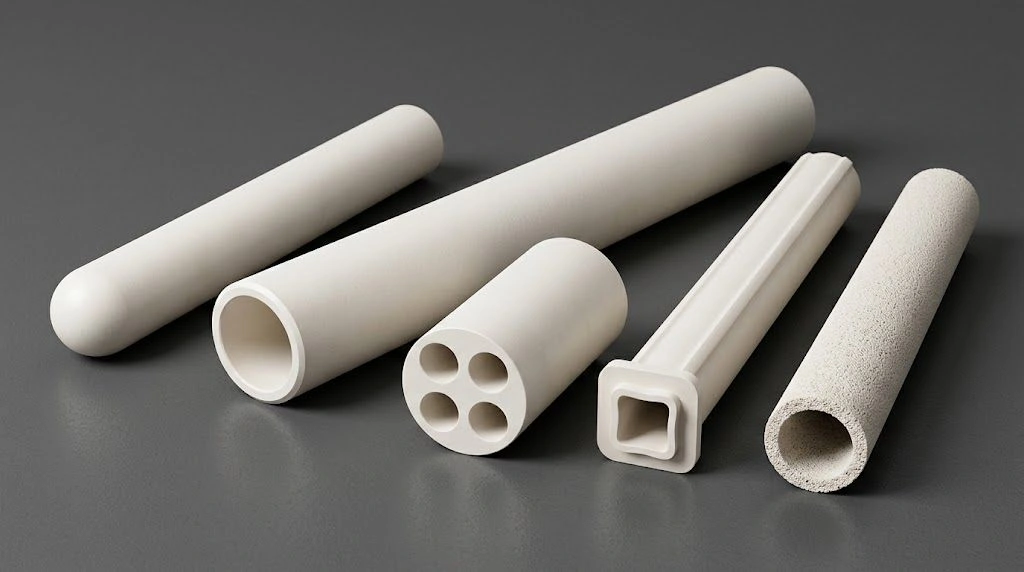
Open-Ended Tubes for Gas Flow Management
Open-ended tubes allow controlled atmosphere flow for reactors and furnaces.
Closed-End Tubes for Sensor and Thermocouple Protection
Closed-end tubes shield sensors under corrosive and cyclic loads. Suitable for temperatures ≥1500°C.
Multi-Bore Tubes for Electrical and Thermal Isolation
Multi-bore tubes provide:
- electrical isolation at a typical insulation order-of-magnitude — confirm on drawing/test
- lower peak stress concentration vs single-bore (geometry-dependent)
- thermally separated pathways
How Purity Grades of Alumina Tubes Influence High-Temperature Applications?
95% Grade
Suitable for general furnace environments near the AD-ALU-950 long-term selection ceiling (~1400°C screening) — duty-dependent.
99% Grade
Improved creep resistance and chemical inertness.
99.70% (AD-ALU-997 class) Grade
Used in precision systems requiring:
- minimal contamination
- dimensional accuracy
- stable high-temperature gradients
Comparing Alumina Ceramic Tube Grades and Their High-Temperature Suitability
| Grade (screening) | Long-term selection °C | Engineering Benefit |
|---|---|---|
| AD-ALU-950 (~95%) | 1400°C | Standard heating |
| AD-ALU-990 (~99%) | 1600°C | Corrosive / higher-duty environments |
| AD-ALU-997 (~99.7%) | 1700°C | Precision / higher-purity measurement |
| AD-ALU-999 (~99.9%) | 1750°C | Highest alumina purity class reviews |
Ceilings = initial material-selection limits, not continuous loaded-service for every duty.
How Structural Designs of Alumina Ceramic Tubes Impact High-Temperature Reliability?
Stress Distribution in Multi-Bore Configurations
Multi-bore tubes can lower peak stresses versus single-bore layouts (geometry-dependent), improving fatigue life when the layout matches the duty.
Closed-End Designs Under Thermal Cycling
Closed-end tubes prevent gas infiltration and thermal fatigue.
Influence of Tube Geometry on Heat Management
| Wall Thickness | Thermal Behavior |
|---|---|
| <2 mm | Quick response, lower strength |
| 2–4 mm | Balanced |
| >4 mm | Maximum stability |
How Engineers Should Evaluate Alumina Ceramic Tube Suppliers for High-Temperature Applications?
Engineers evaluate suppliers based on:
- furnace-grade application history
- ISO 9001 system quality
- buyer-requested ASTM methods (C20, C1161, C1525) — not ADCERAX certified lot results
- engineering drawing support
- small-batch prototyping capability
Quality Tests That Ensure Alumina Ceramic Tube Performance Under Heat?
Thermal Shock and Cycling Validation
Key verification points:
- cycle survivability
- microcrack inspection
- retained strength after cycling
Microstructure and Porosity Examination
| Test | Standard | Requirement |
|---|---|---|
| Porosity | ASTM C20 (buyer-requested) | Confirm requirement on RFQ — method-dependent |
| Density | TDS screening | ~3.75–3.94 g/cm³ class-dependent — not a lot guarantee |
Dimensional Accuracy and Tolerance Checks
Engineering-grade tolerances: state OD/ID/oval/straightness on the drawing (process-dependent)
Key Ordering Considerations for Alumina Ceramic Tubes in High-Temperature Use?
Important procurement factors include:
- stock vs custom lead-time
- required tolerances
- packaging to prevent microcracks
- small-batch flexibility
Conclusion
Selecting the correct alumina tube requires understanding:
- purity-performance mapping
- thermal shock limits
- creep behavior
- microstructure quality
- geometry and tolerance requirements
For non-standard OD/ID/wall/end/bore or small-batch prototypes, send drawings and duty fields for custom review via custom services — map purity class + geometry + requested test data before quoting.
Related reading
- Alumina ceramic tube suppliers — application checklists — When you need supplier application checklists and RFQ evidence packs beyond the tube-selection framework on this page.
- Industrial applications of alumina tubes — When you need industrial use-case context for alumina tubes, not the purity/geometry decision matrix itself.
- Open-both-ends alumina ceramic tubes — When the duty is open-both-ends gas-flow tubes and you need geometry-specific selection notes.
FAQ
Q1: How do alumina ceramic tubes resist thermal shock in furnaces?
Alumina maintains low thermal expansion and high flexural strength, minimizing crack formation during rapid heating and cooling cycles.
Q2: What purity grade of alumina ceramic tube should be used for continuous kiln operation?
99% alumina is recommended due to its superior creep resistance and higher chemical stability compared to 95% grades.
Q3: What should engineers evaluate when choosing a supplier for alumina ceramic tubes?
Engineers review furnace application records, buyer-requested ASTM/ISO test data, customization capability, dimensional tolerance control, and material testing reports.
Q4: How are alumina ceramic tubes packaged for international shipping?
Tubes are packed in shock-resistant foam or reinforced cartons to prevent cracking during long-distance transportation.
Al₂O₃ vs ZrO₂ vs SiC Tube Decision Matrix (Engineering Screen)
Use this as a citeable RFQ screen for furnace work tubes, thermocouple protection tubes, and process tubes. It is typical engineering guidance — not batch-certified limits. Final grade, geometry, and atmosphere fitness are confirmed in engineering review.
Source map: Ceramic material selection matrix (Al₂O₃ / ZrO₂ / SiC / BN). Closed-end TC failure screen: #failure-modes.
| Dominant requirement | First-look material | Why (tube context) | Watch-out |
|---|---|---|---|
| General high-temperature insulation / protection tubes | Al₂O₃ | Baseline engineering ceramic for furnace work tubes, insulation sleeves, and simple thermocouple / sensor protection when no single extreme constraint dominates. | Moderate toughness; not the preferred route when the design is limited by severe thermal shock, impact cracking, or very high heat-flow duty. |
| Noble-metal TC closed-end purity / contamination control | Al₂O₃ (higher-purity grades) | Closed-end alumina sheaths isolate Type S/R/B junctions from furnace gases; purity grade is reviewed against atmosphere and contamination sensitivity (see purity-class mini-table below). | Flag reducing atmospheres and metal vapors early; send TC type, max T, atmosphere, and required purity. See closed-end failure modes. |
| Slag / abrasion + process heat flow (process / protection tubes) | SiC (or dense Al₂O₃ for milder wear) | SiC is the process-route material when heat transfer, wear, low expansion, gas tightness, and high-temperature process duty dominate — common for process tubes and aggressive thermocouple protection routes. Dense alumina remains a first look for milder abrasion. | SiC is harder to machine after firing; toughness is lower than zirconia. Severe slag may need geometry / outer-armor discussion — confirm medium and life target in RFQ. |
| Toughness / crack-limited tube duty (incl. moderate shock) | ZrO₂ (toughness) — or redesign / other ceramic if quench is extreme | Zirconia is the toughness specialist when crack initiation/propagation under impact or shock is the binding constraint. Alumina tubes underperform relative to ZrO₂ when cracking (not heat flow) is the failure driver. | ZrO₂ temperature limits are grade- and stabilization-dependent; not the obvious first look for the hottest sustained furnace process tubes. Extreme quench may need design change rather than a grade swap. |
| Reducing atmosphere or HF / strong-alkali contact | Case-by-case (do not default) | Atmosphere and chemistry must be named in the RFQ before shortlisting. Alumina is chemically inert to many process gases but is not universal; SiC and other ceramics also have atmosphere-dependent ceilings. | Watch-outs (flags only): HF and hot strong alkalis / selected molten salts — flag early. Carbon contact or severe reducing duty at extreme heat — review case-by-case; do not assume unlimited reducing service. No invented limits here. |
Alumina tube grades — purity × long-term temperature (typical selection / engineering-review values)
RFQs typically map five alumina purity classes (AD-ALU-950/990/995/997/999). Long-term temperatures below are typical selection / engineering-review values — not lot-certified guarantees. Actual tube use depends on load, atmosphere, thermal cycle, support span, and installation.
| Grade (SKU) | Al₂O₃ (wt%) | Long-term temp (typical review) | Tube-oriented first use |
|---|---|---|---|
| AD-ALU-950 | 95 | 1400°C | General high-temp insulation / protection tubes |
| AD-ALU-990 | 99.00 | 1600°C | Higher duty furnace / process tubes |
| AD-ALU-995 | 99.50 | 1650°C | Higher purity / harsher thermal environments |
| AD-ALU-997 | 99.70 | 1700°C | High-purity insulation; noble-metal TC closed-end reviews |
| AD-ALU-999 | 99.90 | 1750°C | Highest alumina purity class for demanding cleanliness / thermal reviews |
Long-term selection ceiling — duty-/atmosphere-/load-dependent; not a batch certificate. Confirm against TDS / money-page grade data.
Before quoting a tube, send: OD/ID/length/wall · open- or closed-end · bore layout · continuous & peak T · atmosphere · heating/cooling rate · medium/contaminants · TC type if applicable · quantity.
Send alumina tube drawing for review · Custom alumina tube geometry / small-batch RFQ · Full Al₂O₃ / ZrO₂ / SiC / BN selection matrix · Closed-end TC failure modes