BN crucibles are a strong choice in precious metal recovery laboratories when the step is clean melting, holding, or remelting of precious metals and the lab needs a non-wetting, low-transfer, electrically insulating ceramic with low contamination risk. They are usually not the default answer for every lab step: fire-assay fusion and cupellation belong to a different consumables logic, and aggressive analytical fusion with acids or fusion mixtures is more naturally matched to platinum labware.
The selection error that this guide addresses is assigning BN to the whole laboratory rather than to the specific steps where its interface properties are genuinely the governing advantage. That step-level classification is the difference between a well-specified crucible purchase and a disappointed lab manager.
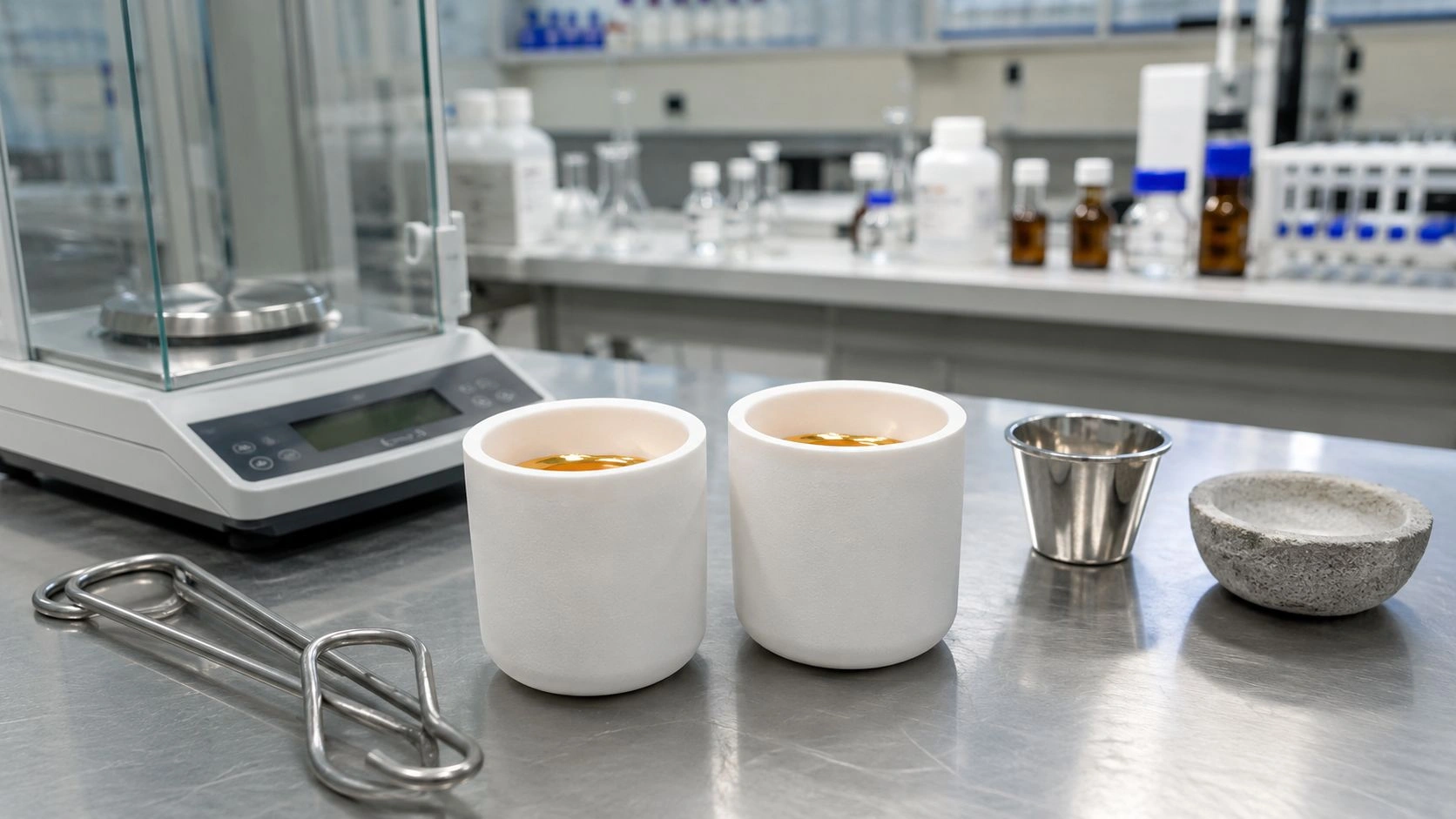
BN crucibles in a precious metal recovery laboratory belong in the clean melting, remelting, and holding steps — not as a universal replacement for fire-assay ware or platinum labware in fusion-chemistry steps.
The boron nitride crucibles used for precious-metal melting and high-purity molten-metal handling represent the specific BN application described in this guide — chosen for non-wetting behavior and low contamination transfer, not as general-purpose assay labware.
What BN crucibles actually do well in a precious-metal recovery lab
The strongest case for BN in a precious-metal recovery laboratory is the clean-interface problem: the lab has a small batch of gold, silver, palladium, or platinum that needs to be melted, held, or remelted without the crucible becoming the major source of sticking, contamination, or metal hold-up. Published materials documentation from Precision Ceramics explicitly lists crucibles for precious metals among BN applications and describes BN as chemically inert and resistant to most molten metals. In that narrow and specific use case — clean molten-metal contact with purity-sensitive materials — BN is a credible and well-documented route.
That is a more precise claim than "best crucible for precious-metal recovery laboratories." The distinction matters because precious-metal recovery and assay facilities perform multiple different types of operations, and not all of them are clean-melt problems. The step classification has to come first.
BN's role is clean-interface containment, not universal assay labware
BN is not positioned in its materials documentation as a replacement for the specialist consumables used in fire assay, cupellation, or aggressive flux-based analytical preparation. Its documented role is at the molten-metal interface: low sticking, low transfer loss, low contamination from the vessel wall. Once the laboratory step moves away from simple molten-metal contact into collector chemistry or fusion-mixture chemistry, the materials logic changes.
Step classification determines whether BN is relevant
Before specifying BN for any precious-metal laboratory application, the step must be named: clean melt, fire assay, or analytical fusion. These three steps share a laboratory and sometimes a material category but have different vessel logic, different failure modes, and different standard consumables. BN belongs clearly in the first; it is not the default answer for the second or third.
Why BN is attractive in clean precious-metal melting steps
BN earns its place in clean precious-metal melting for three reasons that map directly to the failure modes those steps generate.
The first reason is broad non-wetting behavior. Published BN materials documentation describes BN as not wet by most molten metals and slags. In a precious-metal melt, that means less metal adheres to the crucible wall after pouring, lower mechanical hold-up losses, and easier recovery of the metal batch. For laboratories working with high-value materials where every gram of metal loss translates directly to recovery yield, this property has genuine commercial significance.
The second reason is carbon-free composition. Graphite crucibles introduce carbon into the melt through diffusion and surface reaction. In carbon-sensitive precious-metal applications, that pathway is a contamination risk. BN eliminates it. Published comparisons note that BN has much higher oxidation resistance than graphite in air, which reinforces its advantage in processes where graphite degradation generates particulate or dissolved carbon contamination.
The third reason is machinability and electrical insulation. BN can be machined with conventional tooling to custom geometries, and it is electrically insulating. For laboratory-scale induction melting setups where the crucible must be insulating rather than conductive, BN provides a geometry-flexible alternative to other refractory options.
The boron nitride ceramic grades — HPBN, binder-free high-purity grades, and PBN — each contribute different levels of density, purity, and temperature capability to this application, and the grade selection for precious-metal work should be confirmed against the planned operating temperature and atmosphere.
BN is attractive when the lab needs clean release rather than collector chemistry
The distinction between a clean-melt problem and a fire-assay problem is not superficial. In clean melting, the goal is to transfer molten metal from one location to another with minimum loss and contamination. The crucible is a container. In fire assay, the goal is to selectively concentrate precious metals using lead, nickel sulfide, bismuth, or another collector that has chemical affinity for the target metals. The crucible participates in the chemistry. BN is appropriate for the former; it is not the designed vessel for the latter.
The atmosphere constraint is real and should be in the specification
Common hot-pressed BN grades have documented air-service limits in the range of approximately 850–900°C in sampled current materials documentation. Above that range in oxidizing conditions, BN begins to oxidize, and the expected surface and contamination properties change. For precious-metal melting in open-air laboratory furnaces, this is a meaningful constraint that must appear in the specification. In inert gas or vacuum service, BN's temperature capability extends substantially higher.
Which lab steps are being confused when buyers specify BN crucibles
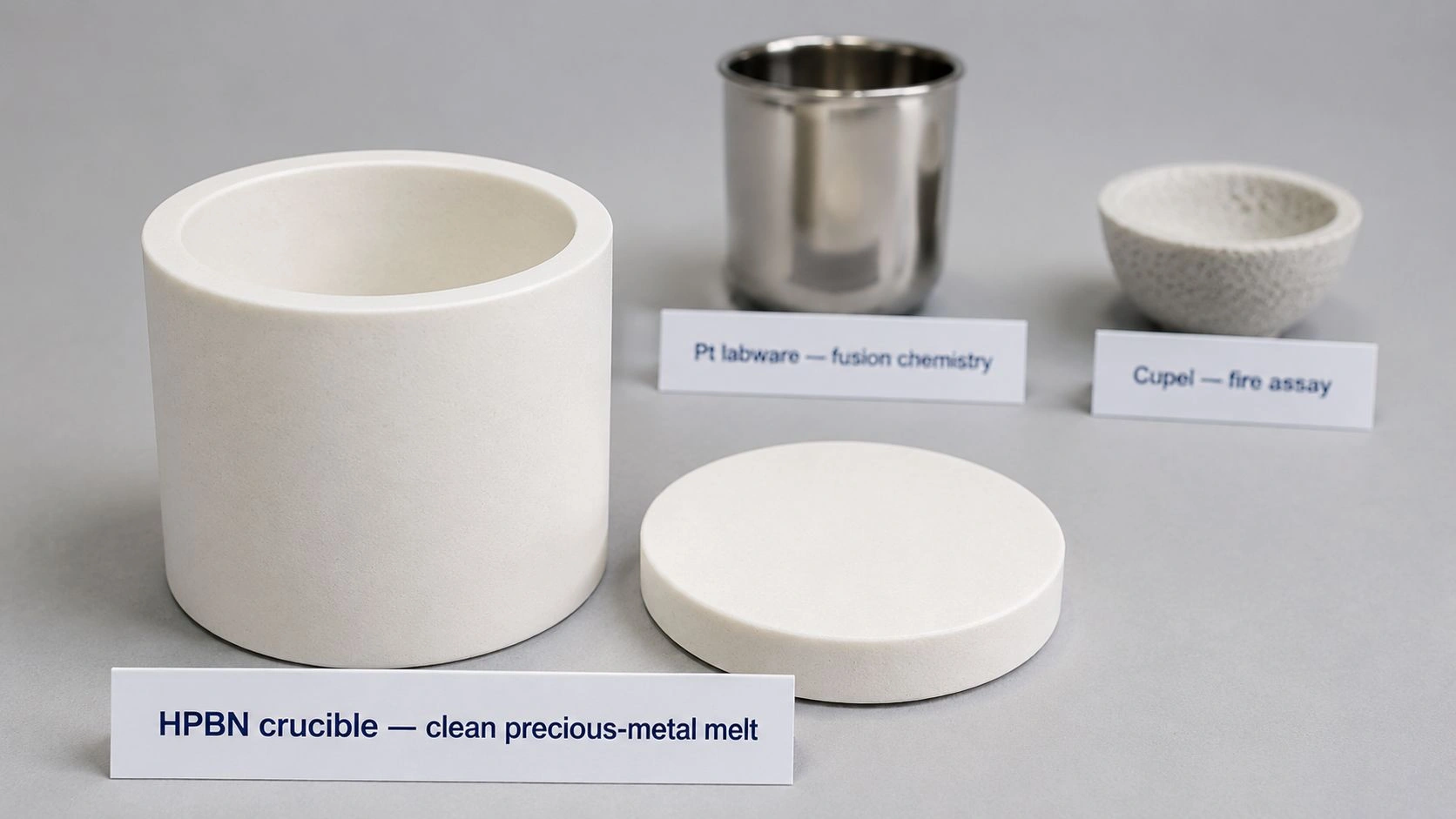
Three confusions account for most BN misspecification in precious-metal recovery laboratories:
Treating fire assay as a clean-melt problem. Fire assay remains a standard or widely accepted route for gold and platinum-group element preconcentration and analysis. The workflow involves fusion-mixture loading, collector formation, and cupellation — a sequence that uses fire-assay crucibles, collectors, and cupels as a coordinated system. Substituting BN crucibles into a fire-assay workflow because BN is "cleaner" misunderstands the chemistry: the step is not a clean-melt problem, and BN's non-wetting properties are not the governing performance variable.
Treating analytical fusion as an extension of clean-melt logic. Laboratories that use fusion mixtures — lithium metaborate, lithium tetraborate, sodium peroxide, and related fluxes — for sample dissolution or XRF bead preparation need labware that resists the chemical attack from those fluxes. Platinum and platinum-alloy labware is explicitly marketed for this duty because of its resistance to acids and fusion mixtures. BN is not positioned for aggressive flux chemistry in the sampled source set, and extending clean-melt logic into flux-dominated steps produces incorrect material selection.
Ignoring the air-oxidation temperature limit. BN's non-wetting properties are documented and real, but they apply within the material's usable service window. A precious-metal lab that works in air at temperatures above approximately 850–900°C with hot-pressed BN grades is operating outside the documented safe range. For high-temperature open-air precious-metal melting, either the atmosphere must be controlled or an alternative crucible route must be considered.
BN is the clean-interface crucible. Fire-assay ware is the collector-and-cupellation route. Platinum labware is the fusion-chemistry apparatus. Once the lab step is classified correctly, the material choice becomes much easier and the risk of buying the wrong "best crucible" drops sharply.
Non-wetting does not eliminate all transfer losses or contamination pathways
BN reduces the sticking and adhesion problem. It does not eliminate all transfer losses — some metal will always wet or adhere to any ceramic surface to some degree — and it does not address contamination from atmospheric sources, flux reactions, or cross-contamination between batches. The SOP must account for cleaning protocols and inspection intervals even with BN in service.
The fire-assay and platinumware boundaries should be in the SOP, not just the RFQ
A purchasing document that specifies BN crucibles for "precious-metal recovery lab use" without defining the step allows operators to make substitutions by convenience. If the laboratory SOPs do not explicitly separate which steps use BN, which use fire-assay consumables, and which use platinum labware, the boundary will be crossed at the bench.
When the decision clearly stays with BN and when it flips
The decision stays with BN when the step is small-batch precious-metal melting, remelting, holding, or transfer, and the main performance requirement is low sticking, low transfer loss, and low contamination from the crucible wall. This is the step that Precision Ceramics' BN applications documentation directly addresses: precious-metal crucibles and high-purity molten-metal contact.
The decision flips in three situations. It flips to fire-assay ware when the step is fire-assay preconcentration or cupellation, because that workflow has its own fusion and collector chemistry that requires purpose-designed consumables. It flips to platinum labware when the step is aggressive analytical fusion with acids or fusion mixtures, because platinum is specifically marketed for that chemical duty. And it weakens even for clean melting when the temperature is above approximately 850–900°C in air and the atmosphere is not controlled, because common hot-pressed BN grades are limited in that operating window.
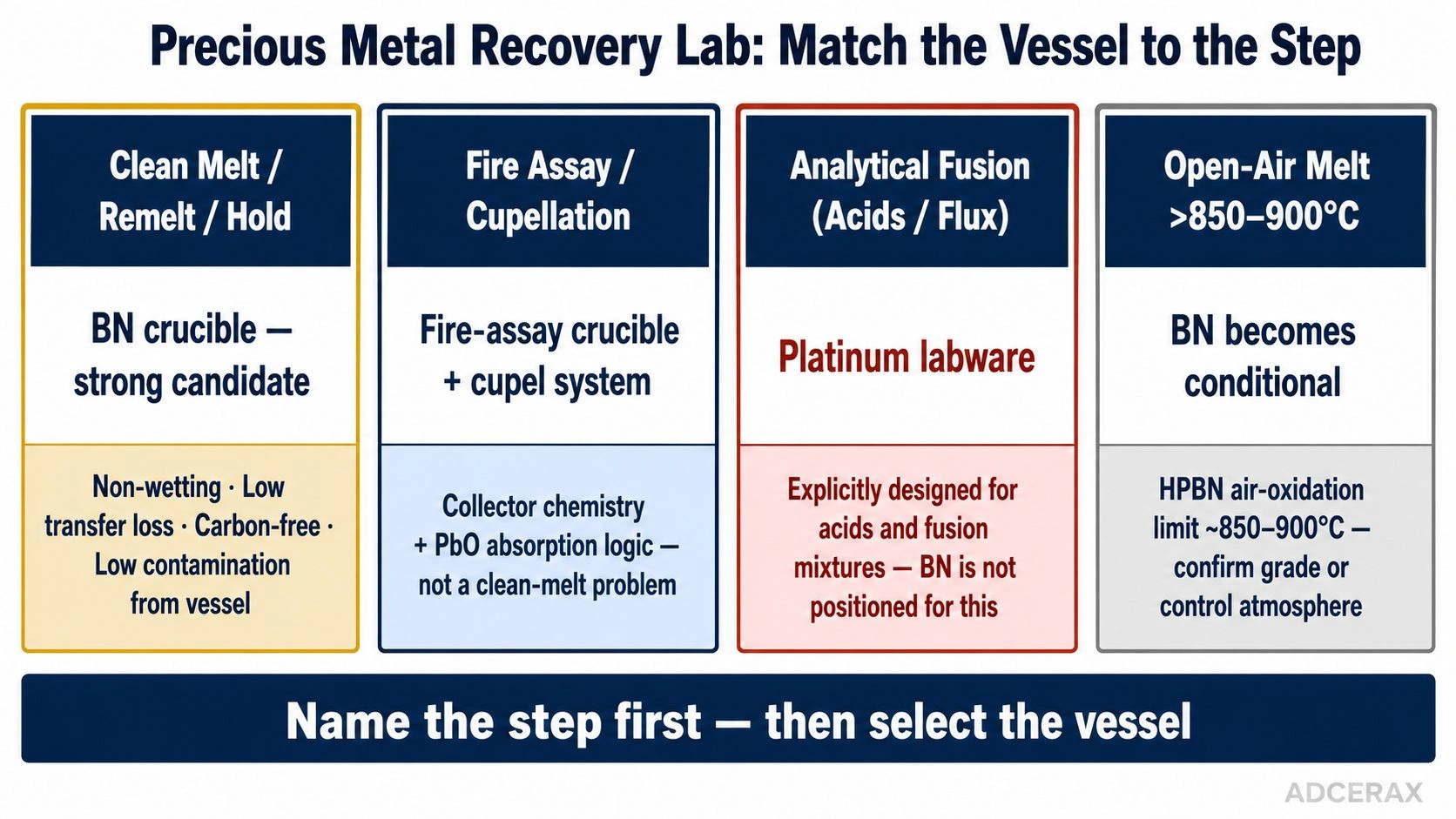
The Step-Fit Matrix below maps this logic to the four main laboratory configurations:
| Lab step | Best-fit logic | Why |
|---|---|---|
| Clean melting / remelting / holding of precious metals | BN crucible is a strong candidate | BN is non-wetting to most molten metals, low-stick, and explicitly positioned for precious-metal crucibles and high-purity molten-metal contact |
| Fire-assay preconcentration | Use fire-assay crucible / cupel route | Fire assay is built around fusion-and-collector logic using purpose-designed crucibles and cupels; this is not a clean-melt problem |
| Analytical fusion with acids or fusion mixtures | Use platinum labware route | Platinum labware is explicitly marketed for acids and fusion mixtures in laboratory analytical preparation |
| Open-air high-temperature melt above ~850–900°C | BN becomes conditional | Typical hot-pressed BN grades have documented air-oxidation limits around 850–900°C; above that, route review is required |
Step-fit logic synthesized from sampled BN materials documentation, fire-assay analysis references, and platinum labware catalogs.
The ceramic crucible material options across alumina, zirconia, BN, and specialty grades for laboratory precious-metal work illustrate the same step-level discipline described above: each material belongs to a specific duty window, and the step must be named before the material can be selected.
What should go into the RFQ and operating SOP
A purchasing document for BN crucibles in a precious-metal recovery laboratory must resolve four questions before the material can be quoted correctly: what step, what atmosphere, what temperature, and what is the contamination mechanism being addressed.
The specification and operating checklist for ceramic labware components in precious-metal laboratory service:
- Step identity — specify clean melt, remelt, hold, transfer, or an adjacent step; do not write "precious metal recovery lab" without the step name.
- Metal family — specify gold, silver, palladium, platinum, or mixed precious-metal composition; some precious metals have specific reactivity considerations that affect refractory compatibility.
- Atmosphere — specify open air, inert gas (argon, nitrogen), reducing, or vacuum; BN's temperature capability varies substantially by atmosphere, and air service above approximately 850–900°C requires grade confirmation.
- Maximum temperature — state the planned peak temperature; for open-air service, confirm the planned temperature is within the BN grade's documented air-oxidation limit.
- Flux or salt contact — state explicitly whether any fire-assay flux, fusion mixture, or cupellation reagent will contact the BN crucible; if yes, BN is likely not the appropriate route for that specific step.
- BN grade — specify HPBN, binder-free high-purity grade, or PBN; these have different density, purity, and temperature ratings that affect both service life and contamination risk in precious-metal work.
- SOP step separation — require that the laboratory SOP explicitly identifies which steps use BN crucibles, which use fire-assay consumables, and which use platinum labware; the boundary must be documented at the operational level, not only in the purchasing document.
If the purchasing document says only "BN crucible for precious metal recovery," it has named the material but not the step. That leaves the application boundary undefined, which is where misspecification occurs.
Conclusion
BN crucibles belong in precious-metal recovery laboratories, but in a specific position: the clean melting, remelting, and holding steps where non-wetting behavior, low sticking, and carbon-free contact are the governing requirements. Fire-assay preconcentration and analytical fusion with platinum labware serve different laboratory functions with different vessel logic, and those boundaries should be explicit in both the RFQ and the operating SOP. A specification that names the step first and then the material will nearly always reach the right answer.
Specifying BN crucibles for precious-metal melting, remelting, or high-purity molten-metal handling? Send the metal family, planned step, operating temperature, atmosphere, and any flux or reagent contact requirements. ADCERAX engineers return a BN grade recommendation with temperature-limit confirmation, atmosphere compatibility, and purity documentation for the confirmed step; turnaround depends on inquiry complexity — no RFQ commitment required at this stage.
Frequently Asked Questions
Can BN crucibles be used for gold, silver, platinum, or palladium melts?
Yes, for clean melting, holding, and remelting they are a strong candidate. Published BN materials documentation from Precision Ceramics explicitly lists crucibles for precious metals among BN applications and describes BN as resistant to most molten metals. The key qualification is that this applies to clean-melt steps — the same logic does not automatically transfer to fire-assay, cupellation, or analytical fusion steps in the same laboratory.
Are BN crucibles a good default for fire-assay labs?
Not as a blanket default. Fire assay remains a standard and widely accepted route for gold and platinum-group element concentration and analysis, and that workflow is built around purpose-designed fire-assay crucibles, collectors, and cupels. BN's non-wetting, clean-melt logic is not what governs fire-assay performance — collector chemistry and cupellation behavior govern it. BN may coexist in the same laboratory for different steps, but it does not replace the fire-assay consumable system.
When is platinum labware better than BN in a precious-metal recovery lab?
When the step is dominated by acids or fusion mixtures. Current platinum labware catalogs explicitly market platinum for laboratory analytical fusion and acid-chemistry duties because of its documented resistance to those chemical environments. BN is not positioned for aggressive flux chemistry in the sampled source set, and the selection should be driven by the step's chemistry — not by a general preference for one material over another.
Can BN crucibles be used in open air for precious-metal melting?
Yes, within a temperature limit. A representative Precision Ceramics hot-pressed BN grade datasheet lists approximately 850°C in air as the service limit, and published BN FAQ sources place the oxidation-resistance ceiling around 900°C. Above that range in oxidizing conditions, the material begins to oxidize, which changes its surface properties and contamination profile. For open-air precious-metal melting above those temperatures, either the atmosphere must be controlled or a different crucible route must be evaluated.
What is the biggest specification mistake for BN in precious-metal labs?
Writing "BN crucible for precious metal recovery" without naming the exact step — clean melt, fire assay, or analytical fusion. Without the step name, the specification cannot confirm whether BN is appropriate or whether fire-assay ware or platinum labware should be specified instead. The step is the first and most important variable in any precious-metal laboratory crucible specification.