Technical Blog

Engineering Guides for Advanced Ceramic Components

Practical articles on material selection, operating conditions, failure prevention, and RFQ preparation for alumina, zirconia, silicon carbide, and boron nitride ceramics — written for engineers and industrial buyers.

Product catalog

Download the ADCERAX Ceramics Catalog

Materials, product forms, and manufacturing capabilities in one PDF — a quick reference for material selection and RFQ preparation.

Latest

Latest Technical Blogs

Selection, application, failure-prevention, and RFQ guides — updated regularly.

Sourcing alumina tubes for a solar cell diffusion furnace is a question about position before it is a question about

A buyer comparing boron nitride crucible quotes often sees prices from under $50 to near $1,000 on the same search

The question engineers ask when a SiC tube is specified for 1400°C furnace service is usually framed as a temperature

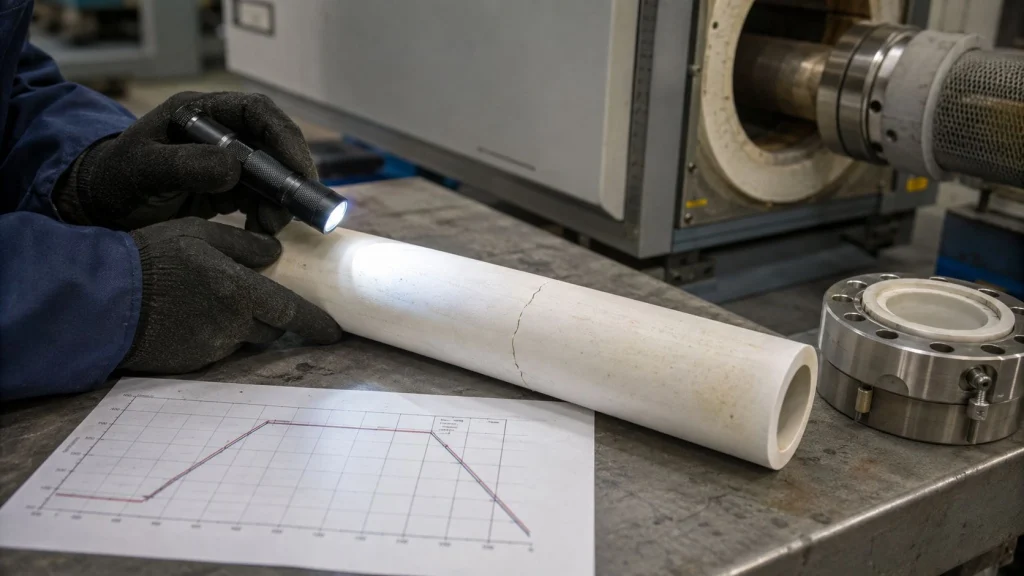
A cracked alumina tube in a tube furnace is not a single problem. It is a category of problems, and

Engineers investigating aluminum alloy casting inclusions usually encounter two kinds of advice that do not quite connect. Foundry literature emphasizes

Specifying an RBSC tube for a chemically demanding service is not the same question as specifying a dense SiC tube.

The container question for rare-earth oxide calcination is rarely a question about temperature alone. A 1500°C-rated alumina crucible can comfortably

The grade decision for a silicon carbide tube — pressureless sintered (SSiC), reaction-bonded (RBSC, also written SiSiC), or nitride-bonded (NBSC)

Engineers reach for boron nitride crucibles when graphite oxidizes, when alumina contaminates the melt, or when an evaporation source needs

A specification-grade discussion of why alumina tubes that "survive" 1500–1700°C in catalog terms can still fail in continuous service, and

A crystal growth engineer specifying a BN crucible faces a choice that looks like two grades of the same ceramic

A technical decision framework for engineers weighing boron nitride against graphite when graphite keeps failing in service. Graphite has been

High-temperature assemblies fail when a “safe” number hides time, cycling, and damage. Escalating thermal loads amplify risk. A usable limit

High-temperature systems frequently fail when heat transfer assumptions deviate from real material behavior, particularly once ceramics are expected to perform

High-performance systems often fail prematurely when material chemistry is misjudged under aggressive media. Misalignment between environment and material stability remains

Unexpected fracture remains one of the most disruptive failure modes in oxide ceramic components, often occurring without visible warning and

High-performance zirconia components often fail to meet expectations because density assumptions are oversimplified or incorrectly generalized across stabilized systems. Zirconia

Unexpected frictional behavior remains one of the most frequent causes of premature ceramic component failure, especially when zirconia parts are

Unexpected surface roughening and strength loss can arrive quietly; consequently, unrecognized degradation triggers microcracking, performance drift, and premature fracture in

High mechanical loads, brittle failure risks, and long-term reliability often limit material choices in demanding engineering systems. Consequently, zirconia ceramic

High-performance ceramics frequently fail when property assumptions oversimplify real conditions; consequently, zirconia ceramics demand a precise property-level understanding to avoid

High-performance engineering systems often fail at the material–component interface; therefore, advanced ceramics increasingly define reliability limits in real industrial equipment.

Ceramic components can fail abruptly under heat and stress; consequently, zirconia demanded decades of scientific corrections before dependable service became

High-duty industrial systems frequently fail when conventional materials reach mechanical, thermal, or chemical limits. Consequently, zirconia ceramic material emerges where

Alumina Plate for Heavy Industrial Systems Wear Lining Performance

Alumina Plate for Heavy Industrial Systems Wear Lining Performance

Alumina Plate linings often fail too early; consequently, abrasion, impact, and corrosion accelerate downtime, while maintenance teams struggle with recurring...
2026-01-15
Read More
HPBN hot-pressed BN crucible in vacuum furnace and air atmosphere furnace temperature limit atmosphere comparison

What Is the Max Temperature of a BN Crucible?

The maximum temperature of a BN crucible is not one number. For hot-pressed BN, sampled supplier data cluster around about...
2026-06-07
Read More
thin film alumina substrates final engineering evaluation scene

Thin Film Alumina Substrates for Advanced Thin Film Systems

In advanced thin-film manufacturing, the alumina substrate serves as the foundational platform upon which electrical, thermal, and mechanical behaviors are...
2026-01-10
Read More
Rectangular Alumina Trays in High Temperature Processing

Rectangular Alumina Trays in High Temperature Industrial Operations

Alumina Trays fail quietly until warpage, contamination, or cracking disrupts runs. Consequently, engineers need Rectangular Alumina Trays that keep geometry...
2026-01-22
Read More
BN boron nitride crucible TGA thermal analysis above 1500°C vacuum inert atmosphere alumina limit selection engineering

BN in Thermal Analysis Above 1500°C: Beyond Alumina Limit

BN can be useful in thermal analysis above 1500°C when the test runs in vacuum, dry argon, dry nitrogen, or...
2026-06-15
Read More
Alumina Ceramic as a Functional Material in Modern Food Processing Systems

Alumina Ceramic Enabling Reliable Operation in Food Processing Systems

Alumina Ceramic is increasingly applied where food processing equipment faces wear, heat, and hygiene pressure simultaneously, yet conventional metals struggle...
2026-01-02
Read More

Working on a Custom Ceramic Part?

Send your drawing, material requirement, dimensions, tolerance, and working conditions. Our engineering team reviews manufacturability before quotation.

Quick Quote

The more details you provide, the faster we can quote.

*We respond within 24 hours. All inquiries are confidential.

Get Your Custom Solution

The more details you provide, the faster we can respond.

customize size

*We respond within 24 hours. All inquiries are confidential.

Download Catalog