Specifying an RBSC tube for a chemically demanding service is not the same question as specifying a dense SiC tube. RBSC is a two-phase composite, and the second phase — residual metallic silicon left from infiltration — responds to several important service conditions very differently from the SiC skeleton around it. Engineers evaluating heat-exchanger tubes, thermocouple protection tubes, radiant tubes, and burner tubes under chemically aggressive conditions often reach for RBSC because of its geometry, dimensional control, and density. The correct follow-up question is whether the specific medium attacks free silicon first, and at what rate. This article traces that path: from free-silicon microstructure to media-specific corrosion behavior to a grade-routing rule that separates environments where RBSC remains a rational choice from those where SSiC is the better answer.
Free silicon changes RBSC tube chemical resistance because RBSC is not a single-phase SiC ceramic — it is a dense SiC–Si composite, and the residual silicon phase is less stable than SiC in several important service conditions, particularly high-pH media, HF-containing environments, and high-temperature windows that approach silicon's thermal limit. In practice, chemical resistance in RBSC tubes is often controlled first by what happens to the free-silicon phase, not by the SiC grains themselves. Lowering residual Si content improves the chemistry window, and aggressive media often force the grade decision toward SSiC.
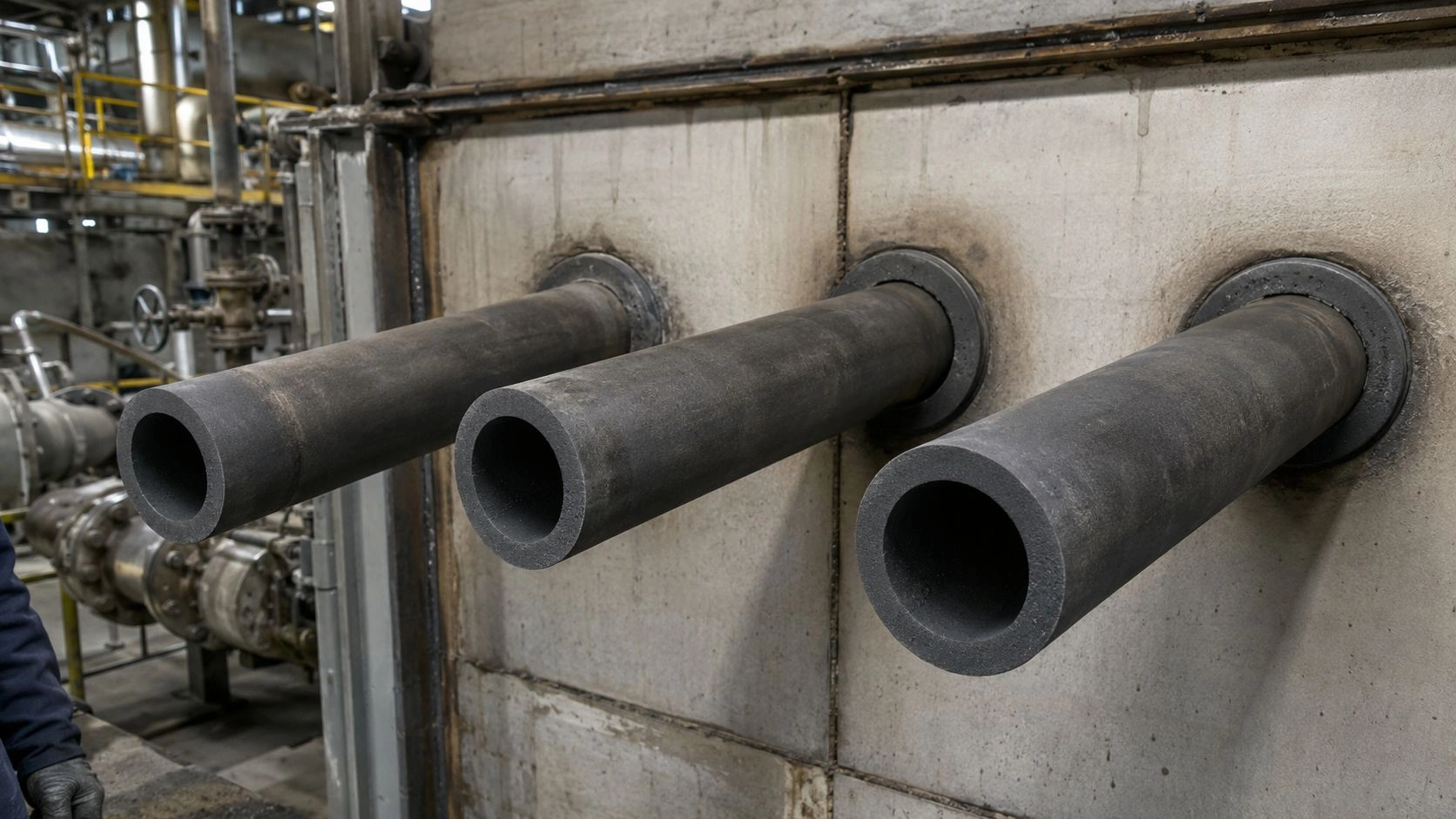
RBSC tubes combine excellent dimensional control and low porosity with a residual silicon phase that becomes the primary chemical variable in aggressive service.
Why free silicon is the weak phase in RBSC tubes
RBSC tube behavior is controlled by a microstructural fact that many datasheets mention but rarely interpret: RBSC is not a monolithic SiC ceramic. It is a SiC–Si composite in which the remaining pore space left after a SiC/carbon preform is siliconized becomes filled by metallic silicon. For screening, treat RBSC residual free silicon as ~15 wt% nominal (confirm phase basis — wt% vs vol% — and test method on the COA or drawing). Residual infiltrated Si is route-dependent across commercial grades; do not treat a broad literature band as an ADCERAX contract window. That second phase is what gives RBSC its near-net geometry advantage during processing, high density, and strong dimensional control for long or complex tube geometries — with open porosity typically ≤0.1 vol% on RB screening grades (not a zero-porosity hermetic claim without a leak spec). It is also the phase that becomes chemically decisive, because free silicon is less stable than SiC in several corrosive and high-temperature environments. Once the service medium can selectively attack silicon, RBSC's chemical resistance stops being governed by the SiC skeleton alone.
Commercial RBSC routes vary in residual free silicon; some lower-residual-Si RBSC routes exist — confirm the vendor grade sheet rather than assuming a published competitor threshold. Some research or process routes aim to reduce residual Si and refine hardness/microstructure — that is not an ADCERAX catalog grade claim. SSiC, by contrast, is pressureless sintered with no infiltrated free-silicon phase (TDS wording) — not an analytical 0.00% guarantee. Where useful for grade orientation, SiC content screens at 85 wt% nominal (RB) / ≥99 wt% (SS). That compositional difference is exactly what separates the chemical performance windows.
The quick-reference table below shows the composition and performance trade-off across the grade range.
| RBSC / SSiC route | Typical free Si content | What improves | What remains limited |
|---|---|---|---|
| Typical commercial RBSC / SiSiC | ~15 wt% nominal (screening; confirm wt% vs vol% on COA/drawing) | Density, near-net processing, dimensional control; open porosity ≤0.1 vol% (RB screening) | Alkali resistance and upper selection-temperature ceiling |
| Lower-residual-Si RBSC (commercial routes) | Route-dependent — confirm vendor grade sheet | May improve strength and resistance behavior vs high-residual routes | Still not equivalent to SSiC chemistry window |
| Minimized-residual-Si RBSC (research/process routes) | Reduced residual Si (not a catalog % claim) | Hardness and microstructural refinement may improve | Still a reaction-bonded route |
| SSiC | No infiltrated free-silicon phase (TDS) — not 0.00% analytical | Best dense-grade chemical resistance; SiC ≥99 wt% screening | Higher processing cost, less near-net-shape freedom |
Screening values; verify per supplier-specific grade, test method, phase basis, and service atmosphere. Not contract guarantees.
RBSC as a two-phase composite, not a single-phase ceramic
Dense SSiC and RBSC look similar on a hardness or flexural-strength table and nearly identical under normal tube handling conditions. The divergence appears when the corrosion environment is selective. A medium that attacks silicon preferentially will trace the silicon network through an RBSC tube and create a degraded path that has no equivalent in a single-phase SSiC body. Framing RBSC as a composite rather than a "SiC product with minor silicon" is therefore not a semantic distinction — it is the engineering premise that makes the rest of the grade decision legible.
Why free silicon improves processing but complicates chemistry
Silicon infiltration gives RBSC its manufacturing advantage: the SiC/carbon preform is shaped first, siliconized second, and emerges with near-net geometry and low open porosity (RB screening ≤0.1 vol% — not a hermetic zero-pore seal claim without a leak spec). The free silicon left from that process sits between the SiC grains as a contiguous or semi-contiguous metallic phase. In neutral or mildly acidic service below the silicon thermal limit, that phase coexists without incident. In alkaline, HF-bearing, or upper-range thermal service, it becomes the weak link that the grade decision cannot ignore.
How different media attack free silicon
The first important correction is that free silicon does not degrade RBSC equally across all media. The degradation mechanism depends on what the medium does to silicon specifically, not to SiC in general. The strongest published SiSiC corrosion evidence shows preferential dissolution of the silicon phase in NaOH, not uniform attack of the SiC skeleton. Published corrosion work on SiSiC explains the chemistry directly: silicon dissolves by forming soluble silicates in basic media, and residual silicon is identified as less stable than SiC at high temperature and in high-pH solutions. In many common acids, the picture is more nuanced, because silicon can form a passivating SiO₂ layer that limits attack — though electrochemical conditions can shift that balance and expose differences between the Si and SiC phases. In HF, the older corrosion literature is more direct: both SSiC and RBSC are chemically active rather than passivated, and in reaction-bonded material the residual silicon is specifically noted as removed. Treat alkali/HF/acid guidance as engineering screening only — medium, temperature, and time specific; qualify on the application (no corrosion-rate contract values). At the upper thermal limit, the free-silicon phase approaches its own thermal boundary, which is why initial material-selection ceilings place RBSC near 1380 °C, well below dense SSiC at 1600 °C — ceilings for selection, not continuous loaded-service life.

Free silicon responds differently to alkali, acid, HF, and elevated temperature — the medium determines whether it is the controlling variable or a tolerated impurity.
High-pH media: free silicon becomes the first dissolving phase
Alkaline service is the clearest trigger. In strong alkaline solutions, preferential corrosion of silicon is directly documented in the SiSiC corrosion literature: the silicon phase dissolves first by forming soluble silicates, while the SiC grains are attacked less rapidly. This means the chemical resistance of an RBSC tube in alkaline service is not governed by SiC's well-known alkali-resistant reputation — it is governed by how fast the free-silicon network is undercut. A dense SSiC tube, with no free-silicon phase, removes that first-failure path entirely.
Acid media: passivation can still make RBSC usable
Acidic service is more condition-dependent. In many common acids, silicon can form a passivating SiO₂ layer at the surface, which limits further attack. Published electrochemical work shows that the corrosion behavior of SiSiC in acids is more complex than in alkalis, with passivation possible under certain conditions. RBSC remains usable in a range of acidic environments where this passivation is stable, provided the service does not simultaneously present high temperature or electrochemical conditions that destabilize the oxide layer. The guidance is not "RBSC is acid-resistant" but "RBSC may remain acceptable in specific acids where silicon passivation holds."
HF and upper-temperature service: the free-silicon boundary becomes explicit
HF is the chemical limit. Corrosion literature on silicon carbide ceramics using conventional and electrochemical methods reports that both SSiC and RBSC are chemically active in HF environments rather than passivated — and in reaction-bonded material the residual silicon is specifically removed. HF is therefore not a medium where RBSC's silicon content can be treated as acceptable under any typical process condition — qualify medium, temperature, and exposure time on the application. The upper-temperature limit follows a different mechanism: as duty approaches the RB initial selection ceiling of 1380 °C, the free-silicon phase moves toward its own thermal boundary, which degrades mechanical and chemical integrity simultaneously. SSiC, which has no infiltrated free-silicon phase to soften, extends the selection ceiling to 1600 °C for tube applications — still not a continuous loaded-life guarantee; define atmosphere, load, and chemistry.
Where RBSC tubes are still acceptable
RBSC remains a rational tube choice whenever its processing advantages and dense microstructure matter more than the chemical weakness of the free-silicon phase. The material combines low open porosity (RB screening ≤0.1 vol%) with near-net processing, strong stiffness, and good thermal conductivity — properties especially valuable for long, dimensionally controlled tubes such as radiant tubes, heat-exchanger tubes, and protection tubes in moderate chemical service. In mildly acidic media where silicon passivation is stable, in oxidizing air atmospheres below the silicon-limited thermal range, and in service duties where abrasion resistance, thermal shock resistance, and geometry matter more than aggressive alkaline chemistry, RBSC can still be the correct tube grade. The free-silicon content becomes a liability only when the environment starts attacking silicon faster than the service can tolerate.
Not every chemical service forces a grade change. The relevant question is not "is free silicon present?" but "does this medium attack silicon faster than the application can absorb?"
The most common misread in this space is treating RBSC as broadly unsuitable once free silicon is understood as a weak phase. The more precise engineering position is that RBSC sits in a defined window of acceptable service conditions. Those conditions — medium acidity range, absence of HF, temperature below the silicon ceiling, and geometry-driven tube applications — describe a large fraction of real industrial tube services. The material only becomes wrong when the chemical or thermal boundary is crossed.
Geometry- and tolerance-driven tube applications
For long radiant tubes, large-diameter heat-exchanger bundles, and burner tubes with tight dimensional specifications, RBSC's no-shrink siliconizing route has no close competitor among SiC grades. SSiC shrinks during sintering, which makes large or geometrically complex tubes harder and more expensive to produce. Where the chemical service is moderate and dimensional precision matters more than the last margin of alkaline resistance, RBSC remains the better total-cost solution.
Chemically acceptable but not chemically universal service windows
RBSC has been used successfully in a wide range of industrial processes involving hot gas handling, mild acid contact, and oxidizing furnace atmospheres. Its service record in these conditions reflects the reality that many industrial service environments do not present the specific conditions — strong alkali, HF, or upper-range temperature holds — that specifically attack the silicon phase. That service record does not extend to conditions outside the passivation window.
When the tube spec should move from RBSC to SSiC
The tube spec should move toward SSiC when the service medium attacks the free-silicon phase faster than the RBSC design advantages can compensate. Three triggers are the most practically decisive.
The first is high-pH chemistry. Published SiSiC corrosion data show preferential silicon dissolution in alkaline solutions, and dense SSiC — with no residual silicon — is positioned by suppliers as the more universally corrosion-resistant dense-grade option in acids and bases. When alkalinity is not a brief or dilute excursion but a sustained service condition, the RBSC grade should be questioned from the start.
The second is HF exposure. Corrosion literature on SiC ceramics explicitly notes that RBSC loses its residual silicon in HF environments. There is no passivation pathway that rehabilitates RBSC for HF service the way acid passivation may in some non-HF acids.
The third is upper-temperature chemical stability. Initial material-selection ceilings place RBSC near 1380 °C and SSiC near 1600 °C; the reason is the free-silicon thermal limit, not SiC grain failure — ceilings are for selection screening, not continuous loaded-service life. When duty approaches the RB selection ceiling and chemistry attacks free Si, evaluate SSiC. A tube specification that requires operation near or above the RB ceiling in a chemically active atmosphere should not rely on RBSC.
The routing table below converts these triggers into a direct selection guide.
| Service condition | What free silicon does | RBSC impact | Better routing |
|---|---|---|---|
| High-pH / alkali solution | Preferentially dissolves to soluble silicates | Chemical resistance drops through Si phase first | Move toward SSiC |
| Common acid media (non-HF) | Can passivate via SiO₂ formation | RBSC may still remain usable | Case-by-case; RBSC still possible |
| HF-containing media | Residual silicon is removed; both phases challenged | RBSC loses its weak phase quickly | Avoid RBSC; evaluate SSiC with caution |
| Oxidizing air below silicon-limited range | Si can remain acceptable if scale is stable | RBSC often still usable | RBSC possible if chemistry is moderate |
| Near RB selection ceiling (~1380 °C) with active chemistry | Si phase approaches thermal limit | RB selection ceiling reached before dense SSiC (~1600 °C) | Evaluate / move toward SSiC (screening) |
The decisive question is not whether SiC in general is corrosion resistant, but whether the residual free-silicon phase remains chemically quiet in the target service medium. Values indicative; verify per actual service atmosphere and supplier-specific grade data.
Where the service window is clearly inside the acceptable RBSC range, cost and geometry arguments favor staying with RBSC. Where the window crosses any of the three triggers above, SSiC is the more defensible default. For tube-grade product options once routing is decided, see silicon carbide tubes; for non-standard media, geometry, or inspection requirements, use custom services.
The strongest counterintuitive finding here: the upper-temperature trigger and the alkaline-chemistry trigger often appear together in industrial hot process streams. A tube that runs near its RB selection ceiling in a process environment with any alkalinity is in double-jeopardy, because both failure modes are active simultaneously. Specifying RBSC for that service on the basis of its neutral-pH acid performance is the most common avoidable overextension of the grade.

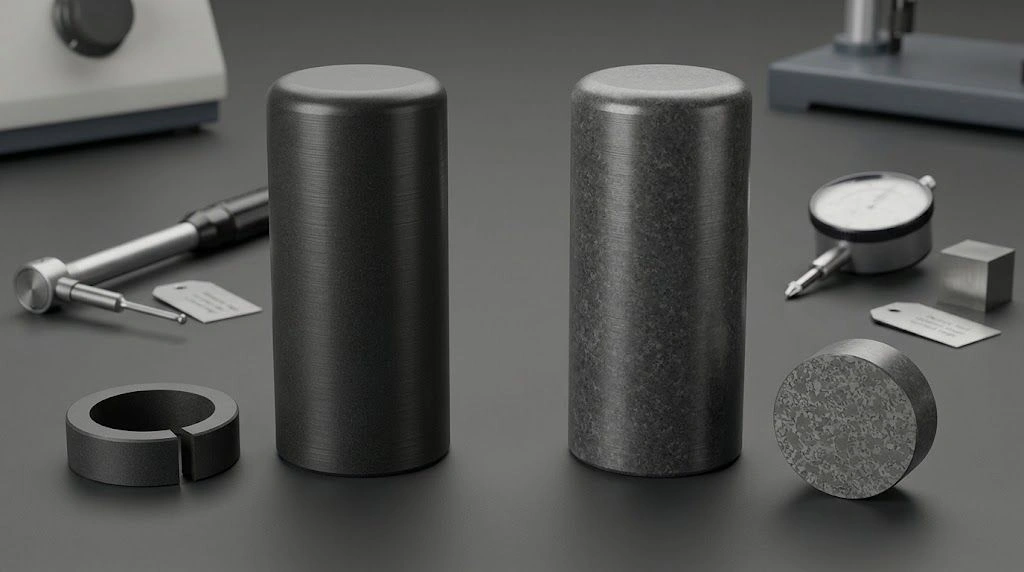
RBSC and SSiC tubes appear identical externally; the grade-routing decision lives in the chemistry the residual silicon phase encounters in service.
What to ask the supplier before approving an RBSC tube for corrosive service
Before approving an RBSC tube for corrosive service, request the data that actually expose the weak phase. Free-silicon content range, confirmed maximum service temperature by atmosphere, and any published corrosion guidance for the target medium — acid, alkali, HF concentration, or oxidizing environment — should all be on record before the tube enters service. A supplier offering "SiC tube" without distinguishing grade is not answering the chemical question. The distinction between RBSC and SSiC is not a fine technical point; it is the boundary between a tube whose residual silicon is the controlling variable and a tube whose silicon phase does not exist. That distinction should appear explicitly in the purchase specification for any chemically demanding service.
The verification checklist for an RBSC tube in corrosive duty:
Process-side items to specify
- Service medium chemistry: pH range, acid identity and concentration, presence or absence of HF, and whether alkalinity is sustained or intermittent.
- Peak service temperature and hold profile: confirm that the peak stays below the RB initial selection ceiling (1380 °C) with a safety margin — ceiling ≠ continuous loaded life.
- Atmosphere type: air, oxidizing gas, inert, or reducing — relevant because silicon oxidation and passivation behavior differ by atmosphere.
- Tube contact mode: flowing medium, static immersion, wet/dry cycling, or abrasion-plus-chemistry combination — each changes the effective corrosion rate on the silicon phase.
- Acceptable contamination level: whether trace silicon dissolution into the process stream is tolerable, which matters for high-purity or food/pharmaceutical-adjacent applications.
Supplier items to confirm
- Stated free-silicon content range for the specific tube grade being supplied — not a generic RBSC description but a grade-specific number.
- Maximum service temperature in the target atmosphere for the tube, not just the bulk material datasheet.
- Chemical compatibility guidance for the target medium from the supplier's own literature — especially explicit guidance for alkaline, HF, or mixed-acid service.
- Whether a lower-residual-Si RBSC route or SSiC is being offered as an alternative for the stated service window, and the supplier's explicit grade recommendation.
- Dimensional confirmation: OD, ID, wall thickness, length, end style, and whether post-siliconizing machining or grinding changes any surface composition that affects the contact layer chemistry.
Escalation rule
If the supplier cannot provide free-silicon content data, or cannot confirm chemical compatibility for the specific medium, treat the absence as an indicator that the tube has not been qualified for that service. Move the specification to SSiC and document the reasoning in the process engineering records.
Conclusion
Free silicon in RBSC is not a minor composition note — it is the variable that sets the chemical boundary for the tube in service. Where the medium is mild or passivating toward silicon, RBSC remains a strong choice because its processing advantages in geometry, density, and dimensional control are real. Where the medium is alkaline, HF-bearing, or thermally extreme, the free-silicon phase becomes the first failure path, and SSiC removes that path by design. The grade decision belongs in the chemistry review, not in a general-purpose SiC catalog selection.
Evaluating whether RBSC or SSiC is the right tube grade for a specific corrosive service? Send the process medium chemistry (acid, alkali, HF, or oxidizing gas), peak temperature, atmosphere, tube geometry, and whether residual free silicon is acceptable. A grade-fit review should return the recommended silicon carbide route, corrosion-window notes for the specific medium, and verification points on the COA/drawing — no RFQ commitment required at this stage.
Frequently Asked Questions
Does more free silicon always mean worse chemical resistance in RBSC tubes?
In chemically sensitive environments, higher free-silicon content generally means lower resistance, because free silicon is the less stable phase in high-pH media and certain other aggressive conditions. The severity depends on the medium — RBSC can still perform acceptably in some acidic or oxidizing services where silicon passivation is feasible. The variable is not free-silicon content in isolation; it is what the specific medium does to silicon at the operating temperature and hold time.
Why can RBSC still be widely used if free silicon is a recognized weakness?
Because the same silicon infiltration that leaves residual silicon also gives RBSC near-net geometry, low open porosity (≤0.1 vol% RB screening), excellent dimensional control, and strong stiffness — properties that are highly valuable in long or precise tube applications. The material remains useful as long as the chemistry window does not attack the silicon phase too aggressively, and the majority of industrial tube service environments do not present the specific alkaline, HF-bearing, or thermally extreme conditions that activate the silicon-phase failure path.
Is alkali always the clearest red flag for RBSC?
It is one of the clearest. Published SiSiC corrosion work shows preferential silicon dissolution in NaOH, making sustained alkaline service a strong warning condition for any tube containing free silicon. HF is equally direct — corrosion literature specifically notes that residual silicon is removed from RBSC specimens in HF environments. Both triggers should be treated as grade-change indicators without further optimization of the RBSC route.
When should the tube spec move directly to SSiC rather than adjusting RBSC?
Move to SSiC when the service medium is strongly alkaline, HF-containing, or the tube must operate near or above the RB initial selection ceiling of 1380 °C with active chemistry. At those conditions the free-silicon phase becomes a first-order liability rather than an acceptable processing trade-off, and the compositional difference between RBSC and SSiC — residual infiltrated silicon versus no infiltrated free-silicon phase — directly translates into a service-window difference that cannot be corrected by reducing silicon content within the RBSC route alone.
Related reading
- Active vs passive oxidation in SiC failure modes — Where SiC failure is driven by active vs passive oxidation — a different atmosphere path than free-silicon attack in alkaline or HF media.
- SiC heat-exchanger tubes: design and selection — How SiC heat-exchanger tube design choices differ from the free-silicon chemical-boundary decision on RBSC grades.
- ReSiC tubes for ultra-high temperature — When ultra-high-temperature duty points to recrystallized SiC tubes instead of dense RBSC with residual free silicon.