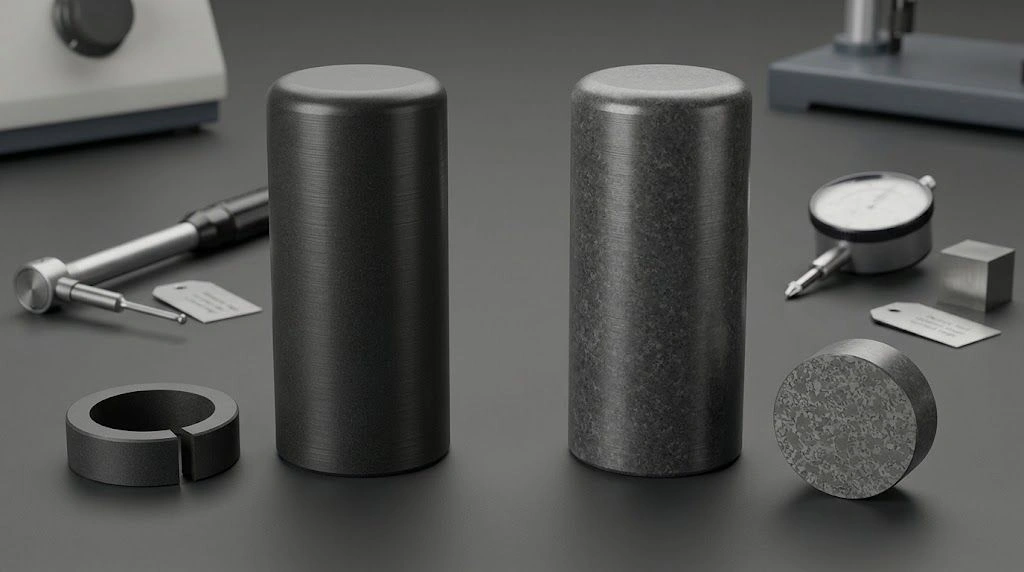
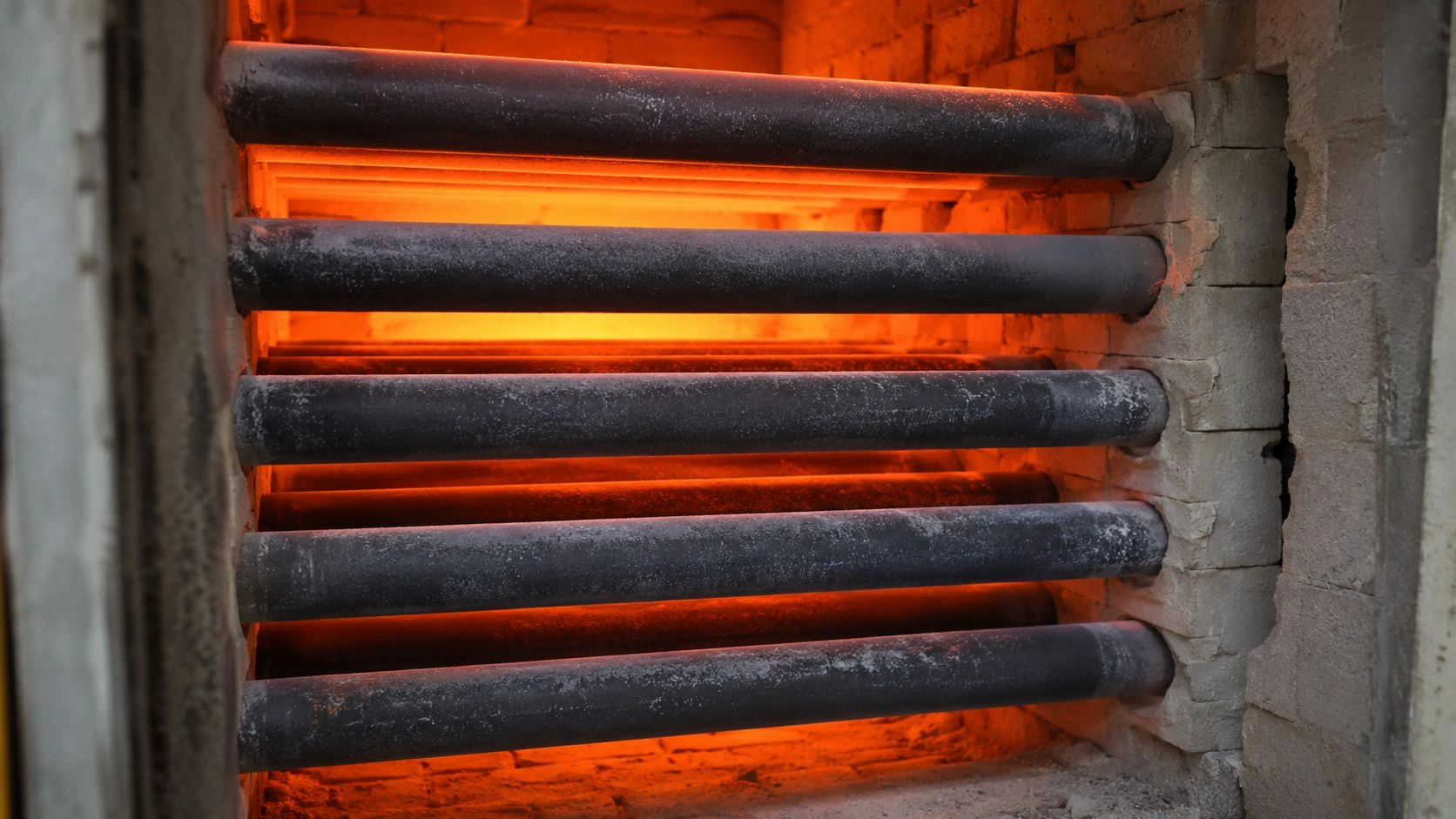
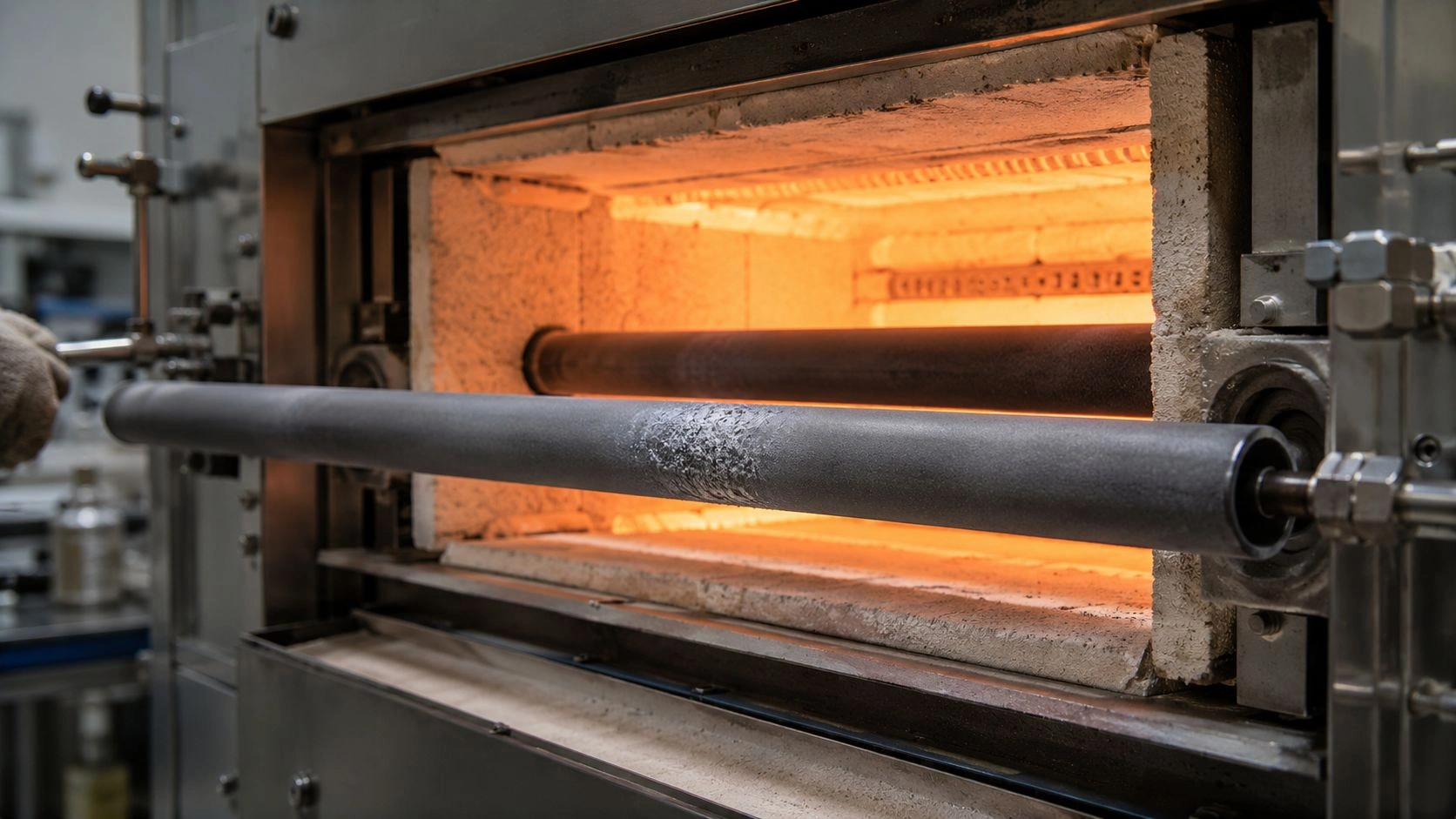
Dense SSiC tubes become expensive to machine because fully sintered silicon carbide is already at near-final ceramic hardness after sintering — extremely hard, wear-resistant, and brittle — so tight final dimensions require slow diamond grinding rather than conventional cutting. Cost rises sharply when drawings require tight ID/OD tolerance, long straightness, OD/ID concentricity, thin walls, deep internal grinding, low Ra surface finish on large areas, or large material removal after sintering. The best cost control is functional tolerancing combined with green machining before sintering wherever geometry allows — reserving post-sintering diamond grinding for the surfaces that actually control sealing, alignment, fit, or flow.
Understanding where the cost comes from — diamond grinding time and tool wear, not raw material — is the starting point for writing a specification that achieves the required function at a manageable cost.
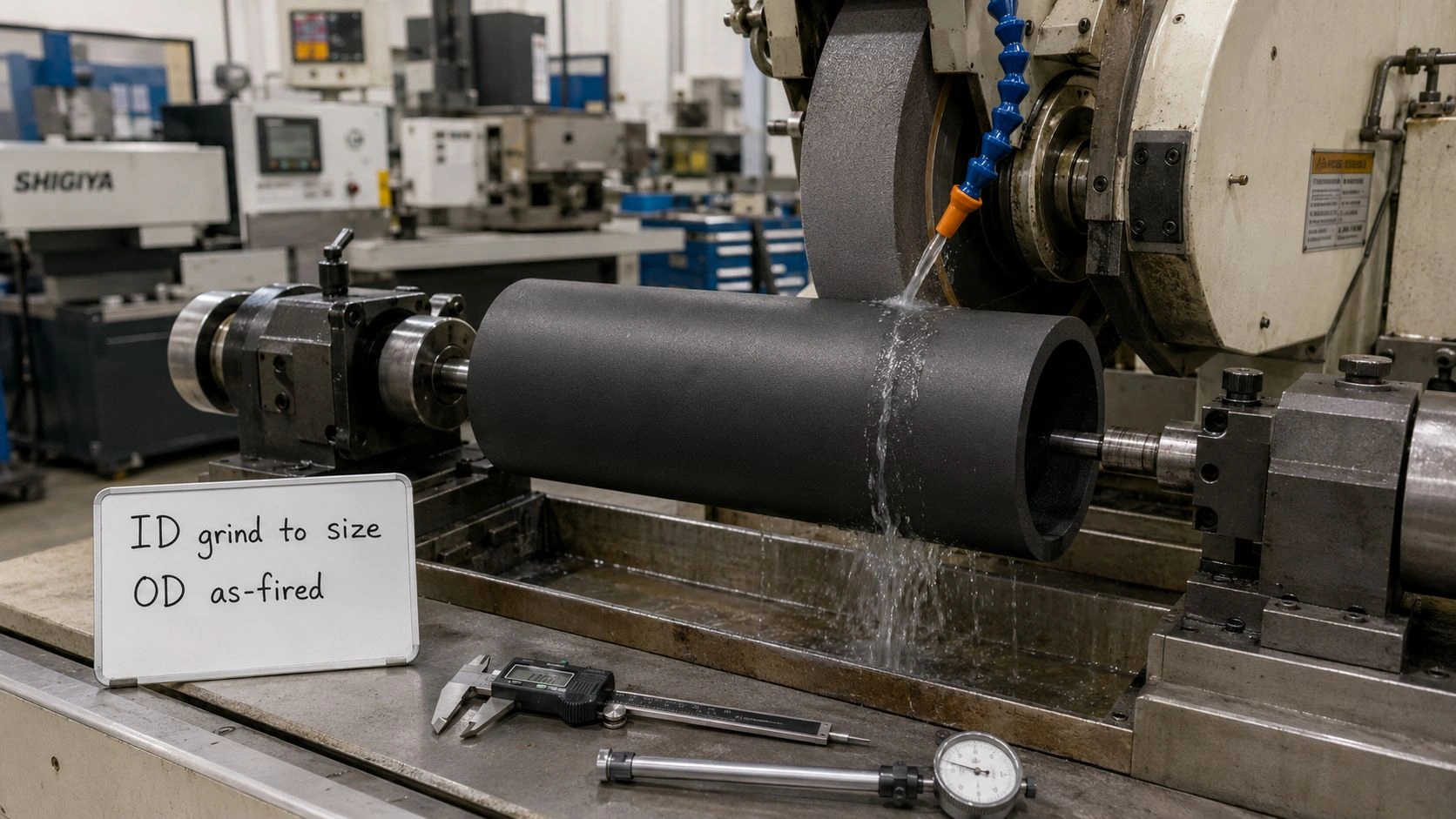
Dense SSiC tube machining cost is driven by post-sintering diamond grinding time — ID access, concentricity, straightness, and surface finish requirements each add grinding area, setup, inspection, and scrap risk.
This article is part of ADCERAX's coverage of silicon carbide tubes for high-temperature, chemical-resistance, and precision mechanical applications, which includes SSiC, RBSiC, and NSiC grades with custom machined dimensions, tolerances, and surface finishes.
Why dense SSiC tubes are expensive to machine
The first cost correction most engineers need when reviewing an SSiC tube quote is the realization that the price is not primarily about raw material. Dense SSiC raw material — the powder, binder, pressing, and sintering — is a significant cost, but it is relatively predictable. The variable that drives large cost differences between geometrically similar SSiC tubes is the post-sintering machining scope, and particularly the diamond grinding time.
Published technical documentation on hard ceramic machining confirms the mechanism directly: diamond grinding is used as a finishing technique for hard technical ceramics including sintered silicon carbide to improve surface finish and achieve tight dimensional tolerances. A 2023 review on SiC ceramic precision grinding establishes that SiC machining is limited by serious tool wear, low machining efficiency, and surface-quality challenges caused by the material's high hardness and wear resistance. These are not edge-case observations — they reflect the fundamental physical constraint that a fully sintered SSiC tube cannot be cut with conventional carbide tooling at economical speeds and must be ground with diamond abrasive at relatively slow material removal rates.
Dense SSiC is not cut like metal after sintering. After full sintering at temperatures above 2000°C, SSiC reaches a Vickers hardness around 2500–2800 HV — harder than most machining tool materials except diamond. The material cannot be turned, milled, or drilled with conventional tooling at acceptable tool life or dimensional accuracy. Every tight-dimension feature on a finished SSiC tube is the result of diamond grinding after sintering, or of green machining before sintering with sintering shrinkage carefully accounted for.
Diamond wheel wear and slow material removal. Diamond grinding removes material at much slower rates than metal machining and wears the grinding wheel progressively. For SSiC, wheel wear is significant because the material's hardness accelerates abrasive degradation. The grinding process must be interrupted for wheel dressing, measurement, and setup verification, all of which add time that appears in the quote. Longer grinding time, more dressing cycles, and more inspection steps directly translate to higher part cost.
Why tubes are harder than plates, rings, or simple bushings. A flat plate or simple ring is ground from accessible external surfaces. A tube requires grinding of the internal bore — a smaller, more confined space where tool overhang is limited, coolant delivery is restricted, chip evacuation is more difficult, and in-process measurement is harder. Long tubes compound these challenges because the grinding tool must traverse a longer path with consistent contact force while the tool deflects from its own weight and the workpiece vibrates. Every millimeter of additional tube length or every millimeter of bore depth that requires grinding adds cost in proportion to the grinding challenge, not the material cost.
The cost drivers: ID grinding, concentricity, straightness, and surface finish
After understanding that diamond grinding time is the cost variable, the next question is which drawing features drive that time fastest.
[CITE: Published research on SiC ceramic precision grinding identifies serious tool wear, low machining efficiency, and surface-quality challenges as the fundamental constraints — and grinding surface finish documentation confirms that achieving specified Ra on hard ceramics depends on operational parameters including wheel dressing, grit size, coolant delivery, and machine condition — establishing that every additional specification requirement imposed on a dense SSiC tube surface translates directly to additional grinding setups, dressing cycles, and inspection time, not simply to proportionally longer machining passes.]
The Dense SSiC Tube Diamond Grinding Cost Driver table below maps each drawing feature to its cost mechanism and a lower-cost specification path:
| Cost driver | Why it raises cost | Lower-cost specification path | RFQ question |
|---|---|---|---|
| Long ID grinding | Low tool rigidity, difficult coolant and measurement access | Grind only sealing or flow-critical ID zones | "Which ID length is functional?" |
| Tight OD/ID concentricity | Requires controlled datums and multiple setup checks | Define functional datum surfaces only | "Which surface is assembly datum?" |
| Long straightness requirement | Length amplifies small deviations | Specify straightness only where alignment matters | "What straightness is functionally required?" |
| Full-surface low Ra | Increases grinding area and inspection time | Apply Ra only to sealing, flow, or sliding zones | "Which surfaces need Ra control?" |
| Thin wall | Higher fracture and distortion risk | Increase wall where possible or relax ID/OD stack | "What is minimum functional wall?" |
| Holes and slots | Edge chipping and extra finishing risk | Green machine rough features; finish only edges that matter | "Are edges functional or clearance only?" |
| Tight end parallelism | Requires additional face grinding and inspection | Control only sealing or mounting end faces | "Which end face is datum?" |
Values are qualitative; verify with supplier-specific SSiC grade data, drawing review, and trial grinding results.
ID grinding and deep bore access. ID grinding is the highest-impact single cost driver for SSiC tubes because the constraints are multiplied by geometry. The grinding spindle must fit inside the bore, which limits its diameter and therefore its stiffness. A stiffer tool can take more aggressive cuts; a slender internal grinding mandrel deflects under cutting force and must advance slowly. As bore depth increases, all these problems are amplified. For a tube with a sealing zone at one end, specifying the ground ID zone to only that end reduces grinding time dramatically compared to specifying a ground ID over the full tube length.
OD/ID concentricity vs separate tolerances. Specifying OD tolerance and ID tolerance separately allows them to be ground in separate setups. Specifying concentricity requires that the two surfaces share a datum reference and be controlled as a functional system — which usually requires a more complex grinding sequence, additional fixture setup, and additional measurement steps. If concentricity is functionally required by the application (rotating components, precise annular flow clearances), it must be specified. If concentricity is implied habit rather than functional requirement, removing it from the drawing can meaningfully reduce cost.
Straightness over long SSiC tubes. Straightness deviation in a ceramic tube is a consequence of residual stress distribution in the sintered blank and of the grinding process itself. For short tubes, straightness control is usually achievable without major cost impact. For tubes above 300–400 mm length, straightness becomes a more significant specification because any measurable curve must be corrected by grinding material from the convex side of the tube — which may require multiple light passes and in-process measurement. If the application tolerance is generous relative to typical sintered straightness, specifying straightness only where it affects function avoids unnecessary correction grinding.
Surface roughness where it matters, not everywhere. Surface finish (Ra) requirements increase grinding time when applied to large areas. A sealing zone that requires Ra 0.4 μm or finer is a genuine engineering requirement. The same Ra applied to the entire OD and ID of a 500 mm tube when only a 30 mm sealing length is functional multiplies the grinding time without improving the tube's performance. Functional surface finish zoning — applying Ra to the specific surface zones that control sealing, bearing, sliding, or flow — is one of the most practical DFM improvements available for dense SSiC tube specifications.
Do not misdiagnose diamond grinding cost as supplier markup
When an SSiC tube quote is significantly higher than expected — or significantly higher than quotes received for RBSiC or alumina tubes of the same nominal dimensions — the cause is almost always drawing-driven machining scope, not supplier pricing behavior.
Raw material cost vs grinding cost. Dense SSiC raw material, pressing, and sintering costs are relatively consistent across qualified suppliers for comparable part sizes. The major variable between quotes for the same part is how each supplier interprets the grinding scope from the drawing. A supplier who reads the drawing as requiring final diamond grinding on every toleranced surface will quote far more time than a supplier who identifies that most surfaces can be green-machined plus sintered.
Tolerance stacking vs functional tolerance. Tolerance stacking occurs when multiple tolerances are specified — OD, ID, concentricity, straightness, roundness, end parallelism, and surface finish — as individual requirements on the same part, and each pushes the others to require additional grinding for control. The total cost of the stack can be several times the cost of grinding any single feature. Functional tolerancing — specifying only the tolerances that directly control assembly, sealing, alignment, or flow — removes tolerance stacking from the cost calculation.
Inspection cost and scrap risk. Every tolerance requirement in a dense SSiC tube specification adds inspection time. CMM measurement, bore gauging, roundness measurement, surface roughness assessment, and visual edge inspection each add direct cost. More importantly, each inspection step provides an opportunity to find out-of-tolerance parts — and for SSiC, a part that fails inspection cannot be reworked by conventional means. Scrap risk is real and is built into supplier quotes as a probability-weighted cost. Complex, tight specifications increase scrap probability and therefore increase the price needed to deliver qualified parts.
Why "same drawing" generates different supplier assumptions. Suppliers who have not previously made the specific part must interpret drawing notes, tolerances, and surface finish callouts from scratch. If the drawing does not clearly identify which surfaces are functional and which are non-critical, different suppliers will make different assumptions — and price accordingly. Explicit DFM annotations on the drawing ("grind to size," "as-fired surface acceptable," "green machined + sintered") reduce quote variability and allow accurate cost comparison between suppliers.
The Misdiagnosis Matrix below maps common quote symptoms to better diagnostic questions:
| Quote symptom | Common assumption | Better diagnostic question |
|---|---|---|
| Price much higher than RBSiC tube | Supplier markup | Does dense SSiC require final diamond grinding for all critical features? |
| Long lead time | Poor supplier planning | Are ID grinding, straightness, and concentricity driving setup time? |
| High cost for small batch | Material cost issue | Is setup and inspection cost spread across few pieces? |
| Supplier asks to relax Ra | Capability problem | Is full-length low Ra actually functional? |
| Supplier rejects thin-wall design | Supplier unwillingness | Is grinding force or chipping risk too high? |
| Different quotes from suppliers | Unfair pricing | Are suppliers interpreting datum and grinding scope differently? |
| High inspection cost | Excess QA | Are concentricity, straightness, and surface finish all specified together? |
Quote differences should be diagnosed against drawing scope interpretation before changing suppliers.
Green machining vs post-sintering diamond grinding
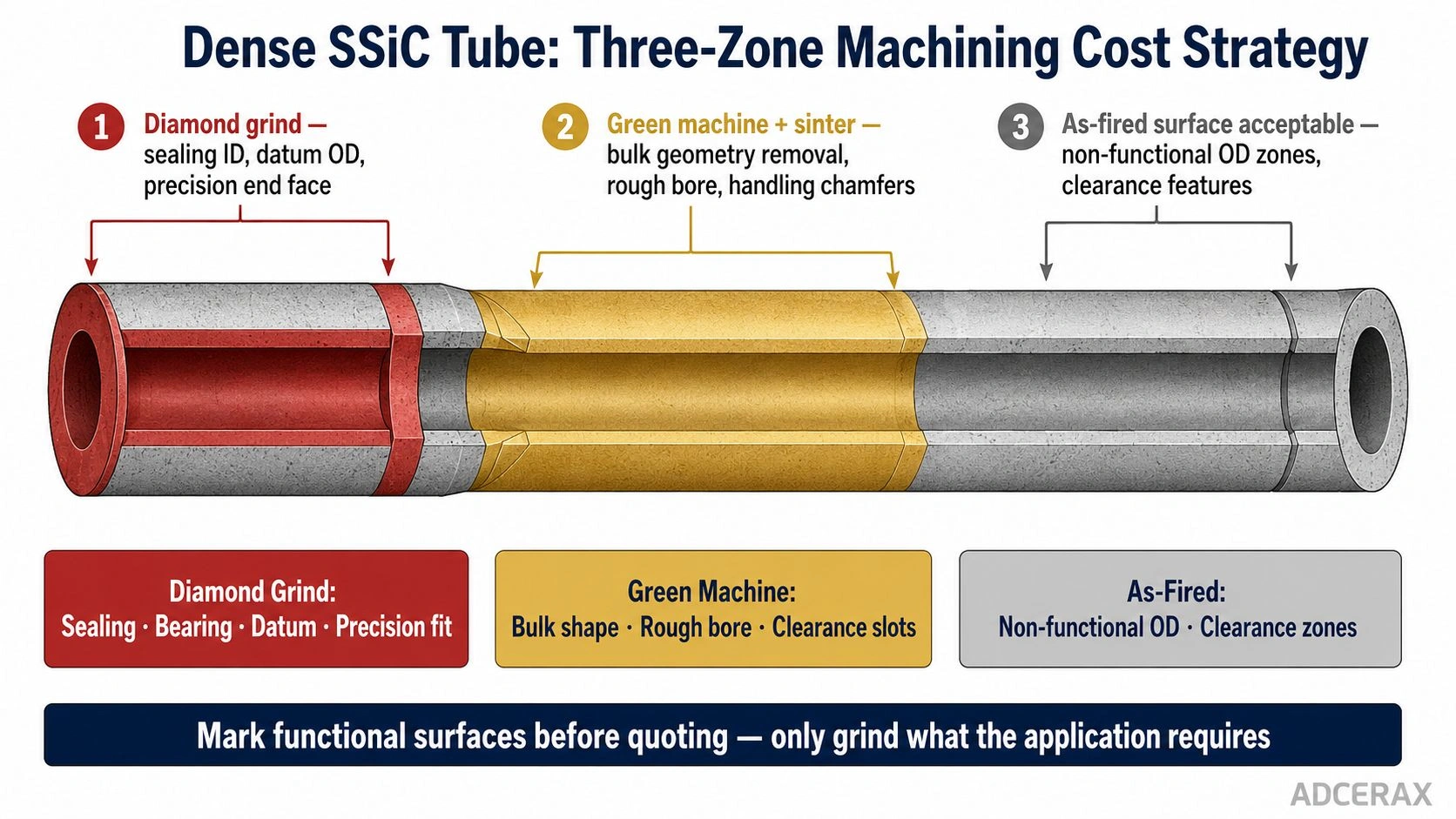
Dense SSiC tube cost control requires splitting the part into three zones: as-fired surfaces, green-machined features, and post-sintering diamond-ground functional surfaces — only the last category requires full grinding cycle time.
After identifying which drawing features drive diamond grinding cost, the manufacturing route decision assigns each feature to the most economical process that still meets its functional requirement.
The Green Machining vs Post-Sintering table maps feature types to their processing route:
| Feature type | Green machining fit | Post-sintering diamond grinding needed when | Cost note |
|---|---|---|---|
| Bulk OD/ID geometry | Good when tolerance is moderate | Final fit, sealing, or precision alignment required | Near-net blank reduces removal |
| Length cut | Good with shrinkage allowance | Exact length and parallel end faces required | Face grinding adds setup |
| Holes/slots | Useful for rough geometry | Sharp location, edge finish, or sealing around hole required | Edge chipping must be controlled |
| Chamfers | Good for handling chamfers | Functional sealing or assembly chamfers required | Specify only functional edges |
| Full bore finish | Usually not ideal for final precision | Flow, sealing, or bearing surface demands low Ra | Deep ID finish is costly |
| Datum surfaces | Rough datum may be formed | Assembly datum must be precise | Keep datum count low |
| Decorative finish | Avoid for industrial tubes | Rarely justified | As-fired surface may be enough |
Features suitable for green machining. Any tube feature that can tolerate sintering shrinkage — typically 15–20% linear for SSiC depending on the blank route — and does not require final micron-level dimensional accuracy can be produced by green machining before sintering. This includes bulk geometry removal (reducing from a large pressed blank to near-tube form), rough bore through-holes, clearance slots, and handling chamfers. The silicon carbide ceramic material grades — SSiC, RBSiC, and NSiC — have different shrinkage characteristics, and the supplier must plan the green-machined blank dimensions to compensate for the expected sintering shrinkage before final grinding.
Features that require final diamond grinding. Functional surfaces that control assembly, sealing, alignment, or sliding fit cannot rely on green machining plus sintering alone. Sintering introduces geometric variation from temperature gradients, particle rearrangement, and residual stress that cannot be predicted precisely enough for tight tolerance applications. Post-sintering diamond grinding of datum OD surfaces, sealing ID zones, precise end faces, and chamfers that control assembly alignment is unavoidable for tight-tolerance SSiC tubes. The design discipline is to minimize the area of these surfaces by clear functional zoning on the drawing.
Cost-aware datum strategy for SSiC tubes. Every additional datum surface that must be diamond ground to reference quality adds setup, inspection, and verification time. A cost-aware datum strategy selects the minimum set of functional surfaces as datums — usually the primary mating OD and the sealing ID zone — and specifies the remaining surfaces relative to those. This keeps the grinding sequence short and the inspection scope manageable.
The silicon carbide mechanical components at ADCERAX — precision-ground SiC wear rings, seal faces, bushings, and rotating parts — apply the same functional zoning logic: identifying which surfaces control function and grinding only those, while allowing non-functional surfaces to remain at lower cost finishing levels.
The ceramic tubes and pipes across alumina, SiC, zirconia, BN, and ZTA provide cross-material context for cases where machining cost makes another ceramic worth evaluating — alumina tubes, for example, can achieve comparable service life in less aggressive environments at lower machining cost because alumina's lower hardness reduces diamond grinding time.
RFQ checklist for dense SSiC tube machining cost control
A complete RFQ for machined dense SSiC tubes must communicate the functional intent of each drawing requirement — not simply list tolerances — so the supplier can confirm which surfaces require post-sintering diamond grinding and which surfaces can be produced more economically.
[CITE: Engineering guidance on dense SSiC tube machining specification confirms the RFQ discipline: mark which surfaces require post-sintering diamond grinding, identify the functional datum, specify surface roughness only on sealing/flow/sliding zones, state concentricity and straightness only where assembly or function requires it, and ask the supplier to confirm achievable tolerances, scrap risk, and whether a drawing manufacturability review is recommended before quoting — because a supplier who receives only "SSiC tube, tight tolerance" cannot distinguish functional from non-functional grinding scope, cannot allocate scrap risk correctly, and cannot provide a stable quote without the remaining specification context.]
| RFQ field | Why it matters | Recommended wording |
|---|---|---|
| SSiC grade | Defines density and machining behavior | "Quote dense SSiC; state density/open porosity" |
| Functional surfaces | Prevents over-grinding | "Mark surfaces requiring final grinding" |
| OD/ID tolerance | Controls grinding scope | "Separate as-fired, green-machined, and ground tolerances" |
| Concentricity | Requires datum strategy | "Define datum surface and inspection method" |
| Straightness | Length-sensitive cost driver | "Specify straightness only over functional length" |
| Surface roughness | Can multiply grinding time | "Apply Ra only to sealing/flow/sliding zones" |
| Wall thickness | Controls breakage risk | "Confirm minimum grindable wall after sintering" |
| Holes/slots | Edge chip risk | "State whether edges require post-grind chamfer" |
| Inspection method | Avoids quote mismatch | "Confirm CMM, bore gauge, optical, or roundness method" |
| Quantity/batch | Affects setup allocation | "Quote prototype and production quantities separately" |
RFQ fields are the minimum for a machined dense SSiC tube inquiry; add mating component drawing, assembly fit description, and operating temperature for complete manufacturability review.
The most productive first step before sending a dense SSiC tube drawing to suppliers is to mark the functional surfaces on the drawing in a DFM annotation layer: "diamond grind to tolerance," "green machine + sintered surface acceptable," or "as-fired surface." This single annotation exercise forces the design team to identify which tolerances are truly functional and produces a drawing that suppliers can quote consistently and accurately.
Specifying machined dense SSiC tubes? Share your tube drawing, functional surfaces, OD/ID tolerance class, concentricity and straightness requirements, surface roughness zones, wall thickness, length, holes or slots, inspection method, and operating environment. ADCERAX engineers provide a machining route review and manufacturability assessment, including whether green machining can reduce cost for non-functional surfaces; turnaround depends on inquiry complexity — no commitment required at this stage.
Frequently Asked Questions
Why is dense SSiC tube machining expensive?
Dense SSiC is fully sintered and extremely hard — typically 2500–2800 HV — so conventional cutting tools cannot produce tight final dimensions. Diamond grinding is required, and it is slow, wears the grinding wheel progressively, and requires careful in-process measurement. For tubes, ID grinding access limitations, concentricity control, and straightness over long lengths add further cost compared to simpler geometries.
Why does ID grinding cost more than OD grinding?
ID grinding is harder because the grinding tool must fit inside the bore, limiting its stiffness and diameter. A less stiff tool deflects under cutting force and must remove material slowly. Long bores reduce coolant delivery, chip evacuation, and measurement access, all of which add setup and inspection time relative to external OD grinding of the same length.
Can SSiC tubes be machined before sintering?
Yes — green machining before sintering can reduce cost for many features. The ceramic is softer before sintering and can be machined with conventional carbide tooling at higher rates. However, sintering causes shrinkage of approximately 15–20%, so dimensions must be oversized in the green state. Final sealing, datum, bearing, and precision-fit surfaces still typically require post-sintering diamond grinding to correct sintering-induced geometric variation.
Which tolerances increase SSiC tube cost most?
The highest-impact cost drivers are long ID grinding, tight OD/ID concentricity, full-length straightness on long tubes, low Ra applied to non-functional surface areas, thin walls, and the combination of multiple tight tolerances applied simultaneously. Any single driver adds cost; combinations multiply it.
Should every surface be diamond ground?
No. Only surfaces that directly control sealing, alignment, fit, flow, or bearing function should be diamond ground to final tolerance. Non-critical surfaces — bulk OD geometry, internal surfaces away from sealing zones, handling surfaces, and clearance features — can often remain as green-machined plus sintered or as-fired, which reduces both grinding time and inspection scope.
What should I send to a supplier for a realistic quote?
Send the drawing with functional surfaces explicitly marked, OD/ID tolerance class, concentricity and straightness requirements with the functional basis for each, surface roughness specifications with the zones they apply to, wall thickness, tube length, holes or slots with edge finish requirements, inspection method, operating environment, and both prototype and production quantities. A supplier who receives this information can produce a stable, accurate quote; a supplier who receives only a tight-tolerance drawing without functional context will produce a quote based on grinding every toleranced surface to full precision.