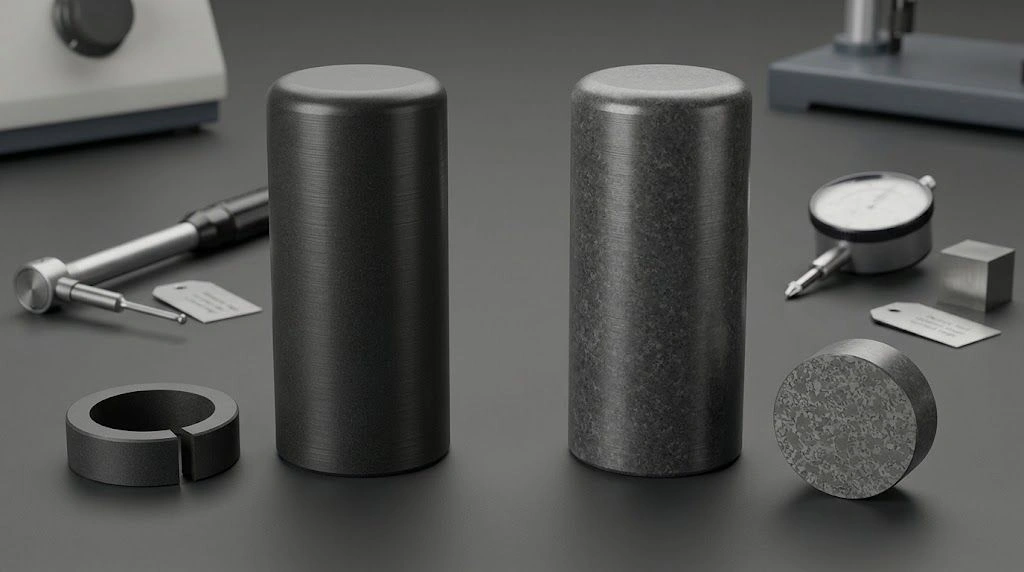
Select SiC bearings for magnetic drive pumps when the internal bearing and shaft-support system must resist corrosion, sliding wear, chemical exposure, and dimensional drift while operating inside the pumped liquid. The key selection variables go beyond SiC grade: they are fluid lubrication quality, cooling flow, viscosity, solids content, dry-running risk, shaft and bushing pairing, axial and radial load, operating temperature, and bearing clearances. SiC is strong in wet lubricated service, but it still needs protection from dry running, cavitation, trapped particles, and thermal shock. The selection must be based on the actual pump fluid and operating boundary, not on material hardness alone.
The silicon carbide mechanical components at ADCERAX — including SSiC and RBSiC bearing bushings, shaft sleeves, and thrust washers for corrosive and abrasive pump service, with custom bore geometries, precision clearances, and groove or channel designs available by drawing — provide the product context for the selection decisions described in this guide.

SiC bearings for magnetic drive pumps provide high wear and corrosion resistance in wet lubricated service — but dry running, cavitation, vapor lock, low-viscosity fluids, and trapped abrasive particles can still cause brittle fracture or rapid wear, requiring operating-envelope review before material selection.
When should SiC bearings be selected for magnetic drive pumps?
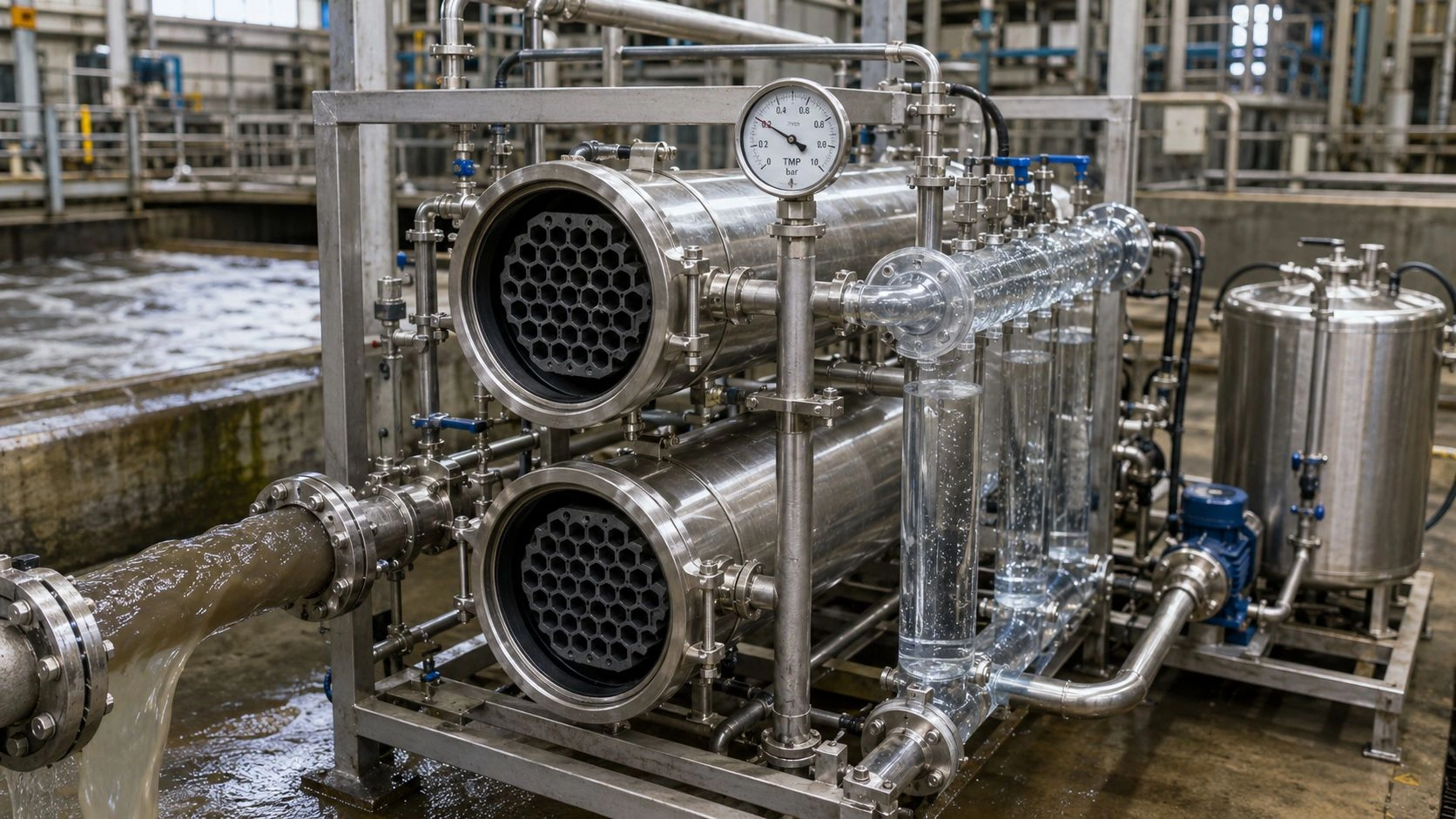
Magnetic drive pumps are sealless — the pump rotor is magnetically coupled to the motor without a shaft seal. This eliminates mechanical seal leakage but places the internal bearings and shaft-support system in continuous contact with the pumped fluid. The fluid must simultaneously perform three functions for the bearing system: provide chemical containment, deliver a lubricating film at the bearing interface, and remove the heat generated by bearing friction.
Corrosive chemical transfer and sealless pump duty. SiC bearings are specified in magnetic drive chemical pumps because they combine the corrosion resistance needed in acid, alkali, solvent, and mixed-chemical service with the hardness and wear resistance needed to survive continuous sliding contact inside the pumped fluid. Unlike mechanical seals, which can be flushed from an external clean-fluid source, magnetic drive pump bearings are typically wetted by the process fluid itself. This means the bearing material must be compatible with the process fluid not only as a static immersion but as a dynamically loaded sliding interface in that fluid.
Why pumped-fluid lubrication defines bearing life. The same fluid that provides corrosion resistance defines the bearing's operating safety margin. A high-viscosity, clean, non-vaporizing fluid provides excellent lubrication and cooling, giving SiC bearings long service life. A low-viscosity, vaporizing, solvent, or particle-bearing fluid reduces the safety margin — the bearing interface may see boundary lubrication or brief dry contact during process fluctuations, and each such event adds heat and wear. This is why material grade alone does not determine bearing service life in magnetic drive pumps.
How do lubrication, cooling, dry-running risk, and solids change the selection?
After confirming SiC is appropriate for the chemical environment, the fluid behavior and operating conditions must be audited before the bearing material and pairing are finalized.
Low-viscosity and vaporizing fluids reduce bearing margin. Low-viscosity solvents, liquefied gases, light hydrocarbons, and process fluids near their vapor pressure provide thinner and less stable fluid films than water or high-viscosity process liquids. Under these conditions, the bearing safety margin against dry contact is reduced, and brief pump upsets — cavitation, vapor lock, partial flow blockage — can expose the SiC bearing to dry sliding that would not occur in more viscous service. Published Texas A&M dry-running research on sealless pumps confirms that users want designs tolerant of system upsets and short dry-running periods, and confirms that silicon carbide bearings are a strong universal choice for magnetic pump service but are less forgiving during dry-running events.
Solids and dry-running require pairing and protection review. When the pumped fluid contains suspended solids, catalyst particles, crystallizing species, or mineral fines, these particles can enter the bearing clearance gap. If they are harder than SiC — diamond-like abrasives or quartz fines in certain mineral slurries — they can cause rapid wear at the bearing bore. If they are softer than SiC, SiC typically performs well. If particle size approaches the bearing clearance, particles can become trapped and wedge between the shaft and bushing, causing local stress concentration and fracture. The bearing clearance specification and groove design must account for the particle characteristics of the pumped fluid.
For dry-running risk specifically — startup without fluid, system upsets, vapor lock, or suction loss — the bearing design strategy must be evaluated alongside material selection. Published Pump & Systems reporting confirms that sintered SiC has long been used in magnetic pump bearings but that thermal and mechanical shock can fracture brittle SiC parts, reinforcing the need to address operating boundary as part of the selection.
Which bearing material or pairing should be selected?
After the fluid audit, the bearing material and pairing decision can be made systematically. The grade decision starts with corrosion acceptability of the SiC grade, and the pairing decision starts with the lubrication and shock conditions.
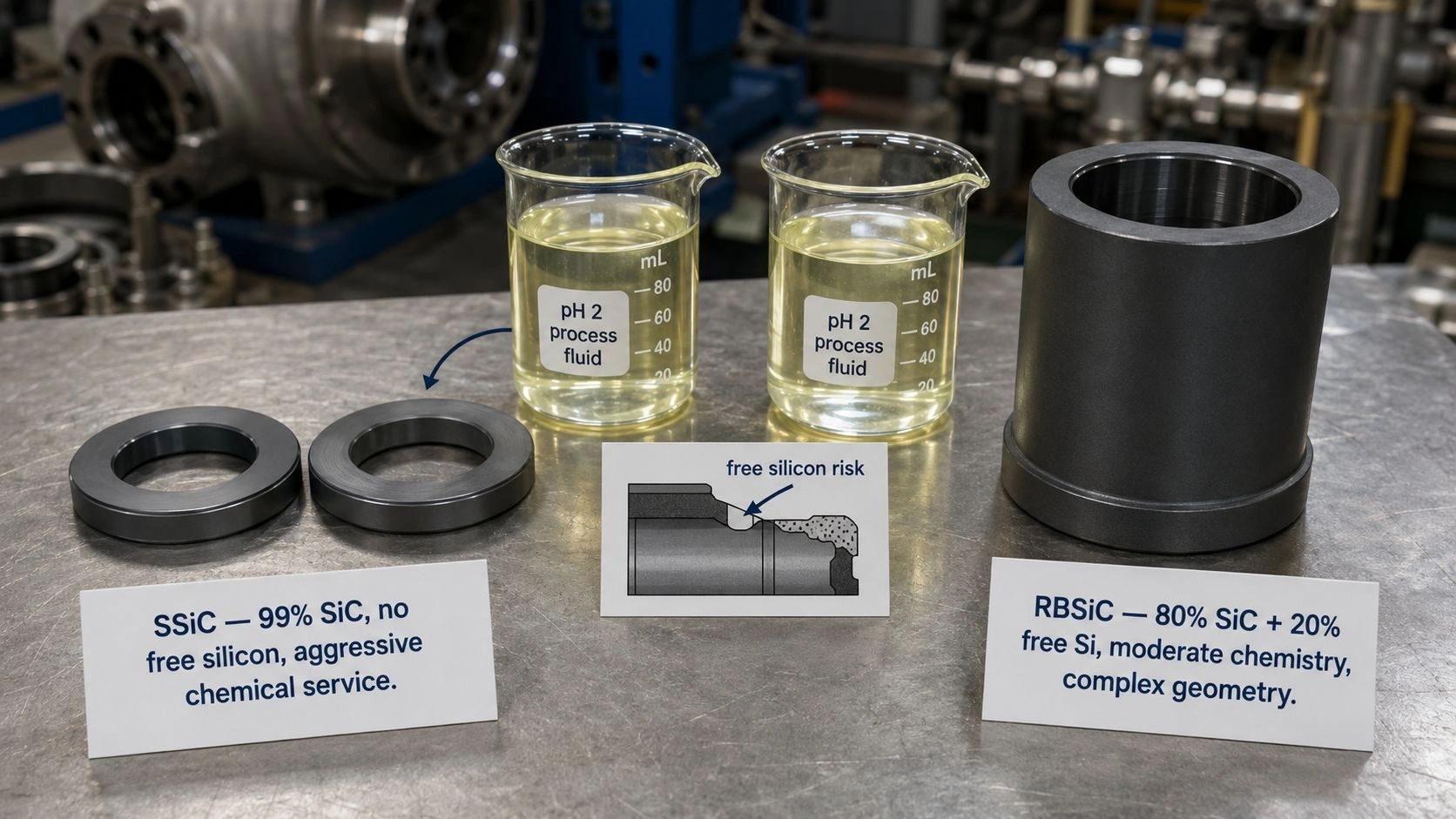
SSiC and SiC-SiC for corrosion, wear, and lubricated service. Dense sintered SSiC is the standard first choice when the pump handles corrosive, high-purity, or abrasive chemicals and needs stable clearances, high hardness, and chemical resistance at the bearing bore. SSiC avoids free-silicon phase compatibility concerns that apply to reaction-bonded grades in certain caustic or amine chemical environments. SiC-SiC pairing — both the shaft sleeve and the bushing in sintered SiC — provides a matched hardness pair that resists sliding wear in lubricated corrosive service. Liquiflo's application data confirms that SiC is used for bearing, shaft, wear plate, and seal-seat components in gear pump service under defined lubricated conditions, documenting real-service performance.
Carbon or WC pairings when dry-running, heat, or impact changes the priority. Carbon-SiC pairing — using a carbon bushing or shaft against an SiC counterpart — can provide better boundary lubrication behavior during low-flow, startup, or mild upset conditions because carbon's self-lubricating character reduces friction even when the fluid film is thin. This trade-off accepts lower abrasion resistance on the carbon face in exchange for better upset tolerance. Published dry-run guidance confirms that SiC/SiC pairing requires cooling and that ceramic/WC or similar pairings may be considered when dry-running is anticipated. Magnatex's published bearing technology notes describe specialized SiC-based bearing designs as more forgiving during startup and upset conditions in magnetic drive pumps, indicating that bearing geometry and design — groove patterns, clearances, and thrust-washer configuration — can extend the dry-run tolerance of SiC systems.
The SiC Bearing Selection Matrix for Magnetic Drive Pumps maps the service conditions:
| Pump service condition | Recommended first check | Why | Watch-out |
|---|---|---|---|
| Corrosive chemical liquid | SSiC bearing/sleeve | Dense SiC supports chemical resistance and geometry stability | Confirm free-silicon boundary and secondary materials |
| Clean lubricating liquid | Carbon-SiC or SiC-SiC review | Fluid film can support stable sliding | Do not overspecify hard-hard pairing if friction dominates |
| Abrasive liquid with solids | SiC-SiC or SSiC pair | Hard surfaces resist wear and scoring | Solids trapped in clearance can still damage bearings |
| Low-viscosity solvent | SSiC plus clearance/cooling review | Limited lubricity reduces safety margin | Evaluate vaporization and bearing heat |
| Dry-running risk | Dry-run-protected design/WC review | Heat dissipation and upset tolerance become priority | Standard SiC-SiC may be less forgiving |
| Frequent start-stop duty | Bearing groove + material pairing review | Boundary lubrication is common during transient operation | Check heat buildup and axial thrust |
| High shock/vibration | WC or compliant support review | Toughness may matter more than pure wear resistance | Validate chemical compatibility |
| High-purity chemical | SSiC with clean packaging | Low contamination and stable clearances matter | Confirm packaging and inspection controls |
Selection guidance is indicative. Verify with pump OEM limits, supplier SiC grade data, fluid compatibility testing, and operating conditions.

Mag-drive pump SiC bearing selection should begin with service condition: SSiC bearing or sleeve for corrosive liquids, SiC-SiC pairing for abrasive lubricated service, and protected designs or pairing review when dry-running risk is present.
The Bearing Material / Pairing Matrix compares the main options:
| Bearing pair | Best fit | Main advantage | Main limitation |
|---|---|---|---|
| SSiC-SSiC | Corrosive, abrasive, lubricated chemical duty | High hardness, corrosion resistance, dimensional stability | Needs adequate fluid film and cooling |
| Carbon-SiC | Clean or moderately challenging fluids | Better lubricity and boundary behavior | Carbon may wear or react in some fluids |
| SiC-WC/ceramic-WC | Dry-run or shock-sensitive review | Better heat/toughness balance in some designs | WC chemistry and corrosion must be validated |
| Alumina/ceramic pair | Lower-severity or cost-sensitive duty | Economical ceramic option | Lower wear/corrosion margin than SiC in harsh duty |
| Polymer-supported design | Special dry-run or low-load cases | Can improve upset tolerance | Temperature and chemical limits may dominate |
The silicon carbide seal ring page at ADCERAX provides the adjacent product context for SiC sealing components in the same corrosive pump environments. The ceramic shaft page covers ceramic shaft components for magnetic drive pump shaft-support systems.

The main SiC bearing components in magnetic drive pumps include radial bushings, shaft sleeves, and thrust washers. Each part should be specified by role, clearance, mating material, surface finish, groove design, and operating load.
What failure modes occur when SiC bearings are mis-specified?
Many magnetic drive pump bearing failures that appear in the field as "SiC broke" or "SiC wore out too fast" are system failures — the pump operating outside its design boundary — rather than material failures.
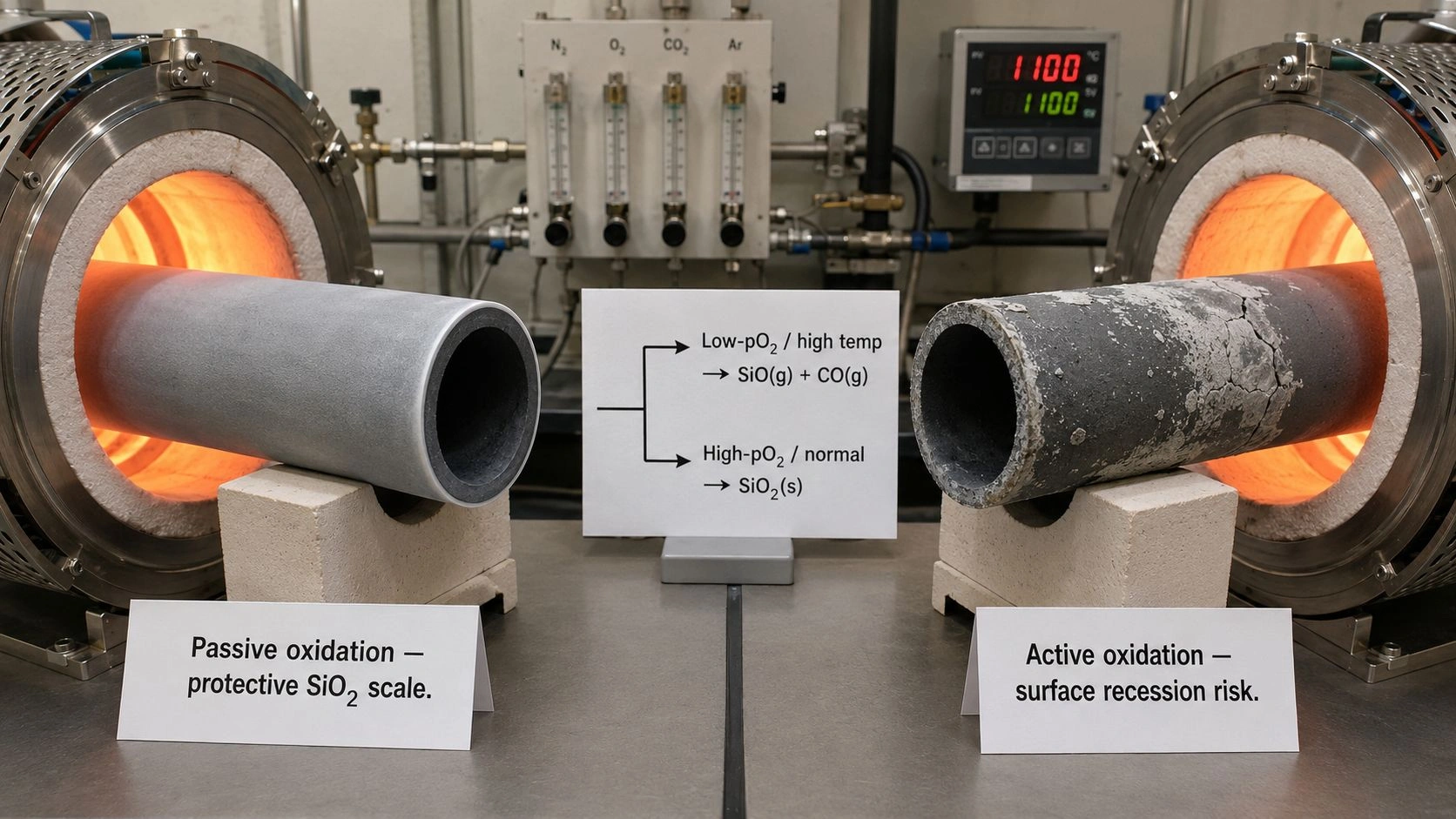
Dry running, low flow, cavitation, and heat buildup. A magnetic drive pump bearing that experiences dry contact — even briefly — generates heat far faster than the ceramic can dissipate. The thermal gradient across the SiC creates tensile stress, and SiC, which has low fracture toughness relative to metals, can fracture in seconds under severe thermal shock. Fractured SiC bearing debris re-enters the bearing gap and accelerates damage throughout the bearing system. Root cause investigation must always begin with whether the pump was operating with an adequate fluid flow rate through the bearing region when the failure occurred.
Particle trapping, clearance loss, shock, and installation stress. Hard particles from process scale, corrosion products, or upstream contamination can enter the bearing clearance and wedge between the shaft and bushing. The resulting point load on a brittle ceramic exceeds the tensile strength and initiates cracking that spreads across the bushing bore. Radial misalignment between the shaft and bearing centerline, axial thrust loads beyond the design thrust washer capacity, and installation stress from over-tight tolerance fits or incorrect mounting are mechanical mechanisms that can fracture SiC without any dry-running event.
The Misdiagnosis Matrix maps the common field failure patterns:
| Observed problem | Common wrong diagnosis | Better engineering question |
|---|---|---|
| Bearing cracks after upset | "SiC is too brittle" | Was there dry running, thermal shock, cavitation, or sudden load change? |
| Rapid wear on bushing ID | "Need harder SiC only" | Are particles trapped in clearance or is lubrication flow insufficient? |
| Pump decouples or overheats | "Magnetic coupling is undersized" | Did bearing friction rise due to dry running, vapor lock, or low flow? |
| Bearing scores during startup | "Material pair is wrong only" | Was the pump started without stable liquid film or with debris in the system? |
| Axial thrust washer wears unevenly | "SSiC quality is poor" | Is hydraulic balance, thrust load, or groove design incorrect? |
| Repeated sleeve fracture | "Use thicker sleeve only" | Is installation stress, shaft misalignment, or shock load driving fracture? |
Failed bearing inspection — crack location, wear pattern, surface analysis, and pump operating log review — must precede any material or geometry change decision.
What RFQ data should be sent for SiC bearings in magnetic drive pumps?
The RFQ Parameters for Magnetic-Drive-Pump SiC Bearings table maps the required specification fields:
| Parameter | Why it matters | Required in RFQ? |
|---|---|---|
| Bearing role | Radial bearing, thrust washer, shaft sleeve, or bushing need different geometry | Yes |
| OD/ID/length | Defines fit, clearance, load area, and lubrication gap | Yes |
| Clearance target | Controls fluid film, heat, and particle tolerance | Yes |
| SiC grade | Determines density, porosity, corrosion boundary, and cost | Yes |
| Mating material | Controls friction, dry-run tolerance, and wear-pair behavior | Yes |
| Fluid chemistry | Defines corrosion and compatibility risk | Yes |
| Viscosity/vapor pressure | Controls lubrication and vaporization risk | Yes |
| Solids content/particle size | Controls abrasion and trapped-particle risk | If present |
| Speed/load | Determines PV condition and heat generation | Yes |
| Dry-running risk | Decides whether protected bearing design is needed | Yes |
| Groove/channel design | Controls cooling and flushing of bearing interface | Recommended |
| Surface finish | Affects friction, wear, and startup behavior | Yes |
A complete RFQ should also include pump manufacturer and model number if known, bearing position in the pump assembly, shaft diameter and tolerance, groove or lubrication-channel design requirement, start-stop frequency, and any dry-run sensor or protection system already in the pump. Ask the supplier to confirm SiC grade with density and porosity data, free-silicon status where relevant for the chemical service, Vickers hardness, bore finish capability and measurement method, chamfering or edge-radius treatment for stress concentration reduction, and packaging for chemical pump components. If replacing a failed bearing, provide a photograph and description of the crack pattern, wear location, and operating history to help confirm whether the failure was a material, operating boundary, or installation problem.
Selecting SiC bearings, bushings, or sleeves for a magnetic drive pump? Share your pump type, bearing role, drawing, fluid chemistry, pH, viscosity, solids content, temperature, shaft speed, axial and radial load, dry-running risk, mating material preference, surface finish, clearance target, and quantity. ADCERAX can review whether SSiC or RBSiC in the required bore geometry, surface finish, and groove configuration fits the operating envelope and propose a grade with material data.
Frequently Asked Questions
Why are SiC bearings used in magnetic drive pumps?
SiC bearings are used because they provide high wear resistance, corrosion resistance, and dimensional stability in chemically aggressive pump media. Magnetic drive pumps are sealless and use the process fluid to cool and lubricate internal bearings, which requires a bearing material that withstands both the chemical environment and the mechanical demands of continuous sliding contact. MUNSCH's published documentation confirms SiC as the standard plain-bearing construction material in chemical magnetic-coupled pumps for these combined reasons.
Can SiC bearings run dry?
Standard SiC bearings should not be selected as if dry running is without consequences. SiC provides strong corrosion and wear resistance in wet service, but dry running removes the fluid film and cooling that prevent overheating and thermal fracture. Published Texas A&M dry-running research confirms that SiC bearings are a strong universal choice for magnetic pump service but are less forgiving during dry-running events. When dry-running risk is significant, dry-run-protected bearing designs, monitoring systems, or modified bearing pairings must be evaluated alongside material selection.
Is SiC-SiC always the best bearing pair for magnetic drive pumps?
No. SiC-SiC pairing is strong for lubricated corrosive and abrasive service, but it still requires adequate fluid film and heat removal to function safely. Carbon-SiC or WC-containing pairings may provide better boundary lubrication behavior during low-flow, startup, or mild upset conditions where the fluid film is temporarily thin or absent. The correct pairing depends on the specific fluid, lubrication margin, dry-running risk, and pump operating profile.
When should SSiC be selected over RBSiC for mag-drive pump bearings?
SSiC should be the first grade evaluation when the pump handles caustics, amines, aggressive acids, or high-purity process fluids where the free-silicon phase in RBSiC could be a compatibility concern. SSiC's dense, single-phase structure also provides more consistent clearance stability and surface finish performance than reaction-bonded grades, which can be important in precision bearing applications with tight clearance targets.