Component roles, SiC vs silicon nitride/sialon boundaries, and RFQ fields for aluminum degassing ceramic tubes.
When a purchase request says "SiC immersion tube for aluminum degassing," the phrase is correct but incomplete. Inside a single degassing unit there are at least three different component jobs — heater protection, thermocouple protection, and rotary gas dispersion — and each carries its own material logic. Specifying SiC across all three without distinguishing them is the fastest way to get a mismatched bill of materials. The question worth answering is not whether SiC can survive molten aluminum contact. It can. The question is which component role benefits most from SiC, and where the decision flips toward silicon nitride or sialon.
A SiC immersion tube is a defensible choice in aluminum degassing when the part is serving as a static immersed protection or heater tube, where the primary demand is thermal endurance, molten-aluminum compatibility, and acceptable service life at controlled cost. It is not automatically the strongest answer for every degassing component: many supplier catalogs commonly position silicon nitride and sialon as a first-look route for premium inline heater tubes, thermocouple protection tubes, and long-life rotary degassing assemblies — OEM- and alloy-dependent, while SiC remains credible for static protection duty and some one-piece rotor routes where service data support it.
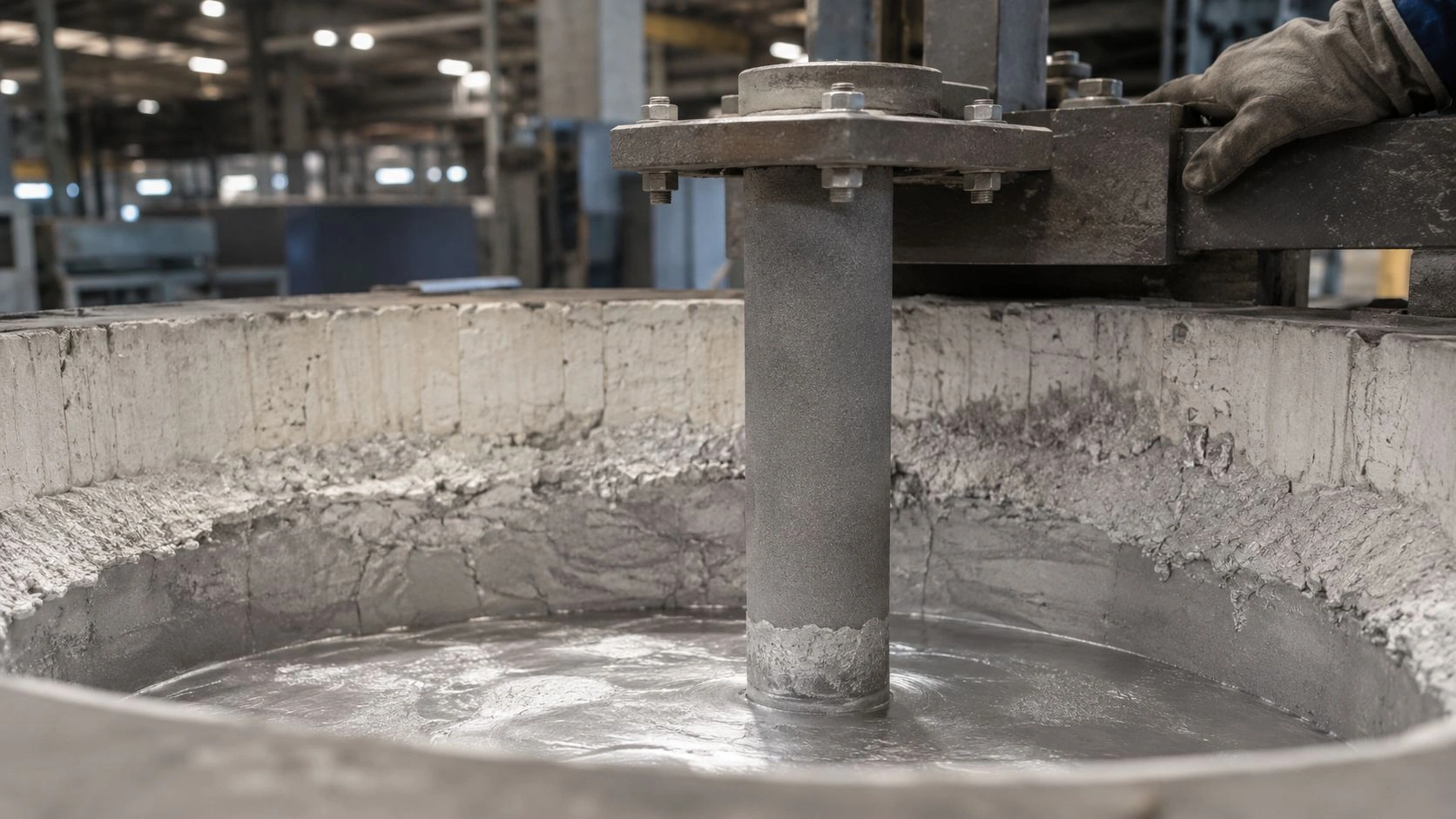
Static immersed SiC protection tube in a box-type aluminum degassing unit — the static protection role that often maps to SiC capability in molten aluminum screening — RFQ must still name the exact component class.
What Does a SiC Immersion Tube Actually Do in Aluminum Degassing?
In an aluminum degassing unit, a SiC immersion tube is most commonly not the rotating gas-dispersion head. In degassing equipment language, the phrase often maps to a static cylindrical protection tube — a barrier that encloses a heater element or thermocouple inside a degassing box while remaining immersed in molten aluminum. The hydrogen-removal mechanism itself is driven by introducing purge gas through a rotary degassing unit, where fine inert-gas bubbles collect dissolved hydrogen and carry it out of the bath. The immersed protection tube supports that process indirectly by enabling the thermal management and temperature measurement hardware that keeps the bath in the correct treatment window.
That distinction changes the material selection problem. A heater protection tube or thermocouple protection tube is evaluated primarily on thermal endurance, molten-aluminum corrosion resistance, and dimensional stability under immersion. A rotor or shaft is evaluated on those properties plus rotational wear, geometry retention over many cycles, and gas-dispersion efficiency. Treating both as the same material problem is the most common source of an underspecified RFQ.
Static immersed protection duty and rotary gas-dispersion duty are separate component classes
Current degassing-unit component descriptions confirm this separation explicitly. The heating system in modern online and box degassing units uses a silicon-carbon rod heater inside a cylindrical silicon carbide or silicon nitride protection tube immersed in the aluminum bath, with a thermocouple inside the tube for temperature control. That assembly is the immersed tube most buyers are pricing when they search for "SiC immersion tube for aluminum degassing." The rotor, shaft, and gas-dispersion assembly are different parts, evaluated separately in the same sourcing project.
Recognizing the distinction early saves material-review time. The engineering check is simple: confirm whether the drawing says "heater protection tube," "thermocouple protection tube," or "rotor/shaft assembly" before opening a ceramic tube datasheet.
For silicon carbide tubes used in immersed aluminum contact, the relevant specification inputs are outside diameter, wall thickness, immersion depth, and bath temperature — not rotor geometry or wear-cycle data.
Why Is SiC Used in Immersed Aluminum Degassing, and Where Does It Work Well?
SiC is used in immersed aluminum degassing components because it offers practical thermal endurance, acceptable corrosion resistance in molten aluminum contact, and cost-balanced service life in static protection duties. Some OEM equipment pages list silicon carbide among material options for cylindrical protection tubes in degassing-unit heating systems — not an industry-wide “standard part” claim. SiC can be evaluated for static immersed aluminum contact when the buyer validates alloy chemistry, temperature, atmosphere, and grade family (free-Si vs dense sintered), making it a credible screening route for heater and sensor enclosure applications where the part remains stationary in the bath.
The stronger edge for SiC appears when the component's job is to shield a heater or sensor rather than to perform a mechanically demanding moving function. Static immersed duty puts geometry retention and corrosion resistance at the top of the selection list. SiC's combination of high thermal conductivity, good thermal shock resistance relative to dense alumina, and established molten-aluminum track record makes it a natural fit. Cost control also plays a role: SiC production routes for cylindrical tubes are mature, which gives procurement teams a predictable acquisition cost versus premium alternatives.
SiC is strongest in static immersed barrier and protection roles
The engineering logic is straightforward. When the tube is a static protection barrier — thermally coupled to a heater rod or thermocouple and surrounded by aluminum melt — the dominant failure modes are chemical attack, thermal cycling fatigue, and slow dimensional drift. SiC addresses all three at acceptable cost.
SiC also appears in rotor routes, but that is a different selection problem
Some foundry routes use one-piece SiC rotors as an alternative to graphite; compare wear, geometry retention, and oxidation under the actual duty — not a guaranteed longer life. This is a legitimate screening route, but it belongs to a different evaluation: rotor selection compares SiC against graphite, sialon, and silicon nitride on geometry retention, wear rate, and gas-dispersion efficiency — not on protection-tube immersion behavior. Reviewing silicon carbide ceramic grades for rotor duty requires a different checklist than reviewing them for static tube duty.
Which Component Roles Are Being Confused When Buyers Say "SiC Immersion Tube"?
The most common specification error is treating heater protection tube, thermocouple protection tube, degassing rotor, and shaft as a single material decision. Current source coverage does not support that simplification. Equipment component pages show SiC or silicon nitride as options for the cylindrical immersed protection tube around a heater system. Sialon and silicon nitride supplier pages simultaneously market heater tubes for premium inline degassing, thermocouple protection tubes, and premium rotor and shaft assemblies for molten aluminum service as a coordinated high-performance route. A buyer who collapses these into one line item gets a quote that answers a different question than the drawing asks.
The most common diagnostic error in aluminum degassing component sourcing is reading a SiC protection-tube datasheet and applying its immersion-resistance logic to a rotary shaft or premium inline heater-tube assembly, where silicon nitride or sialon is commonly positioned as a first-look route in many supplier catalogs — OEM- and alloy-dependent.
Heater tube, thermocouple tube, and rotor must each be specified separately
In a complete degassing unit, the heater protection tube and the thermocouple protection tube may share material options but serve different mechanical and thermal profiles. The rotor and shaft carry a third distinct set of requirements: geometry retention under rotational wear, resistance to the specific shear conditions at the gas-dispersion head, and service life measured in degassing cycles rather than static immersion hours.
Current sialon supplier pages position thermocouple protection tubes in non-ferrous molten-metal service and inline heater tubes for premium inline / ALPUR-style OEM degassing designs (third-party trademarks; not an ADCERAX product or compatibility claim) as dedicated silicon nitride or sialon product families. That product-line logic suggests those suppliers have validated the premium ceramic route for those specific component classes. SiC tube credentials in the same supplier literature typically describe static protection and enclosure roles rather than premium inline degassing assemblies.
A correct SiC heater-tube decision does not automatically justify SiC for every degassing part
A process engineer who validates SiC for the heater protection tube in a box-type degassing unit has answered one selection question. The thermocouple protection tube, the rotor, and the shaft each require a separate validation step. A specification review for a molten-aluminum degassing component replacement project should list each component class on its own line, with its own material route and its own acceptance criteria, before any tube or rotor order is placed.
When Does the Decision Stay with SiC, and When Does It Flip to Silicon Nitride or Sialon?
The decision stays with SiC when the part is a static immersed protection or heater tube, or when the plant already runs a validated SiC route and the goal is reliable molten-aluminum immersion at a cost-balanced maintenance interval. Foundry case material also supports SiC in one-piece rotor applications, showing service-life and oxidation advantages over graphite in aluminum degassing service. The decision flips to silicon nitride or sialon when the component is premium inline degassing hardware — heater-tube assemblies for ALPUR-style OEM designs, thermocouple protection tubes for long-exposure non-ferrous service, or high-cycle rotary degassing assemblies — where current supplier language consistently positions silicon nitride and sialon as the stronger material route.
The practical selection rule follows component duty, not the shared word "degassing."
The table below summarizes the selection logic by component class, drawn from current equipment descriptions and material supplier positioning.
Screening only — OEM design, alloy, and buyer validation required. Verify against the exact component drawing, bath temperature, immersion depth, and maintenance interval target before release.
| Criterion | Threshold / Decision Trigger | Decision Direction |
|---|---|---|
| Component = static immersed protection / heater tube | Part shields heater or sensor and remains stationary in molten aluminum | SiC or Si₃N₄ — final choice follows life target and supplier validation |
| Component = rotary degassing rotor / shaft | Part disperses inert gas bubbles while retaining geometry under rotational wear | Evaluate SiC rotor vs graphite vs Si₃N₄/sialon as separate selection problem |
| Premium inline degassing hardware | Premium inline heater tube (incl. ALPUR-style OEM designs), premium thermocouple protection, or long-life rotary assembly | Silicon nitride or sialon as first-look screening route |
| Cost-balanced static immersed aluminum contact | Static tube duty with acceptable maintenance interval | SiC remains defensible |
| Unclear component description in sourcing document | "SiC immersion tube" used as a blanket term for all degassing ceramics | Reject wording; rewrite by exact component class before issuing RFQ |
Silicon nitride is overspecified for routine heater-protection applications where a validated SiC tube already meets service-life expectations. The cost-to-performance argument for upgrading is clearer when the component is a thermocouple protection tube in long-exposure molten-aluminum service or a rotary degassing assembly where geometry retention over many thousands of cycles directly affects hydrogen-removal efficiency.
For articles comparing silicon nitride ceramic components against SiC in high-performance molten-aluminum service, the boundary is component duty severity, not material preference.
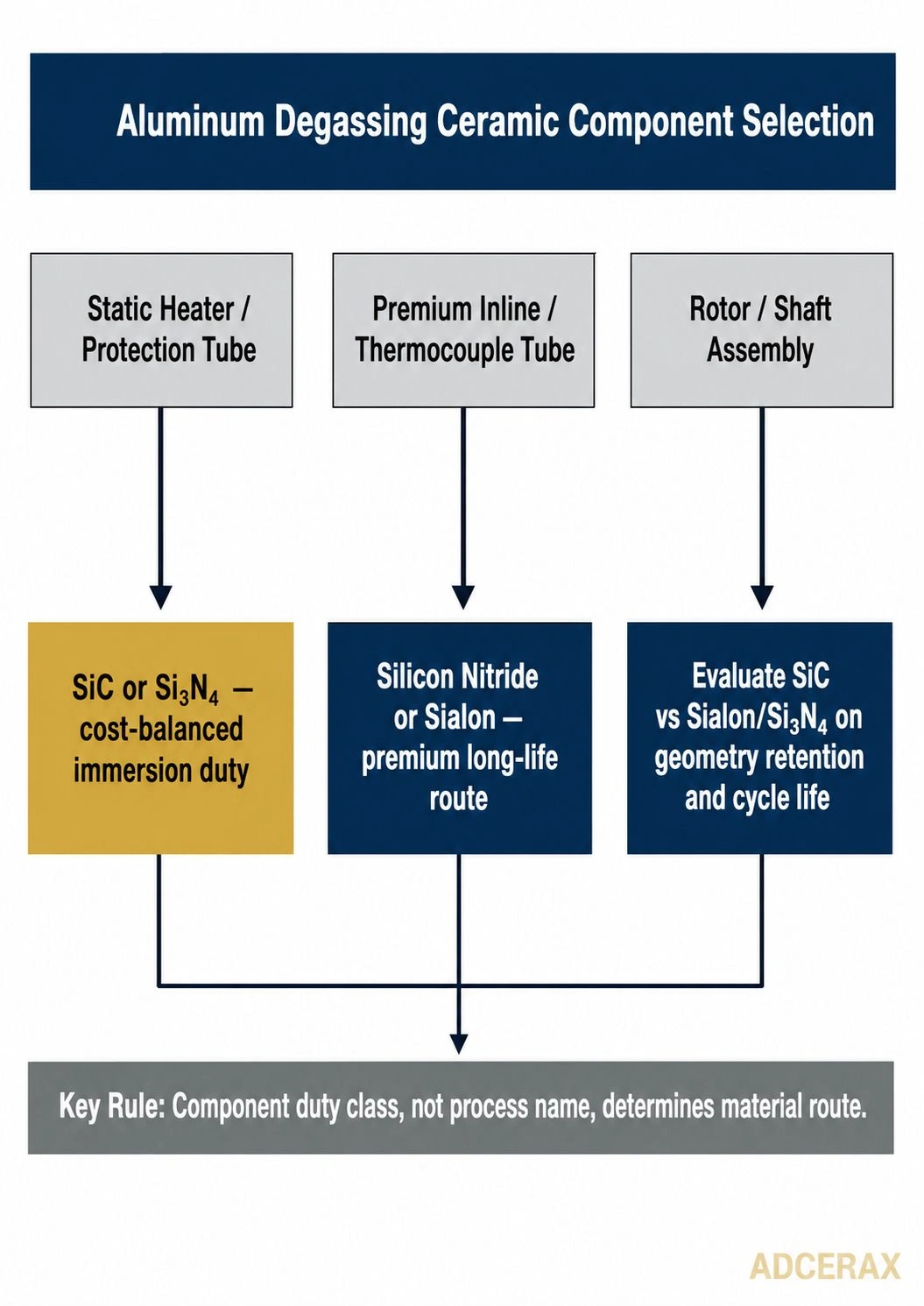
Component-duty-based selection rule: SiC for static immersed protection, silicon nitride or sialon for premium inline and rotating degassing hardware — the distinction is the part's job, not the process name.
What Should Go Into the RFQ and Operating SOP?
An RFQ for aluminum degassing ceramics that lists only "SiC immersion tube" has not yet been written. The specification needs to identify each component class separately — heater protection tube, thermocouple protection tube, static immersed protection tube, rotor, shaft — and pair each with its duty conditions. That is the minimum required before a vendor can return a technically comparable quote.
The following checklist covers the required fields for a complete degassing-component RFQ and operating SOP. Each field represents a dimension where suppliers diverge if the specification is silent.
- Component class — state the exact part: heater protection tube, thermocouple protection tube, static protection tube, one-piece rotor, or shaft assembly
- Material route — specify whether SiC, silicon nitride, or sialon is required, or whether equivalent performance alternatives are acceptable
- Geometry — outside diameter, inside diameter or wall thickness, total length, end style (square cut, chamfered, flanged), and tolerance class
- Bath temperature — maximum continuous service temperature in the aluminum melt
- Immersion depth and cycle profile — full immersion depth, frequency of insertion and withdrawal, and target service life in hours or degassing cycles
- Atmosphere at the non-immersed end — air, inert gas, or partial vacuum, because the external face of the tube sees a different chemical environment than the immersed face
- Static vs rotating duty — confirm whether the part is stationary or part of a rotating assembly; this field alone determines whether rotor geometry and wear criteria apply
- Flux or additive exposure — note whether fluxing agents contact the tube during treatment cycles
- Inspection acceptance criteria — dimensional tolerance at installation, visual crack criteria, and re-inspection interval
- Reference component class for failure — name the observed failure mode on the outgoing part (oxidation, cracking, wall thinning, geometry distortion) so the replacement specification can address the root cause rather than repeat the same selection
The operating SOP should further distinguish inspection criteria for static tubes from wear and geometry criteria for rotors. Degassing efficiency is sensitive to rotor geometry, and bubble-dispersion performance degrades progressively as the rotor head wears. Treating a rotor inspection the same as a static tube inspection misses the performance-critical wear variable.
For geometry and grade inputs on static immersed parts, start from the SiC tube specification path; when the RFQ points to premium inline, thermocouple protection, or long-life rotor duty, evaluate the silicon nitride tube route. Non-catalog OD, wall, immersion depth, or end-style needs go through custom ceramic fabrication. Name the component class and grade family (e.g. free-Si RBSC vs dense SSiC) when molten-aluminum chemistry matters.
Before you issue the RFQ: name the component class (heater protection / thermocouple protection / rotor / shaft), material route (SiC vs silicon nitride or sialon), geometry (OD, wall, length, end style), bath temperature and immersion depth, cycle profile, static vs rotating duty, and the observed failure mode on the outgoing part. Those fields prevent mismatched ceramics more reliably than a blanket “SiC immersion tube” line item.
Related reading
- NBSC tubes for molten aluminum protection — Where NBSC tubes are evaluated for molten-aluminum protection duty versus SiC immersion parts in degassing boxes.
- SiC foam filters for aluminum casting — How SiC foam filters for aluminum casting are a different component decision than immersion tubes in degassing units.
- Non-wetting ceramics for molten metal processing — When non-wetting behavior matters at the melt interface — separate from naming the correct degassing tube class in an RFQ.
Frequently Asked Questions
Is a SiC immersion tube the same thing as the degassing rotor?
No. In current aluminum degassing equipment descriptions, the immersed SiC tube often maps to a static heater-protection or thermocouple-protection tube — RFQ must still name the exact component class, while the rotor is a distinct component class evaluated on rotational wear, geometry retention, and gas-dispersion cycle life. Both roles can use ceramic materials, but they require separate material selection processes and separate specifications.
Can SiC still be used as a rotor material in aluminum degassing?
Yes. Some foundry routes use one-piece SiC rotors as an alternative to graphite; compare wear, geometry retention, and oxidation under the actual duty — not a guaranteed longer life. The selection decision for a rotor still requires its own separate evaluation from heater or protection tube selection.
When should buyers look first at silicon nitride or sialon instead of SiC?
When the part is a premium inline degassing heater tube (including ALPUR-style OEM designs), a thermocouple protection tube in extended molten-aluminum service, or a long-life rotary degassing rotor or shaft assembly. Current silicon nitride and sialon supplier product families are built around these component roles in molten-aluminum degassing, and catalog language commonly positions them as a first-look route for high-performance and long-cycle duty — OEM- and alloy-dependent.
Why does rotor material affect degassing efficiency so directly?
Because the hydrogen-removal mechanism depends on inert-gas bubble dispersion, and bubble formation and distribution are controlled by the rotor head geometry. Rotational wear or geometry distortion progressively degrades dispersion quality over service. A rotor material that retains geometry for more cycles maintains degassing efficiency without requiring early replacement, which is why silicon nitride and sialon are marketed specifically for this function in molten-aluminum degassing systems.
What is the most common specification mistake when sourcing degassing ceramics?
Using the phrase "SiC immersion tube" without identifying the exact component class — heater protection tube, thermocouple protection tube, rotor, or shaft — in the purchase order. The phrase describes a material and a general function but does not specify duty conditions, geometry, or whether the part is static or rotating. A vendor receiving only that description cannot confirm whether the material route, geometry, or inspection criteria match the actual operating requirement.