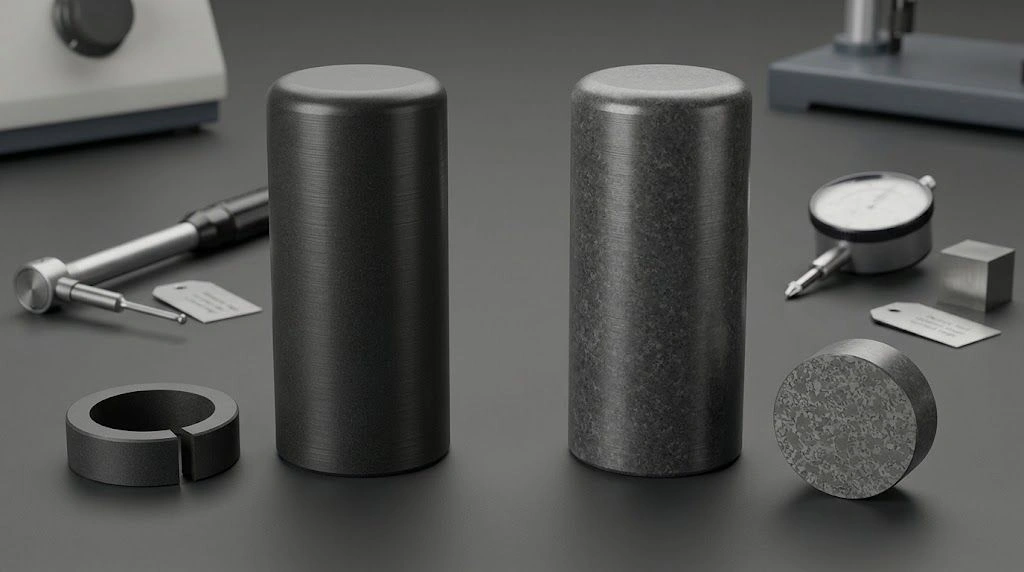
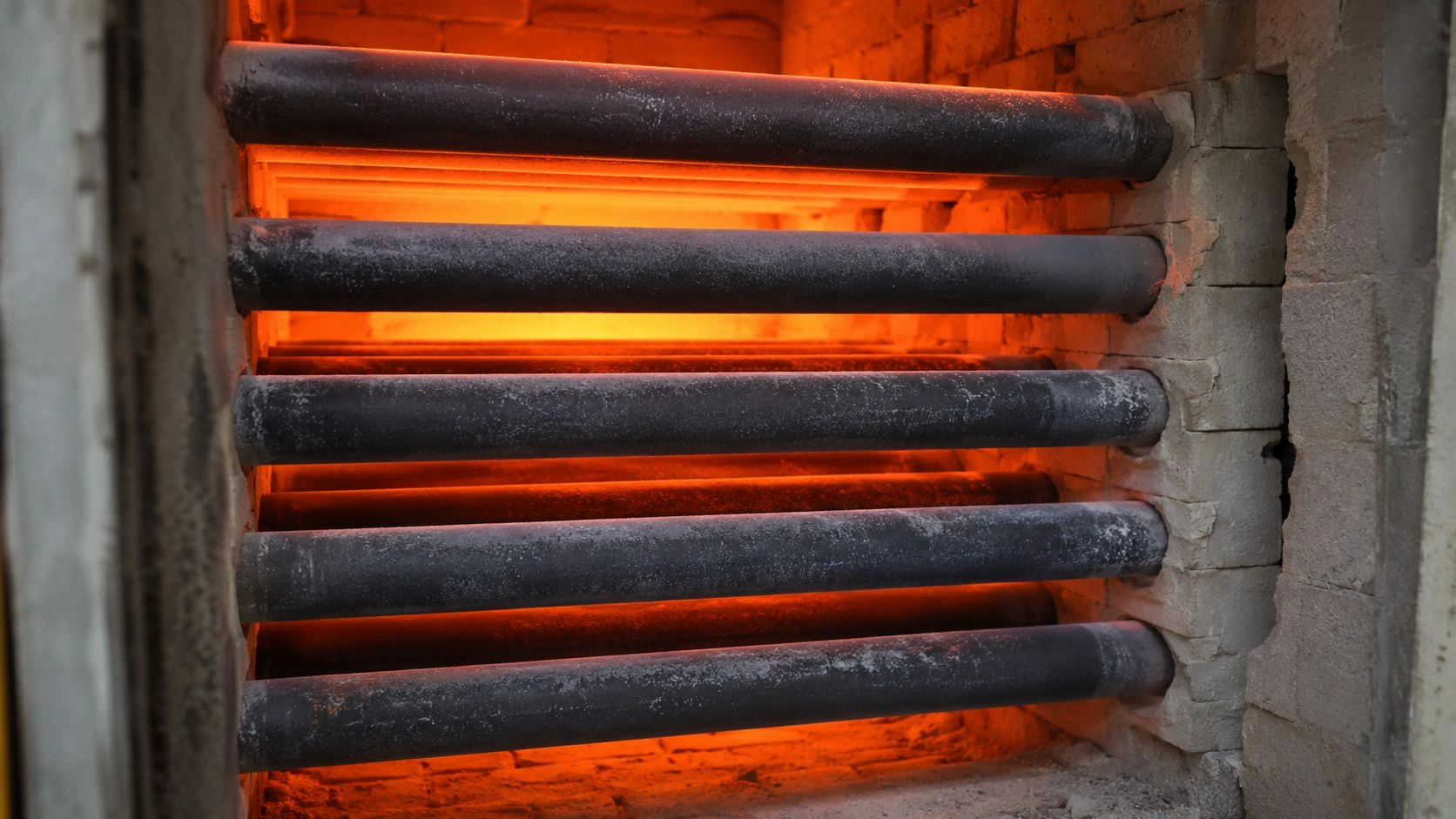
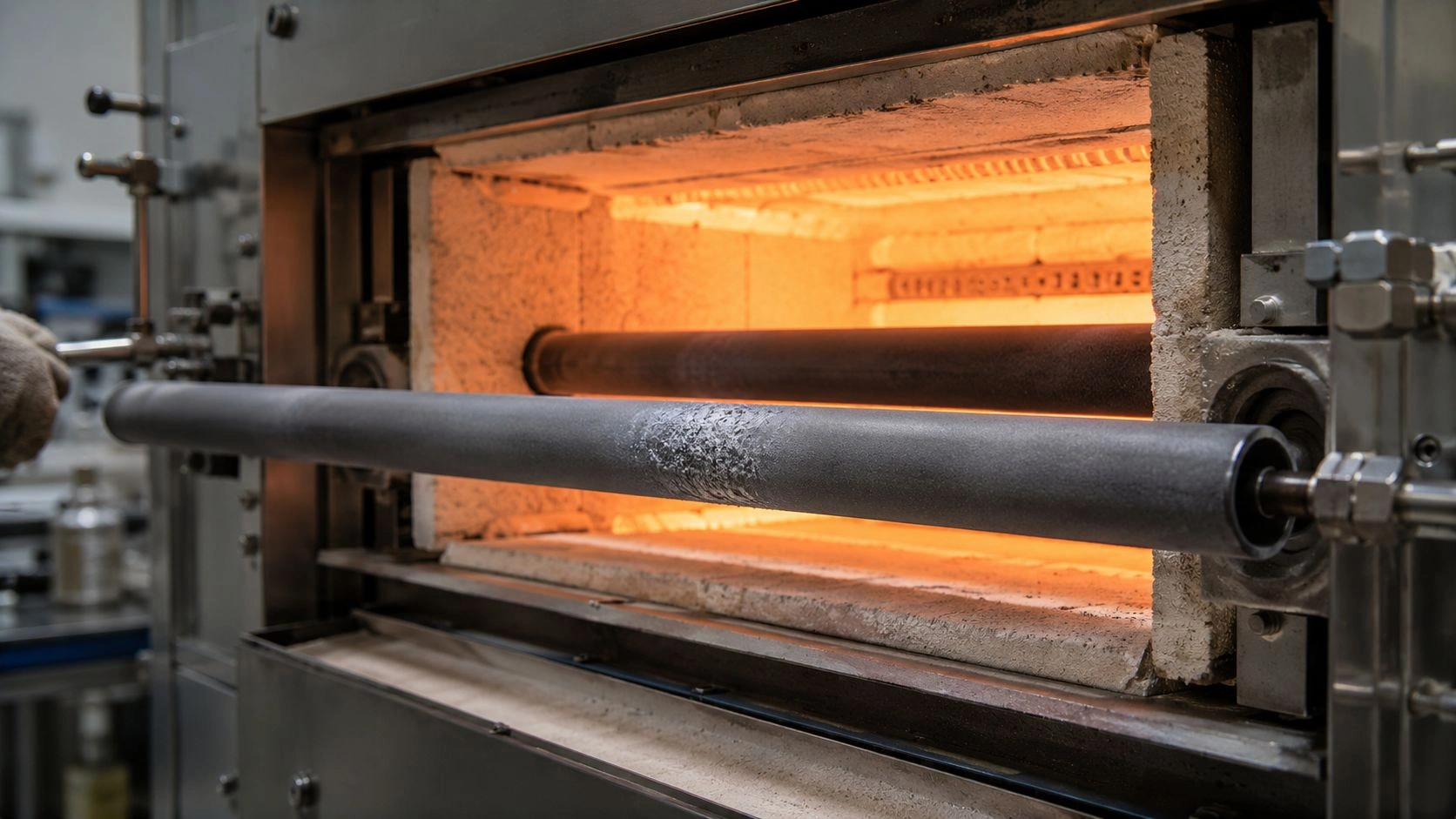
SiC tubes can crack under thermal shock because thermal shock resistance and fracture toughness are not the same property. Silicon carbide conducts heat well and expands relatively little, so it resists thermally induced stress better than many ceramics — but monolithic SiC still has modest fracture toughness, typically around the same order as alumina rather than zirconia. If a crack starts from a pore, machining flaw, edge chip, rigid support, or steep local temperature gradient, SiC cannot deform plastically like metal to redistribute the stress. The crack propagates rapidly and the tube fractures suddenly.
Understanding that distinction — thermal shock resistance as a system property, fracture toughness as a material limit — is the engineering basis for both preventing cracks and diagnosing them correctly when they occur.
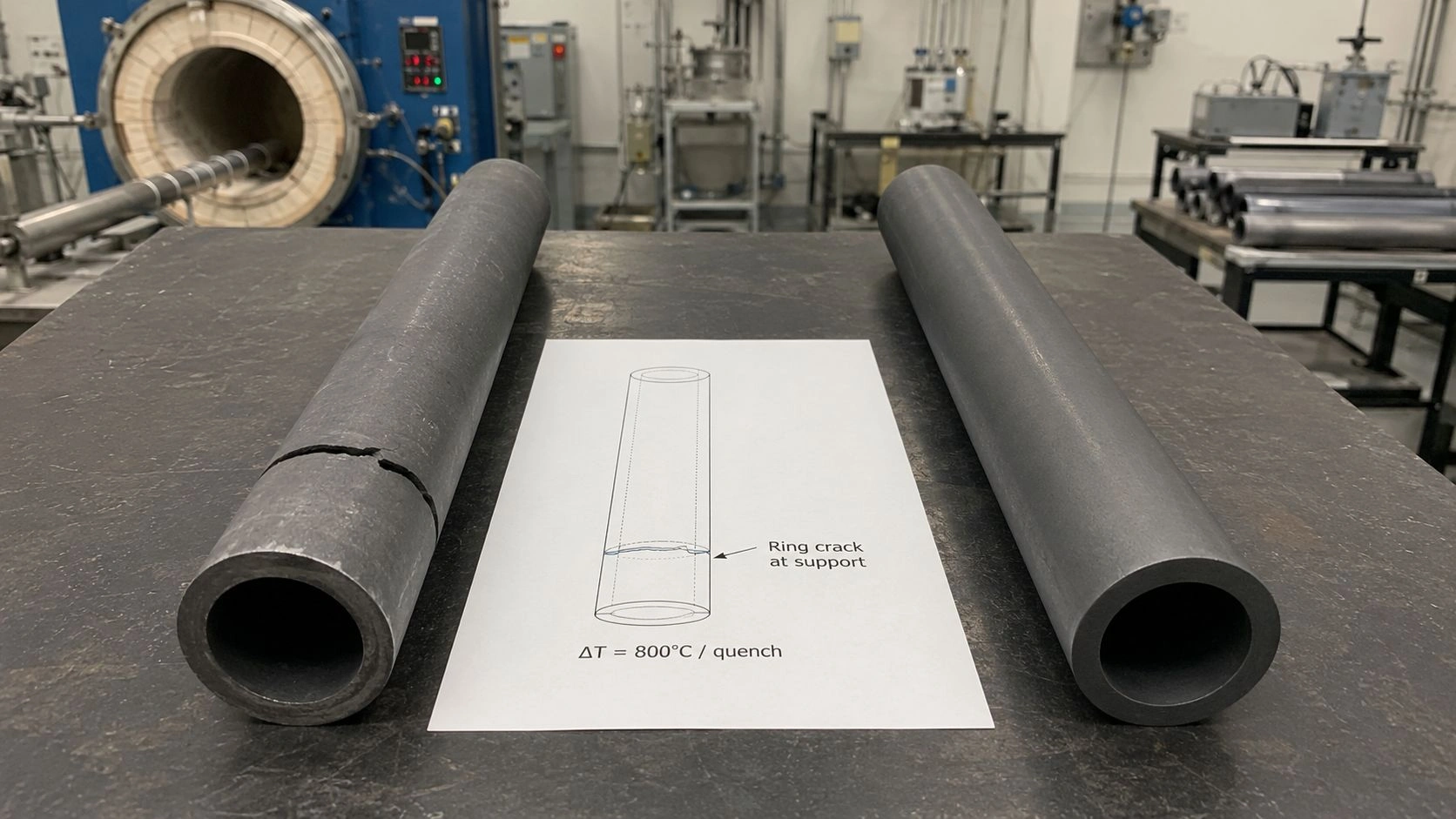
SiC tubes have strong thermal shock resistance relative to many ceramics, but limited fracture toughness — cracks begin at pores, machining flaws, support points, or steep temperature gradients and propagate without plastic deformation.
This guide stays on the engineering path: why thermal-shock-resistant SiC tubes still crack, how crack location reveals the initiation source, how grade boundaries change under shock severity, and which RFQ fields let a supplier confirm wall, edge, support, and cycle fit.
Fracture toughness is not the same as thermal shock resistance
The apparent contradiction — SiC is described as thermally shock resistant, yet SiC tubes crack — is resolved by understanding that thermal shock resistance and fracture toughness measure different aspects of a ceramic's performance under rapid temperature change.
Thermal shock resistance is governed by the combination of thermal conductivity, thermal expansion coefficient, and strength. High thermal conductivity reduces temperature gradients by spreading heat quickly, so the temperature difference between the hot and cool regions of the tube wall is smaller. Low thermal expansion means that even when a gradient exists, the strain induced is smaller. Together, these properties make SiC one of the better ceramic choices for rapid thermal cycling — and high thermal conductivity with thermal shock resistance are the primary reasons SiC is selected for heat, wear, and dimensional-stability applications.
Fracture toughness — expressed as the critical stress intensity factor K_Ic in units of MPa·m^(1/2) — describes resistance to crack propagation from an existing flaw. Published elevated-temperature fracture resistance data for dense sintered alpha-SiC commonly cite fracture toughness around a literature-typical order of ~3 MPa·m^(1/2) (alumina-class), method- and orientation-dependent (ISO 23146 / ASTM C1421) — not a tube drawing or lot guarantee — with a relatively flat crack-growth resistance curve. Monolithic SiC is commonly discussed in the low single-digit MPa·m^(1/2) band; confirm by grade TDS / coupon method on the ordered route. Toughened zirconias are often cited higher than dense SiC — grade-/stabilizer-/method-dependent (illustrative published bands span roughly mid-single to low-double digits depending on grade; see the zirconia grade sheet), not a universal zirconia contract value.
The Fracture Toughness vs Thermal Shock Resistance table maps the two properties:
| Property | What it means | Why SiC performs well | Why SiC still cracks |
|---|---|---|---|
| Thermal conductivity | Heat spreads through material | Reduces temperature gradients | Local hot/cold spots can still be severe |
| Thermal expansion | Dimensional change with temperature | Lower expansion reduces strain | Restrained expansion creates tensile stress |
| Fracture toughness | Resistance to crack growth | Better than glassy brittle materials | Still modest vs tough ceramics like zirconia |
| Flexural strength | Stress before bending failure | High in dense SiC grades | Strength drops if flaws or shock damage exist |
| Thermal shock resistance | Retained strength after shock | Strong compared with many ceramics | Severe quench, pores, and supports can exceed limits |
Why SiC beats many ceramics in shock but still behaves brittle. SiC outperforms alumina in rapid thermal cycling in most furnace applications because its thermal conductivity is substantially higher than many oxide ceramics (for example versus dense alumina grade-sheet values; SSiC selection conductivity is typically cited around 100–120 W/(m·K) on the material data sheet — not a rated multiplier). A tube wall that equalizes temperature faster generates far less peak thermal stress during the same heating or cooling event; quantify with your wall thickness and boundary conditions. But that advantage only reduces stress — it does not eliminate flaws. If a flaw of sufficient size and orientation exists at a point where thermal stress reaches a local maximum, fracture follows regardless of the grade's thermal shock ranking.
Why zirconia can tolerate impact better but SiC handles heat flow better. Zirconia's toughening mechanisms — primarily stress-induced phase transformation — raise its fracture toughness to a range where edge loads, impacts, and sharp stress concentrations are more survivable. For applications where the primary concern is mechanical shock, edge chipping, or thin-wall impact, zirconia may be a better choice than SiC. For applications where the primary concern is rapid heating and cooling in a hot furnace or gas-phase environment, SiC's thermal conductivity advantage makes it the more practical candidate.
Why SiC tubes crack under shock
After establishing that fracture toughness is the limit even when thermal shock resistance is strong, the crack-initiation sources in real tube service are what determine where and when failure occurs.
Published quench studies on monolithic alpha-SiC tubes (high temperature into room-temperature water) show that pre-existing pores influence brittle fracture and crack development during the quench event. ASTM C1525 evaluates thermal shock resistance of advanced ceramics by heating specimens, water-quenching them, and measuring retained flexural strength — framing shock damage as a strength-retention question rather than a binary pass/fail, where pre-existing flaws determine how much strength remains after the shock cycle. That is a standard method description, not a claim that every tube lot is C1525-certified.
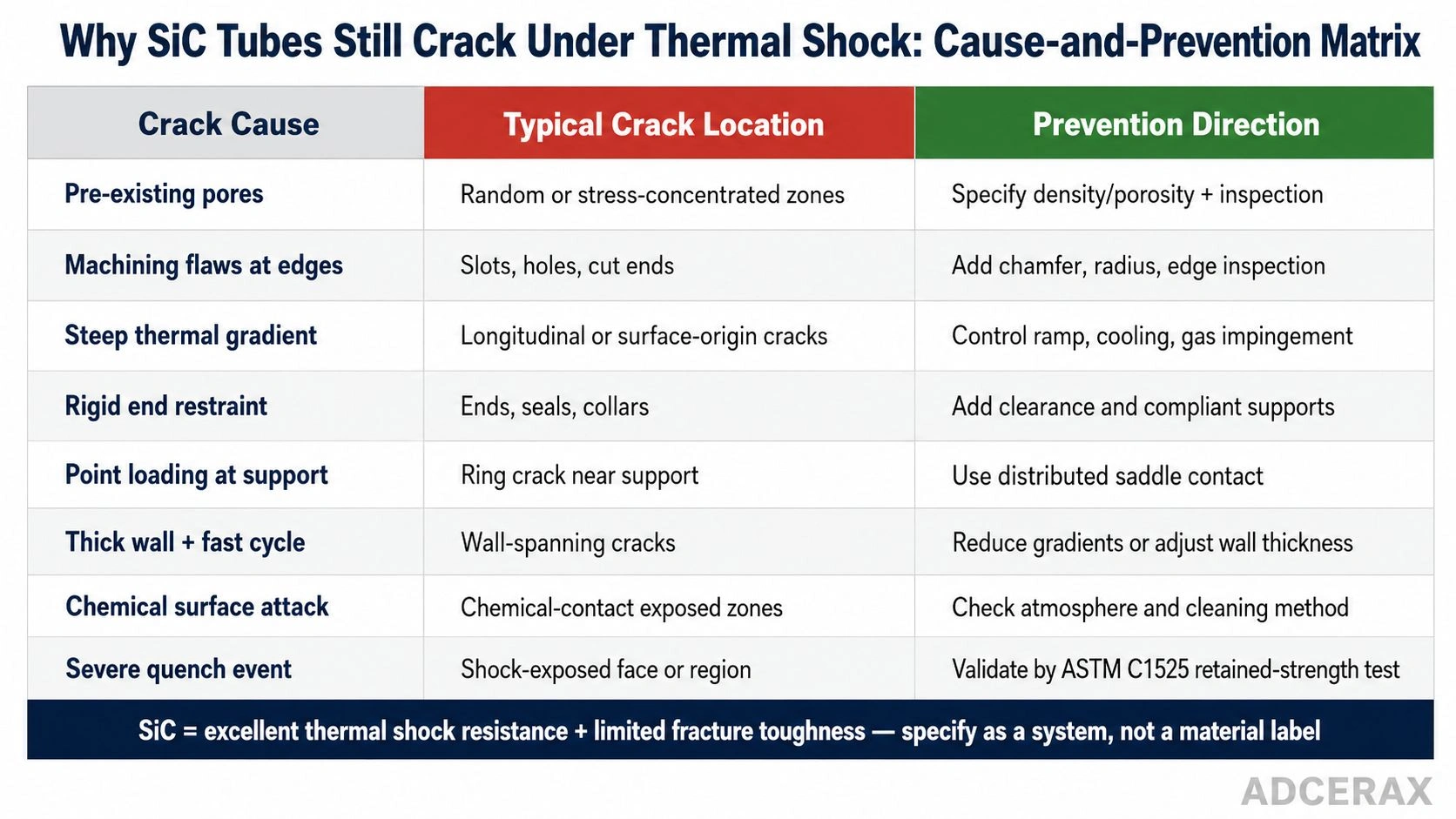
The Why SiC Tubes Still Crack table maps each cause to its crack signature and prevention direction:
| Cause | What happens | Typical crack location | Prevention direction |
|---|---|---|---|
| Pre-existing pores | Pores act as crack initiators | Random or stress-concentrated zones | Specify density/porosity and inspection |
| Machining flaws | Grinding marks or edge chips start cracks | Slots, holes, cut ends | Add chamfer, radius, and edge inspection |
| Steep thermal gradient | Surface expands/contracts faster than core | Longitudinal or surface-origin cracks | Control ramp, cooling, and gas impingement |
| Rigid end restraint | Tube cannot expand freely | Ends, seals, collars | Add clearance and compliant supports |
| Point loading | Tensile stress concentrates at support | Ring crack near support | Use distributed support contact |
| Thick wall | Larger through-wall temperature difference | Wall-spanning cracks | Reduce thermal gradients or adjust wall |
| Chemical surface attack | Roughened surface lowers crack-initiation threshold | Exposed chemical-contact zones | Check chemistry and cleaning method |
| Fast quench | Thermal stress exceeds retained strength | Shock-exposed regions | Validate by thermal shock testing |
Values indicative; verify by crack pattern inspection, fracture surface analysis, and thermal-cycle documentation.
Pores and density variation. A pore in a SiC tube is a stress concentrator. When thermal stress develops during heating or cooling, the local stress at a pore scales with the pore geometry and the applied field stress. For a dense SSiC grade, pore size and distribution are controlled by sintering; for RBSiC and ReSiC, open porosity is higher and the pore geometry can be more variable. Specifying density and open porosity — not just material name — is a functional requirement for shock-critical tubes.
Machining marks, edge chips, and slot corners. Diamond grinding of SiC produces surface cracks at scales of tens to hundreds of micrometers depending on wheel grit, feed rate, and depth of cut. At slot corners and hole edges, the effective crack length is the corner radius plus any grinding crack extending from it. Requiring a minimum corner radius and chamfer at cut edges, and specifying an edge inspection method, reduces the probability that a grinding flaw becomes the crack initiator under shock loading.
Thermal gradients across wall thickness. A thick SiC tube wall creates a larger temperature difference between the outer and inner surfaces during rapid heating or cooling — and larger temperature difference means larger thermal strain and thermal stress. ASTM C1525 water-quench testing uses standardized specimen geometries to measure this effect under defined conditions. For a furnace tube, reducing wall thickness where geometry permits, and controlling the heating and cooling rate, are the first engineering responses before changing SiC grade.
Rigid support and end restraint. A SiC tube that cannot expand freely during heating accumulates compressive stress during the heat cycle and tensile stress during cooling. If the tube is clamped, pinched, or constrained at its ends by metal hardware, the resulting stress pattern is superimposed on the thermal gradient stress — and the combination can exceed the fracture toughness at the constraint point. Adding axial clearance for thermal expansion in tube mounting designs prevents this failure mode.
SiC grade matters: SSiC, RBSiC, NBSiC, ReSiC, and composites
After understanding the crack-initiation mechanisms, the grade decision determines which SiC route best matches the tube geometry, thermal severity, chemistry, and replacement philosophy of the application.
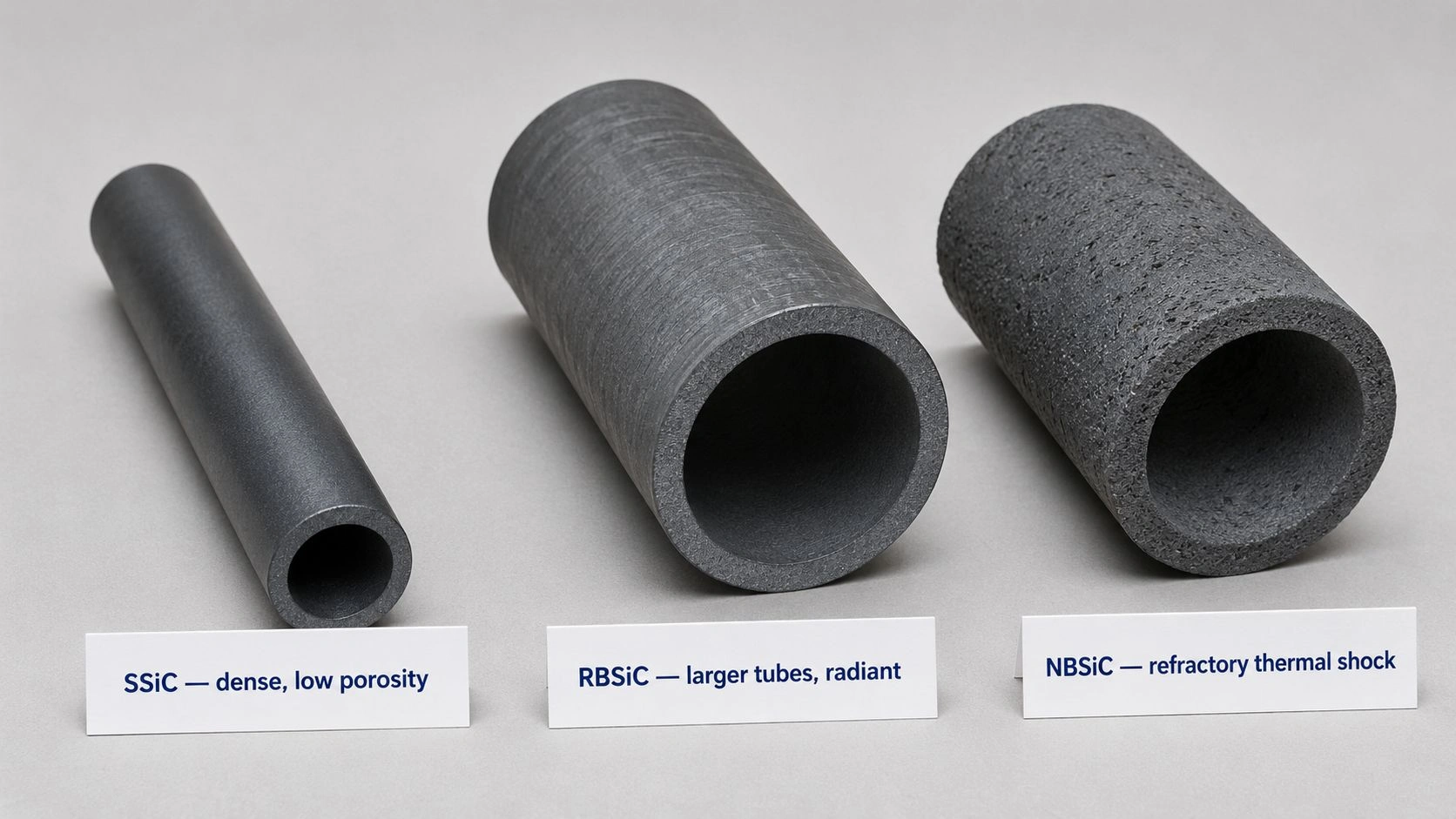
The SiC Grade and Shock-Risk Matrix maps the main options:
| SiC route | Best-fit shock scenario | Main advantage | Main boundary |
|---|---|---|---|
| SSiC | Dense chemical tubes, high-purity sleeves, precision parts | Low porosity, high corrosion resistance | Brittle and machining-sensitive |
| RBSiC/SiSiC | Larger tubes, radiant tubes, complex shapes | Good thermal shock and forming flexibility | Residual silicon chemistry limit |
| NBSiC | Refractory-style furnace tubes and larger hot-zone parts | Thermal shock and size capability | Bonding phase/porosity must be reviewed |
| ReSiC | High-temperature structural tubes | Good high-temp stability | Open porosity and gas-tightness limits |
| SiC CMC | Extreme shock/damage-tolerant systems | Better crack tolerance | Different cost and supply category |
For tube geometries, wall, and grade routing under thermal-cycle duty, see the silicon carbide tube product page; drawings and shock-duty custom routes can go through custom services.
SSiC: dense, corrosion-resistant, still brittle. Dense sintered SiC provides the lowest porosity among common SiC grades, which minimizes pore-initiated cracking and maximizes resistance to chemical surface attack that can precede shock fracture. For small precision tubes, protection tubes, and chemical reactor internals where contamination control and gas-tightness are required, SSiC is typically the starting point. However, its high density also means it has less geometric flexibility than RBSiC, and its brittle behavior at machining edges and sharp features requires careful design.
RBSiC/SiSiC for larger tubes and radiant tubes. Reaction-bonded SiC can be formed into larger, more complex geometries because it does not shrink as much during conversion. For long radiant tubes, heat-exchange tubes, and furnace tubes where thermal cycling severity is moderate and tube size or shape flexibility is more important than maximum density, RBSiC provides a practical combination of thermal shock performance and formability. The residual silicon phase in RBSiC has a chemistry and temperature boundary that must be confirmed for the specific process atmosphere.
NBSiC for refractory-style thermal shock applications. Nitride-bonded SiC is used in kiln furniture, refractory liners, and high-temperature structural applications where larger part size, moderate open porosity, and refractory-grade thermal shock tolerance are acceptable. Its bonding phase provides a degree of thermal cycling tolerance that can make it more forgiving than SSiC in severely cycled, less chemically sensitive environments.
The ceramic tube and pipe comparison across SiC, alumina, zirconia, and BN illustrates the same grade-and-property trade-off: zirconia offers higher toughness for impact-prone or edge-loaded positions, while SiC offers superior thermal cycling performance for high-conductivity, corrosion-resistant service.
The silicon carbide mechanical components range — precision-ground SiC seal faces, bushings, and wear components — applies the same flaw-management principles at the component level: edge finish, surface inspection, mounting clearance, and density specification are part of the engineered product, not afterthoughts.
Do not misdiagnose every crack as low fracture toughness
When a SiC tube cracks, the cause is often not the grade's intrinsic fracture toughness — it is a system design or operating condition problem that a different grade will not automatically fix.
End cracks from restraint, seals, or clamp pressure. Cracks that appear at tube ends, collar zones, or adjacent to metal seals almost always reflect axial restraint or clamp load rather than material brittleness. If the tube is not free to expand axially during heating, the collar imposes a bending moment at the end, and fracture initiates there under thermal stress. Adding clearance in the axial direction resolves this without changing the SiC grade.
Support cracks from point loading and bending. Ring-shaped cracks that encircle the tube at a support contact point are the classic signature of point loading — the support creates a localized bending moment, and the ring crack forms in the tensile zone on the opposite face. Distributing the support contact over a larger area (saddle support, ceramic fiber pad, or distributed cradle) reduces the local stress concentration below the fracture threshold without changing the tube material.
Slot cracks from sharp corners or grinding flaws. A slot, hole, or notch machined into a SiC tube creates a stress concentration that scales inversely with the corner radius. A zero-radius sharp corner is effectively a pre-existing crack; an illustrative 1 mm radius corner is far less severe (illustrative geometry — not a design allowable). Crack initiation at machined features is one of the most preventable failure modes — a minimum corner radius requirement on the drawing, combined with edge inspection before installation, eliminates most slot-initiated cracks.
Thermal-gradient cracks from uneven heating or cooling. Longitudinal cracks that run parallel to the tube axis typically indicate that one side of the tube heated or cooled significantly faster than the other — creating a circumferential temperature difference that generates tensile stress on the cooler side. This can come from asymmetric gas flow, flame impingement on one side of the tube, cold purge gas entering from one end, or uneven furnace element placement. The crack pattern and the thermal history together identify the source.
Chemical roughening followed by shock fracture. A SiC tube that has operated in an aggressive chemical atmosphere — chlorinated gas, alkali vapor, oxidizing steam — may develop a roughened surface with shallow corrosion pits that act as stress concentrators before the next shock cycle. Inspection after chemical exposure and before restart identifies whether surface degradation has increased the crack-initiation risk beyond what a clean tube would show.
RFQ checklist for SiC tubes under shock loading
A complete RFQ for shock-critical SiC tubes must provide both the geometric and operating context so the supplier can confirm whether the proposed grade, wall thickness, and edge design are appropriate for the thermal-cycle severity.
A complete RFQ and failure-review sequence for shock-prone SiC tubes covers SiC grade, tube geometry including wall thickness and edge features, thermal cycle parameters including ramp rate and cooling rate, cold-gas or quench exposure, support design and expansion clearance, furnace atmosphere, cleaning method, failure photos with crack location and pattern, and whether ASTM C1525 retained-strength testing or application-specific thermal cycling validation is recommended. Grade, geometry, and operating conditions together determine whether fracture toughness limits are exceeded at any specific location — a supplier who receives only "SiC tube, thermal shock resistant" cannot confirm wall design, edge finish, support clearance, or shock severity without that context.
| RFQ field | Why it matters | Recommended wording |
|---|---|---|
| SiC grade | Different routes crack differently | "SSiC/RBSiC/NBSiC/ReSiC required or recommended" |
| Wall thickness | Controls thermal gradient | "State ID, OD, wall, and tolerance" |
| Thermal cycle | Main shock driver | "Ramp rate, cooling rate, ΔT, cycle count" |
| Cold gas/quench | Creates local tensile stress | "Any air blast, water, purge gas, or flame exposure" |
| Support design | Controls bending and restraint | "Support spacing, contact width, expansion clearance" |
| Edge features | Crack initiation sites | "Slots, holes, ports, chamfers, minimum radius" |
| Atmosphere | Can weaken surface before shock | "Oxidizing, reducing, chlorine, sulfur, alkali, vapor species" |
| Test data | Confirms real limit | "Request retained strength after thermal shock or application cycling" |
| Failure history | Speeds root-cause review | "Send photos, crack map, run history, and location" |
RFQ fields are the minimum for a shock-critical SiC tube inquiry; add operating pressure, orientation, and chemical exposure history as needed.
For applications where shock severity is high — rapid quench cycles, cold gas impingement on hot tubes, direct flame exposure, or large ΔT across thin walls — requesting application-specific thermal cycling testing or ASTM C1525 retained-strength / quench data from the actual tube production route is more informative than relying on catalog thermal shock resistance ratings alone. That is an RFQ / method-discussion field — not a claim that every tube lot is C1525-certified.
Evaluating SiC tubes for shock-prone furnace or reactor service? Share your tube drawing, SiC grade, wall thickness, support layout, ramp and cooling rate, gas atmosphere, shock events, and failure photos. A supplier can review whether SSiC, RBSiC, NBSiC, ReSiC, or a different ceramic route better fits the thermal-cycle condition against the grade data sheet — no catalog commitment required at this stage.
Frequently Asked Questions
Why do SiC tubes crack if SiC has good thermal shock resistance?
Because thermal shock resistance and fracture toughness are different properties. SiC's high thermal conductivity reduces temperature gradients during rapid cycling, and its low thermal expansion reduces induced strain — both of which contribute to strong thermal shock resistance. But monolithic SiC still has limited fracture toughness, commonly discussed in the low single-digit MPa·m^(1/2) literature-typical band (method-dependent; confirm on grade/coupon — not a tube lot guarantee). If thermal stress starts a crack from a pore, machining flaw, support point, or steep local gradient, the crack propagates suddenly without plastic deformation.
What is the fracture toughness of silicon carbide?
Dense sintered alpha-SiC fracture toughness has been reported around a literature-typical order of ~3 MPa·m^(1/2) in published elevated-temperature fracture resistance work (ISO 23146 / ASTM C1421 method- and orientation-dependent — not a tube drawing / lot guarantee). Monolithic SiC is commonly discussed in the low single-digit MPa·m^(1/2) band; confirm by grade TDS / coupon method. Toughened zirconias are often cited higher — grade-/stabilizer-/method-dependent (illustrative published bands span roughly mid-single to low-double digits depending on grade), not a universal zirconia contract value.
Does higher thermal shock resistance mean SiC is tougher than alumina?
Not necessarily. SiC often handles rapid temperature changes better than alumina because of its significantly higher thermal conductivity, which reduces temperature gradients across the tube wall. But the two materials have similar fracture toughness ranges — the advantage of SiC is in thermal transport behavior, not in resistance to crack propagation from flaws.
What crack locations reveal the cause of fracture?
End cracks typically point to rigid mounting, seal compression, or axial restraint. Ring cracks near support points indicate point loading and bending stress. Longitudinal cracks suggest circumferential thermal gradients from uneven heating or cooling. Cracks at holes, slots, or machined ports usually begin at sharp-corner grinding flaws. Surface cracks in aggressive-atmosphere service may follow chemical roughening that lowered the crack-initiation threshold before a shock event.
Which SiC grade is safer under thermal shock?
There is no universal answer. RBSiC/SiSiC and NBSiC often offer more practical thermal shock tolerance for larger tube geometries, while SSiC provides high density and chemical resistance. The grade must match the application's chemistry, gas-tightness requirements, load, tube geometry, and shock severity. Requesting retained-strength data after thermal shock testing is more informative than grade name alone.
What should I send to a supplier for a shock-critical SiC tube?
Send the tube drawing with OD/ID/wall and all edge features, SiC grade if known, support spacing and contact geometry, ramp and cooling rate, maximum ΔT, atmosphere and any corrosive species, cold-gas or quench exposure details, operating temperature, load, cleaning method, and failure photographs with crack location mapped on the drawing. Also specify whether ASTM C1525 retained-strength testing or application-specific thermal cycling validation is required before production.
Related reading
- SiC tube creep resistance near 1400°C under load — how SiC tubes behave under sustained load near 1400°C — creep vs sudden fracture.
- Active vs passive oxidation SiC failure modes — active vs passive oxidation paths that destroy SiC in furnace atmospheres.
- Free silicon content in RBSC tubes and chemical resistance — why residual free silicon in RBSC tubes changes chemical-resistance routing.