Specifying a SiC tube as a hydrogen barrier in high-temperature service requires answering a question that most SiC tube product pages do not raise: which SiC route, at which wall temperature, under which hermeticity definition? A generic "SiC is corrosion-resistant and thermally stable" statement does not answer it. The engineering literature on hot hydrogen in SiC splits into at least three separate evidence streams — hydrogen-isotope permeation data on dense CVD SiC, gas-tightness tests on SiC/SiC composite tubes under nuclear conditions, and hot-hydrogen corrosion and strength-retention studies on sintered grades — and those streams do not all tell the same story. This article maps what each stream means for a tube buyer: what constitutes true wall permeation, how fast the barrier advantage erodes with temperature, which observed leaks are misread as permeation, when dense SiC is still a defensible route, and what the RFQ must say to make "SiC tube for hydrogen" an engineering specification rather than a material name.
Dense SiC tubes can function as real high-temperature hydrogen barriers, but only within a route-specific and temperature-specific window. The best direct evidence comes from hydrogen-isotope data: CVD-SiC shows permeation coefficients more than three orders of magnitude lower than SS316 at 600°C, yet by 950°C its permeation approaches that of stainless steel at a much lower temperature, and separate hot-hydrogen studies show that some sintered SiC grades can lose mass and strength above about 1000°C in dry H₂.
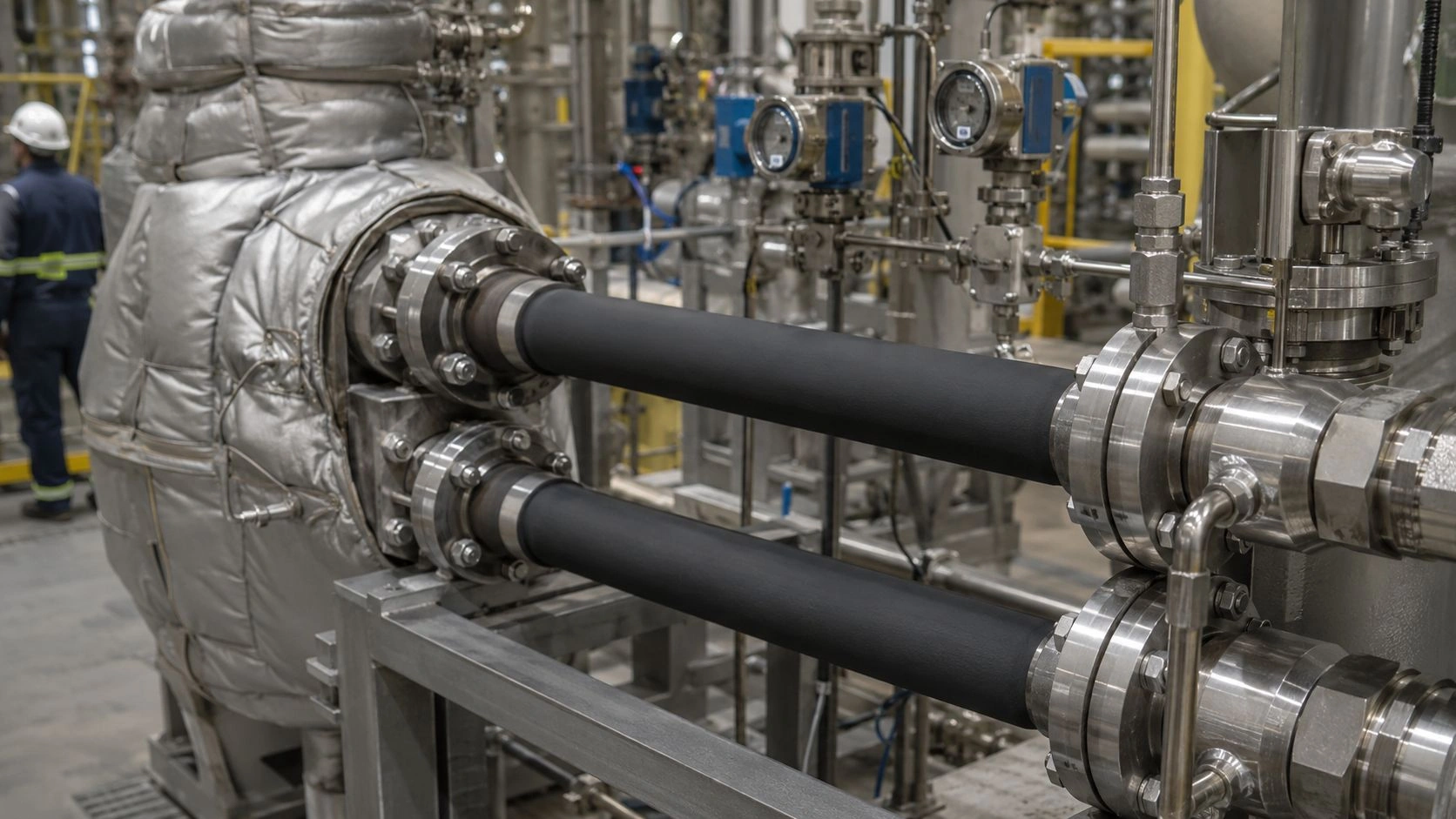
A dense monolithic SiC tube in high-temperature hydrogen service is a real barrier — but its effectiveness depends on route, wall temperature, and hermeticity definition, not on the word "SiC" alone.
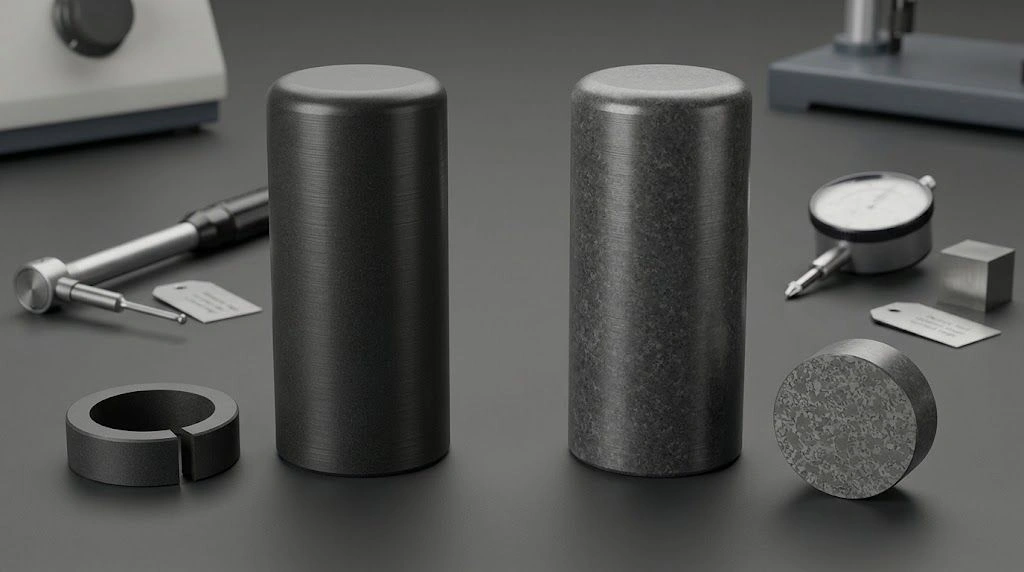
The silicon carbide tubes used in high-temperature hydrogen service — dense sintered SSiC grades in precision tube geometries — sit at the high-performance end of the ceramic tube family that this barrier-route analysis describes.
What "hydrogen permeation through a SiC tube" actually means
In dense SiC tubing, hydrogen permeation is not the same as a visible crack or a bad fitting. It is the transport of hydrogen atoms — in the most directly relevant evidence base, studied using deuterium and tritium as engineering proxies for hydrogen permeation behavior — through the ceramic body itself under a partial pressure gradient at elevated temperature. The distinction matters because the best available direct evidence for this topic comes from fusion materials work, where dense SiC was specifically evaluated as a tritium or deuterium barrier for nuclear applications. Those studies frame the engineering question correctly: not "does SiC leak like a porous ceramic?" but "how much hydrogen isotope moves through a nominally dense SiC body, and by which internal path?"
This framing is why the technical literature consistently separates monolithic CVD SiC, pressureless sintered SiC, and SiC/SiC fiber composites rather than treating all SiC tubes as a single class. Once a tube contains fiber interfaces, additive-rich grain boundaries, or microcracks from thermal or mechanical loading, the word "permeation" begins to overlap with "loss of hermeticity through defects" — a different engineering problem with a different solution.
Hydrogen-isotope data are the best direct proxy for H₂ barrier behavior at high temperature
Deuterium and tritium permeation experiments on dense CVD SiC represent the most quantified direct evidence available for ceramic hydrogen-barrier behavior at elevated temperatures. The results — particularly the comparison against stainless steel permeation coefficients across a range of temperatures — give engineers a defensible baseline for specifying dense SiC in hydrogen service, with the important caveat that the baseline is temperature-dependent and route-specific.
Dense monolithic SiC and composite SiC are not the same hermeticity problem
A dense CVD SiC tube with a well-controlled microstructure addresses bulk transport through a low-defect ceramic body. A SiC/SiC composite tube with ceramic fiber interfaces addresses a structurally different problem — damage-tolerant mechanical performance — but introduces additional leakage paths through fiber-matrix interfaces and can lose gas tightness through mechanisms that do not affect a dense monolithic body. Treating these two product types as equivalent for a hydrogen-barrier specification produces the wrong answer for at least one of them.
Which mechanism controls permeation, and how fast does the barrier weaken with temperature
At 600°C, CVD-SiC showed hydrogen-isotope permeation more than three orders of magnitude lower than SS316 in the sampled fusion literature — a large and practically significant barrier advantage. Kyoto/JAEA deuterium diffusion studies on CVD-SiC at 1073–1183 K led researchers to conclude that transport through dense CVD SiC is primarily grain-boundary-dependent rather than controlled by ideal bulk lattice diffusion. That grain-boundary dependence has direct implications for specification: grain boundary density, additive chemistry, and manufacturing route quality all affect the effective permeability of a nominally identical material class.
The temperature penalty documented in the literature is as important as the barrier advantage at moderate temperature. A re-evaluation of SiC permeation coefficients found that the 600°C advantage over stainless steel shrinks substantially by 950°C — at that temperature, CVD-SiC permeation already approaches the level of SS316 at a considerably lower temperature. The barrier is still present, but it is no longer in the "neglect it" range. At even higher temperatures in the range of 1200–1450°C, dense SiC tubes were reported to have somewhat higher hydrogen permeability than dense alumina, though both remained two to three orders of magnitude lower than the least permeable refractory metals.
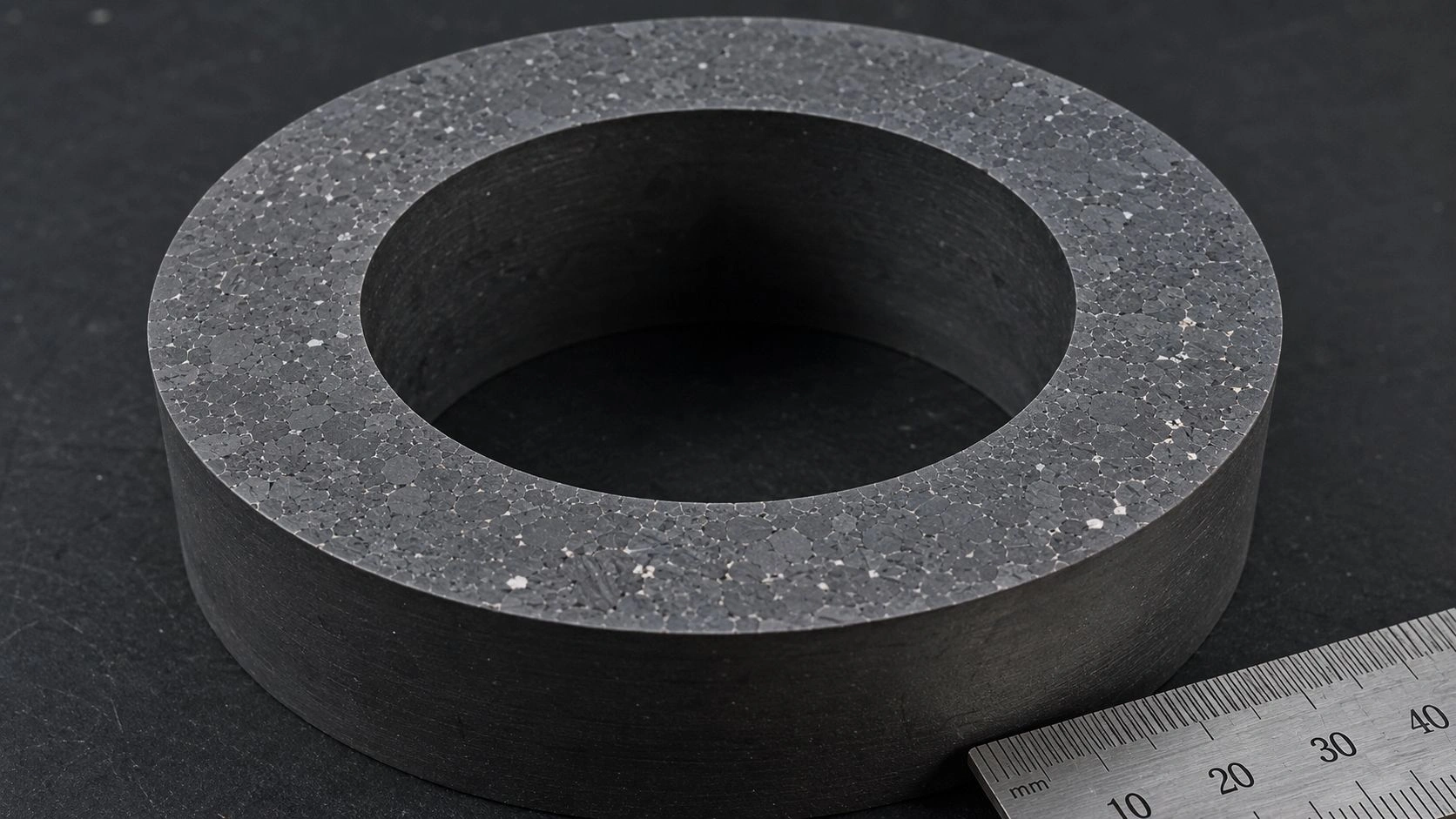
Grain boundaries in dense SiC control hydrogen-isotope transport more than bulk lattice diffusion — which is why route quality, additive chemistry, and manufacturing method all matter for permeation specification.
The silicon carbide ceramic grades available for tube service — SSiC, RBSC, and CVD-grade SiC — differ in grain-boundary character, additive content, and resulting permeation behavior. The dense SSiC route with minimal additives and maximum density is the most defensible starting point for hydrogen-barrier specification.
Grain boundaries, additives, and route quality matter as much as the word "SiC"
Two tubes both labeled "SiC" can have materially different permeation behavior if they were made by different processes, contain different sintering aids, or reached different densities. The grain-boundary transport mechanism means that anything that creates more grain-boundary area, more grain-boundary impurity, or more grain-boundary second-phase content will increase effective permeation relative to the dense CVD SiC benchmark. Route documentation — not just material name — is the critical procurement input.
Above approximately 900–1000°C, "barrier" does not mean "negligible permeation"
The temperature range where CVD SiC's advantage over stainless steel is large and practically dominant is roughly the 500–800°C range in the sampled literature. At 950°C the re-evaluation data already show a materially smaller advantage, and above 1000°C the hot-hydrogen corrosion literature introduces a different failure mode that may become the binding constraint before permeation is even fully characterized. Engineers specifying "SiC tube for hydrogen" without a wall-temperature ceiling are leaving the most important variable undefined.
Which observations are being misread as permeation
In pure dry hydrogen, some sintered α-SiC grades showed weight loss and corrosion after 50 hours at 1000°C in the sampled NASA study — a result that belongs to the degradation category rather than the permeation category, but which produces gas-tightness and mechanical consequences that can look like a permeation problem in field inspection. That overlap is the source of the most expensive misdiagnosis in hot-hydrogen ceramic barrier work.
The Failure Mode Classification Table below maps the four distinct failure pathways that are regularly confused with each other:
| Mode | Root cause | Diagnostic signature | Prevention / decision direction |
|---|---|---|---|
| True through-wall permeation | Temperature-activated hydrogen-isotope transport, mainly grain-boundary controlled in dense CVD SiC | Low but measurable flux without visible cracks; rises strongly with temperature | Use dense monolithic route and specify acceptable flux ceiling |
| Apparent permeation that is really bypass leakage | Seal, holder, or wraparound leakage in the test fixture or installation | Flux changes disproportionately with fixture changes; poor test repeatability across nominally identical tubes | Separate fixture leak test from wall permeation test before attributing flux to SiC permeability |
| Loss of hermeticity in composites | Microcracking, fiber-matrix interface leakage, or irradiation damage in SiC/SiC composites | Sudden gas-tightness loss in composite routes that does not appear in monolithic dense SiC tubes under comparable conditions | Avoid treating composite tube gas-tightness specifications as equivalent to dense monolithic tube hermeticity |
| Hydrogen corrosion and material loss | Hot dry H₂ causes grain-boundary deterioration, pitting, or material loss in some sintered SiC grades | Weight loss, pitting, retained-strength drop after extended exposure | Add post-exposure integrity criteria alongside permeation criteria; do not assume low permeation means no degradation |
Values and thresholds indicative; verify with route-specific permeation and post-exposure data under the exact H₂ duty.
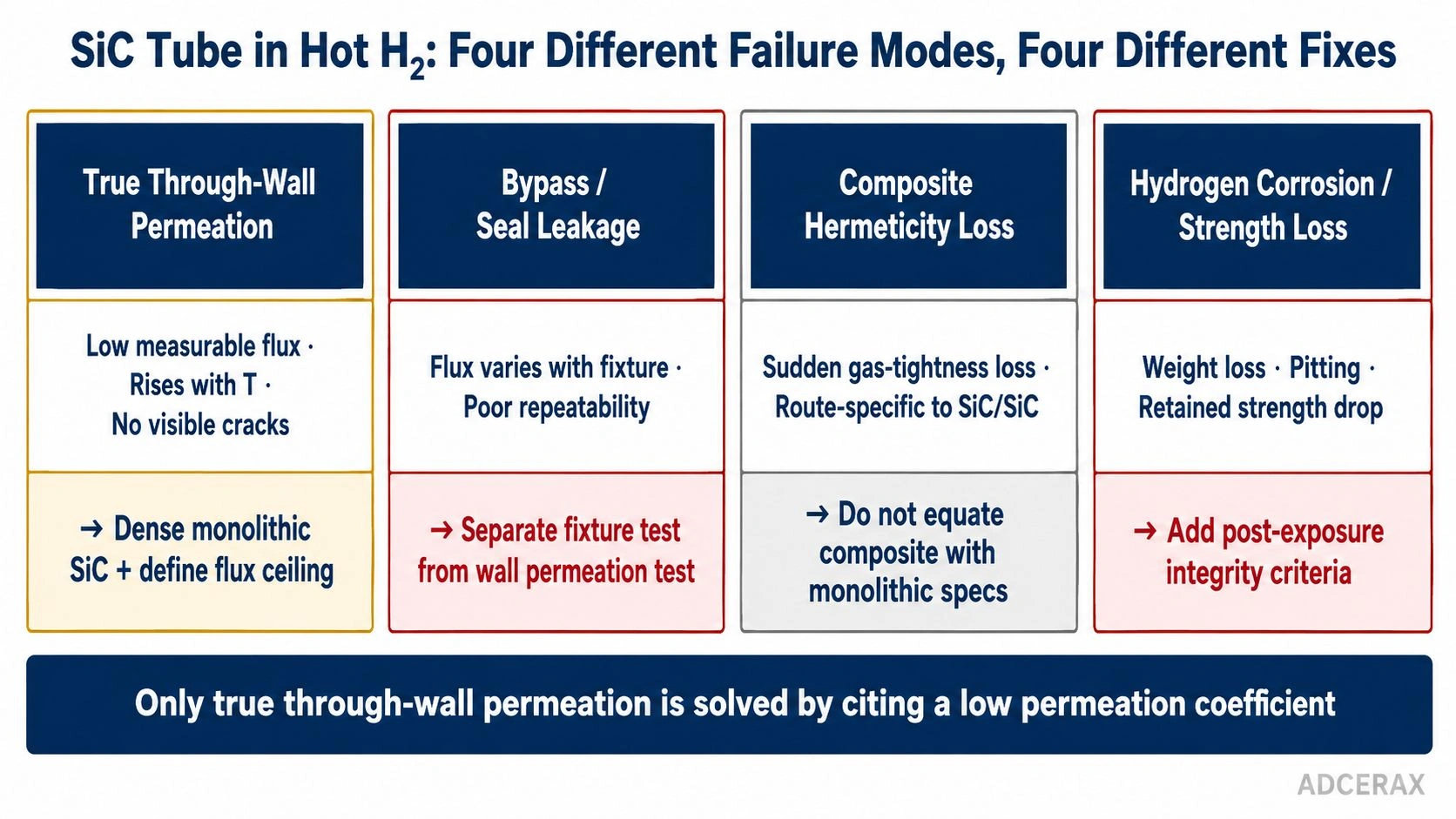
Four different failure modes can all produce "hydrogen leakage" in a SiC tube system — only true through-wall permeation is addressed by citing a low permeation coefficient.
The three most common diagnostic errors that result from this conflation:
Seal and bypass leakage misread as tube permeation. The ORNL and Kyoto/JAEA permeation researchers invested significant experimental effort in controlling wraparound flow and fixture leakage precisely because bypass leakage is common at high temperature and can mimic through-wall permeation in a poorly controlled setup. A tube that appears to fail a permeation test may be failing a seal test.
Composite tube hermeticity loss reported as "SiC permeability." Nuclear-grade testing documented by ORNL shows a crucial route split: CVD SiC tubes retained gas tightness after neutron irradiation while SiC/SiC composite tubes under comparable conditions often did not, and coatings only partially restored hermeticity. The failure mechanism in composites is damage-related, not transport-related, and is not described by a permeation coefficient.
Hydrogen corrosion at high temperature misread as purely a permeation problem. A sintered α-SiC specimen in pure dry hydrogen that is losing mass and experiencing grain-boundary corrosion at 1000–1300°C is not failing primarily by permeation in the steady-state transport sense. It is failing by reactive chemical attack. The corrective action is different from increasing wall thickness to reduce permeation flux.
Diagnose hydrogen loss in three steps: Is the tube dense and monolithic? Is the leakage path through the wall or around the system? Is hydrogen already damaging the microstructure? Only after all three are answered does "permeation specification" become the primary document to write.
True permeation data are invalidated easily by seal bypass and holder leakage
Any permeation test result on a SiC tube that does not demonstrate separate fixture leak validation is suspect. This is not a minor quality detail — it is the dominant source of unreliable data in the literature on ceramic hydrogen barriers, and it is why only a small number of well-controlled studies on dense CVD SiC constitute the defensible evidence base.
Composite gas-tightness and monolithic gas-tightness are different specifications
A procurement document that says "SiC tube — hermetic for hydrogen service" without specifying dense monolithic versus composite may be receiving a composite tube qualified for structural duty, not for gas barrier duty. The hermeticity performance of the two routes under thermal cycling and irradiation is fundamentally different.
When is dense SiC defensible, and when does the route need coatings or redesign
Dense monolithic SiC is defensible as a hydrogen barrier when the tube is genuinely dense and flaw-controlled, the service temperature is low enough that the permeation penalty remains within an acceptable budget, and the gas chemistry is clean enough that hydrogen-induced corrosion is not attacking the microstructure on a timescale relevant to the service interval. Older corrosion work reported clean H₂ at approximately 900°C to be essentially inert for dense SiC in one review, but the same body of work and the NASA sintered-grade data place the degradation onset for some grades at 1000°C, with significant effects by 1100–1300°C.
The practical selection rule derived from this evidence:
The Selection Threshold Matrix below converts the combined assessment into route guidance:
| If the duty looks like… | Prefer | Why |
|---|---|---|
| Dense monolithic tube, moderate high-T H₂, clean environment, measured leak budget | Dense CVD or high-density monolithic SiC | Best direct evidence for real barrier behavior is on dense monolithic SiC; barrier advantage is large below ~800°C |
| Composite route with microcrack risk or irradiation | Coated or redesigned route | Composite hermeticity can collapse even when monolithic CVD SiC survives under comparable conditions |
| Very high temperature approaching or exceeding the corrosion regime | Route review required | Permeation rises and some SiC grades corrode or lose strength in dry H₂ above ~1000°C |
| Simple "SiC is inert in hydrogen" assumption without qualification | Reject assumption | Dense SiC can be inert around 900°C in clean H₂ in one older review, but that does not cover hotter, longer, or chemically varied duties |
Indicative route logic synthesized from the sampled literature; verify with route-specific permeation and post-exposure data.
The ceramic tube material options available for high-temperature hydrogen service — SiC, alumina, mullite, and advanced composite routes — each carry different permeation characteristics, hermeticity definitions, and temperature-degradation profiles that must be matched to the specific duty rather than inferred from generic material rankings.
"Dense monolithic" is the real selection keyword, not just "SiC"
A procurement specification that says "dense monolithic SiC" with a defined density floor and a wall temperature ceiling is making a meaningful engineering statement. A specification that says "SiC tube, hydrogen service" is naming a material without specifying the hermeticity basis. The difference between these two documents determines whether the supplier delivers a tested barrier or an untested ceramic.
Once wall temperature or microcrack risk rises, coatings become route logic rather than optional extras
Coating strategies for SiC in hydrogen service — particularly tungsten or tungsten-alloy barrier coatings for nuclear applications — are part of the route architecture when the dense monolithic tube alone no longer provides adequate barrier performance. The ORNL data showing that coatings only partially restore composite tube hermeticity suggests that coatings are most effective when applied to an already-hermetic monolithic substrate, not as a repair for a defect-prone composite route.
What should go into the RFQ and validation plan
Before placing an order for SiC tubes in high-temperature hydrogen service, the specification must resolve at minimum four items: the SiC route, the maximum wall temperature, the acceptable leak or permeation rate, and the validation method. Without all four, "SiC tube for hydrogen" is not a hydrogen-barrier specification.
The specification and validation checklist for industrial ceramic components in high-temperature hydrogen tube service:
- SiC route — specify CVD monolithic SiC, pressureless sintered SiC with defined additive type and density floor, or SiC/SiC composite; do not accept "SiC" alone as a route descriptor.
- Maximum wall temperature — state the planned peak wall temperature; the permeation coefficient increases with temperature and some degradation mechanisms onset at approximately 1000°C for certain sintered grades.
- Hydrogen pressure range — specify the operating and peak H₂ partial pressure differential across the tube wall.
- Allowable permeation or leak rate — state the maximum acceptable flux in defined units under stated conditions; require the supplier to demonstrate this has been measured, not assumed.
- Permeation test basis — specify whether hydrogen-isotope proxy data are acceptable or whether direct H₂ permeation data are required; define the test temperature and pressure conditions.
- Fixture leak validation — require evidence that permeation measurements exclude seal and bypass contributions; this is the most common source of unreliable permeation data.
- Proof-of-gas-tightness — specify whether each tube must be individually tested before and after a thermal cycling protocol.
- Post-exposure integrity criteria — define rejection criteria for weight loss, surface pitting, or retained-strength change after high-temperature hydrogen exposure; do not rely on permeation data alone for a service that is near or above the corrosion regime.
- Route-specific hermeticity evidence — require the supplier to provide test data specifically for the proposed tube route; data from a different SiC route or a different tube geometry are not transferable without qualification.
If the supplier cannot provide route-specific hermeticity evidence at the planned service temperature, the buyer is purchasing a ceramic tube — not a qualified high-temperature hydrogen barrier.
Conclusion
Dense SiC tubes, particularly CVD-grade or high-density sintered routes, are real hydrogen barriers at moderate high temperature, and the isotope-permeation literature quantifies that advantage relative to stainless steel at useful resolution. But the advantage is temperature-dependent, route-dependent, and structurally specific. Composite routes can lose hermeticity by damage mechanisms that have nothing to do with bulk permeation. Some sintered grades can experience hydrogen corrosion before permeation is even the binding constraint. The specification that protects against all three failure modes names the route, defines the wall temperature, states the permeation budget, and requires validated test data — not a general claim that SiC is resistant to hydrogen.
Evaluating SiC tubes for high-temperature hydrogen service or specifying a barrier route? Send the planned wall temperature, H₂ pressure differential, allowable leak rate, SiC route under consideration, and any existing permeation or gas-tightness test data. ADCERAX engineers return a route-fit assessment with grade recommendation, hermeticity documentation, and thermal-duty limits for the confirmed specification; turnaround depends on inquiry complexity — no RFQ commitment required at this stage.
Frequently Asked Questions
Is SiC a real hydrogen barrier at high temperature?
Yes, dense monolithic CVD SiC can be. The best direct isotope-permeation data show a large barrier effect relative to stainless steel at the lower end of the studied high-temperature range — more than three orders of magnitude lower at 600°C in the sampled fusion literature. The barrier is real, but it is temperature-dependent, route-dependent, and requires a controlled microstructure without grain-boundary defects or second-phase content that would increase effective permeability.
Does the barrier advantage stay constant as temperature rises?
No. Published re-evaluation of CVD SiC permeation coefficients shows the advantage over stainless steel shrinks materially as temperature rises toward 950°C. The route is still a barrier at that temperature, but it is no longer in the range where permeation can be neglected without accounting for operating temperature. A single room-temperature or low-temperature claim should not be extrapolated to define performance at higher-temperature duty.
Are all SiC tubes equivalent for hydrogen service?
No. Dense monolithic CVD SiC, sintered SiC with various additive chemistries, and SiC/SiC fiber composites are not interchangeable from a hermeticity standpoint. Composite routes can lose gas tightness through fiber-matrix interface damage and microcracking mechanisms that do not affect a dense monolithic body under comparable conditions, and the two route types require different hermeticity specifications and validation methods.
Can hydrogen damage SiC even when permeation is still low?
Yes. In pure dry hydrogen at high temperature, some sintered α-SiC grades showed measurable weight loss, surface corrosion, and retained-strength reduction after extended exposure — documented in a NASA study on high-temperature hydrogen effects on sintered SiC. Degradation can become the binding design constraint before through-wall permeation reaches an unacceptable level, particularly as temperature approaches or exceeds approximately 1000°C.
What is the biggest specification mistake buyers make for SiC in hydrogen service?
Specifying "SiC tube" without defining the SiC route, maximum wall temperature, allowable leak rate, and validation method. That leaves true through-wall permeation, seal bypass leakage, composite hermeticity loss, and material degradation from hydrogen attack all unaddressed in the same document, with no test basis to distinguish between them during supplier evaluation or acceptance testing.