Sourcing alumina for a solar cell diffusion furnace is a position decision before it is a grade decision. Quartz owns the direct process path—diffusion tube and wafer boat—for mainstream POCl₃ emitter work. Alumina belongs outside that path: as an outer liner, support sleeve, or insulation-adjacent structural tube around the hot zone. Treating alumina as a drop-in process tube is the wrong assignment. For liner and support forms and ADCERAX material selection grades, review the alumina tube grade catalog for liner and furnace support review.
This guide is for PV process and procurement engineers who must decide where alumina belongs in a quartz-centered diffusion furnace, which alumina composition to screen first, and what to put on the RFQ. It does not claim alumina replaces quartz process-contact hardware, and it does not treat bare percentage drawings as complete specifications.
3-Minute Decision: Quartz Process Path vs Alumina Support Path
3-minute decision: Separate process-contact hardware from outer liner / support hardware, then pick an ADCERAX grade only for the alumina position.
- Contacts POCl₃ / wafers / carrier boat path → quartz. Keep quartz as the diffusion process tube and wafer boat. Do not specify alumina as a drop-in process tube for mainstream PV diffusion.
- Coaxial outer liner or hot-zone stabilizer around the quartz tube → alumina; start screening at 99.5% alumina. Default for wafer-environment-adjacent liner / support.
- Stricter cleanliness / metallic-impurity boundary → 99.7% or higher-purity alumina. Step up only when process owners name a tighter limit than 99.5% covers.
- Remote structural sleeve / insulation-related tube isolated from process gas → 99.5% or lower-purity alumina. Use lower-purity alumina when contamination sensitivity is low and isolation is clear.
- Near-wafer environment → do not prefer low-purity alumina. 95% (C795) is generally not first choice adjacent to the wafer-processing boundary.
Default path: quartz for process contact → 99.5% alumina for outer liner / near-hot-zone support → escalate to 99.7% or higher-purity alumina only for named cleanliness drivers → consider lower-purity alumina only for remote structure. Purity never replaces position confirmation.
How a solar diffusion furnace is actually built
Public solar-cell process literature still describes POCl₃ emitter diffusion as a quartz diffusion-tube furnace process. Wafers load on a quartz carrier boat inside a quartz diffusion tube; phosphorus oxychloride flows at controlled temperature, time, and gas ratios. Quartz tube and boat remain the direct process-contact hardware because of stability in the typical 1000–1200 °C process window, very low metallic contamination, and halogen-gas compatibility. Continuous-use marketing for quartz hardware often cites about 1150 °C—process-tube service language, not an ADCERAX alumina selection ceiling. The alumina question is where alumina improves the surrounding structure—not whether it replaces that quartz core.
Quartz process tube and quartz boat as the main process-contact hardware
Quartz diffusion tubes and quartz wafer boats are the established process-contact standard for low-contamination phosphorus diffusion in PV manufacturing. Neither role is the conventional alumina assignment in mainstream solar diffusion equipment.
Why “tube in a furnace” does not mean the same material everywhere
A solar diffusion furnace is a multi-component assembly: quartz process tube, heating elements, chamber structure, outer liner or support hardware, and insulation-associated parts. Direct process contact demands contamination control and POCl₃ compatibility. Outer structural positions demand rigidity, dimensional stability, and thermal performance across the furnace cycle. Different positions, different materials.
Where alumina tubes actually add value in a solar diffusion furnace
The strongest documented role for alumina here is as an outer liner or support-related structural tube around the quartz core—not as the main diffusion process tube. Industrial furnace-tube practice and patent assemblies describe alumina outer liners / insulating layers around quartz or heated furnace tubes for support, outer-boundary purity, temperature stability, and electrical duty. Broader industrial furnace ceramics context—alumina, mullite, silicon carbide, and zirconia—explains why liner and support roles sit beside, not instead of, the quartz diffusion tube.
Five positions, ranked by alumina fit:
- Outer liner around quartz diffusion tube — strong fit (mechanical support, resistance to quartz sag, high-purity outer hot-zone surface).
- Insulation-adjacent support sleeve or structural outer tube near the hot zone — conditional fit (rigidity and stability outside the direct process path).
- Non-process structural component in end-cap or flange region — reasonable candidate when gas isolation is clear.
- Wafer carrier boat — quartz standard; alumina is not the conventional PV diffusion boat material.
- Main solar diffusion process tube — quartz mainstream; alumina is not the primary fit.
Outer liner around quartz diffusion tubes
An alumina outer liner sits coaxially around the quartz diffusion tube, supports it structurally, and holds a dimensionally stable outer hot-zone boundary. It helps limit quartz sag under sustained load, manages the thermal gradient toward the furnace body, and can be replaced on a different maintenance cycle than the quartz tube. Default screening for this wafer-adjacent outer position: 99.5% alumina.
Insulation-associated or support-related tube roles near the hot zone
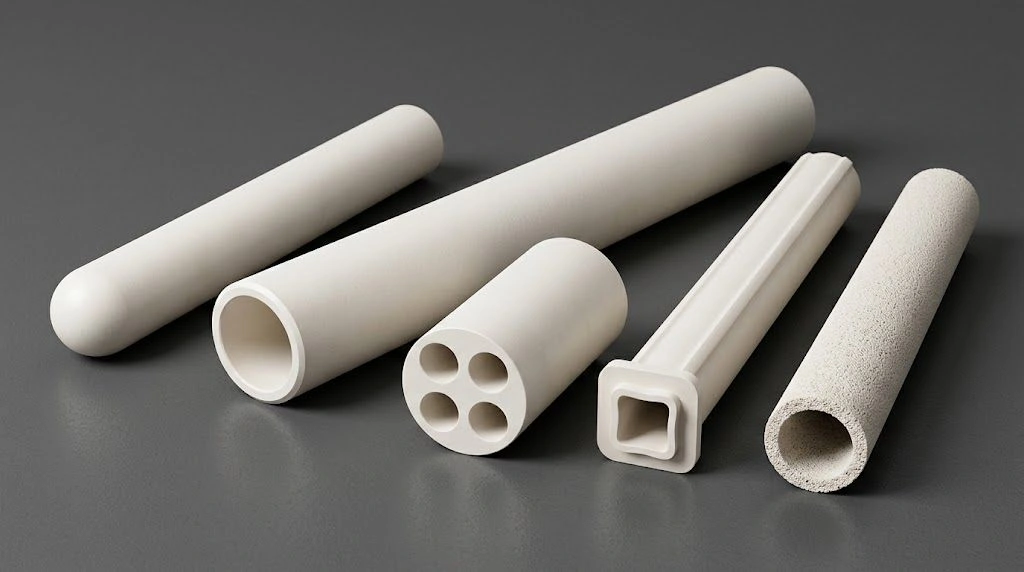
Beyond the coaxial liner, alumina can serve in end-cap assemblies, support sleeves, or structurally loaded outer tubes where temperature is high but direct POCl₃ or wafer contact is limited. Governing requirements are dimensional stability, thermal-cycle resistance, and mechanical / electrical design fit. For multi-material tube families across furnace positions, see multi-material ceramic tubes as context only; this article stays on PV diffusion position logic.
Why alumina is useful outside the direct process path
Alumina brings mechanical rigidity and creep resistance under sustained load more consistently than quartz in support roles. Quartz remains superior for low metallic contamination in the process gas path and thermal-shock behavior inside the diffusion tube. An outer alumina liner stabilizes long horizontal quartz tubes against sag without entering the diffusion atmosphere.
Use composition and process requirements—not bare “≥99.5%” language—as the selection frame. Wafer-environment-adjacent liner / support: start screening at 99.5% alumina (C799); step to 99.7% or higher-purity alumina for stricter cleanliness; remote structure may screen lower-purity alumina; 95% is generally not preferred near the wafer environment.
Mechanical rigidity and hot-zone stability
In high-throughput lines, furnace tubes run continuously under substantial wafer loads. Alumina’s higher flexural strength and creep resistance at elevated temperature make it the more reliable long-term structural material for support—while quartz retains the contamination and chemical-compatibility role inside the process path. Both requirements coexist; they are not resolved by one material in every position.
Purity and insulation value outside the main gas process path
Dense, high-purity alumina also provides an electrically insulating, chemically stable surface at the hot-zone boundary. Where heating elements, thermocouple wells, or support hardware pass near the hot zone, an alumina outer component can supply both a contamination barrier and electrical isolation—support-path value, not a license to move alumina into the POCl₃ process tube.
Where quartz remains the better choice — and alumina becomes the wrong one
The quartz / alumina boundary is architectural. Quartz stays correct wherever the tube is primary process-contact hardware. The most common sourcing error is specifying alumina as the main diffusion process tube without validating furnace architecture. The architecture is already quartz-centered. Alumina is a structural addition, not a drop-in process-tube replacement.
| Furnace position / function | More defensible primary material | Why | Alumina fit |
|---|---|---|---|
| Main solar diffusion process tube | Quartz | Mainstream PV diffusion hardware is quartz-based | Usually not primary |
| Wafer carrier boat in tube diffusion | Quartz | Public process descriptions place wafers on quartz boats | Usually not main fit |
| Outer liner around quartz diffusion tube | Alumina (or mullite in some designs) | Support, purity, and stability around the quartz core | Strong fit — start 99.5% alumina |
| Insulation-adjacent outer tube / support sleeve | Alumina | Rigidity and stability outside direct process path | Conditional fit — 995 or 990 by isolation |
| Direct replacement for mainstream quartz diffusion chamber | Quartz remains default | Process literature frames quartz as core | Low-confidence for alumina |
Values are indicative; verify against furnace design, process gases, and component position before sourcing. Position-first logic also applies across other alumina ceramic tube selection matrices—this page only locks the PV diffusion furnace assignment.
Quartz as the mainstream process-tube material
Quartz diffusion tubes are standard in silicon solar manufacturing because contamination performance, thermal-shock behavior, and halogen-gas compatibility are validated in high-volume production. That validation does not transfer to alumina without separate, position-specific process qualification. Alumina can serve adjacent positions without that burden precisely because it is not in the direct process-gas path.
Alumina as the wrong choice for the wrong tube position
Alumina placed as the primary diffusion process tube—contacting POCl₃ and sitting against wafer carriers—is not the mainstream public PV approach. Protect process quality by keeping quartz in the direct process position and alumina in the structural support / liner position.
ADCERAX Grades for Diffusion-Furnace Liner / Support Screening
ADCERAX sells liner and support tubes against ADCERAX SKUs tied to IEC 60672-3 groups C795 and C799. Long-term temperatures below are material selection ceilings—not load life, not guaranteed continuous operating temperature under arbitrary atmosphere or load, and not the quartz POCl₃ process window (typically 1000–1200 °C). Grade ceilings sit well above that window; still re-check atmosphere, cycle, geometry, and clearance. Density, MOR, and k are typical references for comparing SKUs, not finished-tube guarantees at every length and wall.
| Al₂O₃ wt% (nom.) | IEC 60672-3 | Density g/cm³ typ. | MOR MPa 20 °C typ. | k W/(m·K) 25 °C | Selection ceiling °C |
|---|---|---|---|---|---|
| 99.90 | C799 | 3.94 | 315–340 | 35–42 | 1750 |
| 99.70 | C799 | 3.94 | 330 | 35–40 | 1700 |
| 99.50 | C799 | 3.90–3.92 | 320–350 | 30–38 | 1650 |
| 99.00 | C795 | 3.80–3.91 | 300–320 | 24 | 1600 |
| 95 | C795 | 3.75 | 280 | 18–25 | 1400 |
Tube straightness for the listed alumina grades is commonly controlled to 1 mm/m against the drawing datum—confirm for coaxial liner fit. IEC grouping is a composition class, not a finished-part certificate. Do not use older three-band purity / temperature tables as catalog truth.
Position → starting composition (screening only): coaxial outer liner near wafer environment → 99.5% alumina (step up in purity for stricter cleanliness); hot-zone support / insulation-related structure with clear gas isolation → 99.5% or lower-purity alumina; main process tube / boat → not an alumina primary assignment.
What to specify when sourcing alumina tubes for solar diffusion-furnace support roles
Define the tube’s position in the furnace assembly before grade or geometry. Position determines which properties govern the RFQ.
Position and role definition
- Confirm outer liner, support sleeve, insulation-adjacent structural tube, or other non-primary-process component. An RFQ that only says “for solar diffusion furnace” without position invites mismatched answers.
- Confirm relationship to the quartz diffusion tube: coaxial outer liner, separate support, or independent structural part.
- Confirm whether alumina contacts process gas directly or is separated by the quartz tube and a gas-isolation boundary.
Geometry and interface specification
- OD, ID, wall, and length relative to the quartz tube it surrounds or supports (size review belongs on the drawing / quote package—not as a sizes catalog chapter here).
- Straightness and concentricity—for coaxial liners, call out 1 mm/m semantics when that is the drawing basis.
- End style: plain, chamfered, or machined flange for end-cap / seal integration.
- Thermal clearance: alumina liner ID vs quartz OD must allow differential expansion without constraining the quartz tube or creating point loads.
Material grade and documentation
- Preferred composition: default 99.5% alumina for wafer-adjacent liner / support; use 99.7% or higher purity for stricter cleanliness; lower-purity alumina is for remote structure; avoid 95% near the wafer environment unless isolation and load review justify it.
- State IEC C795 or C799 with the SKU. Prefer a dense, low-porosity body to limit outgassing / carryover across cycles.
- Request purity / impurity documentation at the offered class—without inventing unsupported ppm guarantees.
- Confirm supplier experience with liners or support tubes for quartz diffusion-tube assemblies, and ask for coaxial installation / clearance notes.
Conclusion
Alumina tubes in solar cell diffusion furnaces serve best outside the quartz process path—in liner and support roles where rigidity, thermal stability, and boundary purity matter more than direct process-gas contact. Quartz remains mainstream for the primary diffusion tube and wafer boat. The first sourcing question is not “Can alumina survive the furnace?” It is “Is this alumina in a position where structural and insulation properties control the design—not quartz process chemistry?”
Specifying an alumina liner or support tube? Send furnace model, hot-zone profile, position relative to the quartz tube, dimensions, and preferred alumina composition (99.5% alumina start unless a named driver says otherwise). ADCERAX returns a grade recommendation with geometry notes for the confirmed role—no RFQ commitment required at this stage.
Frequently Asked Questions
Are alumina tubes the main process tubes in solar diffusion furnaces?
Usually not. Published PV diffusion descriptions treat quartz tubes and quartz boats as the mainstream process-contact hardware for POCl₃ emitter diffusion. Alumina serves structural liner and support roles outside that path rather than replacing the quartz process tube.
Where do alumina tubes make more sense in a solar diffusion furnace?
As outer liners, support sleeves, or insulation-adjacent structural tubes around the hot zone. Start screening at 99.5% alumina for wafer-adjacent outer liner / support; step up in purity for stricter cleanliness; consider lower-purity alumina only when the part is remote from the process-gas path.
Why not replace quartz with alumina if alumina is stronger?
Selection is position-based. The quartz process tube and boat occupy a role validated for POCl₃ chemistry, contamination performance, and wafer handling. Alumina in that same position would need separate process qualification. Apply alumina’s mechanical advantage in liner and support positions—not as a drop-in process tube.
What should be defined first when sourcing alumina for PV diffusion equipment?
Position in the furnace assembly—before grade or dimensions. Confirm outer liner vs support sleeve vs other non-process structure, and confirm spatial relationship to the quartz diffusion tube.
Does the alumina selection ceiling replace the 1000–1200 °C diffusion process window?
No. The 1000–1200 °C (and ~1150 °C continuous quartz marketing) figures describe the quartz process window. ADCERAX grade selection ceilings (1400–1750 °C by SKU) are material selection limits for comparing grades—not load life and not automatic approval to run any geometry or atmosphere at that number.