Alumina tube surface roughness affects gas flow mainly when the tube has small ID, long flow length, high velocity, turbulent flow regime, particle-laden gas, or strict cleanliness requirements. In laminar, short, low-flow systems, ID size and fittings typically dominate pressure drop far more than Ra. The engineering rule is to specify polished ID only where pressure drop, particle retention, cleaning ease, or contamination control actually requires it — and to allow as-fired or locally finished surfaces everywhere the function permits.
That conditional framing — roughness matters when conditions make it matter, not universally — is the specification principle this guide builds around.
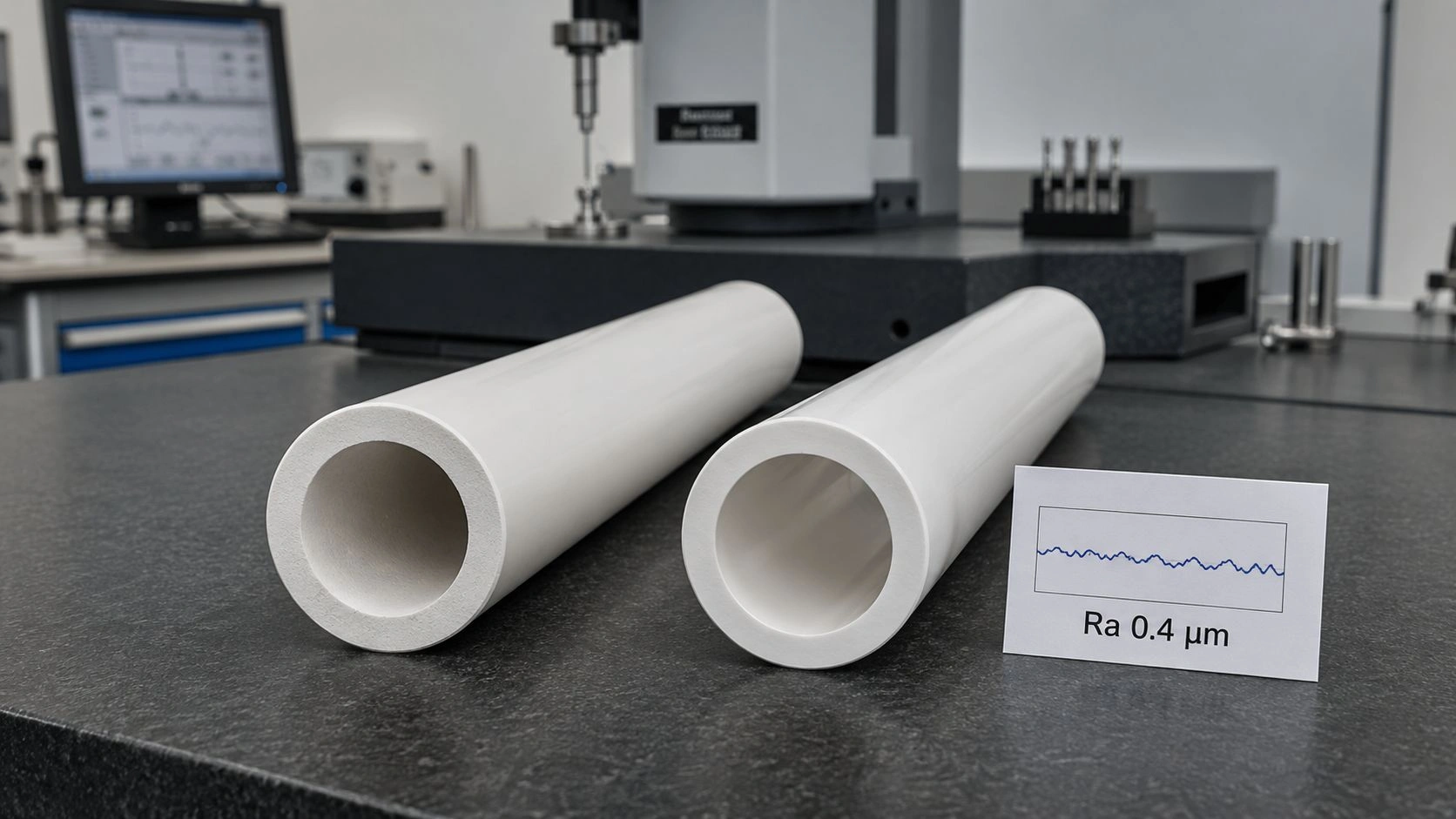
Alumina tube ID roughness affects gas flow through relative roughness, Reynolds number, and flow regime — the same Ra value matters more in a small-bore tube at high velocity than in a large-bore low-flow system.
The alumina ceramic tube grades and configurations are the product starting point for the surface-finish specification decisions in this guide. Finish route (as-fired, ground, or polished ID) is process- and grade-dependent — confirm on RFQ.
How surface roughness changes gas flow in alumina tubes
Surface roughness changes gas flow by modifying wall friction at the tube interior, but the magnitude of the effect depends entirely on flow regime and relative roughness — not on absolute Ra alone.
The Darcy-Weisbach framework for frictional pressure drop in pipe flow establishes the mechanism directly: frictional pressure drop is governed by pipe geometry, flow velocity, fluid properties, and friction factor. The friction factor itself depends on Reynolds number and pipe roughness. In laminar flow, the friction factor is controlled by Reynolds number and is essentially independent of roughness for practical purposes. In turbulent flow, pipe roughness enters through the relative roughness parameter ε/D — the ratio of surface roughness height to pipe diameter — and can significantly increase the friction factor above its smooth-pipe value.
For alumina tubes, this means the engineering question is not "what is the Ra?" but "what is the relative roughness at the operating Reynolds number?"
Absolute roughness vs relative roughness
Absolute roughness (ε or Ra) is the physical height of surface texture features, measured in micrometers. Relative roughness (ε/D) is that height divided by the tube inner diameter. A polished alumina tube with Ra 0.4 µm in a 50 mm ID tube has a relative roughness of about 0.000008 (illustrative order-of-magnitude). The same Ra 0.4 µm in a 3 mm ID tube produces a relative roughness of about 0.00013 — more than fifteen times higher. In turbulent flow, these two cases produce meaningfully different friction factors on the Moody diagram. The small-bore tube is substantially more sensitive to the same absolute roughness.
Laminar flow: ID and viscosity often dominate
In laminar flow — typically Reynolds numbers below about 2300 for smooth tubes — friction is governed primarily by fluid viscosity and hydraulic diameter, not surface roughness. The Hagen-Poiseuille equation for laminar pressure drop contains no roughness term. For many gas-flow applications involving clean gas at low velocity through short alumina tubes, the flow is laminar, and the practical consequence is that polishing the ID provides negligible pressure-drop benefit. The most impactful variable is the actual ID tolerance — a tube 0.1 mm undersize on ID raises laminar pressure drop more than doubling the surface roughness would.
Turbulent flow: roughness can raise friction factor
In turbulent flow, surface roughness increases the friction factor above its smooth-pipe value once the viscous sublayer thickness becomes comparable to the roughness height. This is the regime where Ra specification becomes directly relevant to pressure drop. High-velocity gas flows in small-bore tubes at low temperature and pressure are more likely to reach turbulent conditions — Re > 4000 — and to show measurable roughness effects on friction factor and pressure drop.
Why small-bore alumina tubes are more sensitive
The combination of small ID and any roughness creates higher relative roughness, which in turbulent flow means higher friction factor and more pressure drop. For particle-laden or condensate-carrying gas, the same geometry also traps particles and residues more aggressively in surface valleys — which is why cleanliness requirements tighten the roughness specification even for flow systems that operate in laminar regime.
When ID roughness matters most: small bore, high velocity, long tube, and particles
After understanding the flow mechanism, the practical question is which combinations of tube geometry, gas condition, and application requirement actually make ID roughness worth specifying and paying for.
Relative roughness tends to raise frictional pressure drop more in smaller-diameter passages and inertia-dominated regimes. For gas flow, evaluate roughness effects against actual relative roughness and Reynolds number using gas density and viscosity at the operating pressure and temperature — do not assume the effect is negligible simply because the gas is dry or low-pressure.
The Alumina Tube Roughness vs Gas-Flow Decision Matrix below maps common flow conditions to roughness sensitivity and specification direction:
| Condition | Roughness sensitivity | Why it matters | Specification direction |
|---|---|---|---|
| Laminar, low-flow, short tube | Low to moderate | Friction depends more on viscosity, ID, and length | As-fired or locally finished may be enough |
| Turbulent gas flow | Higher | Friction factor depends on Reynolds number and relative roughness | Define ID Ra or Rz in flow zone |
| Small ID tube | Higher | Same roughness creates larger ε/D | Control ID roughness and ID tolerance together |
| Long tube | Higher | Friction accumulates over length | Specify pressure-drop target and finish zone |
| Particle-laden gas | Higher | Surface valleys can retain particles | Polished or honed ID may be justified |
| Condensable vapor | Higher | Rough surfaces can hold liquid or residue | Specify cleanable surface finish |
| Analytical/high-purity gas | Higher | Residue and particle release affect measurement | Ra < 0.2 µm may be evaluated where justified |
| Simple furnace purge gas | Lower | Flow accuracy may be less critical | Avoid full-length polishing unless needed |
Values indicative; verify with gas properties, Reynolds number, tube ID/length, pressure-drop calculations, and supplier-specific surface-finish data.
Small ID and high ε/D. For alumina protection tubes and thermocouple sheaths in the 3–10 mm ID range, even moderate as-fired surface roughness can produce meaningful relative roughness in turbulent flow. Specifying a ground or honed ID in these tubes — rather than as-fired — produces a measurable reduction in friction factor and can reduce pressure-drop margin requirements.
High velocity and turbulent flow. When the application requires high gas flow rates through a narrow passage — purge gas at high flow, analytical sample gas, or carrier gas for powder transport — Reynolds number may reach the turbulent range even in moderate-diameter tubes. As an engineering rule-of-thumb screening band, Re > 4000 is commonly treated as the turbulent side of pipe flow; it is not a guaranteed turbulent threshold. Compute Re with actual gas density and viscosity at operating pressure and temperature — the transition band is fluid- and geometry-dependent. In that screening band, relative roughness contributes increasingly to friction factor, and a polished ID may provide a real pressure-drop benefit over as-fired.
Long tubes and accumulated friction loss. Pressure drop scales with tube length. For a 1000 mm alumina tube at turbulent flow, a 20% reduction in friction factor from polishing translates directly into 20% lower pressure drop for friction-dominated systems. For a 100 mm tube at the same conditions, the same roughness reduction provides five times less absolute improvement. Length amplifies every roughness effect.
Particle-laden or condensable gas streams. Even in systems where pressure drop is not the primary concern, a rough inner surface can trap particles, powder fines, condensed vapor, or reactive residue in surface valleys. In applications where the gas carries entrained powder — kiln atmosphere, spray drying, chemical vapor — a smoother inner surface reduces retention and makes cleaning more effective. This is a cleanliness and maintenance driver rather than a pressure-drop driver, and it applies in laminar and turbulent flow alike.
Clean analytical gas paths and residue control. Analytical gas systems, process gas analyzers, and gas chromatography sample lines that use alumina tube sections require clean inner surfaces because any residue can desorb, react, or contribute contamination to the gas stream. For these applications, Ra < 0.2 µm may be evaluated for the gas-contact zone, and cleaning protocol (ultrasonic clean, clean packaging) should accompany the surface-finish specification.
Do not misdiagnose every flow problem as a roughness problem
When a gas system shows higher-than-expected pressure drop, flow drift, particles in the outlet, or residue after service, alumina tube inner surface roughness is one possible contributor among many — and often not the dominant one. Diagnosing roughness as the cause before checking other variables leads to specifying more expensive polished tubes that do not solve the actual problem.
ID undersizing vs surface roughness. In laminar flow, pressure drop scales with the fourth power of inner diameter — halving the ID increases laminar pressure drop by a factor of sixteen. A tube that is 0.2 mm undersize on ID from manufacturing variation contributes far more to pressure drop than a rough surface would. Confirming the actual measured ID, not just the nominal specification, should precede any decision to tighten surface roughness.
Fittings, bends, reducers, and seals. In most practical gas systems, fitting losses — elbows, reducers, connectors, valves, and filter elements — contribute minor losses that can equal or exceed friction losses in short-to-medium tube lengths. A system that shows unexpected pressure drop with a new alumina tube should be checked against fitting configuration and connection quality before attributing the drop to tube surface condition.
Deposits and particle retention after service. Residue found on the inner surface of a used alumina tube is often process-derived — condensed vapor, powder carryover, reaction product, or furnace insulation debris — rather than ceramic surface shedding. Changing to a polished tube will not eliminate deposits from upstream sources; it may make them easier to clean but will not prevent them from forming.
Gas compressibility and temperature effects. For gas flow — unlike liquid flow — density and viscosity vary with pressure and temperature. A system that shows flow drift with temperature change is responding to gas property variation, not surface roughness. Pressure-drop calculation methods for gas flow require more rigorous treatment than liquid-flow methods because these variations must be accounted for.
Cleaning residues vs ceramic surface finish. After service, alumina tube surfaces may show cleaning agent residue, outgassed species from adjacent materials, or condensate from the gas composition. These residues are not caused by ceramic surface roughness; they result from the cleaning process or the gas chemistry. Tightening Ra will not prevent their occurrence.
The Misdiagnosis Matrix below maps common gas-system problems to better diagnostic questions:
| Observed problem | Common assumption | Better diagnostic question |
|---|---|---|
| Pressure drop too high | Alumina ID too rough | Is ID undersized, tube too long, or fitting loss dominant? |
| Flow rate unstable | Roughness is causing turbulence | Are pressure regulator, temperature, leaks, or gas compressibility controlled? |
| Particles in outlet gas | Tube wall is shedding | Is upstream powder, furnace insulation, or cleaning residue the source? |
| Residue after service | Surface finish too rough | Is vapor condensation or gas chemistry causing deposits? |
| Seal leak | End-face roughness problem | Is flatness, perpendicularity, gasket compression, or OD tolerance the issue? |
| Different supplier results | Material quality issue | Were Ra location, measurement filter, and ID tolerance specified identically? |
| High polishing quote | Supplier overpricing | Did the RFQ require full-length polished ID without functional need? |
Diagnosis should be based on actual ID measurement, system configuration inspection, and process records before any surface-finish change is specified.
How to specify Ra, Rz, and finish zones for alumina gas tubes
After confirming that roughness is a real contributor to the gas-flow problem, the specification must translate the engineering requirement into drawing language that a supplier can measure, produce, and inspect.
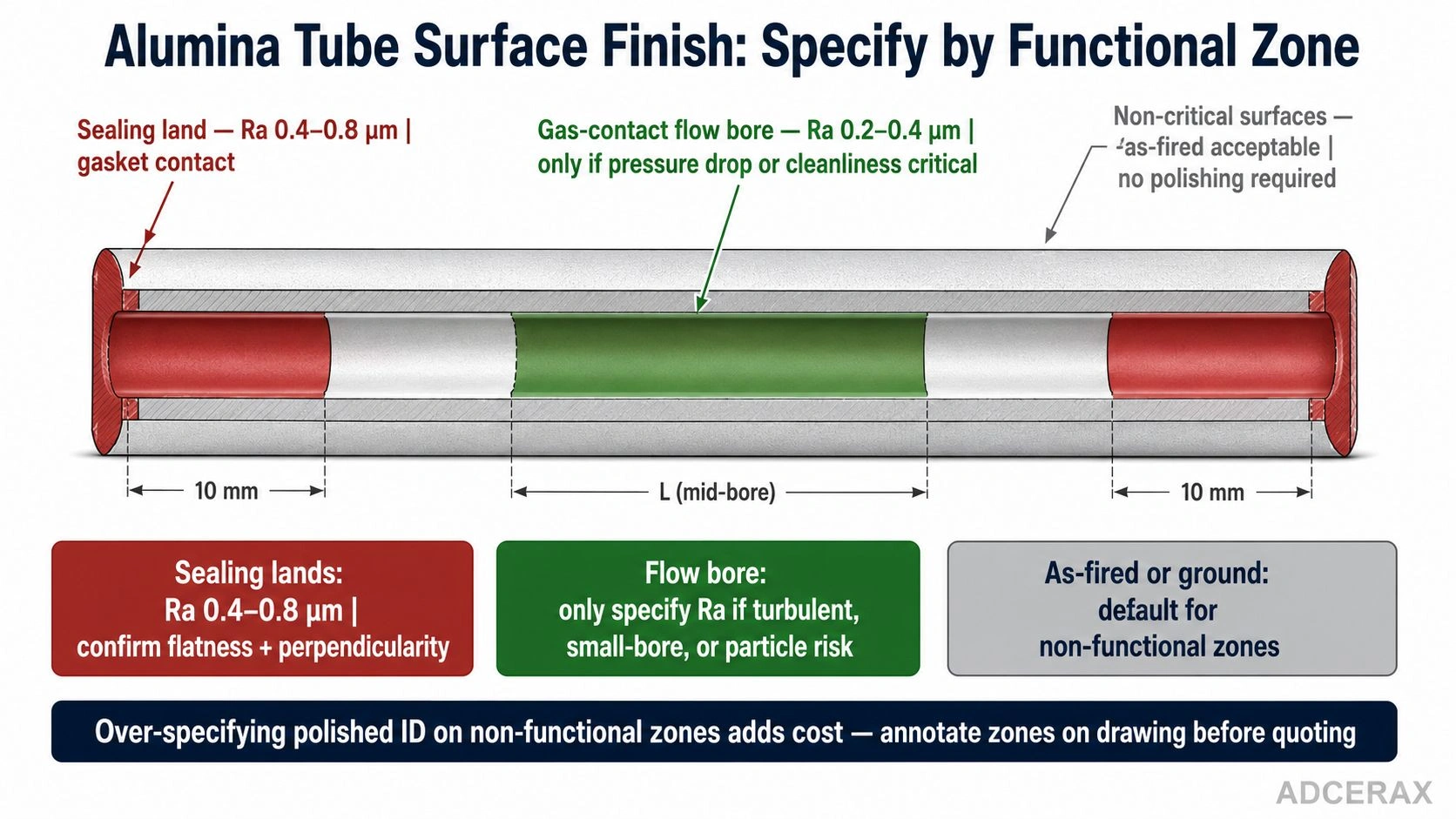
Alumina tube surface finish should be specified by functional zone — sealing lands, gas-contact flow bore, and non-critical OD surfaces each have different requirements, and over-specifying any zone adds polishing cost without functional benefit.
Surface roughness for alumina gas tubes should be specified by function and location — not as a blanket requirement over the full tube. Typical quotation guidance often cites Ra 0.4–0.8 µm for standard sealing contexts and Ra < 0.2 µm for high-purity vacuum or analytical use — as screening / typical quotation bands only (geometry-, process-, and gauge-length-dependent; confirm Ra/Rz, cutoff, and zones on RFQ / drawing — not a universal contract finish). Define finish areas to avoid unnecessary polishing cost; see custom ceramic services for inquiry fields.
The Surface Finish Specification Choices table below maps common alumina tube surface states to their best-fit applications:
| Surface state | Best-fit use | Main advantage | Main limitation |
|---|---|---|---|
| As-fired ID | General furnace purge, non-critical gas paths | Lower processing cost | Roughness and diameter variation may be higher |
| Ground ID | Controlled fit or moderate flow requirements | Better dimensional control | Deep ID grinding can increase cost |
| Honed/polished ID | Clean gas, low residue, tight flow control | Lower retention and smoother functional surface | Must define location and measurement method |
| Glazed surface | Some cleanability or sealing contexts | Smooth surface layer | Chemistry and temperature boundary must be verified |
| Polished end face | Gasket or seal contact | Better sealing behavior | Does not improve full-bore pressure drop |
| Local sealing land finish | Seal-critical surfaces only | Controls cost by finishing only functional zones | Requires clear drawing zones |
Ra is not the only parameter. Ra (arithmetic mean roughness) is the most commonly specified parameter, but it does not capture peak heights, valley depths, or periodicity of the surface texture. Rz (mean roughness depth of the five highest peaks and five deepest valleys over the measurement length) is often a better predictor of particle trapping and sealing behavior than Ra alone. For analytical cleanliness applications, surface defects, porosity, waviness, and lay may all matter in addition to Ra. ASME B46.1 and ISO 21920 are useful standard pointers for naming roughness, waviness, and lay parameters — specify the roughness standard and measurement method on RFQ. This guide does not imply full certified testing to those standards on every tube.
Full-bore finish vs local sealing finish. Specifying Ra across the full inner bore of a long alumina tube adds grinding or polishing over the entire surface area — which is expensive and often functionally unnecessary. If the pressure-drop-sensitive zone is the first 50 mm of bore near the inlet, or if only the sealing land near the tube ends requires tight Ra, the drawing should specify finish by zone. Full-bore Ra specification should be reserved for analytical lines, high-cleanliness gas paths, or systems where the entire tube length is exposed to deposit-forming conditions.
ID roughness measurement access. Measuring Ra inside a long, small-diameter alumina tube is not trivial. Contact stylus profilometers require a probe that fits the bore, which becomes impossible below approximately 6–8 mm ID depending on probe geometry. Optical methods, replica techniques, cut sections, or agreed witness coupons may be necessary for small-bore or deep-bore measurement. The drawing and RFQ should confirm the measurement method before placing requirements that cannot be verified at the specified location.
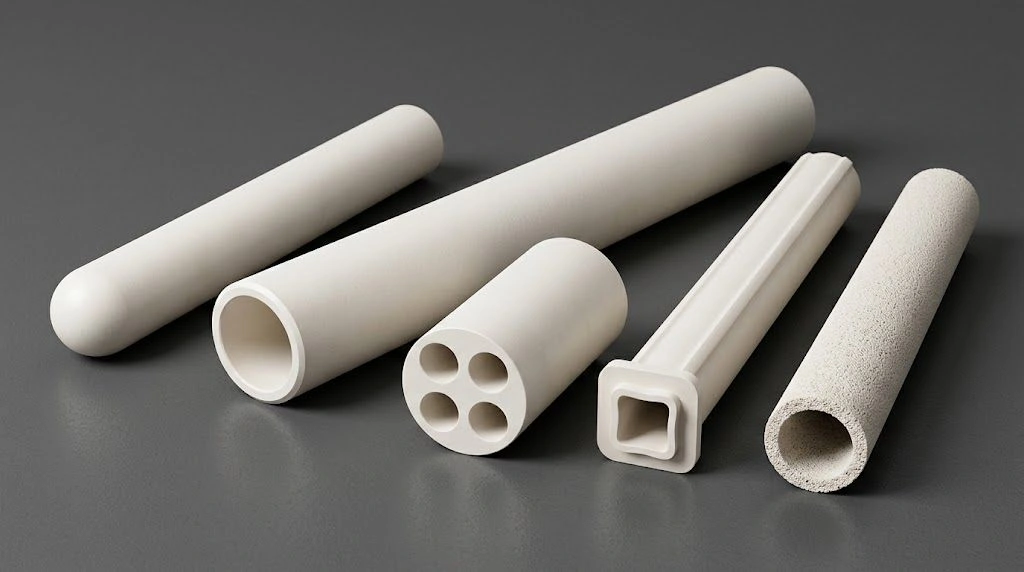
As-fired, ground, honed, polished, or glazed surfaces. The alumina tube configuration guide distinguishes how surface finishing modifies friction and sealing behavior. As-fired surfaces are the lowest-cost option and acceptable for many gas-flow applications. Ground inner surfaces improve dimensional accuracy. Honed or polished inner bores provide the lowest roughness achievable by post-sintering mechanical processing. Glazed surfaces have different chemistry and temperature boundary conditions that must be confirmed before use in high-temperature gas systems.
As-fired roughness and polishability are process- and grade-dependent — confirm starting surface state and finish route on RFQ. See the alumina tubes product range for configuration options that pair with gas-flow finish decisions.
RFQ checklist for alumina tubes in gas-flow systems
A complete RFQ for alumina tubes in gas-flow applications must provide both the gas system conditions and the surface-finish requirements by zone — without both, the supplier cannot confirm whether the proposed surface state is appropriate or whether the measurement method is achievable.
A complete RFQ sequence usually includes gas type, pressure, temperature, and flow rate (to define Reynolds number and flow regime); tube ID, length, and pressure-drop limit (to decide whether roughness governs); functional surface zones (to prevent over-polishing); Ra or Rz with the named standard (ASME B46.1 or ISO 21920) and a bore-appropriate measurement method; particle or vapor exposure; and cleaning/packaging protocol. A supplier who receives only "smooth alumina tube" cannot confirm surface state, parameter, method, or zones without that context.
| RFQ field | Why it matters | Recommended wording |
|---|---|---|
| Gas type and condition | Defines density, viscosity, and reaction risk | "State gas, pressure, temperature, and moisture" |
| Flow rate | Determines velocity and Reynolds number | "Provide normal and maximum flow rate" |
| ID/length | Controls relative roughness and pressure drop | "Specify actual ID tolerance and tube length" |
| Pressure-drop limit | Converts roughness into performance target | "Maximum allowable ΔP at stated flow condition" |
| Surface zone | Prevents over-polishing | "Ra applies to full ID/sealing land/partial bore only" |
| Roughness parameter | Avoids vague "smooth" wording | "Specify Ra, Rz, or ISO 21920/ASME B46.1 parameter" |
| Measurement access | Deep bore may be difficult | "Confirm method: stylus, optical, replica, coupon, or cut section" |
| Particle/residue risk | Drives cleanability requirement | "State powder, dust, vapor, or condensate exposure" |
| Cleaning/packaging | Protects clean gas applications | "Specify ultrasonic clean, clean pack, or standard pack" |
| Sample validation | Confirms real flow behavior | "Recommend sample flow/pressure-drop test if critical" |
RFQ fields are the minimum for an alumina tube gas-flow specification inquiry; add sealing gasket specification, mating component drawing, and operating cycle frequency as needed.
The most productive first step before sending an alumina tube drawing for quotation is to annotate the functional surface zones: "ground ID — sealing land only," "as-fired surface acceptable," "Ra 0.4 µm max — full ID," or "Ra 0.2 µm — analytical contact zone only." This annotation converts a generic roughness note into a manufacturable, measurable, and priceable requirement.
Specifying alumina tube surface roughness for gas-flow systems? Share your gas type, pressure, flow rate, tube ID and length, pressure-drop limit, cleanliness target, particle or vapor exposure, Ra or Rz requirement, finish zone, measurement method, and cleaning protocol. RFQ packages should include those fields so the finish route (as-fired, ground, or polished ID) can be confirmed against geometry and flow regime — see custom ceramic services for inquiry fields. No commitment is required to submit an RFQ package.
Related reading
- Strengthened alumina tube surface treatments — surface-treatment and tube surface-state options that sit next to gas-flow ID finish RFQs.
- Thermal shock failure in alumina tubes for gas delivery — gas-delivery neighbor topic when thermal cycling sits beside roughness and pressure-drop checks.
- How alumina tubes are made: powder to final product — forming-to-finish context for as-fired, ground, and polished ID surface states.
Frequently Asked Questions
Does alumina tube surface roughness affect gas flow?
Yes, but the effect depends on tube ID, length, gas velocity, Reynolds number, and flow regime. In turbulent flow and small-bore tubes, internal roughness increases the friction factor and raises pressure drop more noticeably than in laminar, large-bore, or short-tube systems. In many practical alumina tube gas-flow applications, ID undersizing and fitting losses matter more than surface roughness.
Is polished ID always required for alumina gas tubes?
No. Polished ID is justified when pressure drop, particle retention, residue cleaning, or contamination control requires it. For simple furnace purge gas, non-critical protective tubes, or short low-flow lines, as-fired or locally finished surfaces are typically adequate. Over-specifying polished ID adds cost without functional benefit.
What roughness value should be specified?
Specify roughness by function and zone. Typical quotation guidance often cites Ra 0.4–0.8 µm for standard sealing contexts and Ra < 0.2 µm for high-purity vacuum or analytical applications — as screening / typical quotation bands only, not a universal contract finish. Confirm Ra/Rz, cutoff, gauge length, and finish zones on RFQ / drawing against the actual gas-flow condition, Reynolds number, and cleanliness requirement.
Does Ra alone fully describe gas-flow behavior?
No. Ra is the most commonly specified parameter, but pressure drop depends on ID, length, flow velocity, gas properties, Reynolds number, and relative roughness. Rz and surface defect inspection may better predict particle trapping and sealing performance. Waviness, porosity, and lay can also matter for cleanliness-sensitive applications.
Why are small-bore alumina tubes more sensitive to roughness?
Small-bore tubes have higher relative roughness for the same absolute surface texture — the roughness height is a larger fraction of the hydraulic diameter. In turbulent flow, higher relative roughness moves the operating point to a higher friction factor on the Moody diagram, increasing pressure drop. The effect is most pronounced in tubes below 10 mm ID at high velocity.
What information should I send to a supplier?
Send gas type, operating pressure, temperature, normal and maximum flow rate, tube ID and length, maximum allowable pressure drop, particle or vapor exposure, cleanliness target, required Ra or Rz with applicable standard, surface zone where the requirement applies, ID measurement method, cleaning and packaging requirement, and whether a flow or pressure-drop validation test is required before production.