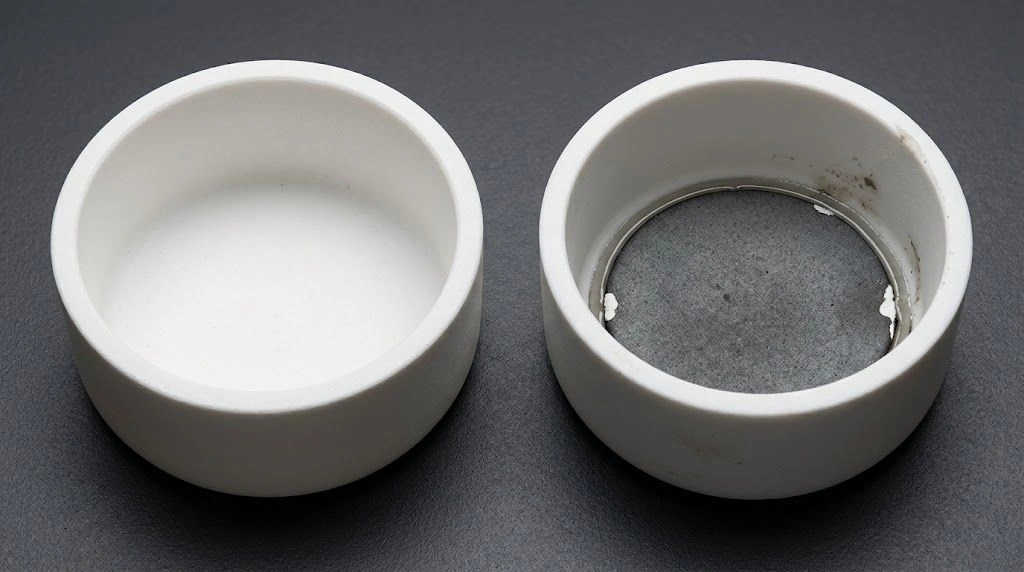
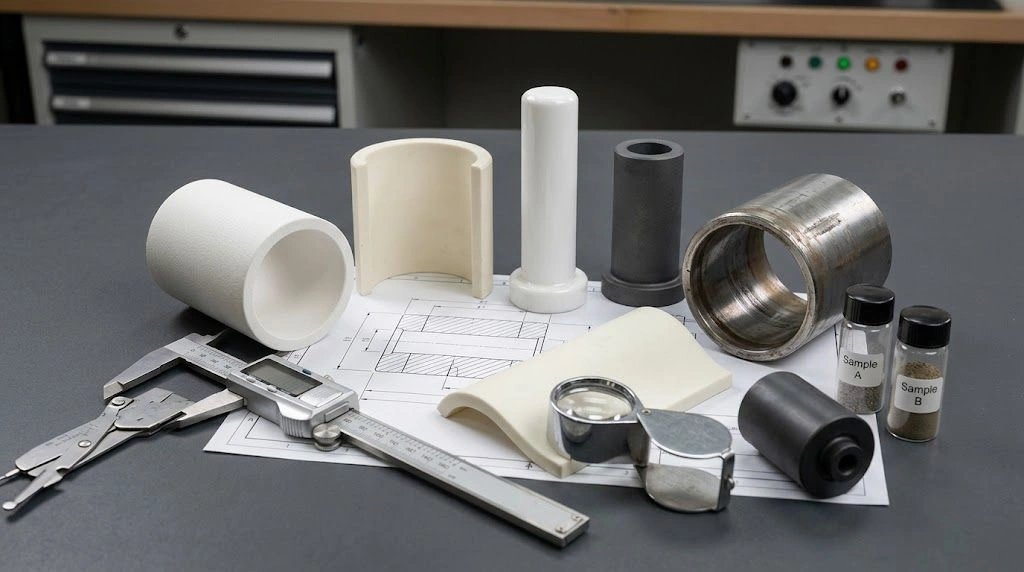
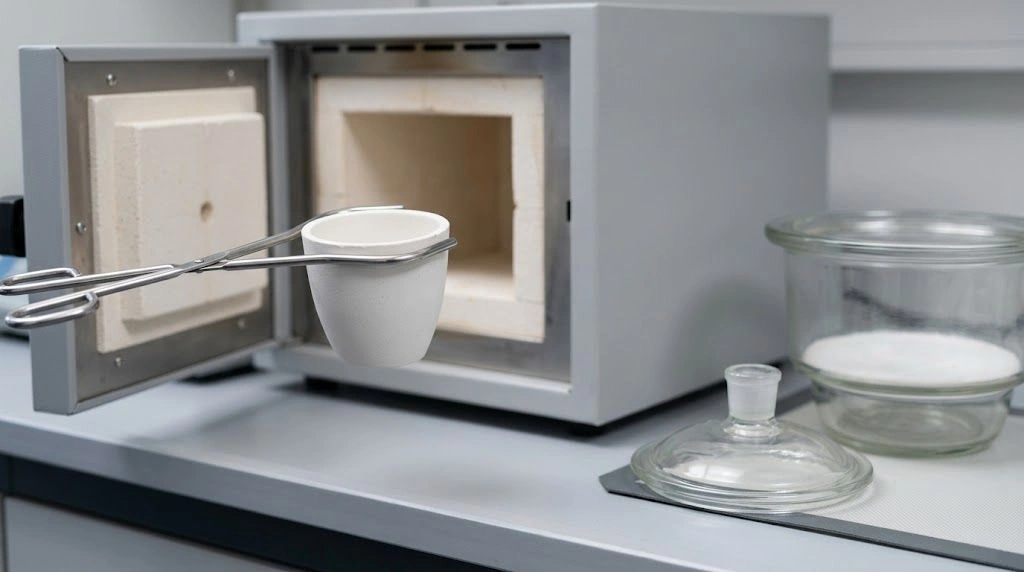
Alumina crucibles can fit quartz glass manufacturing when the work is experimental, small-batch, non-optical, or explicitly tolerant of controlled Al pickup. They are not the default for high-purity fused quartz, optical quartz, semiconductor-adjacent silica, or long hold molten-SiO₂ contact—those routes usually need fused quartz / high-purity silica, zirconia, platinum, or another verified glass-contact material after a melt-contact trial. The decision turns on product impurity limits (Al, Fe, Na, K, Ti), process stage (powder preheat vs partial melt vs full melt + hold), temperature plan, atmosphere, and crucible density/surface finish—not on a generic “high-temperature” label. For melt-contact crucible specifications and ADCERAX grade options, review the alumina crucible grade catalog.
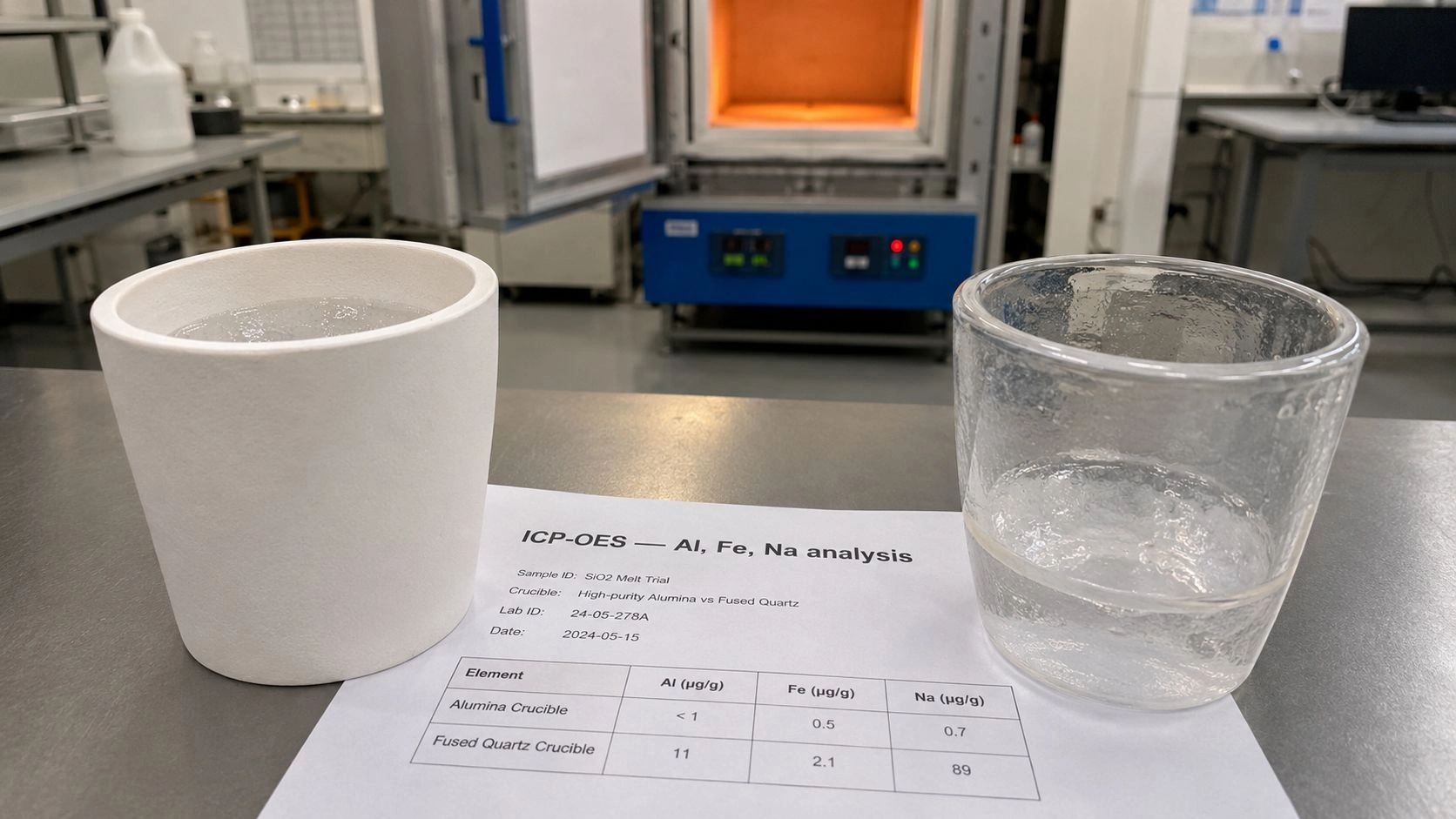
Confirm SiO₂ purity targets and allowable Al before approving any alumina melt-contact step in quartz glass work.
This page is for process and procurement readers screening whether an alumina container is acceptable for a quartz / high-purity SiO₂ step—and when to replace it. It does not rewrite laboratory crucible selection or TGA/DSC consumable guidance. Prefer ADCERAX material selection grades AD-ALU-995 / AD-ALU-997 (IEC C799) as melt-contact candidates; use AD-ALU-990 only for lower-sensitivity or budget screening; reserve AD-ALU-999 when impurity limits are stricter than 997. Do not treat legacy “96% / 99% / 99.5% / 99.7%” labels as ADCERAX SKUs—map them to the nearest AD-ALU grade on the RFQ.
3-Minute Decision: Alumina for Quartz Glass — Use, Caution, or Replace?
3-minute decision: Use this map when you must decide alumina vs fused quartz / other routes for a quartz glass or fused-silica melting step without over-buying purity or under-checking Al risk.
- Powder preheat / solid-state sinter / short non-optical trial → alumina often possible. Prefer denser C799 bodies (AD-ALU-995 or AD-ALU-997) when contact area is large; AD-ALU-990 may fit only if Al limits are loose and post-process chemistry is checked.
- Partial melt or short full-melt hold, non-optical / contamination-tolerant product → alumina with validation. Start AD-ALU-995/997; require melt-contact trial + ICP before production quantities. Treat the grade’s long-term temperature figure as a selection ceiling, not load life.
- Optical, high-purity fused quartz, or semiconductor-adjacent silica → default Caution / Replace. Prefer fused quartz / high-purity silica crucible routes unless a controlled trial proves Al stays inside the product limit.
- Long hold molten silica contact → default Replace or strong exclusion. Al₂O₃–SiO₂ boundary reaction, wall wetting, and inclusion risk rise with time at temperature; do not “buy one grade higher” as a substitute for a different chemistry.
- Drawing says only “99.5% / 99.7% alumina crucible” → map to ADCERAX grades. Rewrite as AD-ALU-995 or AD-ALU-997 (C799) + COA + geometry; do not treat bare percentage strings as sellable SKUs. Escalate to AD-ALU-999 only when named impurity ceilings force it (selection ceiling 1750 °C). AD-ALU-950 is rarely appropriate for melt-contact quartz glass screening.
Default path: confirm allowable Al·Fe·Na·K·Ti → name process stage and hold → start AD-ALU-995/997 for any melt-contact candidate → run a small parallel melt test → replace with fused quartz / zirconia / Pt when limits fail. Purity alone never clears optical or semiconductor-adjacent duty.
When Alumina Can Fit Quartz Glass Work
Alumina is most defensible when the quartz glass application is bounded and the contamination tolerance is written down. Ordinary “glass melting up to ~1700 °C” language from generic crucible guides does not transfer to high-purity SiO₂: in many technical glasses Al₂O₃ is already a batch oxide, while in quartz glass any container-derived Al is a foreign impurity against a single-component SiO₂ target.
| Application condition | Alumina fit | Main risk | What to verify |
|---|---|---|---|
| Lab-scale SiO₂ melting trial | Possible | Al interaction / surface reaction | Post-melt Al by ICP; short hold |
| Non-optical quartz development | Often possible with validation | Inclusions / bubbles | Visual + chemistry vs written limit |
| SiO₂ powder preheat / pre-sinter | Possible | Contact-surface powder pickup | Interior finish; grade purity |
| High-purity fused quartz product | Caution / often exclude | Foreign oxide contamination | Al, Fe, Na, K, Ti ceilings |
| Optical quartz glass | Caution / often exclude | Haze, inclusions, refractive defects | Optical inspection + ICP |
| Semiconductor / solar-adjacent silica | Usually not default | Trace impurity sensitivity | Qualification + purity data |
| Long hold molten silica contact | High risk | Corrosion, reaction layer, inclusions | Static/dynamic melt-contact trial |
Indicative only—confirm with batch chemistry, crucible grade data, and melt-contact testing.
Laboratory and pre-treatment steps. Small-batch trials, powder thermal treatment, and process characterization often need a robust container more than ultra-low Al. Keep contact time short and analyze the glass or powder after the run.
Non-optical / contamination-tolerant development. If the product owner publishes an Al ceiling that your trial stays under, alumina can remain on the traveler. If no ceiling exists, do not assume “high purity alumina” is safe for quartz glass.
Powder support vs melt contact. Powder preheat and solid-state support are chemically milder than full melt + hold. For powder firing hardware context, see ceramic sintering crucible options—that family supports pre-sinter duty; it does not clear molten-silica contact by itself.
When Alumina Becomes a Contamination Risk
The switch from “acceptable” to “unacceptable” is a purity threshold set by the product specification, not a single temperature number on a datasheet.
Al₂O₃–SiO₂ contact is chemistry, not inert containment. At high temperature and extended hold, Al can migrate from the crucible wall into the SiO₂ system. Significance depends on temperature, hold time, melt viscosity, crucible density, open porosity, and interior finish. Literature on aluminum additions to high-purity quartz glass shows that Al in the tens-to-hundreds wt ppm range can already change high-temperature viscosity and deformation behavior—use that as mechanism context, not as an ADCERAX product certificate or guaranteed pickup limit. Confirm with your own melt-contact trial and ICP.
Trace Al can be functional elsewhere and still be contamination here. In some multi-oxide glasses Al is intentional. In optical or semiconductor-adjacent quartz glass, uncontrolled Al is a defect driver for transmission, thermal stability, and downstream compatibility.
Inclusions and reaction layers matter as much as dissolved Al. Grain shedding, spall, or a silica–alumina reaction layer can seed bubbles, haze, or refractory particles that fining cannot remove at typical quartz processing temperatures.
Density and surface finish are selection levers. Prefer denser bodies with lower open porosity and a finer interior finish to reduce melt penetration and reactive surface area. State those preferences on the RFQ in principle-level language; do not invent a finished-crucible porosity % that is not on the certificate of analysis.
Do Not Misdiagnose Every Defect as Crucible Failure
Bubbles, haze, inclusions, or an Al bump after melting do not automatically convict the crucible. Identify the mechanism before you change container chemistry.
| Observed problem | Common assumption | Better diagnostic question |
|---|---|---|
| Al increase after melt | Alumina always unsuitable | Above product limit? Source = crucible, batch, or tools? |
| Bubbles | Crucible reaction | Was silica dry, atmosphere controlled, and fining adequate? |
| Haze / devitrification | Alumina contamination | Cooling profile, alkali, or seed crystals controlled? |
| Inclusions | Crucible shedding | Furnace lining, tools, or feedstock contribution? |
| Cracked crucible | Wrong material | Thermal shock, overfill, or support contact? |
Run a side-by-side melt test: same SiO₂ batch, same thermal cycle, same atmosphere, different container materials. Pair ICP-OES/MS with optical inspection and bubble counting so the crucible contribution is measured, not assumed.
ADCERAX Grades for Melt-Contact Screening
ADCERAX sells alumina crucibles against material selection grades tied to IEC 60672-3 groups C795 and C799. Use the table below—not leftover three- or four-band percentage marketing—as the selection source of truth for quartz glass screening. Long-term temperature values are material selection ceilings: they are not load life, not guaranteed continuous operating temperature under arbitrary atmosphere or fill, and not a substitute for melt-contact validation. Density, MOR, and thermal conductivity are typical grade references for comparing SKUs, not finished-crucible guarantees at every wall and capacity.
| SKU | Al₂O₃ wt% (nom.) | IEC 60672-3 | Density g/cm³ typ. | MOR MPa 20 °C typ. | k W/(m·K) 25 °C | Selection ceiling °C |
|---|---|---|---|---|---|---|
| AD-ALU-999 | 99.90 | C799 | 3.94 | 315–340 | 35–42 | 1750 |
| AD-ALU-997 | 99.70 | C799 | 3.94 | 330 | 35–40 | 1700 |
| AD-ALU-995 | 99.50 | C799 | 3.90–3.92 | 320–350 | 30–38 | 1650 |
| AD-ALU-990 | 99.00 | C795 | 3.80–3.91 | 300–320 | 24 | 1600 |
| AD-ALU-950 | 95 | C795 | 3.75 | 280 | 18–25 | 1400 |
For quartz melt-contact screening, treat AD-ALU-995 and AD-ALU-997 as the practical C799 starting pair (997 when you need the 1700 °C selection ceiling or lower secondary-phase content than 995). Use AD-ALU-999 only when impurity limits or thermal selection headroom explicitly require it (ceiling 1750 °C). AD-ALU-990 is a budget / low-sensitivity option, not a default for optical silica. AD-ALU-950 is generally outside melt-contact quartz screening. IEC grouping is a composition class, not a finished-part certificate. Legacy drawing language such as “96% / 99.6% / 99.5% / 99.7%” must be remapped to the nearest AD-ALU SKU—do not treat those percentages as ADCERAX catalog lines.
When to Replace Alumina (Fused Quartz, Zirconia, Platinum, Refractory Routes)
Once the alumina boundary is reached for the product grade, substitute by chemistry need—not by buying a higher Al₂O₃ wt% alone.
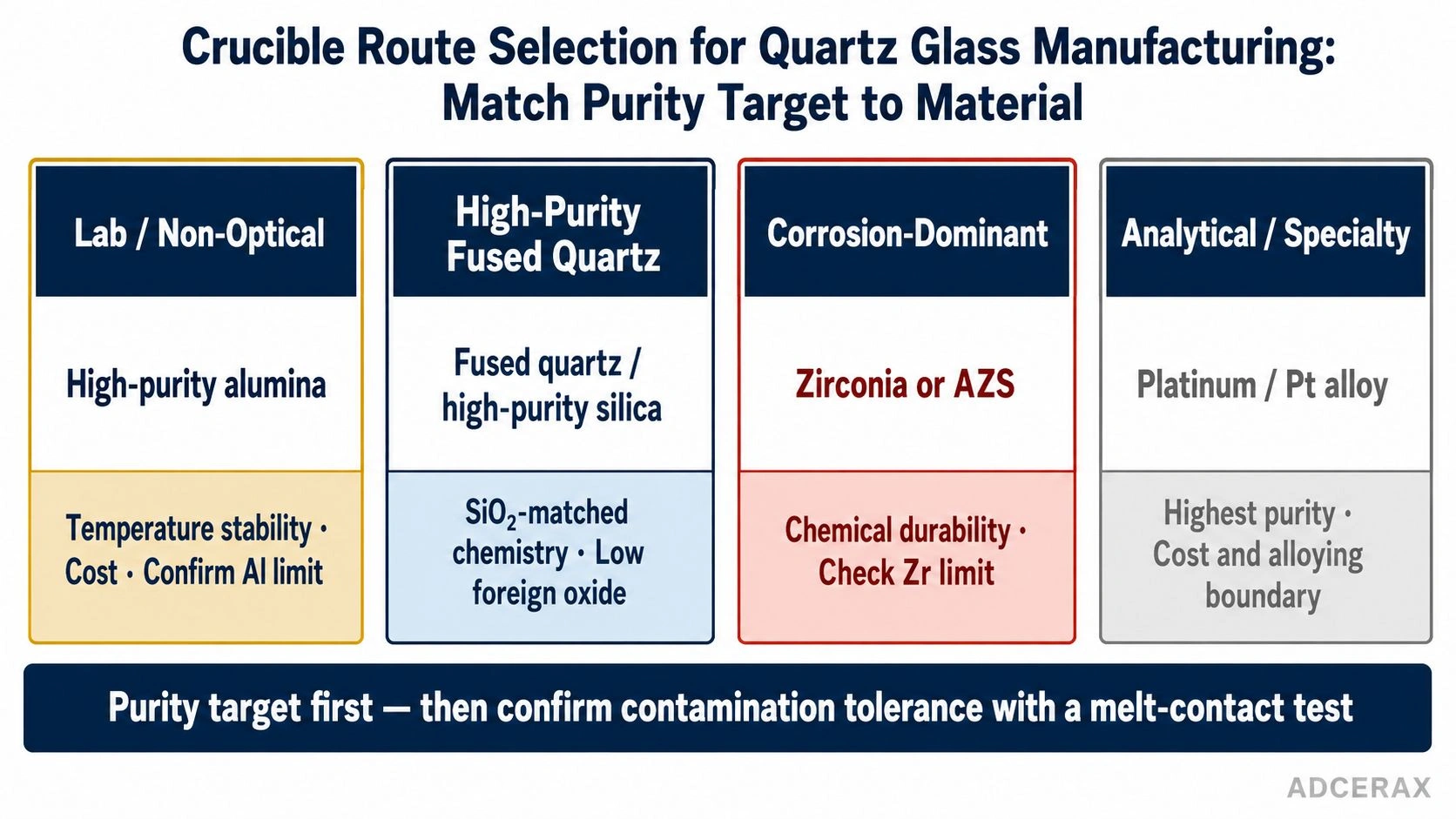
Choose the crucible chemistry from purity target, hold time, and contamination tolerance—not from temperature marketing alone.
| Crucible material | Best-fit role | Main advantage | Main boundary |
|---|---|---|---|
| High-purity alumina (AD-ALU-995/997/999) | Lab melting, pre-treatment, non-optical / controlled-Al systems | Thermal robustness and geometry options | Al₂O₃ interaction with SiO₂ |
| Fused quartz / high-purity silica | High-purity SiO₂ compatibility | Chemistry close to the product | Devitrification / temperature / geometry limits—verify |
| Zirconia | Corrosion-heavy glass-contact work | Strong high-temperature corrosion resistance | Zr pickup and thermal-shock sensitivity |
| AZS-type refractory | Severe industrial molten-glass contact | Erosion resistance at scale | Not a small high-purity lab default |
| Platinum / Pt alloy | Analytical or specialty melts | High purity in selected chemistries | Cost; confirm Pt–glass compatibility |
Fused quartz / high-purity silica for chemical similarity. When foreign oxide introduction must stay minimal, a silica crucible route keeps container chemistry aligned with the product (SiO₂ ≥99.8 wt% class fused-quartz bodies are typical in this family; density and apparent porosity vary by route). Confirm temperature, crystallization, and geometry limits on the actual part—do not copy alumina selection ceilings onto fused quartz. For fused-silica / quartz ceramic component context, see the fused quartz ceramic route.
Zirconia when glass corrosion dominates. If alumina wall attack is excessive, evaluate a zirconia glass-contact alternative and budget for Zr analysis plus thermal-cycle checks. Broader ZrO₂ material context: zirconia ceramics for glass-contact alternatives.
Multi-material screening. When the traveler still lists several chemistries (alumina, zirconia, BN, SiC), use ceramics for glass manufacturing as the application hub—then freeze one crucible chemistry after the melt-contact trial, not after a catalog browse.
Platinum when analytical purity justifies cost. Confirm chemistry compatibility; some reactive melts interact with Pt at temperature.
RFQ Checklist for Quartz Glass Crucible Inquiries
Without purity context, a supplier cannot confirm whether an alumina grade, density, and interior finish fit the quartz glass limit. Keep the RFQ short and quartz-specific—do not expand this page into a general laboratory crucible guide.
| RFQ field | Why it matters | Recommended wording |
|---|---|---|
| Quartz glass grade / purity tier | Sets contamination tolerance | “Optical / lab / high-purity / solar / semiconductor-adjacent” |
| Allowable impurities | Defines pass/fail | “Max Al, Fe, Na, K, Ti (and others as required)” |
| Process stage | Changes material choice | “Powder preheat / sinter / partial melt / full melt + hold” |
| Temperature and hold | Controls reaction risk | “Peak °C and dwell; compare to AD-ALU selection ceiling—not load life” |
| Atmosphere | Affects bubbles and reactions | “Air / vacuum / inert / reducing / wet gas” |
| Crucible geometry | Thermal stress and melt behavior | “OD, ID, height, wall, bottom radius, lid” |
| ADCERAX grade preference | Locks impurity baseline | “Prefer AD-ALU-995 or AD-ALU-997 (C799) with COA; 990/999 only if justified” |
| Density / finish intent | Contamination and gas release | “Dense body, low open porosity, fine interior finish—method on COA” |
| Validation test | Confirms suitability | “Small melt-contact trial + ICP before production qty” |
Add optical inspection, ICP method, and bubble-count criteria when the product tier requires them.
A short melt-contact trial on the real SiO₂ batch remains the only reliable production gate. Grade certificates and selection ceilings are necessary starting points, not final approvals.
Screening alumina for quartz glass manufacturing? Send SiO₂ grade, target application, allowable Al/Fe/Na/K/Ti, process stage, peak temperature and hold, atmosphere, geometry, and preferred AD-ALU-995/997 (or 990/999 with justification). ADCERAX engineering will say whether alumina remains plausible or whether a fused quartz / zirconia / other route should lead—no production commitment required at inquiry.
Frequently Asked Questions
Can alumina crucibles be used for quartz glass manufacturing?
Yes, in controlled cases: lab-scale SiO₂ melting, powder pre-treatment, non-optical development, or work with a written Al tolerance and a passing melt-contact trial. They are not the default for high-purity fused quartz or optical / semiconductor-adjacent silica.
Why can alumina be risky for quartz glass?
Alumina places Al₂O₃ chemistry at the SiO₂ boundary. At high temperature and long hold, Al can migrate into the glass; surface reaction layers or refractory particles can also appear. If the product needs very low Al or optical cleanliness, that pickup can be disqualifying.
Is fused quartz better than alumina for high-purity quartz glass?
Often yes when chemical similarity and low foreign-oxide introduction are the main goals. Fused quartz / high-purity silica crucibles keep container chemistry close to SiO₂. Verify temperature, devitrification, and geometry limits—do not assume alumina selection ceilings apply.
Does aluminum always damage quartz glass?
Not by definition. Al can be intentional in some glass systems. The issue is uncontrolled Al pickup relative to the product specification—whether container contribution exceeds the allowable limit for that quartz grade.
What should we check after an alumina melt-contact trial?
Al (and other critical elements) by ICP-OES/MS, inclusions, bubble count, haze/devitrification, crucible interior reaction layer, and optical clarity where relevant. Use chemistry plus inspection—not temperature rating alone.
What should we send on the RFQ?
Quartz grade and impurity limits, process stage, peak temperature and hold, atmosphere, geometry, preferred ADCERAX grade (AD-ALU-995/997 typical; 990/999 only with justification), COA expectations, and whether a melt-contact validation lot is required before production quantities. Remap legacy “99.5% / 99.7%” wording to AD-ALU SKUs.