Alumina crucibles appear frequently in laboratory environments that handle platinum, palladium, and rhodium, but that does not mean they belong at every step of a Pt/Pd/Rh analytical workflow. The distinction matters because noble-metal assay labs are not generic high-temperature labs. They move through thermal preparation steps, aggressive analytical fusion steps, collector-based preconcentration routes, and in some methods cupellation stages — each of which has a different vessel logic and a different reason to prefer one container type over another. Treating alumina as the universal ceramic answer for all of these misassigns the vessel to steps where the chemistry, the reproducibility requirement, or the analytical method demands something else. This article maps alumina's correct workflow role, explains why it fits certain lab duties and not others, removes the most common mislabeling between alumina, platinumware, and cupels, and closes with the specification language for a RFQ and lab SOP that reflects the actual step assignment.
Alumina crucibles are useful in Pt, Pd, and Rh assay labs when the step is thermal preparation, clean heating, calcination, drying, or small-batch holding where the lab needs a stable, inert ceramic vessel at reasonable cost. They are usually not the default answer for the most aggressive fusion-mixture or fire-assay fusion steps, because those workflows are more commonly tied to platinum labware or stage-specific consumables designed for reproducible analytical fusion and collector chemistry.
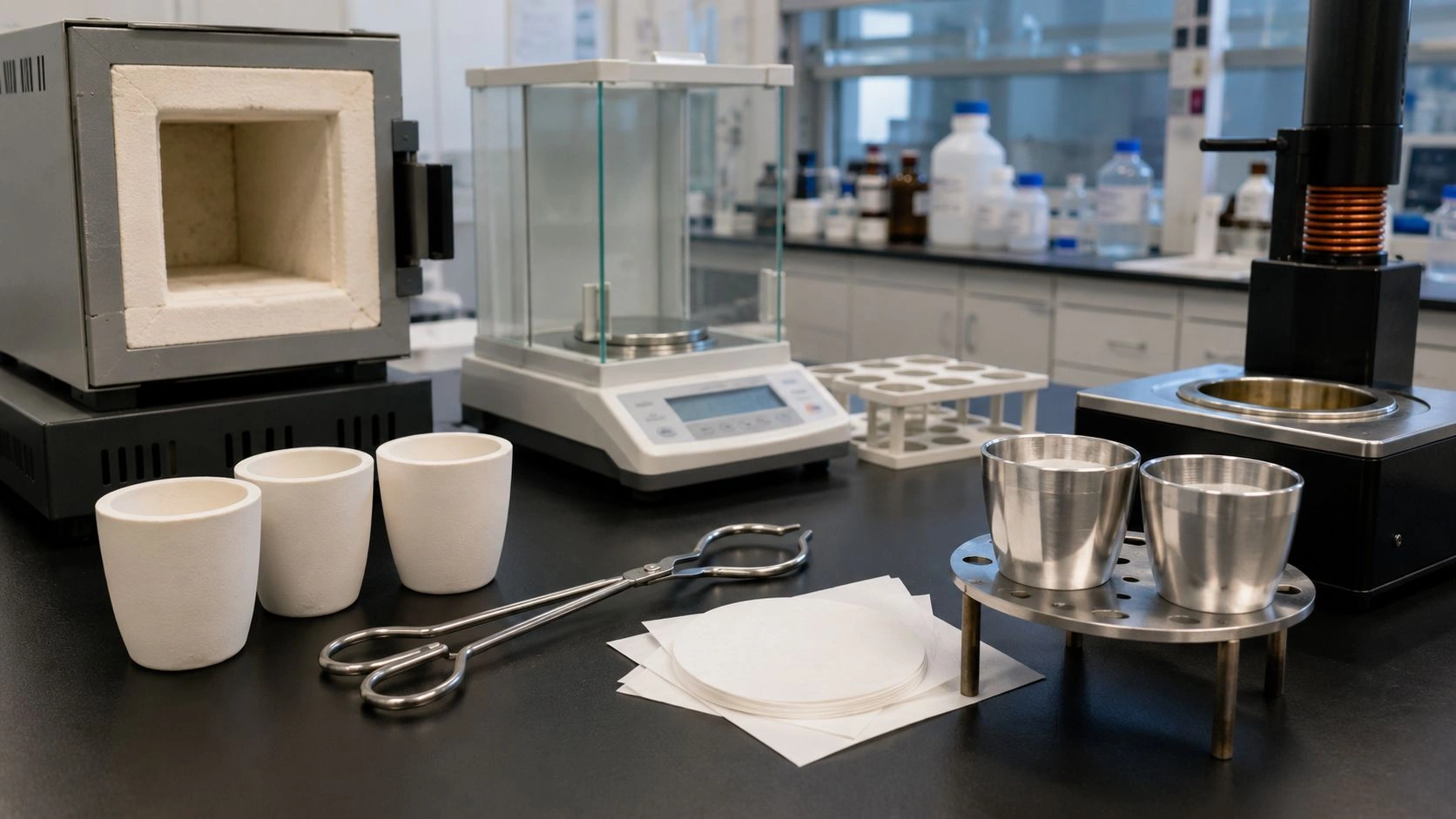
Alumina crucibles in a noble-metal assay lab belong in the thermal preparation steps — calcination, drying, ignition, and clean heating — not as a universal substitute for platinumware in analytical fusion.
The alumina crucibles used in assay laboratory service — high-purity, dense, geometrically stable bodies for repeated thermal cycling — provide the procurement context that this workflow-fit analysis connects to directly. For geometry or grade variants outside a stock form factor, see custom ceramic services and the broader materials overview; keep ceramic crucible and labware ceramics hubs for adjacent vessel classes.
What assay-lab jobs alumina crucibles can do reliably in Pt/Pd/Rh workflows
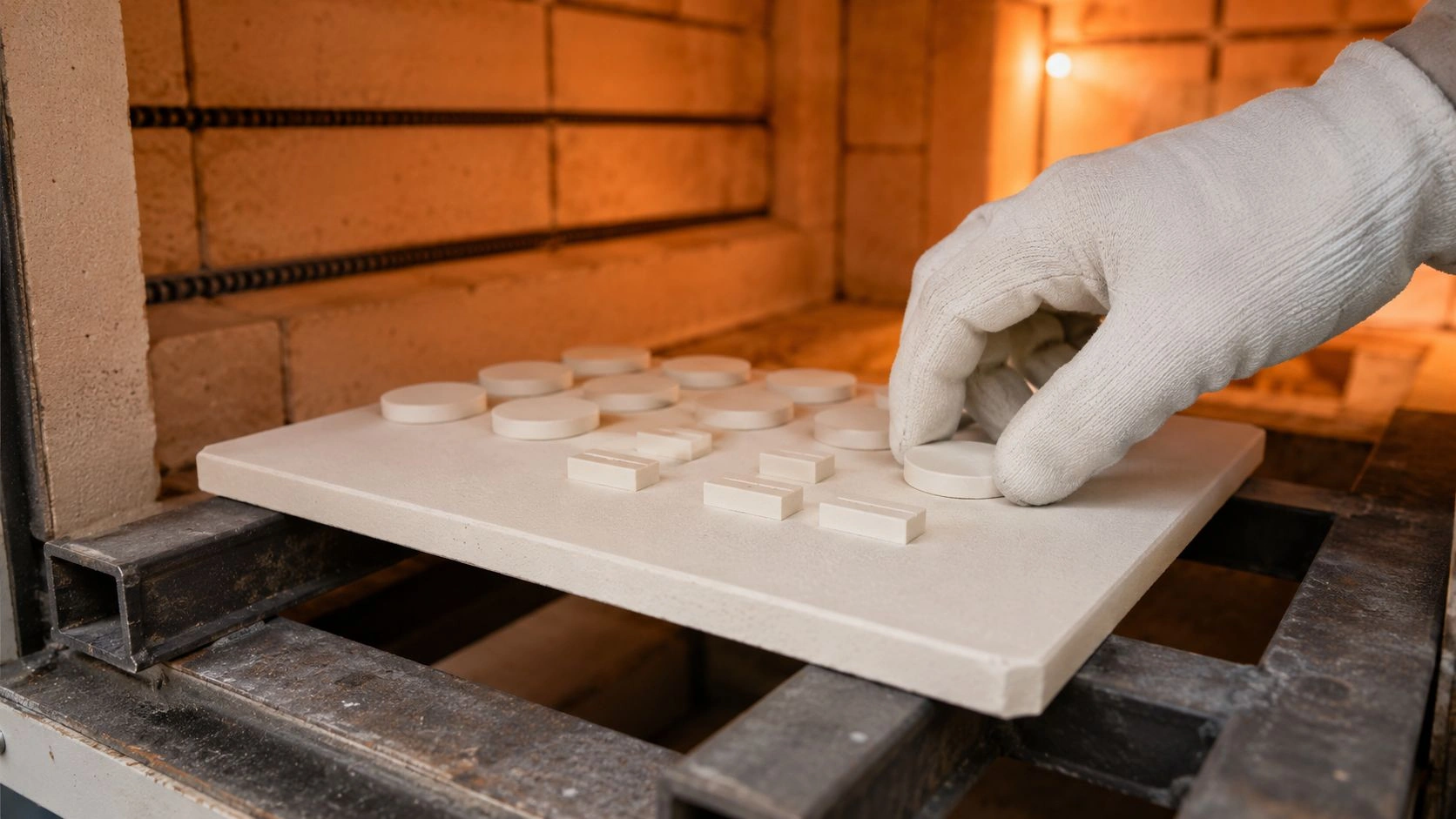
In Pt, Pd, and Rh assay labs, alumina crucibles are best understood as process-support crucibles rather than universal analytical vessels. Their correct role is in the thermal preparation segment of the workflow: drying samples, igniting organic material before fusion, calcining precursor material to remove volatiles, and holding or transferring small batches in the early stages of sample preparation. In these steps, the key requirement is a clean, dimensionally stable, high-temperature ceramic vessel selected to minimize metallic contamination contribution from the wall (confirm grade-sheet / trace path on TDS+COA+RFQ) and can withstand repeated heating cycles without warping or degrading. High-purity dense alumina is application-typically screened for those thermal-prep requirements — confirm grade and duty on RFQ.
What alumina is not automatically suited for is the downstream analytical fusion and collector-stage chemistry that are central to many PGM assay methods. PGM analytical workflows still strongly rely on fire-assay style preconcentration, making vessel choice a stage-specific method decision rather than a generic "ceramic is fine" decision. A lab that equips every bench position with alumina crucibles and assumes the material will serve from sample intake through final fusion will encounter stages where that assumption is wrong.
Alumina's best fit is often pre-treatment, not every final analytical fusion step
The thermal preparation stages before fusion — drying, ignition, calcination, pre-ash work — share a common requirement: controlled heat with chemical inertness and no contamination from the vessel wall. Dense high-purity alumina provides exactly that. The critical steps that follow — fusion-mixture-based analytical fusion, collector-based preconcentration, cupellation — impose additional requirements that alumina is not designed to meet as the primary answer.
Assay labs use more than one container type for a reason
The multiplicity of container types in a Pt/Pd/Rh assay lab reflects a real workflow architecture: different stages have genuinely different material requirements. Understanding which stage corresponds to which container type is the analytical equivalent of understanding which reagent goes in which step of a titration. Conflating them does not simplify the lab; it introduces systematic method errors.
Why alumina crucibles are attractive in those thermal preparation steps
Alumina is attractive in noble-metal assay labs for those supporting roles because it delivers high-temperature stability, chemical inertness during clean heating, dense microstructure with low porosity and low contamination risk, repeatable geometry through many thermal cycles, and significantly lower replacement cost than precious-metal labware. For assay-lab operations that do not involve aggressive fusion mixtures or collector chemistry, these properties make alumina the most economical route to reliable ceramic containment.
In high-purity alumina grades, documented positioning includes calcination, sintering, and small-batch melting applications with stable geometry and dense microstructure — properties that map directly to the drying, ignition, and calcination steps that precede fusion in most Pt/Pd/Rh sample-preparation sequences. Major technical ceramic labware suppliers also position high-purity alumina as a standard ceramic labware route alongside zirconia for demanding laboratory and chemical-processing environments.
Alumina reduces dependence on metal labware where chemistry does not require it
A lab that uses alumina for pre-treatment steps reduces the number of cycles that high-cost platinumware is exposed to, extending its effective service life. That is a real cost and maintenance benefit. The key is that the reduction in platinumware use is achieved by correctly identifying the steps that do not require fusion-grade labware, not by extending alumina into steps that do require it.
Stable geometry matters in repeatable sample prep, not only in melting
Dimensional stability through thermal cycling is a practical concern in assay labs where vessel-to-vessel variability in geometry can introduce systematic errors in sample mass or contact geometry. Dense alumina with well-documented dimensional tolerances provides the consistency that accurate sample preparation requires, even in steps that are not chemically demanding.
Which workflow steps are being mislabeled as alumina jobs
PGM analytical workflows still strongly rely on fire-assay style preconcentration, making vessel choice a stage-specific method decision — and three distinct workflow stages get conflated in this decision more often than any others.
Platinum labware is explicitly marketed as suitable for acids and fusion mixtures, while alumina crucibles are positioned for calcination, sintering, and small-batch melting. That difference in market positioning reflects a genuine difference in what each material is qualified to do in analytical practice. When a lab tries to standardize everything on alumina crucibles, it compresses that difference into a single procurement decision and loses the step-by-step clarity that analytical methods require.
The three stages that are most commonly misassigned:
- Aggressive analytical fusion using fusion mixtures (lithium metaborate, lithium tetraborate, sodium peroxide, and related fluxes) — platinum and platinum-alloy labware are explicitly positioned for this role in analytical labware catalogs. The governing requirements are chemical resistance to the fusion mixture, high-temperature non-wetting, and reproducible analytical surface behavior. These are different from the requirements of a calcination vessel.
- Collector-based PGM preconcentration (lead fire assay, nickel sulfide fire assay, bismuth oxide routes) — these stages are method-specific, often involving collector buttons or beads that capture the PGM fraction. The container must be compatible with the collector chemistry and the collection geometry. The fire-assay review literature shows that lead and nickel sulfide collection routes remain central in PGM analysis. This is a stage-specific vessel problem, not a generic ceramic-crucible problem.
- Cupellation — cupellation absorbs PbO into a porous ceramic body (the cupel), leaving the precious-metal bead behind. The cupel is the critical consumable for this operation; it is not the same class of vessel as an alumina crucible used for calcination. Peer-reviewed work on lead recovery from cupel waste confirms that PbO absorption is the governing function of the cupel — a mechanism entirely different from the containment function of a general-purpose alumina crucible.
The Selection Criteria Table below organizes the workflow-fit decision into specific triggers:
| Criterion | Threshold / decision trigger | Decision direction |
|---|---|---|
| Workflow step = drying / calcination / ignition / clean heating | Step is mainly thermal preparation, not aggressive analytical fusion | Prefer alumina crucible |
| Workflow step involves acids or fusion mixtures as the main labware challenge | Analytical fusion reproducibility and resistance to fusion mixtures matter | Move to platinum or platinum-alloy labware |
| Workflow uses Pb-fire assay style cupellation | PbO absorption at cupellation is the governing function | The critical consumable is the cupel, not a general alumina crucible |
| Workflow is fire-assay / collector-based PGM preconcentration | Lead, nickel sulfide, bismuth, or related collection logic governs the stage | Treat vessel selection as stage-specific, not all-alumina by default |
| Goal is low-cost clean ceramic support ware for non-final-fusion stages | Lab wants high-temp inert ceramic ware without precious-metal cost | Alumina remains attractive |
Values and workflow assignments are method-logic screening only — application-dependent. Verify against the lab SOP / validated method / standard family for the exact Pt/Pd/Rh assay step. This is not a universal alumina / platinumware / cupel triad SLA.
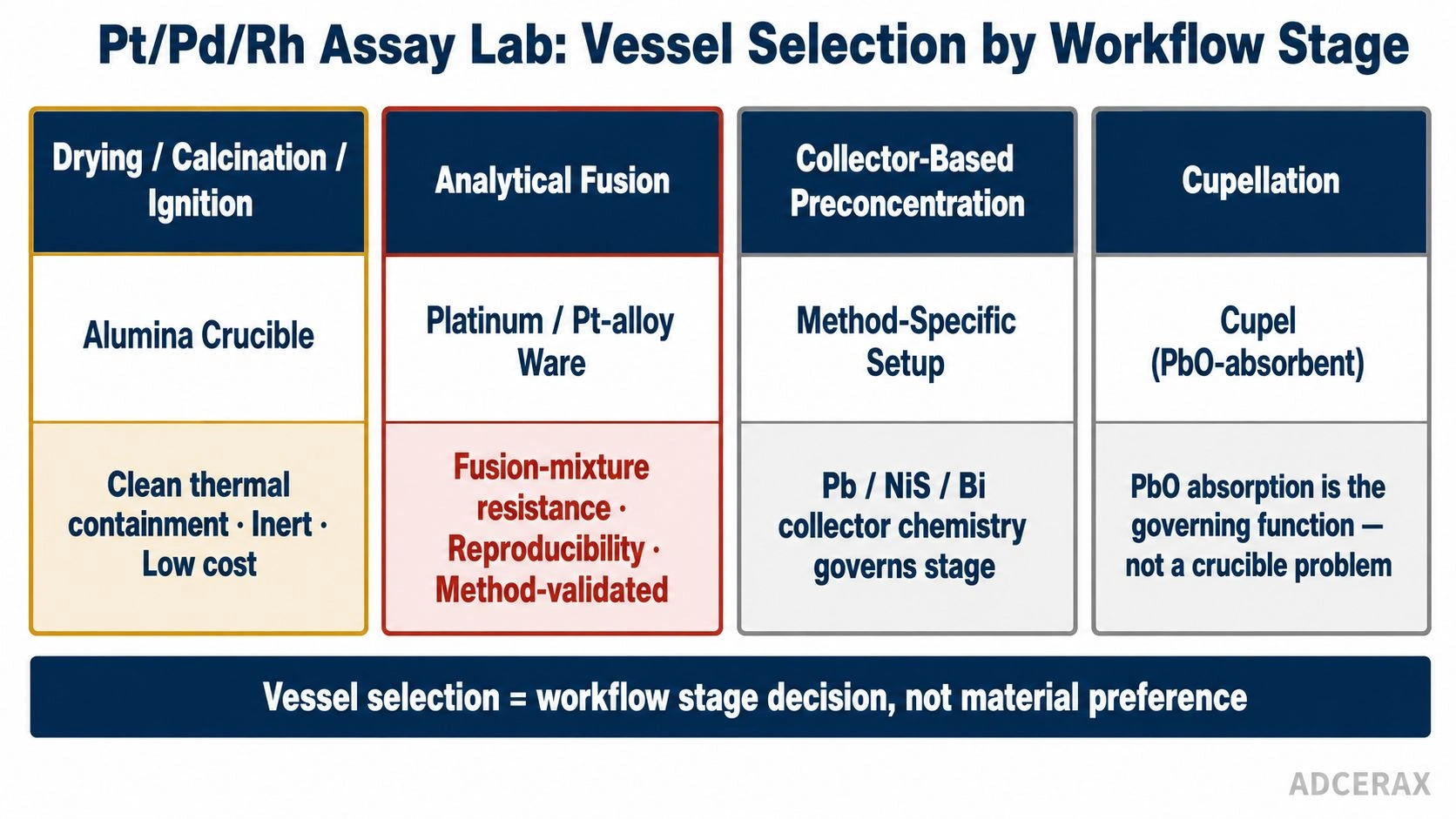
Method-logic screening (application-dependent): alumina often fits thermal preparation, platinumware often fits analytical fusion, and cupels fit cupellation — confirm against lab SOP / validated method; not a universal triad SLA. Conflating stages introduces systematic method errors.
Fire assay, fusion, and cupellation are not the same labware problem
Each of these three stages has a governing requirement that determines the correct container class. Fire assay with collector chemistry requires a vessel and process compatible with the collector mechanism. Analytical fusion with aggressive flux requires the chemical durability and surface reproducibility of platinum-alloy labware. Cupellation requires the porous PbO-absorbing character of a traditional cupel. Alumina provides none of these stage-governing properties — but it does provide the thermal-preparation properties that precede these stages reliably.
The material question is really a workflow-stage question
A lab manager who thinks about container selection in terms of workflow stages rather than material properties will reach more defensible decisions. The question is not "Is alumina better or worse than platinum?" but "What does this step in my validated method actually require?" That reframing prevents the substitution of economic convenience for analytical rigor.
When the decision clearly flips away from alumina
The decision clearly flips away from alumina when the assay step is controlled by aggressive fusion chemistry, highest-reproducibility analytical fusion, or specialized fire-assay collection and finishing logic, rather than by ordinary high-temperature containment. Platinum and platinum-alloy labware are described in analytical labware catalogs as widely used laboratory apparatus because of their high melting point and resistance to acids and fusion mixtures — with platinum-gold and platinum-rhodium alloys sold specifically to improve high-temperature strength, non-wetting behavior, and fusion durability. That is a different product logic from alumina's positioning as a dense, inert, high-temperature ceramic vessel.
The ceramic crucible material options available to assay labs — alumina, zirconia, mullite, and platinum-family ware — each occupy specific positions in the workflow based on chemistry, temperature, and method requirement rather than generic high-temperature capability. For applications where oxide-ceramic alternatives to alumina are being evaluated, zirconia crucible options provide a different chemical stability profile that may suit specific fusion chemistries where alumina is not optimal.
The Workflow Fit Matrix below converts the decision logic into step-by-step assignments:
| Assay-lab step | Best-fit container logic | Why |
|---|---|---|
| Drying / calcination / pre-ash / ignition | Alumina crucible | Dense, inert, high-temperature ceramic support ware for clean heating |
| Aggressive fusion-mixture analytical fusion | Platinum / platinum-alloy ware | Explicitly marketed for acids and fusion mixtures, analytical reproducibility |
| Lead-fire-assay cupellation stage | Cupel-based step | PbO absorption defines the operation; the cupel is the key consumable |
| Collector-based PGM preconcentration (Pb, NiS, Bi) | Method-specific fire-assay setup | PGM assay workflows are collector-driven; vessel choice must follow stage chemistry |
Assignments are method-logic screening — application-dependent. Verify with the lab's SOP / validated method and accreditation requirements; not a universal triad guarantee.
Alumina is excellent when the vessel's job is to contain heat cleanly. It is less likely to be the best answer when the vessel's job is to participate in a validated analytical fusion system.
Platinumware is chosen for chemistry and reproducibility, not just prestige
Platinum and platinum-alloy labware in analytical labs carry a validated performance history in fusion chemistry and acid environments that reflects decades of method development. The choice is analytical, not prestige-based — and the lab protocols built around platinum-family ware encode information about what each step of the method requires from its container. Overriding that with a ceramic alternative requires method revalidation, not only a labware procurement change.
Alumina is strongest as support ware, not as universal fusion ware
The most operationally useful way to position alumina in a Pt/Pd/Rh assay lab is explicitly as support ware: the pre-treatment container system that does the clean thermal work before samples enter the critical analytical steps. Framing it this way protects both the lab's analytical integrity and the realistic cost-optimization benefit that alumina offers in the steps where it belongs.
What should go into the RFQ and lab SOP
The RFQ should specify more than "alumina crucible for noble-metal assay." It should define the exact workflow step the crucible is being purchased for — drying, calcination, ignition, small-batch holding, or transfer — and should confirm that the step does not involve fusion flux contact, aggressive acid exposure, or collector-chemistry environments where platinumware is the validated route.
The specification and SOP checklist for ceramic labware components in Pt/Pd/Rh assay lab service:
- Workflow step assignment — specify which workflow step the crucible serves; do not order "assay crucibles" generically.
- Alumina purity grade — for noble-metal thermal-prep screening, labs often start from a high-purity grade-sheet band around ≥99.5% Al₂O₃ (application-typical screening aligned with high-purity families such as ≥AD-ALU-995 class language — not a contract purity or contamination guarantee). Confirm Al₂O₃%, binder/impurity path, and trace elements on the TDS + COA, then lock the grade on RFQ.
- Crucible geometry — OD, ID, height, wall thickness, and rim style should match the furnace, muffle, or heating equipment in use for that step.
- Maximum working temperature — confirm the planned peak temperature and hold duration; alumina crucibles for assay use should be rated and tested for the planned cycle profile.
- Heating atmosphere — confirm whether the step runs in air, inert gas, or reducing conditions; alumina is compatible with all of these in the pre-treatment temperature range, but the supplier should confirm grade suitability.
- Flux or collector contact exclusion — state explicitly that the crucible is not intended for use with fusion fluxes or collector-bearing step chemistries; if these are introduced, the vessel specification must be reviewed.
- Reuse policy — specify the inspection and replacement criteria for alumina crucibles in noble-metal sequences; given the trace-metal sensitivity of Pt/Pd/Rh analysis, contamination carryover from reused crucibles should be characterized for each application.
- SOP step separation — the lab SOP should explicitly list which steps use alumina crucibles and which steps use platinumware, cupels, or other stage-specific containers; mixing these assignments without documentation introduces systematic method uncertainty.
If the lab's vessel specification does not distinguish between pre-treatment, fusion, and cupellation containers, it is still describing labware at too generic a level for a noble-metal assay workflow.
Conclusion
Alumina crucibles have a legitimate and valuable role in Pt, Pd, and Rh assay labs — in the thermal preparation segment of the workflow where clean heat, chemical inertness, stable geometry, and lower replacement cost are the governing requirements. The specification error that limits their usefulness is assigning them to steps governed by fusion chemistry, collector behavior, or cupellation logic, where platinum labware or stage-specific consumables are the validated and more appropriate choice. A lab that maps its workflow by stage — thermal preparation, analytical fusion, cupellation — and assigns container types accordingly will use alumina where it performs well and platinumware where the method requires it.
RFQ checklist for assay-lab alumina crucibles
Before locking a thermal-prep crucible purchase for a Pt/Pd/Rh assay or sample-preparation workflow, package the following on RFQ (neutral checklist — no brand commitment):
- Assay step — drying / calcination / ignition / clean heating / small-batch holding (state explicitly; do not order "assay crucibles" generically).
- Purity / trace targets — Al₂O₃% band, binder/impurity path, and trace-element limits to confirm on TDS + COA.
- Geometry — OD, ID, height, wall thickness, rim style matched to the furnace / muffle for that step.
- Atmosphere — air, inert, or reducing; peak temperature and hold duration.
- Contact time / chemistry exclusion — confirm the step does not involve fusion flux or collector chemistry where platinumware or cupels are the validated route; state contact time and reuse/inspection policy.
Lead time depends on inquiry complexity. For grade and form-factor context, see alumina crucibles, custom ceramic services, and materials.
Related reading
- Ash content testing with recrystallized alumina crucibles — when the limiter is recrystallized alumina ash/impurity contribution, not which assay stage the vessel serves.
- Types of alumina crucibles: shape, form, lid & purity RFQ — when the decision is crucible form factor (boat/lid/cylindrical geometry), not Pt/Pd/Rh workflow stage routing.
- Alumina crucibles for semiconductor dopant evaporation — when the duty is semiconductor dopant evaporation source crucibles, not fire-assay / cupellation lab prep.
Frequently Asked Questions
Can alumina crucibles be used in Pt, Pd, and Rh assay labs?
Yes, but for selected thermal-preparation steps rather than as a universal substitute for all noble-metal analytical labware. Alumina is well positioned for calcination, ignition, drying, and clean high-temperature handling before fusion. For the aggressive fusion-mixture steps and collector-based preconcentration stages central to many PGM analytical methods, platinum or platinum-alloy labware and method-specific stage equipment are the more conventional and validated choices.
Why not standardize the whole lab on alumina crucibles?
Because certain critical analytical steps are governed by fusion-mixture chemistry, collector behavior, or cupellation logic that alumina is not designed to handle as the primary container. Platinum labware's role in analytical fusion is built on decades of method validation around the chemical durability and surface reproducibility that platinum-family alloys provide in acid and fusion environments. Overriding those with alumina requires method revalidation, not only a labware substitution.
When is platinumware the better choice in a noble-metal assay lab?
When the step requires high reproducibility under acids or aggressive fusion mixtures, or when the validated analytical method is built around platinum or platinum-alloy labware. PGM assay methods that use lithium metaborate, lithium tetraborate, sodium peroxide, or related fusion fluxes are typically developed and validated with platinum-family ware as the fusion container, and the method performance expectations reflect that choice.
Does cupellation use the same kind of container decision as pre-ash or calcination?
No. In cupellation, the cupel is the critical consumable because it absorbs PbO during the operation, leaving the precious-metal bead behind on a porous ceramic surface. That is a fundamentally different material-selection problem from choosing a ceramic crucible for thermal preparation. Research on lead recovery from cupel waste confirms that PbO absorption is the governing function of the cupel — which means cupellation cannot be managed with a general-purpose alumina crucible substitution.