Alumina crucibles are suitable for semiconductor dopant evaporation when the evaporant is chemically compatible with Al₂O₃, the source temperature stays within the crucible's operating window, and contamination control depends more on dense high-purity ceramic containment than on electrical conductivity. For reactive, high-expansion, or strongly wetting evaporants, a liner or alternative crucible material should be evaluated before qualification. The selection should be based on dopant chemistry, vapor pressure, thermal cycling, fill level, and supplier COA rather than alumina purity alone.
The most common specification error in this application is selecting an alumina grade by purity number while leaving evaporant compatibility, fill behavior, and liner logic unresolved. This guide separates those variables into a decision sequence that converts material knowledge into an actionable RFQ.
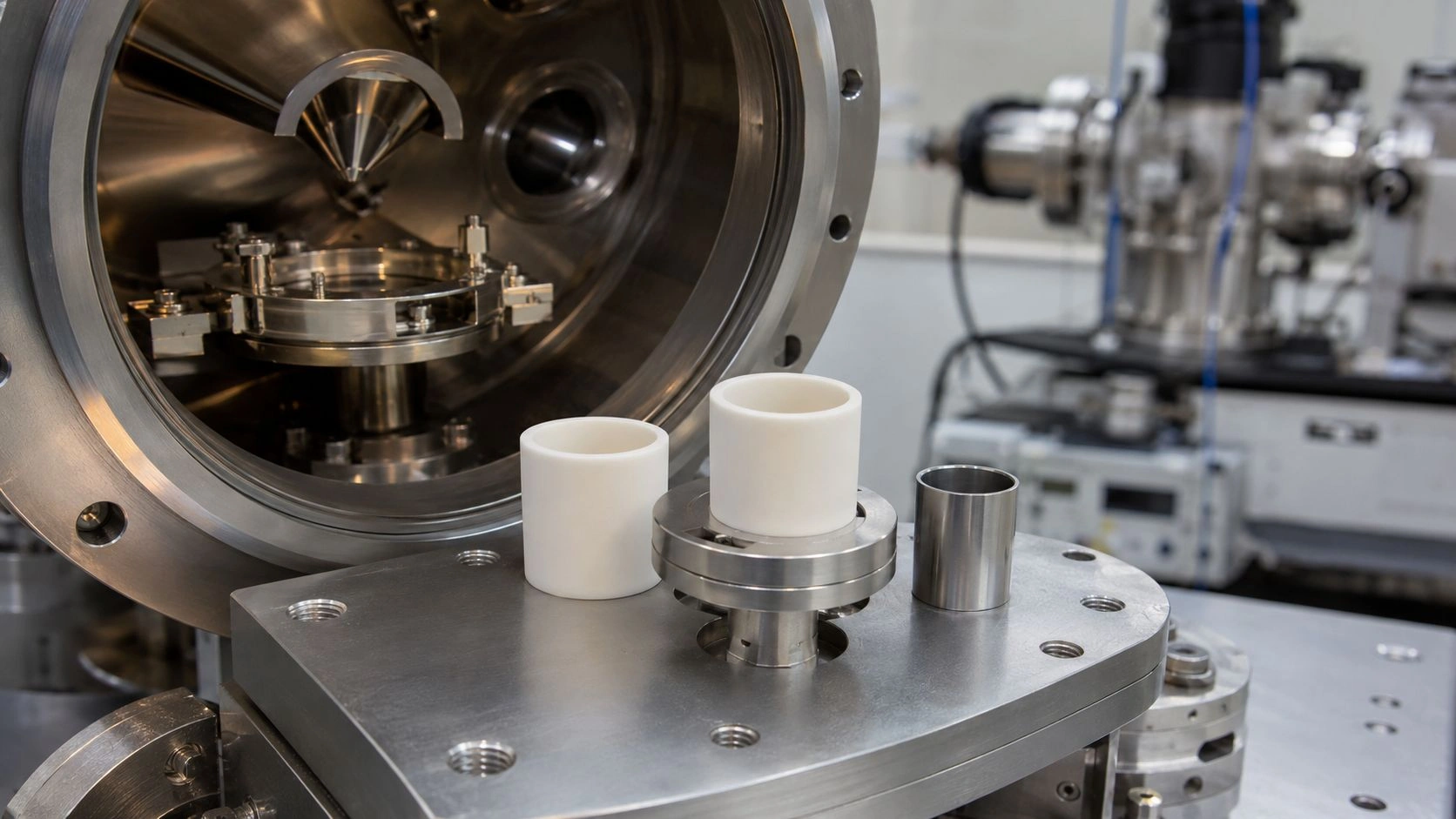
High-purity alumina crucibles in semiconductor evaporation source hardware — compatibility, purity, fill behavior, and liner logic must all be confirmed before qualification.
The alumina crucibles for high-purity melting and evaporation described in this guide include 99.7% and 99.9% Al₂O₃ grades in standard and custom geometries for vacuum-system source-zone containment and thermal evaporation applications.
When alumina crucibles are suitable for dopant evaporation
Alumina crucibles should remain on the candidate list for dopant evaporation when three conditions are satisfied simultaneously: the source material does not aggressively react with Al₂O₃, the process does not require electrical conductivity from the crucible itself, and the evaporation temperature stays within the qualified operating limit of the selected alumina grade.
In vacuum evaporation, the crucible is not simply a container. It is part of the thermal and contamination-control system. Published evaporation equipment guidance consistently positions crucible selection around the material being evaporated — a framing that treats the crucible as a source-zone compatibility decision rather than a generic purchase of high-temperature ceramic. That framing matters especially in semiconductor-adjacent applications: the crucible contacts the source material, not the wafer, so it should be specified as source-zone hardware with defined material compatibility, not as a blanket semiconductor process material with implied wafer-contact certification.
For dopant evaporation sources, alumina is attractive because it offers high maximum operating temperature, good vacuum compatibility, low outgassing in dense dense-fired grades, and established electrical insulation. Those properties address the most common source-zone requirements when the evaporant is compatible. They do not resolve compatibility by themselves.
Alumina as a source-containment material, not a dopant recipe variable
The crucible's contribution to the process is thermal and chemical containment of the source material during evaporation. Its role ends at the crucible wall. Dopant dose, deposition profile, and film composition are controlled by the process recipe, not by the crucible material — provided the crucible is compatible and clean. This distinction is important because it defines what must be verified at the crucible level: compatibility, purity, geometry, and surface condition, not dopant recipe performance.
Why "semiconductor grade" must be translated into measurable ceramic data
The phrase "semiconductor grade" does not correspond to a specific ASTM, ISO, or industry standard for crucible ceramics. When specifying alumina crucibles for evaporation source hardware, the correct approach is to request specific, measurable ceramic properties: Al₂O₃ content by percentage, trace oxide limits for the elements most relevant to the deposition application, density or open porosity confirmation, dimensional tolerance, and surface condition. Those are the data points that support a material-compatibility review.
Which thresholds decide alumina, liner, or alternative crucible
The selection matrix below maps the five governing decision variables to acceptance conditions and transition points:
| Decision variable | Accept bare alumina when | Add liner / reconsider when | Verification needed |
|---|---|---|---|
| Evaporant chemistry | No known strong reaction with Al₂O₃ | Evaporant reacts with oxide ceramics | Compatibility review |
| Source temperature | Within supplier-rated operating window for the specific grade | Near or above grade-specific operating limit | Process temperature + supplier grade data |
| Thermal expansion mismatch | Melt does not lock against wall during cooling | Material expands/contracts against crucible wall during solidification | Liner evaluation |
| Fill level | Controlled and below high-risk fill range | High fill or residue after cooling expected | Loading procedure review |
| Purity requirement | Trace oxides acceptable for source-zone hardware | Trace contamination directly affects film performance | COA + test run |
Values indicative. Verify per supplier-specific test data and actual evaporation trial results. ASTM C20 covers apparent porosity, water absorption, and bulk density of shaped refractory ceramics; ASTM E228 covers linear thermal expansion by push-rod dilatometry and is applicable for thermal expansion mismatch evaluation.
Published evaporation crucible guidance provides reference temperature limits for alumina. Published liner selection guidance adds that thermal expansion mismatch between molten material and the crucible wall is one of the documented cracking causes — leading to recommendations for metal liners, controlled fill levels, and complete material evaporation before cooling for materials that do not sublime cleanly.
Temperature limit is not the same as melting point
Sintered alpha-alumina melts near 2050°C — a literature-typical melting point for dense α-alumina, not a continuous operating rating for an evaporation crucible. Confirm grade and geometry on the RFQ. Mechanical strength, thermal conductivity, and thermal expansion all change significantly with temperature. NIST property data for high-purity sintered alpha-alumina confirms this temperature dependence. For crucible selection, use the supplier-rated operating window for the specific grade and geometry — not the melting-point figure from a materials reference.
Liner logic: reaction, expansion mismatch, and furnace protection
A liner addresses one or more of three problems: chemical reaction between the evaporant and the alumina wall, thermal expansion mismatch that causes mechanical stress during melt and cool cycles, or the need to protect a more expensive or precisely configured outer crucible from degradation. Liner materials commonly evaluated for thermal evaporation include tantalum, molybdenum, graphite, and pyrolytic BN, each with its own chemical compatibility and thermal behavior. The liner decision is parallel to the alumina crucible decision — it requires the same evaporant compatibility review, not just a hardware addition.
Why contamination or cracking is often misdiagnosed
Before changing alumina grade or switching to an alternative crucible material, the failure mechanism should be identified. Most evaporation source problems fall into one of four categories, and each category has a different root cause that purity grade substitution alone cannot fix:
| Observed problem | Common assumption | Better diagnostic question |
|---|---|---|
| Film contamination | Alumina purity too low | Which trace element appeared, and can it be traced to ceramic, evaporant, handling, or chamber? |
| Crucible crack after run | Poor ceramic quality | Did residual melt freeze against the wall during cooling? |
| Unstable evaporation rate | Bad crucible | Was heater contact uneven or source material wetting the wall? |
| Unexpected residue or reaction product | Wrong purity grade | Did the material react, decompose, or incompletely evaporate? |
Published thermal-evaporation crucible guidance — including Denton Vacuum notes on melt/wall expansion mismatch, liner use, fill practice, and complete evaporation before cool-down — identifies thermal expansion mismatch between molten material and the ceramic wall as a cracking cause. That failure mode is distinguishable from ceramic manufacturing defects because it correlates with fill level, material behavior during cooling, and cycle history rather than with initial visual inspection of the crucible.
The most practical diagnostic sequence is: identify what trace element or failure mode appeared, ask whether it could have originated from ceramic, evaporant, handling, or chamber, and then ask whether the failure correlates with cycle count, fill level, temperature ramp, or cooling rate. That sequence identifies the governing variable before a new material is specified.
Purity issue vs compatibility issue
A purity problem produces trace element contamination that can be traced to the ceramic composition — specifically to the impurity elements present in the COA for the alumina grade used. A compatibility problem produces reaction products, wetting behavior, or film composition anomalies that do not trace directly to alumina impurities. Distinguishing these two requires process knowledge and, often, post-run crucible inspection and film analysis — not only a higher-purity crucible.
Thermal mismatch vs ceramic manufacturing defect
A crack that appears after the first or second thermal cycle with a specific fill level is more likely to reflect thermal expansion mismatch than a manufacturing defect in the ceramic. A crack in an unfired or barely used crucible at the same location across multiple parts is more likely a manufacturing or handling issue. The cycle correlation — whether the crack appears after the first melt/cool cycle or persists from the initial inspection — is the most useful first-order diagnostic.
What specifications should be written for semiconductor evaporation use
A correct RFQ for alumina crucibles in dopant evaporation source hardware should resolve six specification variables before submission:
| RFQ field | Why it matters | Recommended wording |
|---|---|---|
| Al₂O₃ grade | Controls impurity baseline | "Specify 99.7% or 99.9% Al₂O₃ with COA" |
| Trace oxides | Relevant to contamination-sensitive applications | "List SiO₂, Na₂O, Fe₂O₃, MgO, CaO limits by percentage" |
| Density / porosity | Affects outgassing and cleaning | "Provide density value and open porosity test method" |
| Geometry | Controls heater fit and heat distribution | "Confirm OD, ID, height, wall thickness, bottom radius to ±X tolerance" |
| Surface / cleaning | Reduces handling contamination | "Confirm unglazed interior, cleaned, and individually packed" |
| Liner decision | Reduces reaction / cracking risk | "Comment on liner need for the named evaporant at the stated temperature" |
NIST sintered α-alumina property data confirms that mechanical strength, thermal conductivity, and thermal expansion change significantly with temperature — which is why supplier-grade-specific operating temperature data matters more than generic alumina melting-point references for this application. Melting point is not the appropriate operating limit for crucible selection in thermal evaporation.
For crucible-material context beyond the alumina source cup, see the ceramic crucibles category — then confirm evaporant compatibility before changing material family.
Without the operating details — source temperature, vacuum level, whether the material melts or sublimes, fill level, and whether residue remains after each run — a supplier cannot responsibly confirm that bare alumina, alumina with liner, or another material is the right specification for the application.
Minimum RFQ fields for alumina crucibles
The minimum useful RFQ for alumina crucibles in semiconductor evaporation source hardware requires: Al₂O₃ grade and COA, trace oxide limits for relevant impurities, density or open porosity test result, dimensional drawing with tolerance, surface and packing condition, and a compatibility comment for the named dopant or evaporation material at the stated source temperature.
When to request 99.7% vs 99.9% Al₂O₃
Industrial alumina ceramic material options span lower purity grades through 99.9% Al₂O₃ and differ in trace oxide content, density, and microstructure. For dopant-evaporation source-zone RFQs, default screening is 99.7% and 99.9% Al₂O₃ (compare on COA trace oxides — not percentage superstition); lower industrial grades are not the recommended evaporation SKU here. Higher purity reduces the impurity baseline but does not eliminate reaction, wetting, thermal mismatch, or handling contamination pathways.
RFQ checklist for alumina crucibles in dopant evaporation
Before submitting an RFQ or requesting a sample, confirm the following operating details are included in the inquiry:
- Evaporant identity and purity — name the specific dopant or evaporation material and its purity; this is the first input for a compatibility review.
- Source temperature range — state the working and peak source temperature, not the furnace or substrate temperature.
- Vacuum level — specify the base and process vacuum level; this affects outgassing requirements and acceptable surface condition.
- Ramp and cool profile — specify the temperature ramp rate and cool-down method; these affect thermal shock and melt/cool cracking risk.
- Fill level — state the expected fill level as a percentage of crucible volume and whether all material is expected to evaporate before cooling.
- Cycle count — specify how many melt/cool cycles are expected per crucible before replacement; this affects dimensional and integrity requirements.
- Liner decision — state whether a liner is already specified or whether a recommendation is needed.
- Verification requirements — request material certificate, COA, density or porosity data, dimensional report, compatibility comment, and sample packing method.
For qualification, request sample crucibles from the same grade and forming route intended for production, not catalog-grade substitutes. Qualification samples should be accompanied by the full COA, a dimensional report for the specific lot, and a written compatibility statement for the named evaporation material.
Specifying alumina crucibles for a vacuum evaporation or dopant source application? Share evaporant identity, source temperature, crucible drawing, fill level, and vacuum level for a compatibility and purity-grade review. For drawing-driven or non-catalog source cups, use custom services; semiconductor process context is also covered under semiconductor ceramics. No RFQ commitment is required at the inquiry stage.
Related reading
- Alumina ceramic in semiconductor manufacturing — When alumina parts must hold process stability in semiconductor tools beyond the evaporation source cup.
- Alumina crucibles for quartz glass manufacturing — When the duty is high-temperature quartz-glass manufacturing rather than dopant evaporation.
- How to make an alumina crucible — When you need forming-route and purity manufacturing context before writing the crucible RFQ.
Frequently Asked Questions
Are alumina crucibles suitable for semiconductor dopant evaporation?
Yes, when the dopant or evaporation material is chemically compatible with Al₂O₃, the source temperature stays within the qualified operating range for the selected grade, and the application requires dense high-purity ceramic containment. They should not be selected by purity grade alone — chemical compatibility, thermal behavior, and liner logic must all be confirmed for the specific evaporation material.
Is 99.7% alumina enough, or is 99.9% required?
It depends on which trace elements are present in each grade's COA and whether those elements are relevant to the specific evaporation chemistry and film sensitivity. A higher purity percentage reduces the impurity baseline but does not automatically solve reaction, wetting, thermal mismatch, or handling contamination problems. The comparison should be made at the trace-oxide level against a defined film-contamination threshold, not simply by percentage.
When should a liner be used with an alumina crucible?
Evaluate a liner when the evaporant reacts with Al₂O₃, has a thermal expansion coefficient that risks locking against the crucible wall during cooling, wets the ceramic surface in a way that affects evaporation behavior, or is expected to leave residue that bonds to the crucible interior. The liner decision requires the same evaporant compatibility review as the alumina crucible decision — it is not a default add-on.
What causes alumina crucibles to crack during thermal evaporation?
The most commonly documented causes in published evaporation equipment guidance are thermal expansion mismatch between the molten material and the ceramic wall during cool-down, excessive fill level, residue freezing against the wall before the crucible cools, and rapid thermal cycling. Manufacturing defects are a less common cause and correlate with problems visible before the first use rather than after specific cycle conditions.
Can alumina crucibles be used for all dopants?
No. Alumina is broadly useful for many dopant and evaporation materials, but it is not universal. Each material must be checked for reactivity with Al₂O₃, vapor pressure and temperature compatibility, wetting behavior, and whether the evaporation leaves a residue that changes crucible behavior across cycles.
What supplier documents should be requested before qualifying an alumina crucible for dopant evaporation?
Request the COA with Al₂O₃ grade and trace oxide limits for relevant impurities, density or open porosity test result and method, dimensional drawing with tolerance confirmation, surface and packing condition description, a written compatibility comment for the named evaporation material at the stated source temperature, and sample lot traceability linking the qualification samples to the production batch.