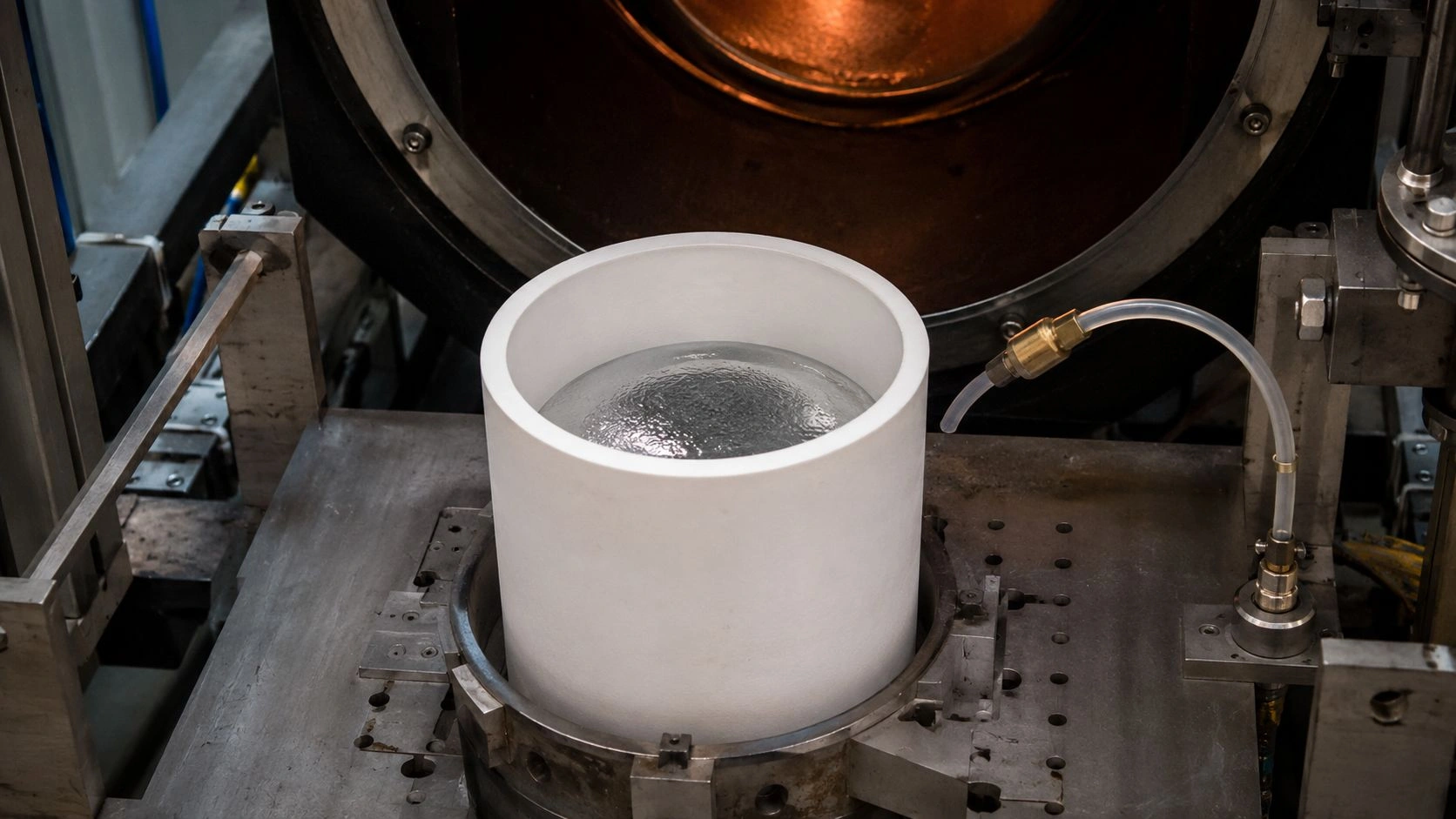
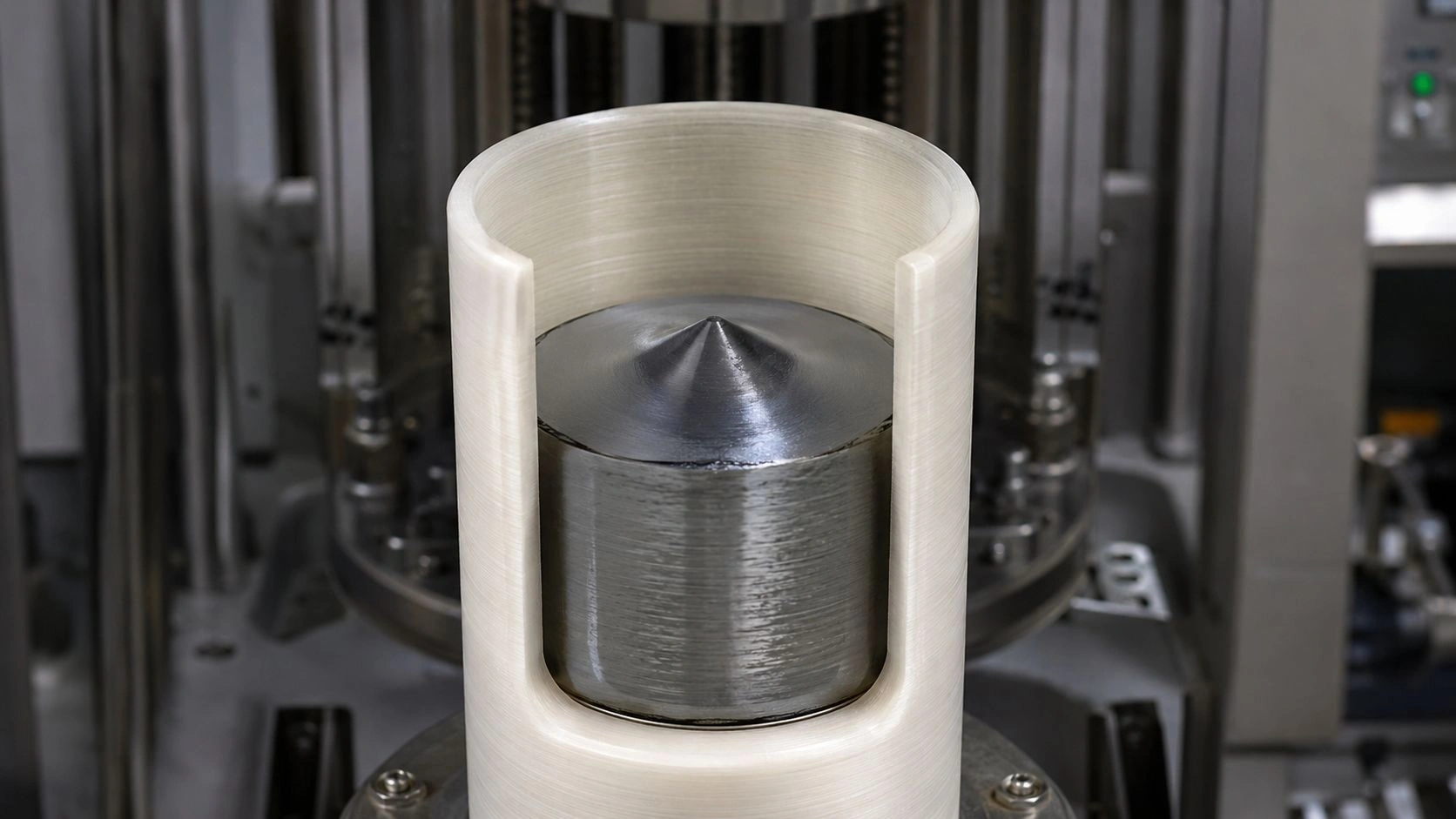
Boron nitride crucibles do not have a universal lifetime. In dry inert gas or vacuum, a BN crucible may survive many controlled heating cycles if the melt does not react with, wet, or erode the wall. In air, wet gas, oxidizing atmospheres, aggressive melts, frequent thermal shock, or rough cleaning, service life can drop sharply — sometimes to a single cycle. Hot-pressed BN is typically retired when it shows cracking, erosion, surface powdering, contamination carryover, or dimensional change; PBN is retired more often because of outgassing, source residue, wall delamination, or vacuum-process instability rather than visible mechanical damage.
That condition-based framing — lifetime governed by exposure history, not by the material name alone — is the engineering basis for this guide.
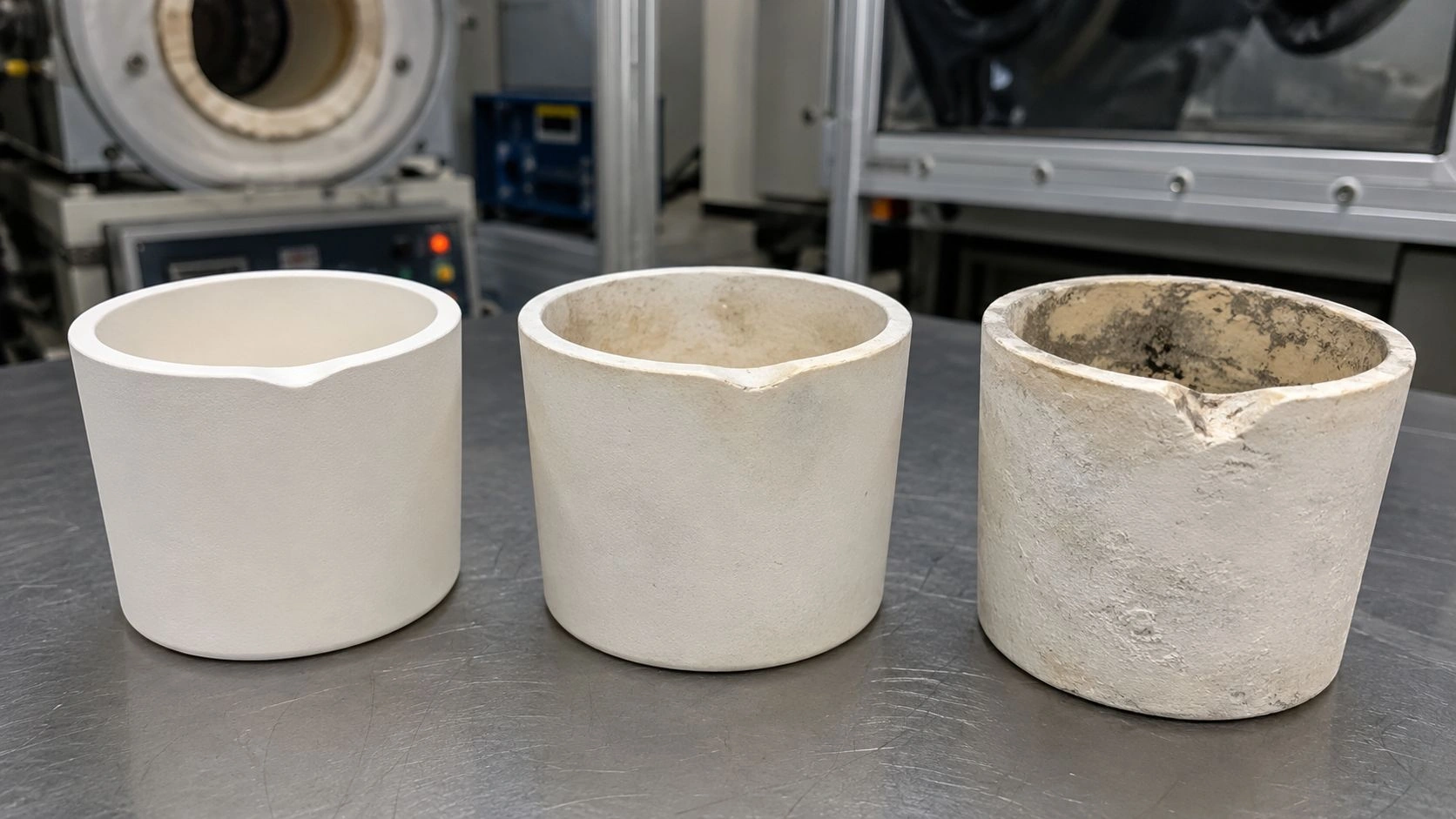
BN crucible lifespan depends on atmosphere, peak temperature, melt chemistry, thermal cycle rate, cleaning method, and storage conditions — not on a fixed cycle count. The same crucible may last many cycles in dry inert gas and fail in one cycle in air at high temperature.
The boron nitride crucibles and PBN crucibles at ADCERAX — covering hot-pressed HPBN grades for machinable non-wetting metal processing and CVD PBN grades for high-purity low-outgassing vacuum applications, with custom volumes, wall thicknesses, and geometries — are the starting point for the service-life decisions described in this guide.
Why BN crucible lifetime has no fixed number
The question "how many cycles does a BN crucible last?" cannot be answered without knowing the application conditions. The same BN crucible material specification can yield very different service lives depending on where and how it is used.
BN's performance advantages — non-wetting behavior, chemical inertness to many molten metals, thermal shock resistance, electrical insulation, and ease of machining — appear most strongly in non-oxidizing, controlled environments. In those environments, BN is not consumed, corroded, or chemically altered at a measurable rate during each cycle, and the mechanical condition of the crucible determines when it is retired.
In oxidizing or wet environments, BN is actively consumed. Published supplier data from a thermal ceramics manufacturer lists hot-pressed BN for use to approximately 1000°C in air and 1800°C in vacuum or inert atmosphere — a difference that reflects BN oxidation behavior, not an arbitrary rating. Published NASA oxidation research on monolithic boron nitride confirms that BN oxidation depends on orientation, porosity, crystallinity, and density, and that even small amounts of water vapor can volatilize boron oxide species. In that context, a BN crucible used in air above its air limit, or stored in humid conditions and not baked out before use, is already partially consumed before the first production cycle.
Why temperature rating is not the same as service life. A crucible rated for 1800°C in vacuum can still fail in a few cycles if the melt reacts with the BN wall, the cooling rate is too fast, or cleaning abrades the surface each cycle. Conversely, a crucible rated to only 1000°C in air may last many cycles if it is used at 800°C in dry argon with a compatible melt and gentle handling. Rating temperature defines a material boundary; service life is what happens within that boundary under real operating conditions.
Why dry inert gas and vacuum are BN-friendly. In argon, nitrogen, or high vacuum, the BN surface is not exposed to the oxidizing chemistry that produces the most aggressive lifetime reduction. BN remains dimensionally stable, non-wetting, and chemically inert to many molten metals. Cycles accumulate damage only through mechanical means — thermal shock, melt erosion, handling — rather than through simultaneous chemical consumption.
The main factors that decide BN crucible life
After establishing that lifetime is condition-driven, the specific variables that matter most can be ranked by their typical impact on service life.
[CITE: Published BN material supplier data lists hot-pressed BN for use to 1000°C in air and 1800°C in vacuum or inert atmosphere — NASA oxidation research on monolithic BN confirms that oxidation rate depends on microstructure including orientation, porosity, crystallinity, and density, and that water vapor accelerates boron oxide volatilization at elevated temperature — and published BN storage guidance from a major BN manufacturer recommends storing solid BN grades dry, tightly sealed, and in original packaging when possible, because adsorbed moisture can later contribute to oxidation and outgassing during high-temperature or vacuum use — confirming that atmosphere control, operating temperature relative to the material's atmosphere-specific limit, and pre-use moisture state together are the primary determinants of BN crucible service life rather than material composition alone.]
The Service-Life Decision Matrix below maps common service conditions to lifetime direction and practical control:
| Service condition | Expected lifetime direction | Main risk | Practical control |
|---|---|---|---|
| Dry argon/nitrogen | Longer | Melt reaction or residue buildup | Use clean loading and controlled cooling |
| High vacuum | Longer if baked and clean | Outgassing, source memory | Pre-bake and RGA/blank test |
| Air above BN air limit | Shorter | Oxidation and surface powdering | Avoid high-temp air exposure |
| Wet gas or humid storage | Shorter | Moisture-related oxidation/volatilization | Dry storage and bake-out |
| Non-wetting molten metal | Longer | Mechanical damage during demolding | Avoid scraping and impact |
| Reactive melt or flux | Shorter | Chemical attack or wall erosion | Compatibility test before production |
| Frequent thermal cycling | Variable | Crack initiation at edges/walls | Control ramp and cooling rate |
| Aggressive cleaning | Shorter | Scratches, particles, wall thinning | Use validated gentle cleaning |
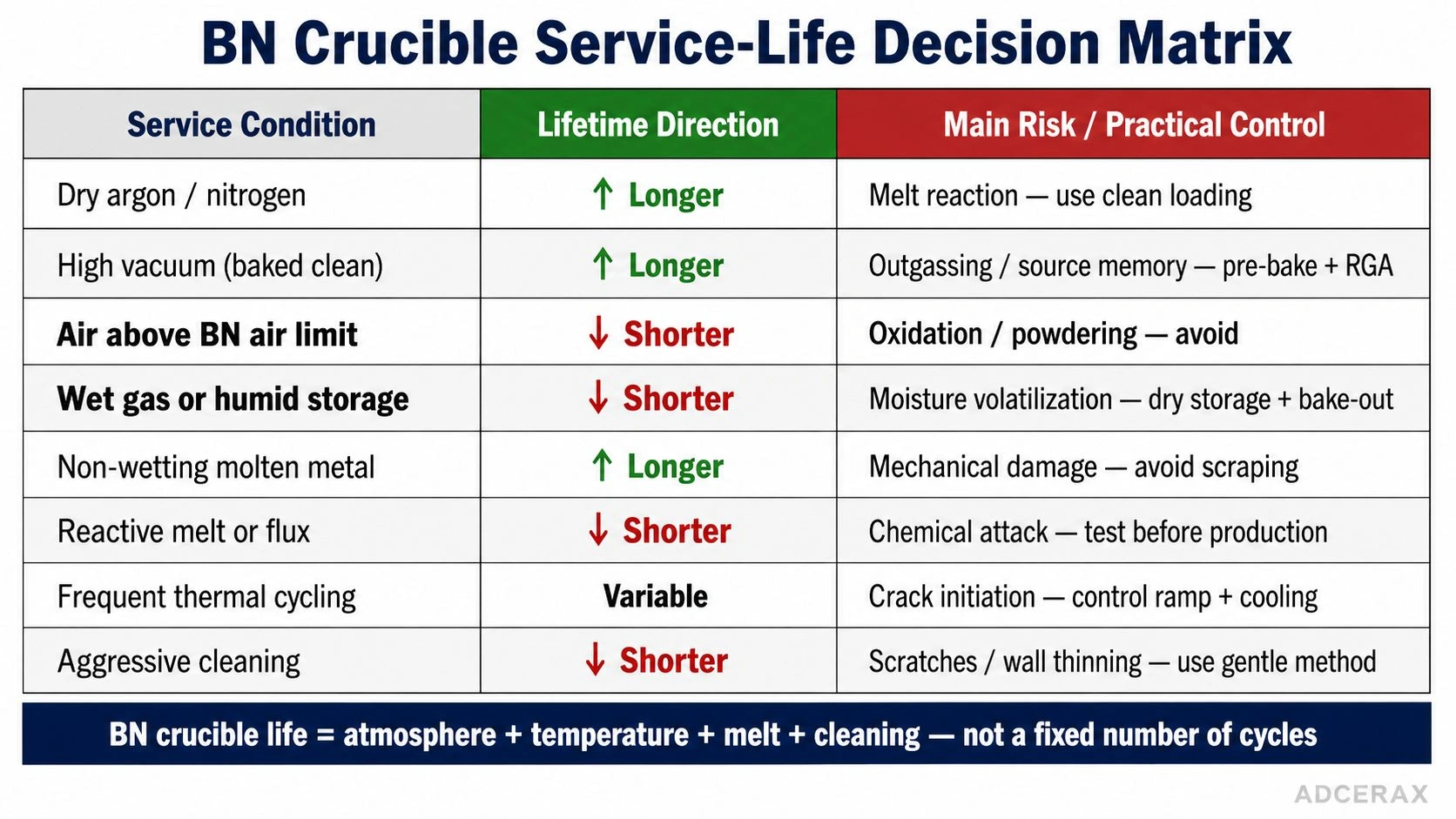
Atmosphere: vacuum/argon/nitrogen vs air/wet gas. The atmosphere variable has the largest effect on BN crucible life because it determines whether the crucible is chemically consumed during service or only mechanically worn. BN crucibles used in dry argon or nitrogen for compatible metal melting can accumulate many cycles before retirement. BN crucibles exposed to air at elevated temperature above the material's air limit lose mass and surface integrity with every cycle.
Temperature and dwell time. Even in protective atmospheres, higher temperatures and longer dwell times accelerate any residual chemical attack, grain boundary diffusion, thermal creep in thin walls, and grain growth that changes surface texture. For a crucible used at 80% of its rated vacuum temperature versus 95%, service life typically differs substantially — the material is not linear in its response to temperature near its limit.
Melt compatibility and wetting behavior. BN's non-wetting advantage applies to many molten metals — aluminum, gallium, tin, lead, zinc, bismuth, and some iron alloys under certain conditions — but not universally. Melts that wet BN create a reactive interface where metal can penetrate grain boundaries, create thermal expansion mismatch stress during solidification, and react chemically with the ceramic. The BN crucible liner product documentation at ADCERAX notes that compatibility with the specific melt chemistry must be confirmed before assuming reusability.
Thermal cycling and wall thickness. Rapid heating and cooling creates through-wall thermal gradients that generate stress. Thin-wall crucibles equalize temperature faster and accumulate less thermal-gradient stress per cycle than thick-wall crucibles, but they have less material reserve against crack propagation. The combination of wall thickness, thermal ramp rate, and crucible geometry determines how many cycles accumulate without crack initiation.
Cleaning, scraping, and handling damage. Every cleaning cycle that involves mechanical scraping removes surface material, increases roughness, and introduces surface cracks. BN is machinable by design, but that machinability means it is also susceptible to surface damage from metal tools, abrasive brushes, or ultrasonic cleaning with hard particles in suspension. The Saint-Gobain BN guidance to store BN dry and sealed applies equally to the cleaning protocol: gentle methods preserve the surface and extend life; aggressive methods trade service life for apparent cleanliness.
Hot-pressed BN vs PBN lifetime
After understanding the main life-controlling variables, the grade-specific retirement logic differs between hot-pressed BN and PBN in ways that reflect their different manufacturing and application contexts.
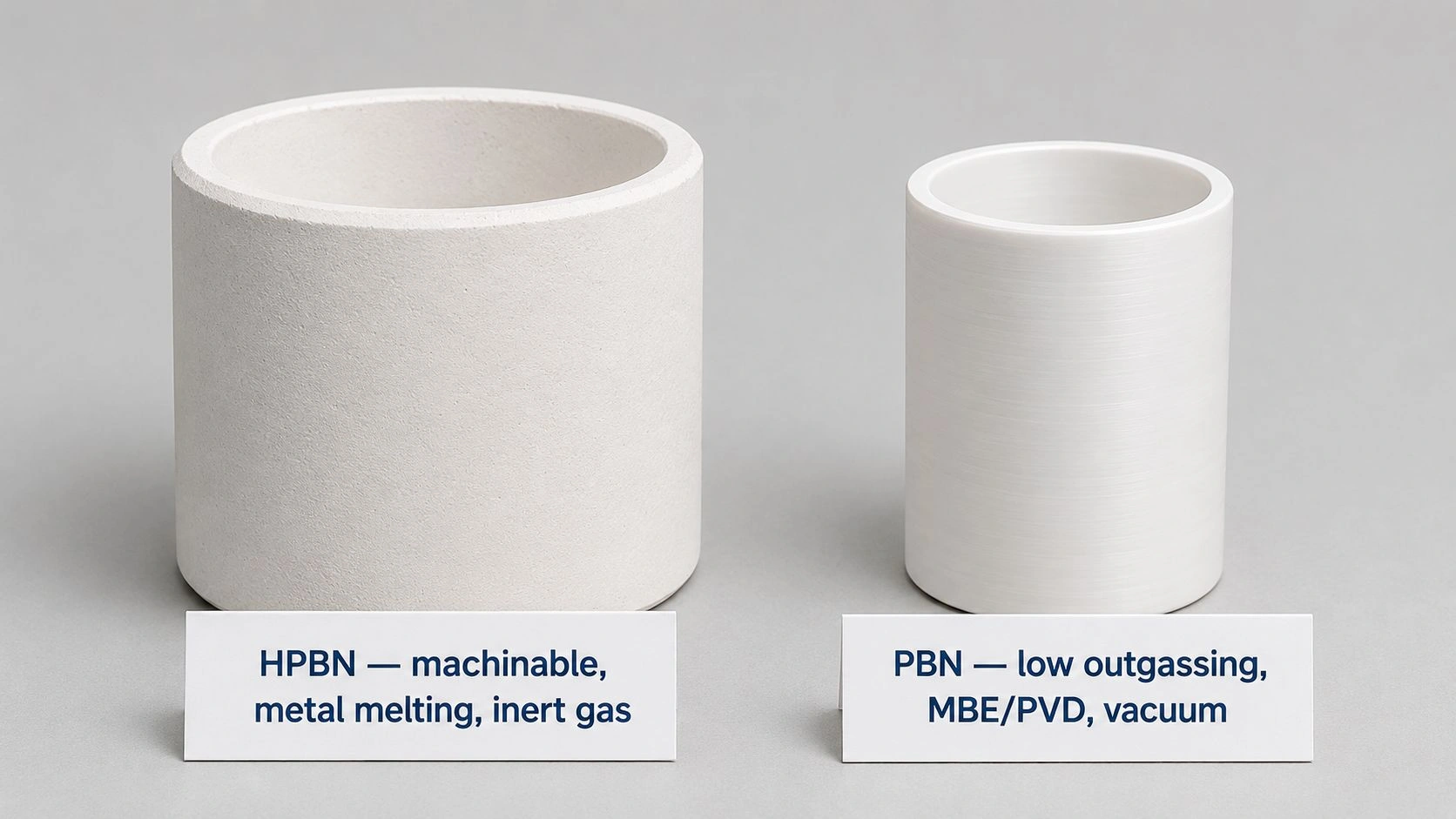
The HPBN vs PBN Lifetime Logic table maps the grade-specific variables:
| Variable | Hot-pressed BN | PBN | Selection direction |
|---|---|---|---|
| Main advantage | Machinable, custom, cost-effective | Dense, high-purity, low outgassing | Choose by purity and vacuum need |
| Common use | Metal melting, liners, fixtures, sintering | MBE, PVD, evaporation, high-purity sources | PBN for UHV/high-purity |
| Main lifetime risk | Oxidation, erosion, chips, residue | Source memory, delamination, RGA background | Inspect by process type |
| Cleaning tolerance | More mechanically robust but still brittle | Clean carefully; avoid wall damage | Avoid scraping both |
| Atmosphere sensitivity | Strongly atmosphere-dependent | Also atmosphere-dependent, cleaner in vacuum | Validate by actual cycle |
| Cost logic | Lower upfront cost | Higher upfront cost | Use PBN only when needed |
| Reuse criterion | Visible damage + contamination carryover | Vacuum/process stability + residue | Track crucible history |
Hot-pressed BN: machinable and reusable, but atmosphere-sensitive. Hot-pressed BN can be machined into virtually any geometry needed for metal melting, powder sintering, thermal analysis, or laboratory fixture applications. When used in dry inert gas or vacuum at appropriate temperatures with compatible melts, hot-pressed BN crucibles can be cleaned and reused multiple times. The retirement decision is typically visible: a crack in the wall, a chipped pour lip, erosion through the wall thickness, or irreducible contamination carryover.
PBN: cleaner and denser for vacuum and evaporation use. The PBN crucibles at ADCERAX are described as low-outgassing containers for MBE and PVD evaporation — applications where cleanliness and process repeatability are more important than simple mechanical survival. PBN does not typically fail by visible wall fracture in well-controlled vacuum evaporation service; it is retired when the process begins to show repeatable contamination, RGA background increases, source memory from a previous evaporant appears, or the wall geometry shows delamination or surface damage from thermal or chemical history.
Why PBN may fail by source memory rather than visible cracking. In MBE effusion sources, a PBN crucible that has been used for one source material — gallium, indium, aluminum — and then cleaned for reuse with a different source material may show cross-contamination in the next growth run even if the crucible looks clean. The dense PBN wall can adsorb trace quantities of the previous material at grain boundaries or surface sites that are not visible but are still active during the next heated source cycle.
The hot-pressed BN vs PBN comparison at ADCERAX distinguishes the two routes by manufacturing method, purity, density, gas permeability, and vacuum suitability — the comparison directly supports the grade-specific retirement criteria described here.
Do not reuse a BN crucible after these warning signs
Knowing when to stop reusing a BN crucible is as important as knowing when to continue. The temptation to continue using an expensive crucible past its useful life often costs more in contaminated runs, extended troubleshooting, and process instability than the crucible replacement would have.
Through-wall cracks. A crack that penetrates through the crucible wall creates a leak path that can allow melt infiltration, atmosphere contamination, or sample exposure. For a process tube application, a through-wall crack is an immediate retirement criterion regardless of how small it appears.
Chipped lips and edge cracks. Chips at the pour lip or cracks at machined edges can shed particles into the melt during the next heated cycle. Even a small particle from BN entering a high-purity melt or semiconductor source is a contamination event. Lip chips and edge cracks are retirement criteria for high-purity work.
Surface powdering from oxidation or overheating. A BN crucible that has been exposed to oxidizing conditions above its air limit develops a powdery surface layer — boron oxide that has partially crystallized or lost integrity. This powdery layer sheds particles during handling and the next heating cycle and cannot be fully restored by cleaning. Retire for clean work; consider downgrading to non-critical fixture service.
Residue that cannot be removed without abrasion. If the only way to clean the crucible is to mechanically scrape or abrade the wall, the cleaning process is creating new damage while removing the previous run's residue. At this point, the crucible's surface condition is deteriorating with every clean-reuse cycle. Stop and replace before the surface damage becomes the contamination source.
The End-of-Life Signs table below maps warning signs to reuse direction:
| Warning sign | What it means | Reuse direction |
|---|---|---|
| Through-wall crack | Loss of containment risk | Stop reuse |
| Lip chip or edge crack | Pouring and crack-growth risk | Stop or downgrade use |
| Surface powdering | Oxidation/overheating in air | Stop reuse for clean work |
| Deep wall erosion | Melt or cleaning attack | Stop reuse |
| Persistent residue | Carryover contamination risk | Clean only if non-abrasive method works |
| Dimensional distortion | Poor fit in holder or source | Stop for precision use |
| RGA background increase | Vacuum contamination risk | Re-bake or retire |
| Source memory | Previous material carryover | Dedicate or retire crucible |
Retirement decision should be based on documented service history, visual inspection, mass measurement after cleaning, and process-quality monitoring — not on visual inspection alone.
RFQ checklist for BN crucible service-life review
Whether evaluating a new BN crucible for a demanding application or assessing a replacement purchase for an existing workflow, the supplier needs the application conditions — not just the crucible geometry — to recommend an appropriate grade and realistic reuse expectation.
[CITE: Engineering guidance on BN crucible service-life specification and reuse assessment confirms the complete RFQ sequence: BN type (hot-pressed BN or PBN), process atmosphere with oxygen level and dew point, peak temperature and dwell time with ramp and cooling rate and cycle count, melt or sample material with flux and reactive species, fill level and overflow risk, crucible geometry including volume/wall/lip/lid and bottom radius, cleaning method, storage conditions, current failure mode with photographs, purity or contamination limits, and validation protocol including blank cycle, mass change, RGA analysis, and ICP/GDMS if needed — because atmosphere, melt chemistry, and thermal cycle together determine both the expected service life and the appropriate retirement criteria, and a supplier who receives only "BN crucible, need to know how long it lasts" cannot confirm grade suitability or provide defensible reuse guidance without the remaining application context.]
| RFQ field | Why it matters | Recommended wording |
|---|---|---|
| BN type | HPBN and PBN age differently | "Hot-pressed BN/PBN/BN liner" |
| Atmosphere | Primary lifetime driver | "Vacuum, Ar, N₂, air, O₂, wet gas; include dew point" |
| Temperature profile | Controls oxidation and thermal stress | "Peak, dwell, ramp, cooling, cycle count" |
| Melt/sample chemistry | Controls reaction and residue | "Metal, salt, oxide, alloy, powder, flux" |
| Fill level | Controls wall exposure and thermal stress | "Normal fill height and overflow risk" |
| Geometry | Controls cracking and cleaning | "Volume, wall, lip, lid, bottom radius, taper" |
| Cleaning method | Controls damage and carryover | "Solvent, bake-out, mechanical scraping, ultrasonic" |
| Reuse plan | Controls contamination risk | "Single-use, limited reuse, or tracked reuse" |
| Failure history | Speeds diagnosis | "Photos, crack location, erosion depth, residue pattern" |
| Validation | Confirms real service life | "Blank cycle, mass change, RGA, ICP/GDMS if needed" |
RFQ fields are the minimum for a BN crucible service-life review; add dedicated-crucible-per-material-family plan and lot traceability for controlled reuse workflows.
For applications where service life matters most — high-value metal melting, semiconductor-adjacent gallium or indium handling, MBE effusion source work — tracking each crucible's identity, run history, cleaning record, and blank-test results across its lifetime provides the data needed to set realistic retirement criteria for the specific application rather than relying on generic guidance.
Evaluating BN crucible lifespan for your process? Share your BN grade, melt material, atmosphere, peak temperature, dwell time, cycle count, fill level, cleaning method, and failure photos. ADCERAX can review whether hot-pressed BN, PBN, a BN liner, or another crucible route fits the service-life target; turnaround depends on inquiry complexity — no commitment required at this stage.
Frequently Asked Questions
How many times can a BN crucible be reused?
There is no universal number. In dry inert gas or vacuum with a compatible melt and gentle handling, a BN crucible can often be reused for multiple cycles. In air above the material's air limit, with a reactive melt, or with aggressive cleaning, it may fail in one or two cycles. Use visible damage — cracks, erosion, powdering, contamination — as the retirement criterion, not a fixed cycle count.
Why do BN crucibles fail faster in air?
BN oxidizes at high temperature in air or oxygen-containing atmospheres, forming boron oxide (B₂O₃) that can flow, volatilize, and leave the surface porous and mechanically weakened. Published supplier data commonly lists hot-pressed BN to approximately 1000°C in air and 1800°C in vacuum or inert atmosphere, reflecting this behavior. NASA oxidation research confirms that water vapor accelerates the process.
Is PBN longer-lasting than hot-pressed BN?
PBN is usually better suited for high-purity vacuum and evaporation applications because of its dense CVD structure, higher purity, and lower outgassing. Hot-pressed BN can be more practical for custom-machined metal-melting vessels and liners. Which lasts longer depends on the actual failure mode — mechanical for HPBN, process contamination for PBN — not on a general durability ranking.
When should I stop reusing a BN crucible?
Stop reuse when the crucible shows through-wall cracks, deep wall erosion, surface powdering, loose particles, persistent contamination carryover, chipped lips, distorted geometry, worsening RGA background, or source memory in vacuum work. Each of these indicates the crucible is either structurally compromised or contaminating the process.
How can I extend BN crucible life?
Use dry inert gas or vacuum where possible. Avoid high-temperature air exposure. Control ramp and cooling rates. Avoid overfilling. Use gentle, validated cleaning rather than mechanical scraping. Store the crucible dry and sealed. Dedicate crucibles to a specific material family to avoid cross-contamination. Run blank tests before high-purity reuse.
What information should I send a supplier for a BN crucible lifetime review?
Send BN grade (hot-pressed or PBN), melt or sample material, furnace atmosphere and dew point, peak temperature and thermal cycle profile, cycle count to date, fill level, crucible geometry, cleaning method, storage conditions, current failure mode with photographs, and purity or contamination limits. This information lets the supplier confirm grade suitability and provide application-specific retirement guidance.