SiC membranes are best when the feed is chemically aggressive, oily, abrasive, high-fouling, high-temperature, or requires repeated harsh chemical cleaning. Alumina ceramic membranes are a practical middle ground when a filtration system needs ceramic durability and cleaning tolerance but not the extreme flux recovery, hydrophilicity, or chemical severity that justifies the higher cost of SiC. Polymer membranes — including PVDF, PES, PTFE, and related materials — are usually the most economical choice for standard water treatment, low-temperature feeds, and mature large-scale systems where chemistry and cleaning conditions remain within polymer limits. The right choice depends on feed chemistry, temperature, solids content, oil load, fouling rate, cleaning chemicals, target flux, module format, and total lifecycle cost across the system's operational life.
The ceramic membranes at ADCERAX — covering alumina, zirconia, and SiC options by chemical exposure, abrasion level, and uptime goal — provide the product context for the three-way material comparison described in this guide.

SiC, alumina, and polymer membranes serve different operating envelopes — SiC for harsh aggressive feeds, alumina for ceramic durability in stable industrial filtration, polymer for economical standard water treatment — the selection depends on feed severity, cleaning strategy, and lifecycle economics.
What is the core difference between SiC, alumina, and polymer membranes?
Before comparing specific performance claims, the material families must be placed in their operating context — because the performance gap between these three options matters most in the feed conditions each was designed for.
[CITE: Published ScienceDirect research comparing ceramic and polymeric membrane implementation in industrial filtration confirms that ceramic membranes permit more aggressive chemical cleaning conditions than polymeric membranes, which is one of the most practically important operational differences between the two material families — because the ability to use higher-concentration oxidants, stronger acids or alkalis, and higher-temperature cleaning cycles directly determines how well a membrane system can recover from fouling without requiring premature replacement.]
SiC = severe-duty ceramic membrane for harsh feeds. Silicon carbide membranes represent the most chemically and mechanically robust option in the membrane comparison. SiC provides a covalently bonded, highly dense ceramic structure with strong inherent hydrophilicity — a surface property that supports lower adhesion of oil and organic foulants relative to conventional oxide ceramics. The pore structure is produced through controlled sintering of SiC powder, and the surface maintains its properties through repeated chemical cleaning cycles at extreme pH conditions.
Alumina = established ceramic membrane for stable industrial filtration. Alumina ceramic membranes have the longest commercial track record in industrial microfiltration and ultrafiltration. The asymmetric membrane structure — a thin alumina top layer on a coarser alumina or mullite support — provides a well-characterized pore size distribution and reliable filtration behavior. Alumina supports moderately aggressive chemical cleaning and has strong resistance to many common industrial chemicals, though its oxide-ceramic character creates some pH sensitivity at extreme alkaline conditions.
Polymer = economical membrane for standard, controlled feeds. Polymer membranes — primarily PVDF, PES, PP, and PTFE in industrial filtration — dominate total installed membrane capacity globally because of their lower cost, broad module availability, and compatibility with the standard hollow-fiber and spiral-wound configurations that most water-treatment system designers work with. Their limitation is the envelope of conditions they can tolerate: moderate chemical cleaning, moderate temperature, and feeds that stay within the pH and solvent tolerance of the specific polymer.
When should SiC membranes be selected instead of alumina or polymer?
After establishing the three material families, the conditions that justify the higher initial investment in SiC must be specifically identified — because SiC is not worth its cost in every application, and overselling it undermines the engineering credibility of the recommendation.
[CITE: LiqTech's published silicon carbide membrane technical data confirms that SiC membranes are hydrophilic, chemically inert across the full pH 0–14 range, and thermally resistant to 800°C — establishing the extreme operating envelope that makes SiC the appropriate choice for feeds where both alumina and polymer would be chemically or thermally limited — and published PMC research on SiC membrane performance confirms strong corrosion resistance in both acidic and basic test media after extended exposure, while published ScienceDirect research on produced-water treatment identifies SiC membranes as preferred in some contexts because of lower irreversible fouling compared with other ceramic membrane systems, albeit at higher material cost.]
High-fouling oily wastewater and produced water. The combination of hydrophilicity and chemical stability makes SiC membranes particularly useful when the feed contains significant oil and grease — produced water from oil-field operations, cutting oil wastewater, metal-surface treatment effluent, or food-processing wastewater with emulsified fat content. SiC's inherent surface energy reduces the adhesion of oil droplets and organic foulants relative to hydrophobic polymer membranes, which is why flux recovery after cleaning tends to be stronger in SiC systems for these feed types. Published produced-water research confirms this advantage, noting lower irreversible fouling in SiC systems compared with conventional ceramic membranes.
Strong acid/alkali cleaning and harsh chemical feeds. When the membrane system requires cleaning with concentrated sodium hypochlorite, hydrogen peroxide, strong acids, or concentrated caustic soda — cleaning conditions that polymer membranes cannot survive for more than a limited number of cycles — SiC membranes can continue operating through cleaning intensities that would degrade PVDF or PES. This difference in cleaning tolerance directly affects the OPEX comparison: a polymer membrane that requires replacement every one to two years because cleaning must be kept mild accumulates higher total cost over ten years than a SiC membrane that can be aggressively cleaned and lasts substantially longer.
Abrasive solids, high temperature, and uptime-critical duty. In feeds with hard suspended solids — mining water, mineral processing streams, battery recycling wastewater with inorganic particle loads — SiC's hardness protects the membrane surface from physical erosion better than polymer or alumina membranes. When operating temperature is elevated — above 60–80°C in thermophilic MBR or high-temperature process water — SiC maintains its properties where PVDF begins to soften and alumina oxide-ceramic properties may limit service.
When are alumina ceramic membranes or polymer membranes the better choice?
The three-way comparison is only useful if the genuine advantages of alumina and polymer membranes are stated as clearly as the advantages of SiC.
Use alumina when ceramic durability is needed but SiC severity is not. Alumina membranes are the right choice for industrial filtration systems where the feed requires ceramic robustness — moderate chemical exposure, reliable cleaning tolerance, and longer membrane life than polymer — but where the feed is not severe enough to justify SiC's cost premium. Applications like food and beverage clarification, stable industrial water polishing, moderate wastewater streams, and clean-in-place (CIP) food-grade filtration often fall in the alumina window. ADCERAX's ceramic membrane product range separates alumina membranes for water filtration and stable industrial duty from SiC membranes positioned for mining, chemical, and oil-water separation contexts.
Use polymer when feed conditions are controlled and cost dominates. Polymer membranes remain the correct choice for applications that fit their operating envelope: municipal water polishing, standard MBR with controlled feed, clean ultrafiltration processes for food-grade water, and large-scale reverse-osmosis pretreatment where CAPEX and wide supplier availability are the dominant decision factors. Published commercial membrane-system guidance confirms that polymeric membranes perform well in applications with predictable feed conditions, while ceramic membranes are favored when the effluent or process stream is unpredictable or harsh. Polymer membranes fail the comparison only when operating conditions push outside their envelope — aggressive cleaning, high temperature, abrasive particles, or oil-laden feeds — not when the feed is well within their design range.
The SiC vs Alumina vs Polymer Membranes comparison table maps the full decision:
| Decision variable | SiC membrane | Alumina ceramic membrane | Polymer membrane |
|---|---|---|---|
| Best fit | Harsh wastewater, oil-water, chemicals, abrasive or high-fouling feeds | Stable industrial filtration needing ceramic robustness | Standard water treatment and controlled low-severity feeds |
| Chemical resistance | Strongest in this comparison | Strong, oxide-ceramic dependent | Material-specific, usually more limited |
| Cleaning tolerance | Strong chemical cleaning possible | Strong cleaning possible | More restricted by polymer chemistry |
| Temperature tolerance | Highest | High | Usually lower |
| Fouling recovery | Strong where hydrophilicity and harsh cleaning help | Good in stable systems | Good when feed is controlled; can suffer irreversible fouling |
| Initial cost | Highest | Medium to high | Lowest |
| Lifecycle value | Best when uptime and harsh cleaning matter | Good when ceramic durability is needed | Best when replacement cost and standardization dominate |
| Main risk | Over-specified for moderate feeds | May not handle most severe oil/chemical/abrasive feeds as well as SiC | May age or foul under harsh cleaning and aggressive feeds |
Values indicative. Verify with feed testing, supplier-specific membrane data, and pilot operation.
How do fouling, cleaning, flux, temperature, and chemistry change the decision?
After mapping the material boundaries, the operating variables that determine real-world membrane system economics must be compared systematically — because many membrane selection decisions that appear to be material choices are actually cleaning strategy, pretreatment, and flux management decisions.
Flux recovery matters more than initial clean-water flux. A membrane's initial permeability in clean water tells only part of the performance story. After fouling with the actual process feed, what fraction of the initial flux is restored by backwash? By chemical cleaning? By the most aggressive cleaning the membrane material can tolerate? These flux recovery numbers — not the clean-water permeability in a datasheet — determine the sustainable flux in a real system and the cleaning frequency required to maintain it. SiC can justify its cost premium specifically when its flux recovery from aggressive cleaning is substantially better than alumina or polymer in the same feed, because that recovery difference directly translates to lower cleaning frequency, lower chemical consumption, and higher net production.
Cleaning chemistry can make or break polymer vs ceramic economics. For feeds where biological fouling, oil adhesion, or scaling require frequent oxidant cleaning at high concentration, the polymer membrane's cleaning limit becomes the system's constraint — not the membrane's flux or rejection. Systems designed around monthly aggressive NaOCl cleaning at 1000–2000 ppm may need quarterly membrane replacement if PVDF cannot survive long-term oxidant exposure at those concentrations. Ceramic membranes — both alumina and SiC — allow higher oxidant concentrations and cleaning temperatures, which changes the cleaning economics completely. When the cleaning protocol can be more aggressive, cleaning frequency can be reduced, cleaning volumes can be smaller, and total downtime per year is lower.
The Application Selection Matrix maps the operating context to membrane selection:
| Application/feed | Recommended first check | Why | When to reconsider |
|---|---|---|---|
| Produced water/oil-water separation | SiC | Hydrophilicity and lower irreversible fouling | Alumina or polymer if feed is mild and cost dominates |
| Strong acid/alkali wastewater | SiC or alumina | Ceramic cleaning and chemical resistance | Polymer only if chemistry stays within certified limits |
| Municipal water polishing | Polymer or alumina | Mature systems and cost matter | SiC if fouling/cleaning is unusually harsh |
| Food & beverage filtration | Alumina or polymer | Cleaning chemistry and hygiene validation depend on process | SiC if high-temperature/chemical cleaning is severe |
| Mining/abrasive wastewater | SiC | Abrasion and harsh chemistry favor SiC | Alumina if duty is moderate and budget matters |
| MBR retrofit | Polymer or ceramic by module constraint | Existing module format often controls choice | SiC/alumina if fiber breakage or cleaning limits are costly |
| Battery recycling wastewater | SiC or alumina | pH, solids, metals, and cleaning severity matter | Polymer only after compatibility and fouling testing |
| Low-cost standard filtration | Polymer | CAPEX and availability dominate | Ceramic if membrane replacement and cleaning costs rise |

Feed condition is the real selection driver: SiC is the first check for harsh, aggressive, oily, or abrasive feeds, alumina fits stable ceramic-duty filtration, and polymer remains the standard economical choice for controlled water-treatment conditions.
Module format and retrofit constraints may override material preference. Existing systems designed around hollow-fiber polymer modules cannot simply substitute a flat-sheet or tubular ceramic module without reconfiguring the pressure vessel, piping, and control system. This module-compatibility constraint can make upgrading to ceramic technically correct but economically impractical in retrofit scenarios. In new system design, the material selection can drive the module format. In retrofits, the existing module format often drives the material selection.
The Misdiagnosis Matrix maps common membrane selection errors:
| Observed problem | Common wrong diagnosis | Better engineering question |
|---|---|---|
| Flux drops quickly | ""Membrane material is bad"" | Is pretreatment, crossflow velocity, pore size, or cleaning strategy wrong? |
| Polymer membrane ages fast | ""Need finer pore size"" | Is chemical cleaning or temperature exceeding polymer limits? |
| Ceramic membrane seems expensive | ""Supplier is overpriced"" | Does longer life, higher flux recovery, or stronger cleaning reduce OPEX? |
| SiC does not outperform alumina | ""SiC is over-marketed"" | Was the feed severe enough to justify SiC? |
| Alumina fouls in oily feed | ""All ceramics behave the same"" | Would SiC hydrophilicity or surface chemistry improve recovery? |
| Pilot result differs from lab result | ""Membrane batch changed"" | Did feed variability, oil load, solids, or cleaning cycle change? |
The silicon carbide membrane page at ADCERAX covers tubular SiC membrane modules and MBR formats for harsh wastewater and industrial filtration. The ceramic membrane product category covers the alumina and SiC product range with pore size and module options. The silicon carbide ceramic material hub provides the broader SiC filtration context including porous components.

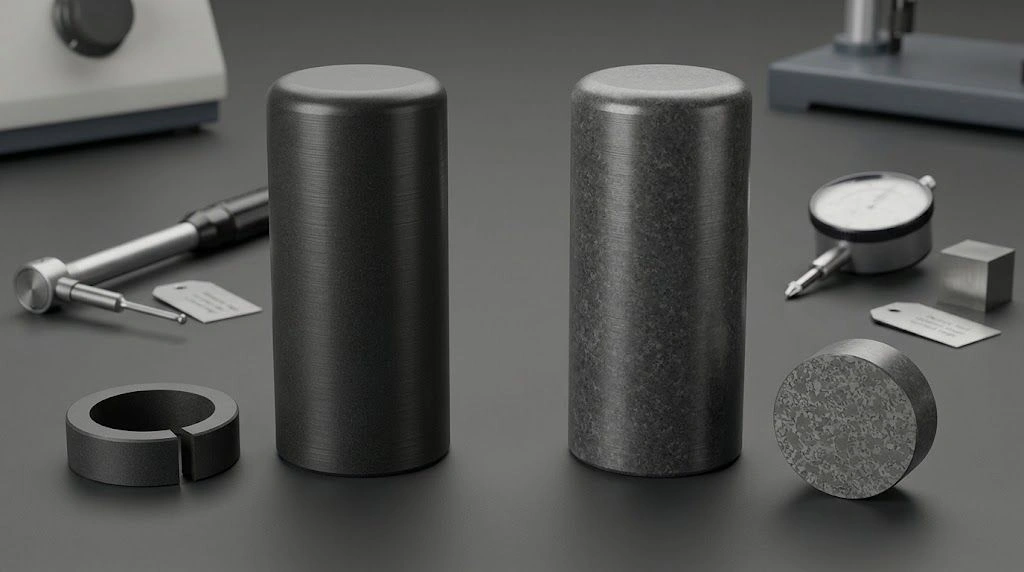
This side-by-side product view highlights the practical material families behind membrane selection: SiC for harsh chemical or oily duty, alumina for stable industrial ceramic filtration, and PVDF polymer membranes for standard water-treatment service.
What RFQ and pilot-test data should be sent before membrane selection?
A membrane RFQ that asks only ""which is better: SiC, alumina, or polymer?"" cannot be answered reliably without feed data. The selection requires characterizing the actual feed and operating conditions.
The RFQ/Pilot-Test Data Checklist maps the required information:
| Parameter | Why it matters | Required? |
|---|---|---|
| Feed chemistry/pH | Determines chemical compatibility | Yes |
| Temperature range | Controls polymer vs ceramic feasibility | Yes |
| TSS/particle size | Controls pore selection and fouling risk | Yes |
| Oil and grease | Strong driver for SiC vs alumina/polymer | If present |
| COD/TOC | Indicates organic fouling load | Recommended |
| Target pore size/MWCO | Defines separation duty | Yes |
| Desired permeate quality | Prevents under- or over-specification | Yes |
| Cleaning chemicals | Decides material compatibility and OPEX | Yes |
| Crossflow/dead-end mode | Changes flux and fouling behavior | Yes |
| Target flux | Drives membrane area and economics | Yes |
| Module format | Can override material preference in retrofit | Yes |
| Pilot-test duration | Needed for stable flux and cleaning recovery | Yes |
For ceramic membrane suppliers, request in the RFQ: membrane material family (SiC, alumina, zirconia), layer structure (top layer material and pore size, support material), module geometry (tubular OD/ID, flat sheet dimensions, or hollow fiber dimensions), maximum pH range for operating and cleaning conditions, maximum temperature, mechanical strength specification, sealing material compatibility, recommended cleaning protocol, and available references from comparable industrial applications.
A pilot test at minimum six to twelve weeks duration — long enough to observe fouling development, cleaning cycle frequency, and flux recovery trend — provides substantially more useful selection data than any short-term bench-scale comparison. Feed variability, seasonal chemistry changes, and upstream process upsets are revealed only in longer pilot operations.
Comparing SiC, alumina, and polymer membranes for your filtration system? Share your feed type, pH range, temperature, TSS, oil content, COD/TOC, target pore size, cleaning chemical limits, module format constraint, flux target, and investment horizon. ADCERAX can review whether alumina, SiC, or zirconia ceramic membranes best fit the feed severity and OPEX targets, and propose a pilot-test configuration.
Frequently Asked Questions
Are SiC membranes better than alumina membranes?
SiC membranes perform better than alumina when the feed is oily, abrasive, chemically aggressive, high-fouling, or requires strong and frequent chemical cleaning. In those conditions, SiC's hydrophilicity, pH range, and cleaning tolerance deliver meaningfully higher flux recovery and longer membrane life. Alumina membranes may be a better choice when the duty is moderate and the project needs ceramic durability at lower cost.
Are ceramic membranes better than polymer membranes?
Ceramic membranes outperform polymer membranes in harsh chemical, thermal, abrasive, or aggressive-cleaning environments — specifically because ceramic materials permit more aggressive cleaning conditions than polymer membranes can tolerate. Polymer membranes remain better for standard water treatment and controlled feeds where CAPEX, module availability, and system standardization are the primary decision factors.
When should SiC membranes be selected?
Select SiC when the feed involves significant oil content, abrasive particles, aggressive pH swings, elevated temperature, hard-to-clean organic foulants, or frequent high-concentration chemical cleaning — conditions where uptime and flux recovery matter more than initial membrane cost.
When should polymer membranes still be used?
Use polymer membranes when the feed is predictable and within polymer tolerance, the operating temperature is moderate, cleaning chemicals are mild, the module format is already standardized for the plant, and CAPEX is the dominant constraint. Well-within-envelope polymer systems can operate reliably for years and are supported by the widest range of system integrators and replacement parts.
Is alumina a good middle-ground membrane material?
Yes. Alumina ceramic membranes provide ceramic strength, reliable chemical cleaning tolerance, stable pore size, and broad industrial application experience at a lower cost than SiC. They fit well in applications where the feed needs more than polymer can provide but is not severe enough to justify SiC.
What is the biggest mistake in membrane material selection?
The most common mistake is selecting membrane material by name rather than by feed severity and operating requirements. SiC that is over-specified for a moderate feed adds unnecessary cost. A polymer membrane that is under-specified for a harsh feed fouls irreversibly and requires frequent replacement. In both cases, the feed characterization — pH, oil, solids, temperature, and cleaning chemistry — should drive the selection before material preference does."