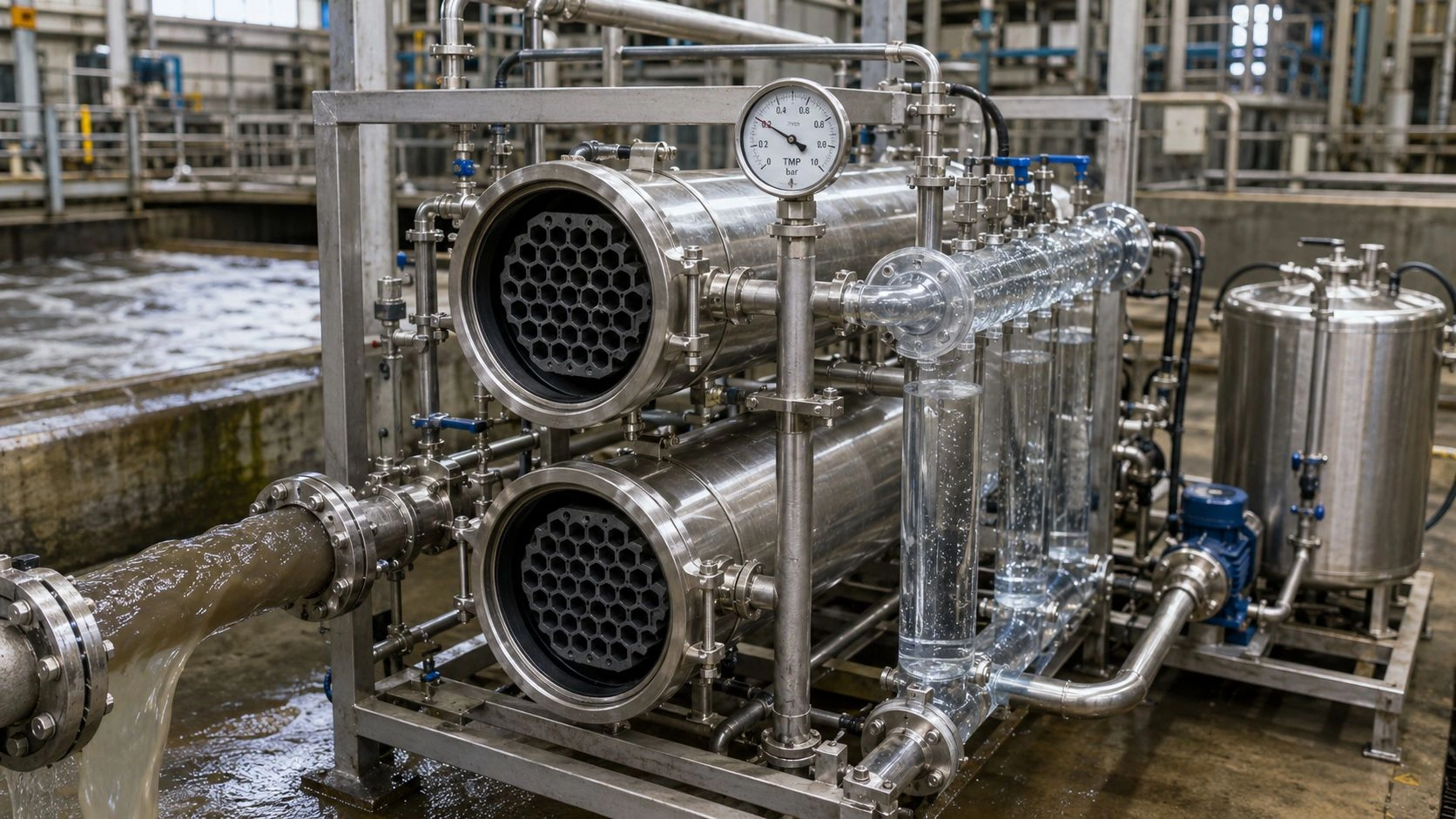
Clean porous ceramic filters by diagnosing the fouling type before applying any chemical or physical cleaning method, then working from the least aggressive effective method upward: forward flush or crossflow rinsing, backwash or backpulse, targeted chemical cleaning by fouling category, and only then deeper regeneration methods such as ultrasonic treatment or controlled thermal treatment where compatible with the filter material and process residue. Regeneration is confirmed only when pressure drop, permeability, flow distribution, and filtrate quality return to an accepted baseline — not when the cleaning step has been completed. If repeated cleaning no longer restores stable performance, the decision shifts from maintenance to replacement or re-specification.
The porous ceramics at ADCERAX — covering porous tubes, discs, plates, rods, and membranes in alumina, silicon carbide, zirconia, and custom ceramic materials for filtration, diffusion, flow restriction, and permeable support applications — provide the product context for the cleaning and regeneration decisions described in this guide.
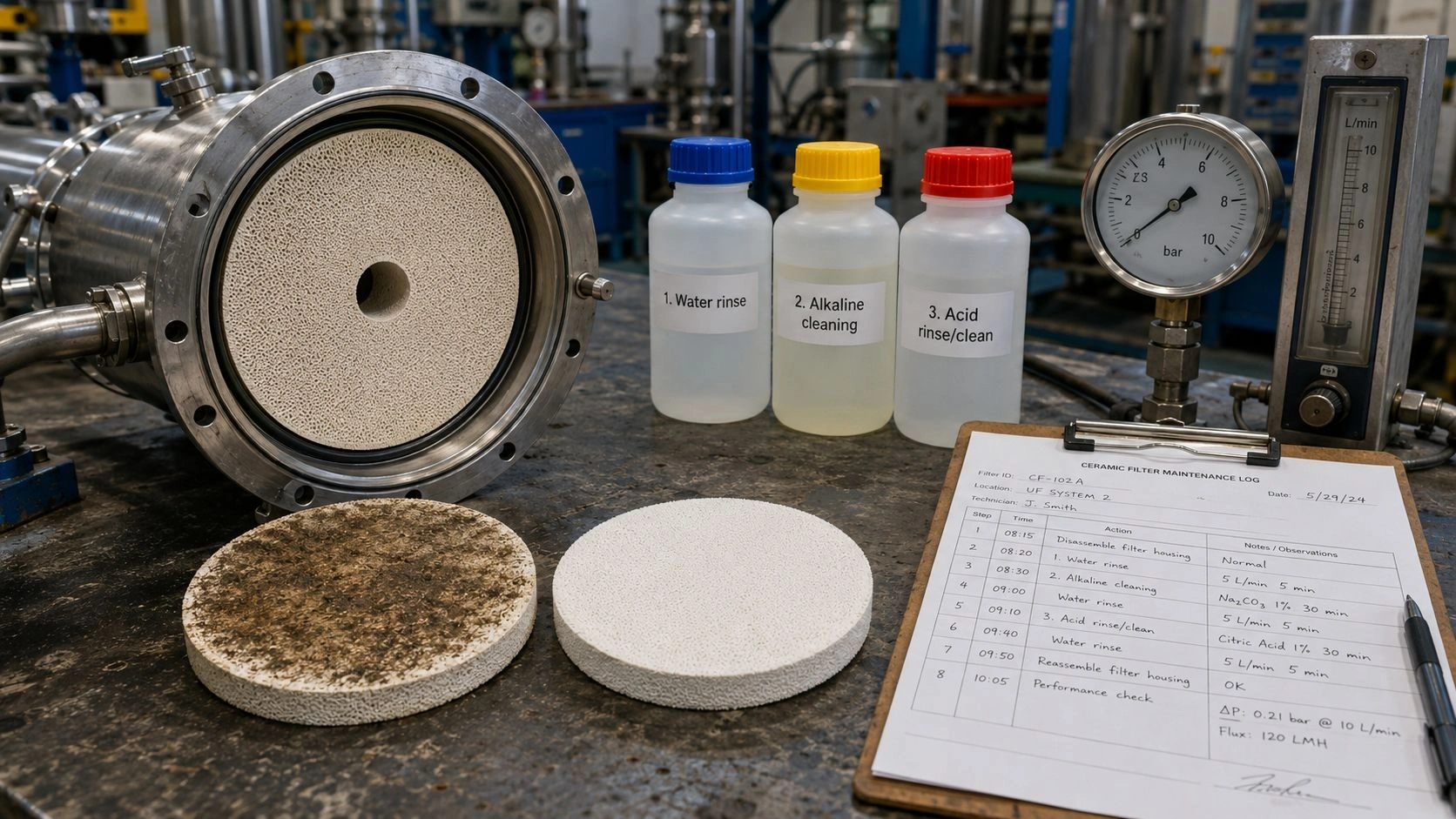
Porous ceramic filter regeneration begins with fouling diagnosis — not chemical application — then progresses through rinse, backwash, chemical cleaning, and verification by recovered pressure drop, permeability, and filtrate quality; cleaning without diagnosis risks wrong method selection, material incompatibility, and wasted downtime.
Diagnose the fouling before cleaning the porous ceramic filter
The most common cleaning mistake is applying a standard chemical protocol before confirming what is actually blocking the filter. Porous ceramic filters can lose performance for very different reasons — particle cake, emulsified oil, organic film, mineral scale, biofouling, embedded fines, or structural damage — and these fouling types respond to different cleaning approaches. Using the wrong method wastes time, risks material incompatibility, and can permanently embed some foulants deeper into the pore structure.
Record operating symptoms before touching the filter. Before any cleaning begins, measure and record the current pressure drop across the filter, the process flow rate or flux at that pressure, any available permeability measurement, and the filtrate quality. Compare these values against the baseline from initial commissioning or the last successful cleaning. The pattern of deviation provides the first diagnostic clue: a rapid, large pressure-drop increase after a change in feed solids loading suggests cake fouling; a gradual, persistent decline after months of service with oil-bearing feed suggests progressive organic or oil fouling; hard, scale-like deposits on visual inspection suggest mineral precipitation.
LiqTech's published ceramic membrane maintenance documentation confirms that particles, oil, and biomass accumulate on ceramic membrane surfaces and can cause fouling and system downtime if not removed — recognizing these as distinct fouling mechanisms that require different cleaning approaches rather than a single generic cleaning step.
Surface cake versus internal pore plugging. A filter with surface cake — loose, unconsolidated solids deposited on the upstream face — typically responds well to physical cleaning: crossflow flushing, increased flow velocity, or backwash. A filter with internal pore plugging — where fine particles, oil, or precipitated scale have filled the interconnected pore network — requires chemical dissolution of the foulant before physical cleaning can remove the residue. These two conditions can produce similar pressure-drop readings, which is why visual inspection of the filter surface and operating history analysis are both necessary before selecting a cleaning approach.
Fouling versus structural damage. A cracked or chipped ceramic filter, a filter with collapsed pore walls from thermal shock, or a filter with degraded seals or adhesive will not recover through cleaning. Physical damage looks like cleaning failure — pressure remains high, flow remains low, and filtrate shows particle breakthrough — but no chemical protocol will repair mechanical damage. Before committing to a cleaning program, inspect the filter for visible cracks, edge chips, uneven flow distribution across the filter face, and seal condition.
Use a stepwise cleaning sequence: rinse, backwash, chemical clean, then regenerate
After diagnosis, the cleaning sequence should proceed from the least aggressive method that can accomplish the required recovery, escalating only when less intensive steps prove insufficient.
LiqTech's published ceramic membrane cleaning framework describes three main cleaning processes in order of frequency and intensity: crossflow operation for continuous low-level fouling control, backwash for periodic recovery, and CIP for deeper recovery when backwash is insufficient. TU Delft's 2024 review of ceramic membranes in oily wastewater treatment identifies pretreatment, backpulsing/backwashing, and chemical cleaning as the main fouling-control strategies — confirming the same stepwise progression from physical to chemical intervention.
The numbered cleaning sequence:
- Record pressure drop, flux or flow rate, permeability, and filtrate quality as the pre-cleaning baseline.
- Remove loose surface deposits with forward flush or crossflow rinse at increased velocity.
- Apply backwash or backpulse if forward flushing does not restore flow to acceptable levels.
- Select chemical cleaning by fouling type — not by habit — and confirm material and seal compatibility before applying.
- Rinse thoroughly until all chemical residue is removed and the rinse effluent is clean.
- Retest clean-water flow, process flux, pressure drop, and filtrate quality against the pre-cleaning baseline.
- If recovery is not achieved or does not hold across subsequent cycles, escalate to deeper regeneration or begin replacement evaluation.
Step 2: crossflow rinse or forward flush. A forward flush at higher-than-normal velocity mobilizes and carries away loose surface cake before it compacts. In crossflow ceramic membrane systems, maintaining crossflow velocity during operation provides continuous shear at the membrane surface that prevents cake buildup. When performance has already declined, increasing crossflow velocity temporarily can partially recover flux before more intensive steps are needed.
Step 3: backwash or backpulse. Reversing flow through the filter — from the permeate side back through the pore network — dislodges particles, oil droplets, and biomass from channel walls. PMC's published review of ceramic ultrafiltration membrane cleaning confirms backflushing, backwashing, and ultrasound as physical methods for treating reversible fouling. Published ScienceDirect review literature on oily wastewater similarly confirms that backpulsing/backwashing supports long-term ceramic membrane operation by periodically dislodging accumulated foulants before they become irreversible.
Step 4: chemical cleaning by fouling type. Chemical cleaning should be selected and sequenced based on what the foulant is, not what is most convenient. Alkaline cleaning targets organic films, oils, grease, and biological residue. Acid cleaning targets mineral scale from calcium, magnesium, iron, or silica precipitation. Oxidizing or disinfecting cleaning targets biofouling where sanitation is part of the operating requirement. The MBR Site's published cleaning guidance confirms that sequential chemical cleaning using oxidative and acid methods is applied in membrane systems, distinguishing the purposes of maintenance cleaning, chemically enhanced backflush, and recovery cleaning by their cleaning intensity and contact time.
Match the cleaning method to the fouling type
After confirming the cleaning sequence, the specific method and chemistry must be matched to the fouling mechanism. The same alkaline cleaning that works for oil fouling will not dissolve mineral scale. The same acid cleaning that removes calcium carbonate will not break down organic biofilm.
The Cleaning Method Selection Matrix maps the fouling type to the cleaning approach:
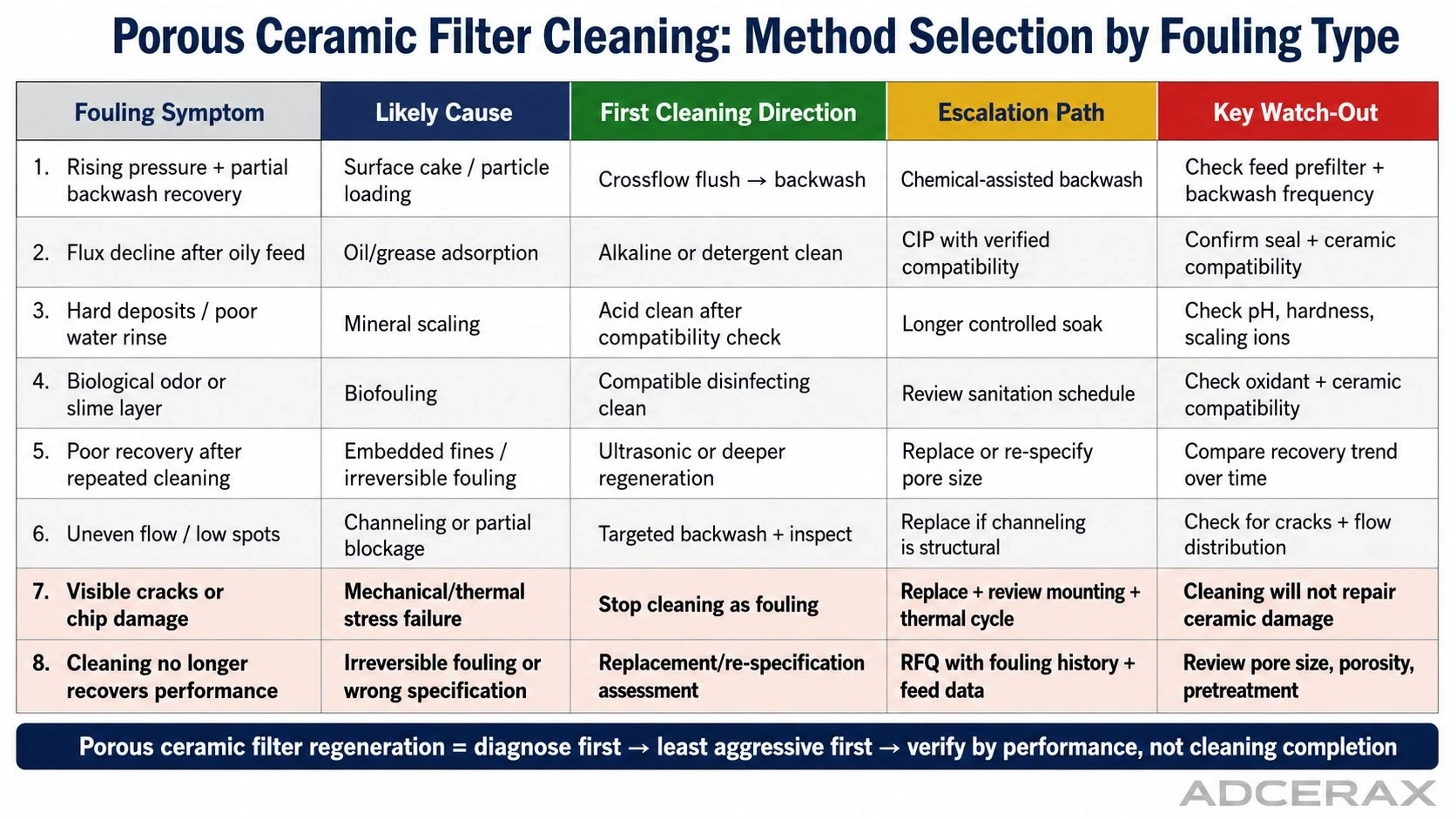
Porous ceramic filter cleaning should be selected by fouling symptom and likely cause: surface cake usually starts with flush or backwash, oil and grease require alkaline or detergent cleaning, mineral scale requires acid cleaning after compatibility review, and visible cracks or chip damage require replacement rather than further cleaning.
| Fouling symptom | Likely cause | First cleaning direction | Escalation path |
|---|---|---|---|
| Gradual pressure-drop rise with solids | Surface cake/particle loading | Rinse, crossflow flush, backwash | Chemical-assisted backwash |
| Flux decline after oily feed | Oil/grease adsorption | Warm rinse if allowed, then alkaline/detergent clean | CIP with verified compatibility |
| Hard deposits after mineral-rich feed | Mineral scaling | Acid cleaning after compatibility check | Longer controlled soak/supplier review |
| Biological odor or slime | Biofouling | Compatible disinfecting or oxidizing clean | Review sanitation and pretreatment schedule |
| Poor recovery after repeated cleaning | Embedded fines or irreversible fouling | Ultrasonic or deeper regeneration review | Replace/re-specify pore size or pretreatment |
| Uneven flow or visible cracks | Structural damage | Stop treating as normal fouling | Inspect, replace, review mounting/thermal stress |
Values indicative; always verify cleaning chemistry, material compatibility, seal compatibility, and site EHS procedure before use.
Particle cake: flush and backwash first. For filters with straightforward particle cake from suspended solids, backwash alone can often restore 80–90% of original permeability. The decision to add chemical cleaning should be based on whether the backwash recovery is adequate and stable across cycles, not on a fixed time schedule.
Oil and grease: alkaline or detergent-assisted cleaning. Emulsified oil and grease deposits on ceramic pore walls are best dissolved with alkaline pH conditions — sodium hydroxide solution at a concentration and temperature confirmed to be compatible with the ceramic material, seals, and adhesives. Sterlitech's published documentation on ceramic membrane disc cleaning confirms that ceramic discs can undergo repeated regeneration, backflushing, and chemical cleaning due to their chemical and thermal durability.
Mineral scale: acid cleaning after compatibility check. Calcium carbonate, calcium sulfate, silica, and iron precipitation require acid cleaning. Before applying acid cleaning to a porous ceramic filter, confirm that the ceramic material, bonding phase, seals, and housing are chemically compatible with the proposed acid type and concentration. Some porous alumina filters can tolerate dilute mineral acids; others may require modified cleaning conditions.
Biofouling: compatible oxidizing or disinfecting program. Biological fouling from bacteria, algae, or EPS accumulation requires a cleaning approach that disrupts the biological matrix. Where the ceramic filter and process conditions allow, a sodium hypochlorite solution or compatible oxidizing agent can be used. Confirm that the concentration, temperature, and contact time are within the ceramic material's tolerance and that all downstream equipment is compatible with the cleaning effluent.
The ceramic membrane page covers crossflow ceramic membrane systems for liquid filtration with strong cleaning-based regeneration in chemically aggressive or fast-fouling feeds. The silicon carbide porous ceramic page covers SiC porous components for harsh filtration, high-temperature, and corrosive service where cleaning tolerance is particularly important. The microporous alumina filter tube page and porous alumina rods page cover alumina porous tube and rod geometries for diffusion, filtration, and high-temperature porous ceramic applications.
Confirm regeneration by performance, not by cleaning time
A filter that has been cleaned but not tested is not a regenerated filter. Regeneration is confirmed only by measured performance recovery relative to the accepted baseline.
Compare pressure drop and permeability before and after cleaning. Pressure drop across the filter at a defined flow rate or velocity should return close to the original clean baseline after successful regeneration. A significant and stable reduction in pressure drop — or equivalently, a significant and stable increase in permeability at constant pressure — confirms that the pore network has been reopened to its functional state.
Confirm clean-water flux or process flux recovery. For liquid filtration porous ceramics, measuring clean-water flux or permeability at a standard test pressure before and after cleaning provides a direct comparison of pore network openness. For process filtration systems, measuring the process flux at normal operating TMP after cleaning and rinse confirms real-feed performance recovery.
Inspect for cracks, edge chips, seal damage, and uneven flow. Visual inspection after cleaning is part of acceptance, not an afterthought. A filter that has passed through an aggressive cleaning cycle should be checked for edge chips, surface cracks, loose seal material, discolored pore zones, or uneven visual wetness patterns that indicate channeling or partial blockage.
Log cleaning method, chemistry, time, temperature, and result. Without records, each cleaning event starts blind. Maintaining a cleaning log — including fouling symptoms observed before cleaning, method applied, chemical type and concentration, contact time, temperature, rinse protocol, and post-cleaning performance measurements — allows the maintenance team to identify when a cleaning method that previously worked is no longer recovering performance, which is the early warning sign that replacement or re-specification is needed.
The Regeneration Acceptance Checklist maps the performance criteria:
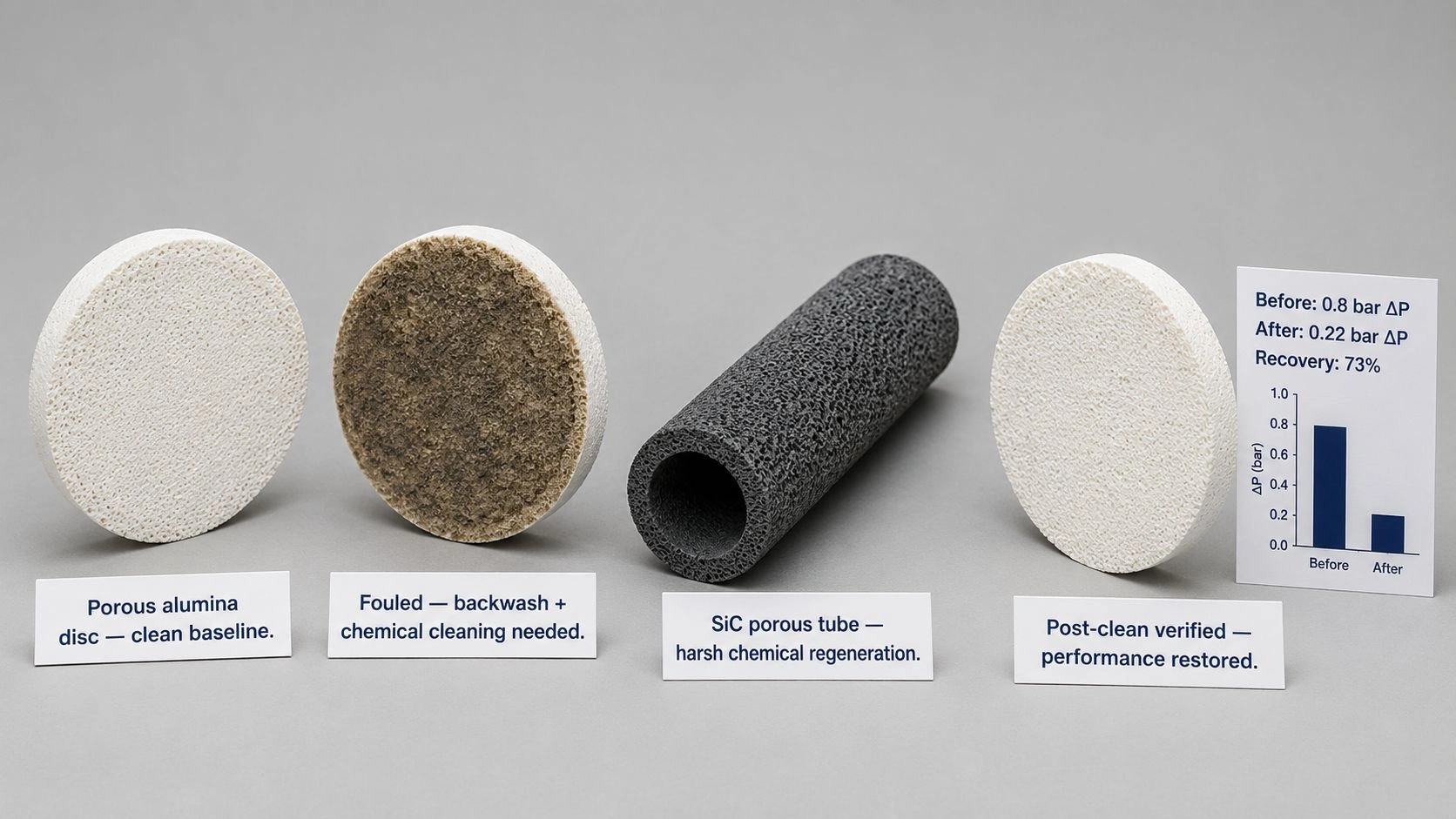
Porous ceramic filter regeneration should be verified by measurable recovery — pressure drop, permeability, flow distribution, and filtrate quality — rather than by completion of a rinse, backwash, or chemical cleaning step alone.
| Checkpoint | Why it matters | Pass condition |
|---|---|---|
| Pressure drop | Shows hydraulic resistance | Returns near accepted baseline |
| Clean-water flux/permeability | Confirms pore recovery | Stable after cleaning and rinse |
| Process flux | Confirms real-feed operation | Stable under normal operating feed |
| Filtrate quality | Confirms separation still works | No unacceptable particle breakthrough |
| Flow distribution | Detects channeling or partial blockage | Uniform enough for process target |
| Visual inspection | Finds cracks, chips, deposits | No visible structural damage |
| Cleaning log | Prevents repeat mistakes | Method, chemistry, time, result recorded |
| Repeatability | Confirms sustainable regeneration | Similar recovery across cycles |
Replace or re-specify the filter when cleaning no longer restores stable operation
When the cleaning sequence has been correctly applied, the fouling type has been correctly identified, and acceptable performance is still not restored — or not maintained for a reasonable operating interval before the next cleaning cycle — the maintenance decision becomes a specification decision.
The alumina ceramic foam filter page illustrates a porous ceramic product designed for single-use or limited-regeneration scenarios in molten metal filtration — where the pore size, thermal exposure, and metal contact make regeneration impractical, confirming that not all porous ceramic filtration components are designed for indefinite cleaning cycles.
The Replacement/RFQ Data Checklist maps the information needed for a filter replacement order:
| RFQ item | Why it matters |
|---|---|
| Filter type | Disc, tube, plate, membrane, foam, rod, custom geometry |
| Material | Alumina, SiC, zirconia, other ceramic |
| Pore size/porosity | Controls flow, retention, and cleanability |
| Dimensions | Determines fit, sealing, flow path, and pressure drop |
| Feed chemistry | Determines chemical compatibility and cleaning program |
| Solids profile | Determines plugging risk and pretreatment need |
| Operating pressure/flow | Determines mechanical and hydraulic load |
| Temperature | Affects material, seals, cleaning, and thermal stress |
| Cleaning history | Shows what failed or worked before |
| Failure symptoms | Helps supplier avoid repeating wrong specification |
Common replacement triggers include: performance that consistently falls below 80% of baseline permeability after correct cleaning; cleaning cycles that become more frequent than operationally viable; visual evidence of cracking, pore collapse, or irreversible channeling; chemical incompatibility between the required cleaning chemistry and the filter material or seals; and a root-cause diagnosis showing that the pore size, porosity, or material is mismatched to the feed characteristics.
Porous ceramic filter not recovering after cleaning? Share your filter type, material, pore size, operating symptoms, feed chemistry, solids profile, cleaning history, and post-cleaning performance measurements. ADCERAX can review whether the filter is suitable for the application, recommend a cleaning approach, or propose a replacement specification better matched to the feed and duty.
Frequently Asked Questions
Can porous ceramic filters be cleaned and reused?
Yes, many porous ceramic filters and ceramic membranes can be cleaned and reused when fouling is reversible and the ceramic structure is not damaged. Ceramic membrane systems commonly use crossflow rinsing, backwash, and CIP to restore performance, and properly cleaned filters can maintain repeatable regeneration across many cycles when fouling type, cleaning chemistry, and ceramic material are all correctly matched."