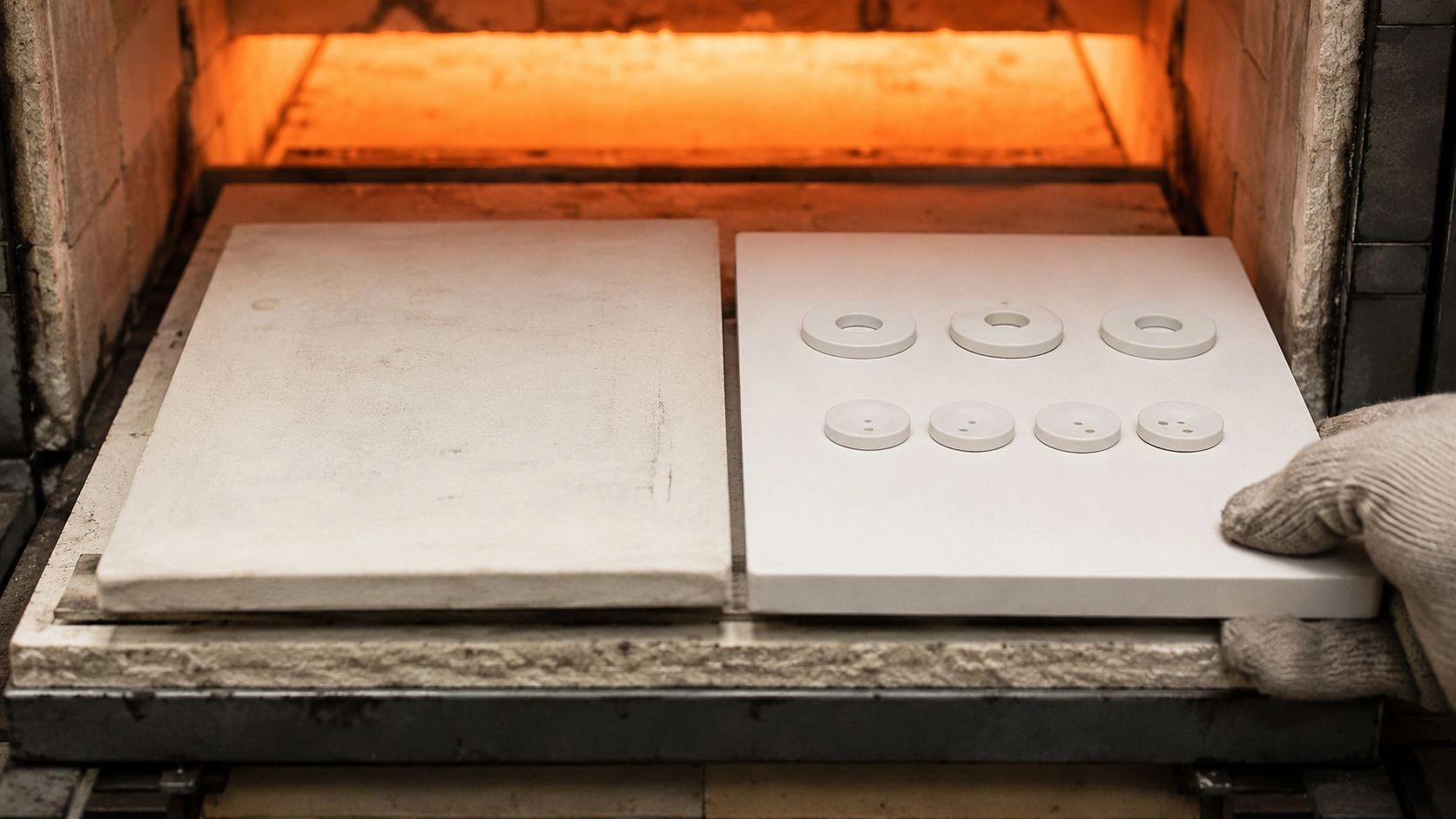
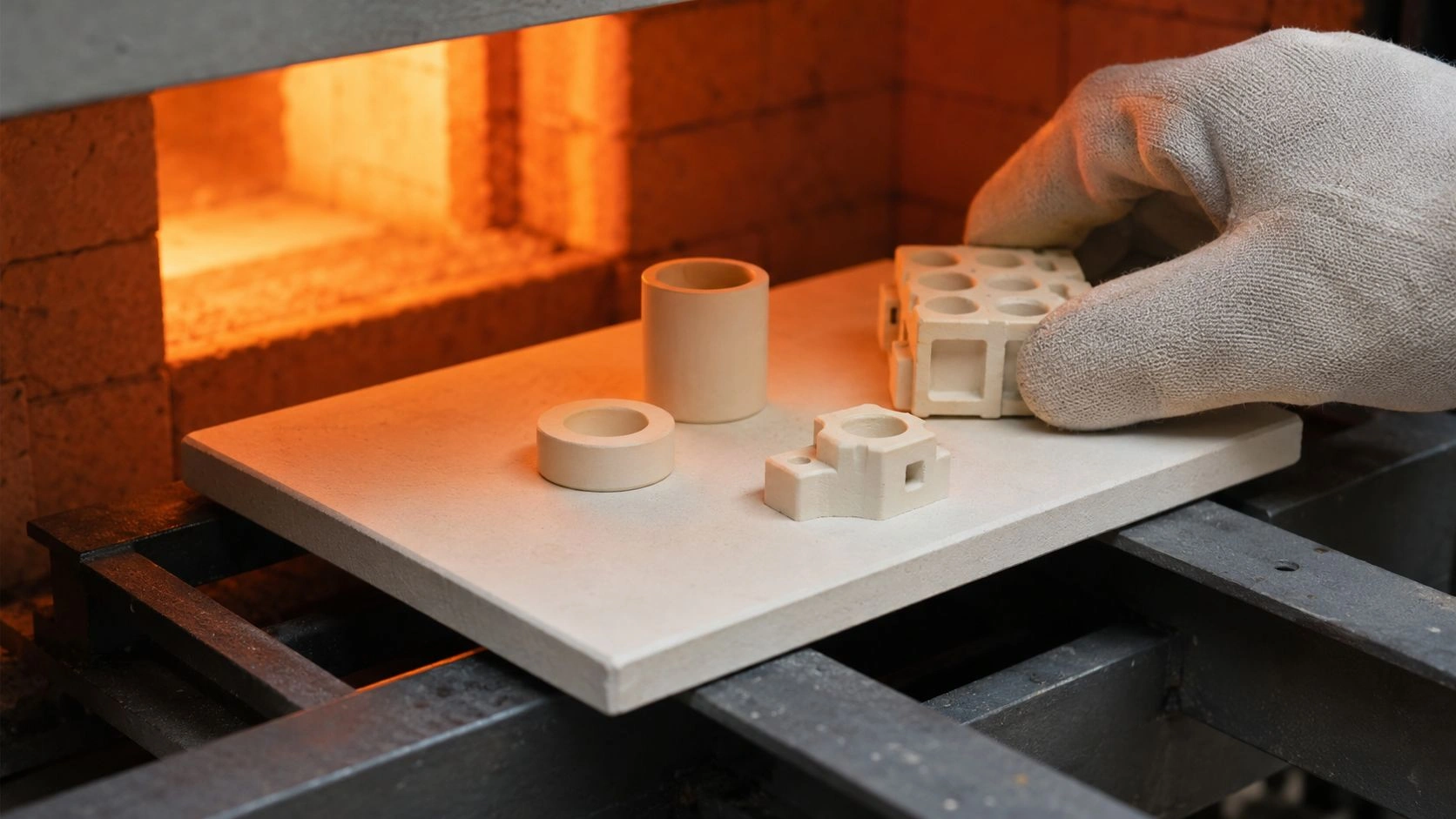
A process-engineer's selection framework for alumina setter plates, hearth plates, and support boards — covering material choice, critical specifications, failure modes, and RFQ data.
Kiln furniture selection decisions rarely fail because an engineer chose the wrong temperature rating. They fail because a plate sagged under a load the support layout could not distribute, cracked during a ramp rate the material could not absorb, reacted with the atmosphere or the fired product surface, or was replaced repeatedly without diagnosing whether the problem was the material, the geometry, or the firing schedule. Alumina ceramic plates are the correct kiln furniture solution in a well-defined set of conditions — and the wrong solution in others. This guide works through the application logic, material boundaries, critical specifications, failure modes, and RFQ data that allow a process engineer to make and document that decision.
Alumina ceramic plates are suitable for kiln furniture when the firing process requires high-temperature stability, chemical inertness, clean contact surfaces, sag resistance, electrical insulation, or stable support for ceramic, powder-metal, or technical oxide components. The correct plate depends on alumina purity, thickness, flatness, load distribution, firing atmosphere, thermal cycle, surface finish, and support span — not on temperature rating alone.
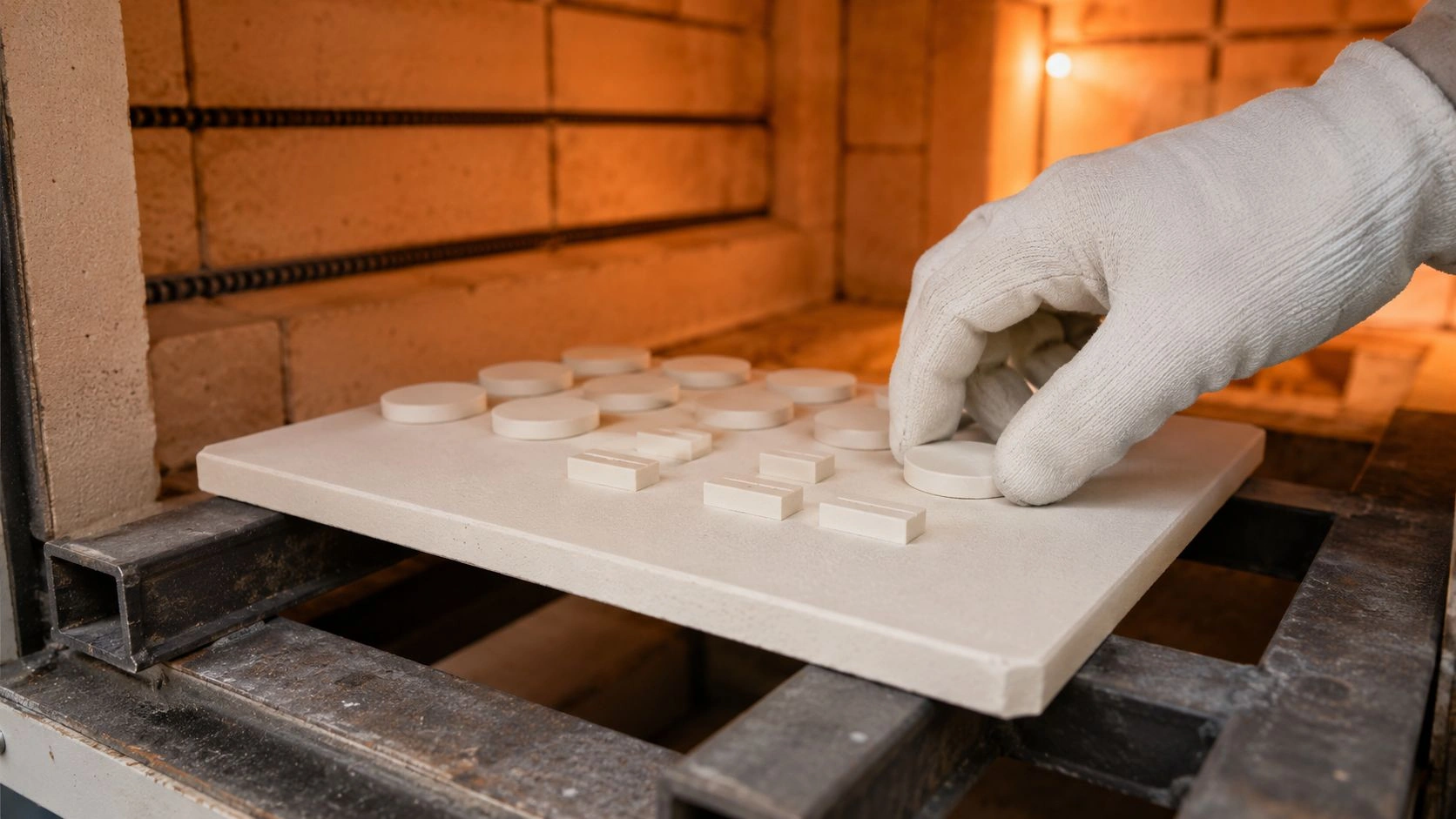
Alumina ceramic plates in kiln furniture service carry load, resist chemical interaction with the fired product, and maintain flatness across repeated thermal cycles — functions that depend on purity, thickness, support span, and firing schedule together.
Why Alumina Ceramic Plates Are Used as Kiln Furniture
Alumina ceramic plates fill a kiln furniture role that conventional refractory shelves cannot: high-temperature support that simultaneously controls contamination, electrical insulation, surface inertness, and dimensional stability across many firing cycles. In setter-plate service, the plate is not simply a flat shelf. It holds the product weight at peak temperature, resists reaction between the plate surface and the fired part, survives repeated heating and cooling without warping or cracking, and maintains the contact flatness that prevents fired products from inheriting plate defects. ADCERAX's alumina ceramic plates range covers kiln furniture, setter plates, insulation boards, and heat-treatment supports in 96%, 99%, 99.5%, and 99.7% Al₂O₃ with thicknesses from 0.1 mm to 50 mm and custom formats up to 1000 × 1000 mm. Dense alumina setter plate references describe high-purity alumina plates as hearth plates, kiln furniture, separators, and weights for rapid-heat electric furnaces, emphasising chemical inertness, rigidity, and dimensional stability at high service temperatures.
Setter plates and hearth plates
Setter plates support individual ceramic components or powder-metal parts during sintering. The plate surface must be flat enough to prevent fired-part distortion, inert enough to resist chemical bonding or reaction, and stiff enough to carry distributed product weight without deflecting between support points. Hearth plates serve a similar structural role in continuous or batch furnaces but often span longer distances and carry higher aggregate loads. In both cases, alumina grade and thickness determine whether the plate maintains its geometry through the firing cycle.
Separator plates and insulation boards
Separator plates prevent direct contact between stacked or adjacent fired parts and the kiln atmosphere or adjacent parts. In multilayer stacking configurations, thin alumina separators reduce inter-part contamination while adding minimal thermal mass. Insulation boards serve a different function — thermal and electrical isolation between furnace elements and the kiln structure — where purity and dielectric consistency are the governing requirements rather than load-bearing alone.
Why clean contact surfaces drive alumina selection
The material reason alumina plates displace conventional refractory shelves in technical ceramics, electronic ceramics, and oxide-powder sintering is contamination control. A low-purity or high-silica kiln shelf introduces silicate vapour, surface flux, or reaction products that transfer to sensitive fired parts. High-purity alumina plates — 99% Al₂O₃ and above — minimise this exchange and maintain surface chemistry neutrality across extended firing campaigns. Prairie Ceramics identifies alumina kiln furniture as designed for high-temperature thermal shock and chemical attack resistance, with alumina chemistry from 90–99%. For processes where surface contamination changes product electrical, optical, or dielectric properties, purity is not a secondary specification.
When to Choose Alumina Plates Instead of Cordierite-Mullite, SiC, or Dense Refractory Plates
Alumina ceramic plates are not the default correct choice for every kiln furniture position. The selection depends on whether the firing conditions favour alumina's strengths — high-temperature stability, chemical inertness, sag resistance, and clean contact — over the advantages of alternatives. Understanding the boundary conditions prevents over-specification in one direction and misapplication in the other.
Cordierite-mullite kiln furniture is valued for low thermal expansion and thermal shock resistance in moderate-temperature applications. IPS Ceramics identifies cordierite-mullite kiln furniture as generally stable to 1350°C, combining cordierite's low thermal expansion with mullite's high-temperature strength to produce furniture that tolerates rapid cycling better than alumina in some applications. A Thermal Processing source confirms that cordierite ceramics have low thermal expansion and excellent thermal shock resistance but a more limited use-temperature ceiling near 1200°C. For general pottery, tableware, or tile production below 1350°C with fast thermal cycling, cordierite-mullite is often the more cost-efficient and thermally durable choice. Alumina becomes the stronger candidate above that temperature window, in high-purity and high-cleanliness applications, or where dimensional stability and surface inertness matter more than thermal shock tolerance.
Alumina plates are not thermally shock-resistant by default. The corundum-phase alumina that gives these plates their high-temperature strength and chemical stability also gives them a relatively high thermal expansion coefficient compared with cordierite. Engineers substituting alumina for cordierite-mullite in existing kiln furniture positions without adjusting the ramp profile are among the most common sources of early cracking in alumina setter service.
SiC kiln furniture delivers higher thermal conductivity and better thermal-shock performance under rapid heating and heavy load. Where the dominant requirement is rapid, uniform heat transfer into the fired product or high-load structural support in a cycling furnace, SiC may outperform alumina in total cost of ownership even at higher unit cost. Sunrock's high-purity alumina kiln furniture range spans from 70% to over 99.6% alumina content and temperatures to 1870°C, with the note that alumina-silicate compositions may be preferred where thermal shock resistance is the primary selection criterion.
Six-step material selection guide
- Choose alumina plates for high-temperature kiln furniture where chemical stability, clean contact, and high-purity surface conditions govern.
- Choose high-purity alumina (99%+) when fired parts are sensitive to contamination, surface reaction, or atmosphere exposure.
- Choose cordierite-mullite when operating below ~1350°C and thermal shock resistance or rapid cycling dominates over purity or temperature ceiling.
- Choose SiC kiln furniture when thermal conductivity, rapid heat transfer, or sustained heavy load under cycling conditions governs service life.
- Do not select alumina by maximum temperature rating alone — confirm load, span, ramp rate, atmosphere, and flatness before specifying.
- Do not substitute alumina plates into an existing cordierite-mullite position without reviewing ramp schedule and support spacing.
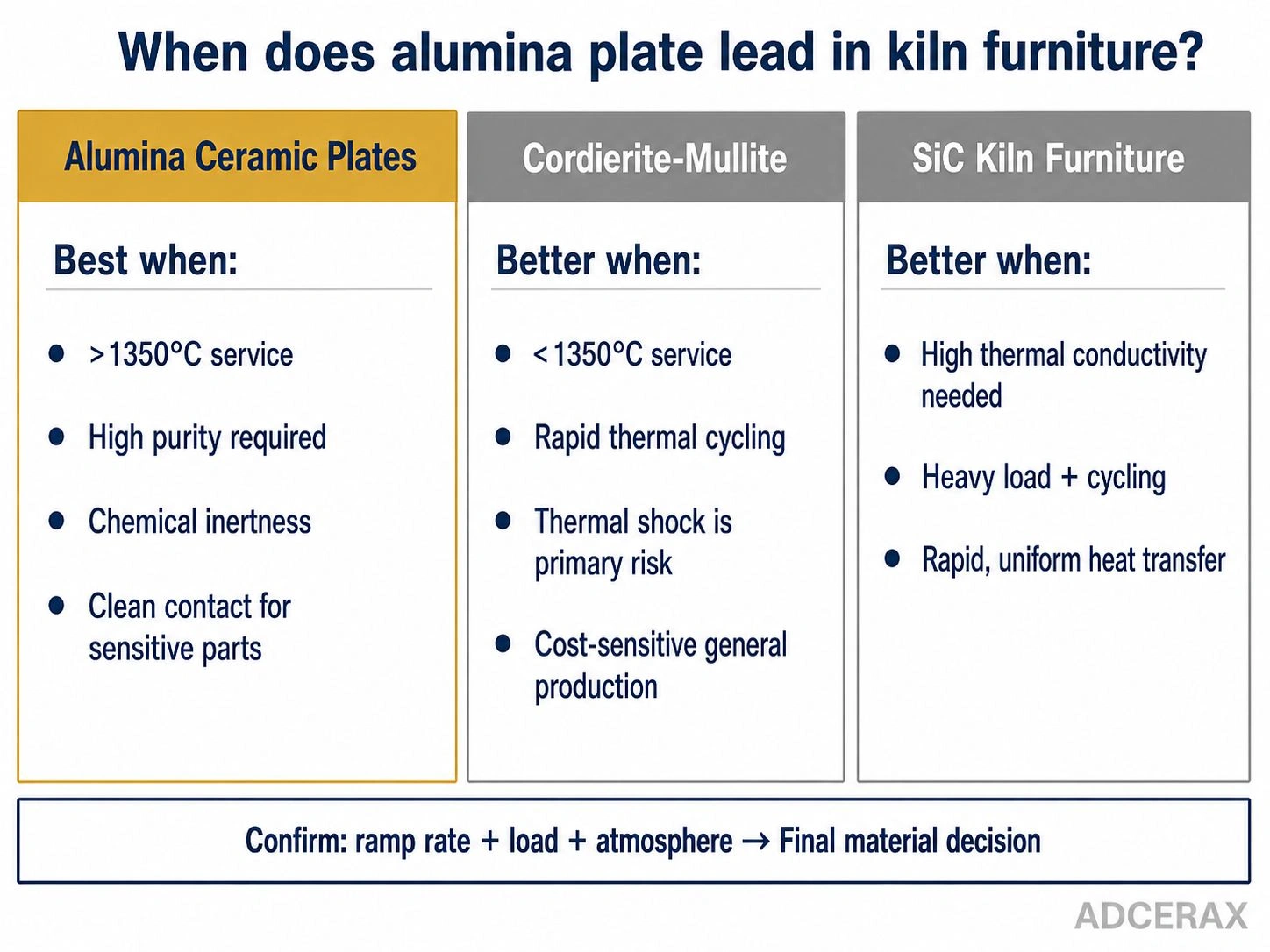
Alumina plates are the strongest kiln furniture candidate when purity, temperature, and surface chemistry matter — cordierite-mullite leads when rapid thermal cycling at moderate temperature governs.
Specifications That Control Alumina Kiln Furniture Performance
Selecting alumina as the material family resolves only the first part of the kiln furniture decision. The specifications that determine whether the plate performs as intended across a full firing campaign are purity grade, thickness, flatness, load rating, support span, surface finish, firing atmosphere, and thermal cycle. Misjudging any one of these converts a correctly specified material into an incorrectly specified part. ADCERAX's custom format range — thicknesses from 0.1 to 50 mm, plates up to 1000 × 1000 mm — confirms that large-area kiln furniture requires drawing review and engineering specification rather than stock selection. Dense alumina setter plate references specifically emphasise sag resistance in both oxidising and reducing atmospheres at continuous high-temperature service, making load distribution and support layout central to any setter plate specification.
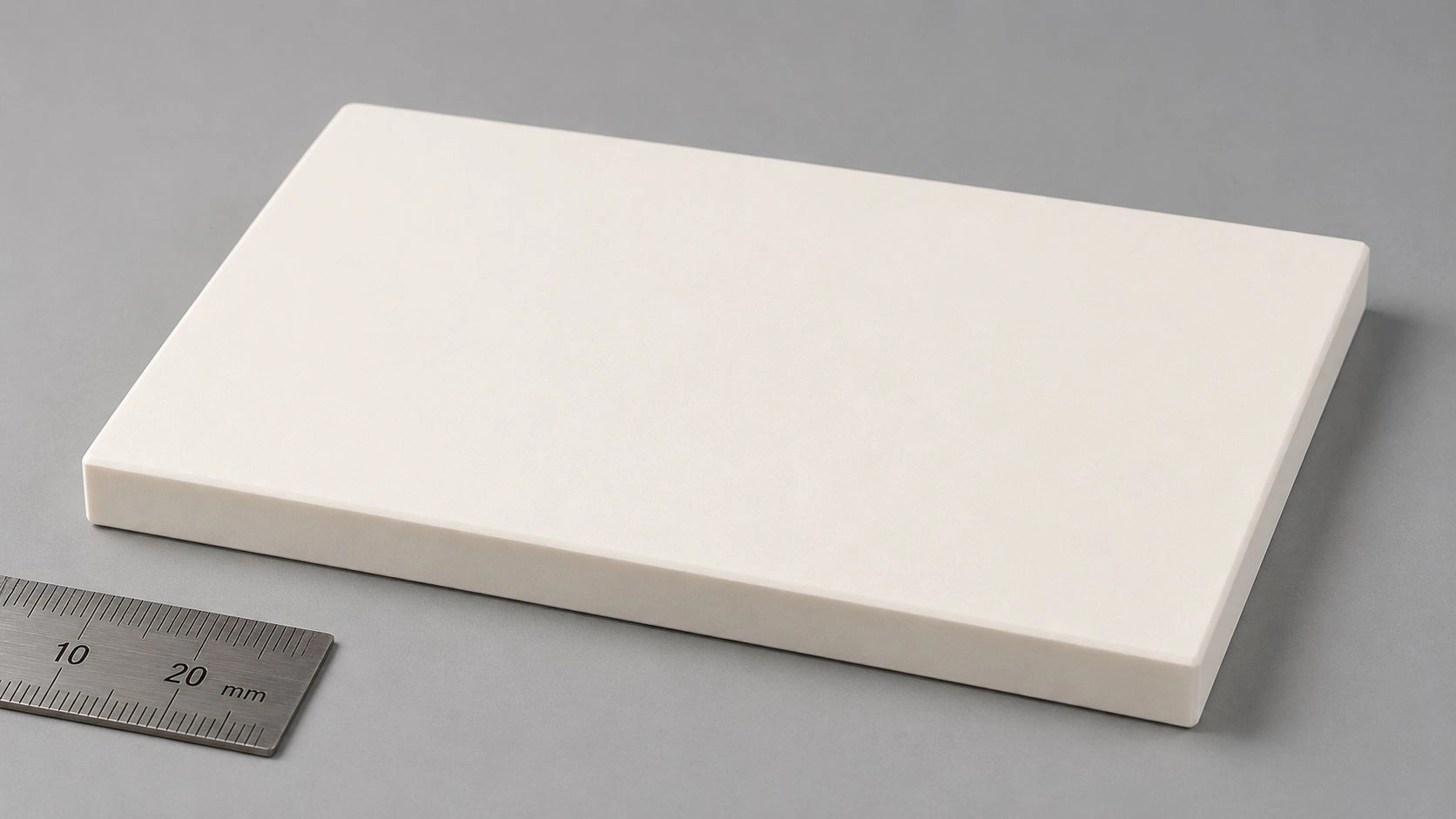
Flatness, surface finish, and edge condition are the setter plate specifications that most directly determine whether the fired product inherits defects from the kiln furniture — not the maximum-temperature rating.
Alumina purity: 96%, 99%, 99.5%, and 99.7%
Purity is the specification that most directly controls contamination risk and high-temperature chemical stability. A 96% Al₂O₃ plate contains glass-phase binders that soften at elevated temperature and may react with sensitive fired parts. A 99.7% Al₂O₃ plate minimises glass phase, extends the practical service temperature ceiling, and reduces surface reactivity with oxide powders, electronic ceramics, and other contamination-sensitive products. The choice between 96% and 99%+ should be driven by the fired product's sensitivity, the firing temperature, and the atmosphere rather than by a general preference for higher purity.
Thickness, load, and sag resistance
Thickness determines bending stiffness and sag resistance at temperature. Alumina retains substantial mechanical strength at high temperature compared with lower-purity refractory materials, but a thin plate spanning a long unsupported distance will still deflect under load. The practical design check for setter plates and hearth plates is the span-to-thickness ratio under the actual product load at the peak firing temperature — not room-temperature bending strength. A specification review for alumina setter plates used in electronic ceramic multilayer capacitor sintering finds that span-to-thickness ratio and product stacking weight together determine the useful firing-campaign length before the first measurable plate deformation occurs.
Flatness: the setter plate specification that transfers directly to fired product quality
Plate flatness controls whether the fired product inherits dimensional distortion from the support surface. A warped setter plate will allow fired parts to shift, crack, or deform non-uniformly during sintering. For technical ceramic components with dimensional tolerances tighter than ±0.2 mm, setter plate flatness becomes a primary quality control parameter, not an aesthetic specification. Ground or lapped alumina plates offer tighter flatness than as-fired surfaces, and the choice between as-fired and ground finish should be explicit in the RFQ.
Atmosphere and surface finish
Firing atmosphere controls which alumina purity grade retains surface inertness. In reducing or hydrogen atmospheres, glass-phase binders in lower-purity alumina grades may be more reactive than in oxidising conditions, which can increase the argument for higher purity. In oxidising atmospheres, surface finish determines whether fired parts release cleanly from the setter plate surface or adhere due to sintering-induced bonding. As-fired surfaces are adequate for many applications; lightly ground surfaces are appropriate where sticking risk or surface transfer marks would affect product acceptance.
The following table consolidates critical specifications into an engineering reference. Values are indicative; verify against supplier-specific grade, drawing, firing schedule, and load testing.
| Specification | What It Controls | Wrong-Spec Risk | RFQ Requirement |
|---|---|---|---|
| Alumina purity (96–99.7% Al₂O₃) | Contamination, chemical stability, temperature ceiling | Surface reaction or product contamination | Specify grade; default to 99%+ for sensitive products |
| Thickness | Bending stiffness, sag resistance, thermal mass | Sagging, cracking, or excessive gradient | Thickness + tolerance; review at peak temp |
| Flatness | Product support quality, distortion transfer | Warped fired product, uneven loading | Flatness value and reference surface |
| Surface finish | Sticking, contact marks, product release | Product adherence or surface defect transfer | As-fired / ground / lapped |
| Support span | Bending moment, deflection, long-term sag | Plate deformation or fracture at load | Support layout and unsupported span |
| Firing atmosphere | Chemical stability and surface reactivity | Purity degradation or reactive surface | Oxidising / reducing / inert / hydrogen |
| Ramp and cooling rate | Thermal shock risk | Cracking during heating or cooling | °C/min for ramp and cool, cycle frequency |
| Edge chamfer/radius | Chipping, stress concentration at edges | Early edge failure and handling damage | Chamfer or radius dimension |
Values indicative; verify against supplier-specific grade data, load testing, atmosphere compatibility, and applicable standards including ASTM C1161 (flexural strength) and ASTM C1525 (thermal shock resistance).
Common Failure Modes in Alumina Setter Plates and Kiln Furniture
Most alumina kiln furniture failures can be traced to one of three root causes: the material specification does not match the operating condition, the geometry or support design does not match the load, or the firing schedule does not account for the thermal mass and expansion characteristics of the alumina plate. Corundum setter plate sources confirm that high-alumina and corundum plates offer high-temperature strength, corrosion resistance, wear resistance, and small deformation above 1650°C — but also identify lower thermal-shock stability as a characteristic constraint. This is not a product defect; it is a material property that must be reflected in the ramp rate and support design.
The causal chain for the three dominant failure patterns is worth stating explicitly, because the wrong diagnosis leads to the wrong specification change:
Sagging and warping — an unsupported plate span exceeds the bending stiffness available at peak firing temperature → the plate deflects under product load → the fired parts inherit the distortion and the plate requires replacement. The fix is a thicker plate, a closer support grid, or a reduced product load per plate — not a higher purity grade.
Thermal shock cracking — rapid heating or cooling creates a transient temperature gradient across the plate thickness → the thermal stress exceeds the alumina's modulus of rupture at that temperature → a crack initiates at the cooler surface or a stress concentration at an edge chip. The fix is a slower ramp rate, a thinner plate section to reduce the gradient, or an edge chamfer to remove the initiation site — not substituting a nominally stronger plate of the same geometry.
Surface sticking and contamination — a reactive glass phase in the plate surface bonds to the sintered product during firing → the product requires mechanical separation and shows surface marks or compositional transfer. The fix is a higher-purity plate grade, a lapped surface, or a release layer — not increasing plate thickness.
Misdiagnosing support design failures as material failures
The error pattern most likely to produce repeated premature replacement is attributing plate failure to material quality when the actual cause is the support spacing or load distribution. A specification review of alumina setter plates in technical ceramic batch-sintering furnaces shows that most cracking initiates at the unsupported midspan, not at an edge or contact point — which confirms that span, not material grade, is the controlling variable. Before reordering to a higher alumina purity or greater thickness, the load map and support grid should be confirmed against the plate's stiffness at peak temperature.
What to Include in an RFQ for Alumina Ceramic Kiln Furniture Plates
A complete RFQ converts this selection logic into supplier-actionable data. ADCERAX's industrial ceramic plates range and custom alumina plate options support a broad specification envelope — but the supplier's ability to confirm material route, grinding sequence, and firing-schedule compatibility depends on the RFQ containing the operating condition, not only the part dimensions.
The following checklist covers the fields that most frequently require clarification in kiln furniture plate procurement.
- Plate role: setter plate, hearth plate, separator, insulation board, or structural support — determines governing failure mode.
- Alumina purity: 96%, 99%, 99.5%, or 99.7% Al₂O₃; driven by fired product contamination sensitivity and firing atmosphere.
- Dimensions: length × width × thickness with per-zone tolerance; flatness specification and reference surface.
- Surface finish: as-fired, ground, or lapped; specify contact face separately from non-contact back.
- Edge chamfer or radius: required for plates in thermal cycling or load-bearing service to reduce chip initiation.
- Maximum firing temperature and continuous service temperature: confirms material and purity window.
- Heating and cooling ramp rate: rate in °C/min; defines thermal shock requirement and allowable plate section thickness.
- Thermal cycle frequency: number of cycles per day or week; drives total accumulated thermal fatigue.
- Load per plate and contact area: product weight distributed over the plate; combine with unsupported span.
- Support layout: support point positions and unsupported span; the single most critical mechanical input for setter and hearth plates.
- Firing atmosphere: oxidising, reducing, inert, hydrogen, or reactive vapour; controls surface reactivity at grade.
- Fired product material and contamination sensitivity: confirms whether as-fired or high-purity surface is required.
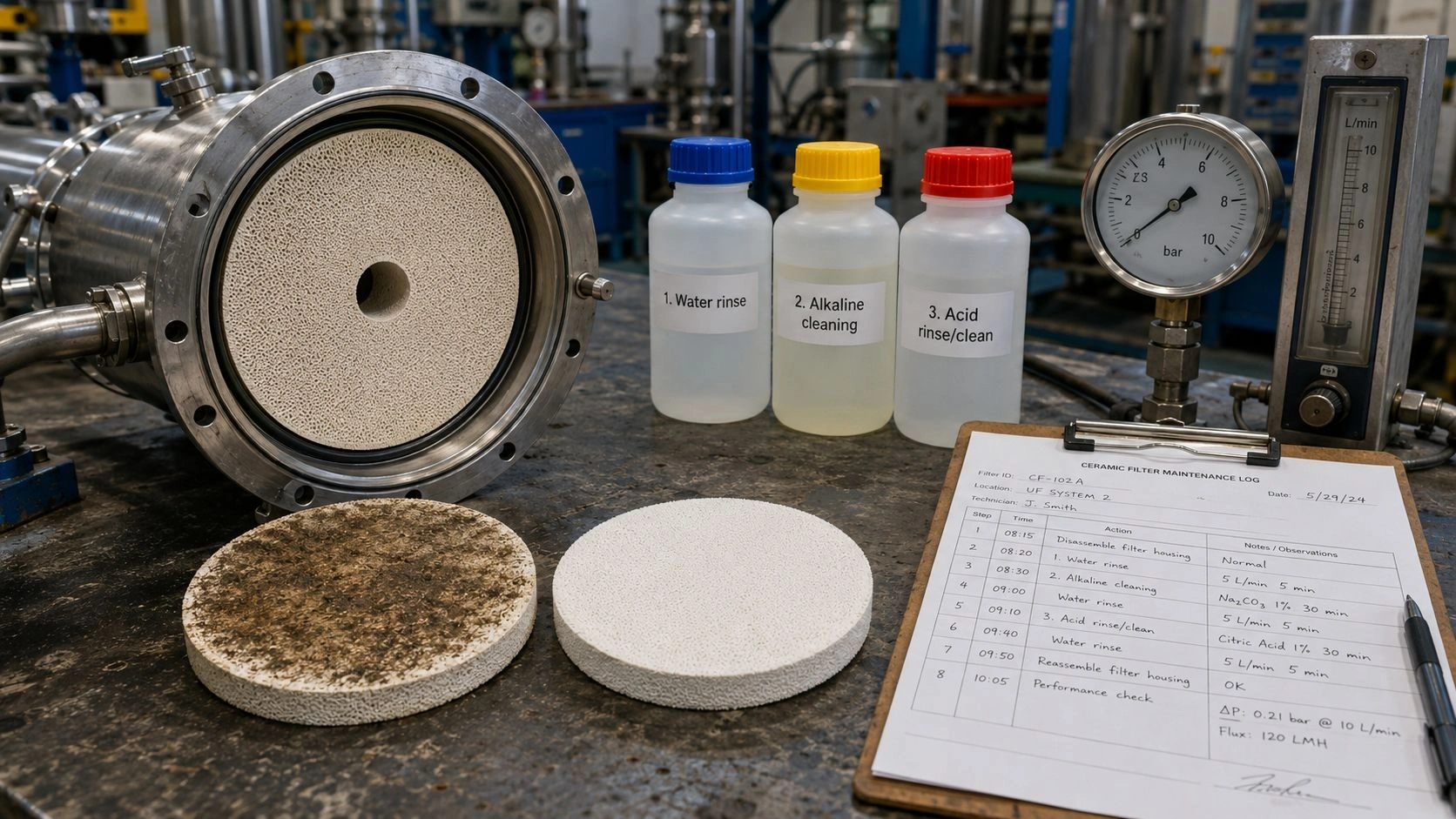
- Cleaning method and reuse expectation: wet/dry cleaning, number of firing cycles before replacement, and whether grinding between campaigns is acceptable.
- Inspection data required: dimensional inspection, flatness measurement, material certificate, and purity verification.
The two most consistently missing inputs in ceramic kiln furniture RFQs are ramp rate and support layout. Both are listed as production process parameters, not ceramic plate specifications — but they are the direct inputs that determine whether a specified plate thickness and alumina grade will survive one firing campaign or fifty.
Conclusion
Alumina ceramic plates are the correct kiln furniture choice when the firing process demands high-temperature support, chemical neutrality at the plate surface, clean contact with sensitive fired parts, and dimensional stability across repeated cycles. They are not universally superior to cordierite-mullite at moderate temperatures and fast ramp cycles, and they are not automatically more reliable than SiC where high thermal conductivity and load cycling matter. The selection is correct when the application conditions match the material's actual performance window.
The failure modes that most frequently cut short an alumina kiln furniture campaign are not material weaknesses — they are geometry and process mismatches. Sagging comes from undersized thickness relative to unsupported span and product load. Thermal cracking comes from a ramp rate the plate cross-section cannot absorb. Surface sticking comes from an inadequate purity grade for the fired product's chemistry. All three are solvable at the specification stage.
Ready to specify alumina ceramic plates for your kiln furniture application? Share your firing temperature, atmosphere, ramp rate, plate dimensions, load, and support layout with ADCERAX's engineering team. We will confirm the alumina purity, thickness, flatness class, and surface finish — and identify whether a standard format or custom-machined plate fits your firing campaign.
FAQ
What are alumina ceramic plates used for in kiln furniture?
Alumina ceramic plates are used as setter plates, hearth plates, separator plates, insulation boards, and structural support plates in high-temperature kilns and furnaces. Their primary value in kiln furniture is the combination of chemical inertness, dimensional stability at temperature, sag resistance, and clean contact surfaces that prevent contamination of sensitive fired parts. Applications include technical ceramics sintering, electronic ceramics processing, powder-metal heat treatment, and laboratory thermal processing.
Are alumina setter plates better than cordierite-mullite kiln shelves?
It depends on the firing condition. Alumina setter plates are better suited to higher temperatures, high-purity applications, chemical environments where surface inertness matters, and processes where contamination of fired parts is a primary concern. Cordierite-mullite kiln furniture is often better suited to moderate-temperature applications — generally below 1350°C — where low thermal expansion and thermal shock resistance are more valuable than high purity or temperature ceiling. IPS Ceramics identifies cordierite-mullite as balancing low expansion for thermal shock resistance with mullite's high-temperature strength.
What alumina purity is suitable for kiln furniture?
The correct purity depends on the fired product's contamination sensitivity and the firing temperature. A 96% Al₂O₃ plate is adequate for many high-temperature industrial support roles. A 99% or 99.5% Al₂O₃ plate is appropriate for technical ceramics and electronic ceramics where glass-phase impurities would transfer to the product surface. A 99.7% Al₂O₃ plate minimises glass-phase content and is suitable for the most contamination-sensitive or highest-temperature applications. ADCERAX alumina ceramic plates are available in all four purity grades with custom machining options.
How do alumina plates resist sagging and warping at high temperature?
Sag resistance depends on plate thickness, support span, product load, and operating temperature — not on purity grade alone. A thicker plate with closely spaced supports distributes bending load more effectively than a thinner plate spanning a long unsupported distance. High-purity alumina retains greater mechanical strength at temperature than lower-purity compositions, which extends the safe operating range but does not eliminate the need for adequate thickness and support spacing. Corundum setter plate data confirms small deformation above 1650°C is achievable, but the support geometry and load distribution are the primary controls for warping in service.
What thickness and flatness should be specified for alumina kiln furniture?
Thickness is driven by unsupported span, product load at peak temperature, and firing schedule. Setter plates for technical ceramic components commonly fall in the 5–15 mm range; hearth plates for heavier loads may extend to 20 mm or beyond. Flatness is driven by the dimensional tolerance of the fired product — tight-tolerance technical ceramic components typically require ground or lapped setter plates with flatness values of ±0.1 mm or better on the contact face. As-fired flatness is adequate for applications where product dimensional tolerance is less critical."