Choose SSiC when purity, absence of residual metallic silicon, or media that may attack free silicon controls the decision. Consider RBSiC, commonly called SiSiC, when near-net-shape manufacture, large geometry, and cost matter, provided the grade fits the atmosphere and contact media. Do not approve either from a generic maximum temperature. Specify grade, cycle, gas, contact material, leak requirement, geometry, unsupported length, mounting, and response target.
What Do SSiC and RBSiC Actually Mean?
SSiC is pressureless-sintered silicon carbide. Fine SiC powder is shaped and densified with sintering additions. It lacks the residual metallic-silicon phase characteristic of reaction bonding, although additives and microstructure remain grade-specific.
RBSiC is reaction-bonded silicon carbide. Molten silicon infiltrates a SiC-and-carbon preform, reacts with carbon to create more SiC, and fills remaining space. The result is a dense SiC–Si composite. RBSiC and SiSiC commonly identify this family, but the supplier must declare its grade and residual-silicon range.
Do not treat NBSiC or recrystallized SiC as synonyms. NBSiC uses a silicon-nitride bond; recrystallized SiC is normally open-porous. Their permeability and manufacturing constraints differ. CeramTec’s SiC material overview distinguishes SSiC from silicon-infiltrated SiSiC and identifies SiSiC for large, complex components.
| Criterion | SSiC | RBSiC / SiSiC | Selection consequence |
|---|---|---|---|
| Manufacturing route | Pressureless sintering | Silicon infiltration of SiC/carbon preform | Different compositions and geometry limits |
| Residual metallic silicon | No reaction-bonded residual phase | Present; grade-dependent | Important for chemistry and contamination |
| Firing shrinkage | Must be controlled | Low during reaction bonding | RBSiC favors near-net-shape production |
| Purity direction | Higher-SiC route | SiC–Si composite | SSiC starts stronger for strict limits |
| Large or complex tubes | Feasibility and yield review | Manufacturing advantage | Compare tooling and qualified total cost |
| Gas tightness | Possible for a qualified dense grade | Possible for a qualified dense grade | Specify a leak test, not an acronym |
| Thermal response | Material plus complete geometry | Material plus complete geometry | Test the installed assembly |
Require the quotation to state route, grade, SiC and residual-silicon ranges, additives, density, porosity, and test conditions. “Dense SiC” does not close the specification.
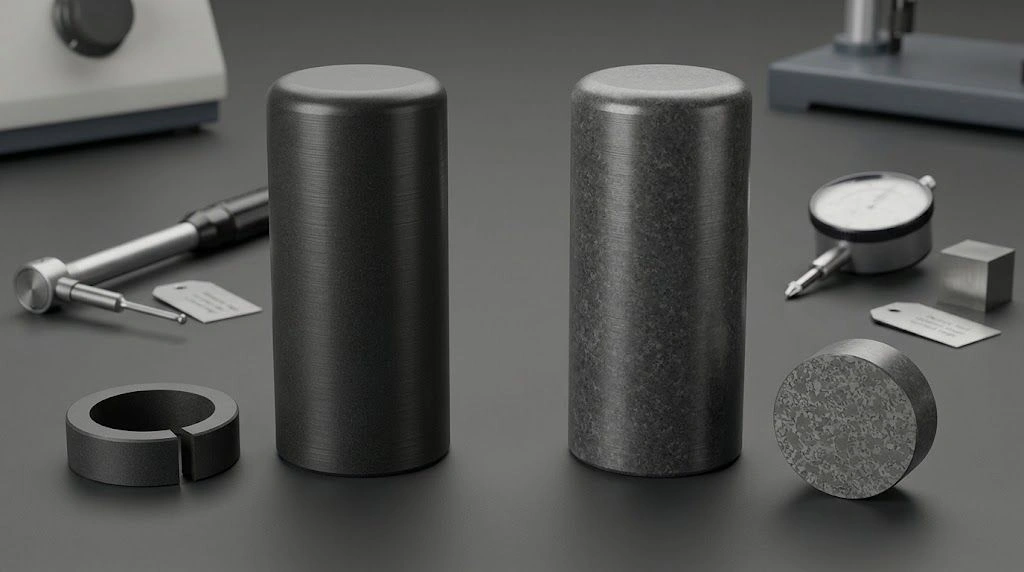
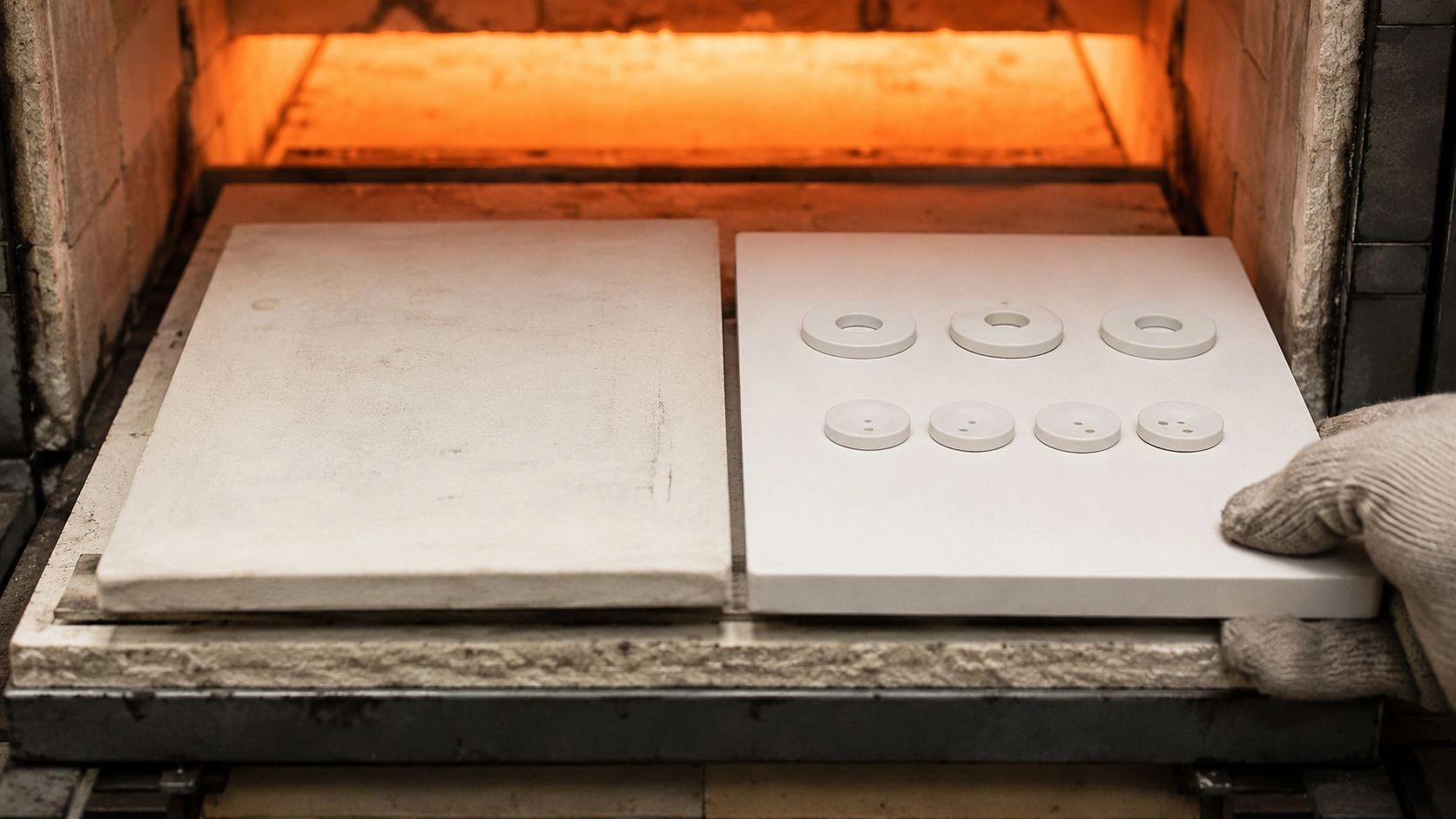
The physical comparison connects two similar-looking tubes to different material routes, residual phases, and inspection evidence.
When Does Atmosphere or Residual Silicon Change the Choice?
Residual silicon is the main compositional boundary, not a universal rejection rule. Start with SSiC when silicon contamination is restricted or the process may attack that phase. RBSiC remains practical for compatible furnace gases and shapes that benefit from low-shrinkage manufacture.
A peer-reviewed study of one sintered and one reaction-bonded SiC found both passive in aqueous HCl, HNO₃, and H₂SO₄ through a silica film; HF attacked both and removed residual silicon from the reaction-bonded specimens. The Aston University research record supports those conditions, not every acid, concentration, temperature, or grade.
| Service condition | First route | Decision flip or hold point | Evidence required |
|---|---|---|---|
| Strict purity or silicon limit | SSiC | Review its additives too | Grade composition and acceptance limit |
| Gas known to be compatible with residual Si | Compare both | Geometry and cost may favor RBSiC | Exact grade and atmosphere data |
| Large, long, or complex closed-end tube | RBSiC feasibility review | SSiC remains possible if manufacturable | Tooling, wall, straightness, and yield review |
| Media suspected to attack free silicon | SSiC | Hold both if SiC itself may react | Representative exposure test |
| Oxidizing, reducing, inert, or vacuum duty | Grade-specific review | Gas composition, pressure, and time can reverse choice | Supplier data for the exact environment |
| Molten metal, slag, salt, or flux contact | Hold selection | Acronym alone cannot prove compatibility | Chemistry-specific immersion test |
| Gas-tight sensor isolation | Qualified dense grade | Reject unverified “zero porosity” claims | Gas, pressure difference, leak method, and limit |
| Severe thermal cycling | Test both as actual tubes | Geometry may dominate material ranking | Representative installed cycle |
Do not transfer a supplier’s maximum temperature to another grade or installation. It may describe short exposure, unloaded specimens, one atmosphere, a specific residual-silicon fraction, or no contact with condensate or melt. Review silicon carbide protection tubes by actual duty and drawing, not one catalogue number.
How Do Tube Geometry and Installation Affect Response and Failure?
A protection tube is part of a measuring assembly. Response depends on conductivity, wall and tip thickness, bore, sensor clearance, junction location, insertion depth, deposits, flow, and heat transfer. Endress+Hauser guidance likewise ties response to sensor and thermowell construction, process conditions, and location.
| Design change | Likely benefit | Possible penalty |
|---|---|---|
| Reduce wall or tip thickness | Faster thermal response | Lower impact and bending margin |
| Increase thickness | More handling margin | Greater lag and thermal mass |
| Reduce sensor-to-bore gap | Faster coupling | Assembly and expansion-interference risk |
| Increase insertion depth | Better hot-zone representation | Higher cantilever load |
| Add an intermediate support | Lower bending stress | New constraint and gradient location |
| Rigidly clamp the ceramic | Stable initial position | Local tensile stress during heating |
A long horizontal tube acts as a cantilever; mass, deposits, vibration, flow, and contact add bending load. At the furnace wall, a steep gradient may coincide with a rigid clamp. A stronger grade cannot correct poor alignment or an unsupported span.
Control open or closed end, tip profile and thickness, OD, ID, minimum wall, total and insertion length, straightness, sensor clearance, junction position, supports, orientation, and each flange, groove, shoulder, or sealing face. For other geometry options, review custom silicon carbide tubes.
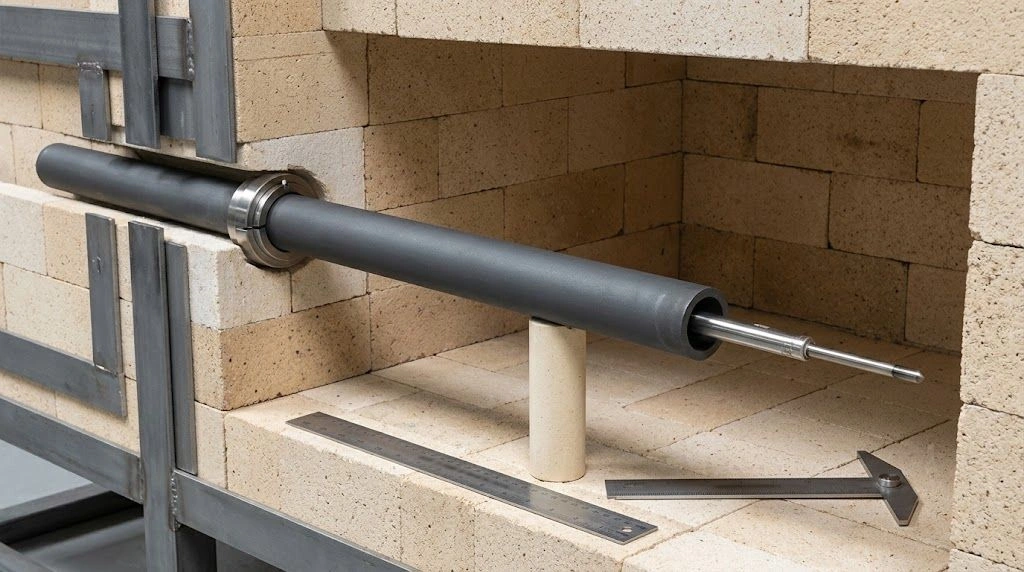
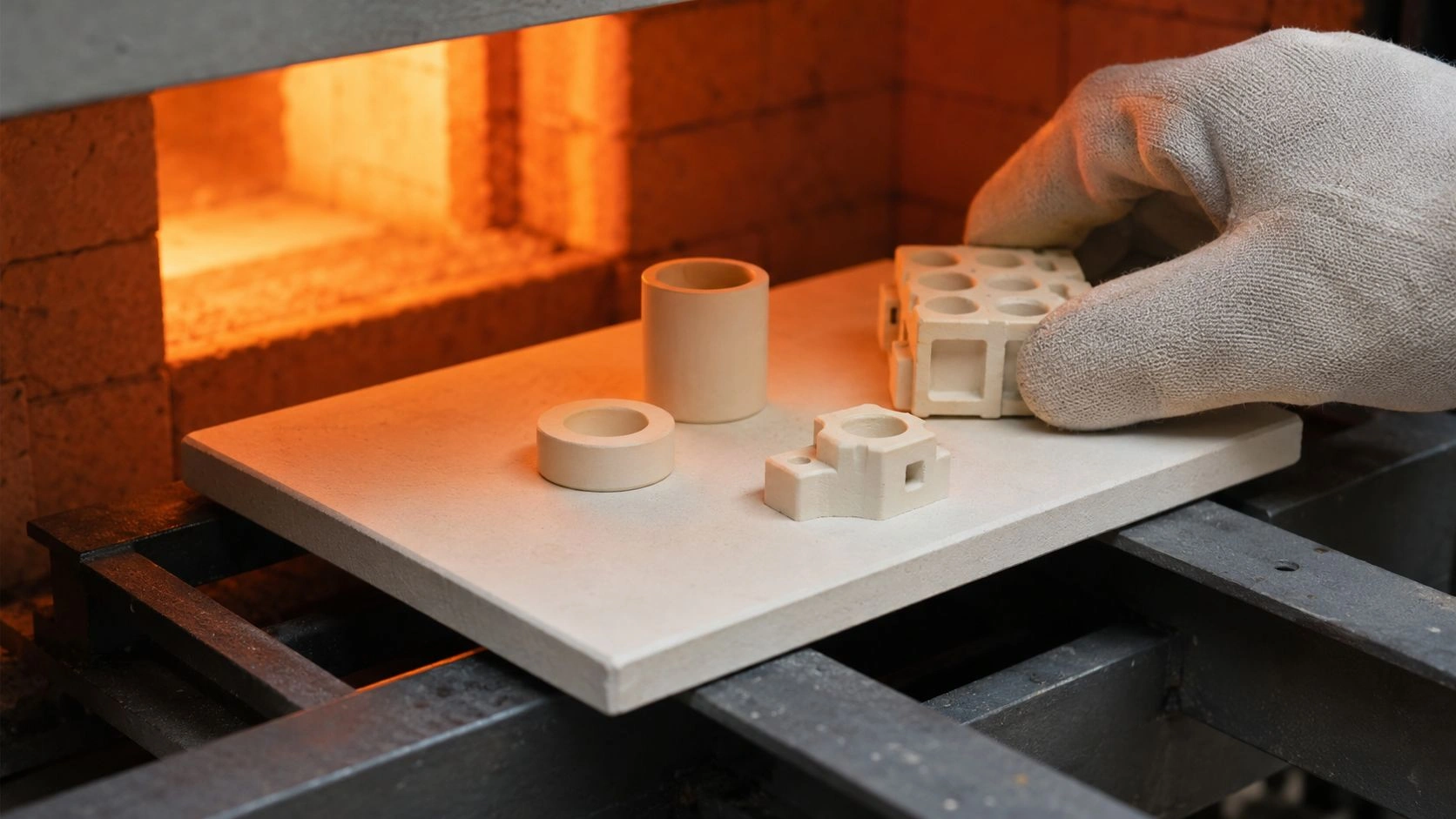
The cold installation shows how insertion length, support, clamping, and sensor clearance can outweigh a simple material ranking.
What Should Be Diagnosed Before Changing the SiC Grade?
Changing RBSiC to SSiC will not resolve every cracked, leaking, or slow tube. Preserve residue and record the fracture position before cleaning the failed part.
| Observation | Contributors to investigate | Useful evidence |
|---|---|---|
| Circumferential crack near furnace wall | Axial gradient, rigid mounting, local cooling | Crack location, temperature profile, mounting photo |
| Crack at flange or shoulder | Sharp transition, clamp load, misalignment | Drawing, radius, fracture origin, assembly method |
| Horizontal mid-span fracture | Cantilever bending, deposits, vibration | Unsupported length, orientation, deposit mass |
| Broken closed end | Impact, rapid insertion, flame impingement | Tip photo, startup sequence, flow direction |
| Tube becomes permeable | Porosity, corrosion, oxidation, or cracking | Leak test and cross-section |
| Slow temperature response | Thick wall, large gap, shallow insertion, buildup | Defined step-response comparison |
| Local surface recession | Condensate, slag, melt, or residual-Si attack | Deposit analysis and representative exposure |
ASTM C1525-18(2024) compares thermal-shock resistance using water quenching and retained flexural strength. Its scope excludes steady gradients, joined-body expansion mismatch, repeated shocks, and direct component qualification. A furnace-wall crack therefore needs installation evidence, not only a coupon property.
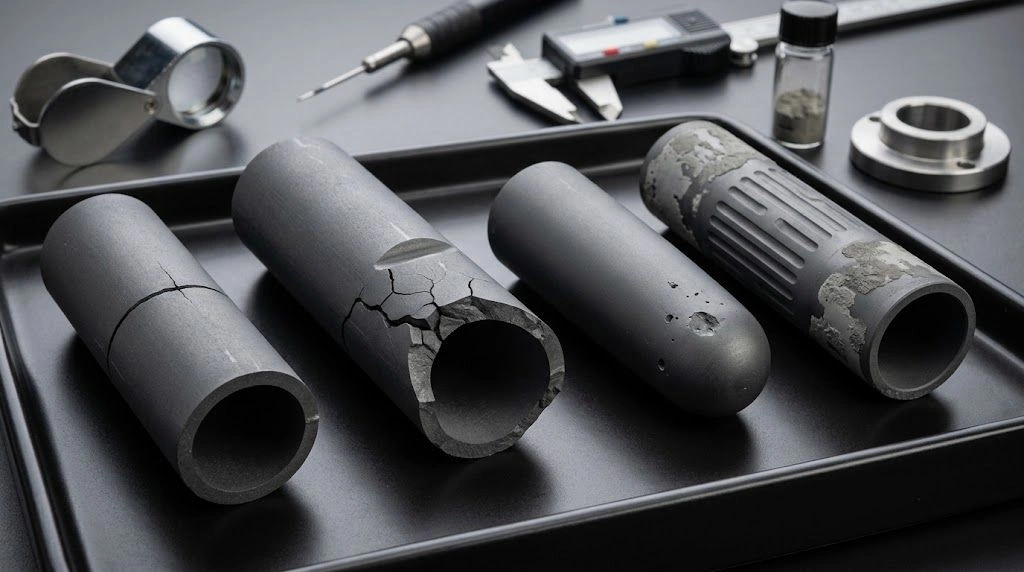
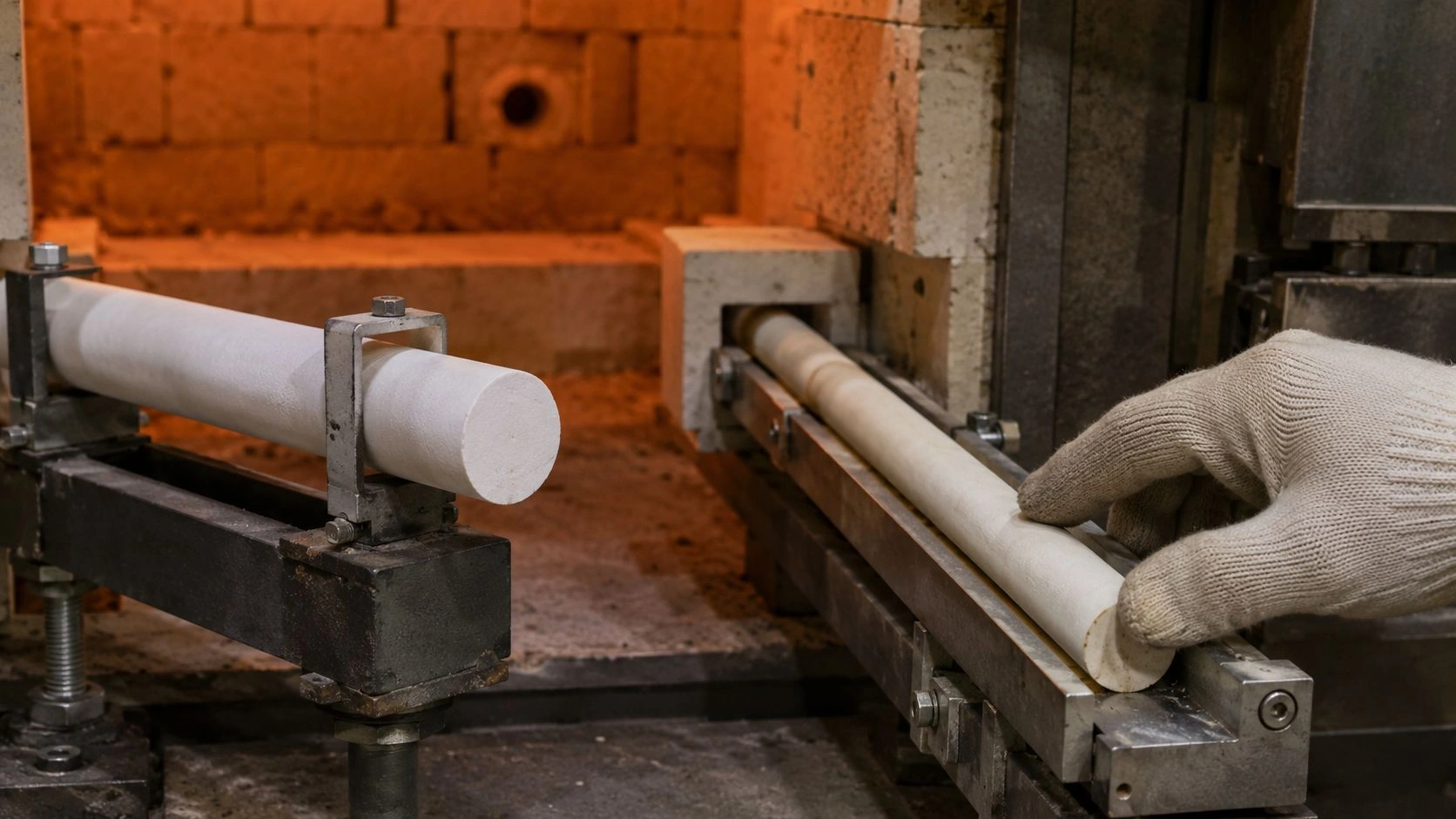
Representative failed parts help separate chemistry, thermal gradients, cantilever loading, and impact before a grade change.
What Belongs in the Qualification and RFQ Package?
Combine the drawing with service conditions. State normal, peak, startup, and shutdown temperatures; ramp, dwell, operating mode, and atmosphere during each phase. Identify flame, dust, vapor, condensate, melt, slag, salt, or flux contact.
| RFQ category | Required information |
|---|---|
| Function | Thermocouple protection, gas sampling, heater sheath, or other duty |
| Material | Current grade; SSiC, RBSiC/SiSiC, or recommendation authority |
| Exposure | Temperature cycle, named gases, pressure, direct-contact media |
| Geometry | OD, ID, wall, tip, length, insertion, straightness, tolerances |
| Installation | Orientation, support positions, clamp, vibration, thermal gradient |
| Sensor | Type, sheath diameter, junction location, internal clearance |
| Performance | Response-test basis, pressure difference, allowable leak rate |
| Quality | Grade declaration, residual Si, dimensions, porosity, traceability |
| Commercial | Prototype quantity, annual demand, packaging, delivery target |
Request an approved drawing, material declaration, critical-dimension report, visual criteria, traceability, and leak result when isolation matters. ISO 18754:2020 covers density and apparent porosity of fine ceramics. ISO 20509:2003 assesses mass, dimensional, and subsequent-strength changes after high-temperature oxidation. Neither predicts tube life.
Qualify the assembly: inspect and cold-fit it, reproduce the cycle and atmosphere, use representative contact media, compare response under a defined temperature step, and reinspect for cracks, leakage, recession, deposits, and contamination. Release production against agreed evidence.
Frequently Asked Questions
Is RBSiC the same material as SiSiC?
The names commonly describe the same reaction-bonded, silicon-infiltrated SiC family. It contains SiC plus residual metallic silicon. Because the residual-silicon fraction and microstructure vary, specify the supplier’s commercial grade, composition range, density, and porosity instead of relying on either acronym alone.
Is SSiC always better than RBSiC for protection tubes?
No. SSiC is a stronger starting point for strict purity or media that may attack residual silicon. RBSiC can be practical for large, long, or complex tubes because its route supports low-shrinkage manufacture. Chemistry, atmosphere, geometry, qualification burden, and cost decide the result.
Can both materials make gas-tight protection tubes?
Qualified dense grades of either family may be suitable, but density and gas tightness are not interchangeable specifications. State the gas, temperature, pressure difference, test method, fixture, and allowable leak rate. Apparent-porosity data alone cannot prove the required assembled sealing performance.
Which grade gives the faster sensor response?
Material conductivity contributes, but wall and tip thickness, tube diameter, internal gap, junction location, insertion depth, deposits, and process flow also matter. Compare the complete proposed assembly under a defined temperature step and report the chosen response metric rather than ranking acronyms alone.
Can SSiC or RBSiC be immersed in molten aluminum?
Do not approve direct immersion from the material acronym. Compatibility depends on alloying elements, melt temperature, flux, oxide films, exposure time, thermal cycling, and the exact tube grade. Use a representative immersion test and evaluate alternative qualified materials if the evidence is inadequate.
Why does a SiC tube crack near the furnace wall?
The transition can combine a steep axial temperature gradient with rigid clamping, misalignment, or local cooling. Record the crack position, mounting arrangement, ramp rate, furnace-wall temperature profile, insertion depth, and unsupported length before changing the material grade or increasing wall thickness.
What should be sent when replacing an obsolete tube?
Send the old tube or clear photographs, a dimensioned drawing, any material markings, failure location, residue evidence, complete temperature cycle, furnace atmosphere, contact media, orientation, insertion and support details, sensor dimensions, leak requirement, response complaint, prototype quantity, and annual demand.