A rod-specific selection framework for engineers deciding between alumina and zirconia by failure risk, operating condition, and specification requirement — not by material name alone.
Both alumina and zirconia appear on ceramic rod shortlists for good reason. They share a common identity as dense oxide ceramics, tolerate aggressive environments, and outlast most polymer and metal alternatives in the roles where ceramic rods are specified. The problem is that SERP comparisons at the material level rarely answer the rod-specific question: which geometry, temperature, contact mode, and failure risk drives one material over the other. This article resolves that question directly — working from function and failure risk to a first-pass material choice, a side-by-side property comparison, a misdiagnosis checklist, and an RFQ specification guide.
Choose alumina rods when the priority is high-temperature insulation, electrical resistance, chemical stability, and stable support at a practical cost across a wide range of furnace and industrial applications. Choose zirconia rods when the priority is higher fracture toughness, impact resistance, precision wear contact, bending strength, or lower chipping risk under mechanical loading. The decision should be based on the rod's function, operating temperature, load type, contact condition, tolerance requirement, and dominant failure risk — not on material name alone.
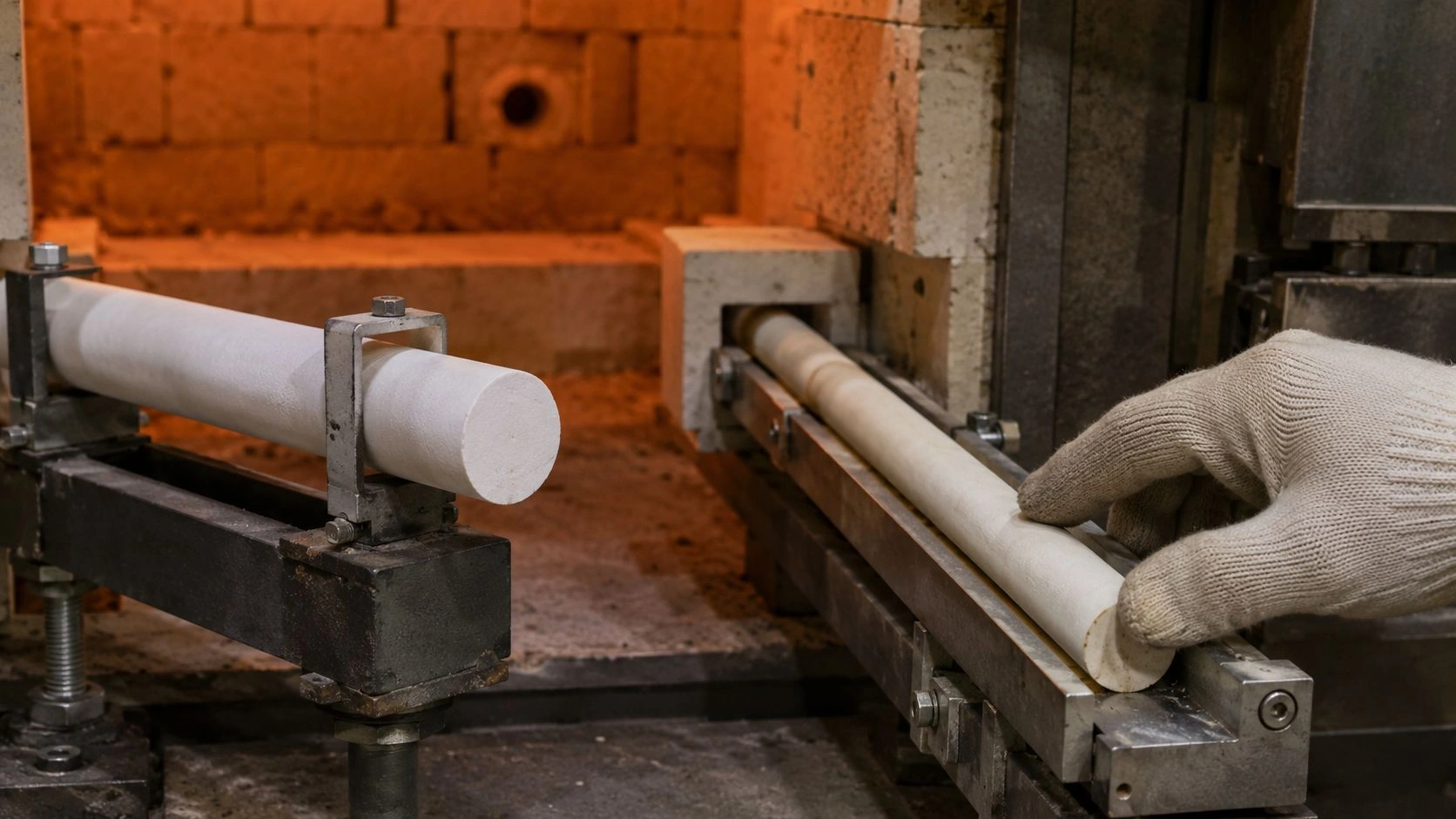
In furnace fixture and wear-contact roles, alumina and zirconia rods serve fundamentally different engineering priorities — choosing by function and failure risk produces better outcomes than choosing by material ranking.
What Is the Core Difference Between Alumina Rods and Zirconia Rods?
Alumina rods and zirconia rods are both dense oxide ceramic components, but their engineering strengths diverge in ways that matter when the rod form factor introduces bending stress, edge exposure, or contact loading. Alumina rods are selected when high-temperature stability, electrical insulation, corrosion resistance, wear resistance, and stable support are the principal requirements. Zirconia rods are selected when the design is more sensitive to fracture toughness, impact resistance, chipping risk, precision wear contact, or high-strength mechanical loading. In rod form, this split is more consequential than in block or plate geometries because long, slender ceramic parts fail preferentially by bending stress, edge chipping, thermal shock, and contact wear.
Alumina rods: insulation, thermal stability, and general-purpose support
Alumina (Al₂O₃) combines electrical insulation, high-temperature stability, mechanical strength, chemical resistance, and good wear resistance in a single material family. Kyocera identifies alumina as one of the most widely used advanced ceramics, distinguished by high electrical insulation and mechanical strength. CoorsTek describes alumina as one of the most commonly used technical ceramics because of its broadly useful property profile. For rod applications, this breadth matters: a 99% alumina rod rated to 1700°C can simultaneously serve as a high-voltage standoff, a furnace support, and a wear-resistant guide — functions that would require different materials in a metal or polymer system.
Zirconia rods: fracture toughness, impact resistance, and precision wear contact
Zirconia (ZrO₂) in stabilized form — most commonly Y-TZP — achieves fracture toughness values significantly above most advanced ceramics. Precision Ceramics identifies zirconia as combining high hardness, wear and corrosion resistance, and one of the highest fracture toughness values in the ceramic category. This makes zirconia rods particularly suited to guide pins, precision alignment shafts, sliding-contact wear parts, and any rod application where chipping or impact loads would crack or chip an alumina part prematurely. The higher density and lower thermal conductivity of zirconia are secondary considerations in most rod-selection decisions, but they become relevant in motion applications and thermally managed assemblies.
Why rod geometry changes the comparison
Material handbooks compare alumina and zirconia at the monolithic coupon level — uniform stress, controlled loading, standardized test geometry. Rod applications in service add bending moments, point contacts, clamp stresses, unsupported spans, and thermal gradients that alter the failure mode completely. Flexural strength testing per ASTM C1161 gives a useful baseline for bending-loaded rods, but the actual failure threshold in service depends on rod diameter, free span, surface finish quality, mounting geometry, and whether the rod cycles thermally during operation. A thin alumina rod spanning 200 mm under lateral load may fail by bending before it reaches a wear or temperature limit; a zirconia rod in the same position may survive the same load with lower chipping risk at the contact points.
When Should Engineers Choose Alumina Rods vs Zirconia Rods?
Choose alumina rods when the application calls for a stable high-temperature insulator, furnace support, electrical standoff, heater fixture, laboratory positioning rod, or general wear-resistant support. Choose zirconia rods when the application involves sliding contact, impact risk, precision alignment, high-load guide pins, wear-critical shafts, or reduced chipping risk in mechanical contact. The practical rule is concise: alumina first for insulation and high-temperature support; zirconia first for toughness and precision wear contact. Both materials are wrong choices when the root failure driver is rod geometry, unsupported span, or surface finish — not material properties.
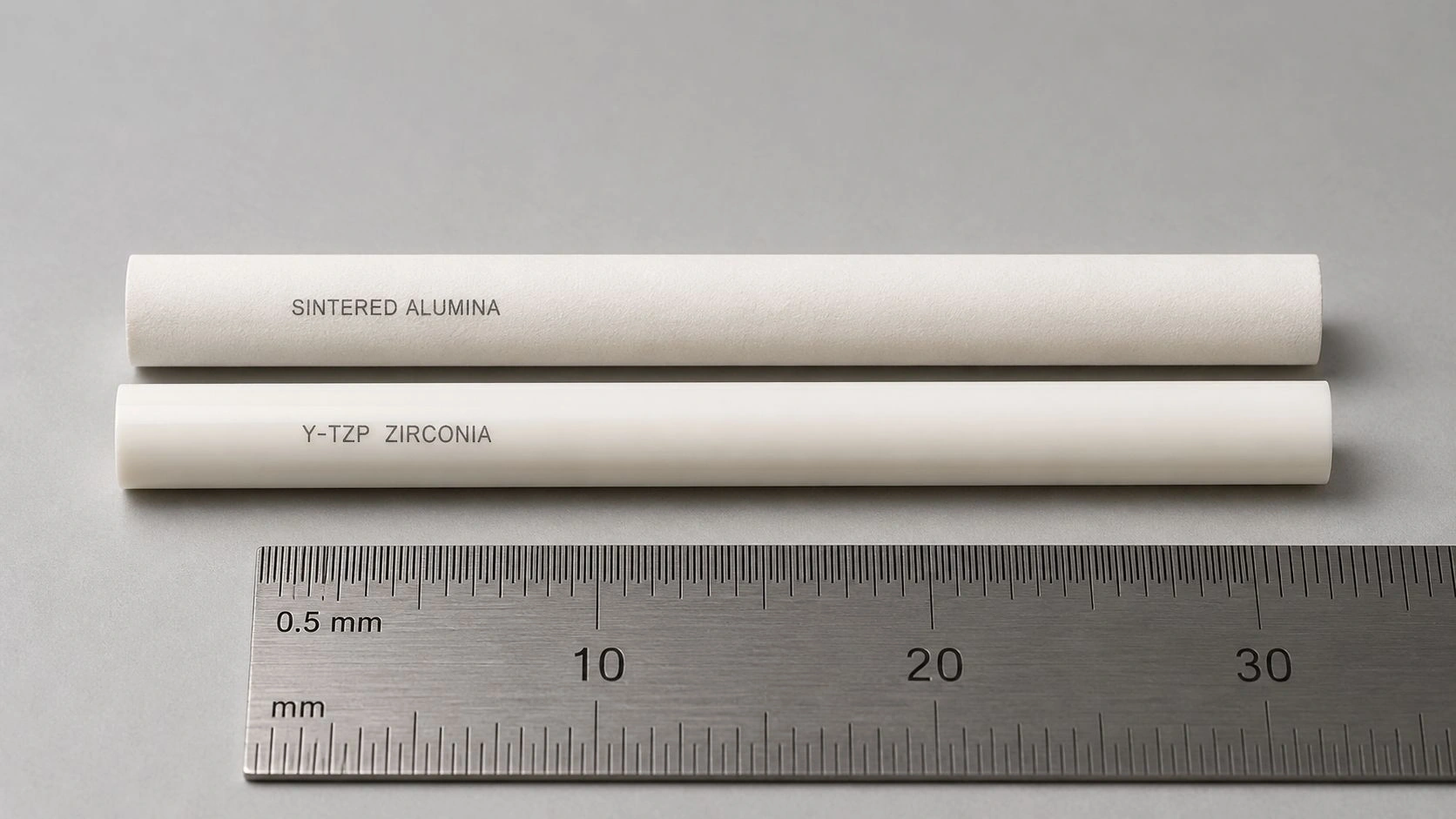
Alumina and zirconia rods occupy overlapping dimensional ranges but serve different dominant functions — alumina for insulation and high-temperature stability, zirconia for toughness and precision wear contact.
Choose alumina rods for furnace, insulation, and stable support applications
ADCERAX alumina ceramic solid rods are available in material from ≥96% Al₂O₃ with maximum service temperatures ranging from 1450°C for 96% alumina to 1730°C for 99.7% alumina, depending on grade and application conditions. This temperature range covers most furnace-support, heater-fixture, and high-temperature standoff roles where electrical insulation and thermal stability matter simultaneously. High-purity grades also deliver lower contamination risk in laboratory or clean-process environments, which matters in applications like tube furnace supports, thermocouple spacers, and precision heating assemblies.
Choose zirconia rods for high-toughness guide and wear applications
Zirconia rods in Y-TZP grade are positioned for anti-abrasion and friction environments. The Y-TZP microstructure transforms under localized stress — a mechanism that absorbs crack energy and reduces chipping relative to pure alumina under the same contact load. For guide pins, precision alignment shafts, sliding-contact pads, and high-load wear parts, this translates to longer service life and fewer replacement cycles in mechanically demanding positions. The tradeoff is cost: zirconia rod manufacturing involves higher material and processing costs than alumina, and that gap is real enough to matter when alumina already meets the functional requirement.
When ZTA rods may resolve the decision
Zirconia toughened alumina (ZTA) is a composite that adds zirconia dispersion into an alumina matrix. Kyocera identifies ZTA as combining alumina and zirconia with higher hardness and bending strength than alumina alone. ZTA is a practical candidate when the application exceeds alumina's toughness boundary but does not require the full toughness premium of pure zirconia — for example, wear parts with moderate impact exposure or guide components in applications where full zirconia is thermally incompatible.
Six-step decision guide
- Choose alumina rods when electrical insulation is the primary requirement.
- Choose alumina rods for furnace supports, heater fixtures, and high-temperature standoffs where service temperature reaches 1600°C or above.
- Choose zirconia rods when impact, edge chipping, bending stress, or toughness controls the failure risk.
- Choose zirconia rods for precision guide, sliding, and wear-contact positions where surface integrity under load matters.
- Consider ZTA rods when alumina is too brittle for the contact condition but full zirconia is more than the application requires thermally or economically.
- Confirm temperature, load, contact mode, surface finish, and rod geometry before finalizing — material name alone is not a sufficient selection basis.
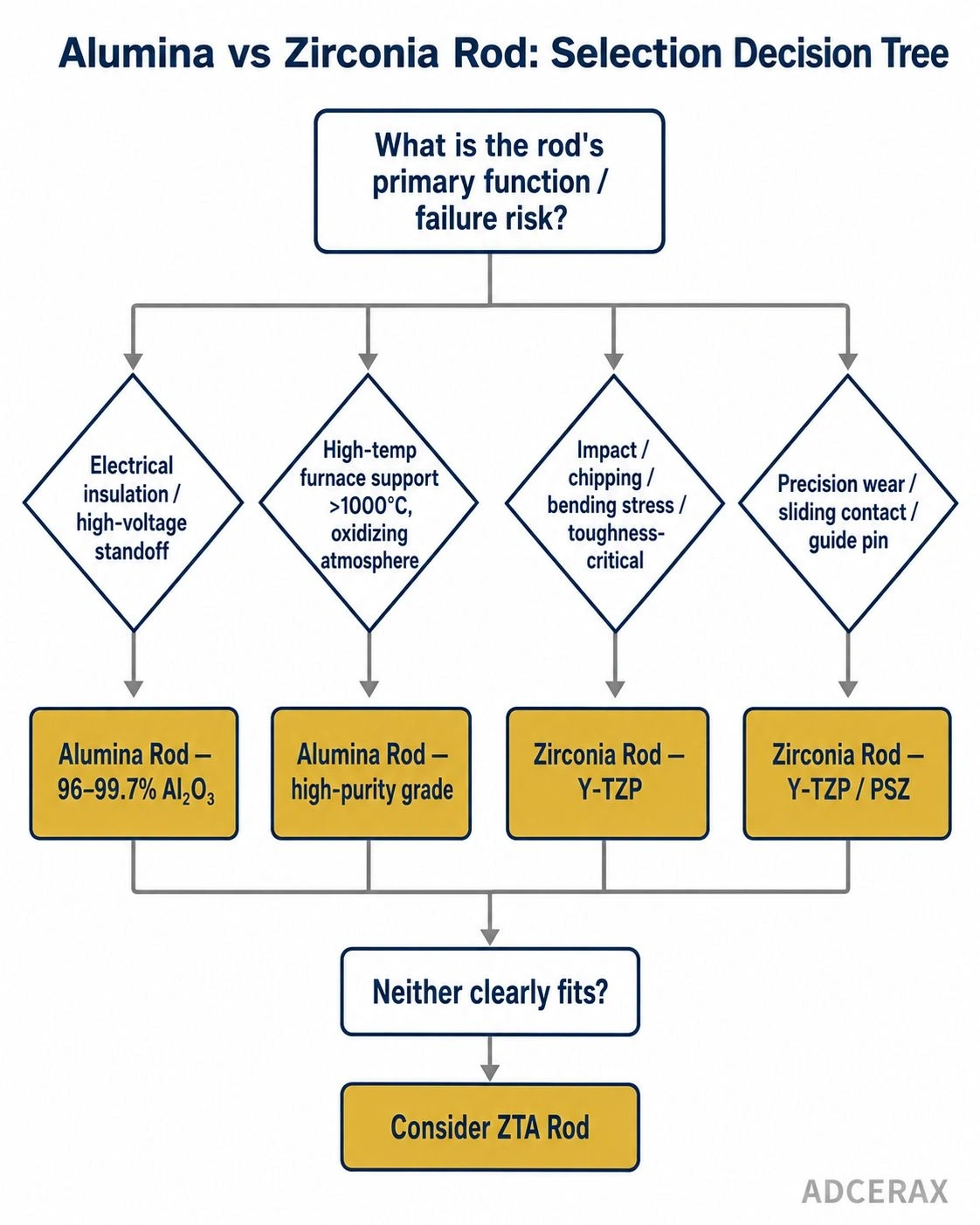
Which ceramic rod fits the application depends on the dominant failure risk — insulation and thermal stability favor alumina; toughness, wear contact, and chipping risk favor zirconia.
How Do Temperature, Toughness, Wear, Insulation, and Dimensional Behavior Compare?
The alumina-versus-zirconia decision becomes engineering-specific when properties are matched to rod function rather than listed generically. Alumina leads in electrical insulation, high-temperature stability in oxidizing atmospheres, and thermal conductivity — the last of which matters in applications where heat dissipation away from a contact point prevents localized damage. Zirconia leads in fracture toughness, bending strength, and resistance to chipping under mechanical contact. Kyocera's material guidance confirms that partially stabilized zirconia provides significant fracture-toughness improvement compared with typical fine ceramics, and separately identifies alumina for high electrical insulation and mechanical strength. For rod form factors, neither property list is absolute: a short, thick zirconia rod under bending load and a long, thin alumina rod under the same geometry do not behave the same way, and service geometry must be part of any comparison.
Zirconia's toughness advantage is real, but it does not transfer automatically to high-temperature oxidizing environments. Above approximately 1000°C in continuous air service, phase stability becomes the governing constraint for stabilized zirconia grades — and that threshold varies with stabilizer content, grain size, and thermal cycling severity. Alumina's stability in oxidizing atmospheres across its full service range is one reason it remains the default for furnace rods even when a designer's first instinct is to upgrade to a tougher material.
The following table summarizes the principal comparison variables for engineers making a first-pass rod selection. Values are indicative; verify against supplier-specific grade data, rod geometry, load conditions, and applicable test standards including ASTM C1161 for flexural strength.
| Property | Alumina Rods | Zirconia Rods | Engineering Meaning for Rod Selection |
|---|---|---|---|
| Max service temp. (air) | Up to ~1730°C (99.7% grade) | ~900–1000°C continuous (phase-stability limited) | Alumina leads for high-temp furnace and insulation roles |
| Fracture toughness | Lower (~3–4 MPa·m½ typical) | Higher (~8–10 MPa·m½ for Y-TZP) | Zirconia reduces chipping and impact failure risk |
| Flexural strength | Moderate (ASTM C1161 basis) | Higher than most fine ceramics | Zirconia carries higher bending loads in short spans |
| Electrical insulation | Strong first-choice material | Also insulating; usually chosen for mechanics first | Alumina more commonly specified for standoff and HV roles |
| Wear resistance | Good; surface-finish dependent | Good; strong in sliding/precision contact | Both wear-resistant; contact mode and mating material govern |
| Thermal conductivity | Generally higher | Lower | Alumina dissipates heat better; zirconia insulates thermally |
| Density | Lower (~3.9 g/cm³) | Higher (~6.0 g/cm³) | Matters in motion applications and dynamic components |
| Relative material cost | Lower; widely available | Higher material and processing cost | Avoid zirconia when alumina already meets the functional need |
| Intermediate option | ZTA when toughness > alumina, cost < zirconia | ZTA when thermal or economic constraints limit full zirconia | ZTA resolves the gap for moderate-impact wear parts |
Values indicative; verify with supplier-specific grade data, rod geometry, thermal cycling conditions, and applicable standards including ASTM C1161 (flexural strength) and ASTM C1327 (hardness).
Thermal shock and dimensional stability
Thermal conductivity and thermal expansion coefficient affect rod behavior during rapid temperature cycling more than any single strength value. Alumina's generally higher thermal conductivity helps distribute temperature gradients along a furnace rod, reducing the risk of transient through-thickness stress that initiates radial cracking. Zirconia's lower thermal conductivity concentrates gradients in thin-wall or long-rod configurations. Precision Ceramics notes that zirconia's high fracture toughness is partly offset by its lower thermal-shock resistance compared with alumina in cycling applications — a constraint that becomes controlling for rods used in batch-loaded furnaces with rapid ramp rates. A specification review for tube-furnace support rods in semiconductor or battery-electrode sintering equipment, where thermal ramp rates can reach 10–15°C per minute, almost always confirms alumina as the first evaluation candidate on thermal grounds alone.
ZTA: the intermediate case
When Kyocera describes ZTA as combining alumina and zirconia with hardness and bending strength above alumina and thermal conductivity above zirconia, the practical implication for rod selection is that ZTA can bridge the gap where alumina chips at contact edges but full Y-TZP is either over-specified or thermally constrained. PSZ and MSZ grades of zirconia offer different toughness-stability trade-offs and may be appropriate when the service temperature pushes above the standard Y-TZP phase-stability ceiling. Confirming grade availability, machining limits, and inspection method for ZTA or alternative zirconia grades should be part of the supplier dialogue before finalizing a specification.
Common Mistakes When Replacing Alumina Rods With Zirconia Rods — or the Reverse
The most frequent wrong substitution is upgrading from alumina to zirconia because zirconia is tougher, without checking whether the failure mode is actually driven by material toughness or by rod geometry, unsupported span, surface finish, or mounting stress. Toughness improves outcomes when impact, chipping, bending stress, or sliding wear dominates — but it does not automatically improve a furnace standoff that is cracking from clamp stress or thermal shock. ADCERAX's ceramic rod selection guide notes that rods serve as supports, guides, standoffs, and wear parts, and those functions expose identical material to fundamentally different failure mechanisms. Reviewing the failed part against the drawing, mounting detail, and operating condition resolves most substitution errors before a replacement order is placed.
Mistake 1: assuming toughness fixes the failure
When an alumina rod cracks in service, the diagnostic first step is to identify where the crack initiates and what the stress state looks like at that point. Cracks at the rod midspan under bending load → span-to-diameter ratio problem; cracks at the mounting point → clamp stress or point-contact geometry problem; edge chips at guide contact → surface finish or mating-material hardness problem. Substituting zirconia resolves the second and third scenarios but not the first, because a zirconia rod with the same unsupported span under the same bending load will fail too — just at a higher load threshold.
Mistake 2: downgrading to alumina without checking contact stress
The reverse error — replacing zirconia with alumina to save cost — is appropriate only when the original reason for zirconia specification was conservative and the contact stress, impact risk, and surface finish requirements are verified at the alumina limit. In precision guide and wear applications, downgrading material without re-examining surface finish specification and mating-material hardness frequently causes faster wear cycling or edge chipping that exceeds the cost saving within the first maintenance interval.
Mistake 3: ignoring unsupported span and bending moment
Rod length, diameter, and free span are the geometric inputs that most directly determine whether bending stress governs failure. For long rods in furnace applications, a straightness specification and support interval matter as much as material grade. The same 99% alumina rod that performs reliably at 200 mm free span may develop a measurable sag or crack initiation at 400 mm if the support interval is not adjusted for the increased bending moment. Specifying straightness tolerance and support geometry in the drawing is not optional for rods in high-temperature support roles.
Mistake 4: treating surface finish and stabilization grade as secondary details
For zirconia rods in precision wear and sliding-contact applications, surface finish Ra and mating-material hardness determine actual wear rate more directly than the bulk fracture toughness number. For Y-TZP rods in applications with elevated temperature exposure, the stabilizer content and grain size control phase-stability ceiling — omitting the grade designation from the RFQ makes it impossible for the supplier to confirm that the part will behave as designed above a given service temperature.
What to Include in an RFQ for Alumina or Zirconia Rods
A complete RFQ for alumina or zirconia rods gives the supplier enough information to confirm material route, grade, machining method, inspection standard, and service suitability without a clarification round. For alumina rods, the minimum useful specification names the Al₂O₃ purity level, operating temperature, electrical insulation requirement, rod diameter and length, straightness tolerance, and end geometry. For zirconia rods, specify the stabilization system — Y-TZP, PSZ, or MSZ — alongside temperature, contact condition, surface finish Ra, tolerance zones, and whether a lapping or grinding operation is required. If neither alumina nor pure zirconia is clearly confirmed, ask the supplier whether ZTA or an alternative grade is appropriate before issuing the drawing.
The following checklist covers the fields that most frequently require clarification in ceramic rod procurement. Each item that is omitted increases the probability of a quote that does not match the engineering intent.
- Rod function: support, guide, standoff, wear contact, fixture, or spacer — the function determines which failure mode governs.
- Material or candidate materials: specify Al₂O₃ purity (96%, 99%, 99.5%, 99.7%) or zirconia grade (Y-TZP, PSZ, MSZ); if ZTA is appropriate, name it explicitly.
- Operating temperature: continuous service temperature and peak temperature; for zirconia, also state cycling frequency and ramp rate.
- Load type: compression, bending, contact, sliding, impact, or a combination; include unsupported span for bending-loaded rods.
- Rod geometry: diameter, length, straightness tolerance, end geometry, chamfer requirement, and thread or feature details.
- Surface finish: Ra value for contact surfaces; distinguish functional contact surfaces from non-contact surfaces.
- Electrical requirement: dielectric strength or volume resistivity class if insulation performance must be verified.
- Chemical exposure: acid, alkali, solvent, or process vapor; concentration and temperature.
- Inspection and certification: dimensional inspection, straightness measurement, material certificate, and any grade or purity verification required.
- Quantity and timeline: batch size, annual volume estimate, and delivery timeline for first-article and production runs.
Specifying ""ceramic rod — alumina or zirconia, quote both"" without naming purity, grade, temperature, load, and surface finish is the most common reason RFQ responses diverge by 2–3× for nominally identical rod geometries. The material specification is not complete until the operating condition, failure risk, and dimensional tolerances are written into the drawing.
Conclusion
Alumina rods and zirconia rods are not interchangeable alternatives in a generic materials list. Alumina is the practical default for applications where electrical insulation, high-temperature stability in oxidizing environments, and broad chemical resistance define the primary requirement. Zirconia — in Y-TZP, PSZ, or MSZ form — is the better candidate when fracture toughness, impact resistance, or wear-contact precision determines service life. ZTA covers the cases where neither pure material is optimal.
The selection flips when the failure mode changes: an alumina rod failing by bending in a long-span support role is a geometry problem, not a material problem, and upgrading to zirconia without adjusting the span solves nothing. A zirconia rod failing in a high-temperature furnace environment may be a phase-stability problem that alumina would not have. Reviewing function, failure mode, temperature ceiling, and contact condition before finalizing the material specification is faster than managing replacement cycles after a wrong choice.
Ready to specify alumina or zirconia rods for your application? Share your rod function, temperature, load, and geometry with ADCERAX's engineering team. We will confirm the appropriate material, grade, and inspection requirement — and identify whether ZTA is worth evaluating for your specific duty cycle.
FAQ
What is the main difference between alumina rods and zirconia rods?
Alumina rods are selected for high-temperature insulation, stable support, electrical resistance, corrosion resistance, and general wear resistance across a wide temperature range. Zirconia rods are selected when higher fracture toughness, impact resistance, precision wear contact, or lower chipping risk governs the design. The materials serve overlapping but non-identical engineering functions in rod form.
Are zirconia rods stronger than alumina rods?
Zirconia generally offers higher fracture toughness and greater resistance to chipping or impact loads. Kyocera identifies partially stabilized zirconia as providing significant fracture-toughness improvement compared with typical fine ceramics. In bending strength, Y-TZP also exceeds most alumina grades. For applications where toughness or edge integrity under contact loading is the controlling factor, zirconia is the stronger candidate.
Which ceramic rod is better for high-temperature applications?
Alumina rods are the more reliable default for sustained high-temperature service in air or oxidizing atmospheres. ADCERAX alumina ceramic solid rods are rated to 1450°C for 96% Al₂O₃ and up to 1730°C for 99.7% Al₂O₃. Stabilized zirconia grades face phase-stability constraints in continuous air service above approximately 900–1000°C, making alumina the more straightforward choice for furnace rods, heater fixtures, and high-temperature standoffs.
Are zirconia rods better for wear resistance?
Zirconia rods are strong candidates for precision wear and sliding-contact roles because Y-TZP combines hardness, wear resistance, and high fracture toughness. Precision Ceramics describes zirconia as offering high hardness, wear resistance, and corrosion resistance. For general abrasion or guide-rod applications, alumina also provides good wear resistance at lower cost. The deciding variable is whether the wear mode is predominantly abrasive or involves impact and edge-chipping risk.
When should engineers consider ZTA rods instead of pure alumina or zirconia?
ZTA becomes relevant when the application exceeds alumina's toughness boundary but does not require the full fracture-toughness premium or accept the cost of pure zirconia. Kyocera identifies ZTA as combining alumina and zirconia with hardness and bending strength above alumina and higher thermal conductivity than zirconia. Practical candidates include wear rods with moderate impact exposure, guide components in intermediate-temperature environments, and applications where the alumina part chips at contact edges but full zirconia is thermally or economically over-specified.
What information is needed to specify alumina or zirconia rods correctly?
A complete rod specification includes: material or candidate grade (Al₂O₃ purity or zirconia stabilization type), operating temperature (continuous and peak), load type and unsupported span, rod diameter, length, and straightness tolerance, surface finish Ra for contact surfaces, electrical insulation requirement if applicable, chemical exposure, and inspection and certification requirements. Omitting operating temperature and load type is the most common reason supplier quotes diverge on nominally identical rod geometries."