A quote-ready ceramic-part RFQ should include the current drawing and revision, available 3D model, part function, assembly position, ceramic grade or request for material review, operating conditions, critical dimensions and datums, surface and edge requirements, inspection and documentation scope, prototype and production quantities, delivery destination, and packaging needs. Mark unresolved items as open instead of leaving suppliers to make hidden assumptions. For a firm quotation, require the supplier to return its proposed material, manufacturing route, drawing exceptions, tooling scope, inspection plan, lead time, pricing basis, and conditions that must be resolved before production.
Use this ten-group quick checklist:
- Part number, name, drawing revision, and units
- Controlled PDF drawing and available CAD model
- Part function, assembly position, and failure history
- Ceramic material, grade, or material-selection request
- Temperature, medium, atmosphere, load, pressure, and motion
- Critical dimensions, datums, tolerances, and mating parts
- Surface texture, edge, cleanliness, and coating requirements
- Inspection, sampling, documentation, and traceability
- Prototype, batch, release, and annual quantities
- Delivery, packaging, tooling, and commercial requirements
1. What Level of Ceramic Quotation Do You Need?
State what decision the quotation must support. A sketch, photograph, or incomplete model may be enough for an early feasibility review, but it is not automatically sufficient for issuing a purchase order. Buyers of custom ceramic parts should distinguish a preliminary cost indication from sample pricing and production-release scope.
| RFQ maturity | Buyer purpose | Minimum useful inputs | Appropriate supplier response |
|---|---|---|---|
| Feasibility inquiry | Check whether the ceramic and geometry are plausible | Function, rough dimensions, service conditions, approximate quantity | Candidate material and route, risks, open questions |
| Budgetary quotation | Establish a preliminary project range | Preliminary drawing, material direction, tolerance level, quantity range | Nonbinding price and lead-time range with assumptions |
| Firm quotation | Compare suppliers for a defined sample or production scope | Controlled drawing, grade, CTQs, inspection, quantities, delivery | Price, tooling, route, exceptions, validity, and timing |
| Production release | Approve or place an order | Approved revision, acceptance plan, packaging, change control | Order acknowledgement and frozen supply boundary |
Write “open,” “supplier recommendation requested,” or “to be confirmed after first article” beside unresolved fields. A blank is not neutral: different suppliers may assume different grades, tolerances, inspection levels, or quantities. Their totals can look comparable while covering materially different work.
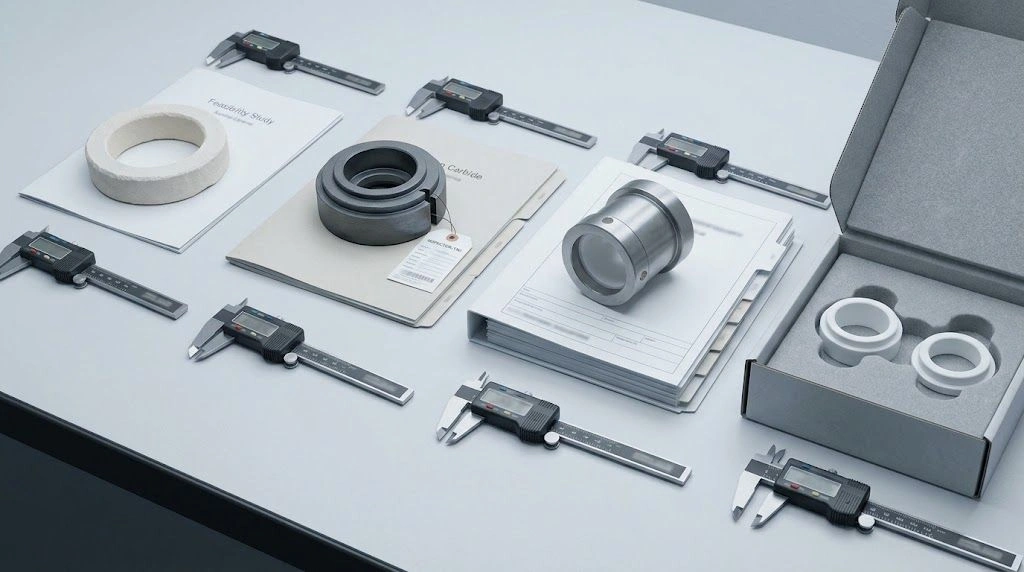
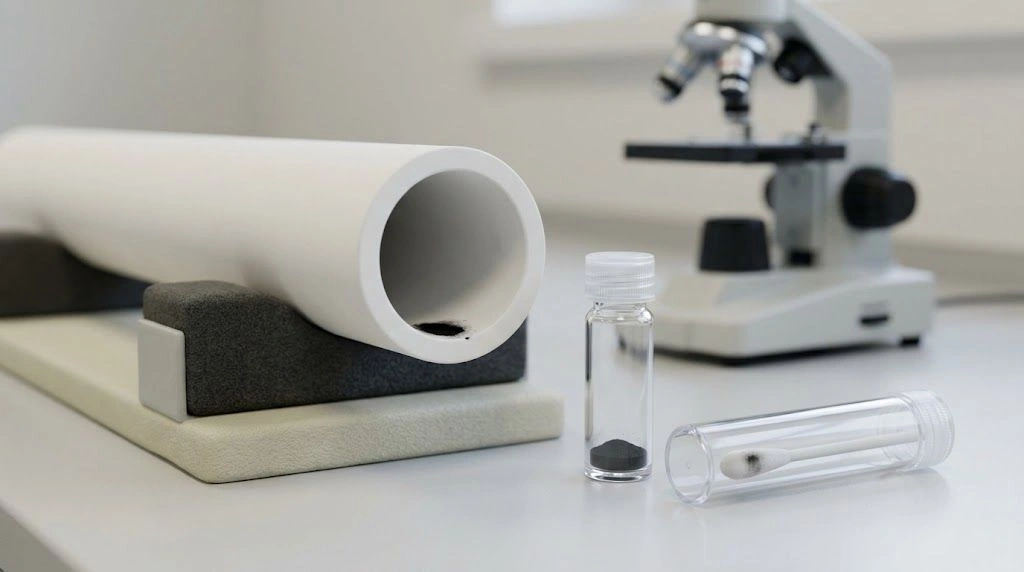
The physical review scene separates feasibility, budgetary, firm-quote, and production-release information without treating them as one scope.
2. Which Drawing, Model, or Sample Controls the Part?
A 3D model communicates nominal shape and helps evaluate complex profiles, blank volume, and tool access. A controlled 2D drawing normally carries revision, units, size tolerances, geometric controls, datums, surface texture, edge conditions, and inspection notes. If model-based definition controls production, identify the authoritative model, revision, embedded tolerances, and conflict rule.
KYOCERA’s ceramic additive-manufacturing RFQ guidance requests a 3D CAD file or 2D drawing, expected quantity, lead time, and target price, with written specifications for critical dimensions, tolerances, and finishes. The exact manufacturing route may differ, but the file-authority principle remains useful.
| Input | What it contributes | What it does not establish automatically |
|---|---|---|
| Controlled 2D drawing | Dimensions, revision, tolerances, datums, and notes | Complete complex nominal geometry |
| STEP or other CAD | Nominal shape, volume, and feature access | Default tolerances or acceptance criteria |
| Old sample | Physical interfaces and manufacturing clues | Original unworn geometry or exact grade |
| Photographs | Installed position, failure, and surface evidence | Reliable dimensions without scale and reference |
| Written specification | Duty, testing, and commercial scope | Complete geometry |
| Approved reference sample | Visual or tactile comparison baseline | Unwritten dimensional acceptance rules |
The drawing should identify OD, ID, length, thickness, wall, holes, slots, grooves, steps, threads, tapers, chamfers, radii, and coating or joining interfaces as applicable. Mark critical-to-quality features and areas allowed to remain as-fired. Confine grinding, lapping, or polishing notes to the functional zones that need them.
For replacement from an obsolete part, provide installed photographs, unused mating-part dimensions, wear or failure locations, material markings, service history, and permission for analysis. State which worn, corroded, deposited, or broken features must be reconstructed rather than copied. If the PDF, CAD model, and sample disagree, name the controlling source and list exceptions for joint review.
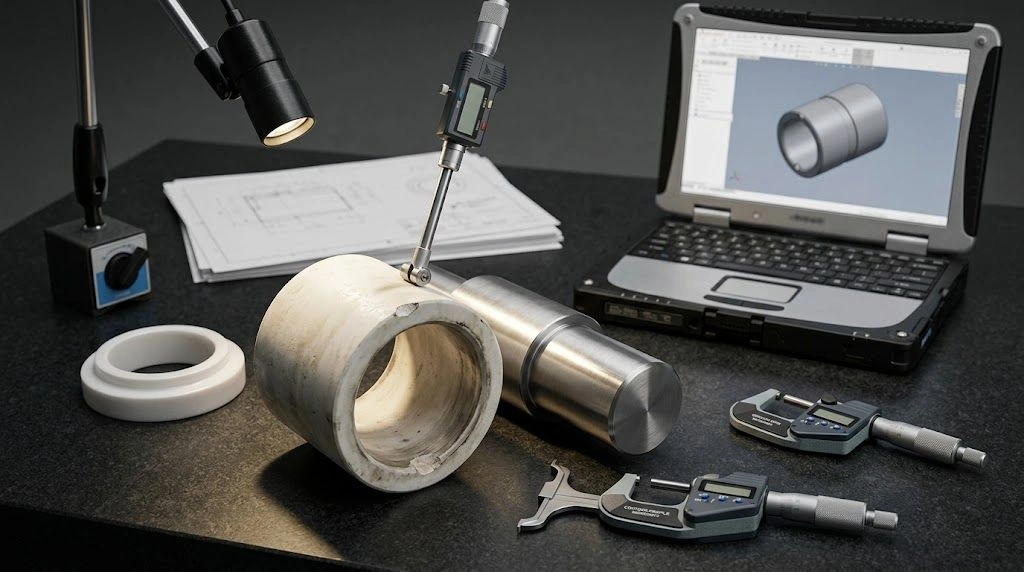
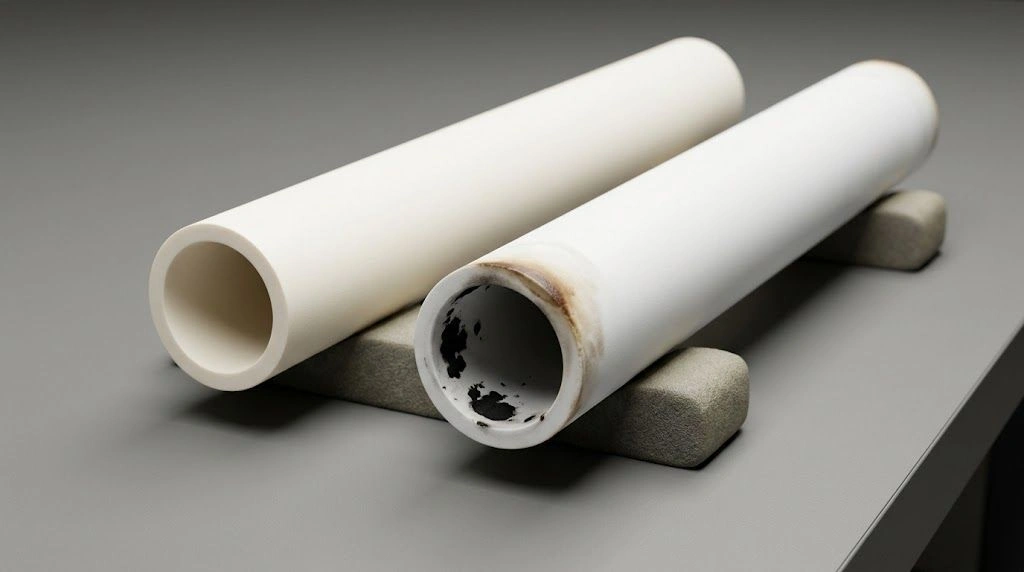
A sample can reveal interfaces and failure evidence, but the RFQ must state which source controls dimensions and acceptance.
3. How Should Material and Service Conditions Be Specified?
“Ceramic,” “alumina,” “zirconia,” or “silicon carbide” may not identify a purchasable grade. Alumina purity, zirconia stabilizer, silicon-carbide bonding or densification route, silicon-nitride route, porosity, and additive system can change performance, machining, and cost. Aluminum nitride, boron nitride, and ZTA likewise require grade-level review.
If an existing material is qualified, provide its exact designation and controlling specification. State whether supplier equivalents are allowed and who approves substitutions. If the choice is open, request a recommendation and disclose the function that controls selection. A catalogue property value should not become a finished-part guarantee unless the test method, specimen basis, and acceptance criterion are agreed.
| Service variable | Information to provide | Why it may change the quote |
|---|---|---|
| Temperature | Normal, peak, dwell, ramp, cycles | Grade, distortion, and thermal-shock review |
| Atmosphere | Air, vacuum, inert, reducing, named gas | Oxidation, volatilization, electrical behavior |
| Chemical medium | Composition, concentration, impurities, cleaners | Compatibility and contamination risk |
| Mechanical duty | Static, cyclic, impact, bending, contact load | Geometry, material, and proof requirements |
| Pressure | Operating, differential, vacuum, transients | Wall, seal, and test scope |
| Motion | Sliding, rotating, reciprocating, speed | Clearance, texture, and wear pair |
| Abrasive solids | Material, size, concentration, velocity | Wear mechanism and grade direction |
| Electrical duty | Voltage, frequency, creepage, temperature | Insulation properties and geometry |
| Contamination | Prohibited metals, silica, particles, residues | Purity, finishing, cleaning, packaging |
Material documentation should be proportionate to the failure consequence. For example, ISO 18754 specifies methods for determining density and apparent porosity in fine ceramics, but requesting that test only makes sense when the property is relevant and the method is suitable. State whether you need a certificate of conformance, material certificate, test report, or lot traceability; do not request every document by default.
4. Which Tolerances, Surfaces, and Inspections Are CTQ?
Identify the dimensions that control assembly, sealing, motion, alignment, flow, minimum wall, or electrical spacing. Separate them from noncritical dimensions that can follow an agreed general or as-fired condition. Morgan’s ceramic component design guide explains why post-fired grinding is slower than machining a pre-fired body, so blanket precision can change both route and price. Use the ceramic tolerance and machining guide to prepare a DFM discussion rather than copying a universal tolerance table.
Size, flatness, parallelism, position, runout, and surface texture are different requirements. ISO 1101 defines geometrical-specification language, while ISO 5459 defines datum and datum-system rules. Specify the functional surface, datum reference, evaluation area, and acceptance method so machining and inspection use the same intent.
| CTQ requirement | RFQ question | Verification direction |
|---|---|---|
| Critical size | Which fit or clearance does it control? | Suitable micrometer, gauge, vision, or CMM |
| Flatness | Which contact or sealing land functions? | Defined area and form method |
| Parallelism | Relative to which datum? | Datum-based setup |
| Roundness or cylindricity | Over what bore or shaft length? | Appropriate form measurement |
| Position | Which datum system locates the feature? | CMM or qualified fixture |
| Runout | What is the operating axis? | Rotational setup |
| Surface texture | Which parameter, direction, and zone? | Agreed profile method |
| Edge quality | Where are chips prohibited? | Defined visual or magnified inspection |
State which characteristics receive 100% inspection and which use sampling. Define sample size or referenced plan, method, location, temperature where relevant, reporting precision, first-article report, batch report, and third-party responsibility. ISO 14253-1 addresses conformity decisions near specification limits when measurement uncertainty matters. Confirm the supplier’s ceramic inspection capabilities before mandating an instrument or report format.
5. What Commercial Scope and Supplier Response Make Quotes Comparable?
State prototype quantity, pilot batch, initial production quantity, annual usage, typical release size, and requested price breaks separately. Quantity can change forming route, tooling allocation, fixture economics, inspection method, and unit price. Do not extrapolate a three-piece sample price to a recurring production program.
Include requested delivery date, destination, Incoterm, tooling or NRE, tooling ownership and storage, quote validity, payment basis, labeling, export documents, spare-part need, and packaging. Fragile ceramic edges may require separated cavities, soft contact, orientation control, clean packaging, or surface protection.
Require each supplier to return the exact grade, proposed forming and finishing route, drawing exceptions, assumptions, suggested alternatives, tooling cost, MOQ, price breaks, prototype and production timing, inspection scope, documentation list, packaging method, change-notification policy, quote validity, and exclusions. This supplier-response matrix often improves comparability more than adding fields to the buyer’s request.
Use a ten-point readiness check: controlled definition; function; material direction; service conditions; CTQs and datums; surfaces and edges; inspection and documents; quantities; delivery and packaging; supplier-response requirements. Scores of 0–3 support feasibility review, 4–6 a budgetary request, 7–8 a conditional firm-quote candidate, and 9–10 a quote-ready package subject to supplier DFM review. This score is an editorial tool, not a quality standard.
For tube, crucible, substrate, pump, valve, or rod details, use the relevant product-specific ceramic RFQ guides instead of overloading the general checklist. Send the latest drawing, application conditions, highlighted CTQs, inspection scope, and sample-to-production quantities. Ask the supplier to return assumptions, exceptions, and cost-reduction alternatives with the quotation.
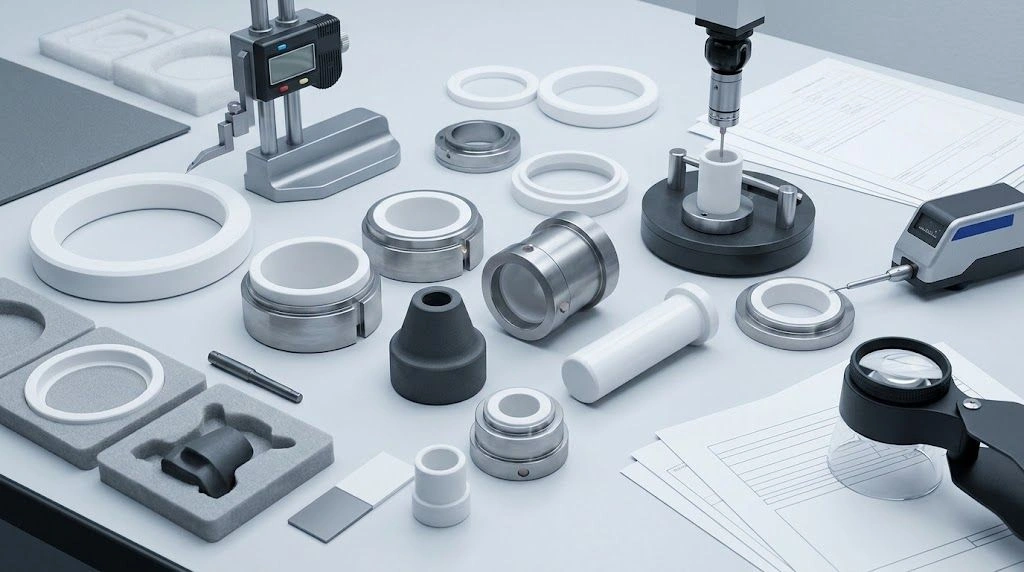
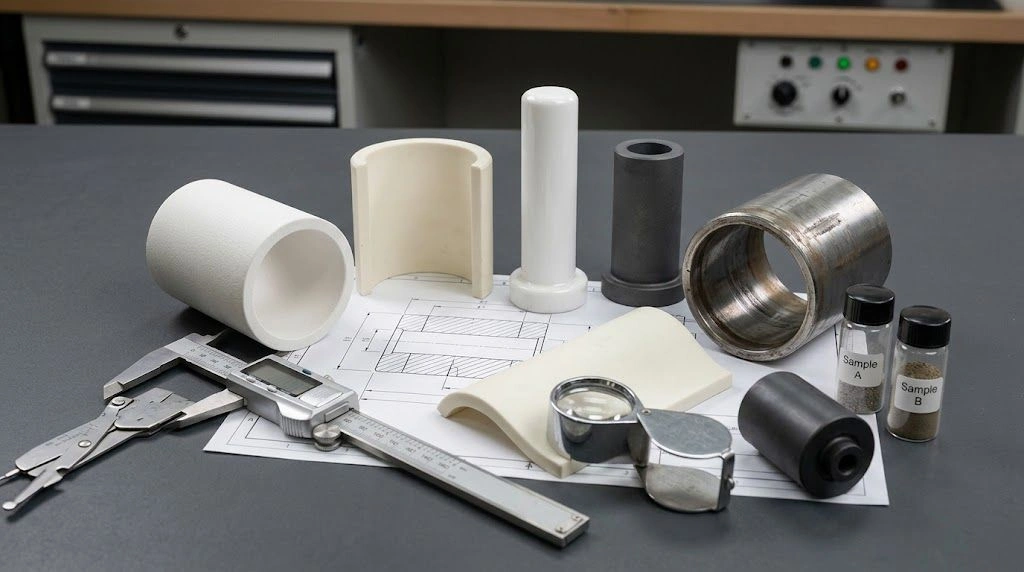
The final review connects technical scope, inspection evidence, production quantities, and packaging to a comparable supplier response.
Frequently Asked Questions
What is the minimum information needed to start a ceramic-part quotation?
Provide the part function, rough dimensions or available drawing, material direction, important operating conditions, and approximate quantity. This can support feasibility review or a budget estimate. A firm quote normally needs a controlled revision, CTQs, inspection scope, quantities, and delivery requirements.
Is a STEP file enough for a ceramic quotation?
Usually not for a firm quotation. STEP communicates nominal geometry but does not automatically define tolerances, datums, surface texture, edge acceptance, inspection, or revision authority. Add a controlled drawing or model-based specification and state which file governs if any sources conflict.
Can a ceramic part be quoted from an old sample?
A sample can support feasibility and reconstruction, but wear, corrosion, deposits, or breakage may have changed it. Provide mating-part dimensions, installed photographs, service history, and known failure areas. Agree which dimensions will be measured, inferred, or approved before production.
How specific should the ceramic material be?
State the exact qualified grade when substitution is not allowed. Otherwise identify the ceramic family, required properties, contamination restrictions, and service conditions, then request a supplier recommendation. “Alumina” or “zirconia” alone may not define purity, stabilizer, additives, porosity, or manufacturing route.
Which inspection documents should be requested?
Request only evidence tied to acceptance risk: for example a first-article report, selected dimensional results, material certificate, certificate of conformance, or lot traceability. Define sampling, methods, and acceptance criteria. Full CMM reports, third-party testing, and 100% inspection can materially affect cost.
What should the supplier confirm with its quotation?
The response should identify the proposed grade, manufacturing route, tooling, inspection, documentation, packaging, price basis, lead time, MOQ, assumptions, exceptions, and alternatives. It should also list unresolved requirements and changes that need buyer approval before samples or production are released.