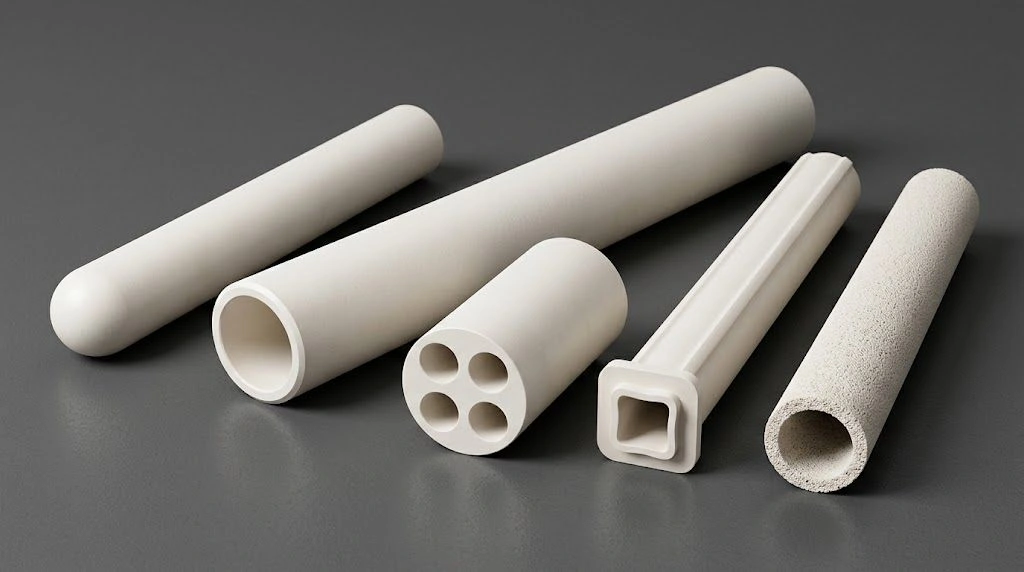
Alumina tubes are a strong baseline choice for glass melting temperature monitoring when the job is to protect a precious-metal thermocouple at very high temperature while maintaining electrical insulation, chemical resistance, and low drift. They are not the universal answer for every glass-furnace measurement point: in some direct molten-glass-contact zones, precious-metal protective sleeves are preferred, while SiC or sapphire routes become relevant when harsher mechanical or gas-tightness demands dominate.
The selection decision in glass-furnace temperature monitoring is driven primarily by where the thermocouple tip lives in the process — which zone, what kind of contact with the melt, and how demanding the chemical and thermal environment is at that specific point. This guide maps alumina's real role in that system, explains the purity logic that makes high-purity alumina essential rather than optional, removes the most common measurement-point confusions, and closes with the specification language for a protection-tube RFQ.
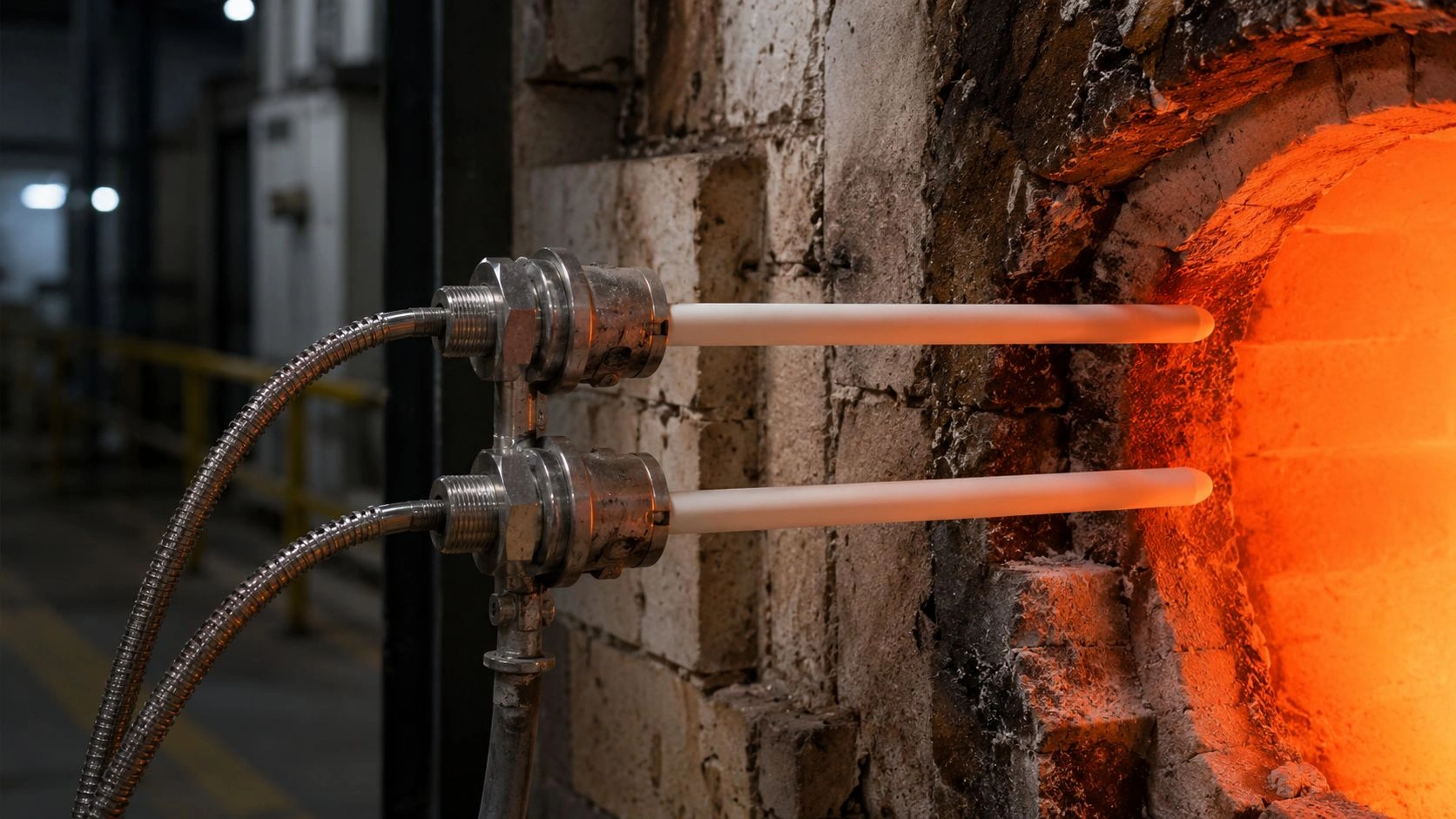
High-purity alumina protection tubes in glass melting furnaces serve as the precision ceramic sheath around precious-metal thermocouples — their role is part of the measurement architecture, not just refractory enclosure.
The alumina thermocouple protection tubes for glass-furnace monitoring described in this guide — high-purity, dense, closed-end protection-tube grades — are the specific alumina form factor used in glass-furnace thermocouple service, not standard open-ended lab tubes or general-purpose refractory components.
What role an alumina tube actually plays in glass melting temperature monitoring
In glass melting temperature monitoring, an alumina tube is best understood as a ceramic protection sheath for a thermocouple rather than as a generic high-temperature tube. Published technical literature from glass-industry thermocouple suppliers is consistent on this point: glass melting, fining, and conditioning involve extremely high temperatures and challenging atmospheric conditions that require special thermocouple technology, and high-purity alumina insulation — often screened at ≥99.7% Al₂O₃ in published glass-industry thermocouple documentation (screening band; confirm grade on RFQ/COA; not the only fit for every measurement point) — is specified for stable precious-metal thermocouple performance at those temperatures.
That makes the alumina tube part of the measurement architecture itself. It insulates the precious-metal thermocouple wires electrically, shields the junction environment from reactive furnace gases and glass vapors, and helps the sensor survive long enough at temperature to deliver stable, drift-free readings. Without adequate protection, precious-metal thermocouple elements in glass-furnace environments experience contamination, silica-related eutectic interactions with the platinum wires, and shortened service life.
The alumina tube is a measurement component, not just a refractory enclosure
This distinction matters for specification. A generic refractory tube and a precision high-purity alumina thermocouple protection sheath may look similar but serve different functions. The protection tube's material chemistry — specifically alumina purity and impurity control — directly affects the thermocouple reading quality and sensor life, not just the structural integrity of the enclosure.
Alumina provides the critical interface between the thermocouple wire and the furnace environment
The alumina tube separates the precious-metal thermocouple elements from the furnace atmosphere, the glass melt, and the furnace wall. Any material migration through that interface — from impurities in the alumina, from furnace gases, or from glass vapors — can compromise the thermocouple calibration and shorten its service life. This is why alumina purity is a measurement-engineering parameter in glass melting service, not only a materials specification.
Why alumina is used there, and why purity matters
Alumina is used in glass-furnace thermocouple protection because it combines high-temperature electrical insulation, chemical resistance, and compatibility with precious-metal thermocouples in a way that few other ceramics can match at the temperatures encountered in glass melting. Glass-furnace TC literature sometimes cites very high peak exposures in the ~1800–1950°C order of magnitude — published peak/order-of-magnitude claims, not an ADCERAX continuous rating or guarantee. ADCERAX long-term selection ceilings are grade-dependent (e.g. ~1700°C for AD-ALU-997 / ~1750°C for AD-ALU-999); confirm peak vs continuous, atmosphere, melt contact, and geometry on RFQ.
Purity matters because glass-furnace temperature measurement is not simply a high-temperature containment problem. Published glass-industry thermocouple literature explicitly identifies the nature and content of residual impurities in the alumina as critical, highlighting contaminants including Fe, Ni, Cr, Sb, and glass-forming residues such as B₂O₃ and SiO₂ as contributors to thermocouple degradation. Low silica content in the alumina is specifically identified as a way to prevent eutectic formation with platinum at temperature — a reaction that would directly damage the precious-metal thermocouple wire rather than simply degrading the tube structure.
The practical consequence is that alumina grade selection for glass-melting thermocouple service should be driven by impurity content and purity level, not only by temperature rating. High-purity grades (≥99.7% Al₂O₃ screening, aligned with AD-ALU-997-class intent) with low silica and controlled trace-element content are a common glass-industry TC documentation starting point — confirm grade on RFQ/COA; not the sole contractual purity for every measurement point. Higher-purity classes (e.g. 99.9% / AD-ALU-999 screening) may apply when the contamination budget is tighter — still confirm on RFQ. Lower-purity grades that would be adequate for structural or thermal-mass applications are typically not equivalent in this service.
High-purity alumina protects the platinum wire, not just the sensor assembly
The eutectic interaction between silica-containing alumina and platinum wire at high temperature is a well-documented failure mechanism in precious-metal thermocouples. A lower-purity alumina tube that meets the temperature rating but contains residual silica above acceptable levels will damage the thermocouple over time through exactly this mechanism — producing drift, shortened life, and unreliable readings — even if the tube itself remains structurally intact.
Electrical insulation at temperature is a measurement requirement
At glass-melting temperatures, the electrical insulation resistance of the alumina protection tube affects the accuracy of the thermocouple signal. Alumina's high electrical resistivity at elevated temperatures is one reason it is specified for this service: it prevents stray electrical currents from corrupting the millivolt thermocouple signal, which becomes especially important when multiple thermocouples share the same furnace zone.
Which measurement points are being confused when buyers specify alumina tubes
Three distinct confusions appear most often when engineers specify alumina protection tubes for glass-furnace temperature monitoring:
Collapsing crown, sidewall, and forehearth/distributor into one specification. Published glass-industry thermocouple supplier documentation clearly distinguishes these zones. Crown and vault thermocouples can use double ceramic protection tubes. Bottom and sidewall temperature measurements can use either precious-metal sleeves or high-quality ceramic protective tubes, depending on the severity of direct glass contact. Forehearth and distributor zone thermocouples, where the measuring tip is in constant contact with hot glass, are explicitly described as using precious-metal protective sleeves — not ceramic tubes — in that supplier documentation.
Treating the alumina tube as the outer protection when it should be the inner protection. In configurations that use SiC outer protection tubes for harsh environments, the inner protection sheath around platinum-wire thermocouples should still be alumina. Published SiC sensor tube documentation explicitly recommends an inner closed-end alumina protection tube when platinum-wire thermocouples are used with a SiC outer tube. In that architecture, alumina remains essential even when the external protection material changes.
Specifying "ceramic protection tube" without distinguishing alumina grade. The glass-furnace environment makes alumina purity a functional requirement, not a commercial preference. Different alumina grades with the same nominal temperature rating can have very different impurity profiles, and only high-purity grades with controlled silica and trace-element content provide the stable low-drift performance that glass-furnace thermocouple applications require.
When the decision clearly flips between alumina, platinum sleeves, SiC, and sapphire
The Measurement-Point Matrix below maps the five main glass-furnace measurement configurations to their appropriate protection route:
| Measurement point / duty | Best-fit route | Why | Main boundary |
|---|---|---|---|
| Crown / vault furnace measurement | High-purity alumina protection-tube route is strong | Crown/vault thermocouples commonly use double ceramic protection tubes; high-purity alumina insulation is specified for stable precious-metal TC performance | Not every crown/vault installation has the same shock or response requirement |
| Bottom / sidewall measurement | Alumina or platinum-sleeve route | Bottom/sidewall temperatures measured in liquid glass or tank wall; route includes precious-metal sleeves or high-quality ceramic protective tubes | Route depends on direct glass contact severity and lifetime target |
| Distributor / forehearth continuous hot-glass contact | Precious-metal protective sleeve route often stronger | Measuring tip is in constant contact with hot glass in this zone; glass-industry supplier documentation states platinum protective sleeves are used here | Clearest position where alumina is often not the lead route |
| Harsher outer protection / more robust outer barrier | SiC outer tube with inner alumina for Pt-wire thermocouples | SiC sensor tubes for harsh environments; inner closed-end alumina tube recommended when platinum-wire thermocouples are used | SiC is not a drop-in replacement for alumina around precious-metal wires |
| Gas-tight poisoning-resistant special reactor duty | Sapphire route | Gas-tight sapphire protection provides longer life in aggressive toxic or hydrogenous atmospheres | Specialty harsh-gas route, not the default glass-furnace baseline |
Route logic synthesized from glass-industry thermocouple supplier documentation, SiC sensor tube literature, and sapphire protection tube specifications.
The plain-English route summary: alumina is the baseline precious-metal thermocouple protection route for many high-temperature glass-furnace measurement points; platinum sleeves take over when direct molten-glass contact becomes continuous in the forehearth/distributor zone; SiC and sapphire are boundary routes for harsher outer protection or gas-tight special cases.
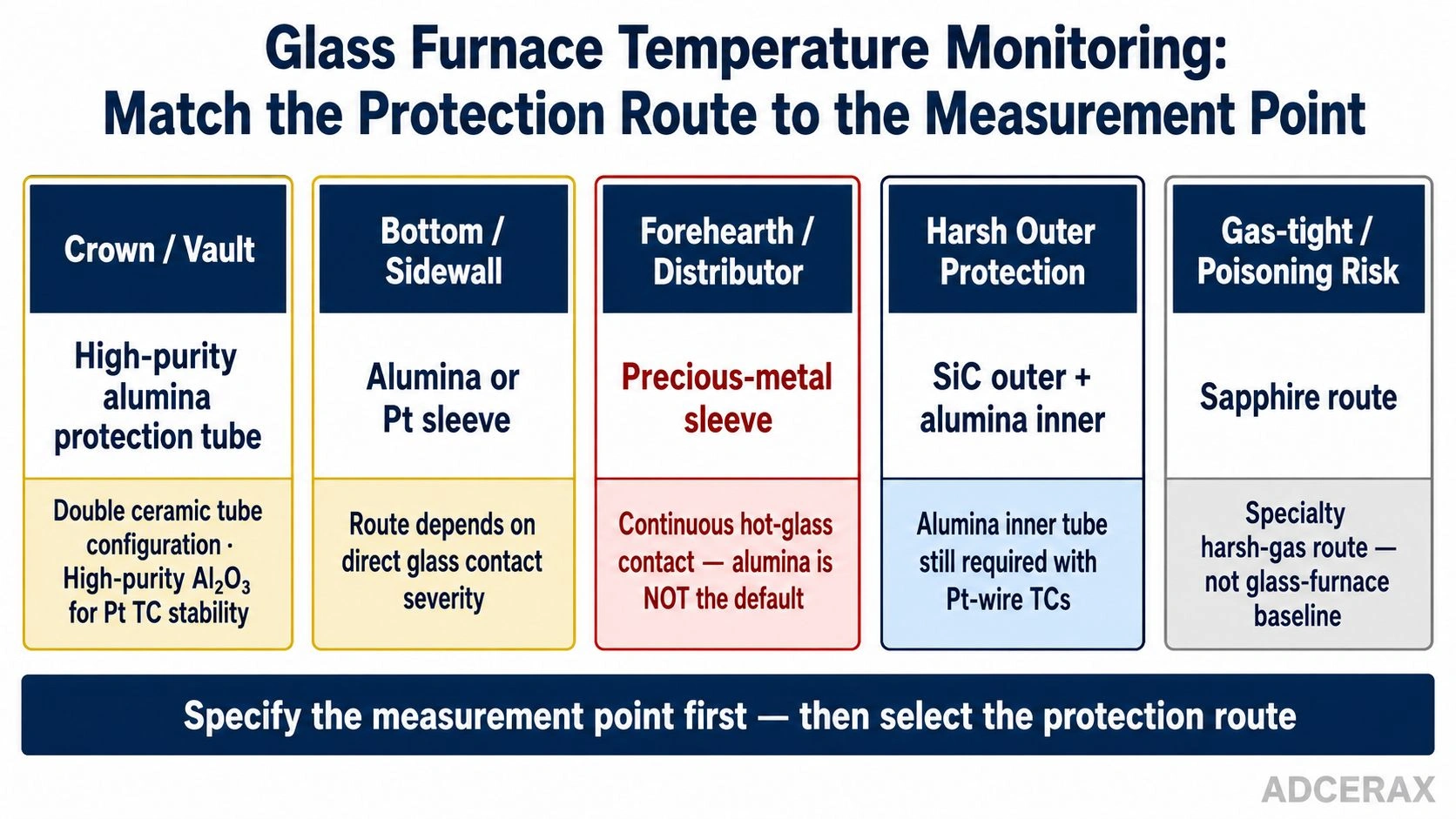
Glass-furnace temperature monitoring splits into distinct measurement zones — crown, sidewall, forehearth, and special reactor — each with a different optimum thermocouple protection route.
Alumina is the inner protection even when SiC becomes the outer protection
The most practically important boundary condition is the SiC case. When a harsher outer protection route is required — mechanical robustness, more aggressive furnace atmosphere — the SiC outer tube does not replace the alumina inner tube. The alumina remains as the direct interface with the precious-metal thermocouple elements, while the SiC provides the outer mechanical and chemical barrier. Specifying SiC without retaining the inner alumina component for platinum-wire thermocouples is often a specification miss. Atmosphere, seal integrity, and CTE stack-up for the outer/inner pair must be on the RFQ — this is not a universal default stack for every duty.
The forehearth/distributor zone is the clearest boundary where alumina does not lead
In zones where the thermocouple tip is in permanent immersion in molten glass, the chemical attack and dissolution risk for a ceramic tube exceeds what high-purity alumina can reliably manage over the required service life. That is why glass-industry thermocouple suppliers often designate precious-metal sleeves — not ceramic protection tubes, however high-purity — as the lead route for that service position.
What should go into the RFQ and operating specification
Before writing "alumina tube for glass furnace," the specification must resolve the measurement point and the thermocouple type. Without those two variables, the protection route cannot be confirmed, and the purity requirement cannot be set.
The specification and operating checklist for ceramic thermocouple protection tubes in glass-furnace thermocouple protection service:
- Measurement point — specify crown/vault, bottom, sidewall, forehearth, or distributor zone; this single variable determines whether alumina, precious-metal sleeve, or a combined route is appropriate.
- Thermocouple type — specify Type R, Type S, or Type B precious-metal thermocouple; alumina purity and impurity control requirements are tied to the precious-metal wire composition.
- Alumina purity — screen at ≥99.7% Al₂O₃ (or a named higher class when contamination risk is tighter) for glass-industry precious-metal thermocouple service; treat as documentation screening — confirm grade on RFQ/COA; not a universal contractual purity for every point.
- Silica and trace-element content — require the supplier to confirm silica content and key trace-element levels (Fe, Ni, Cr, Sb, B₂O₃) where eutectic risk with platinum is a concern at operating temperature.
- Protection configuration — specify single-tube, double-tube (outer and inner), or alumina-inner with SiC-outer, depending on the measurement zone and furnace atmosphere severity.
- Direct molten-glass contact — state explicitly whether the thermocouple tip is in intermittent or continuous contact with molten glass; if continuous, flag for precious-metal sleeve route evaluation.
- Maximum operating temperature — specify planned continuous and peak temperatures separately; confirm the alumina grade selection ceiling for the planned atmosphere (grade-dependent; not a literature peak claim).
- Continuous vs peak temperature — separate continuous duty from short peak exposure; do not treat literature peak claims as continuous TDS ceilings.
- Atmosphere / pO₂ — state oxidizing, reducing, or mixed furnace atmosphere and any reactive vapors at the measurement point.
- Melt contact Y/N — intermittent splash vs continuous immersion; drives alumina vs Pt-sleeve vs combined routes.
- Geometry — OD/ID/length, closed vs open end, single vs double sheath, and inner/outer sheath materials (alumina / SiC / Pt) with seal and CTE notes.
- Thermal-shock considerations — confirm preheat requirements and temperature cycling rate with the OEM / TC-assembly / furnace SOP; ~480°C preheat appears in some published shop-practice notes as an illustrative caution — not a universal insertion recipe.
If the specification says only "alumina protection tube for glass melting," it has not yet resolved the measurement point, the purity requirement, or whether the tip is in continuous molten-glass contact. The route selection must follow from those three inputs.
Conclusion
Alumina protection tubes are the standard ceramic sheath for precious-metal thermocouples in many glass-furnace measurement positions — crown, vault, bottom, and sidewall — where high-purity alumina's insulation, chemical resistance, and low silica content protect both the sensor signal quality and the platinum wire integrity. The specification logic becomes precise only when the measurement point is identified: forehearth and distributor zones with continuous hot-glass contact shift the route toward precious-metal sleeves, and harsher outer-protection requirements add SiC without removing the inner alumina component. Starting with the measurement-point location typically produces the right protection-tube route.
Specifying alumina protection tubes for glass-furnace thermocouple service? Send the measurement point, thermocouple type, continuous vs peak temperature, furnace atmosphere / pO₂, melt-contact Y/N, OD/ID/length, closed/open end, and inner/outer sheath materials. Request grade/purity confirmation on RFQ/COA plus dimensional and route guidance for the confirmed position — see custom ceramic services for inquiry fields. No commitment is required to submit an RFQ package.
Related reading
- Alumina thermocouple protection tubes: purity grades above 1400°C — purity vs thermocouple failure checks when high-temperature TC protection is the RFQ driver.
- Closed-end alumina tubes for thermocouples and furnaces — closed-end geometry and insertion notes that often pair with glass-furnace TC sheath RFQs.
- Alumina protection tubes for platinum-based thermocouples — Pt-wire TC sheath specification fields that sit next to glass-furnace measurement-point routing.
Frequently Asked Questions
What does an alumina tube actually do in glass melting temperature monitoring?
It serves as a ceramic protection sheath around a precious-metal thermocouple, providing electrical insulation, environmental shielding, and chemical protection at the temperatures encountered in glass melting, fining, and conditioning. The alumina tube is part of the measurement architecture: its purity and impurity profile directly affect the stability and service life of the thermocouple rather than only the structural integrity of the enclosure.
Why is high-purity alumina preferred over standard alumina for this service?
Because high-purity alumina with low silica content prevents eutectic interactions between alumina and platinum wire at high temperature — a reaction that damages the precious-metal thermocouple element and causes drift and shortened life. Published glass-industry thermocouple documentation commonly screens around ≥99.7% alumina content and identifies silica, iron, and other trace contaminants as degradation sources — use that as screening, then confirm grade on RFQ/COA. Lower-purity grades that meet a temperature rating but have higher impurity levels are typically not equivalent in this service.
Are alumina protection tubes the right choice everywhere in a glass furnace?
No. They are a strong baseline in crown, vault, bottom, and sidewall measurement positions, but the forehearth and distributor zones, where the thermocouple tip is in continuous contact with hot glass, are often identified in glass-industry supplier documentation as using precious-metal protective sleeves rather than ceramic protection tubes as the lead route.
When does SiC become relevant for glass-furnace thermocouple protection?
When a harsher outer protection route is needed for mechanical robustness or furnace atmosphere severity. However, SiC is not a replacement for alumina around precious-metal thermocouple wires — published SiC sensor tube documentation recommends retaining an inner closed-end alumina tube when platinum-wire thermocouples are used inside an SiC outer protection tube. The two materials serve different functions in that configuration.
When does sapphire become relevant?
When gas-tightness and resistance to toxic or poisoning atmospheres become the primary design requirements. Sapphire protection tubes are positioned as a specialty harsh-gas route with better resistance to gas-phase attack than ceramic protection tubes in aggressive atmospheres containing hydrogen, toxic gases, or reactive species. This is a specialty route for specific measurement positions and is not the standard glass-furnace baseline.