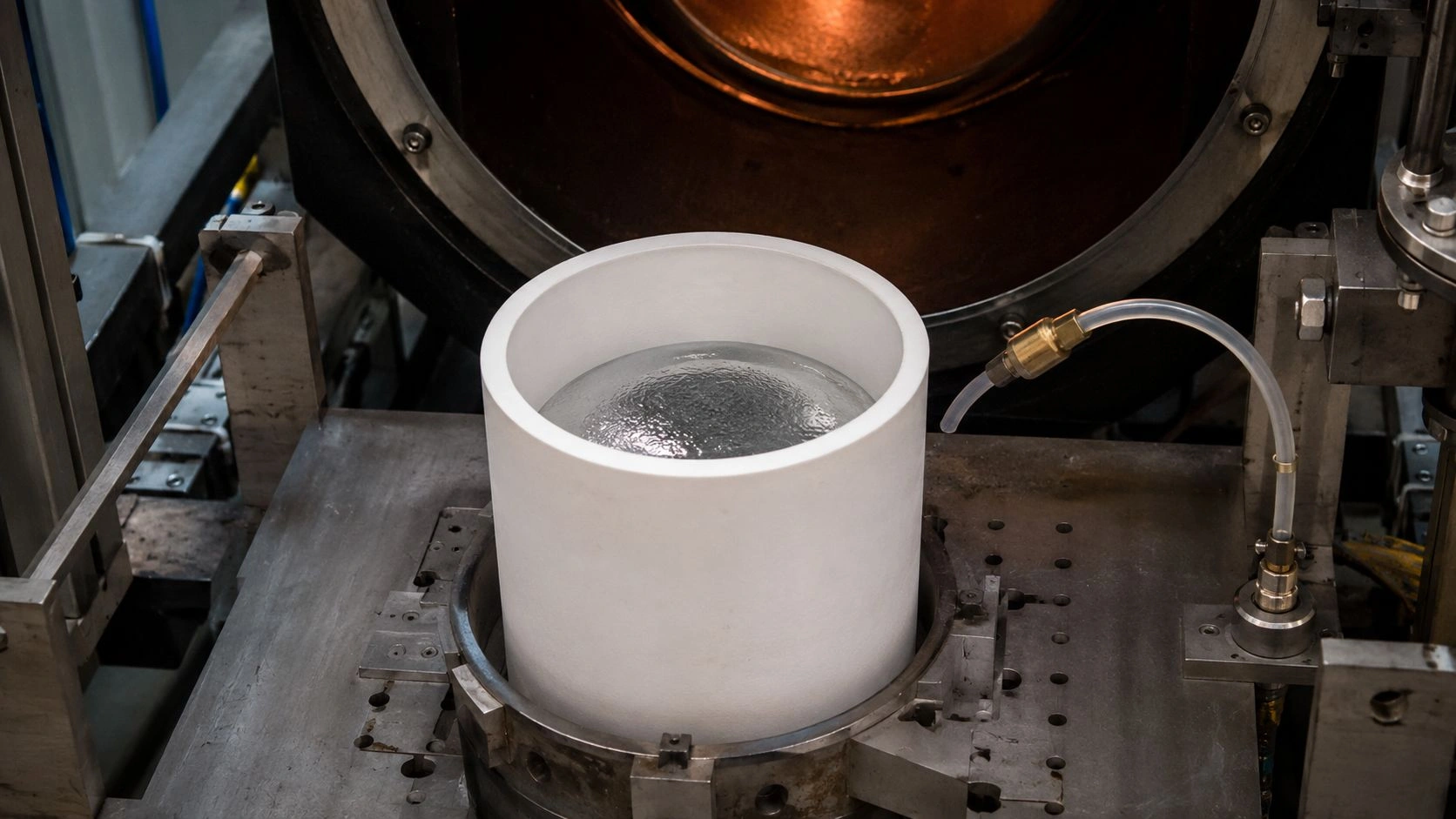
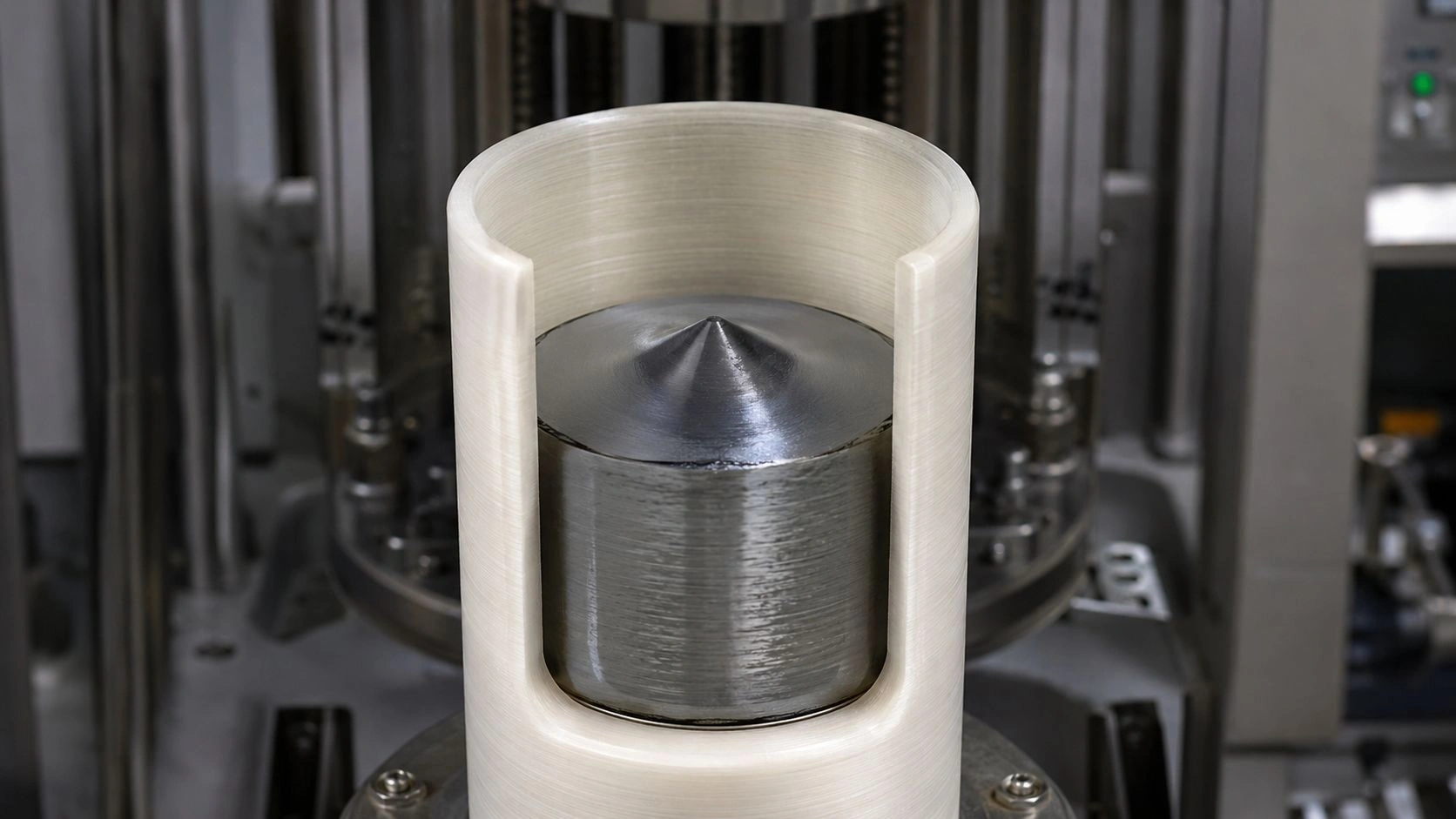
BN crucible shape should be optimized for induction heating when the crucible must isolate the melt, control wetting, improve release, and fit a graphite susceptor or conductive charge without disturbing the thermal field. Because boron nitride is usually electrically insulating, geometry mainly affects heat transfer, melt depth, wall temperature, expansion clearance, and pouring behavior rather than direct induction coupling. The critical design variables are wall thickness, bottom radius, taper angle, height-to-diameter ratio, lip design, fill level, and liner clearance.
This distinction — that BN is the thermal and chemical containment body, not the primary induction-heated body — drives the entire shape optimization logic and is the most common design assumption that leads to disappointing results when it is ignored.
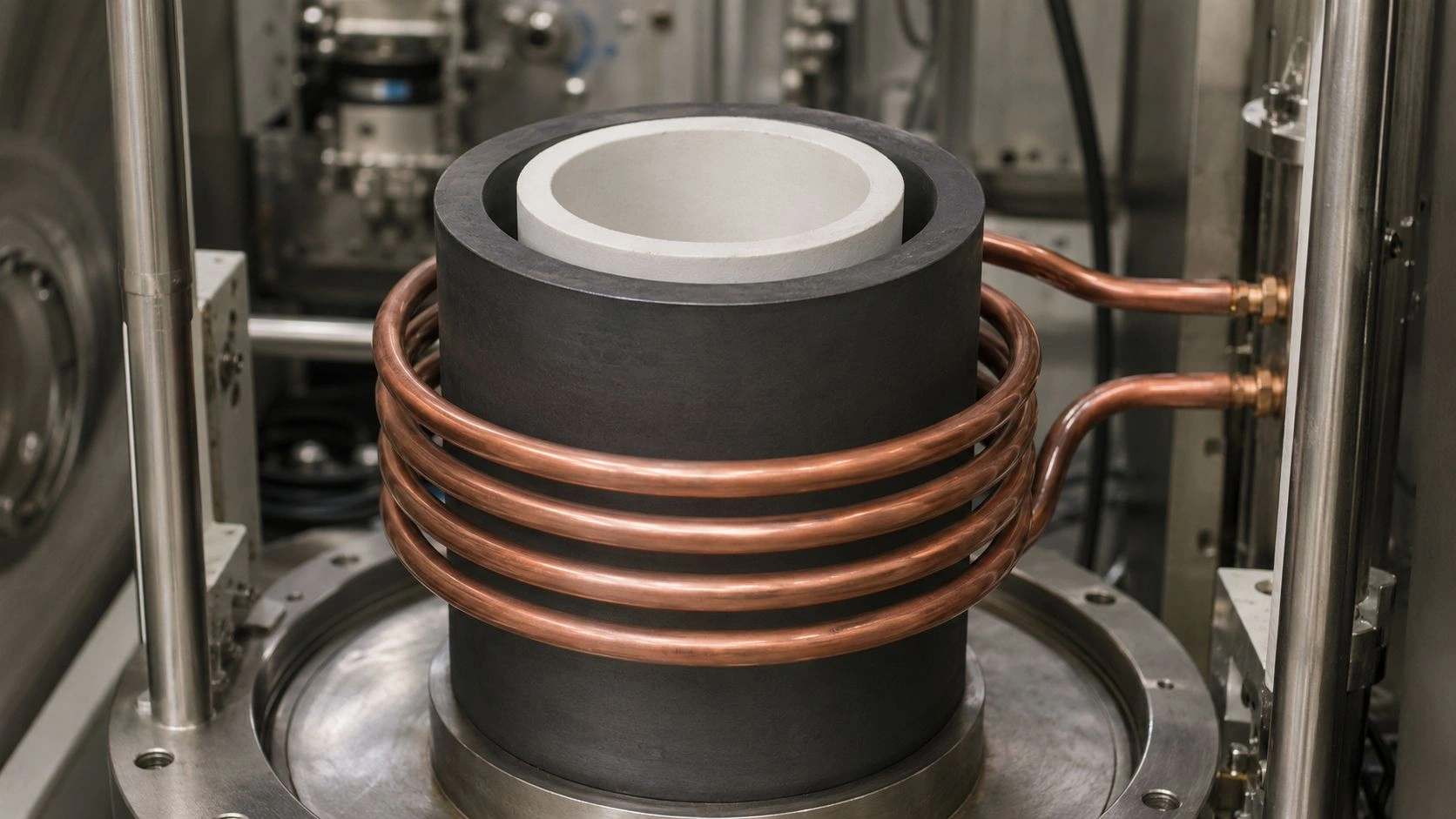
BN crucible shape optimization in induction heating is about managing heat transfer, melt release, and chemical isolation — the graphite susceptor or conductive charge provides the induction coupling, while BN geometry controls everything else.
Product context for the geometry decisions in this guide: boron nitride crucibles for induction heating and high-purity melting (hot-pressed BN, PBN, and BN liner formats in cylindrical, conical, tapered, stepped, flanged, spouted, and lidded custom geometries), plus the boron nitride ceramics hub, BN plate range, materials overview, and drawing · coil · susceptor RFQ. Each geometry must reflect the actual induction system design, not a generic crucible catalog selection. Note the diversion: a contamination-free metal-casting duty is not an induction shape/clearance RFQ; a BN coating-on-graphite route is not a liner-gap optimization; a nuclear-materials compliance crucible is not an induction geometry drawing.
Why BN shape optimization is different in induction heating
BN crucible optimization in induction heating begins with one critical question: what is the primary coupling object in the system? Induction heating generates heat through induced eddy currents in conductive materials. Skin depth — the effective penetration depth of induced current — is governed by electrical resistivity, magnetic permeability, and coil frequency. Because hexagonal BN is widely described as electrically insulating with useful thermal conductivity and thermal shock resistance — attributes that are grade- and densification-dependent — it normally sits outside the primary induction-coupling pathway. The strongest heating typically occurs in the metallic charge, graphite susceptor, or metallic outer crucible rather than in BN itself.
That means the shape of the BN crucible or liner mainly controls thermal transfer between the induction-heated body and the melt, chemical isolation between the melt and the graphite or metal system, melt release and pouring behavior, and mechanical fit within the coil assembly. None of those are the same design problem as optimizing graphite electrode geometry or positioning a metal charge in a coil.
The practical consequence is that the first design question for BN in any induction heating system is not "how thick should the BN wall be for better induction absorption?" It is "where is heat being generated, and how does the BN geometry move heat efficiently to the melt while maintaining the chemical and mechanical performance required?"
Conductive charge heating vs graphite susceptor heating
In a system where the metallic charge itself is conductive enough to couple with the induction field, the BN crucible acts primarily as a non-wetting, chemically inert liner that protects the charge from graphite contamination and the graphite structure from melt attack. In a system where a graphite susceptor is the primary heating body, the BN liner sits between the susceptor and the melt, and its wall thickness, clearance, and contact uniformity with the graphite determine how efficiently the susceptor's heat reaches the melt.
These are two different design scenarios with different geometry priorities. Confusing them — designing the BN as if it were a graphite susceptor, or designing the graphite as if BN were present to absorb induction power directly — produces systems that underperform even when both materials are individually correct.
Why BN geometry affects heat flow but not primary electromagnetic coupling
BN's thermal conductivity — a typical screening / orientation-dependent / grade-sheet band often cited around approximately 25–60 W/m·K for hot-pressed BN perpendicular to the pressing axis, and higher parallel to it — means that wall thickness and contact uniformity affect the thermal gradient between the susceptor or melt and the BN inner surface. Treat that band as screening guidance only (not a contractual acceptance k); confirm the grade sheet, press-axis orientation, and service temperature (T) on the RFQ drawing before locking wall thickness. A thicker BN wall increases thermal lag; a thinner wall decreases it but may reduce mechanical margin. That tradeoff is a heat-transfer engineering problem, not an electromagnetic design problem.
Which geometry variables matter most
The Shape Optimization Matrix below maps the seven key design variables for BN crucibles in induction heating to their lower-risk and higher-risk configurations:
| Design variable | Lower-risk direction | Higher-risk condition | What to verify |
|---|---|---|---|
| Wall thickness | Thin enough for heat transfer, thick enough for handling | Thick wall causing thermal lag, or thin wall causing chips | Thermal gradient + handling load |
| Bottom radius | Rounded inner corner | Sharp internal corner | Residue release + stress concentration |
| Taper angle | Slight taper for release | Straight wall with sticking or shrink-lock risk | Solidification behavior |
| Height-to-diameter ratio | Matched to coil active zone and fill volume | Tall charge column outside heating zone | Coil height + fill height |
| Liner clearance | Uniform fit inside graphite | Rocking, binding, or uneven contact | OD / ID tolerance stack-up |
| Lip / flange | Stable handling and seating | Thin fragile rim | Loading tools + gripping method |
| Spout / pour feature | Controlled discharge | Overly sharp or weak outlet | Pour direction + machining radius |
Values indicative — design guidance only, not a contractual SLA. Verify with supplier-specific BN grade data, induction furnace layout, and application trials; confirm geometry and clearance on the system RFQ.
Published review material on crucibles for induction melting identifies crucible-melt interaction, thermodynamic stability, and thermal shock resistance as important design parameters — confirming that geometry affects chemical exposure, gradient-driven stress, and release behavior in ways that require application-specific design rather than catalog-based selection. Treat that as published-review context for induction-melting crucible themes (thermodynamic stability, crucible–melt interaction, thermal shock), not as a factory-test claim for any specific BN grade; confirm melt chemistry, thermal gradient, and release requirement on the duty RFQ rather than deriving shape from a generic induction furnace geometry template.
Wall thickness and radial temperature lag
In a BN liner inside graphite, the wall thickness determines how much thermal resistance sits between the susceptor surface and the melt inner wall. For a given susceptor temperature and desired melt-inner-surface temperature, thicker walls require either higher susceptor power or longer equilibration time. In small-diameter systems — typical of laboratory induction melting or precision evaporation sources (lab-/small-coil scale context) — even a few millimeters of wall thickness difference can matter qualitatively; confirm on the system RFQ rather than treating millimeters as a universal rule.
Bottom radius, taper, and release behavior
The inner bottom corner is the location most likely to accumulate residue after solidification, to concentrate thermal stress during cooling, and to resist release when the charge shrinks around a vertical wall. A radius at the inner bottom corner distributes both residue and stress. A slight inward taper on the side wall allows the solidified charge to shrink away from the wall during cooling rather than gripping it. Both features improve cleaning and reuse, and they cost nothing to specify on a drawing if the design is captured before the first machining run.
Height-to-diameter ratio and fill level
The height-to-diameter ratio controls whether the charge fits within the effective induction heating zone of the coil or susceptor. A charge that extends above the active coil height receives less heating in the upper portion, creating a vertical thermal gradient that can affect uniformity and melt behavior. The design should target a fill height that keeps the active melt within the coil active length, with the BN crucible height adding only enough extra clearance for handling and overflow protection.
How to distinguish BN shape problems from coil and susceptor problems
Not every unsatisfactory induction melting result is a BN geometry problem. Before redesigning the BN crucible, the failure mode must be correctly identified.
Coil-frequency mismatch produces situations where the charge warms slowly or unevenly across different material phases. This is a system-level issue affecting the primary coupling object and cannot be corrected by changing BN wall dimensions.
Susceptor clearance determines how uniformly the graphite's radiant and conductive heat reaches the BN outer wall. If the BN liner is tilted, rocking, or has inconsistent contact against the graphite, one side of the liner heats faster than the other regardless of the BN material quality or geometry.
Charge conductivity and fill height effects affect how much of the induction energy couples into the charge at the start of a run. A charge that is poorly conductive at cold temperatures — such as some semiconductor materials or reactive metals before they melt — may start as a secondary heating problem even in a well-designed BN/graphite system.
Published skull-melting research context reports that thinner crucible wall structures can improve energy utilization in certain induction melting configurations — but that finding is not automatically transferable to BN liners, because BN is typically an insulating interface rather than the induction-coupled melting body. Reducing BN wall thickness may reduce thermal lag and improve heat transfer to the melt, but it should not be driven by an analogy to thinning a conductive skull; confirm wall thickness and thermal contact on the system RFQ.
The most practically important misdiagnosis in BN crucible design for induction heating is assuming that a poor melt result reflects BN material properties or shape when the root cause is coil geometry, susceptor-to-BN clearance, or charge conductivity at the start of the run. BN geometry changes address the heat-transfer and release layer; they do not correct induction-field coupling problems.
BN liner clearance vs BN material adequacy
If the BN liner is undersized and sits loosely inside the graphite susceptor, the contact between susceptor and liner is inconsistent across the circumference. One side of the liner receives more heat, the other less. The temperature distribution in the melt reflects the liner tilt, not the BN material. Controlling this requires specifying dimensional tolerances for the liner OD and the graphite ID as a matched pair, not just specifying each independently.
Full BN crucible or BN liner inside graphite?
The product-route decision for BN in induction heating systems maps to four configurations:
| Option | Use when | Limitation | RFQ focus |
|---|---|---|---|
| Freestanding hot-pressed BN crucible | Non-wetting, release, insulation, and clean containment are main goals and the heating body is the conductive charge or an external susceptor | BN does not directly couple with the induction field — heating depends on charge conductivity or susceptor design | Support method, wall thickness, capacity |
| BN liner inside graphite | Graphite must provide induction coupling but melt must be isolated from carbon contamination, reaction, or adhesion | Liner clearance and thermal contact with graphite become critical geometric variables | Liner OD / ID, clearance tolerance, bottom seating |
| PBN crucible | High-purity, gas-tight, low-outgassing containment is required for ultra-clean or crystal-growth environments | More specialized and expensive than hot-pressed BN; geometry customization options may be narrower at small lot sizes | Purity documentation, wall profile, vacuum compatibility |
| Non-BN crucible | Mechanical load, air oxidation limit, or specific melt chemistry exceeds BN's usable window | Sacrifices BN's non-wetting, insulating, or cleanliness advantages | Material comparison against confirmed operating conditions |
BN liner designs for graphite crucible isolation are the established route when graphite provides induction coupling while BN provides the melt-contact surface — the two materials work as a complementary screening system rather than as competing alternatives. Confirm liner OD/ID, clearance tolerance, and bottom seating as a matched pair with the graphite crucible on the RFQ.
For the ultra-clean boundary case — high-vacuum evaporation, crystal growth environments, or applications where outgassing and purity are the governing requirements — the distinction between hot-pressed BN and PBN becomes a separate decision that requires documentation of the purity grade, outgassing profile, and wall gas-tightness, not only geometry.
Full BN crucible: when geometry and insulation are enough
A freestanding BN crucible works best when the melt is conductive enough to couple with the induction field without needing a separate graphite susceptor, and when non-wetting release and cleanliness are the dominant design requirements. In that configuration, the BN wall must be dimensioned for sufficient strength, and the system must account for the fact that the BN outer surface is not a coupling surface for the induction coil.
BN liner: when graphite must provide the induction-coupling body
When graphite is needed for induction coupling but the melt must not contact graphite — either because of carbon contamination risk, graphite wetting, or reaction between the melt and carbon — the BN liner inside graphite is the established design route. The liner geometry must be specified as a functional pair with the graphite crucible dimensions, with clearance tolerance, seating flatness, and bottom contact designed to minimize uneven thermal contact.
RFQ drawing checklist for custom BN crucible geometry
The RFQ Drawing Fields table below captures the minimum drawing data for a custom BN crucible or liner request:
| Drawing field | Why it matters | Recommended wording |
|---|---|---|
| OD / ID / height | Determines fit and charge volume | "Confirm OD, ID, height, and tolerance" |
| Wall / bottom thickness | Controls heat transfer and strength margin | "Review wall and base thickness for induction-heated service" |
| Bottom radius | Reduces corner stress and residue trapping | "Specify inner radius; avoid sharp internal corner" |
| Taper angle | Improves release and demolding | "Confirm inner taper and outer taper if required" |
| Liner clearance | Controls contact with graphite body | "Confirm clearance relative to graphite crucible ID as a matched dimension" |
| Lip / flange / spout | Controls handling and pouring | "Quote machined lip, flange, or spout per attached drawing" |
| Surface finish | Influences release and cleaning | "Confirm machined surface condition and edge chamfer" |
A drawing-driven RFQ is the practical path: converting geometry variables — wall thickness, bottom radius, taper, liner clearance, and lip design — into manufacturable dimensions is what transforms a shape optimization concept into a qualified custom BN crucible production request. Supplier review of coil geometry, susceptor dimensions, melt chemistry, and fill volume alongside the crucible drawing is essential before committing to a production batch.
Beyond the drawing fields, the RFQ should include the induction furnace type and coil inner diameter and height, the graphite susceptor or outer crucible dimensions, the target melt material and required purity level, fill volume and expected fill height, atmosphere (vacuum, argon, nitrogen, or air), maximum temperature and thermal cycling profile, and whether pilot trial validation is required before committing to batch production.
When evaluating whether BN, an alternative ceramic, or a hybrid BN-liner-inside-graphite approach is most appropriate for the confirmed operating conditions, start from the induction coupling object, melt chemistry, and geometry RFQ — not from a cross-material catalog headword. Keep the primary money path on BN crucibles and custom drawing RFQ; do not divert to membrane or unrelated for-sale headwords.
Designing a BN crucible or BN liner for an induction heating system? Share coil dimensions, graphite susceptor geometry, melt material, fill volume, atmosphere, temperature profile, and the target drawing via the custom RFQ. A drawing-driven review can confirm BN grade, dimensional tolerances, liner clearance, and surface finish options matched to the induction system layout — without treating screening conductivity bands or indicative matrix rows as contractual SLA.
Frequently Asked Questions
Can BN crucibles be used in induction heating?
Yes, but the design must recognize that BN is usually electrically insulating. In most induction heating systems, the primary heating body is the conductive metallic charge or a graphite susceptor. BN provides containment, insulation, non-wetting release, and chemical isolation — functions that depend on shape geometry, wall thickness, and clearance design rather than on induction coupling.
Does BN heat directly in an induction furnace?
Not in the same way graphite or metal does. BN's electrical insulation means it does not normally act as the main induction-coupled body. The induction system should be designed around the conductive component that actually absorbs induction power, and the BN geometry should be designed around that primary heating body — not as if BN itself were absorbing the electromagnetic energy.
What BN crucible shape works best for induction heating?
There is no universal best shape. The optimized geometry balances wall thickness for heat transfer, bottom radius to reduce residue trapping and corner stress, a slight taper for release, height-to-diameter ratio matched to the coil active zone, lip design for handling, and — when the BN is a liner — clearance tolerance relative to the graphite outer crucible. Each of those variables should be specified on a drawing rather than left to a catalog standard.
Should I use a full BN crucible or a BN liner inside graphite?
Use a full BN crucible when the melt is conductive enough to couple with the induction field and the primary requirements are non-wetting containment, clean release, and chemical isolation. Use a BN liner inside graphite when the graphite must provide the induction coupling body but the melt must not contact graphite. The two configurations require different geometry specifications — liner clearance and thermal contact with graphite are critical in the liner case but not in the freestanding crucible case.
Why does wall thickness matter for BN in induction heating?
Wall thickness affects thermal lag between the induction-heated body and the melt inner surface. A thicker BN wall increases the temperature difference required to drive a given heat flux into the melt, while an overly thin wall may not provide adequate mechanical margin for handling, loading, and removal. The correct thickness depends on crucible diameter, the thermal conductivity of the BN grade, the required inner wall temperature, and the mechanical loads imposed during use.
What should I send to a supplier for custom BN crucible design?
Send the crucible drawing with OD, ID, height, wall thickness, bottom radius, taper angle, lip or flange design, and required tolerances, along with the induction furnace coil dimensions, graphite susceptor or outer crucible dimensions, melt material and purity requirement, fill volume, atmosphere, maximum temperature, heating cycle, and any previous failure mode or performance issue with the prior design. The combination of drawing and operating conditions allows the supplier to confirm grade, geometry, and clearance recommendations before sampling.
Related reading
- BN ceramic for contamination-free metal casting — When the duty is contamination-free metal casting with BN ceramic — not induction shape/clearance drawing RFQ
- BN crucible cost bands and quote inputs — When the buyer path is BN crucible cost bands and quote inputs, not wall/taper/liner geometry
- BN coating on graphite vs solid BN crucible — When the route is BN coating on graphite vs solid BN crucible, not induction liner-gap optimization