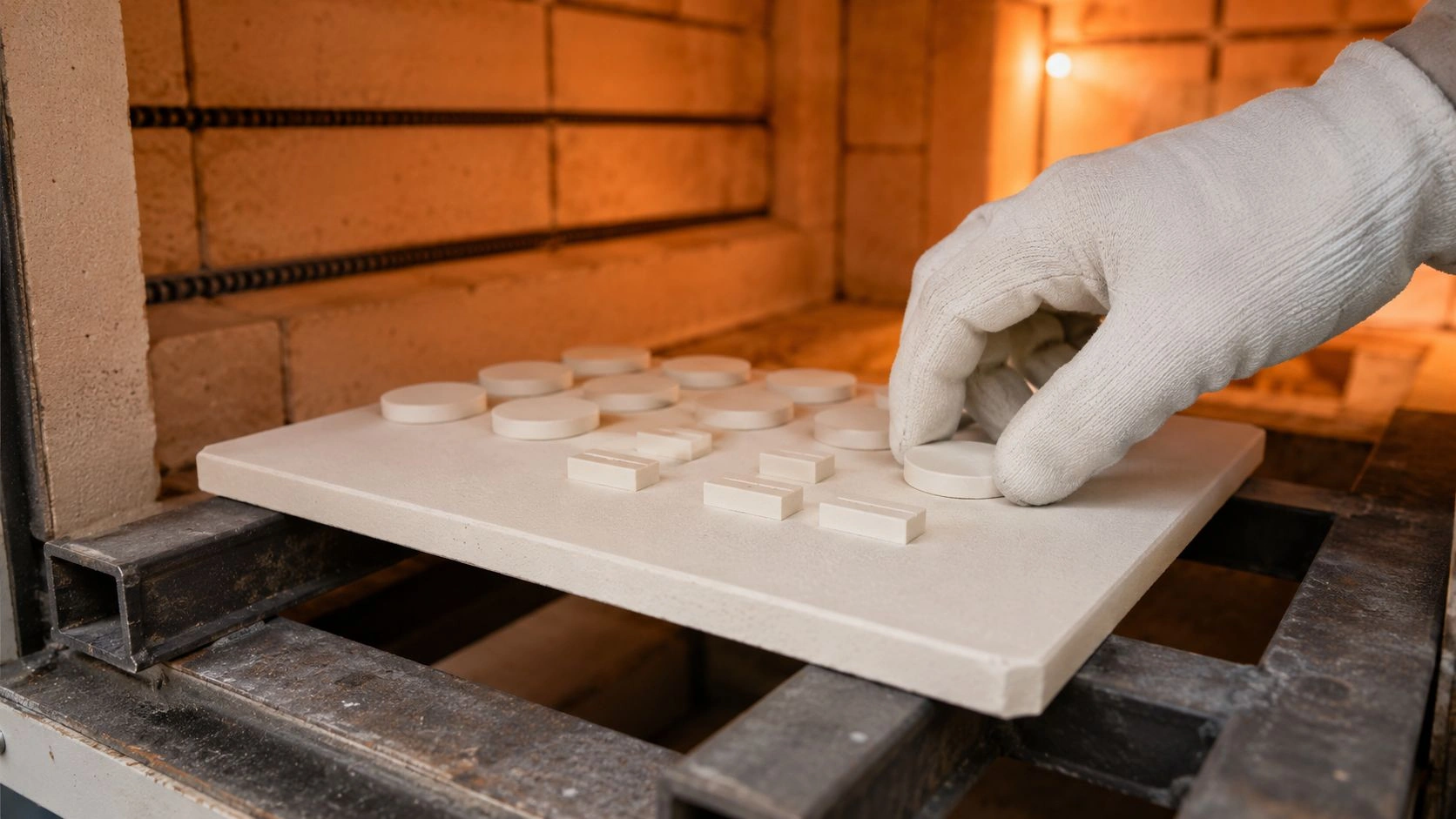
BN crucibles should usually be dried or pre-baked before first use, but they should not be blindly annealed in air at high temperature. The correct first-use conditioning depends on BN grade, storage condition, process atmosphere, and purity requirement. For hot-pressed BN, the main goal is to remove adsorbed moisture and machining residue at controlled, gradual heat. For PBN used in vacuum, MBE, or PVD sources, the goal is low-outgassing bake-out under vacuum or inert gas with RGA or blank validation. High-temperature conditioning should normally be done under inert gas or vacuum — not in wet air or oxygen — because BN's oxidation behavior and temperature capability differ significantly between atmospheres.
That atmosphere-first, grade-first framing — not a universal anneal recipe — is the engineering basis for this guide.
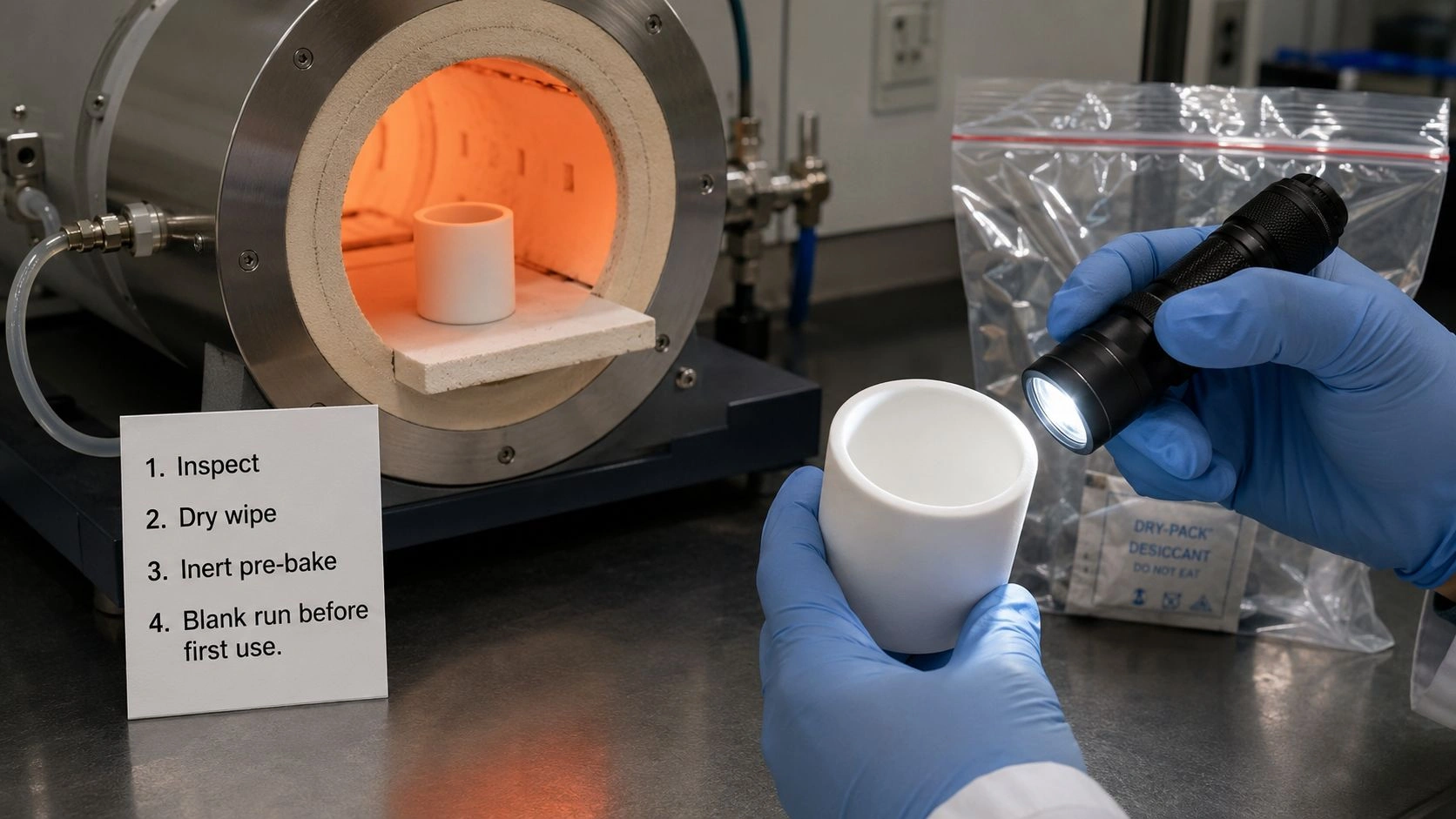
BN crucible first-use conditioning is not one universal step — drying, inert pre-bake, and vacuum bake-out serve different purposes for different BN grades and process atmospheres, and the correct sequence depends on storage condition, operating atmosphere, and purity requirement.
The boron nitride crucibles and PBN crucibles at ADCERAX — covering hot-pressed HPBN grades for machinable high-temperature processing and CVD PBN grades for low-outgassing MBE and vacuum evaporation — provide the starting point for the conditioning decisions described in this guide.
Annealing, drying, and bake-out are not the same step
The first step in any BN crucible first-use procedure is getting clear on what the conditioning is actually trying to accomplish — because """"annealing BN before first use"""" is a phrase that covers three different technical actions with different temperature ranges, atmospheres, and goals.
Drying refers to low-temperature heating to remove adsorbed moisture from storage or handling. For a BN crucible that has been in a factory package but may have seen humidity, drying at a moderate temperature — well below the process operating temperature — removes surface water without thermal stress. This step is almost universally beneficial for hot-pressed BN that will be used in any elevated-temperature process.
Pre-bake refers to controlled heating, often under inert gas or vacuum, to remove moisture, machining residue, and trace organics from the crucible body and surfaces. This is a more thorough version of drying and is the appropriate first-use step for crucibles that will be used in high-temperature, high-purity, or vacuum applications.
Annealing or process conditioning is a higher-temperature thermal cycle — approaching or reaching process operating temperature — used to stabilize the crucible structure and surfaces before the real material is loaded. For most laboratory metal melting or heat-treatment work, the first-use step is not really """"full annealing"""" in the metallurgical sense. It is gradual preheating under a safe atmosphere. For UHV and MBE systems, the equivalent step is vacuum bake-out with RGA monitoring before source material is introduced.
The BN First-Use Conditioning Matrix and the Drying vs Pre-Bake vs Annealing comparison table below map these choices:
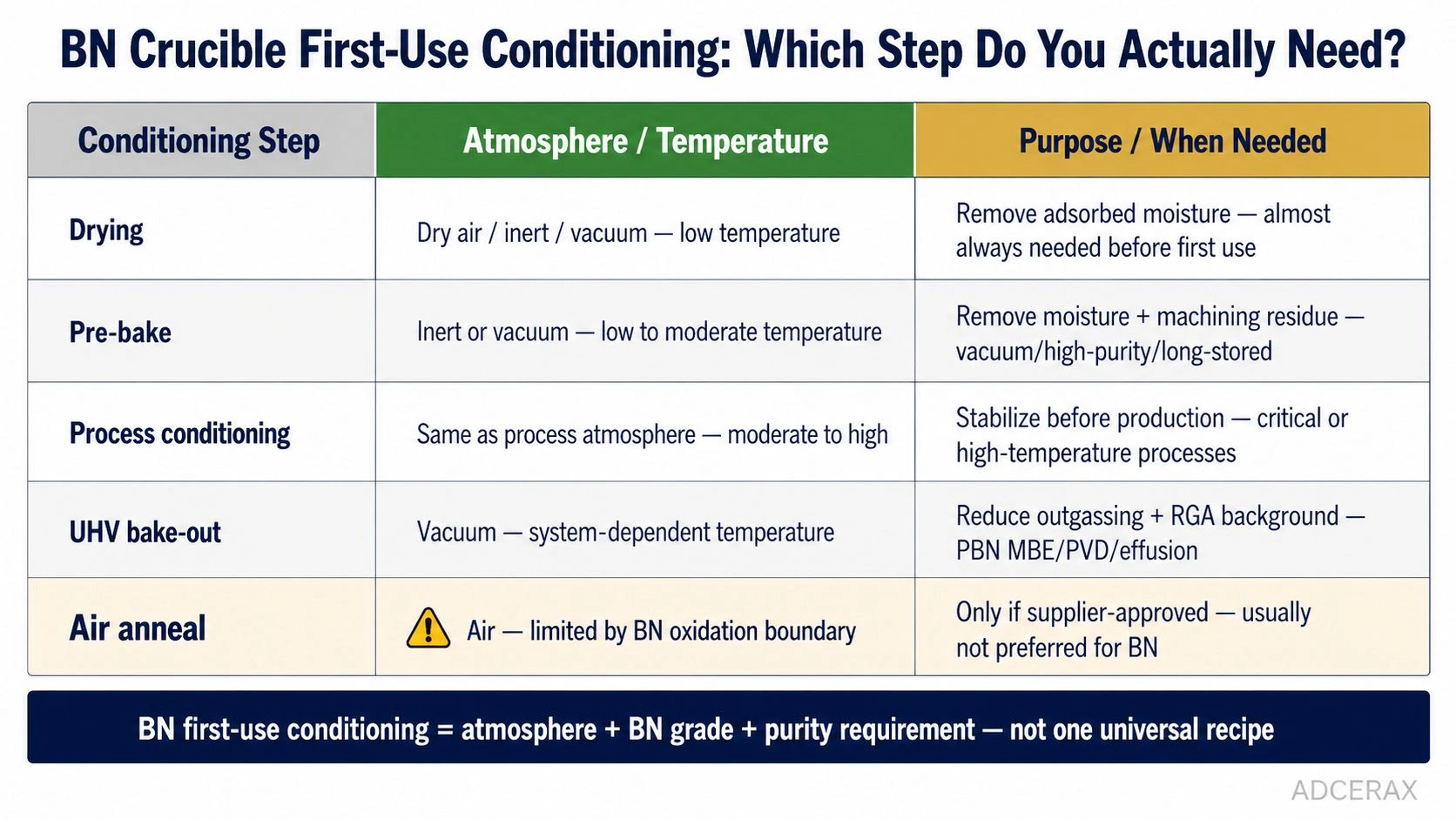
BN crucible first-use conditioning should be selected by atmosphere, temperature, BN grade, and purity requirement — drying, pre-bake, process conditioning, UHV bake-out, and air anneal are different engineering steps, not interchangeable treatments.
Table 1 — BN Crucible First-Use Conditioning Matrix:
| Use case | First-use goal | Recommended direction | Main risk |
|---|---|---|---|
| General inert-gas melting | Remove moisture and surface dust | Slow dry + gradual inert preheat | Thermal shock or moisture outgassing |
| Vacuum melting | Remove moisture and reduce gas load | Vacuum pre-bake before loading | Pump-down delay or contamination |
| Air furnace trial | Avoid oxidation damage | Keep below supplier-approved air limit | BN oxidation and powdering |
| MBE/PVD source | Low outgassing and source cleanliness | PBN bake-out + RGA/blank run | Water, hydrocarbons, source memory |
| Thermal analysis | Stable blank and no false mass change | Empty-crucible conditioning cycle | Blank drift or surface reaction |
| Metal recrystallization | Clean release and low contamination | Dry inert preheat + blank contact test | Oxide/moisture contamination |
| BN liner in graphite crucible | Dry interface and fit stability | Pre-dry liner and host crucible | Trapped moisture at interface |
| Long-stored crucible | Remove absorbed humidity | Extended low-temp dry before high heat | Cracking, spalling, gas release |
Table 2 — Drying vs Pre-Bake vs Annealing:
| Step | Temperature level | Atmosphere | Purpose | When needed |
|---|---|---|---|---|
| Drying | Low | Dry air, inert, or vacuum depending supplier guidance | Remove adsorbed moisture | Almost always before first use |
| Pre-bake | Low to moderate | Preferably inert or vacuum | Remove moisture, light residue, machining contamination | Vacuum, high-purity, or long-stored crucibles |
| Process conditioning | Moderate to high | Same as process atmosphere where possible | Stabilize crucible before production use | Critical or high-temperature processes |
| UHV bake-out | System-dependent | Vacuum | Reduce outgassing and RGA background | PBN MBE/PVD/effusion applications |
| Air anneal | Limited and cautious | Air | Only if supplier-approved | Usually not preferred for BN |
Why air annealing can be dangerous for BN. Several BN use guides explicitly warn against high-temperature air use for hot-pressed BN, limiting air operation to approximately 900°C or below depending on grade. Heating BN in air above this boundary risks surface oxidation — forming B₂O₃, which is liquid above approximately 450°C, flows, and can volatilize — followed by surface powdering, porosity exposure, and potentially the release of boron species into the process environment. An engineer who """"anneals"""" a BN crucible in a 1400°C air box furnace before first use may damage the crucible before the real process begins.
Why first-use conditioning matters for BN crucibles
After establishing what conditioning is, the mechanisms that make it necessary become clearer.
[CITE: NASA's high-temperature oxidation study of monolithic boron nitride found that oxidation rates depend strongly on microstructure — including crystallographic orientation, porosity, crystallinity, and density — and that small amounts of water vapor can contribute to the formation and volatilization of boron oxide species at elevated temperature — while published BN ceramic supplier data commonly lists hot-pressed BN at a much lower allowable temperature in air than in vacuum or inert atmosphere, confirming that BN's practical first-use conditioning must account for both the atmosphere choice and the starting surface moisture level rather than assuming the material is inert in any heating environment.]
Adsorbed moisture and storage humidity. BN, especially hot-pressed grades with higher porosity, can adsorb atmospheric moisture during storage and handling. If a BN crucible is stored in a non-dry environment for months and then rapidly heated to several hundred degrees Celsius, the moisture trapped in pores and at grain boundaries releases suddenly — potentially causing microcracking, surface scaling, or visible steam-like outgassing that contaminates the first melt or processing run.
Machining dust and handling contamination. Hot-pressed BN is machined into final crucible geometry by conventional and diamond grinding techniques. Machining leaves surface dust — both BN particles and tool residue — on the interior surfaces. These particles are fine enough to be invisible in a surface inspection under ambient light, but they will transfer to the first melt if not removed. Dry inspection under bright light, gentle brushing with a clean tool, and alcohol wiping on approved surfaces are the appropriate surface preparation steps.
Oxidation risk above BN's air-use boundary. In air, BN oxidizes progressively above approximately 900°C. The oxidation produces a B₂O₃ surface layer that initially protects the underlying BN, but this layer is fluid at temperatures above 450°C and can run, pool, and volatilize — especially when water vapor is present. For a first-use step, this means any heating of BN above the supplier's stated air limit should be performed under inert gas (argon, nitrogen) or vacuum rather than in ambient air.
Thermal shock from rapid heating. A BN crucible taken directly from room temperature and placed into a furnace at 1200°C experiences a severe thermal gradient across its wall. This is particularly dangerous if the crucible is thick-walled, has enclosed geometry, or is also saturated with moisture that releases steam rapidly. The correct first-use approach is a controlled ramp from room temperature rather than a direct plunge into the target temperature.
Hot-pressed BN vs PBN first-use conditioning
After understanding the general conditioning principles, the grade distinction between hot-pressed BN and PBN determines which conditioning route applies.
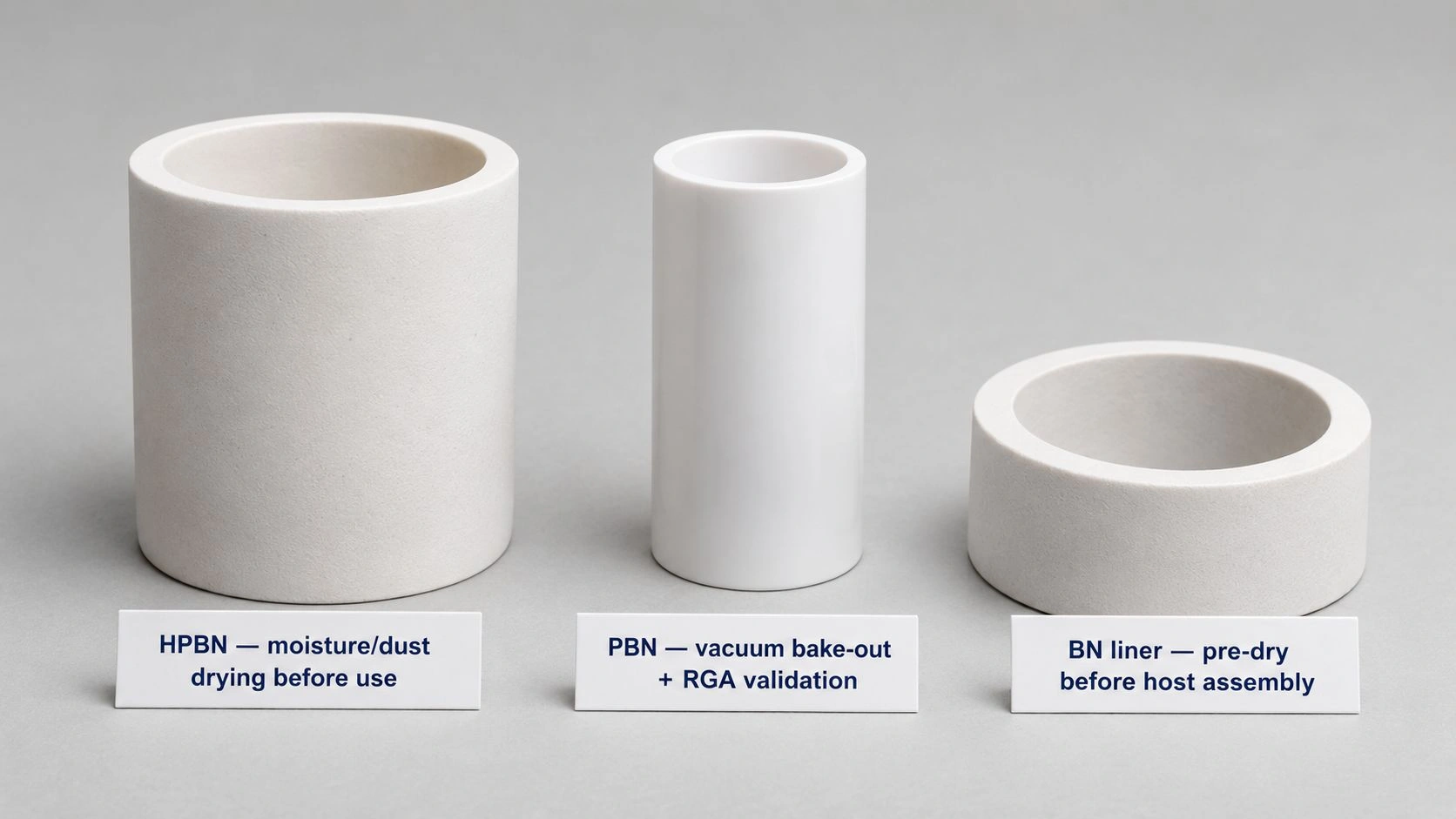
Hot-pressed BN, PBN, and BN liners require different first-use conditioning routes: HPBN focuses on moisture and dust removal, PBN requires vacuum bake-out and validation for UHV source work, and BN liners should be pre-dried before assembly with the host crucible.
The HPBN vs PBN Conditioning table maps the key differences:
| Variable | Hot-pressed BN | PBN | SOP direction |
|---|---|---|---|
| Main first-use risk | Moisture, pores, machining residue | Outgassing, surface contamination, source memory | Match conditioning to grade |
| Typical application | Metal melting, liners, fixtures, sintering | MBE, PVD, evaporation, UHV sources | PBN for UHV/high-purity |
| Cleaning | Dry wipe/alcohol if approved | Clean handling, solvent only if validated | Avoid water cleaning |
| Pre-bake | Useful for moisture removal | Often required for vacuum source work | Define by atmosphere |
| Inspection | Cracks, chips, loose dust | Chips, delamination, surface residue | Inspect before heating |
| Validation | Blank melt or mass check | RGA/flux/blank source run | Application-specific acceptance |
| Storage | Dry sealed storage | Clean dry storage | Avoid humid exposure |
Hot-pressed BN for machinable pre-purification and metal processing. The hot-pressed BN vs PBN comparison at ADCERAX distinguishes the two materials by manufacturing route, purity, density, and gas permeability. For hot-pressed BN, first-use conditioning focuses on the porous microstructure that can trap moisture and the machined surface that carries dust. A practical sequence is: inspect for cracks and chips → remove visible dust with a clean dry brush or dry cloth → heat gradually from room temperature under inert gas or vacuum → dwell at a moderate temperature to complete moisture removal → advance to process temperature.
PBN for UHV, MBE, and high-purity evaporation. The PBN crucibles at ADCERAX are produced by CVD with a dense, high-purity wall structure designed for low-outgassing in UHV environments. First-use conditioning for PBN in MBE/PVD service is more structured than a simple pre-heat — it is a qualification step. Published MBE source preparation references describe PBN crucibles being outgassed for extended periods in preparation chambers before source material is loaded, confirming that for high-purity source work, the bake-out is a multi-step validation, not a single thermal event.
BN liners inside graphite or metal host crucibles. The BN liner used as a non-reactive barrier inside a graphite or metal crucible has its own first-use concern: the interface between the liner and the host. If either the liner or the host is wet, the trapped moisture will release during heating and can cause the liner to loosen, the host to crack, or the melt to contaminate. Pre-drying both the liner and the host crucible separately before assembly is the appropriate preparation sequence.
Common first-use mistakes that damage BN crucibles
Even with the correct conditioning concept, specific handling mistakes frequently cause early BN crucible failures that are then attributed to material quality rather than process control.
Washing BN with water. Published BN use guides from multiple suppliers warn against washing BN crucibles with water or storing them in wet environments. BN can absorb moisture, and once moisture is trapped in the pore structure, it creates outgassing, microcracking, and surface change risks. The correct cleaning approach is dry wiping, compressed air (clean dry), or alcohol cleaning with a validated solvent if surface contamination requires chemical assistance.
High-temperature air annealing. Heating a BN crucible to 1200°C in a box furnace open to air, intending to """"season"""" or """"clean"""" it, may oxidize the outer surface, create B₂O₃ flow, roughen the inner bore, and weaken the surface before the crucible sees its first intended process. This approach is especially damaging if the crucible is then used for metal evaporation or thermal analysis where clean blank values are required.
Fast ramp after humid storage. A hot-pressed BN crucible that has been in a warehouse for 12 months in a non-dry environment may contain significant adsorbed moisture. Placing this crucible directly into a 1000°C furnace ramp creates a rapid moisture release that can cause surface crazing, microcracking, or in a worst case spalling — all appearing as """"material failure"""" when the actual cause is improper first-use procedure.
First-run contamination in high-purity processes. For thermal analysis, gallium purification, crystal growth, or vacuum evaporation, the first melt or deposition run is almost always the noisiest in terms of crucible-derived contamination. Using the first run for critical purity data, without a preceding blank test, creates a higher probability that the first-run result reflects crucible conditioning noise rather than the real process performance.
RFQ and SOP checklist for BN crucible first-use conditioning
A complete RFQ for BN crucible first-use conditioning requirements must provide the BN grade context and the process atmosphere — without both, the supplier cannot confirm the appropriate conditioning temperature, atmosphere, validation method, or whether the crucible should arrive in a pre-dried, pre-baked, or clean-packed state.
[CITE: Engineering and laboratory guidance on BN crucible first-use conditioning confirms the complete specification and SOP sequence: BN type (hot-pressed BN/PBN/BN liner/BN composite), storage condition and humidity history, process atmosphere (air/Ar/N₂/vacuum/reducing/UHV), peak operating temperature with ramp rate and dwell, melt or sample chemistry, purity target (routine lab/high-purity/UHV/MBE), cleaning method with water exclusion confirmation, pre-bake temperature and atmosphere recommendation from supplier, blank run or validation method (mass check/RGA/ICP), and clean dry packaging with lot traceability — because atmosphere, purity requirement, and BN grade together determine the correct conditioning sequence, and a supplier who receives only """"BN crucible for high-temperature use"""" cannot recommend the appropriate drying temperature, bake-out atmosphere, or blank validation protocol without the remaining process context.]
| RFQ field | Why it matters | Recommended wording |
|---|---|---|
| BN type | HPBN and PBN condition differently | """"Hot-pressed BN/PBN/BN liner/BN composite"""" |
| Storage history | Determines moisture risk | """"New, long-stored, exposed to humidity, or dry packed"""" |
| Atmosphere | Primary compatibility driver | """"Air/Ar/N₂/vacuum/reducing/UHV"""" |
| Max temperature | Defines oxidation and shock boundary | """"Peak temperature, dwell, ramp rate"""" |
| Sample/melt | Controls reaction and contamination | """"Metal, salt, oxide, alloy, powder, source material"""" |
| Purity target | Defines validation level | """"Routine lab/high-purity/UHV/MBE"""" |
| Cleaning method | Prevents moisture and residue | """"Dry wipe, alcohol, solvent, no water cleaning"""" |
| Pre-bake request | Converts advice into SOP | """"Supplier to recommend drying and pre-bake schedule"""" |
| Blank run | Confirms first-use stability | """"Mass/RGA/ICP blank before production use"""" |
| Packaging | Protects dried crucible | """"Dry sealed package, lot label, clean handling"""" |
RFQ fields are the minimum for a BN crucible first-use conditioning specification; add maximum safe air temperature, vacuum outgassing data availability, and lot-specific RGA data for UHV/MBE applications.
A practical first-use SOP that applies across most non-UHV BN crucible applications is: inspect for cracks, chips, and loose dust → remove surface dust with a clean dry brush → heat gradually from room temperature under inert gas or in a dry inert atmosphere → dwell at a moderate hold temperature to drive off moisture → advance to process temperature → run an empty-crucible blank before loading the first production charge. For PBN in UHV or MBE service, the sequence continues: vacuum bake-out → RGA confirmation of background → source material loading only after the blank signal is clean.
Evaluating first-use conditioning for BN or PBN crucibles? Share your BN grade, storage condition, process atmosphere, peak temperature, ramp rate, melt or source material, vacuum requirement, purity target, and cleanliness requirement. ADCERAX can review whether dry preheating, inert pre-bake, vacuum bake-out, blank testing, or a PBN-specific conditioning route fits the process; turnaround depends on inquiry complexity — no commitment required at this stage.
Frequently Asked Questions
Should BN crucibles be annealed before first use?
Yes, in the sense that first-use conditioning — drying, pre-baking, or vacuum bake-out depending on the grade and application — is almost always beneficial. The word """"annealing"""" can be misleading because it implies a specific high-temperature microstructure treatment, when for most BN crucible applications the goal is moisture removal and machining residue elimination, not phase stabilization. The atmosphere is the most critical variable: conditioning under inert gas or vacuum is safer than conditioning in air for most BN grades.
Can BN crucibles be annealed in air?
Only within the supplier's stated air-temperature limit, which for hot-pressed BN is commonly around 850–1000°C depending on grade. Above this temperature in air, BN oxidizes progressively, forming a liquid boron oxide layer that can flow, volatilize, and roughen the surface. NASA research confirms that water vapor significantly accelerates this volatilization. High-temperature air annealing as a first-use step is generally not recommended for BN crucibles.
Can BN crucibles be washed before first use?
Water washing should be avoided unless the supplier explicitly provides a validated drying-and-bake-out procedure that follows the wash step. BN can absorb moisture, and several published use guides from BN suppliers warn against wet storage or water washing. Dry wiping, clean compressed air, or approved solvent cleaning are safer alternatives.
Is PBN first-use conditioning different from hot-pressed BN?
Yes. Hot-pressed BN conditioning focuses primarily on moisture removal and surface dust from machining. PBN conditioning for UHV, MBE, or PVD service is a structured validation — vacuum bake-out with RGA monitoring, often over many hours, before source material is loaded. PBN's low-outgassing advantage is only achieved if handling, storage, bake-out, and validation are all controlled.
What happens if first-use conditioning is skipped?
Possible consequences include moisture-related outgassing that contaminates the first melt or deposition run, microcracking from rapid moisture release during sudden heating, surface powdering in air above BN's oxidation limit, slow pump-down in vacuum systems, high water and hydrocarbon peaks in RGA background, and unstable source behavior in the first evaporation campaign.
What information should I send to a supplier about first-use conditioning?
Send BN type (hot-pressed BN, PBN, or BN liner), storage condition and any humidity exposure history, the process atmosphere, peak operating temperature and ramp rate, melt or source material chemistry, purity target, vacuum level if applicable, preferred cleaning method, and whether a blank run or RGA validation is planned before the first production use. The supplier can then recommend the appropriate drying temperature, pre-bake atmosphere, and conditioning schedule for the specific grade and process."