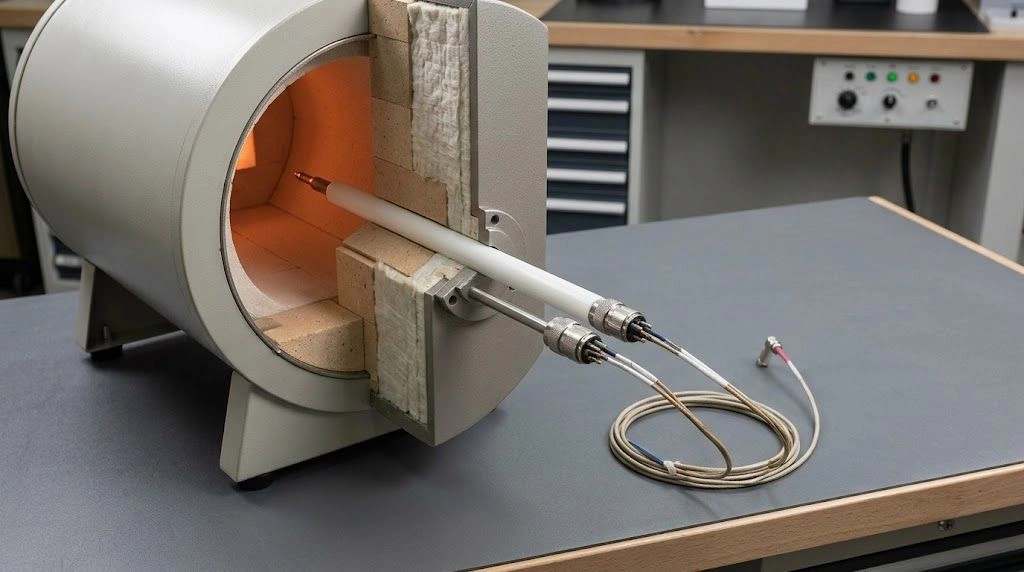
A crucible blank test checks whether sample preparation introduces measurable background. The actual sample is omitted, or replaced with an appropriate blank matrix containing no intentionally added target analyte, while selected treatment steps are reproduced. Background may come from the crucible, furnace, reagents, tools, cooling environment, or measurement system.
This primarily investigates process-introduced contamination—not contaminants already present in the sample. An empty blank cannot test reagents it never receives, and a mass change cannot identify an element. Effective diagnosis starts by defining the blank’s exposure and measurement boundaries.
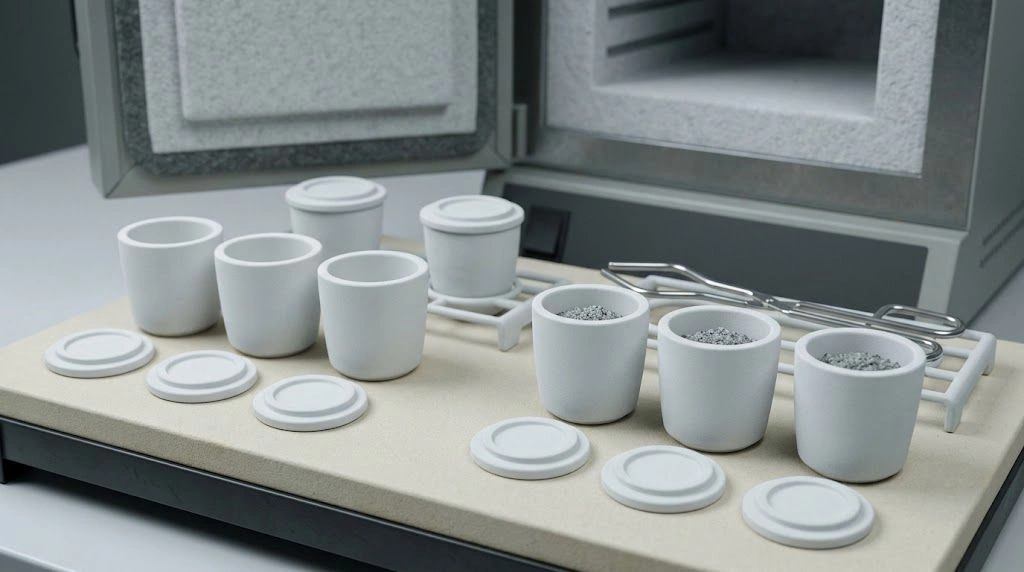
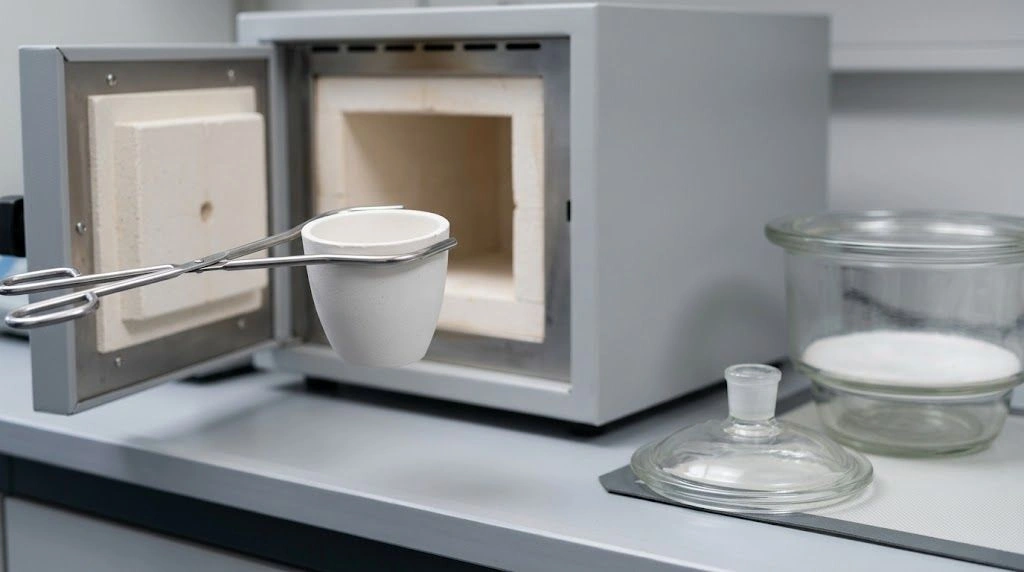
Matched empty and sample-loaded crucibles allow comparison of process background with the complete sample system.
What Is a Crucible Blank Test?
“Crucible blank” is a laboratory description, not necessarily a standardized blank category. It may mean an empty vessel taken through heating, a reagent-containing vessel without sample, or a complete method blank prepared in a crucible. Those configurations answer different questions.
Document what is absent, what is present, which equipment is contacted, which heating and cooling steps occur, and what is measured. Also identify the governing acceptance criterion. Without this definition, two analysts may report “blank results” that represent different exposures.
A tare is a mass reference; a blank is a quality-control sample. A crucible can sometimes serve both roles, but the roles are not interchangeable.
Gravimetric versus chemical measurement
A gravimetric blank measures net mass change:
[
\Delta m{\text{blank}} =
m{\text{final blank}} - m_{\text{initial blank}}
]
Compare the same defined assembly before and after treatment, including the same lid when required. Positive change can reflect deposition, moisture uptake, or oxidation of susceptible constituents. Negative change can reflect residue removal, volatilization, or material loss.
An elemental blank instead measures selected contaminants in an extract, digest, or processed blank solution. ICP-MS, ICP-OES, AAS, or another suitable technique may be used, depending on the analyte and method. Extraction recovery, matrix effects, detection capability, and contamination from the extraction itself must be controlled.
Zero net mass change does not establish chemical cleanliness. Trace contamination can matter below gravimetric sensitivity, and simultaneous mass gains and losses may cancel.
| Configuration | Included exposure | Can reveal | Cannot establish alone |
|---|---|---|---|
| Heated empty crucible | Vessel, furnace, cooling, handling | Mass drift or deposited background | Reagent contamination |
| Unheated crucible extraction | Vessel and extraction procedure | Extractable target contaminants | Furnace-derived background |
| Reagent blank in crucible | Vessel, reagents, defined processing | Combined preparation background | Which component contributed it |
| Full method blank | Applicable preparation and measurement stages | Cumulative no-sample background | Contamination originally in the sample |
| Reference crucible or tare | Defined weighing/environmental exposure | Apparent-mass drift | Chemical identity |
Which Blank Test Finds Which Contamination Source?
Match the blank to the exposure path. A blank can only test materials, equipment, and stages it actually encounters.
For example, an empty furnace-exposure blank can reveal changes associated with heating and subsequent handling. It does not test a flux added only to samples. Conversely, a reagent blank that bypasses heating cannot evaluate thermal deposition.
Names also vary between methods. EPA Method 200.8 defines its laboratory reagent blank as a blank matrix exposed to the sample’s relevant labware, equipment, and reagents, including applicable preparation. Thus, “reagent blank” does not always mean a reagent tested straight from its bottle. EPA Method 200.8, Sections 3.10 and 7.6.2
| Control | Principal exposure | Measurement | Diagnostic purpose |
|---|---|---|---|
| Conditioned-crucible stability check | Repeated prescribed conditioning | Mass | Establish stable tare behavior |
| Furnace-exposure blank | Furnace plus controlled cooling/transfer | Mass or elemental | Investigate thermal change and deposits |
| Handling control | Tools, storage, bench workflow, desiccator | Mass or elemental | Investigate environmental introduction |
| Reagent control | Defined reagents and contacted labware | Relevant final measurement | Investigate reagent/preparation background |
| Full method blank | All applicable routine stages without sample | Full measurement | Evaluate integrated process background |
| Matched lot comparison | Same exposure across crucible lots | Mass or elemental | Investigate repeatable lot differences |
| Fortified blank | Deliberate known analyte addition | Recovery | Evaluate recovery, not background alone |
An empty-crucible blank cannot reproduce sample-driven melting, corrosion, or chemical attack. It also cannot establish analyte recovery or rule out matrix-dependent instrument interference. A passing empty blank is therefore one piece of evidence, not approval of the entire sample method.
For trace-element work, include the instrument controls specified by the method. A preparation blank and a calibration or rinse blank serve different purposes; a signal that appears during final analysis may involve instrument background or carryover rather than the ceramic vessel.
How Should a Positive or Unstable Crucible Blank Be Interpreted?
Interpret magnitude, direction, variability, timing, and relevance to the sample result together. A nonzero response does not automatically identify a defective crucible. A small average does not establish control if individual blanks vary widely.
Compare results on the method’s reporting basis. Mass per crucible, concentration in an extract, and concentration referred to the original sample are not interchangeable. Extraction volume, dilution, and sample-mass normalization can change the apparent importance of the same contaminant contribution.
| Result pattern | Possible meaning | Next check |
|---|---|---|
| Small, repeatable positive response | Stable process background | Compare with method limits and correction rules |
| Large, repeatable positive response | Persistent contamination | Isolate the source; do not assume correction permits acceptance |
| Low average, wide scatter | Intermittent contamination or poor control | Examine individual results and exposure records |
| Progressive mass gain | Deposits, moisture, or oxidation | Compare furnace and cooling/handling exposures |
| Progressive mass loss | Residue removal, volatilization, or damage | Inspect surfaces and verify thermal history |
| Sudden excursion | Particle, chip, spill, or handling event | Investigate and document; do not average it away |
| Element detected without mass change | Trace background below balance sensitivity | Evaluate with the target-element method |
| Mass change without target-element increase | Moisture or another species | Investigate chemistry and weighing conditions |
| Blanks pass but samples remain abnormal | Sample-intrinsic analyte, interaction, or matrix effect | Use appropriate reference and matrix controls |
One blank cannot establish a normal distribution or characterize intermittent contamination. Use the replicate design and routine frequency specified by the method or validated quality plan. Historical control charts can help distinguish a sustained shift from isolated variation, provided the blank configuration has remained comparable.
Should the blank be subtracted?
Only when the governing method permits or requires it. Before correction, verify that the blank represents sample exposure, the background is sufficiently stable, and applicable rejection limits have not been exceeded. Account for blank uncertainty; subtraction does not remove uncertainty or repair unpredictable contamination.
A corrected negative result is not evidence of “negative contamination.” Follow the method’s reporting rules and investigate whether background variability dominates the measurement.
As a hypothetical diagnostic example, suppose replicated full-method blanks show similar elevated responses while furnace-exposure blanks remain low. Reagents, transfer labware, and additional preparation stages become priorities. This narrows the investigation but does not prove that a particular reagent is responsible.
How Can Staged Blank Tests Locate the Contamination Source?
Add or vary one exposure at a time using matched controls. Run comparisons concurrently where practical, and replicate them sufficiently for the quality plan. Changing the furnace, cleaning procedure, crucible lot, and operator together makes attribution difficult.
- As-received assessment: Use a defined extraction or measurement to investigate storage and packaging background. This does not represent the cleaned, production-ready condition.
- Cleaned and conditioned baseline: Check repeatable tare behavior and whether cleaning introduces or removes background. Include extraction-reagent controls where relevant.
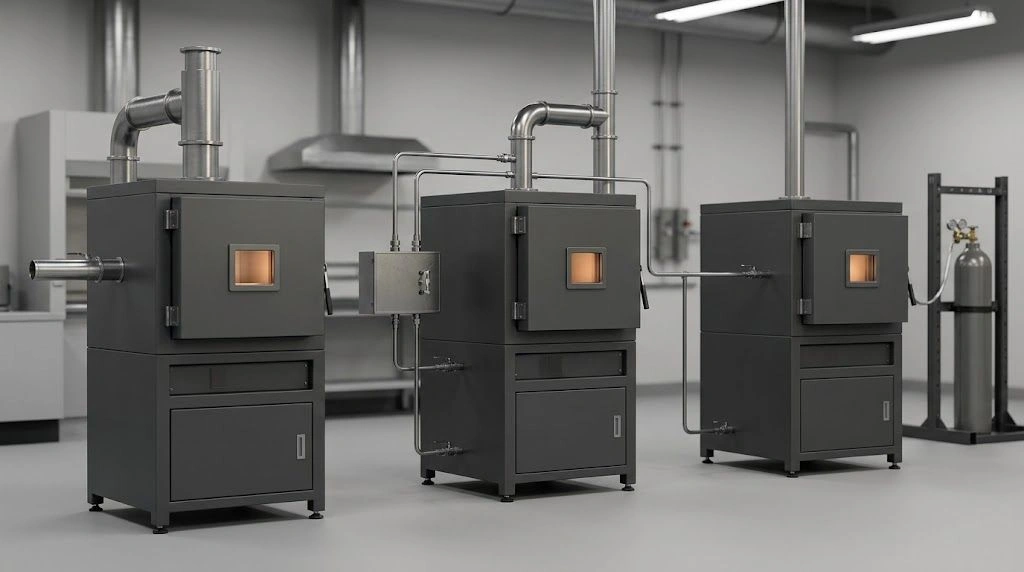
- Furnace exposure: Apply the prescribed thermal cycle with controlled cooling and handling. Compare positions and review previous furnace loads.
- Cooling and handling comparison: Examine desiccator, tongs, storage, and transfer exposure against an appropriate matched control. Maintain safe, method-compatible temperature equilibration.
- Reagent addition: Introduce the normal reagents without sample, then investigate individual reagents if background increases.
- Full method blank: Run the complete applicable no-sample procedure through final measurement.
- Sample-specific controls: Use a suitable matrix blank, spike, reference material, or qualified alternative vessel to investigate effects absent from an empty blank.
“Furnace-only” is shorthand: retrieving and measuring the crucible necessarily adds other exposures. Keep those downstream steps matched before attributing a difference to the furnace.
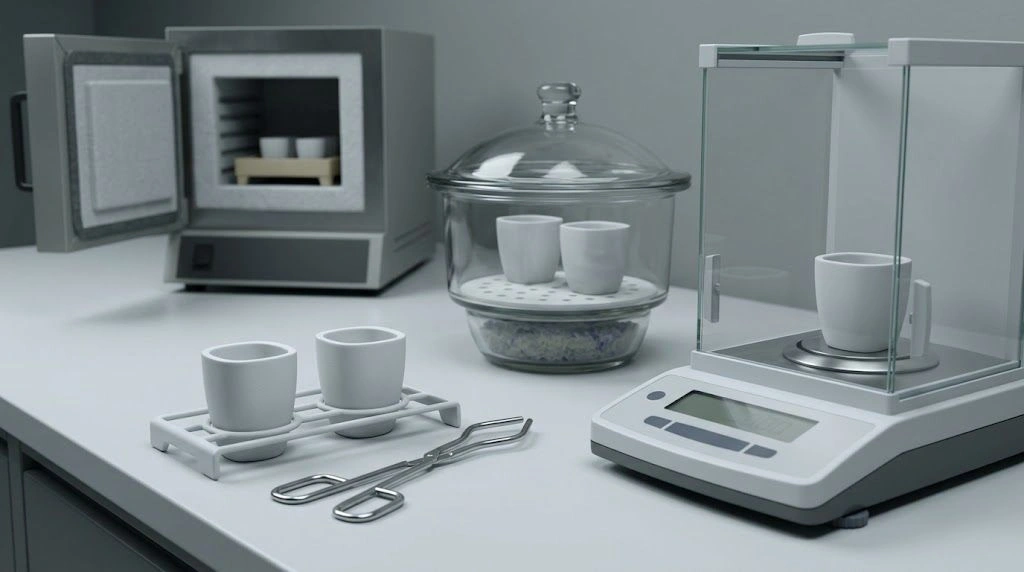
Staged controls help distinguish furnace exposure from cooling, handling, and weighing effects.
| Suspected source | Useful comparison | Supporting observation | Confirmation |
|---|---|---|---|
| Crucible surface | Matched extracts before/after cleaning | Target background changes after cleaning | Analyze extract and extraction blank |
| Furnace | Unheated versus furnace-exposed controls | Increase associated with heating | Analyze deposits; repeat controlled run |
| Furnace position | Matched blanks across positions | Repeated spatial pattern | Repeat mapped comparison |
| Tools | Minimal versus routine tool contact | Increase follows contact | Appropriate tool extraction control |
| Desiccator | Matched controlled cooling exposures | Change associated with a particular chamber | Check chamber, desiccant, and transfer |
| Reagents | Thermal blank versus reagent-containing blank | Increase after reagent processing | Individual reagent/labware controls |
| Sample interaction | Passing blanks versus abnormal loaded vessels | Effect requires sample exposure | Qualified alternative vessel and residue analysis |
| Production lot | Replicated matched lots | Consistent between-lot difference | Expanded qualification study |
Copyable blank-test record
| Blank ID/type | Crucible lot | Cleaning | Furnace position | Temperature/time | Atmosphere | Cooling/handling | Initial mass | Final mass | Mass change | Target analyte/unit | Acceptance | Observation |
|---|---|---|---|---|---|---|---|---|---|---|---|---|
Record the method revision, balance/instrument identity, extraction volume, dilution, timestamps, and deviations with this worksheet.
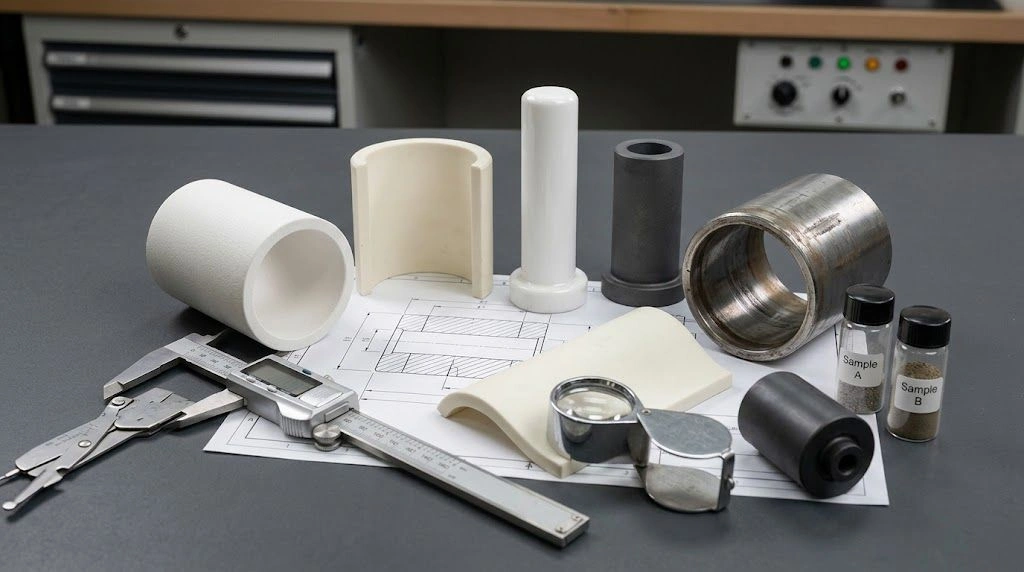
For material or lot comparisons, control geometry, exposed area, wall thickness, cleaning, conditioning history, furnace location, atmosphere, reagent volume, and analytical preparation. Where materials make exact matching impossible, document the differences rather than presenting the comparison as fully controlled.
When an alumina route matches the method, compare alumina crucibles using required purity, geometry, temperature, atmosphere, and contamination limits rather than purity percentage alone.
Bulk purity does not specify surface residue, every trace element, or release under actual exposure. Minor constituents, processing residues, cleaning, packaging, and sample chemistry all require application-specific review.
Expert Insight: Define the Boundary Before Blaming the Material
A blank result describes an experimental configuration. It is not a material certificate. If a cleaned empty crucible gives a low response, the supported conclusion concerns that vessel, exposure, and measurement—not every sample later placed inside it.
Keep mass stability and elemental cleanliness separate. A vessel may have stable total mass while releasing a critical trace element into an extract. Conversely, moisture uptake may change mass without increasing the element being measured. Both results can be valid because the measurements address different quantities.
The same discipline applies to staged testing. A new response after heating implicates the added exposure, but that exposure includes temperature-dependent vessel behavior as well as furnace deposits. Confirmatory chemical measurements and matched cooling controls help separate these explanations.
Finally, preserve the original process while investigating it. Omitting a flux or changing the crucible material may be useful diagnostically, but the altered run does not automatically qualify as a valid reportable sample analysis.
What Should Be Specified for Low-Contamination Crucible Selection?
“High-purity” is not a complete purchasing requirement. State which contaminants matter, their allowable contribution, and how that contribution will be measured. A crucible suitable for gravimetric ash work may not meet a trace-element preparation requirement.
Distinguish bulk composition, surface extract, and processed-blank specifications. They are different tests. Define detection or quantification capability, reporting units, replication, and lot acceptance rather than asking for an undefined “contamination-free” component.
| Requirement group | Include in the inquiry |
|---|---|
| Analytical purpose | Ash, residue, ignition loss, or elemental preparation; method/revision |
| Contamination limits | Target species, permitted contribution, units, test basis, detection capability |
| Chemistry | Sample constituents, reagents, fluxes, possible melts and reactive species |
| Thermal exposure | Working/peak temperature, hold, ramps, atmosphere, cleaning cycle, reuse |
| Geometry | Capacity, load, OD/ID, height, wall/base, lid/vent, equipment fit |
| Qualification | Replicates, lot-acceptance rule, correction policy, required evidence |
| Supply details | Lot identity, cleaning, packaging, documents, trial and repeat quantities |
Do not assume every requested trace-element limit can be certified. Agree on available evidence and qualification testing before ordering. A change in sample chemistry, cleaning, or reuse conditions may require renewed assessment.
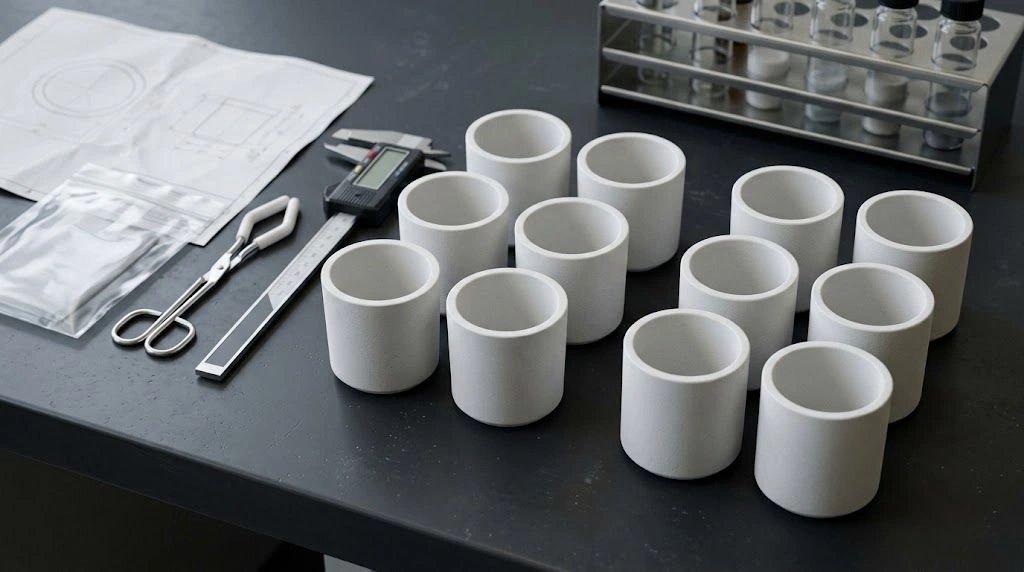
Lot comparisons require controlled geometry and exposure alongside relevant chemical blank measurements.
Copyable RFQ
Subject: RFQ — Low-Contamination Ceramic Crucibles
Application:
Applicable method/SOP and revision:
Downstream analytical technique:
Sample constituents, reagents, fluxes and possible melts:
Critical contamination requirements:
- Target elements/compounds:
- Maximum permitted blank contribution and units:
- Required detection/quantification capability:
- Test basis: bulk composition / surface extract / processed blank
- Replicate count and lot-acceptance rule:
- Method-permitted blank correction, if any:
Thermal conditions:
- Working and peak temperature:
- Hold time and heating/cooling rates:
- Atmosphere and furnace type:
- Expected reuse and cleaning cycles:
Crucible requirements:
- Preferred material/grade:
- Capacity and sample load:
- OD / ID / height:
- Wall/base dimensions and tolerances:
- Lid/vent and handling constraints:
- Maximum combined mass for balance:
- Prototype and repeat quantities:
Cleaning and supply:
- Laboratory cleaning procedure:
- Requested supplier cleaning:
- Packaging restrictions:
- Lot identification:
- Required composition/inspection documents:
Attachments: drawing / part photographs / method / blank data
Frequently Asked Questions
Does a blank identify contamination already in the sample?
No. A no-sample blank evaluates process background. Sample-intrinsic contamination requires sample analysis and suitable reference or matrix controls.
Can a clean-looking crucible fail an elemental blank?
Yes. Relevant trace contamination can be invisible and below gravimetric sensitivity.
Does high alumina purity guarantee a low blank?
No. Nominal purity does not establish target-element release, surface cleanliness, or compatibility with the actual sample.
How many blanks are necessary?
Follow the applicable method and validated quality plan. Replicated investigations are needed to characterize variability; one result cannot establish normal performance.
Can I subtract an unstable blank average?
Do not assume so. A variable average may poorly represent individual samples. Apply the method’s investigation, rejection, correction, and reporting rules.
Conclusion
Crucible blank tests reveal background only within their defined exposure and measurement boundaries. Separate tare drift from elemental contamination, use matched staged controls, and investigate variability before considering correction.
Send ADCERAX the method, target contaminants, blank requirements, chemistry, furnace conditions, and drawing for component review. The laboratory remains responsible for qualifying the complete analytical process and deciding whether results meet its method.