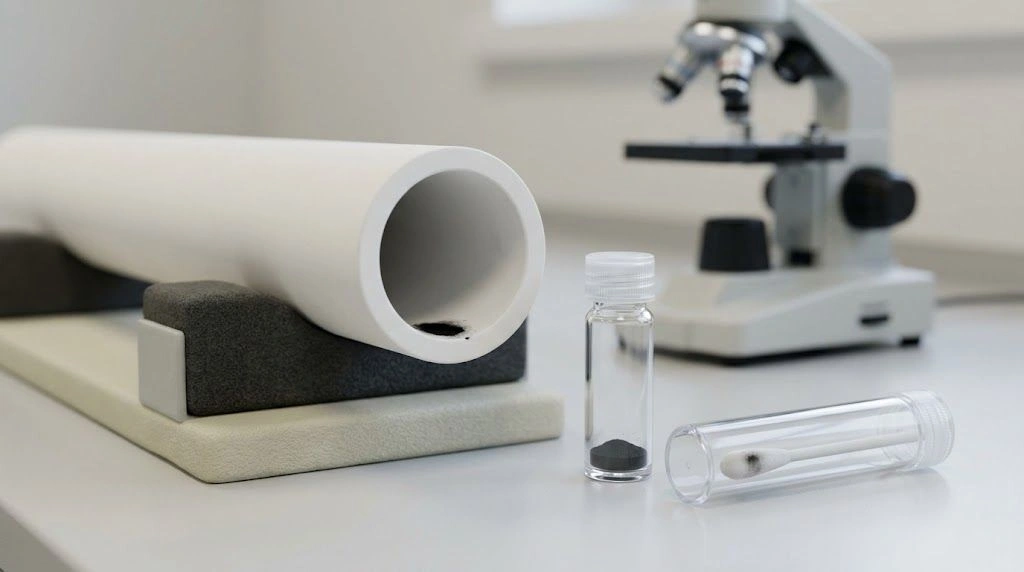
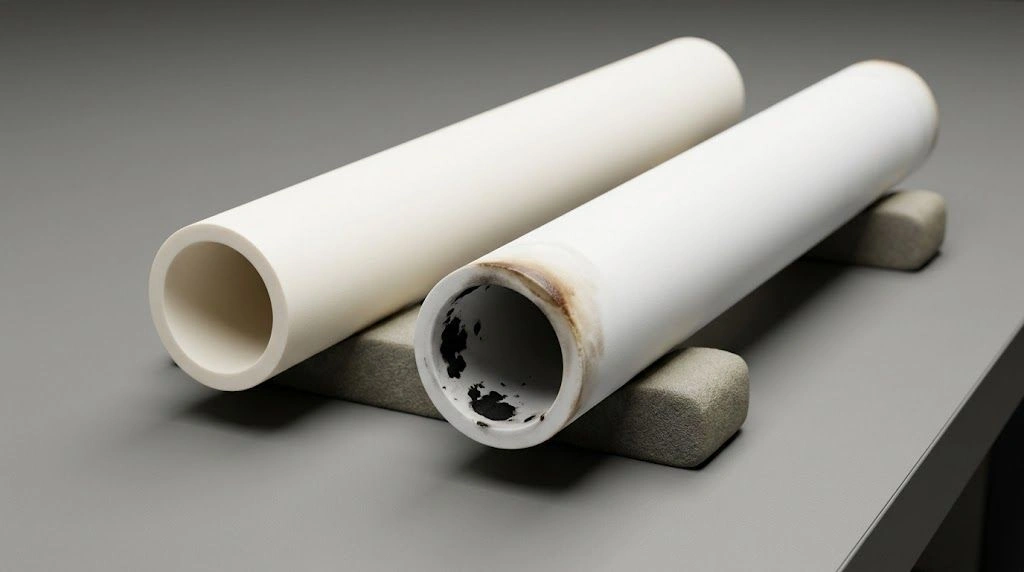
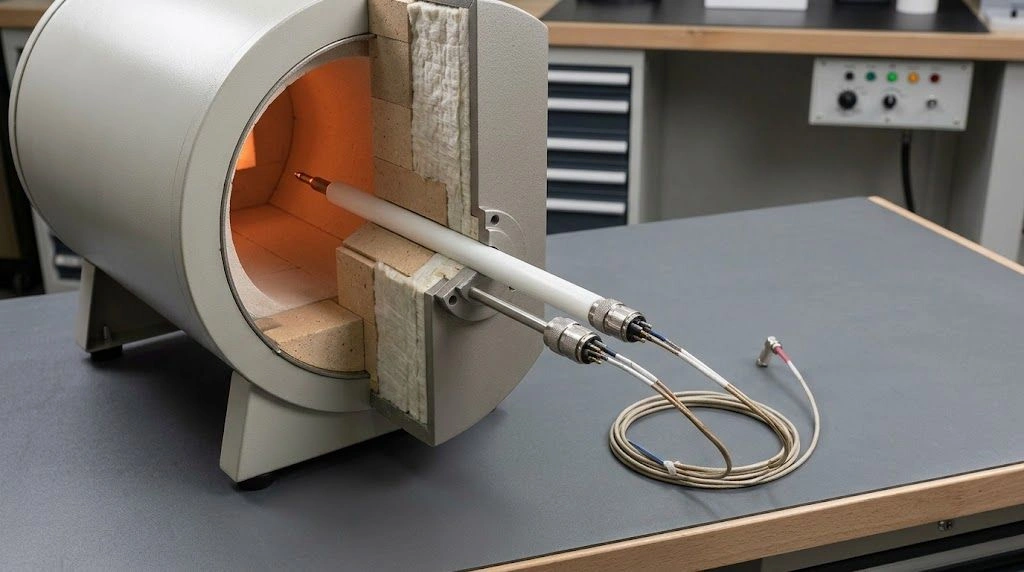
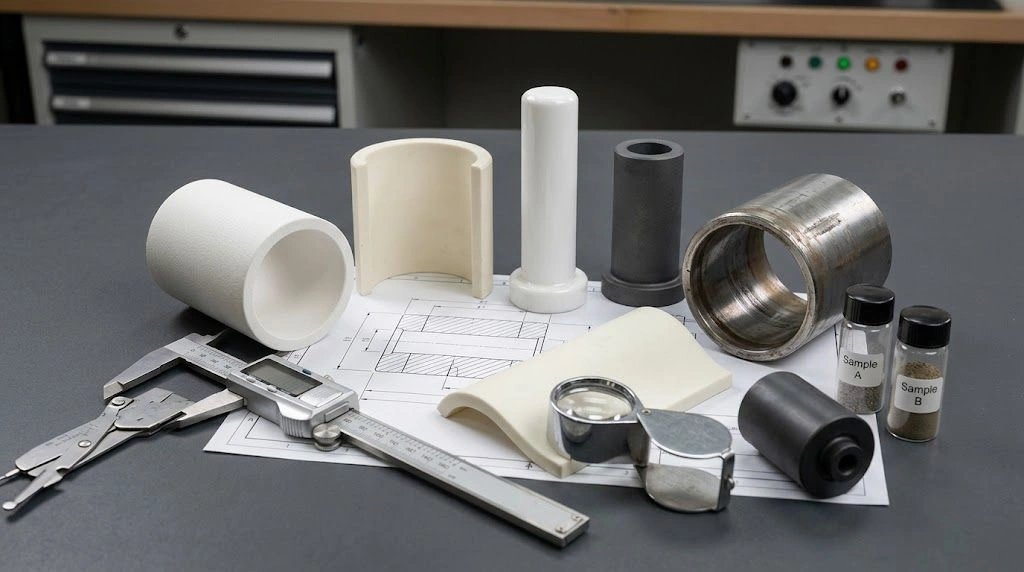
To qualify a new ceramic supplier, do not start with price. Start with material-grade capability, application understanding, drawing review, manufacturability feedback, sample production, first article inspection, batch consistency, documentation, packaging, and change control. A reliable ceramic supplier should confirm the correct ceramic route for the application, explain tolerance risks before production, provide dimensional and material documentation, support pilot-batch validation, and agree not to change powder source, forming method, firing process, machining sequence, or inspection standard without buyer notification. A supplier who accepts every requirement without questions is more likely over-promising than properly engaged.
That qualification-over-price framing — treating the supplier as a manufacturing partner, not a price source — is the engineering basis for this guide.
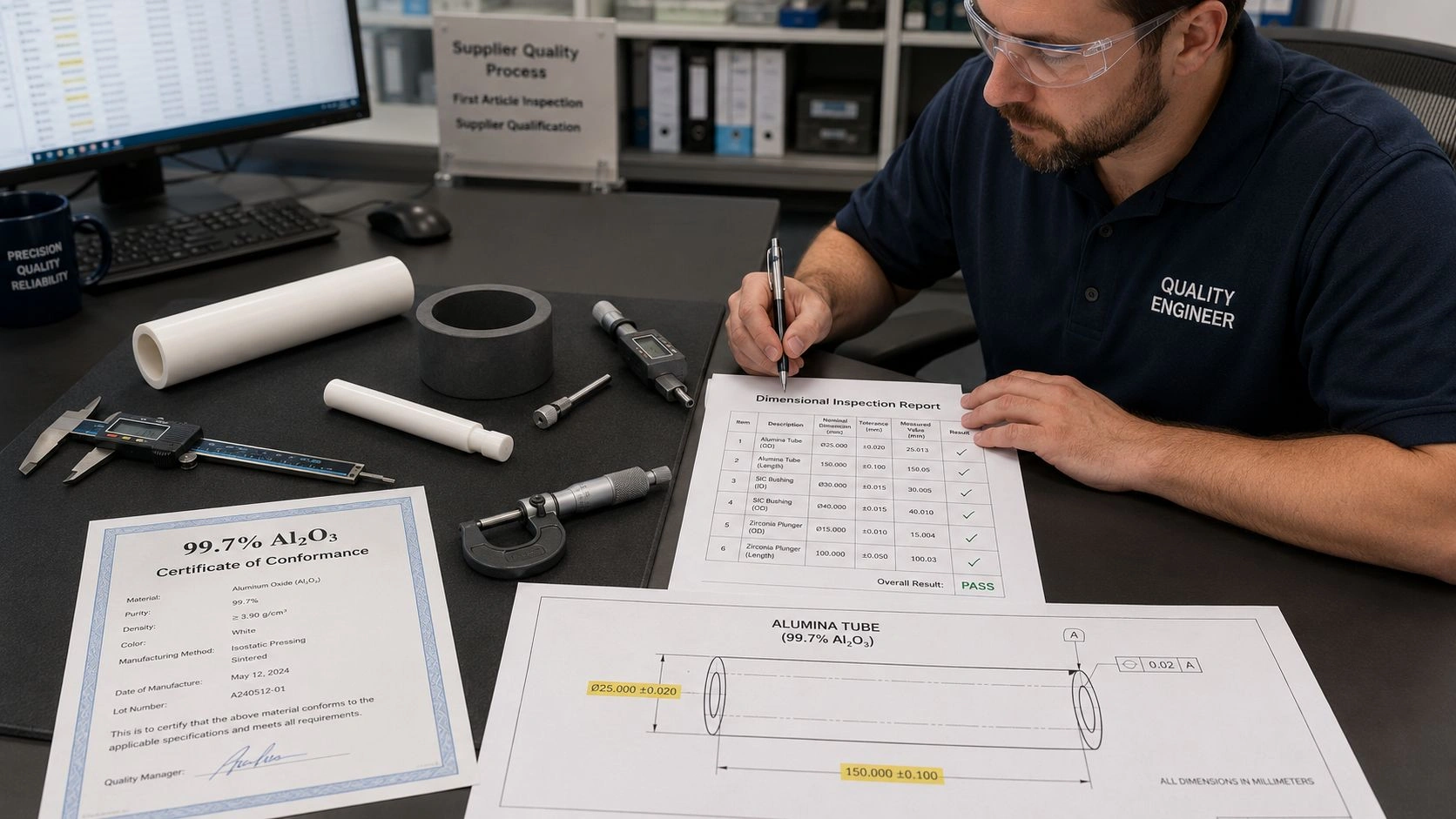
Qualifying a new ceramic supplier requires structured steps from application review through first article inspection, pilot batch validation, and production change control — not just a low-price quote and a good first sample.
The custom ceramic parts manufacturing service at ADCERAX — covering drawing-based custom ceramic manufacturing from 3-piece MOQ, material grade selection, sample production, dimensional inspection reports, material certificates, and optional third-party testing — provides the production context for the qualification process described in this guide.
Start with application fit, not supplier price
The first question to ask a new ceramic supplier is not what they charge. It is what they understand about the part's service environment — because a ceramic that costs 30% less but fails in six months from the wrong material grade or porosity costs far more than the price difference.
The New Ceramic Supplier Qualification Checklist below maps the full qualification sequence:
| Qualification step | What to check | Why it matters | Pass evidence |
|---|---|---|---|
| Application review | Temperature, load, chemistry, wear, insulation | Prevents wrong material route | Written engineering recommendation |
| Material capability | Alumina, zirconia, SiC, BN, Si₃N₄, AlN, ZTA | Confirms supplier can choose, not guess | Material list and grade data |
| Drawing review | Datum, tolerances, wall thickness, edge radius | Prevents impossible ceramic design | DFM comments |
| Sample production | 1–5 first articles | Tests real manufacturability | Sample parts + inspection report |
| First Article Inspection | Critical dimensions and documentation | Confirms process matches design intent | FAIR/dimensional report |
| Pilot batch | Repeatability across multiple parts | Prevents one-sample approval risk | Batch inspection summary |
| Quality system | Documentation, traceability, process records | Supports repeat orders | ISO/QMS evidence or quality manual |
| Packaging | Edge protection and export packaging | Prevents shipping chips and cracks | Packaging photos/standard |
| Change control | No silent material/process changes | Protects production consistency | Written change-notification clause |
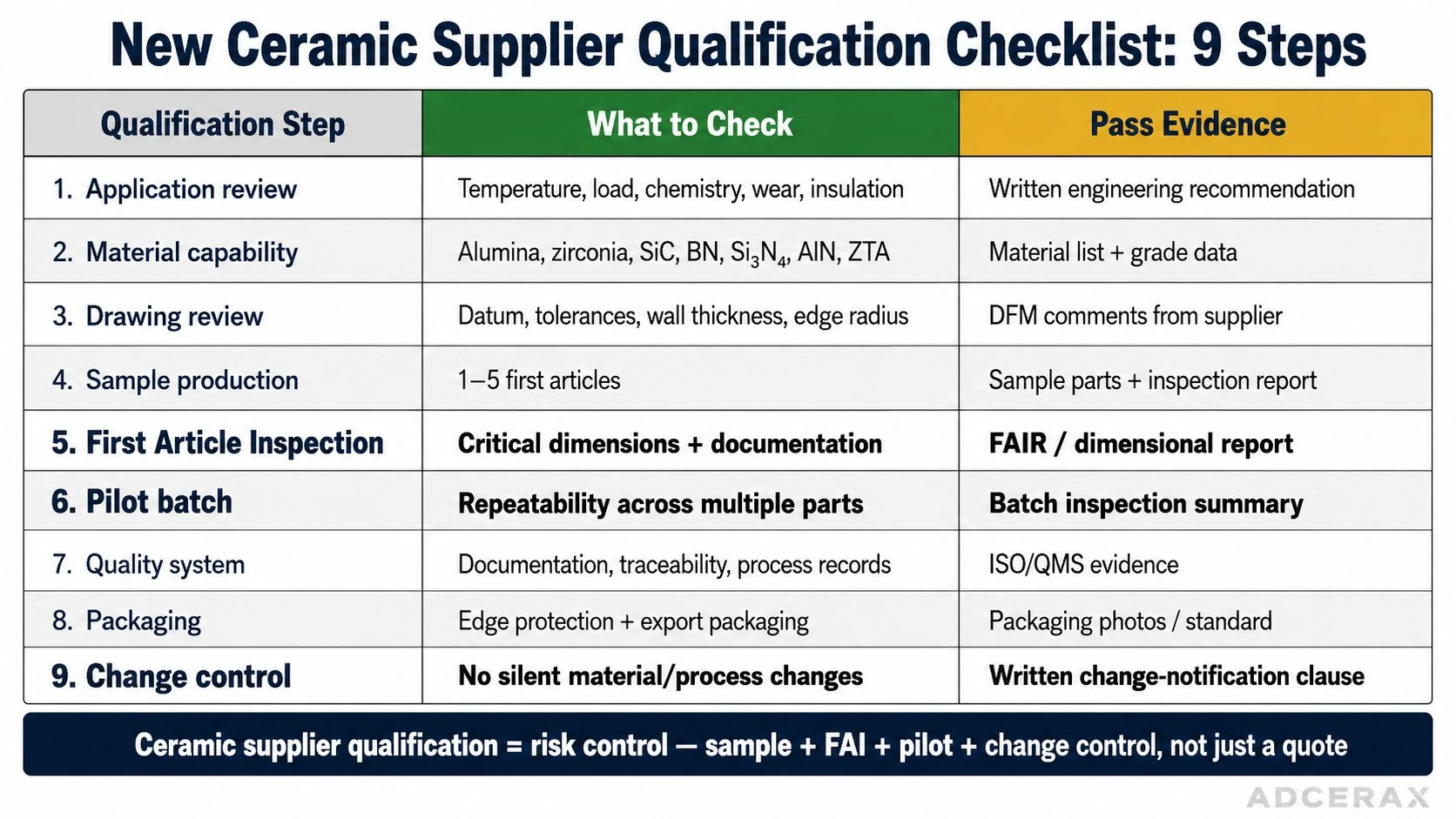
New ceramic supplier qualification should be treated as risk control — application review, material capability, drawing review, sample production, FAI, pilot batch, quality system, packaging, and change control each provide different pass evidence.
Define the failure mode before choosing a supplier. Ceramic supplier qualification should begin with the actual service condition: temperature, atmosphere, chemical exposure, wear mode, electrical insulation requirement, thermal shock frequency, pressure, load, mating material, and expected service life. ADCERAX's custom ceramic guidance confirms that temperature, load, and operating media define success more than part shape alone, and that early engineering review exposes thermal mismatch and stress paths before production.
""Ceramic"" is not a single material. Alumina, zirconia, silicon carbide, boron nitride, silicon nitride, aluminum nitride, and ZTA solve fundamentally different problems. A supplier who receives only ""ceramic sleeve"" or ""SiC part"" without grade, purity, and service context cannot confirm material suitability. The procurement team must use specific material designations — 99.7% alumina, 3Y-TZP zirconia, SSiC, hot-pressed BN, yttria-stabilized Si₃N₄ — and confirm that the supplier understands and can support each route. The advanced ceramic materials portfolio at ADCERAX spans alumina purity grades, stabilized zirconia variants, sintered/reaction-bonded/nitride-bonded SiC, hot-pressed and machinable BN, and AlN.
Ask whether the supplier can challenge the drawing, not just quote it. A capable ceramic supplier should provide manufacturability feedback when the drawing has impossible wall thicknesses, insufficient edge radii, or tolerance specifications that exceed what is achievable by sintering and grinding. A supplier who accepts every drawing requirement instantly, without questions, is either not reading the drawing or planning to supply whatever the process produces regardless of the specified tolerance.
RFQ checklist before you send a purchase order
After confirming application fit and material capability, the RFQ must provide enough information for the supplier to produce the correct part — not just a part that looks correct on a photograph.
The RFQ Checklist for Custom Ceramic Parts maps each required field:
| RFQ field | Why it matters | Recommended wording |
|---|---|---|
| Application | Guides material choice | ""State temperature, atmosphere, load, media, wear mode"" |
| Material grade | Prevents generic substitution | ""99.7% alumina/3Y-TZP/SSiC/HPBN/AlN, etc."" |
| Drawing revision | Prevents version mismatch | ""Quote to drawing Rev. B; all dimensions in mm"" |
| Critical dimensions | Focuses inspection | ""OD, ID, flatness, hole location, straightness, sealing face"" |
| Surface finish | Controls wear, sealing, and fit | ""Ra target, lapped face, polished zone, as-fired allowed"" |
| Quantity | Affects process route | ""Sample, pilot batch, and annual quantity separately"" |
| Inspection method | Prevents disputes | ""CMM, caliper, bore gauge, optical, roughness tester"" |
| Documentation | Supports quality approval | ""Material cert, dimensional report, CoC, lot traceability"" |
| Packaging | Protects brittle parts | ""Individual wrapping, edge protection, export carton/crate"" |
| Change control | Protects repeat orders | ""No material/process/inspection change without approval"" |
Drawing package, material package, function package. The drawing package provides dimensions, datum, tolerances, and revision control. The material package specifies grade, purity, density, porosity requirements, and whether a material certificate is required for quality records. The function package explains what the part actually does — which surface seals, which dimension determines fit, which face provides electrical insulation, which zone is wear-critical. Without the function package, a supplier cannot make intelligent trade-offs when manufacturing deviations are discovered.
Identify critical versus non-critical dimensions explicitly. Ceramic parts become expensive when every dimension is specified to the same tight tolerance. A sealing face flatness of 0.001 mm is meaningful and worth paying for. The same tolerance on a non-contact surface adds cost without benefit. The procurement team should mark each dimension as functional (must be measured and reported), preferred (inspect if accessible), or reference only. This helps the supplier allocate inspection effort correctly and provides a basis for accepting or rejecting parts consistently.
First article inspection: the gate before pilot batch
The first article is the most important qualification milestone for any custom ceramic part, and treating it as an informal trial rather than a formal gate creates the conditions for a quality failure after production begins.
[CITE: Published supplier quality guidance defines First Article Inspection as a planned, complete, independent, and documented inspection and verification process confirming that prescribed production processes produced an item conforming to engineering drawings, purchase order, engineering specifications, and other applicable design documents — and published FAI implementation guidance confirms that FAI also helps the supplier evaluate manufacturability, check design-document completeness, identify design errors, recommend changes, and establish the manufacturing process for the part — confirming that FAI for ceramic parts serves two functions simultaneously: it verifies the produced part against the specification, and it generates the supplier's process understanding that will control all subsequent production.]
For ceramic parts, FAI should confirm all of the following before pilot-batch approval:
The Material Verification Checklist maps the material-specific checks:
| Ceramic material | What to verify | Common procurement mistake |
|---|---|---|
| Alumina | Purity grade, density, open porosity, SiO₂ impurity | Ordering ""alumina"" without 95%, 99%, 99.5%, 99.7% distinction |
| Zirconia | Stabilizer type, toughness, aging risk, finish | Treating all zirconia as the same |
| SiC | SSiC vs RBSC/SiSiC vs NBSiC, free silicon, porosity | Ordering ""SiC"" without route |
| BN | Hot-pressed BN vs PBN, moisture, oxidation limit | Assuming all BN is UHV-ready |
| Si₃N₄ | Sintered vs hot-pressed, strength, bearing grade | Ignoring fracture-critical requirements |
| AlN | Thermal conductivity, purity, metallization compatibility | Buying only by shape, not thermal performance |
| ZTA | Zirconia content, wear/toughness balance | Assuming it behaves like pure alumina or pure zirconia |
| Porous ceramic | Pore size, permeability, filtration efficiency | Specifying porosity without flow/pressure data |
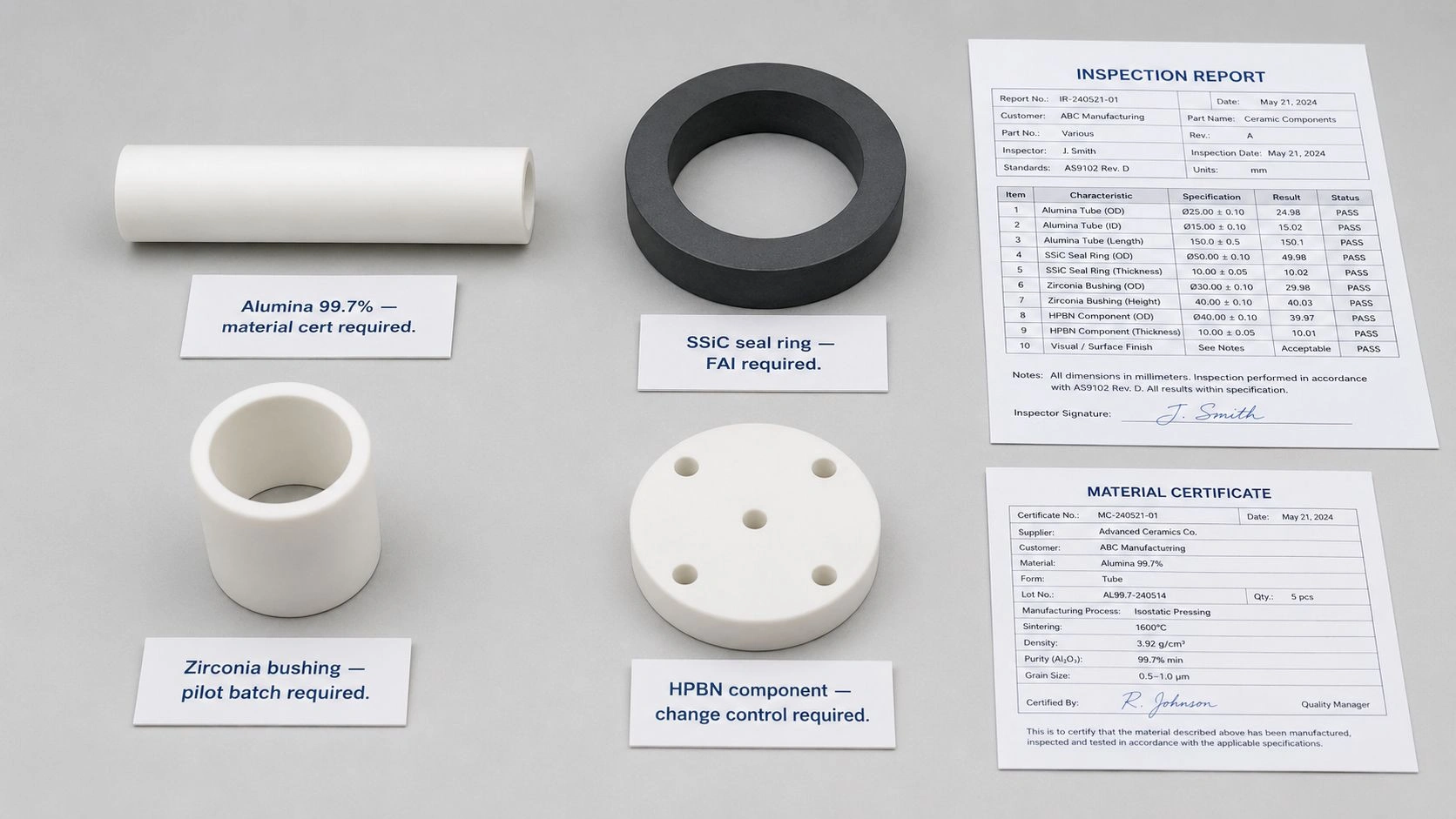
First article inspection and supplier qualification must connect real ceramic parts with measurable evidence — material certificates, dimensional inspection reports, lot records, and change-control requirements.
What FAI must include for ceramic parts. Drawing revision and part revision must match. Material grade must be confirmed from supplier documentation, not assumed from purchase-order description. Dimensional report must cover all functional dimensions — not all dimensions, but all dimensions that determine fit, seal, load, or electrical performance. Visual inspection must document any chips, cracks, pores, discoloration, or edge damage. Surface finish must be measured at functional zones — sealing faces, sliding bores, mating surfaces. Flatness, roundness, straightness, concentricity, or leak test results must be provided where specified. Packaging method must be reviewed before the first shipment, because shipping damage to ceramic parts is the most common preventable quality failure.
Written approval before pilot batch. The first-article approval should be a documented decision — not an email saying ""samples look good."" The approved first-article drawings, inspection report, and material certificate become the baseline against which pilot-batch and production parts are compared.
Pilot batch: prove repeatability, not one-time success
One good ceramic sample proves that the supplier's process can produce one correct part. It does not prove the supplier can repeat that part across a production lot.
Ceramics depend on powder batch variation, forming-process stability, furnace loading pattern during sintering, shrinkage-rate control, machining-wheel condition, and inspection method consistency. Each variable can shift between the first-article run — where the supplier pays extra attention to a new job — and a routine production batch.
Why one sample is not enough. Consider a 99.7% alumina bearing sleeve that requires 0.01 mm bore roundness. The supplier machines the first article carefully, measuring after each grinding pass. In production, the setup is replicated but not re-checked step by step. If the grinding wheel is worn 5% more, or the mandrel runout is 0.003 mm different, or the alumina powder batch has slightly different green density, the production bore may be 0.015 mm out-of-round — outside specification but not discovered until assembly.
Pilot batch acceptance criteria. Before committing to a production order, the buyer should define pilot-batch acceptance criteria: what dimensional spread is acceptable across the pilot batch, how many parts fail before the batch is rejected, and whether the surface finish variation from part to part is within the functional requirement. These criteria should be agreed with the supplier before the pilot batch is started.
When to freeze the process after pilot approval. When the pilot batch passes, the manufacturing process used to produce it should be formally frozen — material grade and powder source, forming method, firing schedule, post-sintering machining sequence, inspection method, and packaging method. Any change to the frozen process requires buyer approval before implementation.
Documentation, quality system, and change control
After sample and pilot approval, the long-term quality relationship depends on documentation discipline and change-control enforcement — because small, unannounced process changes are the most common cause of unexpected ceramic part failures in established supplier relationships.
[CITE: Published external provider quality requirements confirm that ceramic suppliers maintaining quality management systems compliant with ISO expectations should certify that materials and processes meet drawing and specification requirements, with applicable raw material and special process certifications required and supporting inspection and process-control data maintained available for quality review — and ADCERAX's custom ceramic parts documentation includes material certifications, dimensional inspection reports, and optional surface finish, hardness, leak, thermal shock, or third-party testing — confirming that documentation requirements for custom technical ceramics scale with part criticality, from basic conformance records for industrial wear parts to multi-test certification packages for semiconductor, vacuum, or high-purity applications.]
The Red Flags When Qualifying a New Ceramic Supplier table helps identify problematic supplier behaviors early:
| Red flag | Why it is dangerous | Corrective action |
|---|---|---|
| Supplier quotes without application questions | Material may be wrong | Require operating-condition review |
| ""Ceramic"" or ""SiC"" quoted generically | Grade ambiguity | Ask for exact composition/route |
| Tight tolerances accepted instantly | May be overpromised | Request manufacturability comments |
| No FAI process | Sample approval becomes informal | Require first article report |
| No inspection method stated | Acceptance disputes likely | Define gauge and report format |
| No batch traceability | Repeatability risk | Require lot/batch number |
| Poor packaging plan | Chipping during shipment | Require packaging photos/standard |
| No change-control agreement | Silent substitution risk | Add PO quality clause |
| Samples good, pilot skipped | Production variability hidden | Approve only after pilot batch |
| Supplier avoids failure discussion | Weak engineering support | Share failure photos and ask for root-cause input |
Certificate of Conformance vs Material Certificate. A Certificate of Conformance is a statement that the part meets the drawing and specification requirements. A Material Certificate provides the actual data — chemical composition, purity grade, density, key physical properties — from which conformance can be verified. For ceramic parts used in high-temperature, high-purity, or safety-critical applications, a material certificate provides a stronger quality record than a conformance statement alone.
Change notification is the most important long-term control. A supplier should not change 99.7% alumina to 95% alumina, SSiC to RBSC, hot-pressed BN to another BN composite, or a ground surface to as-fired finish without buyer approval. In advanced ceramics, small changes in grade or process can change thermal shock resistance, porosity, corrosion behavior, outgassing, wear life, and dimensional fit. Adding a written change-notification clause to the purchase order — requiring supplier notification and buyer approval before any change in material, forming, firing, machining, inspection, or packaging — converts this expectation into a contractual commitment.
The alumina tube RFQ guide at ADCERAX and the silicon carbide ceramic material grades covering SSiC, RBSiC, and NBSiC routes illustrate how grade-specific documentation requirements differ between ceramic families — and why the qualification process must be material-specific, not generic.
Qualifying a new ceramic supplier? Share your drawing, material grade, application conditions, critical tolerances, surface finish, sample quantity, inspection requirements, and failure history. ADCERAX can review whether alumina, zirconia, SiC, BN, Si₃N₄, AlN, ZTA, or another engineered ceramic route fits the part and propose a sample-to-pilot qualification path with material certification and dimensional inspection reports.
Frequently Asked Questions
How do you qualify a new ceramic supplier?
The qualification process should follow these steps: define the application and failure mode, confirm material-grade capability, submit a drawing with critical tolerances and inspection method, order and formally inspect first-article samples, run a pilot batch to verify repeatability, confirm documentation requirements, approve packaging, and establish a change-notification clause before production begins. Each step reduces a different category of risk.
What documents should a ceramic supplier provide?
For custom technical ceramic parts, the minimum documentation should include a material certificate, dimensional inspection report, and certificate of conformance. For more critical applications — semiconductor fixtures, vacuum components, high-purity crucibles, or pump parts — also request lot traceability, surface finish reports, and any agreed test results such as leak, hardness, thermal shock, or third-party inspection.
Is ISO certification enough to qualify a ceramic supplier?
No. ISO or quality-system certification confirms that the supplier has documented processes, but it does not prove the supplier can produce your specific ceramic part to your drawing and application requirement. You still need drawing-specific first-article inspection, pilot-batch validation, material-grade confirmation, and application testing as separate qualification steps.
Why is first article inspection important for ceramic parts?
FAI verifies that the supplier's actual production process produces a part conforming to the engineering drawing, purchase order, and specifications — not just that the supplier quoted correctly. Published FAI guidance confirms that FAI also helps identify manufacturability issues, design errors, and process-establishment requirements before batch production begins. These benefits are especially valuable for ceramic parts, where sintering shrinkage, machining tolerance, and surface finish are all process-dependent.
What is the biggest mistake in ceramic supplier qualification?
The biggest mistake is treating ceramics as commodity parts and selecting suppliers by price without application review and material-grade specification. Terms like ""alumina,"" ""zirconia,"" or ""SiC"" are not specific enough for procurement. Grade, purity, density, porosity, surface finish, tolerance, and process route must all be defined — and then verified through FAI and pilot-batch validation.
What should I send to a new ceramic supplier when requesting a quote?
Send a complete drawing with revision, material grade designation (not just ""ceramic""), quantity broken into sample/pilot/annual, application conditions including temperature/atmosphere/load/chemical exposure, critical dimensions flagged separately from non-critical ones, surface finish designations, inspection method, documentation requirements, packaging requirements, and failure history if the part is replacing an existing component that failed.
"