For an initial custom-crucible quote, provide the application, contained material, normal and peak temperatures, furnace atmosphere, preferred material or required function, drawing or key dimensions, working capacity, special features, quantity, and delivery target. A production-ready quote also needs the thermal cycle, additives, support and handling method, critical tolerances, contamination limits, inspection documents, and prototype acceptance plan. If the material is undecided, supply the complete process conditions so the manufacturer can recommend a qualified starting route.
What Is the Minimum Information Needed for a Quote?
Ten fields usually support an initial feasibility and budget review:
- crucible application and process step;
- contained material or charge;
- normal and maximum temperature;
- furnace atmosphere;
- preferred material or permission to recommend;
- overall shape and key dimensions;
- working volume or charge mass;
- lid, spout, vent, holes, or other features;
- prototype and production quantities;
- requested delivery timing and destination.
This information may support a budgetary estimate, but it does not authorize production. Missing chemistry, cycle, tolerance, or inspection data should appear as written assumptions or exclusions.
| Quote level | Minimum evidence | Appropriate supplier response |
|---|---|---|
| Budgetary estimate | Application, charge category, temperature, basic size, material direction, quantity | Indicative price, feasibility assumptions, and open questions |
| Prototype quotation | Drawing, full duty, selected grade, CTQs, and trial quantity | Sample route, tooling, inspection, and qualification proposal |
| Production quotation | Frozen drawing, approved grade, accepted sample, sampling plan, batch demand | Firm offer with controlled scope, documents, lead time, and exclusions |
At the inquiry stage, distinguish requirements from preferences. Mark dimensions that control furnace fit, sealing, pouring, or handling as critical, and identify surfaces where a standard manufacturing allowance is acceptable. Separate production conditions from future possibilities. If several sizes or materials are being considered, list each configuration and annual demand independently; combining alternatives into one vague request prevents reliable tooling, inspection, and lead-time estimates.
If no drawing exists, submit a dimensioned sketch, holder drawing, clear photographs with scale, catalogue reference, or the old component. Identify measured OD, ID, height, wall, capacity, and all interfaces that must remain unchanged. A worn or cracked sample should not be copied blindly because its dimensions may no longer represent the original design.
A useful quotation states which nonfunctional surfaces use supplier-standard tolerances, whether material selection remains subject to compatibility review, and whether production requires prototype approval. It should not imply guaranteed service life from the limited information used for an estimate.
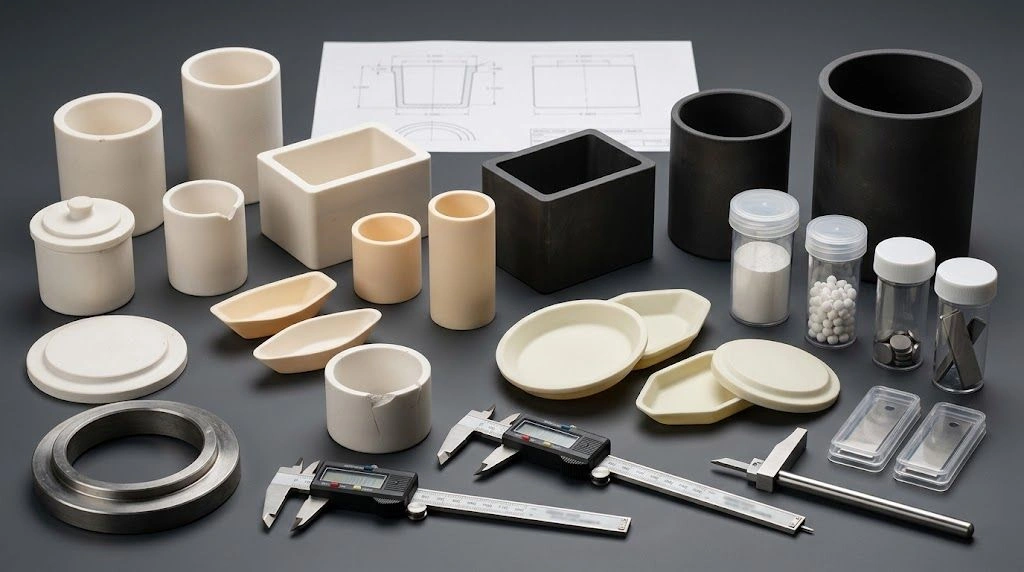
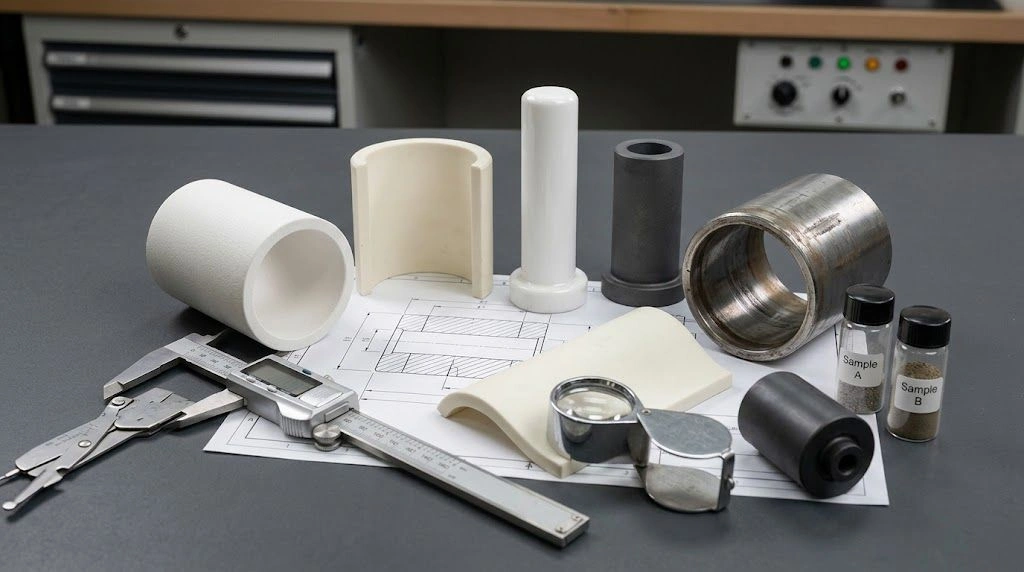
The physical RFQ bench separates a basic price inquiry from a manufacturing-ready technical package.
How Should Chemistry, Temperature, and Atmosphere Be Described?
The most important technical input is the material that contacts the crucible at temperature. A room-temperature powder may melt, decompose, volatilize, release gas, form a reactive salt, wet the wall, or penetrate pores during heating.
Provide the principal composition and range, important impurities, fluxes, salts, binders and additives, charge form, mass, bulk density where relevant, expected phase changes, gas evolution, volatility, prior sticking or penetration, whether the material solidifies inside, and acceptable contamination from the crucible.
NETZSCH crucible-selection guidance emphasizes crucible material, geometry, temperature range, and avoiding interaction with the sample. Its thermal-analysis context is narrower than many industrial processes, but the core lesson applies: material selection requires the complete hot-contact system.
Report a cycle rather than one temperature:
- normal, peak, and upset temperatures;
- starting temperature and hot-loading condition;
- ramp rate and hold time;
- cooling method and rate;
- cycles per day or campaign;
- expected reuse and retirement criteria.
A ceramic may tolerate a high steady temperature yet crack during a steep gradient or rapid cooldown. ASTM C1525 evaluates thermal-shock resistance by water quenching and retained flexural strength. The standard states that it does not determine steady-gradient stresses, joined-body expansion mismatch, repeated shocks, or component performance. Representative application cycling therefore remains necessary.
Define the atmosphere as air, oxidizing, inert, reducing, reactive, or vacuum, then add gas identity, purity and flow, pressure or vacuum range, moisture, atmosphere changes, possible leakage, and whether the crucible is covered, sealed, or vented. “Inert” and “vacuum” alone are not quote-ready descriptions.
| Weak input | Quote-ready replacement |
|---|---|
| “Metal powder” | Composition range, additives, form, impurities, and mass |
| “Up to 1600°C” | Normal/peak temperature, ramp, hold, and cooling cycle |
| “Inert gas” | Gas identity, purity, flow, pressure, and oxygen sensitivity |
| “500 mL” | Charge mass, working fill height, headspace, and total volume |
| “High purity” | Restricted elements, acceptable contribution, and test method |
| “Reusable” | Required cycles, cleaning method, and retirement condition |
Which Geometry, Capacity, and Furnace Interfaces Change the Quote?
Nominal capacity is insufficient. The manufacturer needs total internal volume, normal working volume or charge mass, maximum fill height, and required headspace. Powders, molten metals, foaming reactions, and solidifying charges can require different working limits in the same vessel.
| Drawing field | Required decision | Quotation impact |
|---|---|---|
| Overall form | Cylinder, cone, rectangle, boat, or custom | Forming route and tooling |
| OD/width and height | Maximum envelope and functional tolerances | Furnace, holder, and hot-zone fit |
| ID/internal depth | Usable containment profile | Working volume and wall design |
| Wall and bottom | Thickness zones, base profile, reinforcement | Forming, heat transfer, and thermal stress |
| Radii and taper | Internal/external radii; permitted draft | Manufacturability and stress concentration |
| Rim or flange | Plain, reinforced, lipped, or handled | Lifting, sealing, and chipping risk |
| Lid and vent | Loose, fitted, recessed; vent size/location | Atmosphere exchange and gas release |
| Spout/holes/slots | Geometry, position, and function | Machining cost and fracture risk |
| Surface | As-fired, ground, polished, or coated | Secondary operations and inspection |
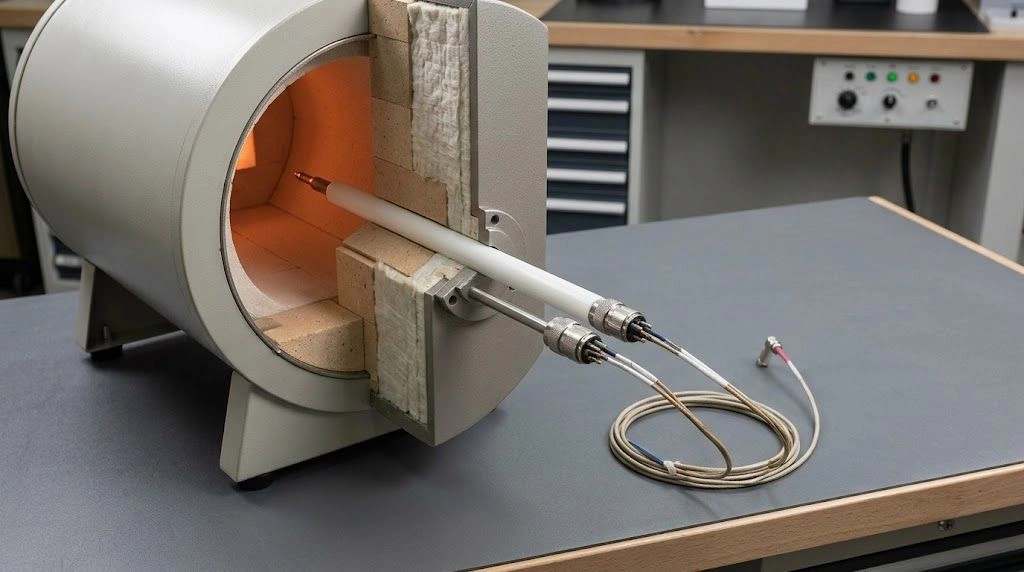
Describe the furnace: box, tube, vacuum, induction, or resistance; hot-zone envelope; heating direction; coil or heater clearance; and neighboring components. Provide the support condition—bottom, rim, ring, setter, shelf, or clamp—and identify areas that must not carry load.
Describe whether the crucible remains stationary, is lifted hot, poured, mechanically transferred, inverted, scraped, brushed, blasted, or chemically cleaned. State whether a charge cools and solidifies inside. These actions affect rim design, wall uniformity, corner radii, support, and material screening.
KYOCERA’s ceramic-design guidance recommends avoiding impact, tensile stress, and sharp stress concentrations while accounting for thermal shock and expansion mismatch. Those boundaries apply directly to unsupported bottoms, sharp internal corners, clamped walls, lifting features, and uneven holder contact.
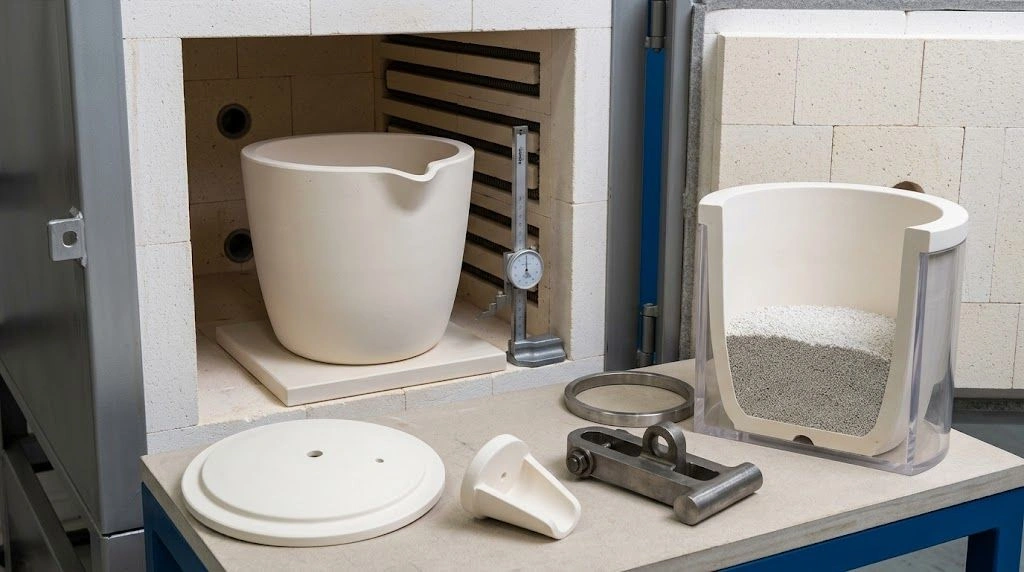
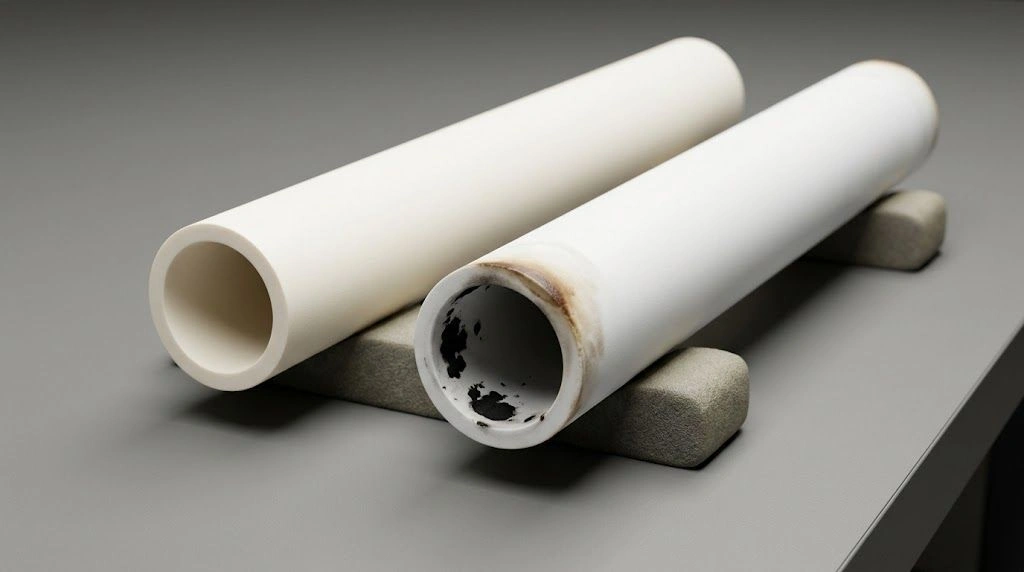
A cold physical mock-up connects crucible geometry and working volume to the real support, lid, handling, and furnace envelope.
How Are Material, Manufacturing, and Qualification Risks Closed?
“Alumina,” “zirconia,” “silicon carbide,” or “boron nitride” names a family, not a complete grade. Alumina purity and forming route, zirconia stabilizer, ZTA composition, sintered versus reaction-bonded SiC, and hot-pressed versus pyrolytic BN can change porosity, contamination, wetting, oxidation, thermal behavior, and price.
Either specify an approved grade or authorize a recommendation. The supplier still needs charge chemistry, temperature, atmosphere, cycle, and contamination limits. A generic property table cannot prove compatibility with a molten salt, flux, alloy, reactive intermediate, or solidifying charge.
Replace “high purity” with nominal composition, prohibited or controlled elements, maximum acceptable contribution to the charge, analytical method, blank-firing or leach requirement, lot traceability, and certificate expectations.
ASTM C20 and ASTM C830 provide methods for apparent porosity, absorption, specific gravity, and bulk density of refractory brick or shapes. Their specimen, liquid, and scope assumptions must be checked before applying them to a dense technical-ceramic crucible. Neither standard validates chemical compatibility or service life.
Use a qualification sequence that reproduces the risk:
- inspect dimensions, edges, surfaces, and supplied material records;
- dry-fit the crucible, lid, holder, and furnace interface;
- complete an empty thermal cycle when technically appropriate;
- run a representative charge in the actual support and atmosphere;
- cool using the intended process, including solidification where relevant;
- inspect cracking, spalling, deformation, penetration, sticking, and residue;
- analyze the charge or blank when contamination matters;
- repeat the cycle when reuse is a production requirement.
Do not request “thermal-shock proof,” “zero contamination,” or universal chemical resistance. Replace each with a defined cycle, elemental limit, analytical method, and pass/fail condition. A covered crucible is not automatically sealed or pressure-rated; reactive or hazardous processes require the buyer’s EHS and equipment review.
What Belongs in a Copy-Ready Custom Crucible RFQ?
Use the following worksheet as the technical cover page for a drawing package.
| RFQ section | Information to provide |
|---|---|
| Project | Part number, new/replacement/failure investigation, quote level, NDA |
| Function | Application, process step, laboratory/pilot/production use, reuse cycles |
| Charge | Composition, range, form, mass, additives, phase change, volatility, contaminants |
| Thermal duty | Normal/peak temperature, start, ramp, hold, cooling, daily cycles |
| Atmosphere | Gas or vacuum, purity, flow, pressure, moisture, cycle changes |
| Furnace | Type, heat source, hot zone, support, holder/coil clearance, orientation |
| Geometry | OD, ID, height, depth, wall, bottom, radii, taper, rim, lid, vent, spout |
| Capacity | Geometric volume, working fill, charge mass, fill height, headspace |
| Material/finish | Grade, purity, supplier recommendation authority, ground/coated surfaces |
| Quality | CTQs, general tolerances, defects, sampling, certificates, traceability, cleanliness |
| Commercial | Prototype, batch and annual demand, destination, delivery target, packaging |
| Attachments | PDF/STEP, sketch, old/failed-part photos, holder drawing, process profile, SDS |
Ask the supplier to return the proposed grade, manufacturing route, dimensional feasibility, recommended tolerance changes, tooling cost, prototype and production prices, lead time, inspection plan, documents, assumptions, exclusions, and qualification recommendation.
Review the ceramic crucibles and boats family before freezing the architecture. For the common oxide route, compare available custom alumina crucibles against the documented chemistry and cycle.
Send the completed worksheet with drawings or sample photographs for a custom ceramic component review. The correct output is the quote level supported by the available evidence—not a firm production promise built on nominal volume and peak temperature alone.
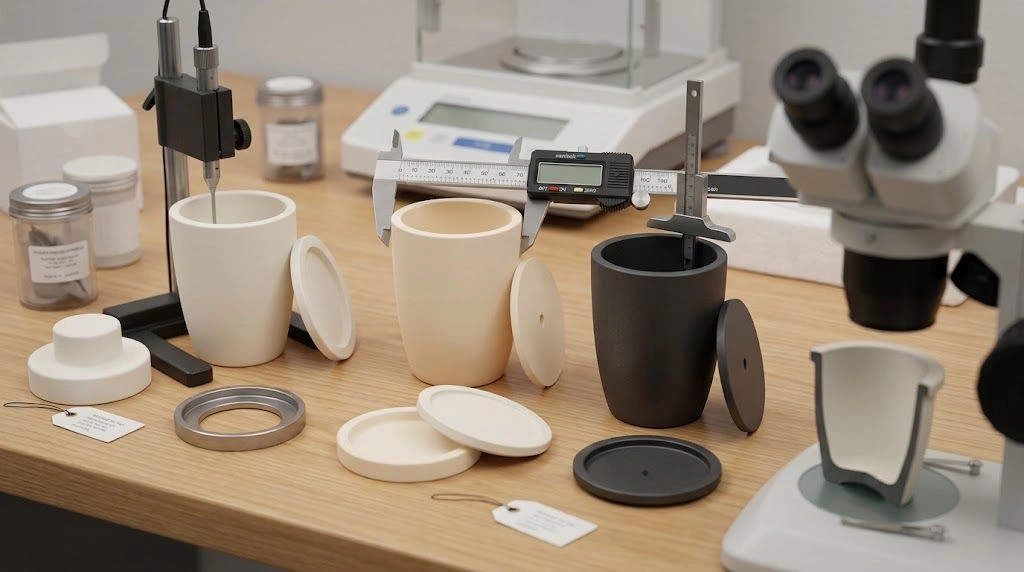
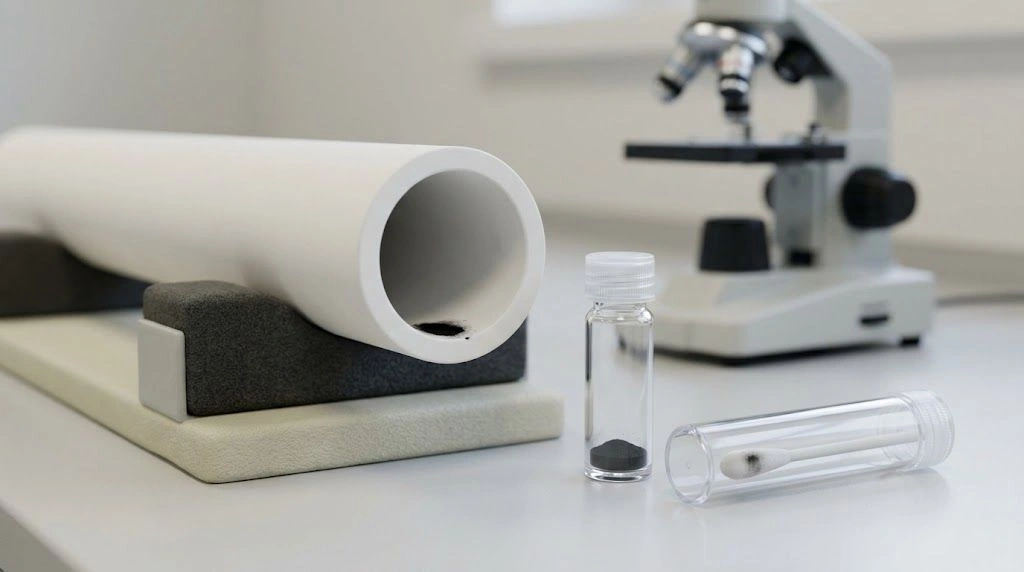
First-article review connects the frozen drawing and material record to furnace fit, representative cycling, contamination limits, and acceptance evidence.
Frequently Asked Questions
What is the minimum information for a custom crucible quote?
Provide the application, contained material, normal and peak temperatures, atmosphere, preferred material or required function, basic dimensions or working capacity, special features, prototype and production quantities, and delivery target. Missing technical fields should appear as assumptions in a budgetary estimate.
Is maximum temperature enough to select a crucible?
No. Selection also depends on charge chemistry and phase, impurities, fluxes, atmosphere, ramp, hold, cooling, gradients, support, and whether material solidifies inside. Maximum temperature is one boundary, not proof of compatibility or resistance to a particular thermal cycle.
How should custom crucible capacity be specified?
Provide geometric internal volume, normal working volume or charge mass, maximum fill height, and required headspace. Include powder bulk density, foaming, gas evolution, volatility, and solidification behavior where relevant. Nominal milliliters alone do not define safe loading or furnace fit.
Can a custom crucible be copied from an old part?
An old part can support reverse engineering, but identify worn, chipped, distorted, and original surfaces. Provide the holder interface, process duty, material records, and failure history. Copying every measured dimension may reproduce wear or the design feature that caused the failure.
What affects the price of a custom ceramic crucible?
Material grade, size, wall uniformity, forming route, tooling, machining, lid or spout features, tolerances, finish, inspection, prototype quantity, batch demand, documentation, and packaging all affect price. Tight requirements should be limited to features that control function or fit.
Should a prototype be tested before production?
Usually, when chemistry, thermal cycling, contamination, solidification, fit, or reuse matters. Inspect and dry-fit the prototype, then run a representative charge and cooling cycle. Production release should use defined pass/fail evidence rather than appearance or an empty-furnace test alone.
Which inspection documents should be requested?
Request only documents tied to risk: dimensional or first-article reports, material composition or grade certificate, lot traceability, visual inspection, density or porosity evidence where applicable, cleanliness records, and analytical results when contamination matters. State the sampling plan and acceptance method.
Can the supplier select the crucible material?
Yes, if the RFQ authorizes a recommendation and provides complete chemistry, temperature cycle, atmosphere, geometry, support, contamination limits, and failure evidence. The proposed grade remains a starting route until representative testing confirms compatibility and the buyer approves the specification.