Zirconia tubes are usually preferred when acid exposure is combined with mechanical stress, thermal cycling, impact risk, acid/alkali cleaning cycles, or a need for higher fracture toughness. Alumina tubes are often preferred when the acid environment is moderate, electrical insulation matters, high-temperature stability is required, and cost control is important. Neither material should be selected by "acid resistance" alone — acid type, concentration, temperature, fluoride content, flow erosion, tube geometry, and sealing design all determine the correct choice.
That conditional framing — acid environment first, material second — is the engineering principle this guide is built around.
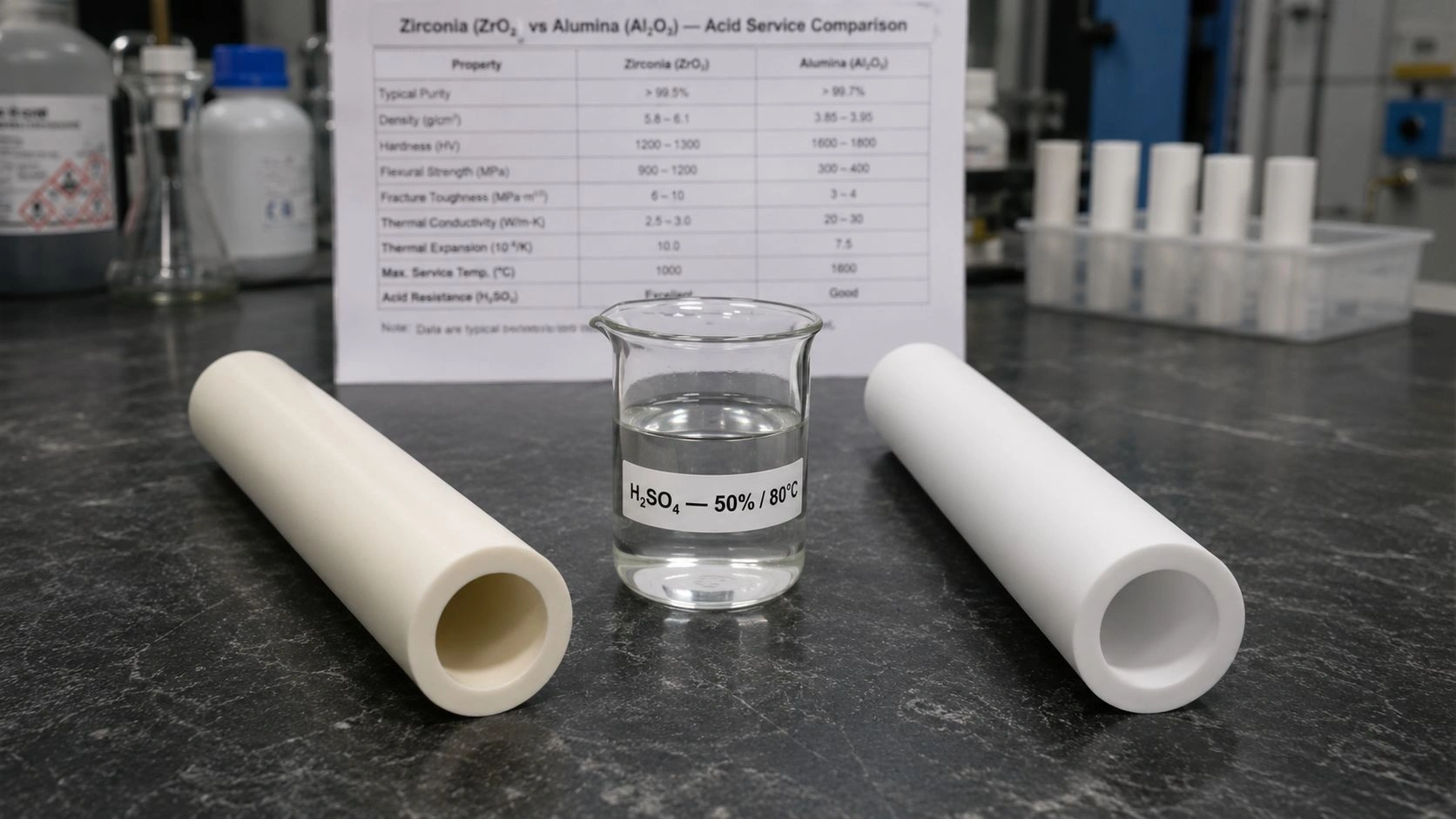
Zirconia and alumina ceramic tubes both offer chemical stability in many acid environments — the decision between them depends on acid type, temperature, mechanical stress, thermal cycling, and whether the system includes fluoride species.
This guide stays on the ceramic tube decision between zirconia and alumina in acid service — how acid chemistry, temperature, exposure mode, and mechanical demand shift the preferred oxide tube route.
The first rule: identify the acid environment before choosing the ceramic
Acid resistance is not one property. A tube exposed to room-temperature dilute sulfuric acid is not facing the same problem as a tube exposed to hot concentrated hydrochloric acid vapor, mixed acid cleaning cycles, acidic condensate, or HF-containing media. The acid type, concentration, temperature, and exposure mode together determine which ceramic survives — and by how much margin.
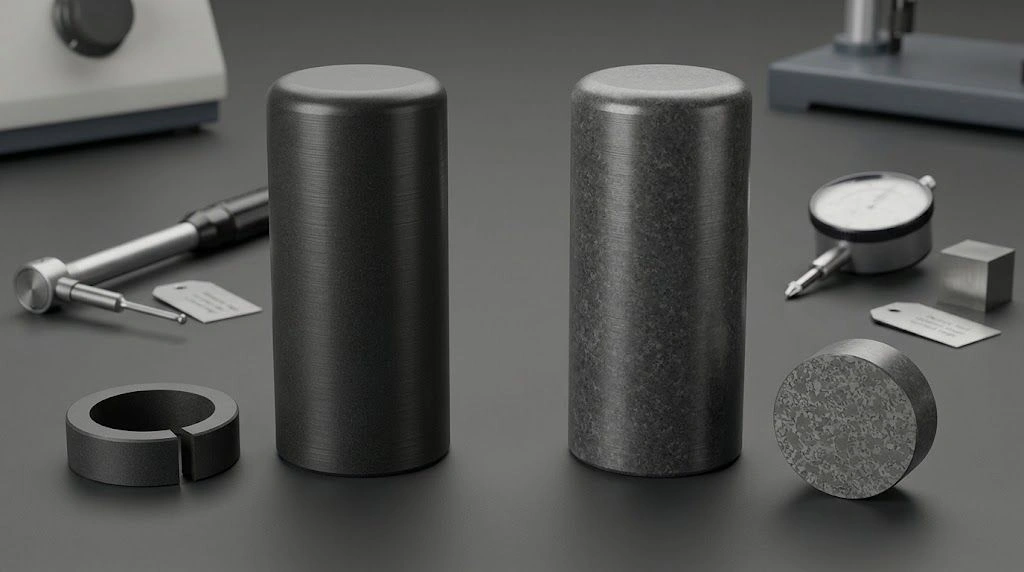
In published comparative immersion tests, dense zirconia often shows lower mass loss than lower-purity alumina under hot concentrated nitric or sulfuric acid. Those results are grade-, density-, surface-, and protocol-dependent; they are not an ADCERAX factory SLA. Confirm immersion testing against the actual acid chemistry on the RFQ before treating any published ranking as a contract guarantee.
The practical consequence is that the correct starting question is not "which material is more acid resistant?" but "what exactly is contacting the ceramic, at what temperature, in what form, for how long, and with what mechanical and thermal demands alongside it?"
Acid type: sulfuric, nitric, hydrochloric, phosphoric, organic acids
Different acid families attack ceramics through different mechanisms. Sulfuric acid can be aggressive at high concentration and temperature. Nitric acid's oxidizing character affects the surface chemistry differently from hydrochloric acid's reducing and chloride-rich environment. Phosphoric acid can be aggressive at elevated temperature. Organic acids vary widely in aggressiveness depending on pH, temperature, and solvent content. A material that is well-characterized for one acid family should not be assumed compatible with another without specific data.
Exposure mode: liquid, vapor, condensate, spray, acid gas
The same acid at the same concentration produces different attack rates depending on whether the ceramic is immersed in liquid acid, exposed to acid vapor, contacted by condensing acid droplets, or sprayed intermittently. Liquid immersion typically produces the most sustained chemical exposure. Acid vapor at high temperature can create concentrated condensate at cooler surfaces. Spray and intermittent exposure may produce cyclic wetting and drying that concentrates acid at the ceramic surface. The briefing and RFQ must specify exposure mode, not only acid identity.
Temperature and concentration as corrosion accelerators
Both temperature and acid concentration accelerate attack. A material that performs acceptably in 10% sulfuric acid at room temperature may show significant weight loss in 50% sulfuric acid at 80°C. Temperature effects are not simply additive — reaction rates often increase exponentially with temperature in the range relevant to ceramic acid service. Published acid-resistance data should always be checked against the actual operating temperature, not assumed applicable across temperatures.
Why HF and fluoride species require separate review
Hydrofluoric acid and fluoride-bearing media are special cases that require separate compatibility review for both alumina and zirconia. Free HF and high-fluoride environments can attack oxide ceramics through fluoride dissolution of the oxide lattice — a mechanism different from the proton-driven corrosion of most mineral acids. Free HF is a critical incompatibility boundary for oxide ceramics (alumina and zirconia grades); chemical compatibility references similarly flag alumina as unsuitable for hydrofluoric or hydrofluorosilicic acid service. If the acid system contains fluoride at any concentration, this must be explicitly disclosed in the RFQ, and compatibility must not be assumed from general acid-resistance data.
When alumina tubes are the better choice
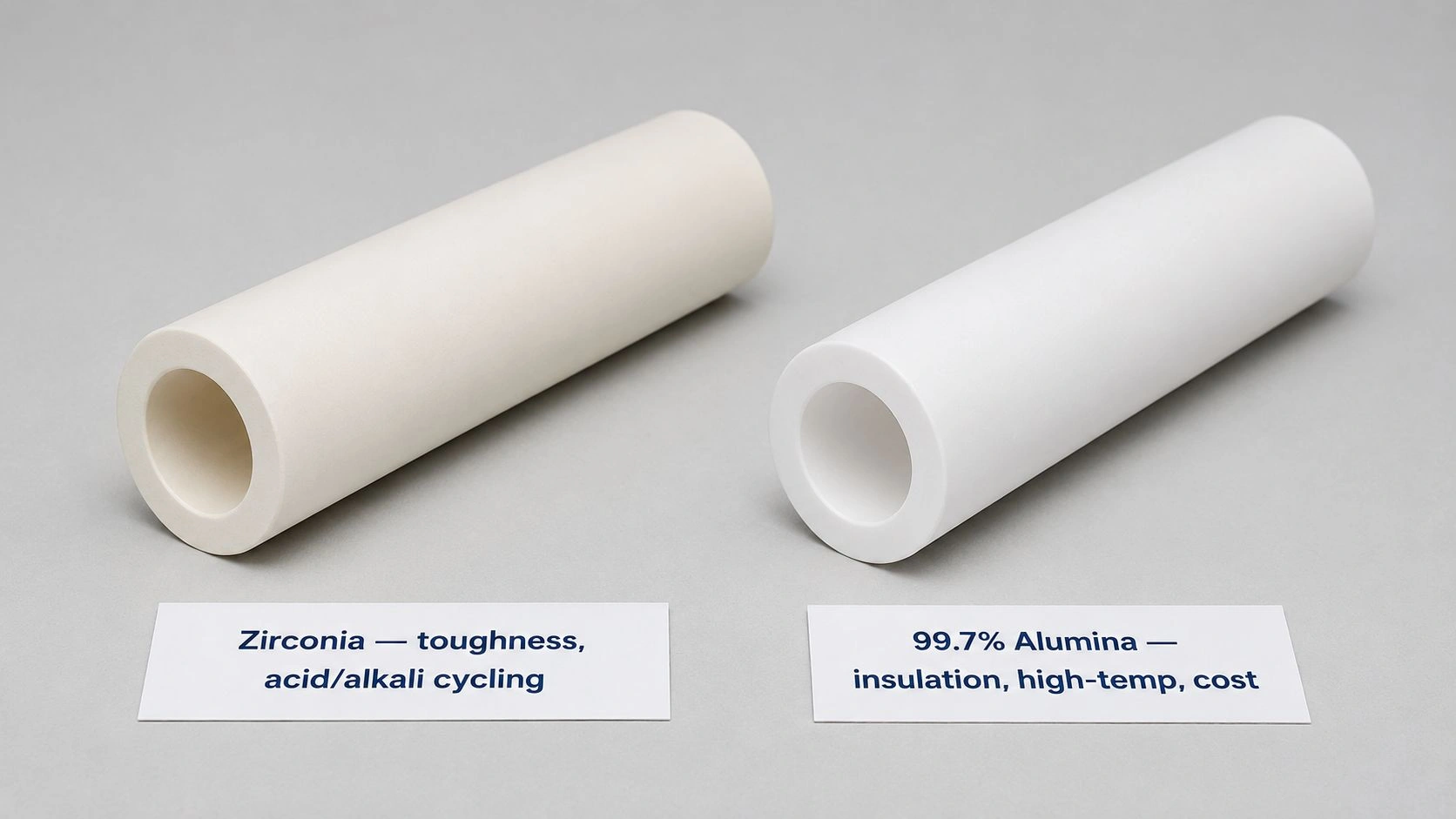
Alumina tubes are often the best starting point when the acid exposure is moderate, electrical insulation is required, the tube also operates at high temperature, and cost-performance matters.
The case for alumina is strongest in applications where the acid is not strongly attacking the alumina surface under the actual service conditions, where the tube is mechanically protected and well-supported, and where the other service requirements — high-temperature capability, electrical insulation, dimensional stability — favor alumina's well-established properties. The alumina ceramic tubes product line covers thermocouple protection tubes, sensor sleeves, furnace tubes, and corrosion-resistant industrial parts. High-temperature capability for 99.7-class alumina (screening ceiling near 1700°C in air) is a separate axis from acid mass-loss rating — do not treat long-temperature capability as an acid immersion guarantee.
Cost-sensitive acid-resistant tube applications. For acid-adjacent service where the ceramic sees occasional acid splash, acid vapor at low concentration, or mild acid cleaning, alumina provides a cost-effective and broadly available tube material. In these applications, specifying zirconia provides little practical benefit and adds significant cost.
High-temperature acid-adjacent gas or vapor systems. In furnace tubes, protection tubes, and thermocouple sheaths that operate in hot gas streams containing acid vapor or acidic combustion products, alumina's high-temperature stability — above the working temperature of most zirconia grades in air — often makes it the natural choice. The acid exposure in these systems is typically indirect and at low concentration, which alumina handles well.
Electrical insulation and sensor protection. When the ceramic tube must maintain electrical insulation alongside corrosion resistance — thermocouple insulation, electrode protection, sensor sleeves — alumina's well-characterized dielectric properties make it the default candidate. Zirconia has adequate insulation properties in many applications, but alumina's longer track record in high-temperature electrical insulation roles is a practical advantage.
When 99%/99.7% alumina is enough. Higher-purity alumina grades (99.5% and 99.7%) typically have lower open porosity and fewer grain-boundary impurities than 96% grades, which generally improves chemical-resistance screening by reducing attack pathways. Use 96 / 99 / 99.5 / 99.7 as a densification and purity screen — not as a claim that 99.7% alumina is universally sufficient, or that the 99 vs 99.7 gap always outweighs an alumina-vs-zirconia family choice.
When zirconia tubes are the better choice
Zirconia tubes become more attractive when acid exposure is combined with mechanical stress, impact risk, thin walls, thermal cycling, or acid/alkali cleaning cycles where fracture toughness and dimensional stability provide real service advantages.
Zirconia's key advantages over alumina in acid service are its higher fracture toughness, its often-lower mass loss in published comparative immersion tests under hot concentrated acid (grade- and protocol-dependent; confirm on RFQ), and its better resistance to crack propagation under combined chemical and mechanical loading. See the zirconia tube product page for geometry and grade options, and the zirconia ceramic chemical resistance behavior guide for how acid type, concentration, temperature, and oxidizing character constrain selection — environment-specific, not a universal zirconia advantage.
Acid exposure with impact or vibration. For pump components, plungers, flow-path sleeves, or analytical tubes that experience mechanical contact, vibration, or handling impact alongside acid exposure, zirconia's higher fracture toughness reduces the probability of brittle fracture compared with alumina under the same combined loading.
Small precision tubes and analytical flow paths. For thin-wall tubes, small-bore analytical components, or precision sleeves where wall thickness is limited, zirconia's toughness provides a meaningful safety margin. Alumina at the same wall thickness is more susceptible to crack initiation from surface defects, seal stress, or thermal gradient.
Acid/alkali cleaning cycles. Many process systems alternate between acid cleaning and alkali cleaning, exposing the ceramic to both environments in sequence. Zirconia generally maintains better dimensional stability and surface condition through repeated acid/alkali cycling than alumina, which can show more surface roughening over extended cleaning cycles.
Where fracture toughness matters more than raw material cost. The cost premium for zirconia over alumina tubes is justified when the consequence of tube fracture — unplanned downtime, contamination of the process stream, replacement in a difficult location — is more expensive than the material cost difference.
Do not misdiagnose acid failure as material chemistry alone
A failed ceramic tube in acid service does not automatically mean the material family was wrong. Before changing from alumina to zirconia or vice versa, the failure mechanism should be documented — because material chemistry is only one of several possible root causes.
Chemical dissolution vs acid + particle erosion. Uniform surface attack is a signature of chemical dissolution. Directional groove marks, local wall thinning at flow-impingement points, or pitting that correlates with particle carryover are signatures of erosion. Zirconia's toughness advantage helps with erosion; neither material is immune to combined chemical and erosion attack in aggressive slurry or particle-laden acid streams.
Seal leakage vs tube wall attack. If the system leaks acid rather than the tube dissolving, the seal design is the most likely root cause — gasket material, ferrule geometry, compression force, and metal-to-ceramic interface compatibility. Replacing the ceramic tube material will not fix a seal design problem.
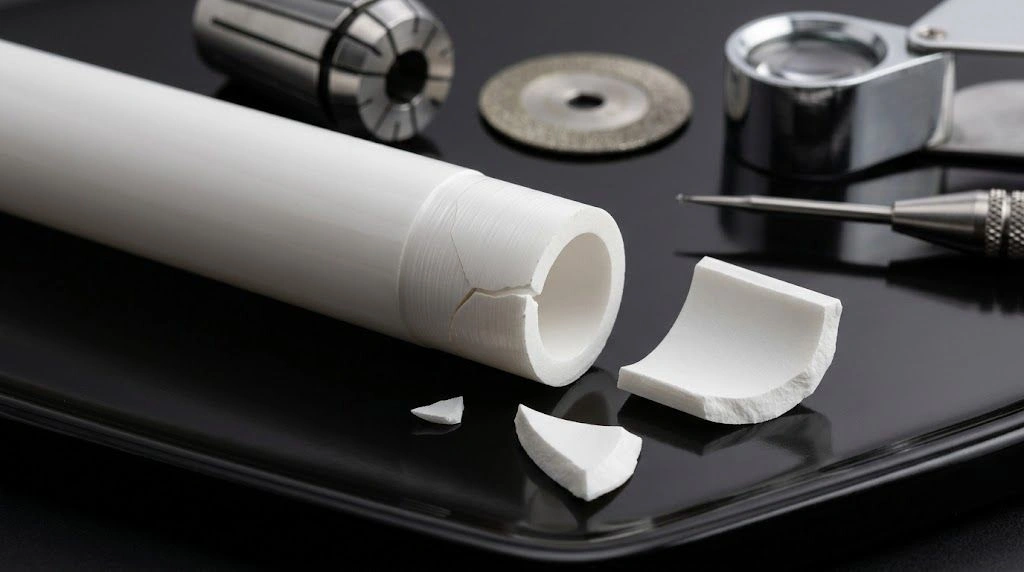
Thermal shock mistaken for acid corrosion. Cracking that occurs at thermal transitions — startup, shutdown, cooling water application, or sudden temperature change — is thermal shock, not acid corrosion. Both alumina and zirconia can crack from thermal shock if temperature gradients are large enough; zirconia's toughness provides some advantage but does not eliminate thermal shock risk.
Fluoride chemistry as a special exclusion zone. When a tube fails in a system that contains fluoride at any concentration, the first diagnostic step is to confirm whether fluoride is at a level that can attack the ceramic oxide lattice. Both alumina and zirconia are vulnerable to fluoride attack by different mechanisms. If fluoride is confirmed as the attack agent, material substitution within the oxide ceramic family may not solve the problem — and materials such as PTFE, PFA, or specialized fluoride-resistant materials may need to be evaluated instead.
The Failure Diagnosis Matrix below maps common acid-service tube problems to better diagnostic questions:
| Observed problem | Common assumption | Better diagnostic question |
|---|---|---|
| Tube cracked near end | Acid attacked ceramic | Was the tube over-clamped or thermally shocked? |
| Rough inner surface | Wrong ceramic | Was there slurry erosion or acid condensate cycling? |
| Leak at connection | Tube corrosion | Is the gasket/ferrule/fitting compatible with acid? |
| White or cloudy residue | Ceramic dissolving | Is it salt deposition, cleaning residue, or acid reaction product? |
| Short life after cleaning | Material defect | Did the cleaning cycle include alkali, fluoride, or thermal shock? |
| Local wall wear | Poor acid resistance | Is flow impingement or particle erosion localized? |
| Different supplier results | Material name mismatch | Were purity, density, porosity, surface finish, and test conditions identical? |
Diagnosis should be based on failure location, surface analysis, chemical history, and cleaning records before any material change is specified.
RFQ checklist for acid-resistant ceramic tubes
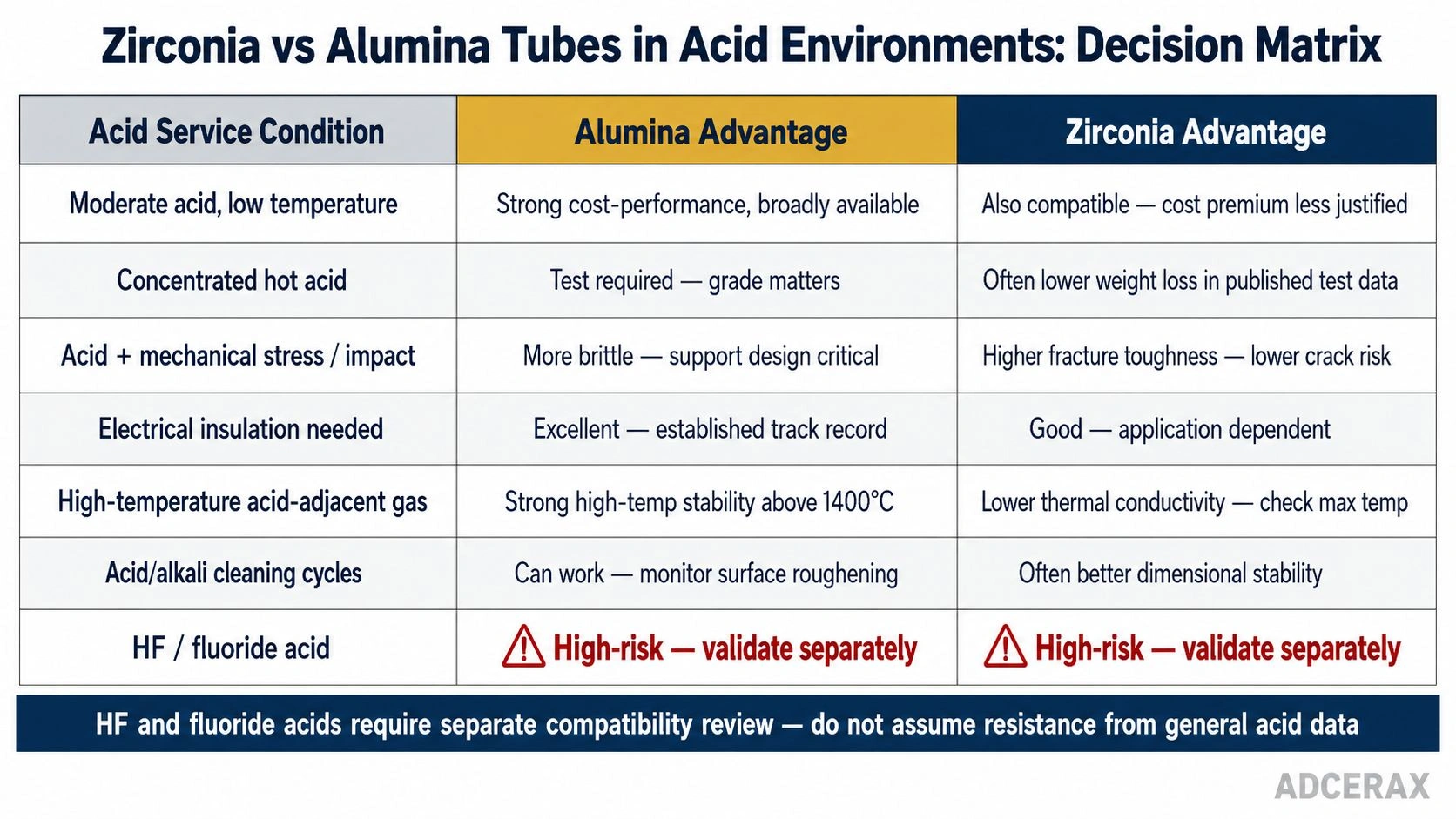
A complete RFQ for zirconia or alumina tubes in acid service must provide the complete acid environment — without it, a supplier cannot confirm material compatibility or recommend testing.
A complete RFQ for acid-service ceramic tubes should sequence: acid name, concentration, impurities including fluoride and chloride content, operating and peak temperature, exposure mode (liquid immersion, acid vapor, condensate, spray, or intermittent contact), flow velocity and particle or slurry content, cleaning cycle chemistry, tube OD/ID/wall/length and end configuration, seal design and gasket material, surface finish requirement, material purity and density, and validation method. Each variable can independently change which ceramic is compatible — a supplier who receives only "acid-resistant ceramic tube" cannot confirm chemistry compatibility, erosion risk, or sealing boundary without that context.
The Zirconia vs Alumina Tubes in Acid Environments comparison tables below summarize the decision logic and acid-type routing:
Table 1 — Decision variable comparison:
| Decision variable | Alumina tube advantage | Zirconia tube advantage | What to verify |
|---|---|---|---|
| Moderate acid exposure | Strong cost-performance | Also compatible in many systems | Acid type, concentration, temperature |
| Strong hot acid | May work depending on acid and purity | Often stronger candidate | Mass loss and surface change |
| Mechanical stress | More brittle | Higher fracture toughness | Impact, vibration, support design |
| Electrical insulation | Excellent | Good, application dependent | Dielectric requirement |
| High-temperature acid-adjacent service | Strong high-temp stability | Lower thermal conductivity advantage | Temperature gradient and thermal cycle |
| Acid + particle erosion | Good hardness | Better crack resistance | Flow velocity and particle load |
| Acid/alkali cleaning cycle | Can work, surface roughening may matter | Often attractive for dimensional stability | Cleaning chemistry and cycle count |
| HF/fluoride acid | High-risk — do not assume compatibility | High-risk when free HF present | Fluoride speciation and pH |
Table 2 — Acid type routing:
| Acid environment | Alumina direction | Zirconia direction | Engineering note |
|---|---|---|---|
| Dilute sulfuric acid | Often acceptable | Often acceptable | Verify temperature and flow |
| Concentrated sulfuric acid | Use with testing | Strong candidate with testing | Published comparative tests often favor dense zirconia vs lower-purity alumina in hot concentrated H₂SO₄ — grade/protocol-dependent; confirm on RFQ |
| Nitric acid | Often acceptable | Strong candidate | Oxidizing character matters |
| Hydrochloric acid | Use caution; test | Often considered where chloride acid dominates | Temperature and concentration matter |
| Phosphoric acid | Use caution | Test required | Can be aggressive at elevated temperature |
| Organic acids | Often acceptable | Often acceptable | Solvent, temperature, and cleaning cycle matter |
| HF/fluoride acids | Generally avoid unless specially validated | Avoid free HF unless specially validated | Fluoride speciation controls risk |
| RFQ field | Why it matters | Recommended wording |
|---|---|---|
| Acid chemistry | Primary compatibility driver | "List acid name, concentration, impurities, fluoride/chloride content" |
| Temperature | Accelerates corrosion | "State continuous and peak temperature" |
| Exposure mode | Liquid, vapor, condensate behave differently | "Liquid immersion/acid gas/spray/condensate" |
| Flow/particles | Adds erosion to corrosion | "State velocity, slurry, particles, or powder carryover" |
| Tube geometry | Controls stress and manufacturability | "OD, ID, wall, length, end type, holes, flanges" |
| Seal design | Often the weak point | "Specify gasket, ferrule, compression, or adhesive" |
| Surface finish | Affects cleaning and residue | "State ID/OD Ra only where functional" |
| Purity/density | Controls corrosion and porosity | "Quote material grade, density, open porosity" |
| Validation | Confirms real compatibility | "Request acid exposure test using actual chemistry" |
RFQ fields are the minimum for an acid-resistant ceramic tube inquiry; add cleaning cycle chemistry, particle size, and service life expectation as needed.
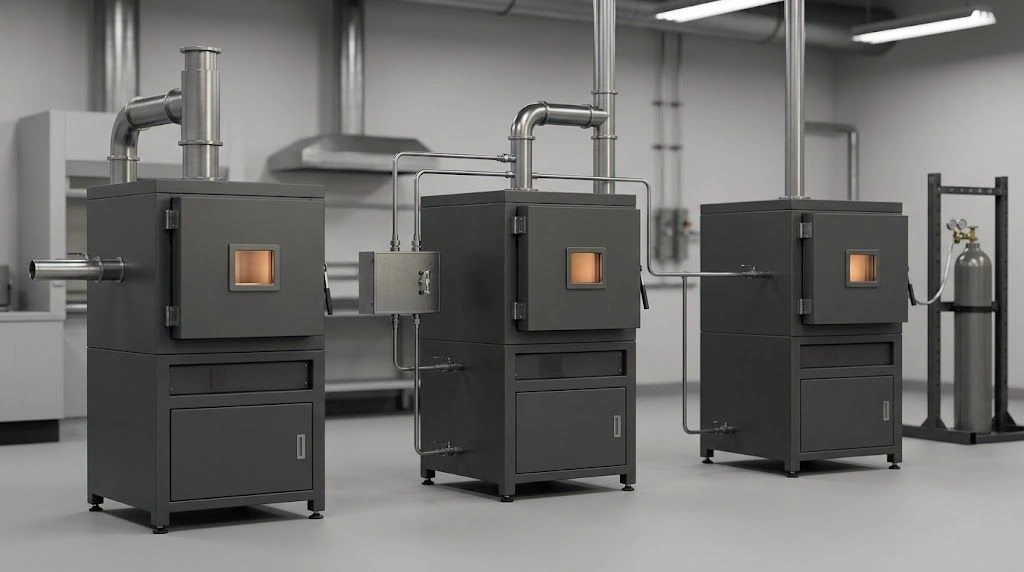
For critical acid service — concentrated acids at elevated temperature, mixed acid systems, systems with fluoride present, or applications where tube failure causes downtime or contamination — a small-scale immersion test using the actual acid chemistry and temperature should be completed before production quantities are ordered. Mass loss measurement, surface roughness inspection, dimensional check, and visual surface analysis after exposure confirm compatibility more reliably than extrapolation from generic chemical resistance tables.
Evaluating zirconia or alumina tubes for acid environments? Share your acid chemistry, concentration, temperature, exposure mode, flow velocity, particle load, tube drawing, seal design, and cleaning cycle so the zirconia-vs-alumina route can be checked against immersion and geometry constraints. For drawings, grades, and validation planning, use custom services — no RFQ commitment required at this stage.
Related reading
- Zirconia ceramic chemical resistance behavior — how ZrO₂ grade and acid chemistry constrain resistance before a zirconia-vs-alumina tube call.
- Alumina tubes for chemical reactors: acid corrosion resistance — Al₂O₃ tube and liner boundaries in acid-reactor service (Al₂O₃-focused complement to this dual-material selection guide).
- High-purity alumina tube chemical resistance performance — how alumina purity and densification shift acid/alkali screening for tube service.
Frequently Asked Questions
Is zirconia more acid resistant than alumina?
Often, dense zirconia shows lower mass loss than lower-purity alumina in published comparative immersion tests — particularly under concentrated hot acid — but those rankings are grade- and protocol-dependent and are not a factory SLA. Alumina can still be the better practical choice for moderate acid exposure, high-temperature insulation, and cost-sensitive designs. Confirm against the actual service condition on the RFQ rather than assuming from the material name.
Can alumina tubes be used in sulfuric acid?
Yes, alumina can be used in some sulfuric acid environments, but concentration and temperature matter significantly. Published comparative immersion tests often show higher mass loss for lower-purity alumina than for dense zirconia in hot concentrated sulfuric acid — results are grade- and protocol-dependent, so critical service should be validated on the RFQ rather than assumed compatible. For dilute or moderate sulfuric acid at lower temperature, alumina is often a practical and cost-effective choice.
Are zirconia tubes suitable for hydrochloric acid?
Zirconia is often considered for hydrochloric acid systems, but performance still depends on concentration, temperature, exposure time, and impurities including oxidizing agents or fluoride. Acid behavior must be evaluated by acid type, concentration, temperature, and oxidizing character rather than by acidity or pH alone — zirconia's compatibility should be confirmed by testing for the specific hydrochloric acid system, not assumed from generic chemical stability.
Which is better for acid combined with mechanical stress?
Zirconia is usually preferred because of its higher fracture toughness. Alumina is more cost-effective but more brittle, so protection from impact, vibration, and over-clamping becomes more important when alumina is specified in mechanical acid-service applications. If the system combines acid corrosion with regular mechanical contact or vibration, zirconia is the lower-risk starting point.
Can either material be used in hydrofluoric acid?
Do not assume compatibility. Free HF and fluoride-bearing acidic systems require separate review and are not covered by standard acid-resistance data for oxide ceramics (alumina and zirconia grades). Free HF is a critical incompatibility boundary for these oxides; chemical compatibility references also flag alumina as unsuitable for hydrofluoric and hydrofluorosilicic acid environments. If the system contains fluoride at any concentration, disclose this in the RFQ and do not proceed without compatibility confirmation.
What information should I send to a supplier?
Send acid name, concentration, temperature (continuous and peak), exposure mode (liquid, vapor, condensate, spray), fluoride and chloride content if present, flow velocity, particle or slurry load, cleaning cycle chemistry, tube drawing with OD/ID/wall/length and end configuration, seal and gasket design, surface finish requirement, and expected service life. A supplier who receives this information can confirm material suitability and recommend whether an acid exposure test is needed before production.