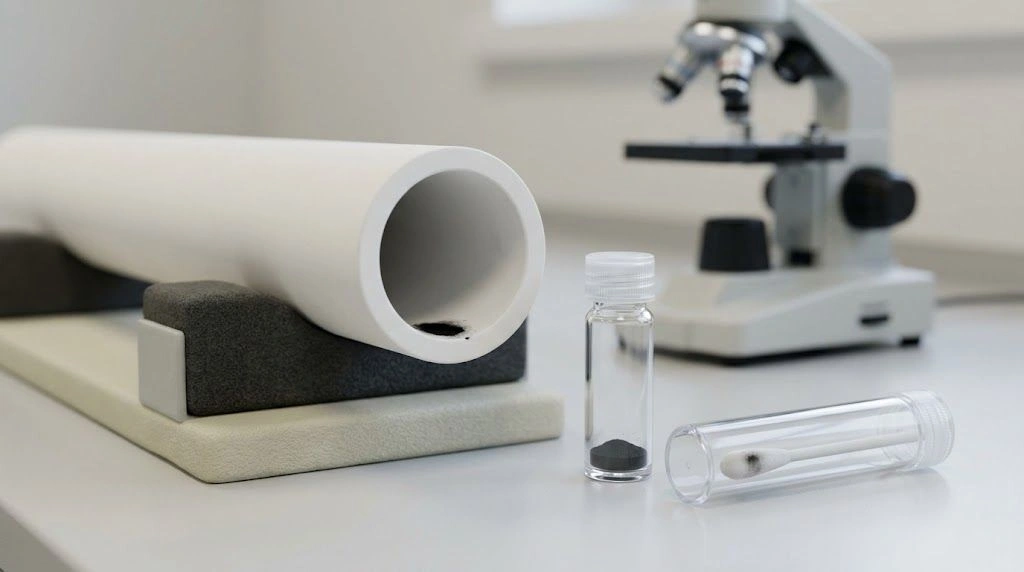
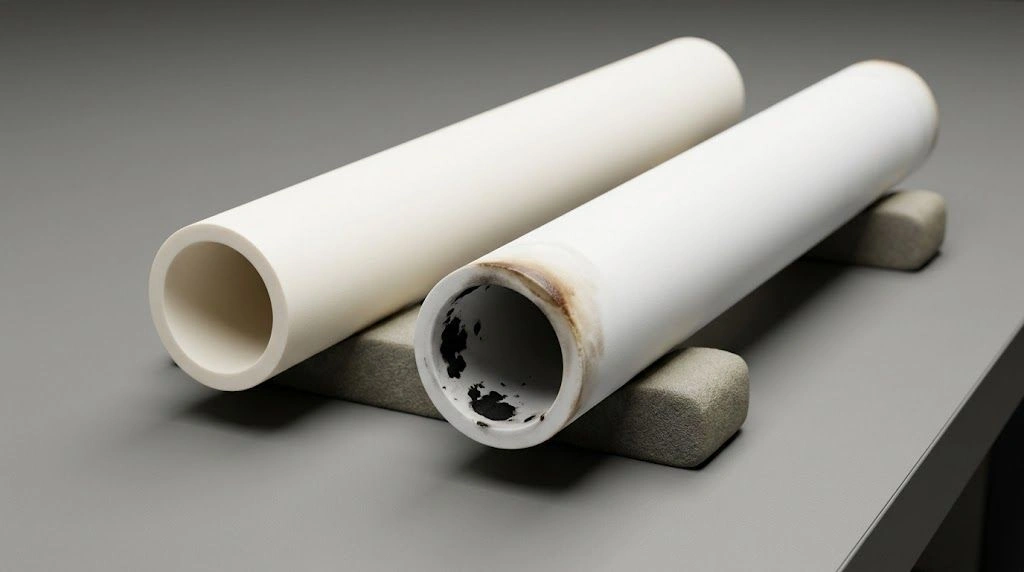
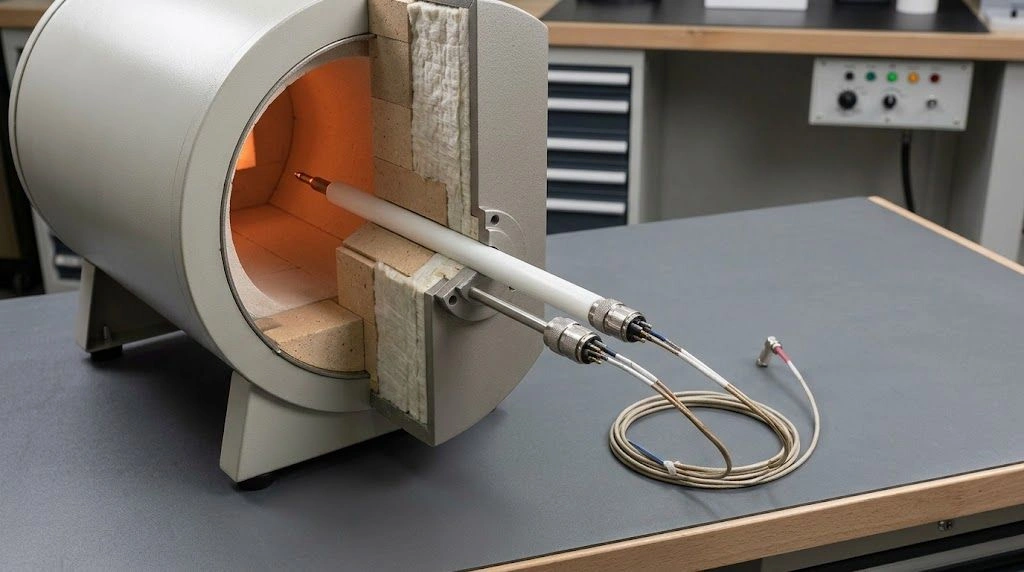
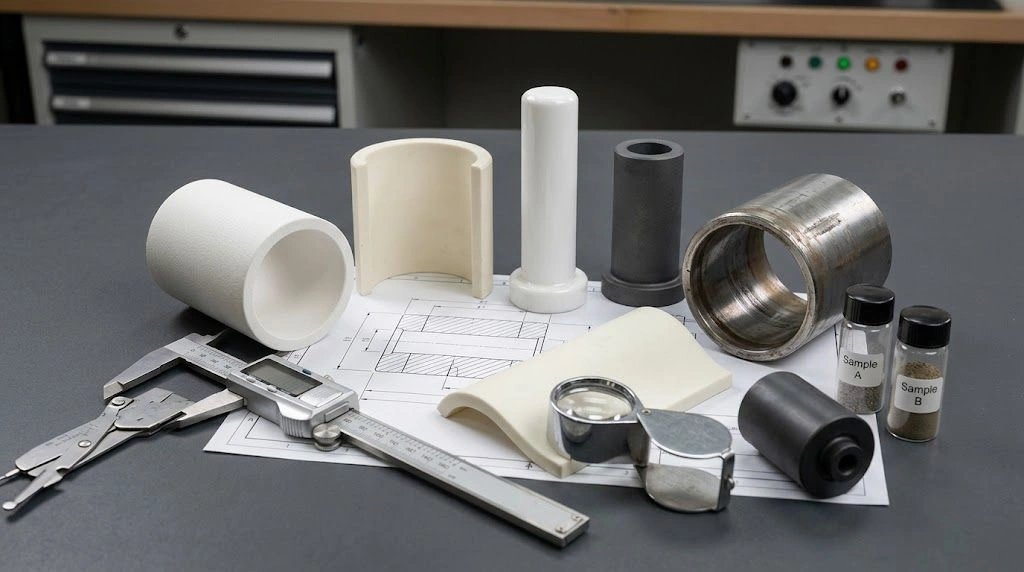
Advanced ceramics in 2026 are selected by the dominant failure mode — heat, wear, corrosion, insulation, thermal shock, fracture, contamination, vacuum outgassing, or dimensional drift. Alumina is the cost-effective baseline for insulation and wear. Zirconia is chosen for toughness and impact tolerance. Silicon carbide is used for extreme wear, corrosion, and heat-transfer duty. Silicon nitride balances strength and thermal shock. Boron nitride supports non-wetting, machinable, high-temperature and vacuum applications. Aluminum nitride is selected when thermal conductivity and electrical insulation must coexist. The correct specification must include material grade, operating environment, geometry, tolerance, surface finish, inspection method, packaging, and validation test — not just the ceramic name.
This article is a reference hub for engineers making ceramic material decisions in 2026. It links out to ADCERAX's specific material and product pages by application. The advanced ceramics manufacturer overview at ADCERAX covers the full range of engineered ceramic materials — alumina, zirconia, silicon carbide, silicon nitride, boron nitride, aluminum nitride, ZTA, and boron carbide — produced as custom parts, standard tube and rod geometries, crucibles, pump components, and furnace elements.
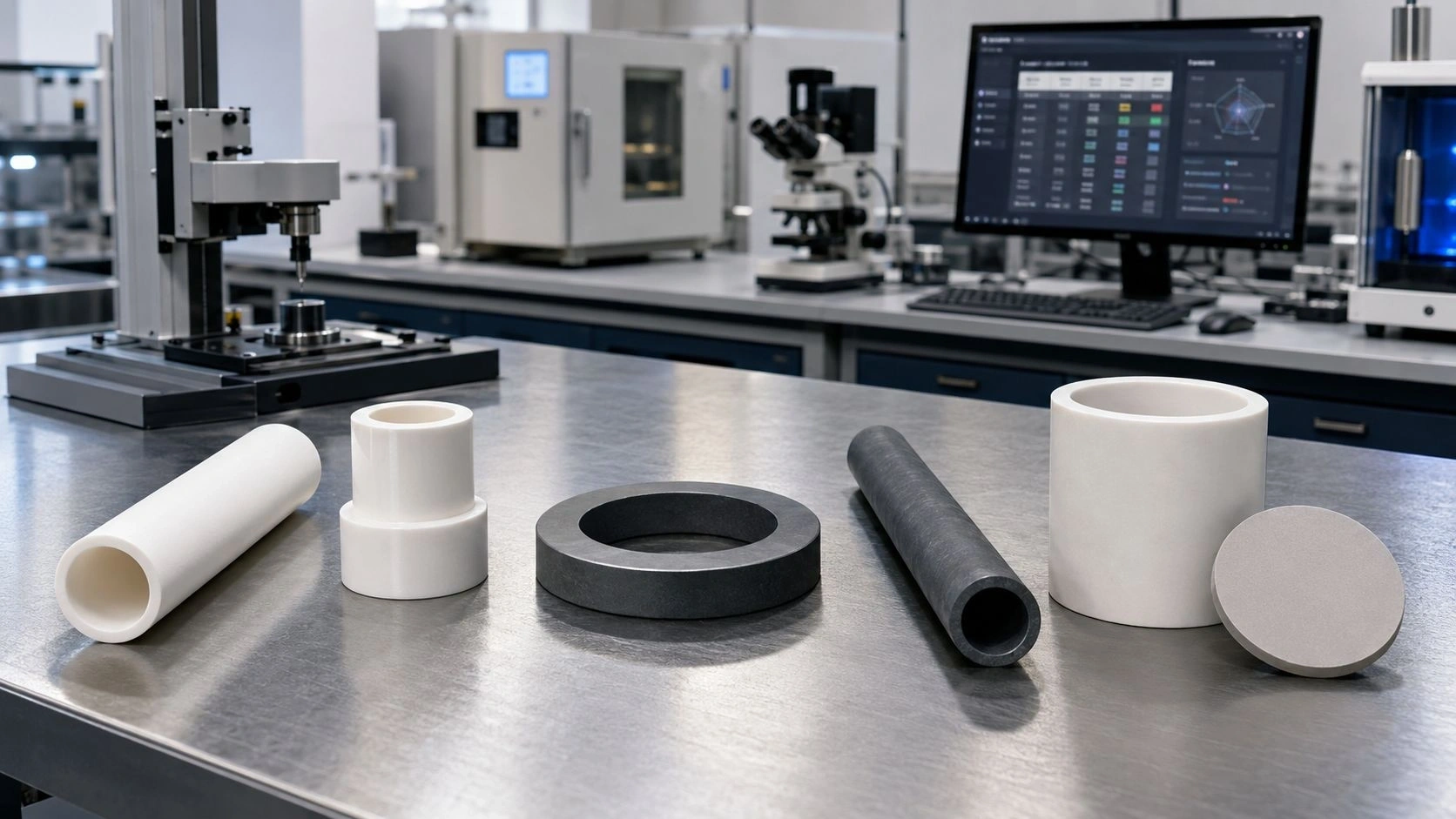
Advanced ceramics in 2026 are selected by failure mode, not material name — alumina for insulation and wear, zirconia for toughness, SiC for corrosion and heat transfer, BN for vacuum and molten metal, AlN for thermal management.
What counts as advanced ceramics in 2026?
Advanced ceramics — also called technical ceramics or engineered ceramics — are high-performance non-metallic materials designed for conditions that standard materials cannot reliably handle: extreme heat, abrasive wear, chemical corrosion, electrical insulation, thermal management, vacuum cleanliness, and dimensional stability over many cycles.
Multiple market research reports in 2025–2026 place the advanced ceramics market in the range of USD 92–105 billion and growing, with projections toward USD 140–170 billion by the early 2030s depending on the research scope and definition. Fact.MR estimated the advanced ceramics market at USD 92.00 billion in 2025, projected at approximately USD 95.96 billion in 2026 and USD 146.19 billion by 2036. Mordor Intelligence estimated the market at USD 105.12 billion in 2026, growing to USD 146.13 billion by 2031. Fortune Business Insights projected growth from USD 104.97 billion in 2026 toward USD 169.13 billion by 2034. Stratview Research's more narrowly defined technical ceramics segment estimated USD 13.40 billion in 2024, growing to USD 23.46 billion by 2032. These figures vary because ""advanced ceramics"" is defined differently across reports — some include refractory and structural ceramic markets broadly, others focus only on precision engineered parts. The common signal is strong growth driven by semiconductor equipment, electric vehicles, aerospace, energy, industrial automation, and healthcare applications.
The material families within advanced ceramics are not interchangeable. SAMaterials lists common advanced ceramics as alumina, zirconia, aluminum nitride, boron nitride, silicon nitride, silicon carbide, and boron carbide, noting that each occupies a distinct performance space. Precision Ceramics confirms that advanced ceramics span many material types with widely varying properties, requiring material-specific selection rather than generic ceramic specification. The ADCERAX advanced ceramic materials range covers alumina, zirconia, magnesia, beryllia, ZTA, silicon carbide, boron carbide, silicon nitride, boron nitride, aluminum nitride, and engineered ceramics — providing the material breadth required for cross-application procurement.
Oxide ceramics: alumina, zirconia, ZTA, magnesia, beryllia. The oxide family includes the most widely used engineering ceramics. Alumina dominates by volume because of its cost-performance balance for insulation, wear, and furnace components. Zirconia — particularly yttria-stabilized tetragonal zirconia (3Y-TZP) — provides higher toughness than alumina in applications where chipping, impact, and fit-critical wear are the failure mode. ZTA (zirconia-toughened alumina) occupies the middle ground.
Non-oxide ceramics: SiC, Si₃N₄, BN, B₄C. Silicon carbide and silicon nitride serve demanding structural, thermal, and tribological applications. Boron nitride — especially the hot-pressed and CVD-grown pyrolytic grades — is unique for machinability, non-wetting behavior with molten metals, and vacuum compatibility. Boron carbide is among the hardest materials available and is selected for wear and armor applications.
Thermal-management ceramics: AlN, BeO, metallized ceramics. Aluminum nitride has become the dominant substrate material for power electronics and thermal management applications where both high thermal conductivity and electrical insulation are required. Beryllia provides even higher thermal conductivity but requires handling precautions due to toxicity.
Advanced ceramic material selection matrix
The practical rule for 2026: choose the ceramic by the problem that will kill the part first, not by the highest-temperature option or the most impressive data sheet. The 2026 Advanced Ceramic Material Selection Matrix below maps each material to its engineering fit:
| Material | Best-fit engineering use | Main advantage | Main boundary |
|---|---|---|---|
| Alumina | Insulators, tubes, crucibles, guides, wear parts | Cost-effective, hard, insulating, chemically stable | Brittle under shock; lower toughness than zirconia |
| Zirconia | Fit-critical wear parts, plungers, guides, sleeves | High toughness and chip resistance | Lower thermal conductivity; temperature limits vary by stabilizer |
| Silicon carbide | Heat exchangers, pump parts, seal rings, furnace tubes | Wear, corrosion, heat transfer, thermal shock | Brittle; grade route matters (SSiC/RBSiC/NBSiC) |
| Silicon nitride | Bearings, rollers, mechanical shock parts | Strength, shock resistance, rolling contact | Higher cost; geometry-specific processing |
| Boron nitride | Crucibles, liners, nozzles, insulators, vacuum parts | Machinable, non-wetting, thermal shock resistance | Oxidation and moisture sensitivity |
| Aluminum nitride | Substrates, heat spreaders, power electronics | High thermal conductivity + electrical insulation | Sensitive to moisture/surface chemistry depending on grade |
| ZTA | Wear parts needing improved toughness vs alumina | Balance of cost, toughness, wear | Not as tough as zirconia; not as low-cost as alumina |
| Boron carbide | Wear, armor, abrasive environments | Extremely hard and lightweight | Brittle and processing-cost sensitive |
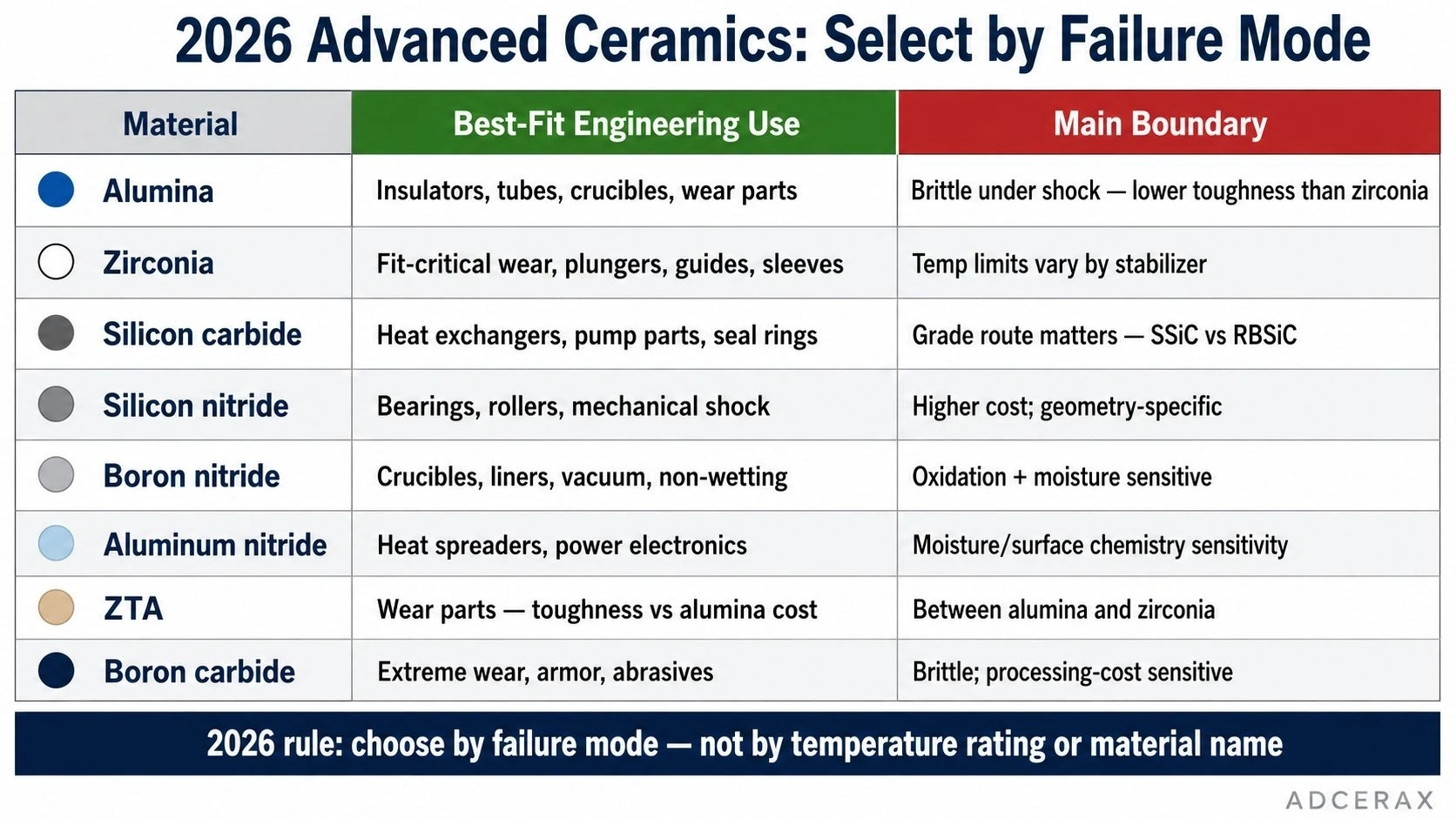
Advanced ceramics in 2026 should be selected by dominant failure mode — not by temperature rating or material name — because each material family has a different best-fit engineering use and boundary.
Select by dominant failure mode, not by maximum temperature rating. A higher-specification material solves the wrong problem if the actual failure is a different mechanism.
Alumina. The alumina ceramic range at ADCERAX covers 95%, 99%, 99.5%, 99.7%, and 99.8% purity grades in tubes, rods, plates, crucibles, and custom parts. Alumina is the most specified advanced ceramic by volume because it delivers reliable electrical insulation, hardness, and chemical stability at a cost accessible for both industrial and research applications. Its main limitation is thermal shock sensitivity and lower toughness compared with zirconia or silicon nitride, which means sharp edges, rapid temperature change, and impact loading must be controlled by design.
Zirconia. Zirconia's toughness advantage — arising from the transformation-toughening mechanism in yttria-stabilized grades — makes it the preferred ceramic for close-tolerance wear parts, pump plungers, guide rods, and sleeves where chipping during handling and service is the primary failure risk. Its lower thermal conductivity and the need to stay within the tetragonal-to-monoclinic phase-stability temperature window are important boundary conditions for specification.
Silicon carbide. Silicon carbide occupies a unique position because it combines high hardness, low porosity in sintered grades, strong corrosion resistance, and high thermal conductivity that enables heat-transfer applications not accessible to most ceramics. The silicon carbide ceramic range at ADCERAX includes SSiC, RBSiC, and NBSiC grades for tubes, seal rings, pump components, heat exchanger elements, and custom machined parts. The grade route matters: SSiC has no free silicon and provides the strongest chemical resistance, while RBSiC allows more complex shapes and lower cost at the expense of some chemical resistance from residual free silicon.
Silicon nitride and boron nitride. Silicon nitride's combination of strength, fracture toughness, and thermal shock resistance makes it the leading ceramic for precision rolling bearings and structural components in demanding environments. Boron nitride — available as machinable hot-pressed grades and ultra-pure CVD-grown pyrolytic grades — serves the applications where machinability, non-wetting contact with molten metals, and vacuum cleanliness are defining requirements. The boron nitride crucibles at ADCERAX cover both hot-pressed BN and PBN grades for metal processing and vacuum evaporation.
Engineering component forms: tubes, crucibles, plates, sleeves, and custom parts
Material selection and component-form selection interact. The same alumina can behave very differently as a thin thermocouple protection tube, a thick-walled crucible, or a flat seal ring — and the critical failure risk shifts with the form.
| Component form | Common materials | Main design risk | RFQ priority |
|---|---|---|---|
| Tubes | Alumina, SiC, zirconia, BN | Straightness, wall thickness, expansion, support | OD/ID, length, wall, thermal cycle |
| Crucibles | Alumina, BN, PBN, zirconia, SiC | Melt compatibility, thermal shock, contamination | Melt chemistry, atmosphere, temperature |
| Sleeves/bushings | SiC, zirconia, alumina | Press-fit cracking, surface finish, clearance | ID/OD tolerance, mating shaft, chamfer |
| Seal rings | SiC, alumina, zirconia | Flatness, lapping, dry running, mating material | Flatness, Ra, mating pair, leakage target |
| Plates/substrates | Alumina, AlN, BeO, zirconia | Warpage, flatness, thermal conductivity | Flatness, thickness, surface finish |
| Liners | BN, SiC, alumina, zirconia | Tolerance stack-up and thermal expansion | Outer part drawing + liner drawing |
| Nozzles | SiC, BN, alumina, zirconia | Erosion, clogging, thermal shock | Bore, pressure, media, particle size |
| Custom parts | All families | Manufacturability and inspection disputes | Datum, critical dimensions, FAI |
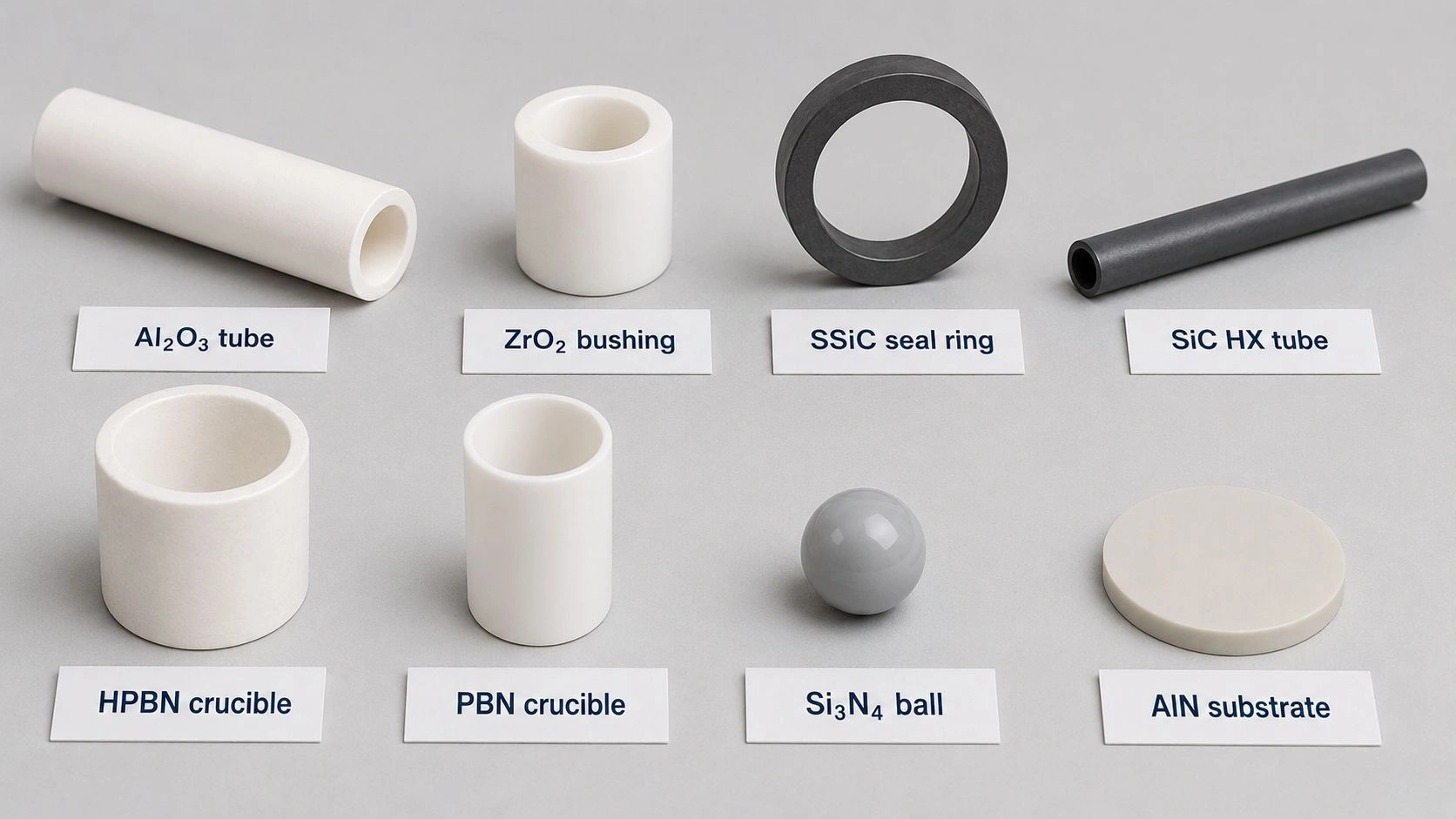
Common advanced ceramic forms — alumina tubes, zirconia bushings, SSiC seal rings, SiC heat-exchanger tubes, HPBN and PBN crucibles, Si₃N₄ balls, and AlN substrates — show why material selection and component geometry must be specified together.
The ceramic tubes and pipes range at ADCERAX covers alumina, SiC, zirconia, and BN tubes from standard stock to custom geometries with lengths up to 3000 mm, custom OD/ID/wall combinations, and surface finish options. The ceramic crucibles range covers alumina, zirconia, SiC, and BN crucibles for laboratory and industrial heating applications.
Long tubes. Ceramic tubes longer than 1 meter require specific attention to thermal expansion allowance, support spacing, sliding versus fixed end design, seal compliance, and heating rate. A tube that passes a room-temperature fit check can still crack under restrained expansion during the first furnace ramp if both ends are locked. The engineering principle for all long ceramic tubes is: one end fixed for alignment, one end free to expand.
Crucibles. The correct crucible material depends on the melt chemistry, operating atmosphere, temperature, and whether contamination of the processed material is a concern. BN is non-wetting with most molten metals and can be machined to close tolerances for precise fit inside graphite or metal support crucibles. PBN provides additional low-outgassing and vacuum-compatible wall structure for compound semiconductor crystal growth and MBE applications.
Pump seals, sleeves, and bearings. Silicon carbide — particularly SSiC — is the dominant ceramic for mechanical seal rings, pump sleeves, and magnetic-drive pump bearings because it combines corrosion resistance, high hardness, and thermal conductivity. The grade distinction between SSiC and RBSiC matters for aggressive chemical service: RBSiC contains residual free silicon that can limit chemical resistance in strong acids and alkalis.
Common failure modes engineers must design around
Ceramics fail not from general ""brittleness"" but from specific, predictable stress conditions that can be designed out if identified before production.
The Material Choice by Failure Mode table maps dominant failure conditions to the correct ceramic:
| Dominant failure mode | Strong candidate materials | Avoid this mistake |
|---|---|---|
| Electrical insulation at high temperature | Alumina, AlN, BN | Choosing SiC where insulation is required at high temperature |
| Abrasive wear | Alumina, SiC, zirconia, B₄C | Choosing by hardness only, ignoring impact |
| Impact/chipping | Zirconia, Si₃N₄, ZTA | Using alumina with sharp unsupported edges |
| Acid/alkali corrosion | SSiC, alumina, zirconia, selected BN | Ordering generic SiC without confirming SSiC vs RBSiC |
| Molten metal non-wetting | BN, PBN, selected coatings | Assuming alumina or graphite is always cleaner |
| Thermal shock | SiC, Si₃N₄, BN | Ignoring wall thickness and ramp rate |
| Vacuum/low outgassing | PBN, high-purity alumina, selected CVD ceramics | Using porous grades without bake-out data |
| Heat spreading + insulation | AlN, BeO, selected metallized ceramics | Using alumina when thermal conductivity is critical |
| Fit-critical sliding wear | Zirconia, SiC, alumina | Ignoring surface finish and mating material |
| Long furnace tubes | Alumina, SiC, mullite, zirconia depending on service | Ignoring support, expansion, and straightness |
The Ceramic Failure Diagnosis Matrix maps observed problems to better diagnostic questions:
| Observed problem | Common assumption | Better diagnostic question |
|---|---|---|
| Part cracked at edge | Poor ceramic quality | Was the edge chamfer/radius adequate? |
| Tube cracked near end | Bad tube batch | Was thermal expansion restrained by seals or clamps? |
| Sleeve cracked during assembly | Material too brittle | Was press-fit too high or ID tolerance too tight? |
| Seal ring leaks | Wrong ceramic | Was flatness, lapping, mating face, and spring load controlled? |
| Crucible contaminated melt | Ceramic incompatible | Was grade, cleaning, packaging, and blank test verified? |
| Pump part wears quickly | Ceramic not hard enough | Was particle impact, cavitation, or dry running the real cause? |
| Vacuum part outgasses | Material not UHV-compatible | Was porosity, moisture, cleaning, and bake-out checked? |
| Long tube bends or sags | Supplier defect | Was support spacing, load, temperature, and wall thickness reviewed? |
| Batch 2 performs differently | Supplier inconsistency | Was material/process change control in place? |
Crack location is often the most useful diagnostic input. End cracks indicate restrained expansion. Ring cracks indicate point loading. Longitudinal cracks indicate thermal gradients. Edge chips indicate insufficient chamfer or impact.
When advanced ceramics beat metals — and when they do not
Advanced ceramics beat metals when the dominant problem is high-temperature stability, electrical insulation, chemical corrosion, abrasive wear, low contamination, thermal conductivity with insulation, or non-wetting molten material contact. Several of these advantages can apply simultaneously — for example, a SiC pump sleeve provides corrosion resistance, wear resistance, and high hardness in a single component that no metal alloy can match at the same temperature and chemical exposure.
Metals still win when the part must tolerate impact, bending, ductile deformation, threaded assembly loads, field welding, pressure-boundary code design, or low-cost field repair. Ceramics cannot be welded, bent, or threaded in the conventional sense, and their fracture behavior under tensile stress is sudden rather than gradual, which limits their use in applications where ductile warning of overload is important.
The best engineering solutions are frequently hybrid: metal provides the structure, pressure boundary, or mechanical interface, while ceramic provides the wear surface, insulation layer, corrosion barrier, or thermal interface. A metal pump body with SiC seal rings and sleeve liners, a steel furnace frame with alumina ceramic tubes, and a graphite heating element with a BN crucible liner are all standard hybrid architectures that use each material for its specific advantage.
The lifecycle cost argument also changes between materials. A ceramic sleeve that costs five times a metal sleeve but lasts ten times longer while eliminating contamination reduces the annualized cost well below the metal alternative — but this calculation only holds when the dominant failure mode is actually the one the ceramic addresses. Upgrading to a higher ceramic specification to solve a problem that originates from poor installation design, wrong thermal management, or incorrect mating material selection does not improve service life.
2026 RFQ checklist for advanced ceramic parts
A supplier-ready advanced ceramic RFQ is the practical outcome of the material and failure-mode analysis above. The custom ceramic parts manufacturing service at ADCERAX covers drawing-based production from 3-piece minimum order quantity, with 3–5 day turnaround for simple modifications and 2–4 weeks for new geometries, sample-to-production validation, dimensional inspection reports, and material certificates.
The 2026 Advanced Ceramic RFQ Checklist covers the minimum required fields:
| RFQ field | Why it matters | Recommended wording |
|---|---|---|
| Application | Drives material choice | ""State function, failure mode, and operating environment"" |
| Material grade | Prevents substitution | ""99.7% alumina/3Y-TZP/SSiC/HPBN/AlN, etc."" |
| Drawing | Defines manufacturability | ""2D/3D drawing with datum, revision, and critical dimensions"" |
| Temperature | Controls expansion and shock | ""Continuous, peak, ramp, cooling, cycle count"" |
| Atmosphere/chemistry | Controls corrosion and contamination | ""Air, vacuum, H₂, acid, alkali, molten metal, vapor species"" |
| Mechanical load | Controls fracture risk | ""Compression, bending, vibration, impact, press-fit"" |
| Surface finish | Controls wear, sealing, and particles | ""Ra, lapped face, polished area, as-fired allowed zones"" |
| Inspection | Prevents disputes | ""CMM, bore gauge, flatness, roundness, visual, leak test"" |
| Quantity | Determines process route | ""Prototype, pilot batch, annual volume"" |
| Documentation | Supports quality approval | ""COA, material certificate, dimensional report, traceability"" |
| Packaging | Prevents chips and cracks | ""Individual protection, edge guards, export crate if needed"" |
| Validation | Confirms real service fit | ""Sample test, pilot batch, thermal cycle, chemical exposure"" |
This checklist is the minimum. Add mating material, vacuum level, outgassing requirement, trace metal limit, and change-notification protocol for higher-criticality applications.
The qualification workflow. A complete qualification sequence for a new ceramic supplier or new part should follow: application definition → drawing review and manufacturability feedback → material grade confirmation → first article inspection → pilot batch for repeatability verification → production with batch documentation and change-notification controls. Each step reduces a different category of risk, and skipping any step transfers that risk directly to production parts.
Material substitution is the most common failure. The single most preventable procurement failure in advanced ceramics is generic specification: ordering ""alumina tube"" without purity grade, ordering ""SiC part"" without SSiC/RBSiC/NBSiC designation, or ordering ""BN crucible"" without HPBN/PBN distinction. Each of these generic terms spans materials with meaningfully different performance across corrosion, vacuum, purity, and temperature applications. A qualified supplier should push back on generic specifications and request material-specific designation before accepting a purchase order.
Selecting an advanced ceramic for a 2026 engineering project? Share your drawing, material requirement, temperature, atmosphere, chemical exposure, wear condition, tolerance target, surface finish, quantity, and failure history. ADCERAX can review whether alumina, zirconia, SiC, Si₃N₄, BN, AlN, ZTA, or another engineered ceramic route best fits the application, and propose a sample-to-production qualification path.
Frequently Asked Questions
What are advanced ceramics?
Advanced ceramics are engineered non-metallic materials designed for demanding conditions including high temperature, abrasive wear, chemical corrosion, electrical insulation, thermal management, vacuum cleanliness, and dimensional stability over many cycles. Common material families include oxide ceramics such as alumina and zirconia, non-oxide ceramics such as silicon carbide, silicon nitride, boron nitride, and boron carbide, and thermal-management ceramics such as aluminum nitride.
How do engineers choose the right ceramic material in 2026?
Engineers should start with the dominant failure mode. Alumina fits cost-effective insulation and wear. Zirconia fits toughness and chipping resistance. Silicon carbide fits severe wear, corrosion, and heat transfer. Silicon nitride fits mechanical shock and rolling contact. Boron nitride fits non-wetting and machinability with vacuum compatibility. Aluminum nitride fits thermal management where electrical insulation is simultaneously required. The operating environment, geometry, mating material, and failure history together complete the selection.
Are advanced ceramics better than metals?
Sometimes, in specific conditions. Ceramics are better for high-temperature stability, electrical insulation, chemical corrosion resistance, abrasive wear, low contamination, and thermal management with insulation. Metals remain better for impact tolerance, ductility, threaded assembly, field welding, pressure-boundary code design, and field repair. The strongest engineering solutions often combine both — metal for structure, ceramic for the interface.
What is the biggest mistake when specifying advanced ceramics?
Using generic material names without grade designation. ""Alumina,"" ""zirconia,"" ""SiC,"" and ""BN"" are not complete specifications — they each span grades with meaningfully different density, purity, porosity, and performance. Engineers should specify grade, density, surface finish, tolerance, geometry, operating environment, and inspection method. A supplier who accepts a generic specification without requesting clarification may ship the cheapest available option within the name.
Why do ceramic parts crack?
Ceramic parts crack from specific, predictable stress conditions. End cracks near tube seals typically indicate restrained thermal expansion. Ring cracks at support points indicate point loading from misaligned or narrow supports. Longitudinal cracks indicate circumferential thermal gradients from uneven heating or cold gas impingement. Edge chips after assembly typically indicate insufficient chamfer, over-tight press fit, or impact during handling. Each crack pattern is a diagnostic signal, not just a quality failure.
What should be included in a 2026 advanced ceramic RFQ?
Include material grade, drawing with critical dimensions and revision, temperature profile, atmosphere, chemical exposure, mechanical load, surface finish by zone, inspection method, quantity broken into prototype/pilot/production, documentation requirements, packaging specification, and validation plan. For critical applications, add trace metal limits, vacuum outgassing requirement, mating material specification, and change-notification protocol for any supplier process change.
"