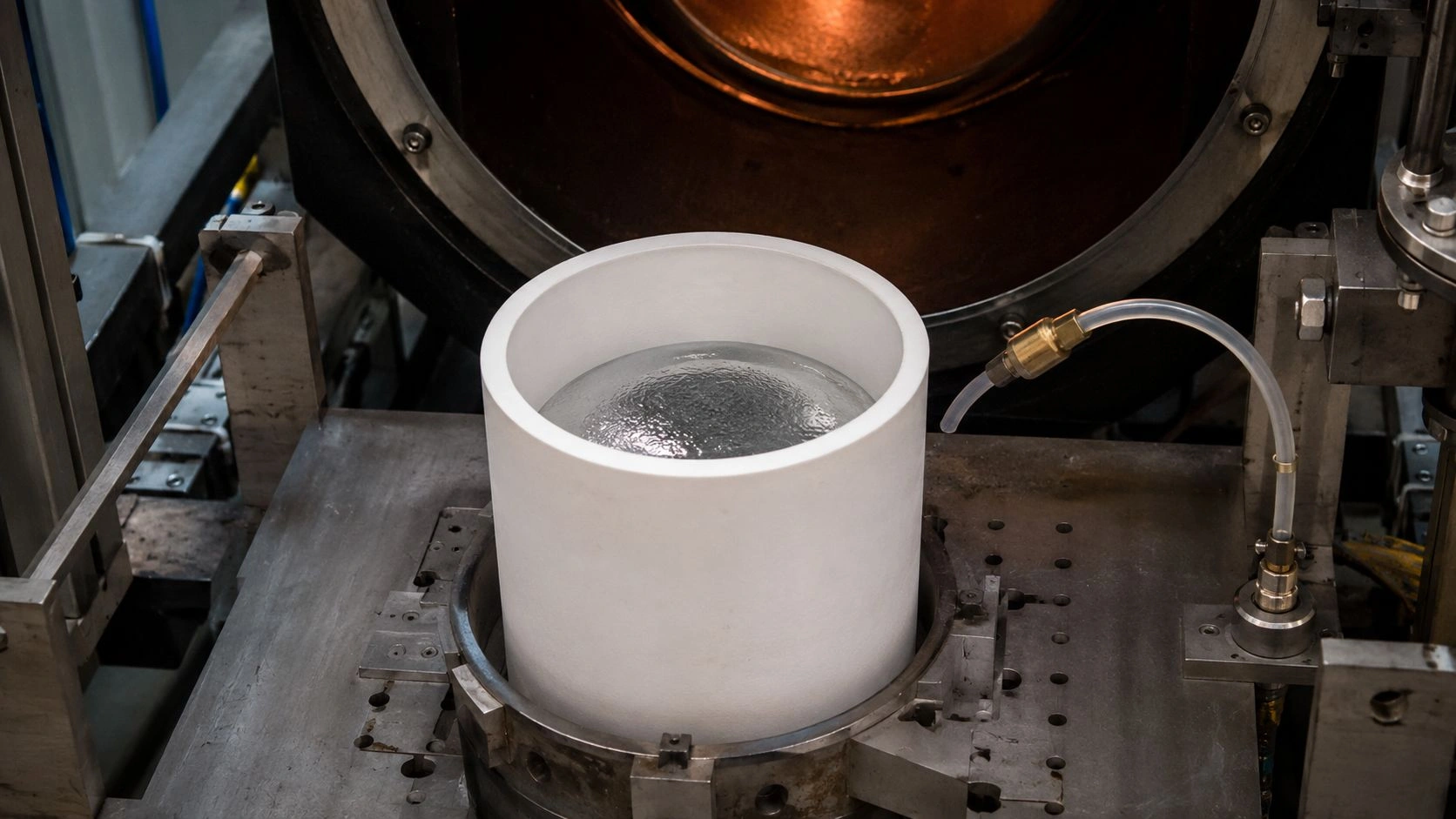
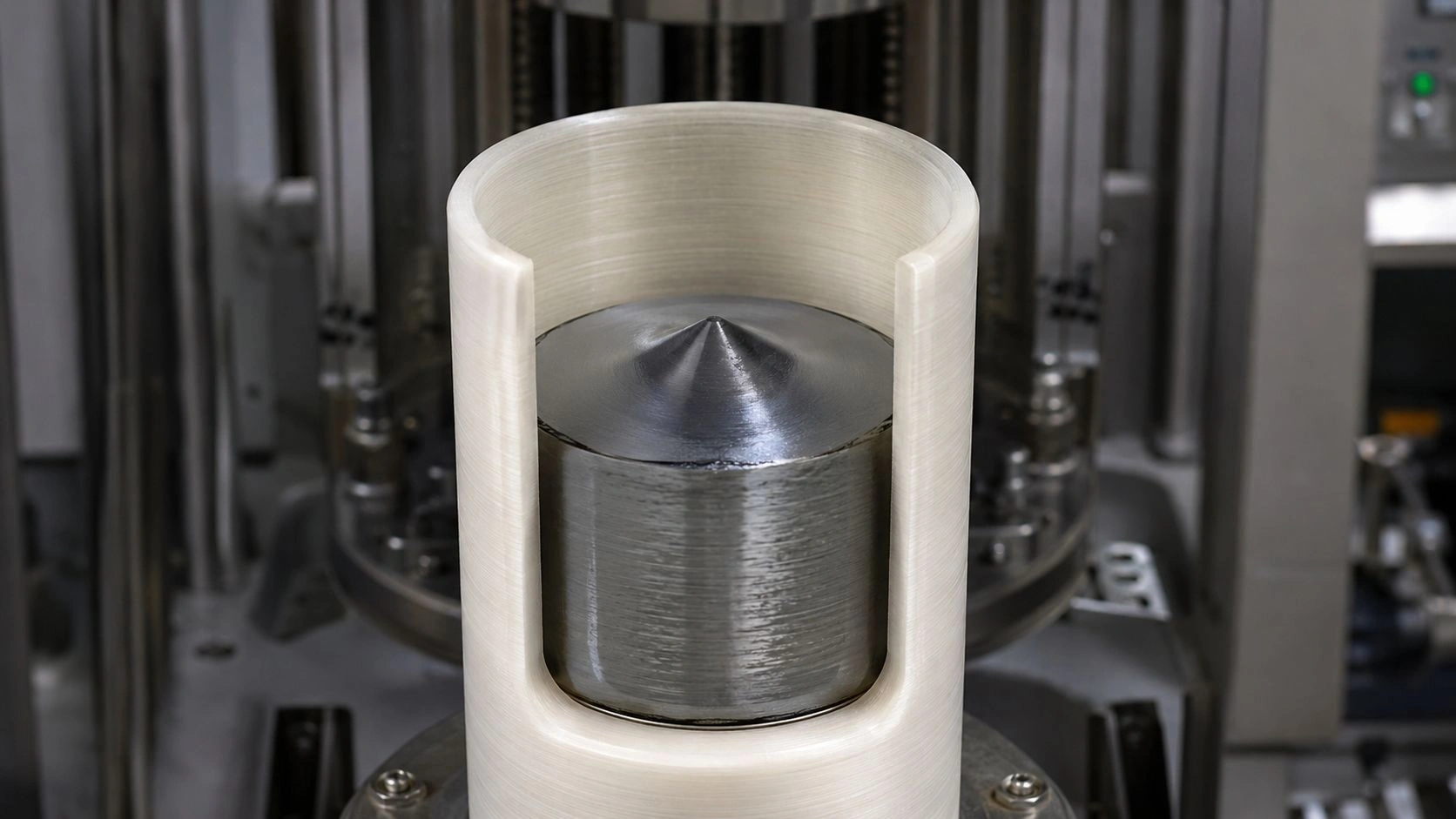
BN can be used in oxidizing atmospheres only within a controlled temperature, time, and moisture window. Hot-pressed BN is commonly treated as usable in air around the 850–900°C range, while its much higher temperature capability belongs mainly to vacuum, inert, or reducing atmospheres. Above the oxidation boundary, BN forms boron oxide species, and water vapor can accelerate volatilization or surface loss. Use BN for short, controlled oxidizing exposure; choose alumina, zirconia, or SiC when long high-temperature air service dominates.
That conditional boundary — not a simple yes or no — is the engineering answer this guide builds.
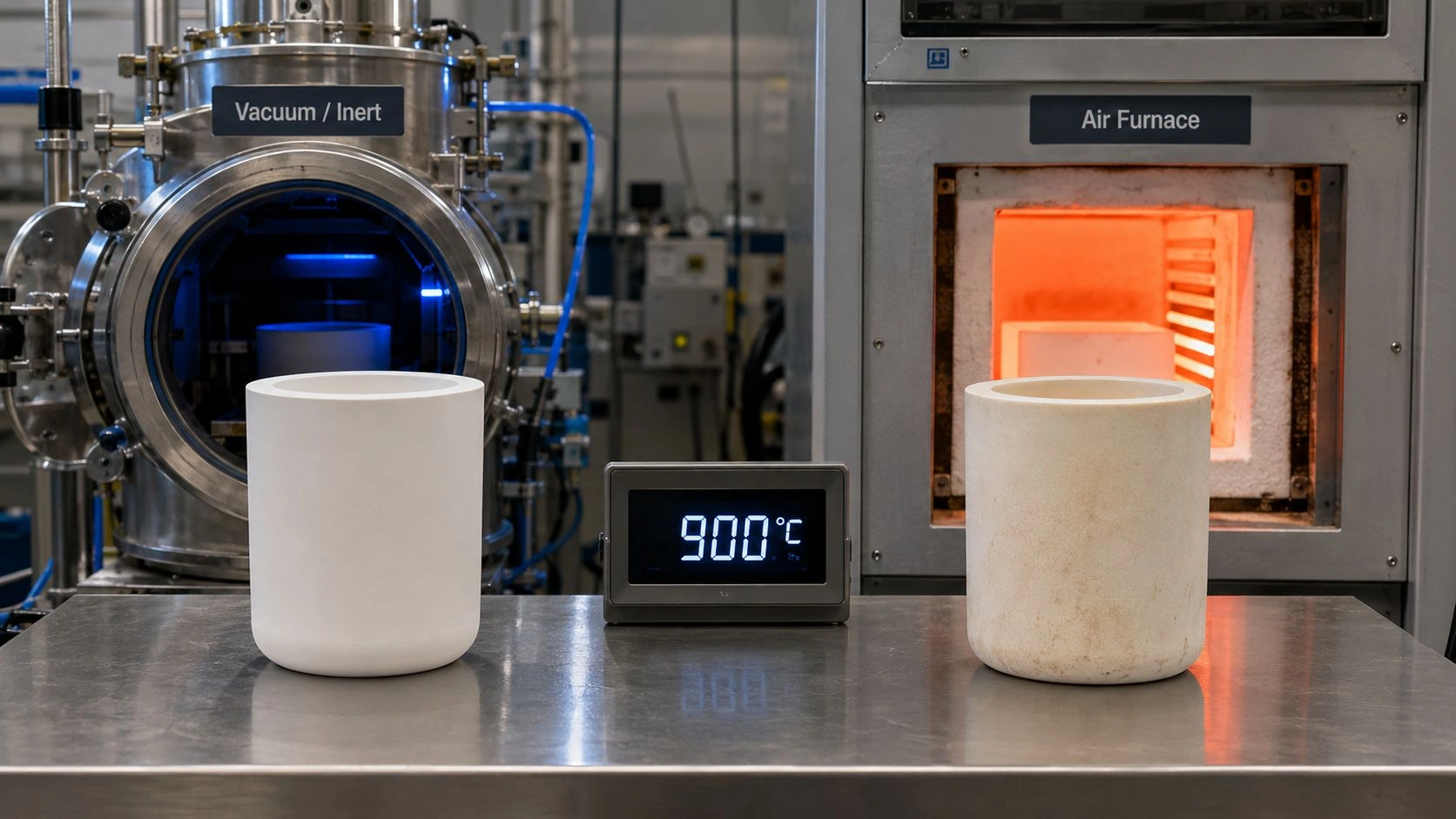
BN's high-temperature advantage is primarily in vacuum, inert, and reducing atmospheres — its usable window in air is significantly narrower and depends on grade, density, hold time, and moisture.
The boron nitride ceramic grades at ADCERAX — hot-pressed HPBN and CVD PBN — carry different temperature boundaries by atmosphere; the air-service limit is listed around 900°C while vacuum and inert-gas service extends substantially higher.
Can BN be used in air or oxygen?
BN can be used in air and oxidizing atmospheres, but only conditionally. Its strongest use case is vacuum, inert gas, or reducing atmosphere, where hot-pressed BN and PBN can operate at temperatures far above their practical air limits. In air, the practical boundary is much lower.
Published application guidance from major BN suppliers places oxidation resistance at approximately 900°C for practical engineering use. That is a useful starting benchmark, but it is not a universal guarantee. The real answer depends on five conditions: how long the exposure lasts, how hot the atmosphere is relative to that boundary, what the oxygen and moisture content are, which BN grade and density is specified, and whether the exposure is continuous or intermittent.
"Oxidizing atmosphere" also covers more ground than open air. Pure oxygen, wet air, combustion products, oxygen leakage into nominally inert gas, and process gases containing oxidizing vapors are not equivalent in their effect on BN. An argon furnace with 50 ppm oxygen leak is not inert from BN's perspective, and a reducing furnace with occasional air ingress during door-opening has a different oxidation exposure history than a clean sealed vacuum system.
Air exposure vs inert/vacuum high-temperature service
The gap between BN's air-service limit and its vacuum/inert-gas limit is large — roughly 900°C in air versus over 1800°C in vacuum or inert gas for hot-pressed grades. That gap means BN is not simply a "high-temperature ceramic" for all furnace types. It is a highly capable ceramic in the right atmosphere, and a moderate-temperature ceramic in oxidizing air.
Why oxygen impurity in "inert" gas still matters
Engineers sometimes assume that argon or nitrogen protection fully shields a BN component from oxidation. In practice, oxygen impurities at even low part-per-million levels at high temperature can trigger surface oxidation over long hold times. Systems with known oxygen leak history, inadequately purged gas lines, or porous furnace insulation are not truly inert environments for BN at elevated temperature.
Short exposure vs continuous service
BN may tolerate intermittent or brief air exposure at temperatures near its practical boundary — for example, during furnace loading, brief open-door events, or short sample changes. The same BN component placed in continuous air flow at similar temperature will likely show surface degradation over time. This distinction between intermittent and continuous oxidizing exposure is important for service life prediction.
What controls BN oxidation: temperature, time, moisture, and grade
The 850–900°C air boundary is a guide, not a fixed material constant. Several engineering variables move that boundary — in both directions.
[CITE: NASA's oxidation study of monolithic boron nitride found that BN oxidation behavior is strongly dependent on microstructure, including grain orientation, porosity, crystallinity, and density, and that water vapor promotes the formation of volatile boron oxide species — establishing that two BN parts with the same nominal chemistry can oxidize at significantly different rates depending on their microstructural state and the moisture content of the atmosphere.]
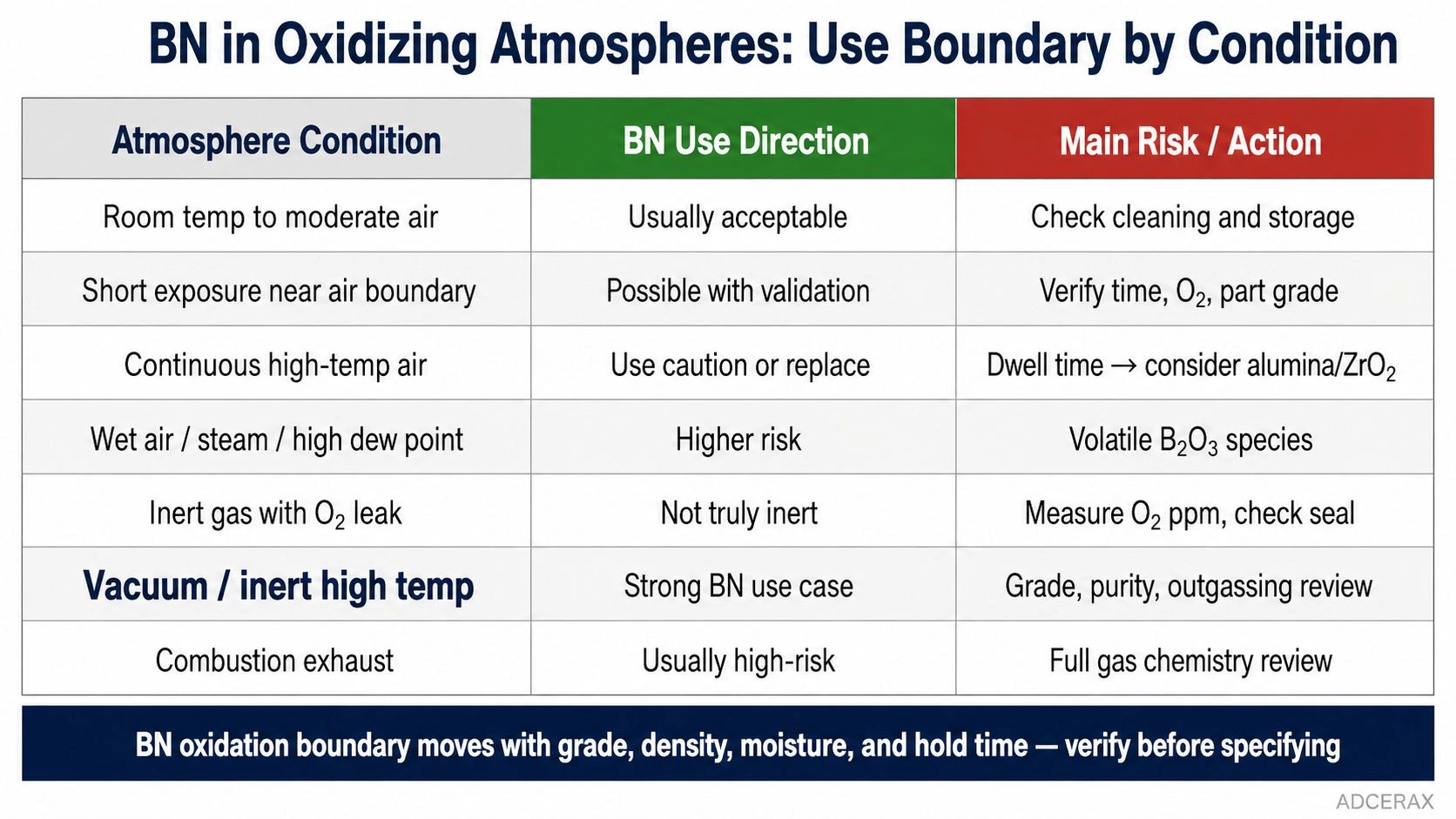
The BN Use Boundary table below maps common oxidizing conditions to expected BN performance:
| Condition | BN use direction | Main risk | What to verify |
|---|---|---|---|
| Room temperature to moderate air exposure | Usually acceptable | Surface contamination or moisture | Cleaning and storage |
| Short exposure near air-use boundary | Possible with validation | Surface oxidation | Time, oxygen level, part grade |
| Continuous high-temperature air | Use caution or replace BN | Oxidation and surface loss | Dwell time and material alternative |
| Wet air/steam/high dew point | Higher risk | Volatile boron oxide species | Dew point and gas flow |
| Inert gas with oxygen leak | Not truly inert | Unexpected oxidation | Oxygen ppm and leak history |
| Vacuum/inert high temperature | Strong BN use case | Contamination or vapor species | Grade, purity, outgassing |
| Combustion exhaust | Usually high-risk | Oxygen + water vapor + reactive gases | Full gas chemistry |
Values are indicative. Verify BN grade, atmosphere, oxygen level, dew point, hold time, and supplier-specific oxidation data before specifying production parts.
Why 900°C is a guide, not a universal guarantee
The 900°C air boundary appears in multiple published sources, but it reflects measured behavior for specific hot-pressed BN grades under dry or moderate-moisture air conditions and moderate hold times. A lower-density BN with open porosity may oxidize more readily because oxygen accesses a larger reactive surface area. A denser CVD PBN has a different microstructure, but it still requires atmosphere validation at high temperature. A component with thin walls or complex internal channels may show different oxidation behavior than the bulk material data suggest.
Water vapor and flowing gas as oxidation accelerators
Flowing gas carries oxidation products away from the surface, which can accelerate the net oxidation rate compared to static air. Water vapor specifically promotes volatile boron species — H₃BO₃ and related compounds — which can exit the surface and cause measurable mass loss. High dew-point environments, steam exposure, and combustion exhaust all contain water vapor at concentrations that matter for BN longevity.
Hot-pressed BN vs PBN vs composite BN
Hot-pressed BN grades may contain binders or sintering aids that affect oxidation behavior differently from the BN phase itself. PBN produced by CVD has a denser, purer structure that is less susceptible to oxygen ingress through open porosity — but its oxidation resistance in air still requires validation at temperature rather than being assumed from structural density alone. Composite or sintered BN grades with different additives need grade-specific data, not generic BN air ratings.
Do not misdiagnose atmosphere mismatch as poor BN quality
When a BN component discolors, loses surface material, or degrades unexpectedly, the first diagnostic impulse is often to conclude that the supplier provided inferior material. In most cases, the root cause is atmosphere mismatch — the operating environment was more oxidizing than the application assumed.
Oxygen leak in inert furnace. A BN liner that performs reliably in clean argon may degrade within a few cycles in a furnace with a leak. The component is the same; the atmosphere has changed. Before requesting a higher-grade BN or switching suppliers, the furnace atmosphere should be measured for oxygen content and leak points identified.
Wet air, steam, and water vapor exposure. Components used near kiln doors, in furnaces that are opened frequently at temperature, or adjacent to water-containing process materials see elevated moisture exposure. This accelerates surface loss through volatile boron oxide formation — a mechanism that looks like erosion or poor material quality but is fundamentally an atmosphere chemistry problem.
Long dwell vs short thermal cycle. A BN component that survives dozens of short cycles at 850°C may still degrade during a single extended hold at the same temperature, because cumulative oxidation exposure scales with time. Short-cycle protocols and continuous-service protocols require different allowable-temperature margins.
Binder-containing BN vs dense PBN interpretation. When a hot-pressed BN part shows glassy surface formation, the B₂O₃ forming may partly reflect binder or additive oxidation as well as BN oxidation. This is not necessarily a quality defect — it is a predictable consequence of the grade's chemistry in an oxidizing environment. Interpreting it as poor BN requires understanding what is in the material, not just what "BN" nominally means.
The Misdiagnosis Matrix below maps observed problems to better diagnostic questions:
| Observed problem | Common assumption | Better diagnostic question |
|---|---|---|
| BN surface turns glassy | Bad BN grade | Was B₂O₃ forming in oxygen exposure? |
| BN loses surface material | Supplier defect | Was water vapor or flowing wet air present? |
| BN part works in argon but fails in air | Batch inconsistency | Did the atmosphere change from inert to oxidizing? |
| BN liner degrades after furnace opening | Poor thermal shock resistance | Was it exposed hot to air during cooling? |
| PBN part discolors | Purity failure | Was oxygen or moisture present during high-temperature exposure? |
| BN nozzle erodes in hot gas | Wrong machining | Is gas chemistry oxidizing, wet, or combustion-derived? |
Diagnosis should be based on atmosphere records, oxygen measurements, and surface inspection before any material or supplier change is specified.
When to replace BN with alumina, zirconia, SiC, or silicon nitride
After confirming that the atmosphere is genuinely oxidizing and that the BN boundary has been reached, the material substitution decision follows a straightforward hierarchy.
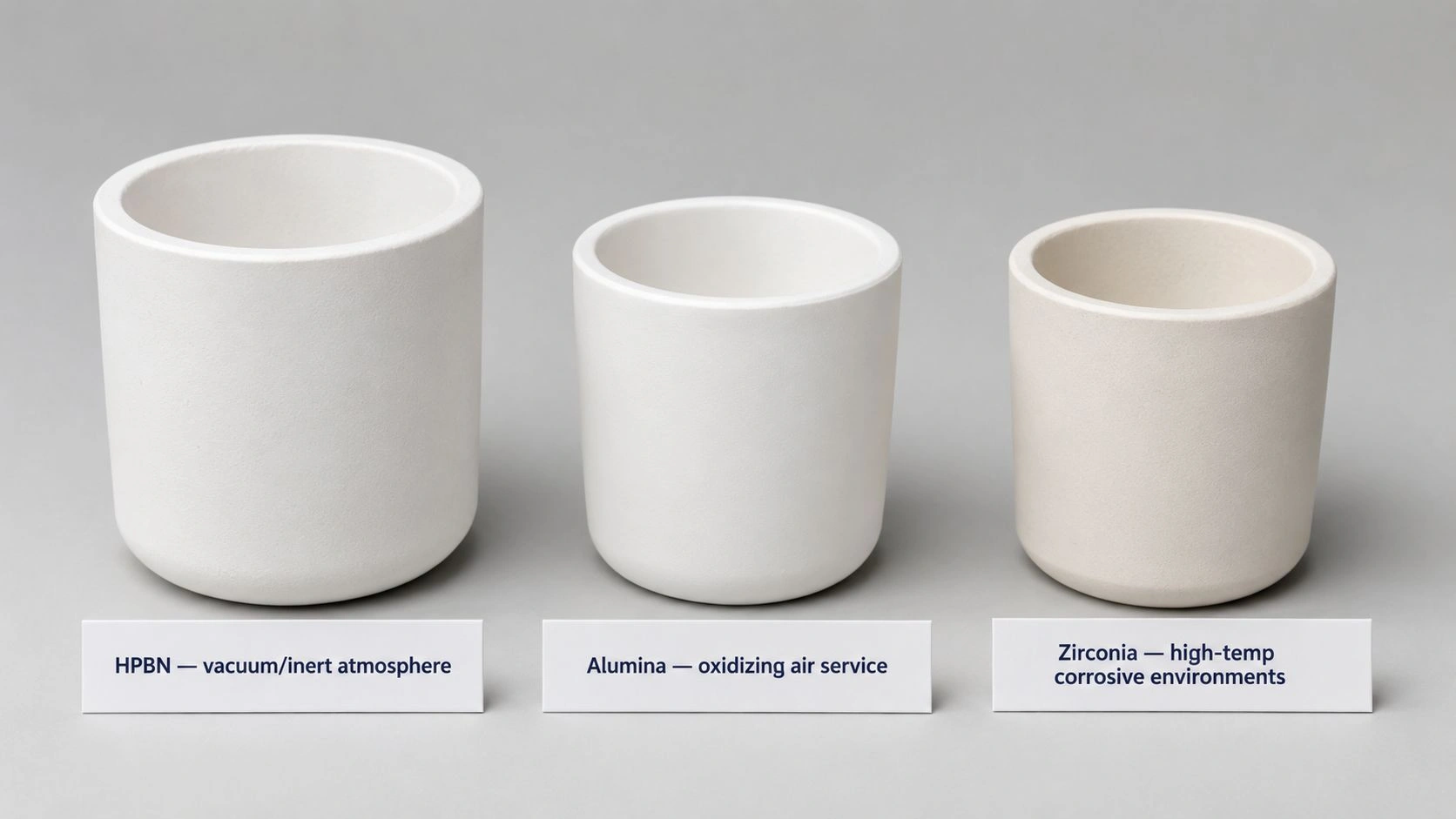
[CITE: Engineering selection guidance for BN in atmosphere-sensitive applications confirms the conditional material rule: use BN when the process is vacuum, inert, or reducing and when non-wetting behavior, electrical insulation, and machinability are the governing requirements; replace BN with alumina, zirconia, or SiC when long continuous air service, wet oxidizing gas, or combustion-atmosphere exposure dominates — because these oxide and carbide ceramics maintain their structural and surface properties under sustained oxidizing conditions where BN's practical boundary has been exceeded.]
The BN vs Replacement Materials table below maps common conditions to the better ceramic candidate:
| Material | Best-fit condition | Oxidizing atmosphere advantage | Limitation |
|---|---|---|---|
| Hot-pressed BN | Vacuum/inert, non-wetting, machinable parts | Limited air use around practical boundary | Oxidation at higher air temperature |
| PBN | High-purity vacuum/inert containment | Dense CVD structure helps cleanliness | Still needs oxygen exposure review |
| Alumina | Long oxidizing-air insulation and furnace use | Stable oxide ceramic | Lower non-wetting advantage than BN |
| Zirconia | High-temperature corrosion/melt environments | Strong oxide stability | Thermal shock and cost boundary |
| SiC | Thermal shock and structural hot-zone duty | Forms protective oxide in many air settings | Water vapor/alkali/corrosive gases matter |
| Silicon nitride | Thermal shock and structural ceramic duty | Better than BN in some hot gas contexts | Oxidation and cost still require review |
Keep BN for vacuum and inert applications. Non-wetting behavior, electrical insulation at high temperature, machinability, and freedom from graphite contamination remain BN's strongest advantages. For any process that operates under vacuum or inert gas, or requires brief controlled oxidizing exposure without sustained air contact, BN remains well suited.
Use alumina when oxidizing-air stability dominates. Alumina is the most straightforward replacement when the process runs continuously in air at temperatures where BN is marginal, and when electrical insulation and chemical stability in oxide form are the primary requirements. The ceramic crucible options at ADCERAX — spanning alumina, zirconia, BN, and SiC — illustrate this multi-material decision logic across temperature and atmosphere conditions.
Use zirconia for high-temperature corrosive melt conditions. When the operating temperature exceeds alumina's practical boundary or when the melt chemistry is aggressive, stabilized zirconia provides stronger corrosion resistance in oxidizing environments.
Use SiC when thermal shock and structural hot-zone duty dominate. SiC forms a protective oxide layer in many air environments and provides better thermal shock tolerance than alumina in cycling applications. The atmosphere boundary still needs review — SiC in water vapor, alkali-containing gases, or strongly reducing atmospheres requires its own compatibility assessment.
The ceramic sintering crucible range illustrates how atmosphere specification becomes a primary selection variable for high-temperature ceramic components across multiple material families.
The boron nitride crucible applications for vacuum and inert high-temperature metal processing confirm that BN's non-wetting and thermally stable behavior in those atmospheres is the design basis — not an air-atmosphere assumption.
Evaluating BN parts for air, oxygen, or mixed-atmosphere service? Share your temperature, dwell time, oxygen level, dew point, gas flow, contact material, and component drawing. ADCERAX engineers review whether hot-pressed BN, PBN, alumina, zirconia, SiC, or another ceramic route fits the atmosphere; turnaround depends on inquiry complexity — no RFQ commitment required at this stage.
RFQ checklist for BN parts in oxidizing or mixed atmospheres
A complete RFQ for BN in any oxidizing or potentially oxidizing environment must provide atmosphere context — without it, a supplier cannot confirm whether the BN grade, grade density, or maximum temperature is appropriate for the service.
| RFQ field | Why it matters | Recommended wording |
|---|---|---|
| Atmosphere type | Primary compatibility driver | "Air/oxygen/argon with O₂ ppm/vacuum/wet gas" |
| Oxygen level | Controls oxidation risk | "Provide O₂ concentration or expected leak condition" |
| Dew point/water vapor | Water vapor can accelerate loss | "State dew point or moisture exposure" |
| Temperature and dwell | Defines oxidation severity | "Continuous and peak temperature, hold time" |
| Thermal cycle | Controls repeated exposure | "Cycles per day and cooling atmosphere" |
| BN grade | Different structures oxidize differently | "Specify hot-pressed BN, PBN, or composite BN" |
| Part geometry | Affects surface-area exposure | "OD/ID/wall thickness/surface finish" |
| Contact material | Melt or powder may change reaction | "State metal, alloy, salt, powder, or vapor" |
| Validation | Confirms real boundary | "Recommend exposure test in actual atmosphere" |
The most critical field is atmosphere type with oxygen level. A supplier who receives only "BN part, 800°C" cannot confirm whether the component will survive a week of continuous air service. A supplier who receives "BN crucible, argon with 20 ppm O₂, 1200°C, 8-hour holds, 3 cycles per week" can make a meaningful grade and geometry recommendation.
Frequently Asked Questions
Can BN be used in air?
Yes, but only within a controlled temperature and time window. Many published application references place the practical air-use boundary around 850–900°C for hot-pressed BN. Above that range in continuous air service, oxidation becomes a meaningful limitation. BN's much higher temperature capability is available primarily in vacuum, inert gas, or reducing atmospheres.
At what temperature does BN oxidize?
The practical engineering boundary is often around 850–900°C in air, but this is grade- and condition-dependent. Oxidation rate is strongly influenced by BN density, crystallinity, porosity, oxygen level, water vapor content, hold time, and gas flow. NASA's oxidation study of monolithic BN found that microstructure and moisture both significantly affect oxidation behavior.
Is PBN better than hot-pressed BN in oxidizing atmospheres?
PBN's CVD structure is denser and purer than hot-pressed BN, which reduces oxygen ingress through porosity. However, PBN should not be assumed automatically safe for extended high-temperature air exposure. Its atmosphere boundary still requires validation at the specific temperature and moisture conditions of the application.
Why does water vapor matter for BN oxidation?
Water vapor promotes the formation and volatilization of boron oxide species, which can cause measurable surface mass loss. Wet air, steam, combustion exhaust, and high dew-point environments are more aggressive than dry air at the same temperature. Dew point is a required input for any BN atmosphere compatibility assessment.
When should alumina replace BN?
Replace BN with alumina when the dominant requirement is long continuous service in air with electrical insulation and chemical stability, and when non-wetting behavior is less important than sustained oxidation resistance. Alumina maintains its structural and surface properties in air across a much wider temperature and time range than BN.
When should BN still be specified?
Select BN when the process operates under vacuum, inert gas, or reducing atmosphere; when non-wetting release from molten metals is required; when graphite contamination must be avoided; or when electrical insulation, machinability, and thermal shock resistance are needed under controlled, limited oxidizing exposure. These conditions define BN's genuine strength range.
What information should I send to a supplier for a BN part in an oxidizing environment?
Send the atmosphere type and oxygen level, dew point or moisture content, operating and peak temperature, hold time, thermal cycle count, gas flow rate, part drawing with OD, ID, and wall thickness, BN grade preference, contact material if any, and whether exposure is continuous or intermittent. Also specify whether a small-scale atmosphere exposure test is required before production quantities are ordered.