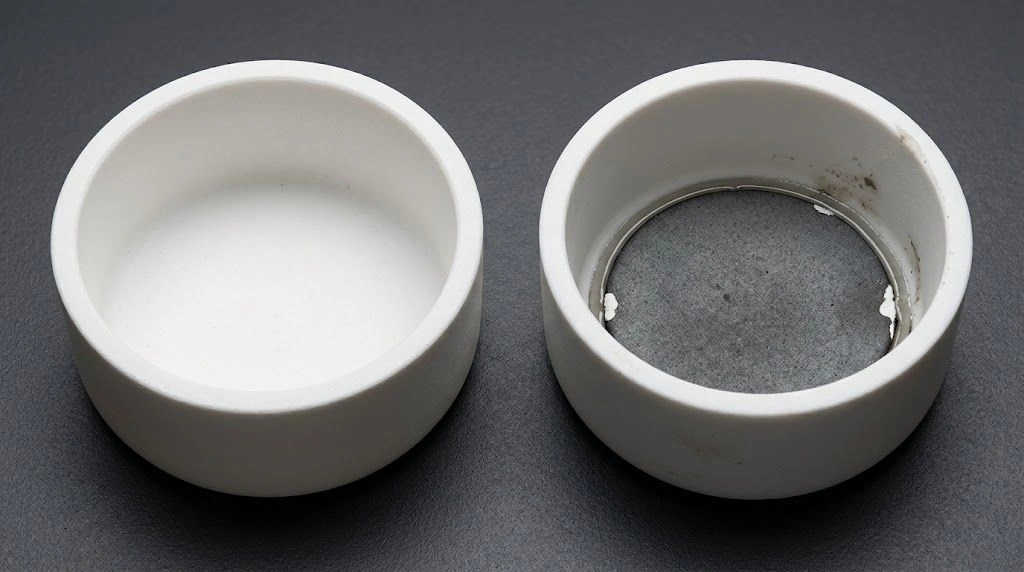
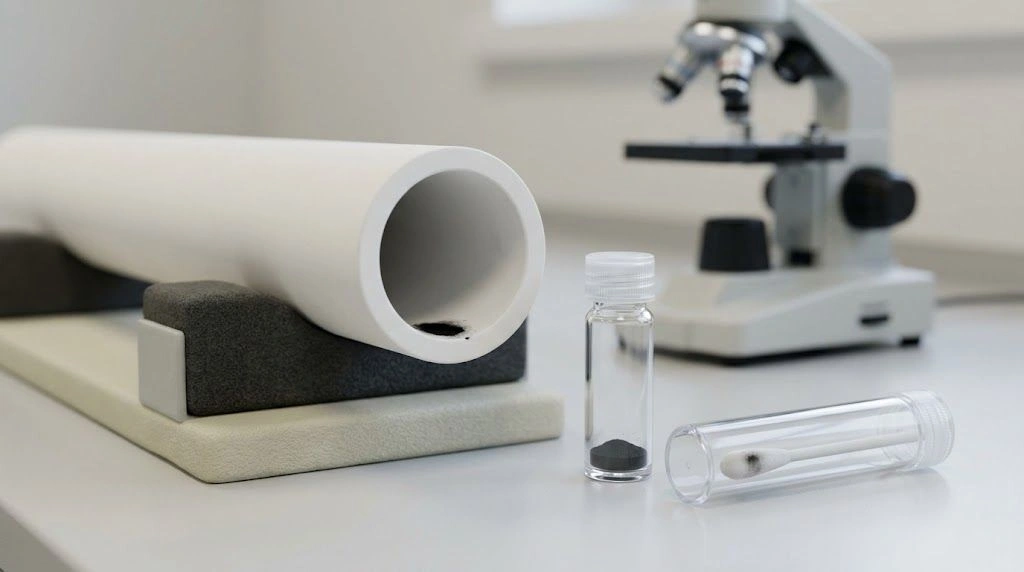
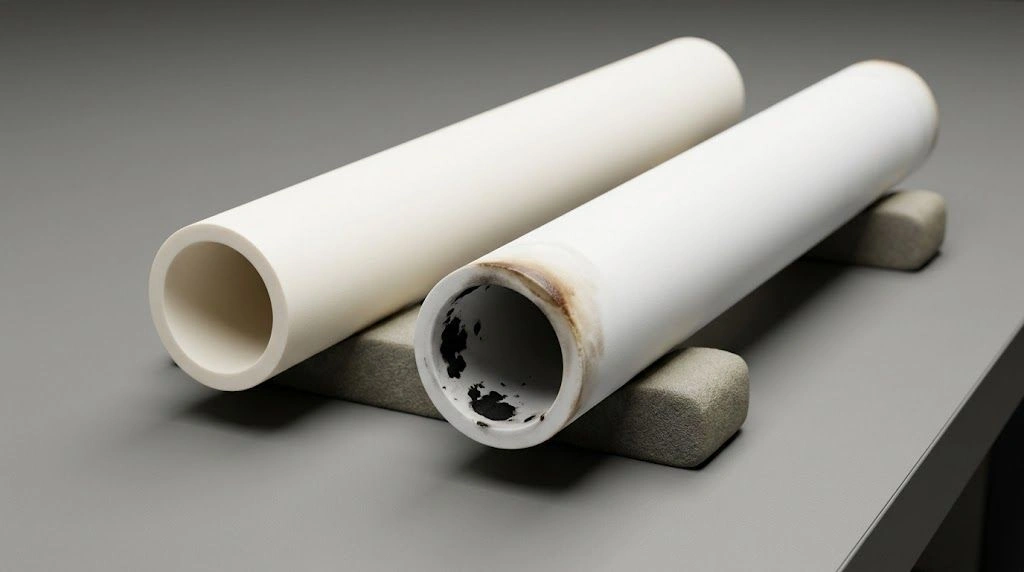
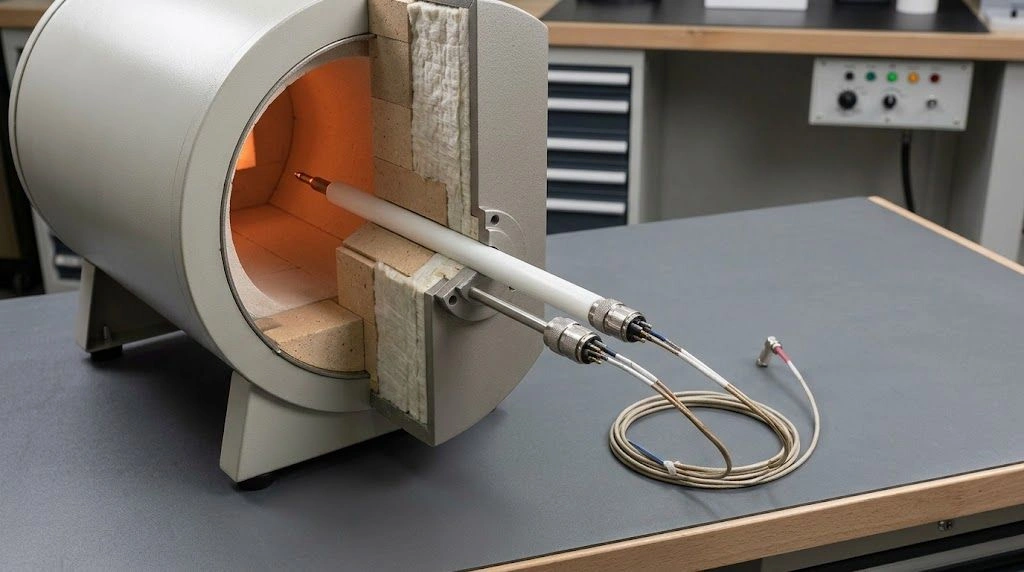
PBN components can usually be stored long term without bulk moisture absorption because pyrolytic boron nitride is dense, nonporous, binder-free, and produced by chemical vapor deposition rather than powder sintering. The real storage risk is not deep water penetration into the PBN body — it is surface adsorbed moisture, packaging residue, airborne particles, fingerprints, handling oil, or edge damage accumulated during storage. Before returning stored PBN crucibles, boats, liners, tubes, or plates to vacuum service, inspect the surface condition, verify packaging history, clean only by approved methods, and run controlled bakeout or preconditioning according to the process owner's vacuum procedure.
The PBN crucibles for MBE and vacuum evaporation at ADCERAX — available in custom volumes, bores, lips, and wall profiles for low-outgassing vacuum evaporation, semiconductor crystal growth, and high-purity PVD applications — are the product context for the storage and restart decisions described in this guide.

PBN component storage risk is primarily a surface contamination problem — not bulk moisture absorption — but surface adsorbed moisture, packaging residue, and particles can cause first-run outgassing, vacuum pump-down delays, and film contamination during restart in MBE, PVD, and OLED evaporation systems.
Does PBN absorb moisture during long-term storage?
The first clarification for any stored PBN component evaluation is the distinction between bulk moisture absorption and surface contamination — because these two failure modes require different responses.
High-quality pyrolytic boron nitride is fully dense, ultra-high purity, and nonporous. Momentive describes its pBN as ultra-high purity, fully dense, and suitable for high-temperature UHV conditions with negligible outgassing — properties that follow directly from the CVD manufacturing route, which builds the PBN structure layer by layer from gas-phase reactants without powder compaction, binders, or pore-generating additives. SAMaterials confirms this characterization, describing CVD-produced PBN as nonporous, glass-like, and binder-free, suitable for ultra-clean high-vacuum applications. MatWeb's PBN data entry from Momentive similarly confirms the nonporous, exceptionally pure character of this material class.
Bulk absorption vs surface adsorption. A porous ceramic or a powder-compacted BN part can absorb water molecules into connected pore space — this is bulk absorption, and recovering from it requires heat to drive the moisture out of the pore network. Dense PBN does not have this connected pore space, so the absorbed bulk water concern that applies to silica gel, porous alumina, or hot-pressed BN with connected porosity does not apply in the same way to properly produced CVD PBN. The moisture that accumulates on PBN during storage is instead adsorbed on the outer surface and into any exposed surface irregularities — a different, shallower phenomenon that is easier to address but still matters in vacuum service.
Why PBN differs from hot-pressed BN and porous ceramics. The hot-pressed BN vs PBN comparison at ADCERAX separates these two materials by manufacturing route, density, and gas permeability. Hot-pressed BN uses powder consolidation with sintering aids and may have connected porosity depending on grade and pressing conditions. Dense CVD PBN does not. This difference in structure is why PBN can justify ""low-outgassing"" claims for UHV service while hot-pressed BN requires more thorough validation of the specific grade before the same claim is made. The storage and restart logic differs accordingly: hot-pressed BN warrants more concern about retained bulk moisture, while dense PBN warrants more concern about surface history.
What moisture risks remain after long storage?
After establishing that PBN bulk absorption is not the primary concern, the surface-level risks that accumulate during storage and affect vacuum restart must be mapped.
Published research on porous BN moisture stability confirms that moisture response in BN materials is strongly tied to surface chemistry, oxygen content, and porosity characteristics — reinforcing the engineering principle that dense PBN and porous BN should be treated as different storage risk categories. For dense PBN, the surface is the risk zone.
Surface adsorbed moisture and vacuum outgassing. A PBN component left in ambient laboratory air for weeks or months will accumulate a monolayer or multilayer of surface-adsorbed water on any exposed surface. In ordinary atmospheric service this is invisible and irrelevant. In a high-vacuum or UHV system, this surface water desorbs during pumpdown, extends the time to reach base pressure, and contributes water-vapor partial pressure to the vacuum background during the early phase of operation. For MBE, OLED evaporation, and high-purity PVD, this first-run water background can contaminate the deposited film, shift spectral performance, reduce adhesion, or cause source instability before the system stabilizes.
Packaging residue as a contamination source. The packaging material that contacts a PBN component during storage is often as important as the storage environment itself. Cardboard, paper tissue, adhesive tape, unlabeled foam, or plastic bags with plasticizer outgassing can transfer organic residues, particles, adhesive vapor, or ionic contamination to the PBN surface. These residues may not be visible in room light but can produce unexpected mass spectrometer background peaks during first-run UHV operation. Packaging that is acceptable for metal hardware is not automatically acceptable for vacuum-use PBN components.
Particles, fingerprints, and edge damage. Particles from workshop air, machining nearby, or foam breakdown can settle on a stored PBN surface and become embedded or electrostatically held. Fingerprints introduce skin oils and salts. Thin-wall PBN crucibles and boats are vulnerable to edge chipping if stacked, dropped, or stored without individual protection — and edge chips can produce ceramic particles that contaminate the evaporation source or the process chamber.
The PBN Long-Term Storage Risk Matrix maps these risk levels:
| Storage condition | Main risk | Bulk PBN risk | Surface/process risk |
|---|---|---|---|
| Sealed clean bag, dry cabinet | Low contamination | Low | Low |
| Original bag opened, ambient shelf storage | Adsorbed moisture and particles | Low | Medium |
| Stored in cardboard or foam contact | Packaging residue and particles | Low | High |
| Handled without gloves | Fingerprint and oil film | Low | High |
| Stored near machining or powder area | Loose particles and abrasive dust | Low | High |
| Long storage before UHV restart | First-run outgassing | Low | Medium to high |
Values indicative. Verify against the process owner's vacuum cleanliness procedure and supplier-specific PBN data.

PBN does not absorb moisture like a porous ceramic, but stored PBN surfaces can carry moisture, particles, oils, and packaging residue that affect vacuum restart — surface/process risk is the real storage concern.
How should stored PBN components be inspected before reuse?
After mapping the storage risks, the practical restart inspection sequence determines whether a stored component is safe to return to service or requires cleaning, conditioning, or replacement.
A stored PBN component should be reviewed in four layers before returning to vacuum service:
The Restart Checklist for Stored PBN Components maps the decision logic:
| Checkpoint | Acceptance direction | Action if uncertain |
|---|---|---|
| Packaging history | Sealed, clean, labeled, protected | Treat as exposed component |
| Visual inspection | No chips, cracks, stains, delamination | Quarantine or replace |
| Surface condition | No visible dust, fingerprints, oil, residue | Use approved cleaning route |
| Vacuum process criticality | UHV/MBE/OLED requires stricter control | Pre-bake or condition per procedure |
| Component geometry | Thin lips and edges intact | Reject if source fit is affected |
| Lot traceability | Grade and batch identifiable | Request supplier confirmation |
Packaging history and visual inspection. Begin with the packaging record: was the component sealed in its original clean bag with the lot label intact, or was it opened and resealed, left exposed, or found without documentation? A component with clear, intact, labeled packaging from the supplier is in a known state. A component found unpackaged on a shelf, in a shared drawer, or without traceability is in an unknown state and should be treated as an exposed part regardless of its visual appearance.
When to pre-bake, clean, or replace. For components that pass visual inspection and show intact, clean packaging but have been stored longer than the process owner's standard interval, a controlled pre-bake or thermal conditioning cycle at a temperature appropriate to the vacuum process — following the facility's standard procedure for introducing new or stored components — is the standard approach before production use. ADCERAX's PBN crucible page positions PBN as a low-outgassing vacuum evaporation source, which implies that source components returning from storage should meet the same vacuum preparation standard as new components before the first production run. Components showing any visible contamination, edge damage affecting the source fit, staining, or missing traceability should be quarantined and the replacement decision reviewed.
The boron nitride crucible hub at ADCERAX covers both BN and PBN crucibles across non-wetting metal processing, vacuum evaporation, and thermal research applications, and the BN ceramic custom parts range covers the broader PBN component forms — boats, liners, tubes, and plates — that follow the same storage logic.
What storage and packaging rules reduce moisture and contamination risk?
After defining the restart inspection, the preventive storage rules that reduce future risk can be formalized for use in internal procedures or supplier RFQs.
PBN storage should protect the surface, not only the bulk material. The principle is dry, clean, sealed, separated, and traceable.
Dry packaging is not enough if the packaging is dirty. The most common storage mistake for vacuum-use ceramic components is assuming that any sealed plastic bag is equivalent to clean vacuum-use packaging. Bags contaminated with adhesive residue, plasticizer vapor, or workshop dust are not clean packaging. For long-term PBN storage, specify packaging materials that are validated for vacuum-use ceramic components — clean polyethylene or similar fluoropolymer-compatible bags without adhesive contacts — individually wrapped to prevent surface-to-surface contact, with desiccant inside the outer bag for long storage or humid-environment shipping.
Storage rules for thin-wall PBN crucibles, boats, liners, and tubes. Shin-Etsu's PBN product documentation positions PBN crucibles as thin yet durable components used for crystal growth, vapor deposition, and powder processing — confirming that the thin-wall architecture that makes PBN effective for evaporation sources also makes it vulnerable to edge chipping and mechanical damage during storage. Individual wrapping, foam-lined boxes or rigid containers, and ""do not stack"" orientation rules are appropriate for crucible and boat storage. Tubes should be supported to prevent rolling damage at the ends.

PBN crucibles and boats should be stored as clean, individually protected, labeled components — sealed packaging, desiccant, lot traceability, and edge protection reduce surface contamination and vacuum restart risk.
What supplier data should be requested for long-term stored PBN components?
When ordering PBN components intended for stock before vacuum use, the RFQ should include storage and packaging requirements alongside the standard material and dimensional specifications.
The Misdiagnosis Matrix maps observed restart problems to better diagnostic questions:
| Observed issue after storage | Common wrong diagnosis | More useful engineering question |
|---|---|---|
| Slow pump-down | ""PBN absorbed water internally"" | Was the surface exposed to humidity, packaging residue, or handling oil? |
| First-run haze or contamination | ""PBN purity is poor"" | Was the component stored open or reused with incompatible materials? |
| Source spitting | ""Material charge is bad"" | Is moisture, residue, or geometry affecting the first heating cycle? |
| Edge flaking | ""PBN aged in storage"" | Was the thin-wall component mechanically damaged during storage? |
| Unexpected background species | ""Vacuum chamber is dirty"" | Was the stored PBN preconditioned before UHV use? |
For PBN components that will be stored in inventory before vacuum use, request from the supplier: material grade identification, CVD manufacturing route confirmation, purity statement, density and nonporous character, dimensional inspection report, surface finish, packaging method with material specification, lot and batch traceability with inspection date, handling instructions including glove requirement, storage label format, and any available vacuum-use pre-use guidance. For crucibles and evaporation boats specifically, include cavity geometry, wall thickness, lip design, and charge-material compatibility confirmation.
Add the following to the RFQ for long-term storage: ""Package for clean vacuum-use storage. Individually protect each component. Double-bag where practical. Include desiccant or humidity-control option for storage exceeding three months or for humid-region shipping. Label lot number, inspection date, and handling instructions. Avoid particle-shedding packaging materials.""
Evaluating long-term stored PBN crucibles, boats, or liners for vacuum restart? Share the component type, drawing, vacuum process, storage duration, packaging condition, current surface description, and vacuum cleanliness requirement. ADCERAX can review whether the component requires cleaning and conditioning or replacement, and can supply clean-packaged, lot-traced PBN components for vacuum evaporation, MBE, or high-purity PVD service.
Frequently Asked Questions
Does PBN absorb moisture during storage?
High-quality CVD PBN is dense and nonporous, so bulk moisture absorption into the material body is usually not the primary storage concern. Momentive describes its pBN as fully dense and suitable for high-temperature UHV with negligible outgassing — properties that reflect the material's non-porous CVD structure. The storage risk for PBN is surface adsorbed moisture and packaging contamination, not deep bulk water absorption.
Can stored PBN components outgas in vacuum?
Yes, stored PBN components can contribute to first-run outgassing if their surfaces carry adsorbed moisture, handling oils, packaging residue, or particles from storage. This does not mean the PBN body is porous or degraded; it means the surface history accumulated during storage needs to be addressed through inspection, approved cleaning, and vacuum preconditioning before production use.
Should PBN crucibles be baked before reuse after long storage?
For UHV, MBE, OLED evaporation, and high-purity PVD service, stored PBN crucibles should be conditioned or pre-baked according to the process owner's approved vacuum preparation procedure before the first production run. The specific temperature and duration should be set by the facility's vacuum process protocol, not assumed from a generic value.
What packaging is best for long-term PBN storage?
Use clean, sealed, individually wrapped packaging compatible with vacuum-use ceramic components — such as clean polyethylene bags without adhesive contacts, in a rigid container with edge protection. Add desiccant or humidity control for storage exceeding several months or for shipping through humid environments. Avoid direct contact with cardboard, dusty foam, tape adhesive, or unvalidated plastic bags.
When should a stored PBN component be rejected rather than cleaned?
Reject or quarantine the component if it shows cracks, edge chips that would affect source fit or geometry, delamination, heavy staining, unknown residues, uncertain prior use with incompatible materials, or missing lot traceability. Components that cannot be traced to their original supplier batch and inspection records should not be assumed clean for UHV or high-purity evaporation service.
What should be added to a PBN RFQ for long-term storage applications?
Add packaging method with material specification, individual protection per component, double-bagging option, desiccant or humidity-control inclusion for long storage or humid shipping, lot and batch traceability with inspection date on the label, handling instructions including glove requirement, and a statement of vacuum-use cleanliness expectations.
"