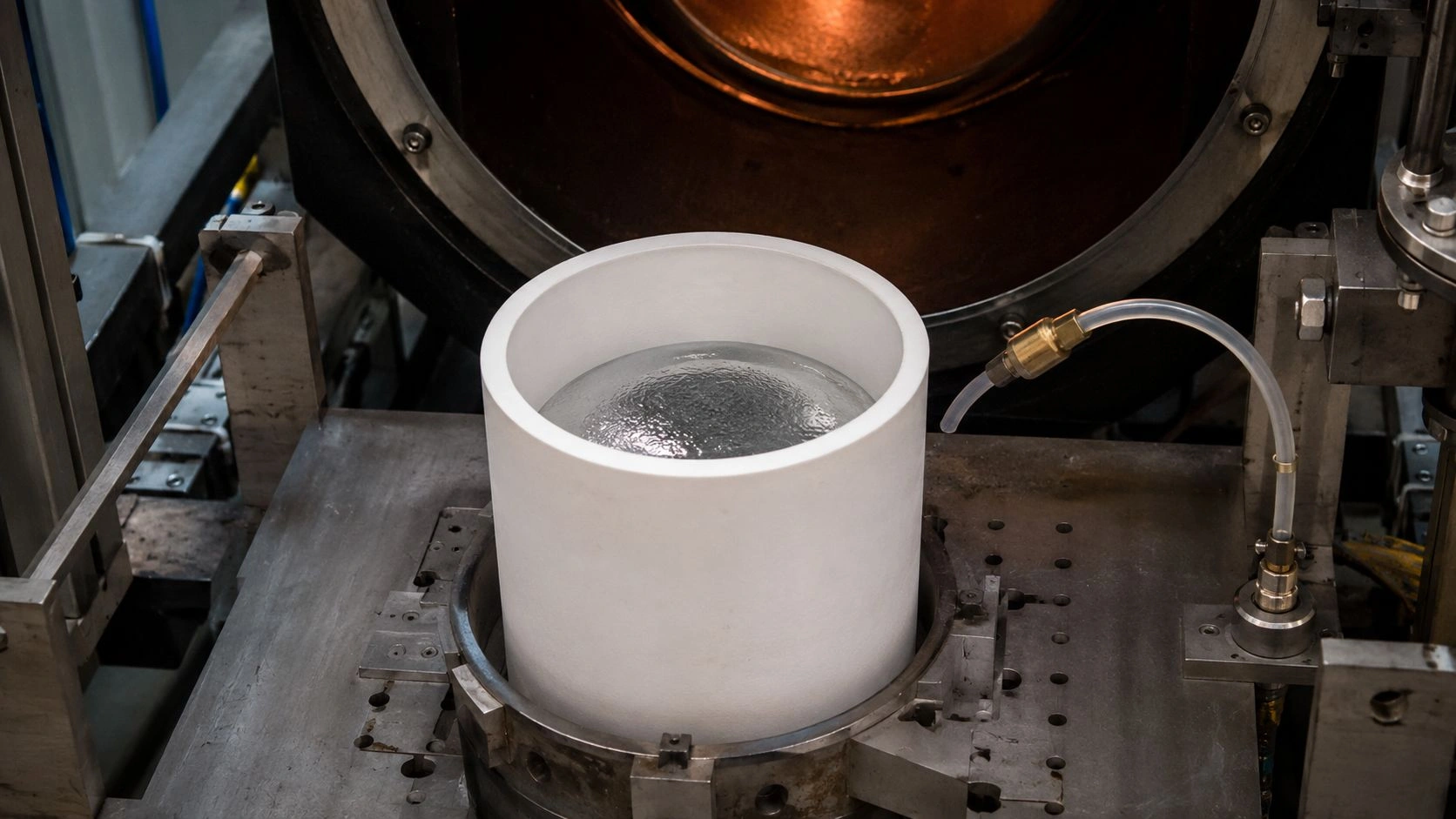
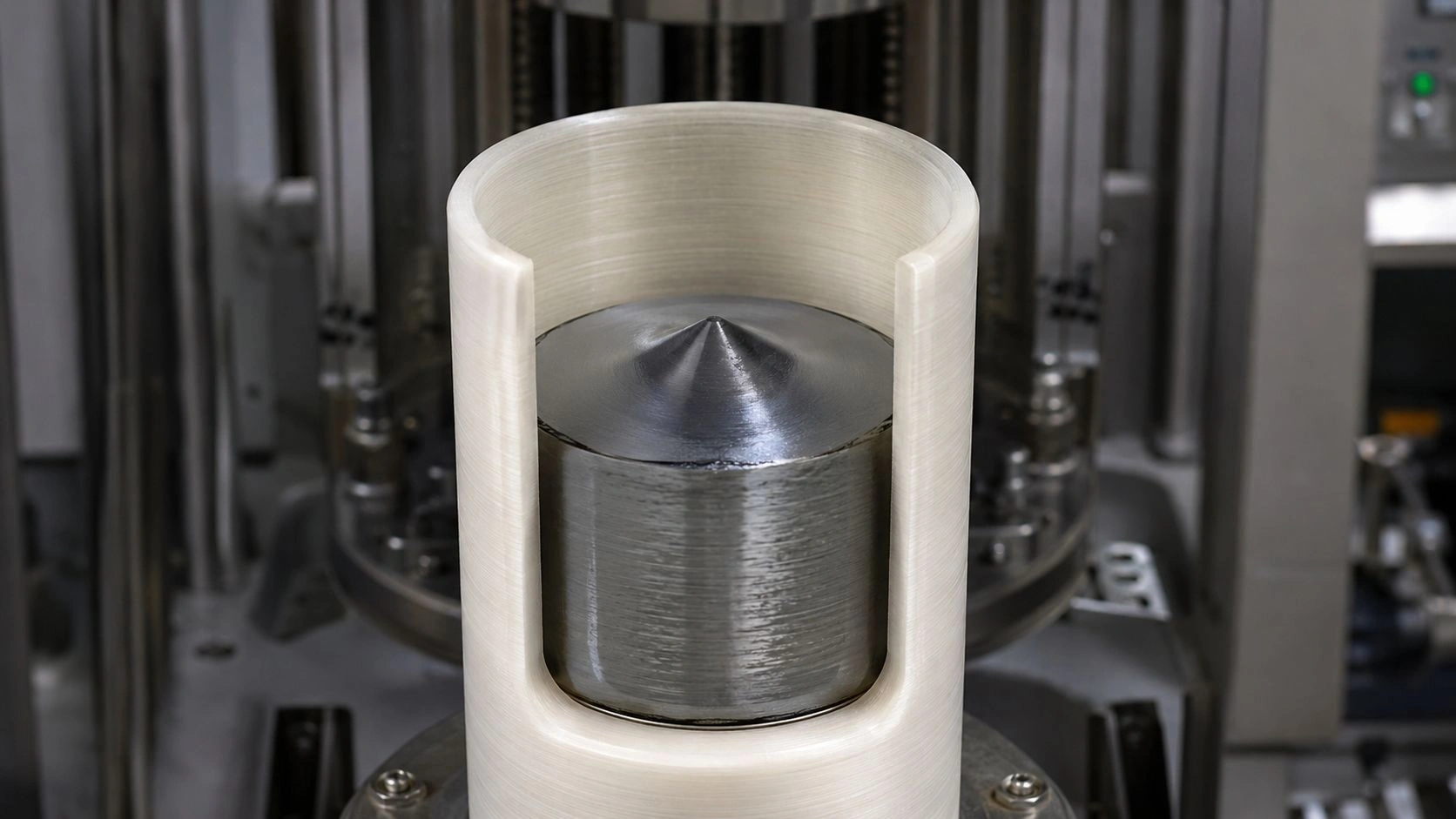
BN crucibles can support optical fiber preform manufacturing when they serve as controlled dopant-source containers, precursor evaporation vessels, or high-temperature auxiliary fixtures under validated vacuum, inert, or dry controlled atmospheres. They are not universal crucibles for high-purity silica preforms, and they should not be assumed compatible with every preform process without validation. The decision depends on dopant chemistry, oxygen and moisture exposure, chlorine-containing drying gases, outgassing limits, BN grade, crucible geometry, and whether any BN-derived contamination can alter optical loss or refractive-index profile.
That role-specific framing — BN as a controlled source component, not a general preform container — is the engineering point this guide builds around. For manufacturable cup and boat forms used as dopant-source hardware, see the boron nitride crucible product page after the role and atmosphere gates below.
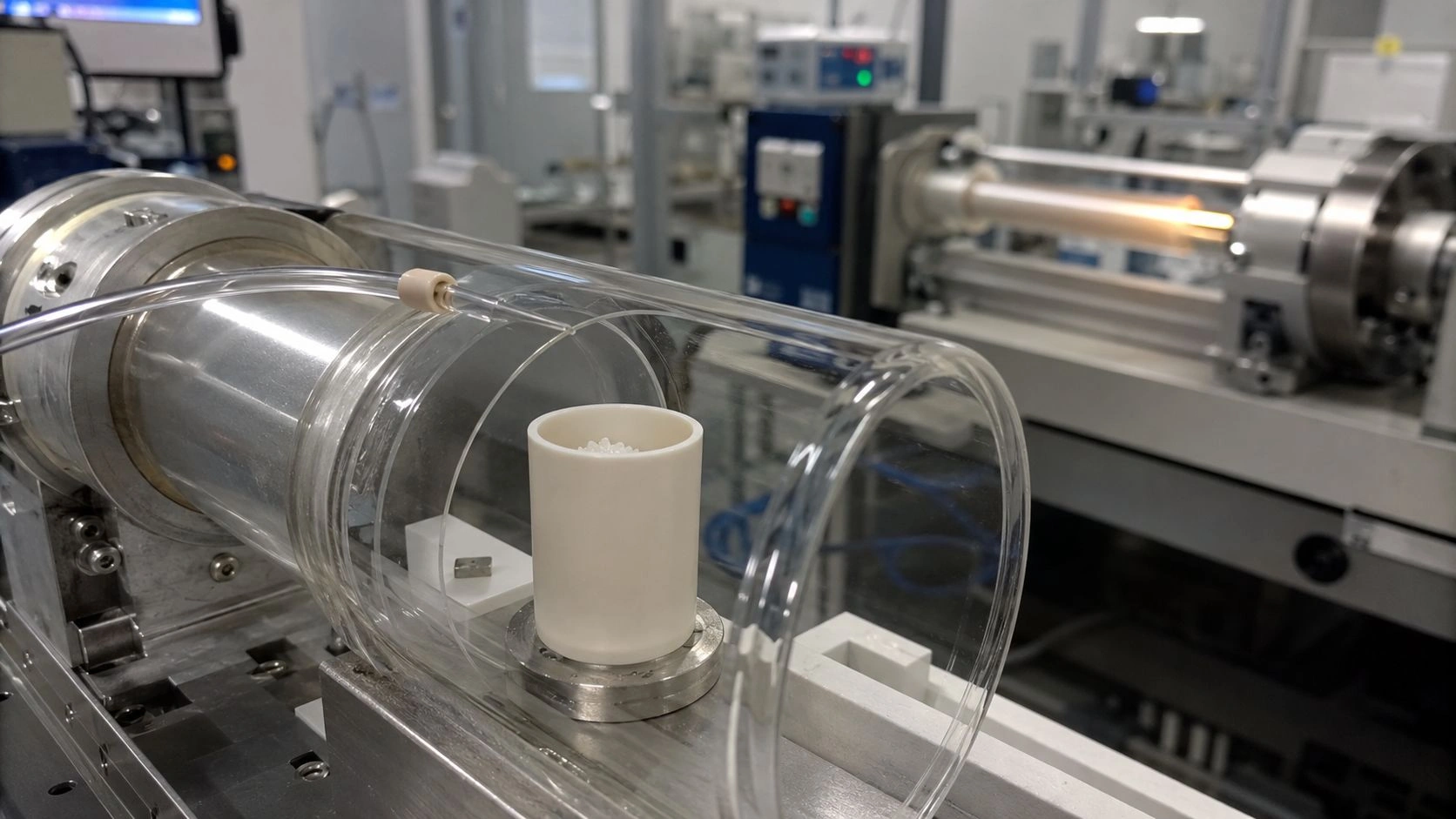
BN and PBN crucibles are candidates for dopant precursor evaporation and auxiliary source hardware in optical fiber preform manufacturing — not general silica preform containers — and their use requires atmosphere, contamination, and optical-performance validation.
Where BN crucibles actually fit in preform manufacturing
Standard silica optical fiber preforms are primarily fabricated through high-purity vapor-deposition routes — MCVD, OVD, VAD, and PCVD — that are specifically designed to keep contamination and OH content below levels that would cause measurable optical loss. Published descriptions of these processes note that purified chemical precursors, controlled atmospheres, and contamination avoidance are central to producing low-propagation-loss silica fibers. In these mainstream vapor-deposition routes, BN crucibles play no standard role — the deposition chemistry proceeds entirely in the gas phase with halide precursors.
BN crucibles become relevant in narrower, more specialized situations within the preform manufacturing ecosystem.
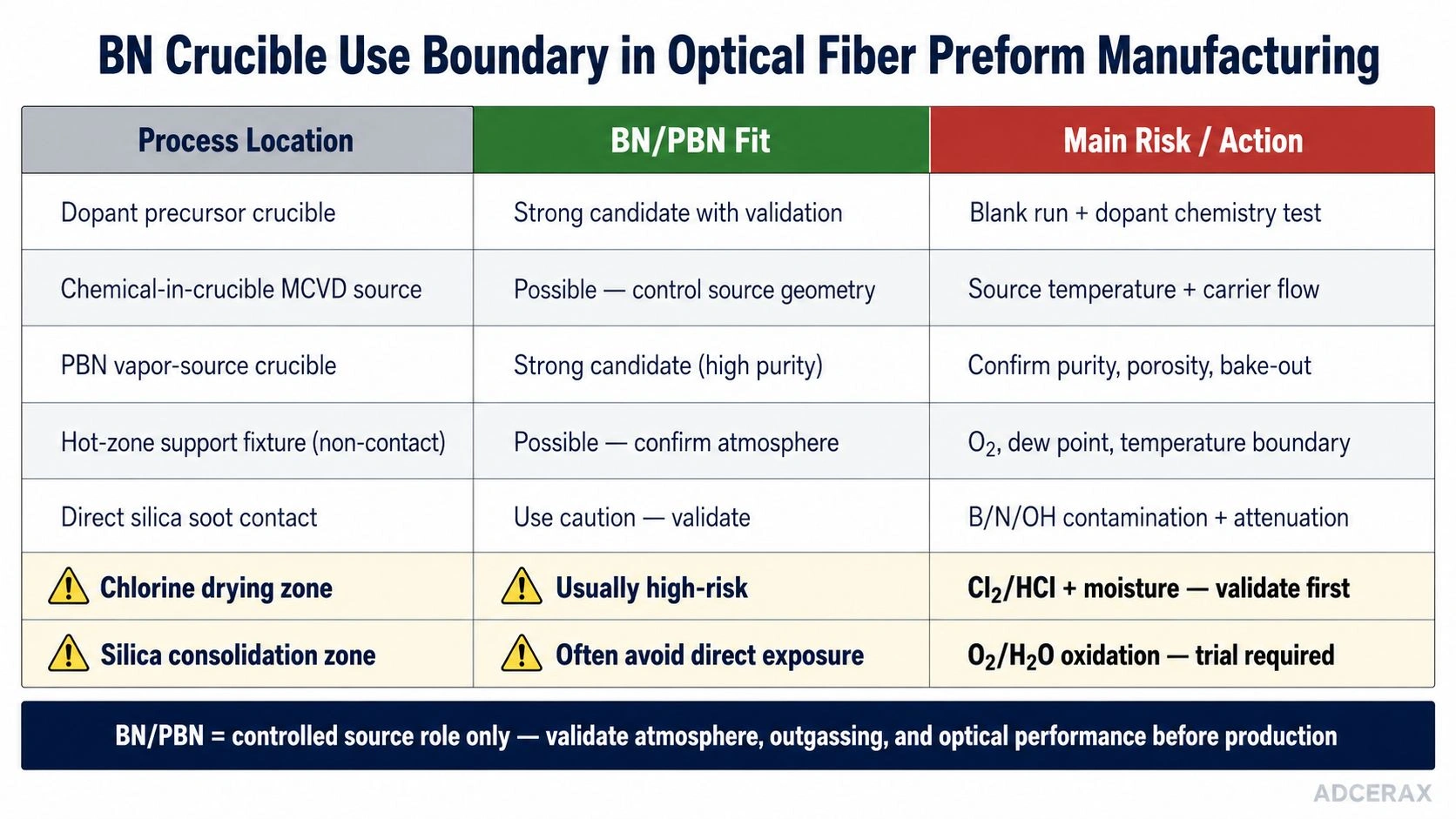
The BN Use Boundary table below maps the main preform process locations to BN/PBN suitability:
| Process location | BN/PBN fit | Main advantage | Main risk | What to verify |
|---|---|---|---|---|
| Dopant precursor crucible | Strong candidate with validation | Machinable source container, thermal stability | Vapor contamination or outgassing | Blank run and dopant chemistry |
| Chemical-in-crucible MCVD source | Possible | Short vapor path and controlled source geometry | Temperature drift, precursor decomposition | Source temperature and carrier flow |
| PBN vapor-source crucible | Strong candidate for high purity | Low outgassing, dense wall, clean geometry | Cost and lead time | Purity, wall profile, bake-out |
| Hot-zone support fixture | Possible if non-contact | Thermal shock and insulation | Oxidizing/wet atmosphere | Oxygen, dew point, temperature |
| Direct silica soot contact | Use caution | Non-wetting and machinability may help handling | B/N/OH contamination risk | Preform chemistry and attenuation |
| Chlorine drying zone | Usually high-risk without validation | None by default | Chlorine/HCl + moisture boundary | Atmosphere compatibility |
| Silica consolidation zone | Use caution / often avoid direct exposure | High-temp fixture potential | Oxygen/water vapor oxidation and contamination | Trial exposure and residue check |
Values indicative; verify with process-specific gas chemistry, dopant chemistry, supplier BN/PBN data, and optical preform validation tests.
Dopant-source crucibles for vapor-phase delivery. In chemical-in-crucible approaches to MCVD-type preform fabrication, a solid or low-vapor-pressure precursor is held in a heated crucible inside the glassware and transported downstream as vapor. Published research on this technique describes the precursor held in a heated crucible inside MCVD glassware and transported as vapor, with source temperature and carrier gas flow as key process variables. In this context, a BN or PBN crucible can serve as the dopant source cup — controlling the precursor geometry, thermal stability, and vapor path — provided the dopant chemistry, temperature, and atmosphere are compatible with BN.
Auxiliary high-temperature fixtures and source holders. In specialty and rare-earth-doped fiber preform work, BN's machinability, non-wetting behavior, and thermal shock resistance make it a candidate for non-contact high-temperature support hardware, lathe chucks, mandrel spacers, or source holder assemblies. In these roles, BN does not contact the preform glass directly, which reduces the contamination pathway significantly.
Why direct silica preform contact is a separate risk category. If a BN component directly contacts the silica soot column, glass tube, or preform surface, contamination pathways multiply. Boron, nitrogen, and any surface species from the BN can transfer to the silica system. Optical fiber specifications for loss and refractive index control are extremely tight — adding uncontrolled boron would shift the refractive index contribution independently of the intended dopant recipe. Direct-contact BN use in preform manufacturing must be validated experimentally, not assumed compatible from BN's general chemical stability.
When quartz, platinum, alumina, or refractory metal routes may remain better. For many dopant source applications adjacent to silica preform chemistry, fused quartz remains the lowest-contamination-risk container because its chemistry is compatible with silica-based processes. Platinum labware offers excellent cleanability for analytical or small-scale sources. Alumina is widely available but introduces Al contamination risk to preforms where aluminum was not an intended dopant. The correct answer is always application-specific, not a default material name.
Hot-pressed BN vs PBN for dopant and precursor sources
After confirming that a crucible or source container role is appropriate for BN, the grade decision between hot-pressed BN and PBN depends on how demanding the outgassing, purity, and vapor-delivery stability requirements are.
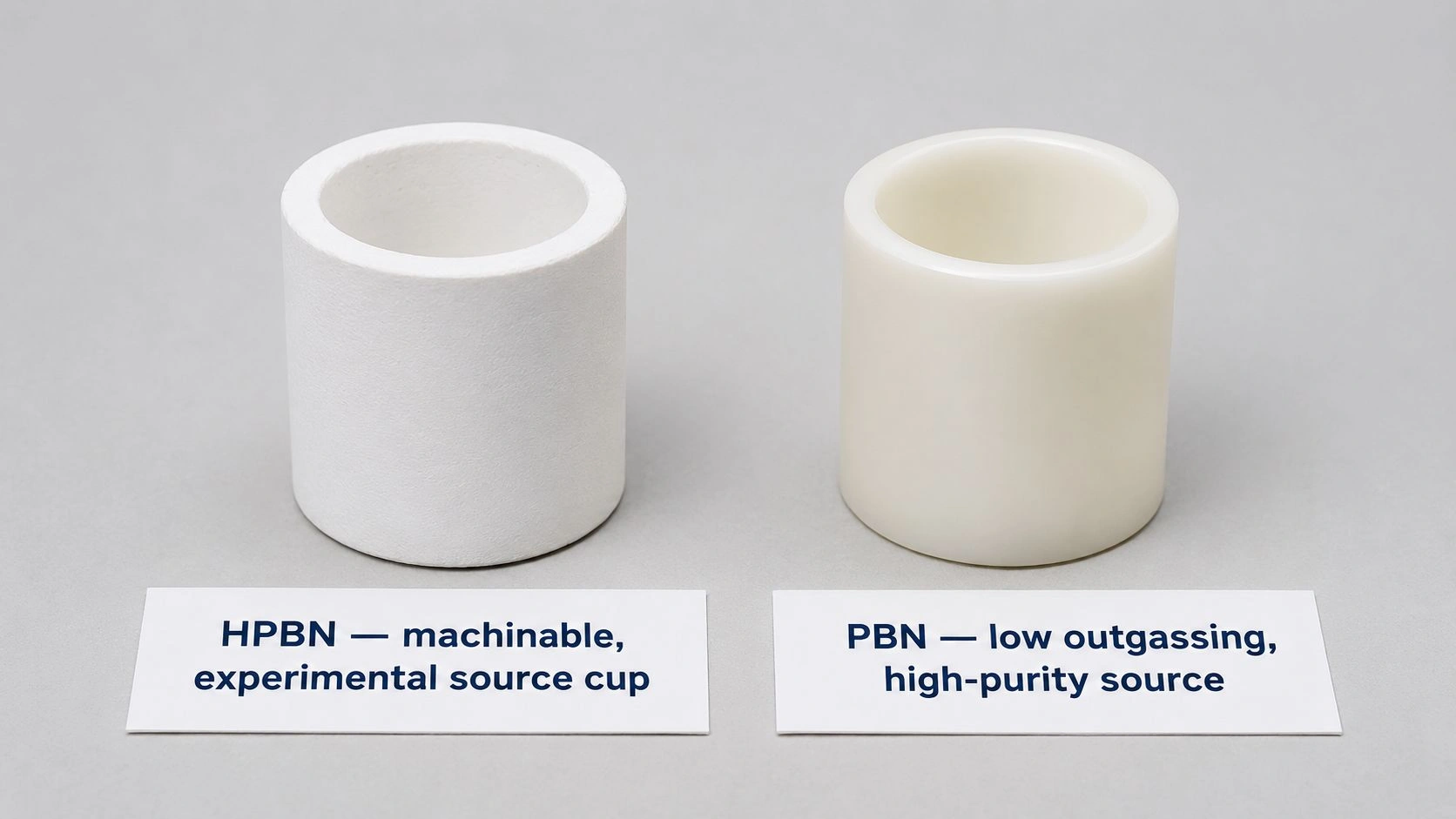
The BN/PBN vs Other Container Routes table maps the main material candidates:
| Container route | Best-fit role | Main advantage | Main boundary |
|---|---|---|---|
| Hot-pressed BN | Machinable source cups, non-contact fixtures, experimental containers | Easy to machine, thermal shock resistance | Porosity, moisture, oxidation, impurity control |
| PBN | High-purity dopant evaporation or vacuum source containment | Low outgassing, dense CVD wall, clean surface | Geometry and cost constraints |
| Fused quartz | Silica-compatible source or preform-adjacent hardware | Similar chemistry to silica systems | Devitrification, temperature, reaction with some dopants |
| Platinum/Pt alloy | Specialty analytical or source containment | Clean and chemically stable in selected systems | Cost and alloying/reaction boundaries |
| Alumina | General high-temperature lab containment | Robust and widely available | Al contamination risk in optical preforms |
| Refractory metal | High-temperature vacuum hardware | Structural and thermal stability | Oxidation and metal contamination risk |
Hot-pressed BN for machinable support and lower-risk containment. Hot-pressed BN can be machined into custom source cup geometries quickly and at moderate cost. Its thermal shock resistance allows it to handle the rapid temperature changes associated with source loading and startup. Its open porosity — higher than PBN — means it may release more outgassed species during heating, which is acceptable in experimental or non-critical dopant delivery hardware but should be confirmed for any application where outgassing contributes to the vapor stream.
PBN for low-outgassing vapor-source containment. The PBN crucibles produced by CVD have a denser, purer wall structure than hot-pressed BN. Their low outgassing in high-vacuum environments — verified by residual gas analyzer measurement during bake-out — is one of their most practically important advantages for optical fiber preform applications where OH content and trace contamination are tightly controlled. When the crucible is close to the vapor delivery path — small source volumes, short vapor path to the deposition zone — PBN's lower outgassing provides a meaningful reduction in background contamination relative to hot-pressed BN.
Why crucible geometry affects vapor delivery stability. For dopant evaporation sources, the crucible geometry — volume, bore diameter, lip shape, and lid or orifice design — controls how the precursor pool heats, how vapor escapes, and whether condensation forms near the lip or transfer line entrance. A well-designed PBN source cup with a controlled lip geometry and appropriate volume-to-bore ratio provides more consistent vapor delivery than a generic cylindrical container. Related boron nitride ceramic forms — plates, rings, tubes, nozzles, and precision-machined components — are reviewed only when the source role truly needs a non-crucible BN shape.
Atmosphere and contamination boundaries for BN in preform processes
After selecting the BN grade and defining the source role, the atmosphere and contamination limits must be confirmed — because BN's behavior in optical fiber preform environments is not uniformly safe across all process conditions.
BN oxidation rates depend strongly on microstructure — orientation, porosity, crystallinity, and density — and water vapor can help form and volatilize boron oxide species. Supplier guidance commonly limits BN use in air around 900°C and warns against moisture, humid storage, water washing, and aggressive oxide or reactive species. For optical-fiber preform duty, validate BN against the actual atmosphere, moisture level, and temperature of each process zone rather than assuming vacuum/inert inertness transfers.
Oxygen and wet gas exposure. BN's strongest high-temperature performance is in vacuum, inert gas, or reducing atmospheres. In the oxygen-containing atmospheres used during silica soot formation (OVD and VAD use oxy-hydrogen or oxy-methane flames), BN would be exposed to conditions significantly more oxidizing than its validated service range. Direct exposure of BN to these flame zones is not appropriate without specific validation.
Chlorine and HCl drying environments. Optical fiber soot preforms are commonly dried with chlorine-containing chemistry — typically Cl₂ or CCl₄ in a consolidation furnace — to remove residual OH before sintering. BN compatibility with these chlorine/HCl-containing atmospheres at high temperature requires specific validation. Standard BN chemical stability data does not automatically cover chlorine drying conditions, and the formation of volatile boron chloride or chloroamine species must be evaluated.
B/N/OH and metal impurity risk. Any boron from the BN crucible that enters the vapor stream and deposits with the silica soot or glass contributes to the refractive index of the fiber. Boron is actually one of the intentional dopants used to decrease refractive index in silica fibers — but unintended boron from the crucible adds an uncontrolled component to the refractive-index profile that cannot be distinguished from deliberately added boron. If the process does not intentionally use boron as a dopant, any BN-derived boron contribution is a contamination event. Nitrogen from BN is also a potential trace dopant; its effect at low concentrations in silica systems should be confirmed against the optical specification.
Direct glass contact vs isolated vapor-source use. The contamination risk from BN scales with how close the crucible is to the silica system and how many transfer steps exist between the crucible surface and the glass. An isolated dopant source cup where the BN never contacts silica soot or glass — and where the only pathway to the preform is through a controlled vapor stream — has a much lower contamination risk than a BN fixture that physically contacts the preform surface or sits inside the silica deposition zone.
Do not misdiagnose preform defects as BN crucible failure too early
When a preform shows unexpected optical loss, refractive-index drift, particles, or contamination after introducing a BN source component, the crucible material is one possible cause among several. Assigning the defect to BN before checking the broader source delivery system leads to replacing the crucible without fixing the actual problem.
Dopant vapor-pressure instability vs crucible contamination. Refractive-index errors in doped preforms often trace to source temperature drift — even a 5°C change in sublimation temperature can shift the vapor pressure of the precursor by a measurable amount. Published MCVD vapor-phase chelate delivery research identifies precursor sublimator temperature and deposition direction as key variables in dopant uniformity. Confirming source temperature stability before attributing a refractive-index problem to crucible contamination is the correct diagnostic sequence.
Carrier-gas moisture vs BN outgassing. OH-related optical loss is one of the most sensitive performance metrics for silica fiber preforms. If OH levels increase after introducing a BN source component, the correct first diagnostic step is to verify the carrier gas dew point and moisture level — because even a few parts per million of water vapor in the carrier gas can contribute more OH than the outgassing from a properly baked-out PBN crucible.
Precursor decomposition vs BN surface reaction. If residue appears near the source or in transfer lines, precursor thermal decomposition — which leaves involatile byproducts at temperatures above the precursor's stability limit — is more commonly the cause than a chemical reaction between the BN surface and the precursor. Confirming that source temperature is within the precursor's verified stability window before blaming BN surface chemistry is the correct approach.
Blank run and post-run residue inspection. The most defensible diagnostic approach is a controlled blank run: operating the source assembly without any dopant precursor, under the intended atmosphere and temperature, then checking gas-phase chemistry, preform blank attenuation, and crucible surface condition. If the blank run shows clean results, adding the precursor and comparing identifies whether any subsequent changes are from the precursor system or the crucible.
The Contamination and Misdiagnosis Matrix below maps observed defects to better diagnostic questions:
| Observed issue | Common assumption | Better diagnostic question |
|---|---|---|
| Higher optical loss | BN contamination | Was OH, transition metal contamination, or drying incomplete? |
| Refractive-index drift | Crucible material changed dopant level | Was precursor vapor pressure or source temperature stable? |
| Particles in preform | BN shedding | Did precursor decompose or deposit in transfer lines? |
| Residue near source | BN reaction | Is dopant precursor condensing or polymerizing? |
| B or N detected | BN source contamination | Was it from crucible, gas line, precursor, or handling? |
| Poor repeatability | BN batch inconsistency | Were fill mass, source temperature, carrier flow, and deposition direction controlled? |
| Crucible surface change | BN not compatible | Was atmosphere oxidizing, humid, or chlorine-containing? |
Diagnosis should be based on blank runs, chemical analysis, carrier gas measurement, and process log review before any crucible material change is specified.
RFQ checklist for BN/PBN crucibles in optical fiber preform work
A complete RFQ for BN or PBN crucibles used in optical fiber preform manufacturing must provide both the process role and the contamination requirements — without both, the supplier cannot confirm grade suitability, geometry, or appropriate cleaning and bake-out protocol.
Each of those variables can independently change whether BN is appropriate and whether PBN is necessary for the contamination tolerance of the optical preform system. Use the RFQ checklist below as the complete field set rather than a short “BN crucible” line item.
| RFQ field | Why it matters | Recommended wording |
|---|---|---|
| Preform process | Determines atmosphere and purity boundary | "MCVD/OVD/VAD/PCVD/specialty preform" |
| Crucible role | Separates source from direct glass contact | "Dopant source/evaporation cup/fixture/glass-contact container" |
| Dopant chemistry | Primary compatibility driver | "List precursor, dopant element, carrier gas, and decomposition risk" |
| Temperature | Controls vapor pressure and BN oxidation risk | "Source temperature, peak temperature, dwell time" |
| Atmosphere | Controls BN compatibility | "Vacuum/N₂/Ar/O₂/Cl₂/HCl/wet gas/air leak" |
| Moisture/OH control | Critical for optical loss | "State dew point or moisture target if known" |
| Geometry | Controls vapor delivery stability | "Volume, bore, lip, lid, wall, bottom, mounting interface" |
| BN grade | Controls purity and outgassing | "Quote hot-pressed BN or PBN with purity/density/porosity" |
| Cleaning/bake-out | Protects high-purity workflow | "State clean packing, handling, bake-out recommendation" |
| Validation | Confirms optical impact | "Run blank source, ICP-MS/GDMS, OH, attenuation, RI profile comparison" |
RFQ fields are the minimum for a BN/PBN crucible inquiry in optical fiber preform work; add precursor fill mass, source cycling protocol, and reuse expectation as relevant.
For critical optical preform development — new dopant delivery geometries, rare-earth source development, or contamination-sensitive active fiber work — running a blank-source trial with the actual crucible grade, geometry, and atmosphere before integrating the dopant precursor is the most reliable validation approach. Optical performance data from a preform processed with the blank crucible establishes the baseline against which the dopant contribution can be separated from any crucible-related background.
Evaluating BN or PBN crucibles for optical fiber preform dopant sources or high-temperature fixtures? Share your preform process type, crucible role, precursor chemistry, atmosphere, dew point, source temperature, crucible geometry requirement, and optical performance target. Engineering review then assesses whether hot-pressed BN, PBN, or another ceramic route fits the application; turnaround depends on inquiry complexity — no commitment required at this stage.
Frequently Asked Questions
Where can BN crucibles realistically fit in optical fiber preform manufacturing?
BN crucibles can serve as dopant precursor evaporation or sublimation cups, chemical-in-crucible MCVD source hardware, and non-contact high-temperature auxiliary fixtures in specialized preform workflows. They are not standard components in mainstream MCVD, OVD, or VAD silica fiber manufacturing, where vapor-phase chemistry dominates. Their use requires validation against the specific process atmosphere, dopant chemistry, contamination limits, and optical performance targets.
When should PBN be preferred over hot-pressed BN for preform-related work?
PBN should be preferred when the crucible is close to the vapor delivery path, when low outgassing is a validated requirement for OH or trace-contamination control, and when the process runs in high-vacuum or high-purity inert atmosphere. Hot-pressed BN may be appropriate for non-contact fixture roles, experimental source hardware, and applications where outgassing from the higher-porosity structure has been confirmed acceptable.
What contamination risks can make BN unsuitable for preform applications?
The main risks are boron or nitrogen entering the vapor stream and depositing in the preform, OH introduction from BN outgassing or surface moisture, and BN oxidation producing boron oxide species in atmospheres containing oxygen or water vapor. BN is also not validated for chlorine/HCl drying environments without specific testing. These risks are manageable in well-controlled source roles but must not be assumed absent without validation.
Can BN crucibles be used in OVD or VAD soot deposition zones?
Generally not as direct-contact components. OVD and VAD soot deposition uses oxy-hydrogen or oxy-methane flames with high oxygen and water vapor content — well beyond BN's validated service range in oxidizing atmospheres. BN components used in auxiliary or non-contact roles near these zones must be validated for the specific temperature, oxygen level, and flame proximity.
How does boron from a BN crucible affect fiber refractive index?
Boron is an intentional dopant in silica fibers — it decreases refractive index. Unintended boron from a BN crucible adds an uncontrolled refractive-index contribution that cannot be distinguished from deliberately added boron. For processes that do not include boron as an intended dopant, any BN-derived boron contamination shifts the fiber's refractive-index profile in a direction that cannot be corrected by adjusting other dopant levels.
What should I include in an RFQ for a BN crucible for preform dopant delivery?
Provide the preform process type, the crucible role (source cup, evaporation container, fixture), the precursor and dopant chemistry including carrier gas and decomposition temperature, the source operating temperature and peak temperature, the atmosphere including oxygen level and dew point, proximity to silica soot or glass, crucible volume and geometry requirements, BN grade preference (hot-pressed or PBN), clean packaging and bake-out requirement, and the validation protocol including blank runs, optical attenuation, OH measurement, and chemical analysis.
Related reading
- PBN crucibles for germanium single-crystal growth — high-purity PBN growth scene; not this optical-fiber preform source axis
- BN coatings on graphite vs solid BN crucibles — coated vs bulk route when geometry or cost forces a different stack
- BN crucibles for magnesium alloy melting (automotive) — molten-metal BN scene diversion; not preform dopant-source duty