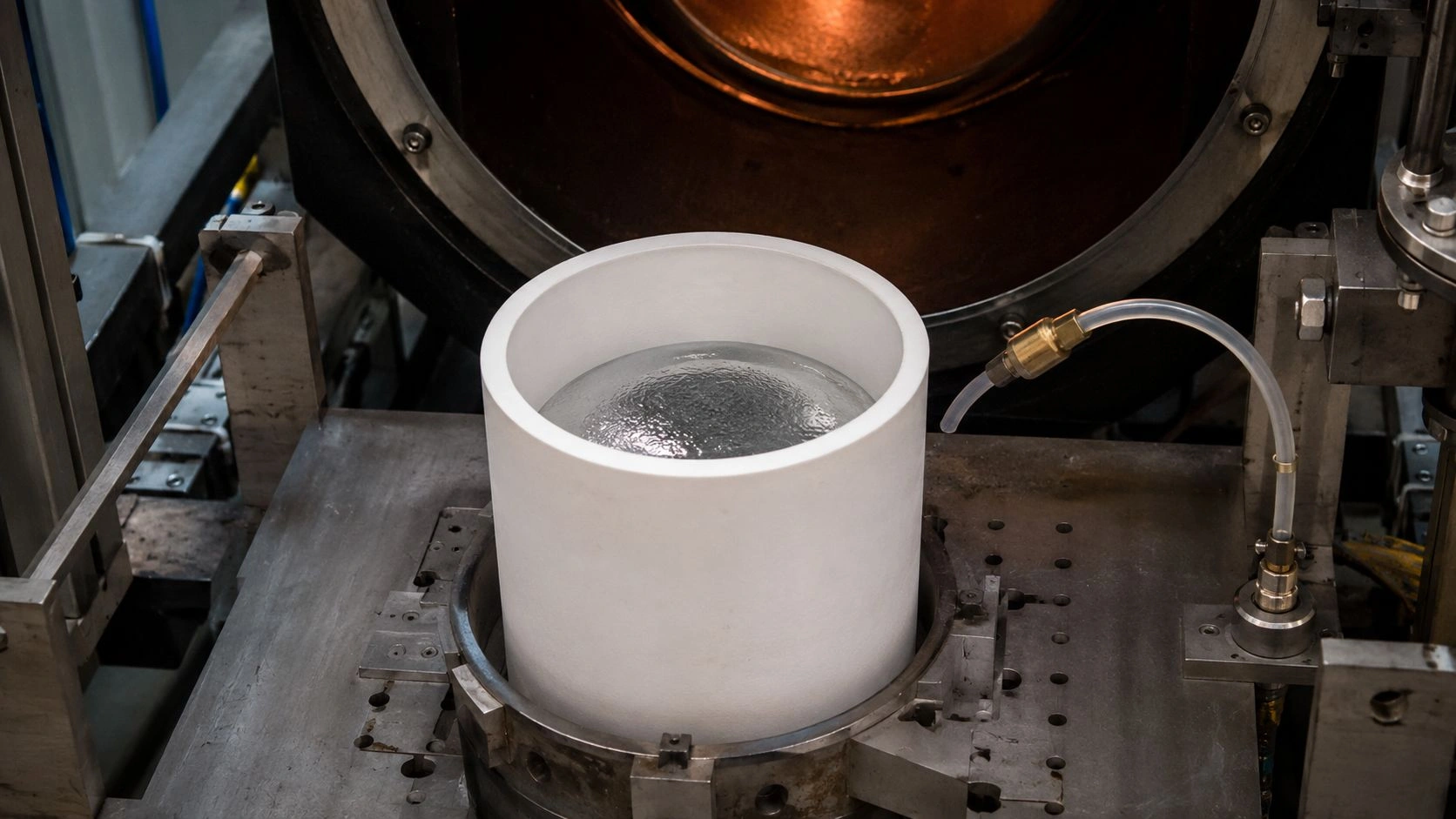
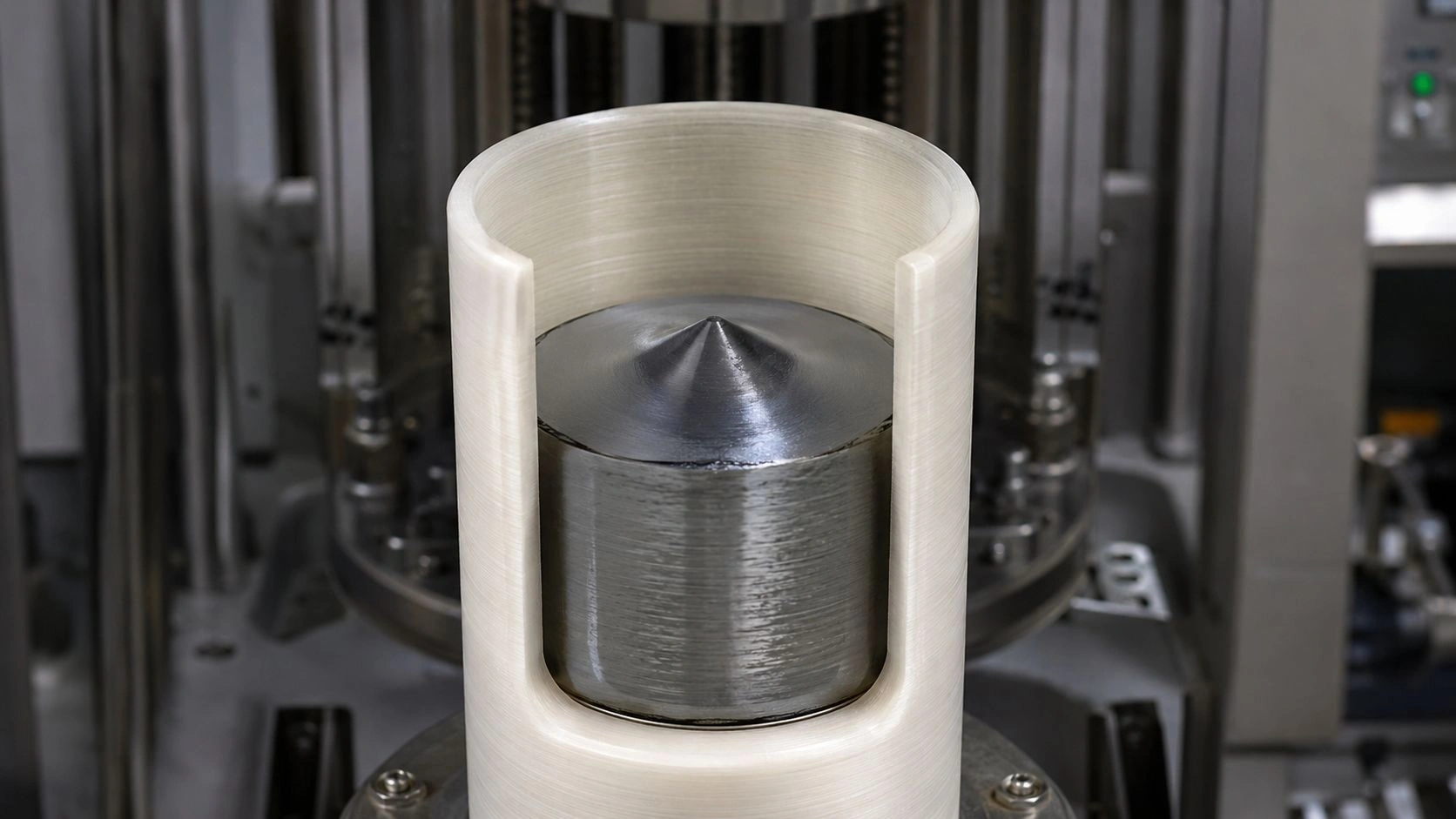
BN can be useful in thermal analysis above 1500°C when the test runs in vacuum, dry argon, dry nitrogen, or another dry inert atmosphere and when the sample benefits from BN's non-wetting behavior, machinability, thermal shock resistance, or lower contamination profile relative to alumina. BN is not a general replacement for alumina in air above 1500°C. Alumina remains the standard reusable TGA crucible near the instrument/OEM-typical range around ~1600°C (confirm OEM datasheet; not an ADCERAX product rating), while BN becomes a specialized crucible or liner for non-oxidizing high-temperature tests where atmosphere, sample chemistry, sensor contact, and blank stability are validated before use.
That atmosphere-first path — BN as a conditional choice for non-oxidizing service, not a universal alumina upgrade — is the engineering principle the sections below build around.
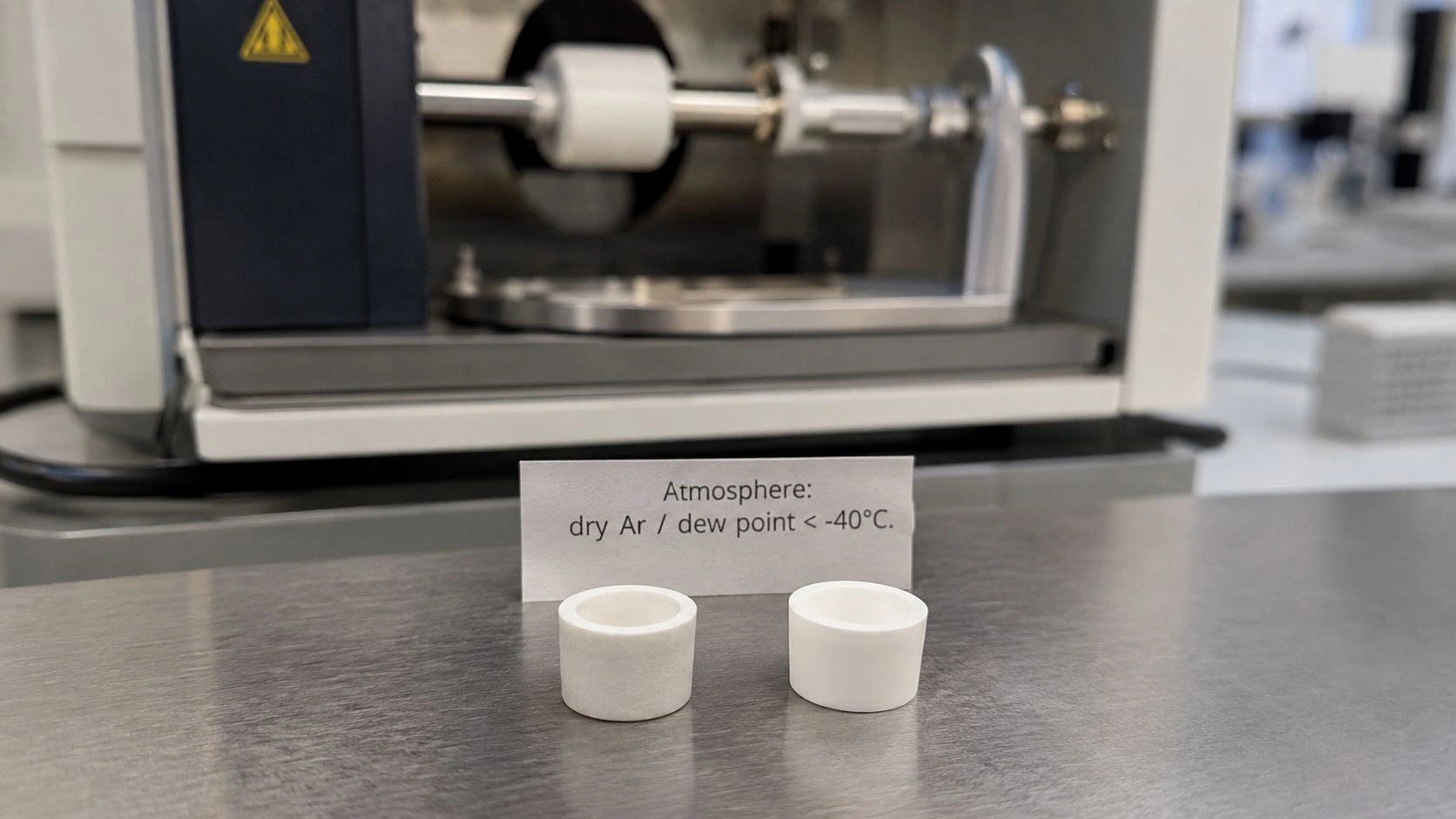
BN crucibles and liners extend high-temperature thermal analysis beyond the practical alumina range — but only under dry, non-oxidizing atmospheres where BN oxidation and water-vapor volatilization are not relevant failure modes.
Why alumina is the default and where the limit appears
Alumina crucibles are the standard choice for thermal gravimetric analysis because they are chemically stable for most inorganic and organic samples, reusable over many cycles, and available in instrument-compatible geometries for all major TGA and STA systems. Instrument and OEM catalogs commonly list reusable alumina TGA crucibles near ~1600°C — confirm the OEM datasheet; that figure is not an ADCERAX product rating. Published thermal-analysis crucible overviews consistently describe alumina as a common TGA crucible material in this instrument-typical range.
The BN vs Alumina comparison table below maps the key decision variables:
| Decision variable | Alumina crucible | BN crucible/BN liner | What to verify |
|---|---|---|---|
| Standard TGA use | Common default up to ~1600°C | Specialized route | Method and temperature range |
| Air/oxidizing atmosphere | Strong candidate | Usually not suitable above BN air limit | Oxygen and water vapor |
| Vacuum/inert atmosphere | Possible but may reach practical limit | Stronger candidate above 1500°C | Dew point and gas purity |
| Molten sample sticking | May wet or react | Often better non-wetting behavior | Sample compatibility |
| Heat-flow comparability | Familiar baseline | Signal may change due to thermal properties | Blank and reference runs |
| Sensor contact | Common with alumina systems | Must check Pt/W/Rh/sensor contact | Instrument accessory limits |
| Reuse | Often reusable | Reuse depends on atmosphere and residue | Blank drift and surface change |
| Cost | Usually lower | Higher and more specialized | Justification by sample need |
Values indicative; verify with instrument manufacturer documentation, BN supplier data, and application-specific blank validation.
Alumina as standard TGA crucible material. Alumina's combination of chemical stability in oxidizing and mildly reducing atmospheres, low thermal expansion, reasonable thermal conductivity, and broad compatibility with furnace hardware and sensor materials makes it the natural default. For tests up to 1500–1600°C in air, an oxidizing atmosphere, or a sample that does not attack alumina, there is no engineering reason to specify BN.
Why 1500–1600°C becomes a practical transition zone. Near alumina's practical TGA ceiling, atmosphere, blank behavior, and sample–crucible chemistry drive BN vs alumina routing — confirm the instrument limit. At high temperature, sample–alumina interaction risk rises and is chemistry-dependent; qualify blank, wetting, and reaction on the actual couple rather than treating any single temperature as a universal reaction-onset contract. This transition zone is where engineers begin asking whether BN offers an advantage — and the answer depends almost entirely on the atmosphere.
When the issue is not temperature but sample–crucible interaction. Some samples begin to be specified for BN crucibles not because of temperature alone but because they wet alumina, react with alumina oxide, stick to the pan on cooling, or introduce Al-containing contamination into the analytical sample at high temperature. In these cases, BN's non-wetting behavior and chemical inertness toward many molten metals and reactive powders under inert or vacuum conditions makes it a functionally superior container even below 1500°C.
Why "higher temperature material" is not enough. The most common specification error in high-temperature thermal analysis is choosing a crucible material by its nominal maximum temperature rather than by the combined requirements of atmosphere, sample chemistry, sensor compatibility, blank stability, and heat-flow signal behavior. A BN crucible screened near ~1800°C in vacuum/inert is not useful in a 1550°C air test because it will oxidize and contribute to the mass-change signal rather than isolating the sample's own mass changes.
BN works above 1500°C only under the right atmosphere
After establishing that the temperature transition zone exists, the critical decision variable is the furnace atmosphere during the thermal-analysis run.
Published supplier screening bands for hot-pressed BN commonly list air service near ~1000°C and vacuum or inert service near ~1800°C — screening figures, not an ADCERAX continuous loaded-service or life rating. Confirm grade, section thickness, dew point, residual oxygen, and dwell before treating either band as a duty limit. BN oxidation depends strongly on microstructure, and trace moisture can volatilize boron-oxide species at elevated temperature, so "BN above 1500°C" is always conditional on a dry, non-oxidizing atmosphere before BN can serve as a stable thermal-analysis container.
The Atmosphere Decision Matrix below maps each furnace atmosphere to BN suitability above 1500°C:
| Atmosphere | BN direction above 1500°C | Main risk | Better route |
|---|---|---|---|
| Dry argon | Possible with validation | Sample reaction or outgassing | BN crucible or BN liner |
| Dry nitrogen | Possible with validation | Nitride-forming samples/chemistry | BN or alternative liner |
| High vacuum | Possible with validation | Sublimation/vapor transport/outgassing | BN, graphite, tungsten, or PBN depending on sample |
| Air | Usually unsuitable past air-screening window | BN oxidation/mass change | Alumina, platinum, zirconia, or other oxide route |
| Oxygen | Avoid | Oxidation and boron oxide formation | Alumina/platinum/oxide ceramic |
| Wet gas/steam | Avoid unless specially tested | Boron oxide volatilization | Alumina, zirconia, platinum, or sealed route |
| Reducing gas | Conditional | Sample and furnace compatibility | BN, graphite, W, or Mo depending on chemistry |
| Combustion product gas | High risk | Oxygen + water vapor + reactive species | Oxide crucible route |
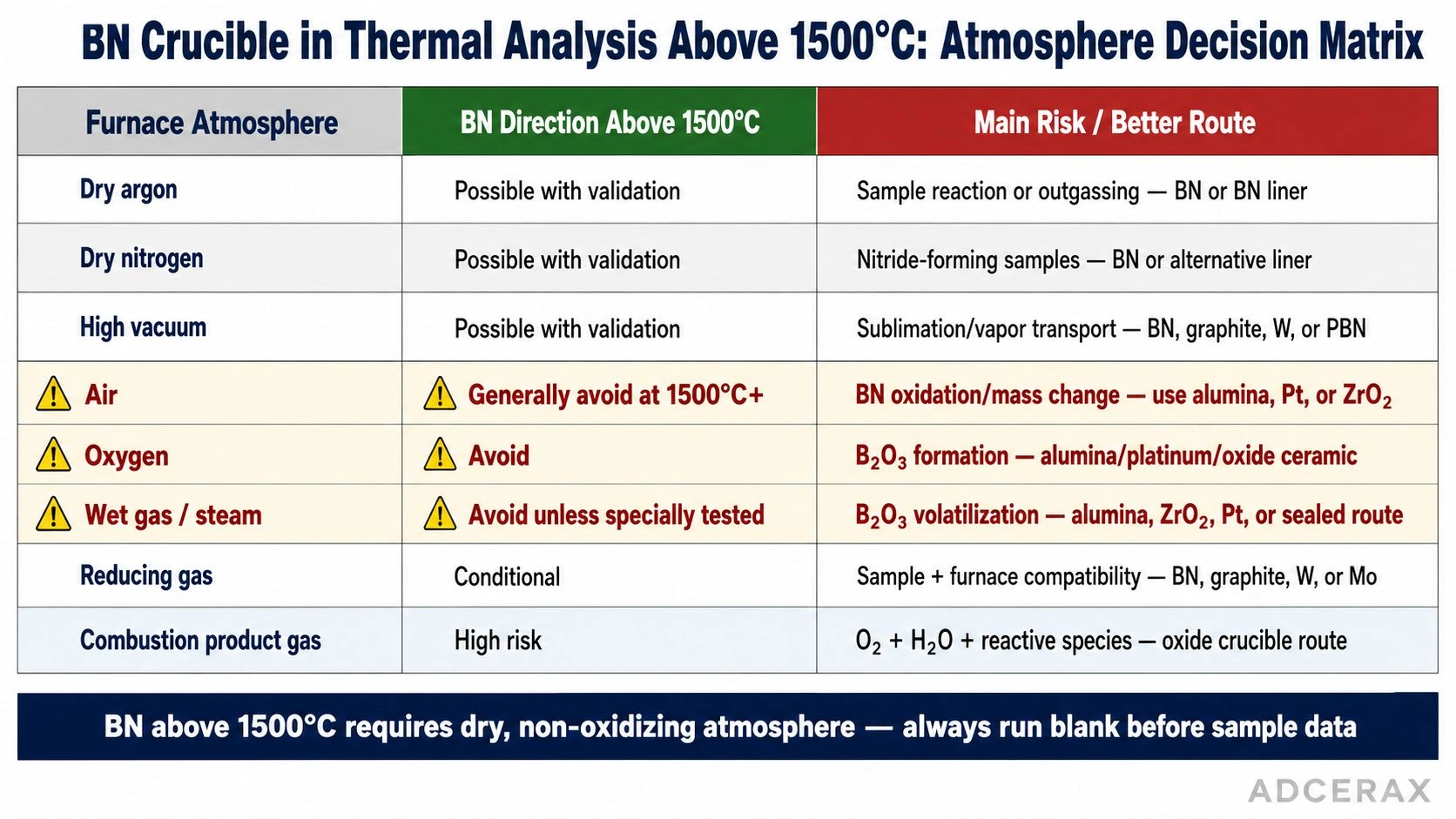
Vacuum, argon, nitrogen: where BN becomes attractive. In a dry, non-oxidizing furnace atmosphere, BN's combination of high thermal stability, non-wetting behavior, electrical insulation, and machinability into custom geometries makes it a genuine candidate above the alumina practical range. Once atmosphere and blank checks clear, review boron nitride crucible geometry against the instrument and duty — dense hot-pressed BN is the usual TGA/STA container logic; treat CVD PBN as a liner/option when purity architecture requires it, not as a general air-ceiling upgrade. For samples that would contaminate alumina, wet alumina, or show high-temperature sample–alumina interaction (chemistry-dependent), BN under dry inert gas or vacuum resolves the sample–crucible interaction problem while extending the thermal-analysis window.
Air and oxygen: where BN becomes risky. Hot-pressed BN air service is oxidation-limited; published supplier screening bands commonly cite about 850–1000°C (often summarized near ~1000°C) — screening, not a continuous loaded-service guarantee. Above this band, BN begins to oxidize — forming B₂O₃, which can melt, flow, and volatilize. In a TGA measurement, B₂O₃ formation and volatilization appear as mass changes that cannot be distinguished from sample-derived mass changes without a controlled blank run. In quantitative air TGA/STA once past the grade's air-oxidation screening window, BN is usually unsuitable as a stable container — short excursions, coatings, or atypical atmospheres need separate validation, not a blanket physics ban.
Why water vapor matters even when oxygen seems controlled. Nitrogen and argon atmospheres are often described as "inert," but delivered industrial gas contains trace moisture that must be measured and controlled. Trace moisture (even low-ppm class) at elevated temperature — often discussed above ~1000°C — can attack BN surface phases and produce volatile boron-hydroxide species; control dew point and confirm with the process gas specification rather than treating ppm figures as a corrosion-rate contract. If the thermal-analysis instrument's gas line is not dried, or if the furnace does not maintain a clean dew point, nominally "inert" gas can still produce BN surface changes that affect blank stability.
Why BN blank stability must be validated. Before using any BN crucible or liner for sample measurements above 1500°C, a blank run — heating the empty BN crucible through the same thermal cycle — must be completed and the mass drift recorded. An acceptable blank for quantitative work is a mass change within the lab's declared uncertainty — or below the analytical LOD for the method — not a contractual “zero measurable drift” guarantee. If blank drift exceeds that criterion, the BN crucible may be reacting with the atmosphere, and the material choice or atmosphere must be corrected before sample data is collected.
When BN is better than alumina in high-temperature thermal analysis
After confirming that the atmosphere is compatible, the use cases where BN is technically preferred over alumina above 1500°C fall into several distinct categories.
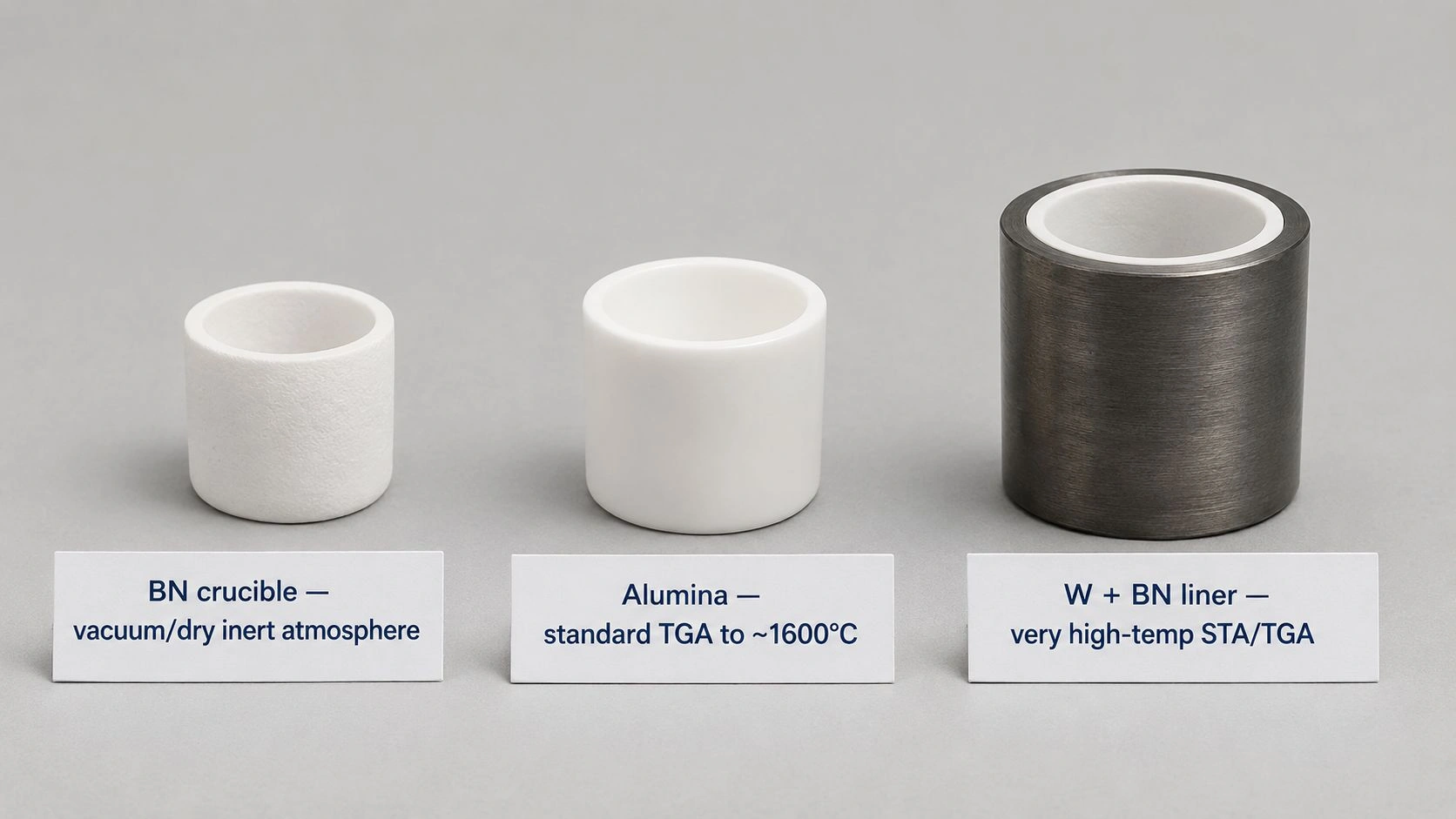
The High-Temperature Thermal Analysis Crucible Route table maps the main material candidates:
| Crucible route | Best-fit use | Main advantage | Main limitation |
|---|---|---|---|
| Alumina | Standard TGA, oxidizing tests, many inorganic samples | Stable, reusable, common | Practical thermal-analysis range near 1600°C |
| BN | Inert/vacuum high-temperature sample-contact tests | Non-wetting, machinable, thermal shock resistant | Not for hot air/wet oxidizing atmospheres |
| BN liner | Sample-contact barrier inside W/graphite systems | Separates sample from structural crucible | Contact reactions and temperature limits |
| Tungsten | Very high-temperature inert/vacuum STA/TGA | High temperature capability | Oxidation risk; sample reactions |
| Graphite | Inert/vacuum high-temperature tests | Thermal shock, machinability | Oxidizes; carbon contamination |
| Platinum/Pt-Rh | Oxidizing DSC/STA where chemistry permits | Good thermal conductivity and inertness in many systems | Cost, melting/softening and sample alloying |
| Zirconia | Oxide route for selected aggressive samples | Corrosion resistance and thermal barrier behavior | Thermal shock and heat-flow limitations |
Non-wetting sample containment. Samples that are liquid or semi-liquid above 1500°C — certain metal alloys, glass melts, reactive oxide systems — can wet alumina and stick permanently to the pan. BN's non-wetting behavior toward many of these systems allows the sample to be recovered after the thermal-analysis run, reduces baseline errors from mechanical sample–pan adhesion, and prevents the signal-masking effect of frozen melt bridges between the sample and pan. The alumina crucibles and the ceramic laboratory crucible options illustrate how crucible material choice follows function rather than temperature rating.
BN liners for tungsten or graphite crucibles. When the test temperature exceeds practical alumina range and requires a high-strength structural crucible — typically tungsten or graphite for very high-temperature STA or TGA — BN can serve as a liner that separates the sample from the structural crucible wall. Published NETZSCH thermal-analysis accessory documentation lists BN liners for high-temperature crucible systems. However, the same documentation notes that BN contact with platinum, tungsten, rhodium, or Pt/Rh alloys must be validated at the planned peak temperature (for example on near-1600°C runs), because interface reactions are couple- and atmosphere-dependent. This means BN liner selection must include review of the crucible body material and the instrument's sensor or carrier plate.
Thermal shock and machinable custom geometry. Some thermal-analysis applications require non-standard crucible geometries — unusual volumes, specific lid-to-sample clearances, notched walls for thermocouple access, or custom bottom profiles for sample contact. BN's machinability allows these geometries to be produced without the forming and sintering constraints that apply to dense oxide ceramics. For specialized high-temperature inert-atmosphere analysis where a non-standard geometry is required, BN is often easier to produce in prototype quantities than zirconia or other refractory oxide alternatives.
Low contamination in vacuum or inert analysis. For analytical thermal measurements where the sample must remain free of Al, Si, Ca, Fe, or other ceramic-derived impurities — reactive rare-earth alloys, semiconductor precursors, certain catalyst systems — BN's composition (boron and nitrogen only) limits the range of ceramic-derived contaminants relative to alumina or mixed-oxide crucible routes. The TGA alumina crucible options and the alumina crucibles category remain the default routes where alumina contamination is not a concern — BN should be specified only when the analytical objective specifically requires it.
Do not misdiagnose thermal-analysis problems as "alumina limit" only
When a high-temperature thermal-analysis run shows unexpected baseline drift, an unusual heat-flow curve, mass changes that do not match the expected sample behavior, or apparent sample contamination, the crucible material is one of several possible causes. Attributing every problem to the alumina crucible's temperature limit leads to switching to BN without solving the actual problem.
Baseline drift vs crucible reaction. Baseline drift in TGA above 1500°C is most commonly caused by buoyancy effects from changing gas density with temperature, gas flow instability, sensor contamination from previous runs, or radiation effects on the balance mechanism — not by alumina reaching a chemical limit. Confirming the instrument's buoyancy correction and running a calibration blank before attributing drift to the crucible material is the correct diagnostic sequence.
Sample evaporation vs crucible failure. Mass loss in a high-temperature TGA run can come from sample volatilization, surface desorption, phase-change evolution, or reactive gas release — none of which are caused by the crucible material. If the mass-loss profile correlates with the expected thermodynamics of the sample rather than with any crucible mass-change pattern visible in the blank run, the sample is the source.
Thermal lag and heat-flow signal changes. Switching from alumina to BN changes the thermal conductivity and thermal mass of the crucible, which changes the heat-flow response in DSC or STA measurements. Instrument OEM guidance (including NETZSCH accessory notes) confirms that crucible thermal conductivity and thermal mass affect heat-flow lag and baseline — follow the instrument OEM guidance rather than assuming a universal k figure. This is not a problem with BN — it is an expected consequence of changing the crucible material. Historical data collected with alumina cannot be directly compared with new data collected with BN without accounting for this change.
BN oxidation mistaken for sample mass change. If BN is used in a test atmosphere that is not confirmed dry and non-oxidizing, B₂O₃ formation and volatilization can produce mass changes that look like sample-derived events. A characteristic signature is mass loss in the 900–1200°C range that cannot be assigned to any feature of the sample's known chemistry — which is the BN crucible reacting, not the sample. A blank run with the same atmosphere and temperature profile reveals this immediately.
RFQ checklist for BN thermal analysis above 1500°C
A complete RFQ for BN crucibles or liners in high-temperature thermal analysis must provide the instrument and method context alongside the atmosphere and sample chemistry — without both, the supplier cannot confirm whether BN is appropriate or whether PBN, a BN liner, or a different crucible material is the better choice.
A complete RFQ for BN crucibles or liners above 1500°C should include analysis method and instrument model, maximum temperature and dwell time, atmosphere with oxygen level and dew point, sample chemistry (molten state, vapor pressure, reaction sensitivity), sensor and carrier-plate material for contact review, crucible role (main container or liner inside tungsten/graphite), geometry (volume/OD/ID/wall/lid and bottom flatness), blank-stability criterion, reuse plan with surface-change tracking, and packaging or pre-bake protocol. "BN crucible for TGA above 1500°C" alone is not enough to confirm atmosphere suitability, sensor contact, or blank stability.
| RFQ field | Why it matters | Recommended wording |
|---|---|---|
| Analysis method | TGA, DSC, STA, DTA require different crucible behavior | "Specify TGA/DSC/STA/DTA and instrument model" |
| Maximum temperature | Defines material boundary | "Peak temperature and dwell time above 1500°C" |
| Atmosphere | Primary BN compatibility driver | "Vacuum/Ar/N₂/air/O₂/wet gas; include dew point" |
| Sample chemistry | Controls reaction and wetting | "List metals, oxides, carbides, nitrides, salts, or powders" |
| Sensor material | Avoids instrument damage | "State Pt, W, Rh, alumina, sapphire, or sensor-plate contact" |
| Crucible role | Main container vs liner | "BN crucible or BN liner inside tungsten/graphite" |
| Geometry | Affects heat transfer and baseline | "Volume, OD, ID, height, wall, lid, bottom flatness" |
| Blank requirement | Prevents false mass signals | "Run empty BN through same cycle; record mass drift" |
| Reuse plan | Controls contamination | "Single-use, limited reuse, or cleaned/reused with tracking" |
| Packaging/pre-bake | Controls moisture and contamination | "Dry pack, clean pack, pre-bake recommendation" |
RFQ fields are the minimum for a BN thermal-analysis crucible inquiry; add instrument accessory compatibility, post-run inspection protocol, and signal comparability requirement with alumina baseline as needed.
For new BN crucible applications above 1500°C, running a blank thermal cycle with the actual atmosphere, temperature profile, and sensor contact configuration is the minimum validation before sample data is collected. Proceed when blank mass change stays within the lab's declared uncertainty / below the method LOD; blank drift above that criterion requires atmosphere correction or material change before the crucible is qualified.
Evaluating BN crucibles or liners for thermal analysis above 1500°C? Share your method, instrument model, maximum temperature, atmosphere and dew point, sample chemistry, sensor material, crucible geometry, and blank-stability target. A supplier can review whether alumina, BN, a BN liner (or PBN when purity architecture requires it), tungsten, graphite, platinum, or a BN-lined route fits the test. For non-standard volumes, wall, or blank protocols, use custom services with the same RFQ fields — turnaround depends on inquiry complexity; no commitment required at this stage.
Related reading
- TGA alumina crucibles for thermal analysis — Alumina TGA crucible defaults for oxidizing and routine thermal-analysis runs below the alumina practical ceiling.
- BN vs graphite crucibles — When inert high-temperature work should route to BN versus graphite on wetting, purity, and cost.
- BN crucible max temperature — How BN crucible temperature limits depend on atmosphere — before you specify above 1500°C.
Frequently Asked Questions
Can BN crucibles be used above 1500°C?
Yes, but mainly in vacuum or dry inert atmospheres — argon, nitrogen, or high vacuum with confirmed low moisture. BN should not be treated as a general high-temperature crucible in air once past published hot-pressed BN air-oxidation screening bands (commonly about 850–1000°C). Published supplier screening often lists vacuum/inert near ~1800°C while limiting air use well below that — screening bands, not continuous loaded-service or life ratings.
Why not just use alumina above 1500°C?
Alumina is the standard default and covers most thermal-analysis needs near the instrument/OEM-typical reusable-alumina range around ~1600°C (confirm OEM datasheet). BN becomes useful when the test temperature exceeds alumina's practical range, when the sample reacts with or sticks to alumina, or when contamination from the ceramic body must be minimized for specific analytical objectives. The switch to BN should be driven by a documented functional need, not by temperature alone.
Can BN be used in air above 1500°C?
Usually unsuitable for quantitative air TGA/STA once past the grade's air-oxidation screening window — not a blanket physics ban on every short excursion or coated atypical case, which still need separate validation. BN oxidation and boron-oxide volatilization become significant above published air screening bands. In a TGA measurement, B₂O₃ formation and loss produce mass changes that cannot be distinguished from sample-derived events without a blank run whose drift stays within the lab's uncertainty / below LOD. Past that air window, alumina, platinum, or a zirconia route is typically more appropriate.
Is BN better as a crucible or as a liner?
Often, BN works best as a liner inside a tungsten, graphite, or other high-temperature structural crucible when the structural crucible provides mechanical strength and BN provides the sample-contact barrier. Published NETZSCH thermal-analysis accessories documentation lists BN liners for high-temperature crucible systems and notes that contact with platinum, tungsten, rhodium, or Pt/Rh alloys must be validated at the planned peak temperature because interface reactions are couple-dependent.
Will switching to BN change the thermal-analysis signal?
Yes, it can. Crucible material affects thermal conductivity, heat transport to the sample, thermal lag, and baseline behavior. OEM guidance notes that crucible materials differ in thermal conductivity and thermal mass, which influences heat-flow lag and DSC-type baselines — confirm with instrument OEM guidance. Historical alumina-baseline data cannot be directly compared with new BN-baseline data without accounting for this change.
What information should I send to a supplier?
Send the analysis method and instrument model, maximum temperature and dwell time, furnace atmosphere and dew point, sample chemistry including molten state and vapor pressure, sensor and carrier-plate material, whether BN is required as the main crucible or as a liner, crucible geometry requirements, blank-stability criterion, reuse plan, and packaging or pre-bake requirement.