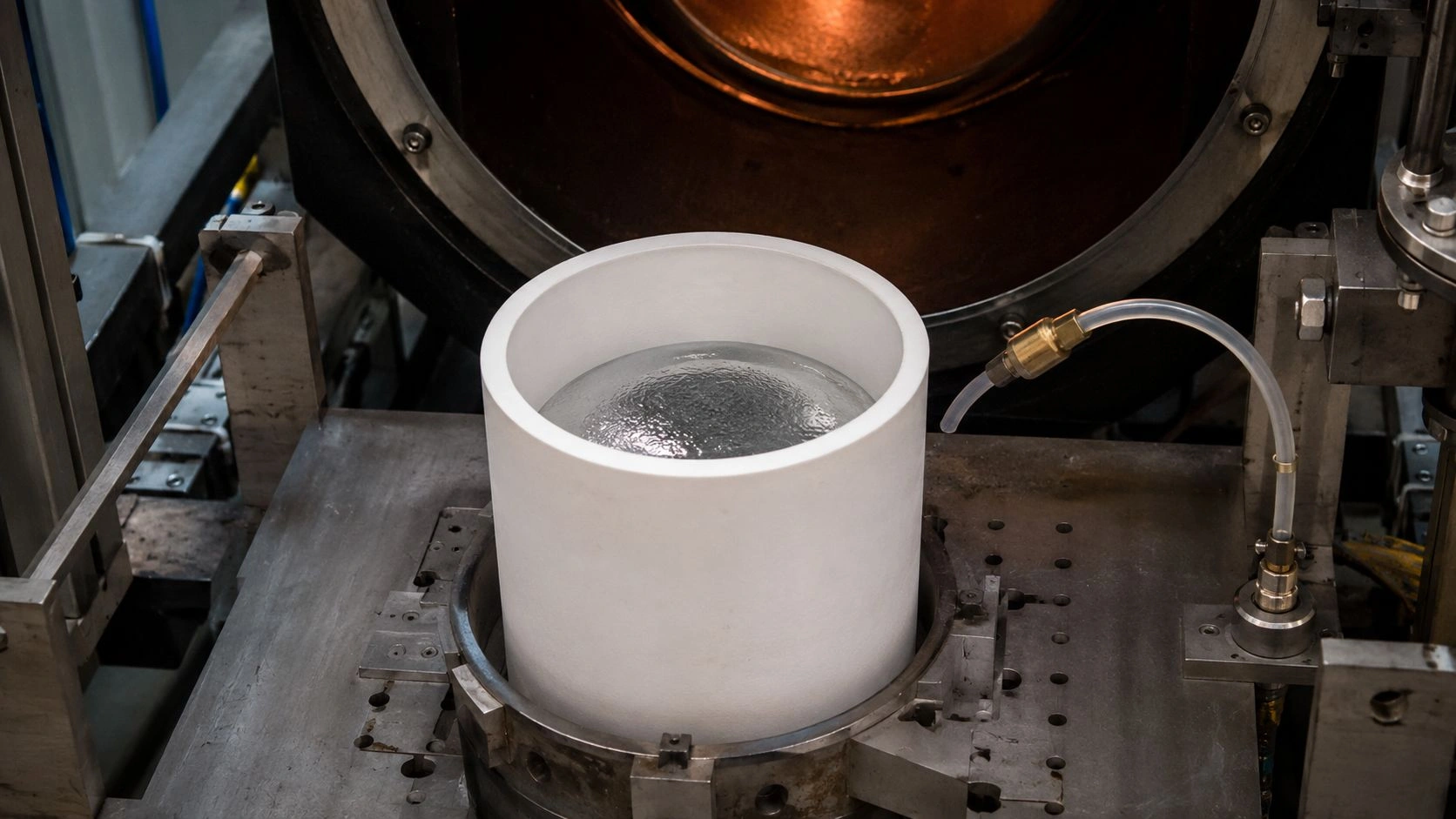
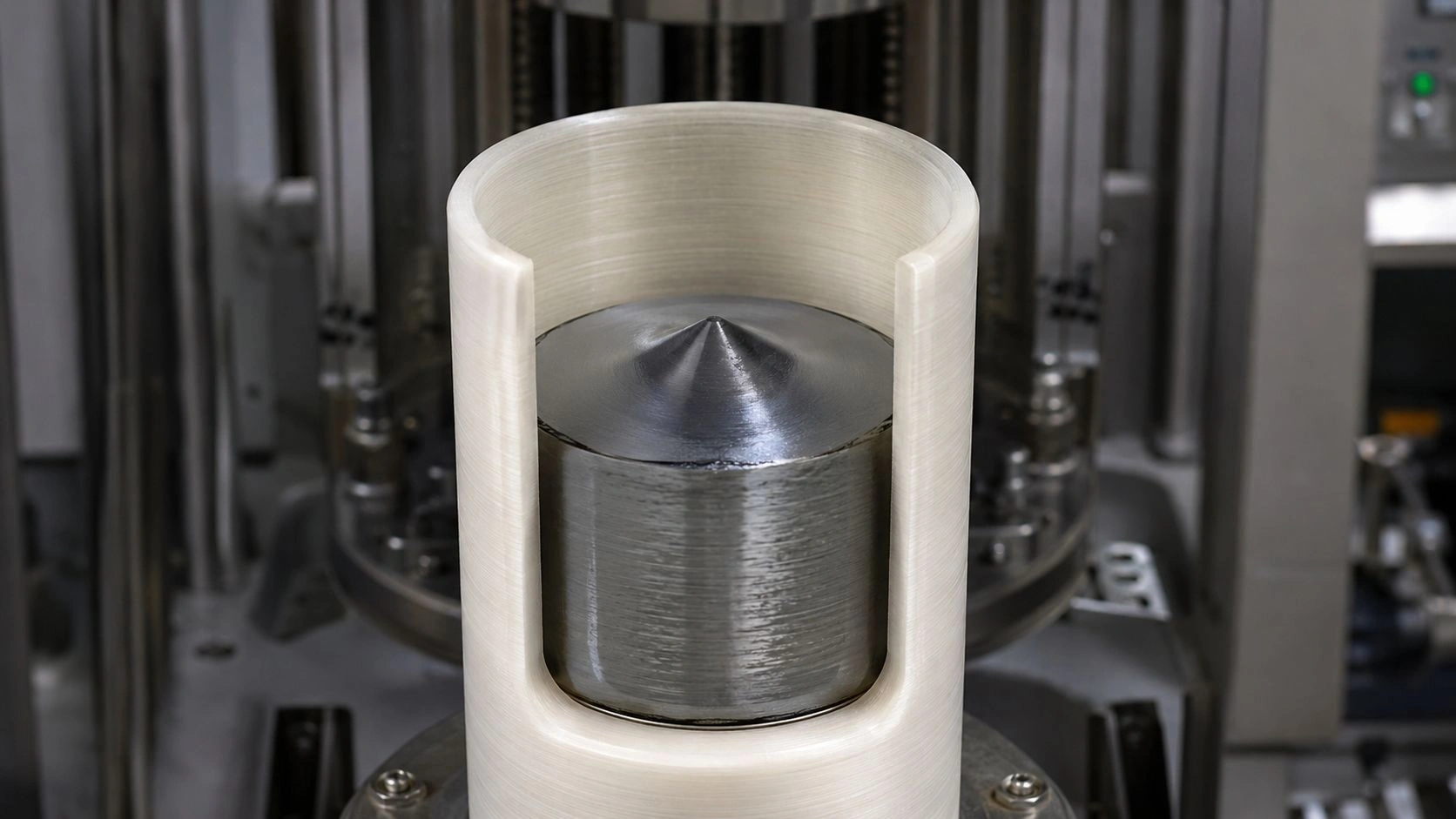
PBN crucibles are used for GaAs effusion because they provide a dense, high-purity, low-outgassing, non-wetting container for Ga, Al, In, and dopant sources in MBE effusion cells. They help protect ppb-level source purity, but they do not guarantee ppb-purity GaAs by themselves. Final impurity control in GaAs MBE depends on source material purity, UHV background, effusion-cell bake-out, RGA monitoring, crucible geometry, fill level, lip temperature, oxide control, and clean handling — the PBN crucible is one controlled element in that system.
That system-level framing — PBN as a contamination-control interface, not a purification technology — is the engineering basis for this guide.
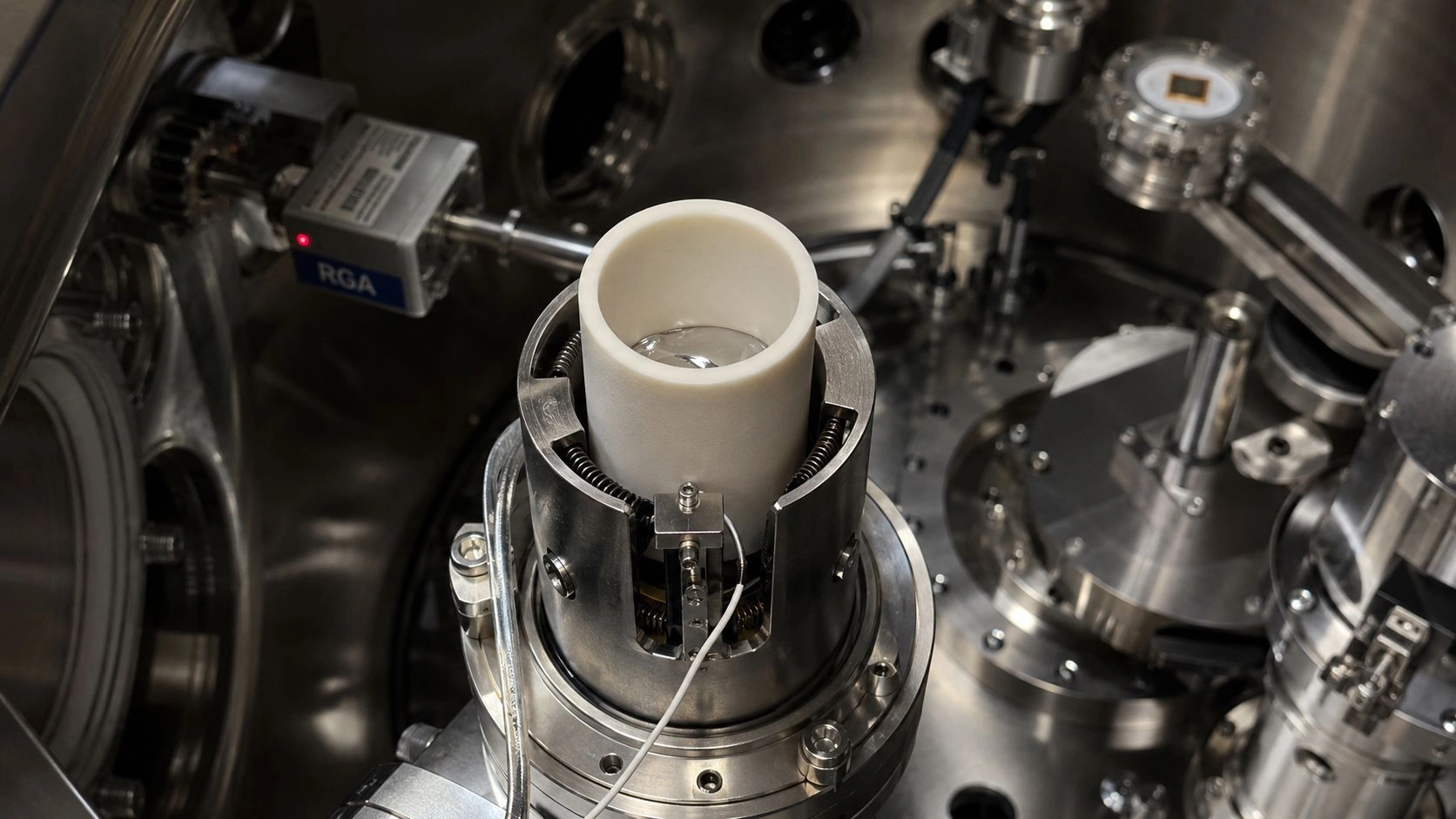
PBN crucibles in GaAs MBE effusion cells hold the Ga source and protect ppb-level purity by minimizing container-derived contamination — but ppb-purity GaAs requires source material purity, UHV background, bake-out, RGA validation, and controlled fill level alongside the crucible.
What "ppb purity" means in GaAs effusion
Before specifying a PBN crucible for ppb-level GaAs effusion, it is important to locate where in the contamination chain "ppb purity" actually applies — because the answer changes what must be validated, and mislocating the source of impurities leads to changing the wrong variable.
In GaAs MBE effusion, group III elements including Ga, Al, and In are held in PBN crucibles and evaporated from standard effusion cells by thermal evaporation. Published ultra-pure gallium research reports that 8N gallium with approximately 10 ppb total nominal impurity content produced higher electron mobility in GaAs MBE experiments than 7N gallium — confirming that source-material purity is a measurable variable in ppb-level GaAs quality, and that the PBN crucible's role is to preserve that source purity by not adding contamination rather than to create the ppb-level purity itself. Those ~10 ppb / 7N–8N figures are published-research attributions, not an ADCERAX contractual purity certificate.
The ppb Purity Chain in GaAs Effusion table maps each control point to its mechanism and what must be verified:
| Control point | What it affects | Why PBN matters | What to verify |
|---|---|---|---|
| Source Ga purity | Background impurities in film | PBN should not add contamination | 7N/8N source data, GDMS/ICP-MS |
| Chamber background | O, C, H₂O, hydrocarbons | Low outgassing helps baseline | RGA before and after crucible loading |
| Effusion cell bake-out | Water and residue removal | PBN must survive bake without contaminating | Bake profile and RGA endpoint |
| Crucible geometry | Flux stability and spitting | Lip/cone shape affects Ga behavior | Source model, fill level, lip design |
| Fill level | Oval defect risk | PBN must be sized for safe charge volume | Less-than-max loading where needed |
| Lip temperature | Condensation and droplets | Heated lip/insert may reduce defects | Condensation marks and flux drift |
| Handling | Particles and surface residue | Clean PBN surfaces protect source | Gloves, dry pack, clean storage |
| Reuse | Source memory | Dedicated crucibles reduce cross-contamination | Crucible ID and source history |
Source purity vs crucible purity vs film impurity. The Ga source material specification — 7N, 7N5, or 8N — describes the elemental gallium before it is loaded into the crucible. The PBN crucible's purity specification describes the crucible wall composition. The film impurity is the result of the entire system: source purity, PBN outgassing, chamber background, substrate, and growth conditions. Improving one element of this chain without the others does not produce proportional improvement in film quality.
Why 7N/8N Ga can still be limited by chamber background. Even when the source material is 8N grade, the UHV background in the growth chamber contributes oxygen, carbon, and hydrogen species that can incorporate into the growing GaAs layer. Published high-mobility AlGaAs/GaAs MBE work identifies charged impurities as potentially originating from background vacuum, hot metal surfaces in the chamber, starting substrates, and source materials — all of which must be controlled in parallel.
PBN as a contamination-control interface. The PBN crucible's engineering function is to hold the Ga source without adding measurable contamination to it during the source-loading, bake-out, and evaporation period. A crucible that outgasses moisture, hydrocarbons, or binder-related species into the UHV chamber adds to the chamber background that the source material purity and bake-out are trying to minimize.
Why ppb-level workflows need blank and RGA validation. A PBN crucible that is clean and properly baked will not show a measurable outgassing signature in RGA beyond the expected H₂O desorption during initial bake-out. A crucible with machining residue, handling contamination, or moisture adsorption from open-air storage will show additional peaks. Running the empty crucible through the bake-out and checking RGA before loading source material is the only reliable way to confirm the crucible contribution to the chamber background.
Why PBN is used instead of hot-pressed BN or alumina
After establishing what ppb purity means in GaAs effusion, the material selection question is why PBN — rather than hot-pressed BN, alumina, quartz, or graphite — is the standard source container for Ga and other group III elements.
The PBN vs Other Crucible Routes table maps the alternatives:
| Crucible route | Best-fit use | Main advantage | Main limitation |
|---|---|---|---|
| PBN | Ga, Al, In, dopant MBE effusion | Low outgassing, non-wetting, high purity | Cost and geometry-specific fit |
| Hot-pressed BN | Moderate vacuum fixtures, noncritical holders | Machinable and economical | Higher UHV validation burden |
| Alumina | Some high-temp lab containers | Stable oxide ceramic | Not standard for Ga MBE source purity |
| Graphite | Heating support/susceptor contexts | Conductive and thermal shock resistant | Carbon contamination risk |
| Quartz | Low-temp/silica-compatible handling | Clean and common | Temperature and devitrification limits |
| Coated or insert-assisted PBN | Long campaigns/flux shaping | Better lip control and stability | More complex RFQ and qualification |
CVD PBN vs powder-sintered BN. Hot-pressed BN is manufactured from BN powder consolidated under pressure and temperature, which can leave residual porosity, grain boundaries, and possible sintering-aid or binder-phase chemistry. PBN is produced by chemical vapor deposition — boron halide and ammonia react on a heated mandrel, building up a dense, high-purity, binder-free BN wall layer by layer. The CVD structure gives PBN its low outgassing behavior, because there is no pore network to trap water or volatile species, and no binder chemistry to release at elevated temperature. For grade identity across BN families, see the boron nitride ceramic hub — keep hot-pressed BN and CVD PBN on separate RFQ tracks.
Low outgassing in UHV effusion cells. CVD-grown PBN crucibles are used in MBE and PVD as low-outgassing, binder-free containers. Confirm CVD-PBN purity and analytical method on the ordered lot COA / PBN grade sheet — industry-typical published figures are not an ADCERAX HPBN or PBN contractual TDS line, and hot-pressed BN composition values must not be treated as PBN purity. Published MBE supplier guidance from MBE Komponenten positions PBN crucibles as accepted for semiconductor MBE growth specifically because of high purity, chemical inertness, thermal stability, low outgassing, and non-wetting behavior toward Ga and other group III source materials.
Non-wetting behavior for Ga source stability. Gallium wets many ceramic and metal surfaces, creating adhesion that can affect how the source pool behaves during heating — surface tension, flow pattern, and evaporation uniformity all depend on the crucible surface energy. PBN's non-wetting behavior toward liquid Ga helps maintain a stable pool geometry and reduces the tendency for Ga to climb the crucible wall, which can lead to spitting if the film of Ga on the wall is heated rapidly.
Crucible geometry, fill level, and oval defects
After confirming that PBN is the correct material for GaAs effusion, the geometry and loading decisions are where performance differentiation between crucibles of the same material grade is determined.
Fill level and Ga droplet formation. Published GaAs/AlGaAs MBE defect research directly measured the relationship between Ga crucible fill level and oval defect density in grown epitaxial layers. The study reported that filling a PBN crucible with Ga to maximum capacity increased Ga-source-related oval defects, while using less than half-volume Ga charge reduced the defect density. The mechanism is that a Ga pool at or above a certain height can form droplets at the crucible lip or shoulder during source heating, and these droplets travel to the substrate surface as macroscopic Ga particles that nucleate oval-shaped morphological defects.
Lip temperature and condensation control. If the crucible lip is significantly cooler than the Ga pool temperature, Ga vapor can condense on the lip surface and accumulate. During subsequent heating cycles, the condensed Ga can run back into the pool or eject as droplets. Riber's heated insert design for Ga and In effusion cells addresses this by maintaining the lip at a temperature that prevents condensation accumulation, and the conical or heated geometry helps direct the Ga flux and reduce cross-contamination between source compartments.
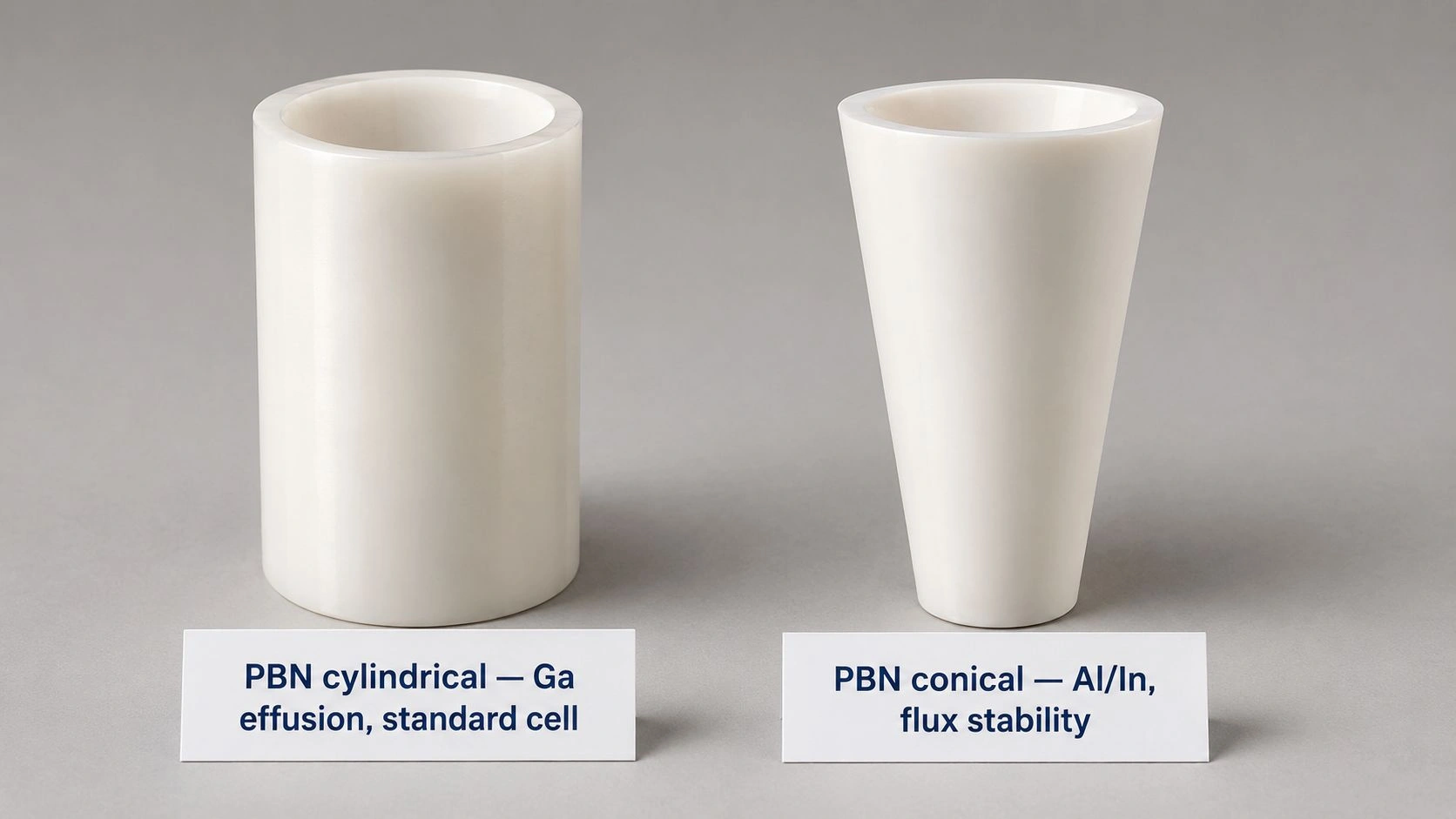
Conical vs cylindrical crucible behavior. Cylindrical PBN crucibles and conical PBN crucibles produce different Ga-flux angular distributions and pool geometries. The effusion-cell model determines which crucible shape and volume fit the heater assembly and determine the flux profile at the substrate. The crucible RFQ must specify the effusion-cell brand and model — Veeco, Riber, MBE Komponenten, or custom — because different cell designs require different crucible shoulder dimensions, lip diameters, bottom radii, and wall heights.
Inserts, beam shaping, and source stability. For long growth campaigns where the Ga source depletes from a full charge to a low fill level over weeks or months, flux drift can occur because the evaporation geometry changes as the pool level drops. Insert-assisted designs or crucibles with specific taper angles can reduce the magnitude of flux drift across the fill-level range. For cell-fit geometry options — standard MBE volumes, lips, bores, walls, and insert-assisted profiles — see BN crucible and custom PBN geometry capabilities and PBN crucibles for MBE and vacuum evaporation when the RFQ already names the effusion-cell model and intended fill percentage.
Do not misdiagnose every GaAs impurity problem as PBN contamination
When GaAs electron mobility drops, oval defect density increases, flux drifts, or pump-down is slow, the PBN crucible is one of several possible contributors — and typically not the dominant one in a well-controlled MBE system. Published high-mobility AlGaAs/GaAs MBE research explicitly identifies charged impurities as potentially originating from background vacuum, hot metal surfaces inside the growth chamber, starting substrates, and elemental source materials. Isolating the crucible as the root cause requires methodical elimination.
Source Ga impurity vs PBN impurity. If electron mobility is below the expected value for the growth conditions, the first diagnostic question is whether the Ga source material purity is confirmed — GDMS or ICP-MS of the source Ga before loading, and comparison of 7N vs 7N5 vs 8N grades, provides more information than changing the PBN crucible.
Chamber background and hot hardware contamination. Hot metal surfaces — heater filaments, cell bodies, manipulator components, and shutter mechanisms — outgas and can contribute oxygen, carbon, and metal impurities to the growth environment during high-temperature operation. If impurity levels improve when all sources are cold and worsen when sources are at growth temperature, the hot hardware inventory is the correct diagnostic target.
Ga oxide, spitting, and fill-level effects. If oval defects increase, the first diagnostic question is fill level — a high fill level can cause spitting as described in published MBE defect literature. If Ga spitting is confirmed, reducing the fill volume is the recommended first step before changing the crucible grade or geometry.
RGA-guided bake-out before source loading. Published MBE hardware guidance from the Weizmann Institute recommends monitoring RGA during cell bake-out and using a staged approach: baking the cell without the PBN crucible at high temperature first, then inserting the PBN crucible and baking at a lower temperature to avoid excessive PBN thermal exposure. This procedure separates cell-related outgassing from crucible-related outgassing in the RGA signature, which is the correct diagnostic sequence.
The Misdiagnosis Matrix below maps observed GaAs effusion problems to better diagnostic questions:
| Observed problem | Common assumption | Better diagnostic question |
|---|---|---|
| Mobility drops | PBN crucible contaminated film | Was Ga source purity, chamber background, or hot hardware checked? |
| Oval defects increase | PBN material is poor | Is Ga fill level too high or lip condensation occurring? |
| Flux drift | Crucible purity issue | Is thermocouple position, oxide skin, or source geometry responsible? |
| Poor pump-down | PBN outgassing | Was chamber baked empty and compared by RGA? |
| New particles | PBN shedding | Were source material, shutter, insert, or handling tools inspected? |
| Ga spitting | Wrong PBN grade | Is fill height, heat profile, or oxide skin causing droplet ejection? |
| Run-to-run variation | PBN batch inconsistency | Were source charge, bake-out, RGA endpoint, and fill level identical? |
Diagnosis should be based on RGA comparison, source-material GDMS, chamber component audit, and fill-level review before any crucible change is specified.
RFQ checklist for PBN GaAs effusion crucibles
A complete RFQ for PBN crucibles in GaAs MBE effusion must provide the effusion-cell context, purity requirements, and geometry — without all three, the supplier cannot confirm whether the proposed crucible geometry fits the cell, whether the PBN grade is appropriate for the target base pressure, or whether bake-out and packaging are matched to the process.
Engineering and MBE hardware guidance on PBN crucible specification for GaAs effusion confirms a complete RFQ sequence: effusion-cell brand and model for geometry fit, source material and Ga purity grade, target base pressure and RGA acceptance limits, source operating temperature and bake-out profile, crucible volume with intended fill percentage, lip OD/ID and shoulder geometry, wall profile (conical/cylindrical/insert-assisted), PBN purity and lot traceability confirmed on the COA / grade sheet, clean individual packaging, and validation protocol including empty-crucible bake-out RGA, Ga loading trial, flux stability measurement, oval-defect monitoring, and post-growth mobility or impurity comparison. Each variable affects whether the PBN crucible adds contamination to the ppb-level Ga source or supports it — a supplier who receives only "PBN crucible for GaAs MBE" cannot confirm cell fit, fill-level recommendation, or bake-out compatibility without the remaining context.
| RFQ field | Why it matters | Recommended wording |
|---|---|---|
| Effusion cell model | Determines geometry fit | "Veeco/Riber/MBE Komponenten/custom cell model" |
| Source material | Controls chemistry and temperature | "Ga, Al, In, dopant, or mixed campaign" |
| Purity target | Defines contamination sensitivity | "ppb-level Ga source protection/high-mobility GaAs" |
| Crucible volume | Controls fill level | "Nominal cc and intended fill percentage" |
| Lip diameter | Controls source beam and condensation | "Specify lip OD/ID and shoulder fit" |
| Wall profile | Affects thermal response | "Conical/cylindrical/insert-assisted geometry" |
| PBN purity | Controls background risk | "Confirm CVD-PBN purity + method on lot COA / grade sheet" |
| Bake-out | Controls outgassing | "Recommended pre-bake and maximum safe temperature" |
| Packaging | Controls particles and moisture | "Clean individual packaging and lot traceability" |
| Validation | Confirms real effect | "RGA, flux stability, defect density, impurity check" |
RFQ fields are the minimum for a PBN GaAs effusion crucible inquiry; add insert or sleeve compatibility, Ga campaign duration, and post-campaign inspection protocol as needed.
For ppb-level GaAs MBE work — high-mobility 2DEG, AlGaAs/GaAs heterostructures, or long growth campaigns where source purity directly determines device performance — running the empty PBN crucible through the full bake-out cycle with RGA monitoring before Ga loading is the non-negotiable first step. The RGA signature of a clean, properly baked PBN crucible in UHV should show only residual H₂O decay during early bake-out and essentially flat background after the thermal protocol is complete.
Evaluating PBN crucibles for GaAs effusion and ppb-level source purity? Send effusion-cell model, Ga grade, base-pressure/RGA limits, volume + intended fill %, and lip OD/ID for a geometry-fit checklist — and confirm CVD-PBN purity on the ordered lot COA / PBN grade sheet. No catalog commitment required at this stage.
Frequently Asked Questions
Do PBN crucibles guarantee ppb-purity GaAs?
No. PBN crucibles help preserve ppb-level source purity by minimizing container-derived contamination, but final GaAs impurity levels depend on source material purity, UHV background, hot hardware outgassing, substrate quality, bake-out discipline, and growth recipe. Published high-mobility AlGaAs/GaAs MBE research identifies multiple contamination sources that operate in parallel with the crucible.
Why are PBN crucibles used for Ga effusion in GaAs MBE?
PBN is used because it is CVD-grown, dense, high-purity, low-outgassing, chemically inert, and non-wetting toward liquid Ga. Group III elements including Ga, Al, and In are held in PBN crucibles and evaporated from standard effusion cells in MBE. PBN's combination of properties makes it the standard source container for contamination-sensitive III–V epitaxy.
What does "ppb purity" usually refer to in this context?
It usually refers to the source material impurity level — the elemental gallium purity specification before loading — not the PBN crucible composition alone. Published ultra-pure gallium research reports approximately 10 ppb total nominal impurity for 8N grade, and that this grade produced higher electron mobility than 7N Ga in GaAs MBE experiments. Treat those figures as published-research attribution, not as an ADCERAX contractual purity certificate for the crucible.
Can PBN crucible fill level affect GaAs oval defects?
Yes. Published GaAs/AlGaAs MBE defect research found that filling PBN crucibles with Ga to maximum capacity increased Ga-source-related oval defects, while using less than half-volume charge reduced defect density. Fill level is a practical process control variable that should be defined in the RFQ alongside crucible volume.
What should be checked during effusion cell bake-out?
Check H₂O, CO, CO₂, hydrocarbon peaks, and oxygen-related species by RGA. Published MBE hardware guidance recommends RGA monitoring throughout bake-out, and a staged approach — baking the cell assembly without the PBN crucible at high temperature first, then inserting the PBN crucible and completing bake-out at a lower temperature — to separate cell outgassing from crucible outgassing in the RGA signature.
What information should I send to a supplier for a PBN GaAs effusion crucible?
Send the effusion-cell brand and model, source material and Ga purity grade, target base pressure, operating temperature, bake-out profile, crucible volume with intended fill percentage, lip OD/ID and shoulder dimensions, wall profile preference, CVD-PBN purity requirement with lot COA / grade-sheet method, packaging requirements, and the validation protocol — including whether empty-crucible RGA bake-out, flux stability measurement, oval-defect monitoring, or post-growth impurity comparison is required before production use.
Related reading
- PBN crucibles for germanium single-crystal growth — PBN crucible choices when germanium crystal growth sets the contamination budget.
- PBN effusion cells for OLED organic deposition — how PBN effusion-cell parts behave in organic deposition versus III–V source duty.
- PBN tubes for effusion cells in MBE systems — when the MBE cell needs a PBN tube geometry instead of a crucible cup.