SiC tubes are suitable for HF reactor service when the application requires a dense, non-metallic tube material with strong resistance to hydrofluoric acid, mixed acids, thermal shock, and abrasive flow. The best-fit material is usually dense sintered SiC or a qualified SiC heat-exchanger or liner tube, not a porous general-purpose ceramic tube. Suitability depends on HF concentration, temperature, pressure, flow velocity, particulate content, sealing design, tube-sheet material, thermal cycling, and supplier corrosion data. HF safety and process operation must be controlled by the facility's EHS, SDS, process hazard analysis, and qualified engineering team — this guide covers only material and component selection.
The silicon carbide tubes for corrosive chemical and heat-exchange applications at ADCERAX — including SSiC, RBSiC, and SiC liner tube grades for acid reactors, chemical heat exchangers, and corrosion-resistant process components — provide the product context for the specification decisions described in this guide.

Dense SiC tubes in HF reactor service must be specified by grade, open porosity, seal interface, phase, temperature, and pressure category — the SiC material alone does not determine system reliability; seal compatibility and joint design are equally critical.
When are SiC tubes suitable for HF reactor service?
SiC tubes are considered for HF reactor service when the component must provide acid corrosion resistance, high thermal conductivity for heat transfer, hardness for erosion resistance, and dimensional stability at elevated temperature — properties that glass, oxide ceramics, and many metals cannot deliver simultaneously in severe HF-contact zones.
[CITE: Mersen's published silicon carbide anti-corrosion material data confirms that pressureless sintered SiC resists common acids including hydrofluoric acid — and CRP's shell-and-tube silicon carbide heat exchanger product description confirms that SiC is the chosen tube material for very aggressive chemicals including nitric and hydrofluoric acid, where the full exchanger design uses SiC tubes in combination with fluoropolymer-lined tube sheets and FFKM seals to manage the full system's wetted-part compatibility — establishing that SiC tube material resistance to HF is demonstrated in commercial heat-exchanger and reactor service, but that system-level compatibility including seals and tube sheets must be designed and verified together with the SiC tube material.]
The SiC Tube Suitability Matrix for HF Reactor Service maps the main service conditions:
| Service condition | SiC tube fit | Preferred SiC direction | Main verification point |
|---|---|---|---|
| Liquid HF or mixed-acid heat exchange | Strong to conditional | Dense SSiC/directly sintered SiC | Corrosion data, tube-sheet seal design |
| HF vapor or corrosive off-gas protection | Conditional | Dense SiC protection tube | Thermal shock, sealing, gas leakage |
| Abrasive HF-containing slurry | Conditional | SiC liner tube/dense wear-resistant SiC | Abrasion + corrosion combined test |
| High-pressure reactor boundary | Conditional | Engineered SiC assembly, not standalone tube claim | Certified pressure design and leak testing |
| Porous or general kiln-grade SiC tube | Weak | Upgrade to dense SiC grade | Open porosity and infiltration risk |
| Oxide ceramic replacement in HF contact | Often strong | SiC instead of alumina/quartz | Confirm full system compatibility |
Values indicative. Verify with supplier-specific data, applicable pressure-equipment codes, plant EHS review, and project-specific chemical compatibility testing.

SiC tube suitability in HF reactor service depends on service condition — liquid HF, mixed-acid heat exchange, HF vapor protection, abrasive slurry, pressure-boundary design, porosity, and oxide-ceramic replacement each require separate verification.
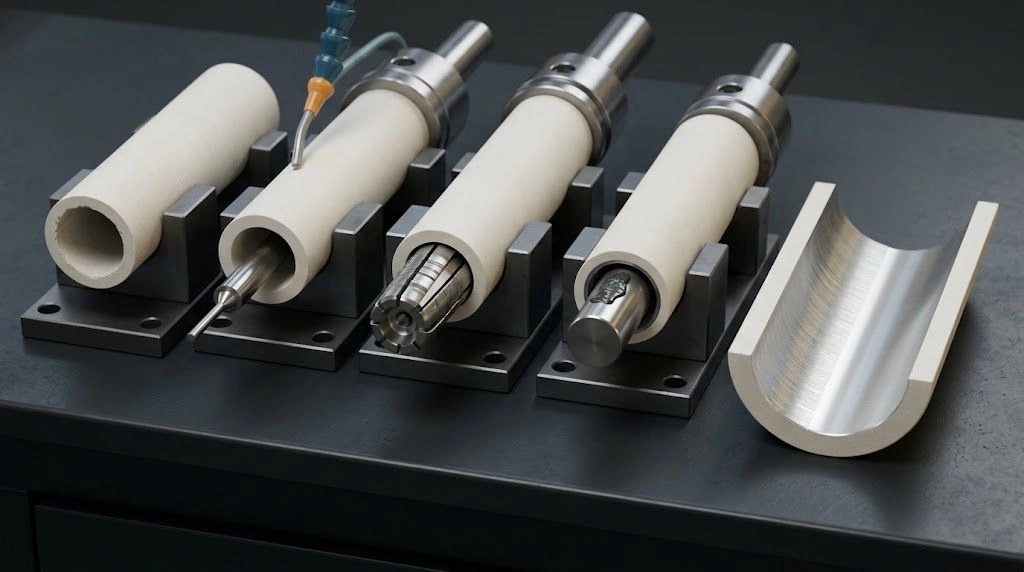
SiC heat-exchanger tubes, liner tubes, and reactor inserts. The most common SiC tube forms in HF reactor service are heat-exchanger tube bundles — individual SiC tubes assembled into a shell-and-tube configuration — and liner tubes that provide a corrosion-resistant inner surface inside a structural metal or ceramic outer body. A SiC liner tube combines the corrosion resistance of SiC with the mechanical strength of a supporting structure, which can be useful where the SiC wall alone would not provide adequate pressure-boundary integrity. The SiC liner tube at ADCERAX covers this reinforced composite architecture for harsh chemical and industrial applications.
Why dense SiC matters more than generic ceramic resistance. The statement ""SiC is acid-resistant"" applies to dense sintered SiC with low open porosity. A porous or partly open SiC structure allows HF to infiltrate the tube wall, attacking the microstructure from inside and potentially causing subsurface degradation that is not visible on the external surface until the wall fails. Dense SSiC with verified low porosity provides the acid-resistance performance that published supplier data refers to; porous grades, general kiln furniture SiC, or poorly sintered SiC tube stock cannot be assumed to provide the same resistance without independent testing.
Why does HF service change the SiC tube specification?
After establishing the use window, the next step is understanding why HF reactor service demands more rigorous specification than ordinary corrosive acid service — and why compatibility charts alone are not sufficient.
SiC grade, density, and porosity. Dense SSiC or directly sintered SiC is usually the preferred grade for liquid HF or mixed-acid service because it provides the lowest open porosity and the most stable microstructure. RBSiC — reaction-bonded SiC, or SiSiC — contains residual free silicon from the manufacturing process. That free silicon can be attacked by some acid environments, including hydrofluoric acid, at higher concentrations or temperatures. Published Cole-Parmer chemical compatibility guidance warns that compatibility data from charts should be used only as a preliminary guide, and that variations in temperature, pressure, and concentration can cause equipment failure even in apparently compatible material combinations. The difference between ""SiC is generally acid-resistant"" and ""this specific dense SSiC grade with verified porosity data is suitable for 20% HF at 60°C"" is the gap that the specification must close.
The silicon carbide ceramic material grades at ADCERAX — covering SSiC, RBSiC, and NBSiC with separate descriptions of density, porosity, temperature capability, and chemical resistance — provide the grade-specific context for this distinction.

SSiC heat-exchanger tubes, SSiC protection tubes, and SiC liner tubes solve different HF-contact component problems — acid-resistant heat exchange, reactor sensor protection, and reinforced corrosion-resistant inserts should be specified separately.
Seals, tube sheets, joints, and gaskets may control system lifetime. The SiC tube itself may have excellent HF resistance, but the tube-to-tube-sheet interface, the seal material, the gasket chemistry, and the tube-end stress condition determine whether the assembled component leaks. CRP's published SiC heat exchanger design uses directly sintered SiC tubes with PFA-lined tube sheets and FFKM seals — confirming that a complete HF-resistant heat exchanger design addresses the tube material, the tube-sheet lining, and the seal elastomer as separate engineering decisions. If the SiC tube is specified correctly but the seal is a standard EPDM or silicone elastomer, HF will attack the seal rather than the ceramic, and the system will fail at the seal rather than at the tube wall.
Thermal shock and erosion-corrosion. HF reactor service may involve temperature cycling — startup, shutdown, process upset — and some HF streams carry abrasive particles from reaction products, catalyst fines, or process scale. SiC's thermal shock resistance is one of the reasons it is considered for HF heat-exchanger service where rapid temperature changes are possible, but thermal shock resistance depends on wall thickness, temperature differential, heating rate, and support design, not only material grade. Abrasive particles in HF service create an erosion-corrosion condition where the corrosion damage rate is accelerated by surface layer removal — requiring thicker walls, harder grade selection, or flow velocity limits.
What failure modes occur when SiC tubes are mis-specified?
When an SiC tube system fails in HF reactor service, the root cause is often not chemical attack on the SiC itself. Attributing failure to SiC material incompatibility before investigating the seal, tube-sheet interface, porosity, grade mismatch, or mechanical stress delays the correct diagnosis and repair.
Material corrosion vs seal leakage vs porosity infiltration. Leakage near tube ends is most commonly a seal or tube-sheet failure rather than through-wall corrosion of the SiC body. Seal materials incompatible with HF — including EPDM, nitrile, standard silicone, and some fluoropolymers — can fail within hours or days in concentrated HF service, producing leakage that appears to come from the tube-ceramic interface. Porous SiC grades can absorb HF into the wall microstructure over time, eventually showing subsurface degradation, wall weakening, or contamination of the cooling fluid that is not visible as surface corrosion.
Thermal shock, vibration, pressure, and abrasion as hidden failure drivers. A sudden temperature change during startup, process upset, or cleaning can crack an SiC tube that would otherwise survive normal service conditions. Vibration from pump pulsation or flow turbulence can impose cyclic stress on unsupported tube sections, eventually causing fatigue cracking at tube ends or support points. Abrasive particles in the HF stream can erode the tube inner surface, reducing wall thickness over time until the residual wall is insufficient for the operating pressure.
The Misdiagnosis Matrix maps observed failures to better diagnostic questions:
| Observed problem | Common wrong diagnosis | More useful engineering question |
|---|---|---|
| Leakage near tube ends | ""SiC is not HF-resistant"" | Did the seal, tube sheet, or joint fail? |
| Surface pitting or roughening | ""All SiC grades are the same"" | Was the grade dense SSiC or a porous/residual-phase material? |
| Rapid tube cracking | ""Chemical corrosion caused failure"" | Was thermal shock, vibration, or installation stress involved? |
| Contamination in process fluid | ""Reactor chemistry changed"" | Is tube, seal, or gasket material releasing ions or particles? |
| Short service life in slurry | ""Need thicker tube only"" | Is erosion-corrosion from particles dominating the damage? |
Root cause should be confirmed by chemical analysis of tube surface residue, seal inspection, porosity measurement, and operating log review before any material or grade change.
What specifications should be included in a SiC tube RFQ for HF service?
A SiC tube RFQ for HF reactor service must describe the component function, operating envelope, and acceptance criteria — but should not share confidential process chemistry or plant operating procedures. The goal is to give the supplier enough information to confirm grade suitability and propose the correct dimensions and configuration.
The RFQ Parameters for SiC Tubes in HF Service table maps the required fields:
| Parameter | Why it matters in HF service | Required in RFQ? |
|---|---|---|
| SiC grade | Determines density, porosity, residual phase, and corrosion boundary | Yes |
| Open porosity | Controls liquid infiltration and hidden degradation risk | Yes |
| OD/ID/length | Controls fit, flow, heat transfer, and replacement compatibility | Yes |
| Wall thickness | Affects strength, thermal transfer, and pressure margin | Yes |
| Surface finish | Affects sealing, fouling, and flow behavior | Yes |
| End geometry | Determines tube-sheet, flange, or liner interface | Yes |
| Seal material | Often limits HF system life more than SiC itself | Yes |
| Temperature/pressure envelope | Changes chemical compatibility and mechanical stress | Yes |
| Liquid/vapor phase | Changes exposure mechanism and leakage risk | Yes |
| Abrasive particles | Converts corrosion problem into erosion-corrosion problem | If present |
| Leak-test requirement | Critical for reactors and heat exchangers | Yes |
RFQ language for grade and porosity. The most important specification fields for HF service are the SiC grade designation and the maximum acceptable open porosity. Specifying ""SSiC, density ≥ 3.10 g/cm³, open porosity < 0.5%"" provides the supplier with sufficient information to confirm whether the proposed tube meets the density and microstructural requirements for HF-contact service. Requesting the supplier's corrosion data for comparable acid conditions — if available — allows comparison against the project's operating envelope.
Seal interface specification. The tube-end geometry and the intended seal material should be included in the RFQ because the supplier can confirm whether the proposed SiC tube end finish and dimensional tolerance are compatible with the planned seal system. Requesting the supplier's recommendation for seal materials compatible with both SiC and HF service — FFKM, PFA, or other fluoropolymer options depending on temperature and concentration — provides useful design input that cannot be assumed from the tube geometry alone.
The ceramic tubes and pipes range at ADCERAX covers cross-material routing for cases where alumina, zirconia, or other ceramic tubes may be more appropriate for specific reactor zones where HF concentration is lower. The petrochemical ceramics range covers corrosive chemical process applications more broadly.
What supplier evidence should be requested before qualification?
Before approving SiC tubes for HF reactor or heat-exchanger service, the following evidence categories should be requested from the supplier.
[CITE: Supplier qualification for SiC tubes in HF-contact service should confirm dense SSiC or directly sintered SiC grade, density and open porosity data per unit or per lot, dimensional inspection report for OD/ID/length/wall thickness/straightness/surface finish, pressure or leak-test method if applicable to the tube form and assembly, compatible seal material recommendation for HF service at the intended temperature, lot traceability and packaging description, and any available immersion or corrosion data for HF or mixed-acid environments at comparable conditions — because grade, porosity, and seal interface together determine whether the SiC tube assembly will maintain its corrosion resistance and leak integrity in actual HF reactor service, and a supplier who provides only ""SiC tube, suitable for acid service"" without confirming grade and porosity cannot support the system-level qualification the engineer needs.]
For heat-exchanger tube bundles, additionally request bundle assembly drawings showing tube-to-tube-sheet connection details, pressure-test results for the assembled bundle, and the supplier's statement on whether a complete assembly qualification or only individual tube testing was performed. For liner tube designs, request the bond or interference-fit confirmation and any thermal cycling data between the liner and supporting body.
Safety boundary. This guide covers SiC tube material compatibility and component specification only. HF handling, PPE, ventilation requirements, emergency response, first aid, concentration preparation, process hazard review, and plant operating procedures must be controlled by the facility's SDS, EHS program, process hazard analysis, management of change, and qualified engineering and safety teams. ADCERAX can review ceramic component suitability and provide material documentation; it does not provide HF handling procedures, safety assessments, or process operating instructions.
Evaluating SiC tubes for HF reactor or heat-exchanger service? Share the tube function, drawing, SiC grade preference, OD/ID/length, wall thickness, end connection, HF concentration range, temperature range, pressure category, liquid or vapor phase, abrasive solids condition, seal interface, and required inspection documents. ADCERAX can review whether SSiC, RBSiC, or SiC liner tube grade best fits the specific HF-contact application. All HF safety and process operating decisions must be handled through your facility's qualified EHS and engineering procedures.
Frequently Asked Questions
Are SiC tubes resistant to hydrofluoric acid?
Dense sintered SiC — specifically pressureless sintered SSiC with low open porosity — is widely documented as having good resistance to hydrofluoric acid. However, suitability still depends on HF concentration, temperature, pressure, phase, and the seal and tube-sheet materials used alongside the SiC tube. Published chemical resistance guidance confirms that compatibility charts are preliminary guides and that project-specific validation is required before production use.
Which SiC grade is preferred for HF reactor service?
Dense SSiC or directly sintered SiC is usually preferred because its low open porosity and stable microstructure reduce the risk of HF infiltration and subsurface corrosion. RBSiC and SiSiC contain residual free silicon that can be attacked by HF in certain concentration and temperature combinations, requiring additional grade-specific evaluation before use in severe HF-contact service.
Why not use alumina or quartz tubes in HF service?
Hydrofluoric acid attacks silica-based materials and most oxide ceramics, including alumina. Quartz is primarily silicon dioxide and is aggressively attacked by HF. Alumina can also react with HF, particularly at elevated temperature or concentration. Dense SiC is typically considered for HF-contact zones specifically because it provides better resistance than these oxide or glass-based alternatives.
Do seals matter as much as the SiC tube material in HF service?
Yes, often more. In HF reactor and heat-exchanger service, the seal material, tube-sheet lining, and gasket chemistry at the tube-to-fitting interface can fail before the SiC tube body shows any significant corrosion. CRP's published SiC heat exchanger design uses FFKM seals and PFA-lined tube sheets specifically to address the system-level HF compatibility requirement alongside the SiC tube material.
What should be included in a SiC tube RFQ for HF service?
Include tube function, drawing, SiC grade with density and open porosity specification, OD/ID/length/wall thickness, end geometry, surface finish, seal material interface, HF concentration range, temperature range, pressure category, liquid or vapor phase, abrasive particle condition if any, and leak-test requirement.
Can this article provide HF handling or operating procedures?
No. HF handling, emergency response, PPE requirements, process recipes, and plant operating procedures must be controlled by the facility's SDS, EHS program, process hazard analysis, and qualified engineering and safety teams. This guide is limited to SiC tube material compatibility and component specification only.
"