Silicon carbide oxidizes at high temperature by reacting with oxygen to form either a protective silica scale or volatile oxide species, depending on temperature, oxygen partial pressure, gas flow, and water vapor content. In passive oxidation, SiO₂ forms a dense surface barrier that slows further oxygen ingress into the ceramic. In active oxidation, volatile silicon monoxide and carbon monoxide form at the surface and can accelerate material recession. The engineering question is not whether SiC oxidizes — it does — but whether the operating atmosphere keeps oxidation in the protective regime.
The silicon carbide ceramics at ADCERAX — including SSiC, RBSiC, and NBSiC grades for tubes, kiln furniture, heat exchanger components, and custom industrial parts — provide the product context for the high-temperature oxidation behavior described in this article.
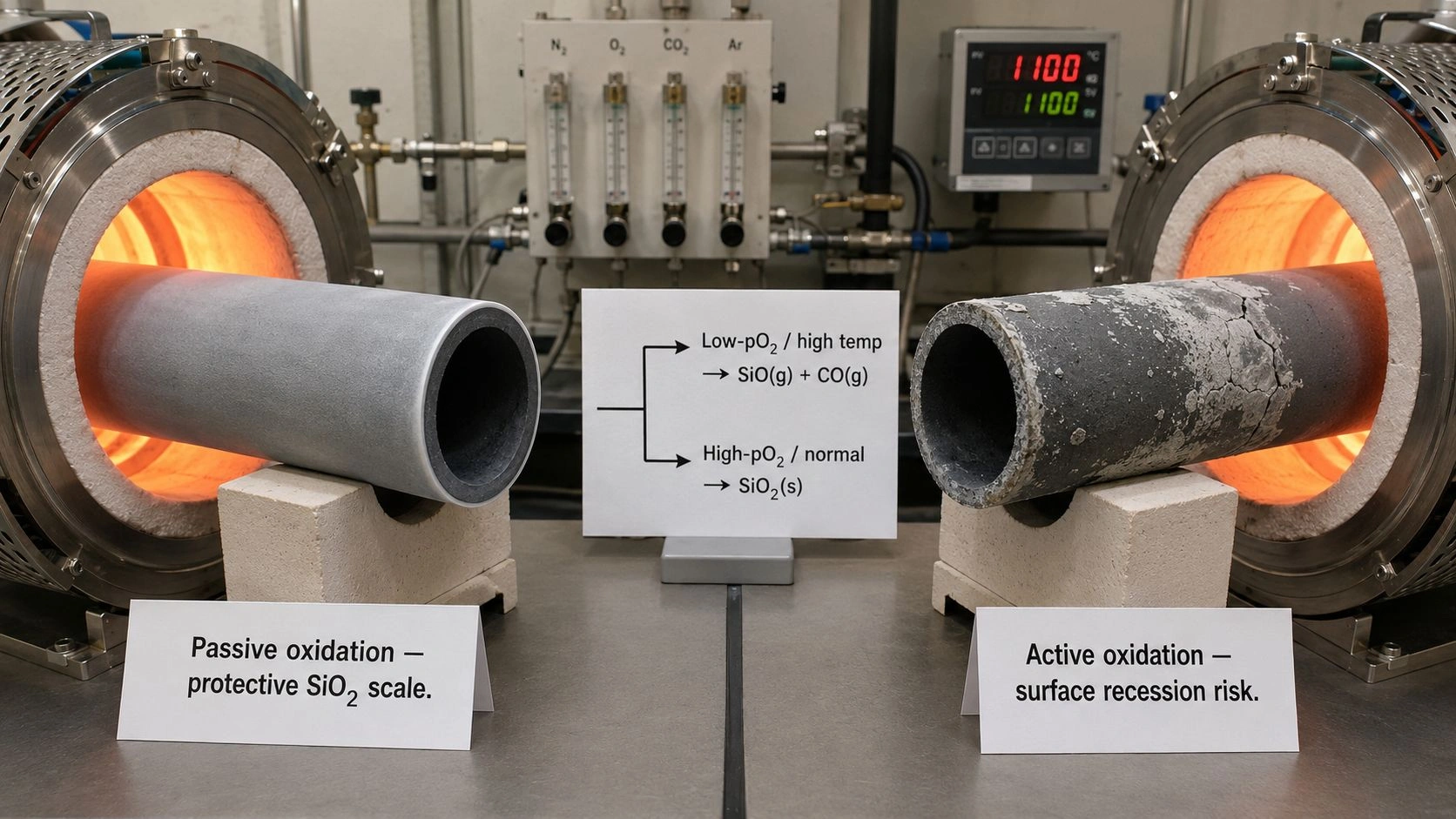
Silicon carbide oxidation at high temperature produces either a protective dense SiO₂ scale in passive oxidation — slowing further oxygen ingress — or volatile SiO and CO in active oxidation that can accelerate material recession; the operating atmosphere, oxygen partial pressure, water vapor, and gas flow together determine which regime applies.
What actually happens when silicon carbide oxidizes at high temperature?
Silicon carbide does not remain chemically unchanged in high-temperature oxygen-containing atmospheres. Its response depends on which surface reaction pathway dominates under the specific operating conditions.
[CITE: NASA Technical Reports Server documentation on active oxidation of SiC confirms that passive oxidation of SiC forms a protective oxide film — primarily silicon dioxide — while active oxidation forms volatile silicon monoxide and carbon monoxide, leading to more extensive SiC recession, with the mode that dominates depending on the temperature and oxygen potential of the surrounding atmosphere.]
Passive oxidation: SiO₂ scale as diffusion barrier. In passive oxidation, silicon carbide reacts with oxygen at the surface to form silicon dioxide. The resulting SiO₂ layer grows between the ceramic body and the oxidizing atmosphere, and once it reaches sufficient thickness and density, it limits the rate at which additional oxygen can diffuse inward to react with fresh SiC. The oxidation rate progressively slows as the scale thickens — a behavior described as parabolic or sub-parabolic kinetics — and the component can remain dimensionally stable over long exposure periods in the right atmosphere. A visible surface change from the original SiC color toward a white or glassy appearance is often associated with passive oxidation scale formation.
Active oxidation: volatile SiO and CO formation. In active oxidation, the reaction at the SiC surface produces silicon monoxide gas and carbon monoxide gas rather than a solid silica layer. Because both reaction products are gaseous under these conditions, they leave the surface without forming a protective barrier. This means each reaction event exposes fresh SiC to the atmosphere, and material is progressively consumed from the surface inward. Active oxidation can cause surface recession and dimensional loss at rates substantially higher than passive oxidation conditions would produce.
Why oxidation resistance does not mean oxidation-free operation. Many engineers interpret ""oxidation-resistant"" as meaning that SiC does not change in oxidizing service. The more precise interpretation is that SiC's oxidation rate in passive-regime conditions is much lower than many metals or less-stable ceramics, and that the surface silica layer can provide effective protection over long service periods. The practical engineering task is to confirm that the application keeps SiC in that protective passive regime.
When is SiC oxidation protective, and when does it become material loss?
Understanding which regime applies is the first engineering judgment in specifying SiC for high-temperature oxidizing service.
Dense SiO₂ layer: acceptable passive oxidation. When the surface oxide forms as a dense, continuous, adherent layer without large pores or cracks, it acts as the intended diffusion barrier. Under these conditions, the oxide layer is not a defect — it is the protection mechanism. Published research on bulk SiC oxidation at 1000–1400°C in argon-water vapor-air atmospheres found parabolic oxide thickness growth characteristic of diffusion-limited passive oxidation, with dense and uniform oxide layers forming below approximately 1200°C.
Cracked or porous oxide: warning sign. The same OSTI-reported research found that pores and cracks appeared in the oxide layer at temperatures above 1200°C in those atmosphere conditions. Once the oxide is no longer continuous, it cannot maintain its diffusion barrier function. Oxygen can penetrate through discontinuities in the scale and reach fresh SiC at rates far higher than the parabolic passive-oxidation model would predict. A cracked or porous silica scale is therefore not simply a cosmetic change — it signals that the protection mechanism is compromised.
Mass gain vs mass loss. A practical way to evaluate oxidation regime in service is through mass change. Passive oxidation typically produces a small mass gain as the SiO₂ layer accumulates on the component surface. Active oxidation, where gaseous products leave the surface, may produce mass loss or a mixed signal depending on whether any oxide remains. In water-vapor-influenced environments, the same surface can show a complex combination where oxide grows in some regions and volatilizes in others.
How temperature, oxygen partial pressure, and water vapor change SiC oxidation mode
After understanding the two oxidation modes, the key engineering task is to map the operating atmosphere to the applicable regime.
[CITE: NASA Technical Reports Server data on the active-to-passive transition in SiC oxidation reports experimentally observed transition temperatures ranging from 1347°C to 1543°C for oxygen partial pressures ranging from 2.5 to 123.2 Pa — confirming that the mode boundary is not a single fixed temperature but a function of both temperature and oxygen pressure — and OSTI-reported Corrosion Science research on bulk SiC at 1000–1400°C in Ar-H₂O-air atmospheres confirms parabolic oxide growth with dense uniform layers below approximately 1200°C and pores and cracks appearing at higher temperatures in those water-vapor-containing conditions.]
Temperature: accelerates diffusion and changes oxide stability. Higher temperature accelerates all oxidation reactions, but it also changes the structural properties of the SiO₂ scale itself. At very high temperatures, silica can soften, crystallize, or react with other species in the atmosphere. The temperature boundary between protective and non-protective behavior is not a single material constant — it depends on the other atmospheric variables simultaneously.
Oxygen partial pressure: controls passive/active transition. A lower oxygen partial pressure at the surface moves the thermodynamic balance toward active oxidation products. The reported transition from passive to active oxidation behavior for SiC spans a range of temperatures and pressures, which means a component operating near the transition boundary under one set of conditions may shift regime with small changes in atmosphere composition or temperature. For practical engineering, this means treating ""low-oxygen,"" ""reducing,"" or ""partial-pressure-controlled"" atmospheres as requiring separate review from standard air.
Water vapor: can increase silica scale instability. Water vapor is a particularly important atmosphere variable for SiC oxidation because silicon dioxide can react with steam to form volatile silica hydroxide species. This reaction reduces the stability of the protective scale in steam-containing atmospheres compared with dry oxidizing conditions. MIT CANES research on SiC oxidation in steam in the context of nuclear fuel cladding confirms that SiC oxidation rates in these conditions are far slower than comparable zirconium alloy oxidation, but it also treats steam as a distinct and more challenging atmosphere than dry air. The engineering takeaway is that wet combustion gas, high-pressure steam, or humid kiln atmospheres are not equivalent to dry oxidizing conditions and need to be specified separately.
Gas velocity: affects volatilization and scale removal. In high-velocity gas streams, silica hydroxide species formed at the surface can be swept away more rapidly than in slow or static atmospheres, reducing the effective protective scale thickness. This means that SiC components in flowing steam or high-velocity combustion gas environments may need a higher safety margin than components in static furnace atmospheres at the same nominal temperature.
How to avoid misdiagnosing SiC oxidation as thermal shock, corrosion, or wear
Surface changes in high-temperature SiC service are often correctly attributed to thermal shock, chemical corrosion, or mechanical wear when oxidation — or an interaction between oxidation and these other mechanisms — is the actual driver. Correct identification is important because the specification change required for thermal shock cracking, chemical attack, or oxidation scale damage is different in each case.
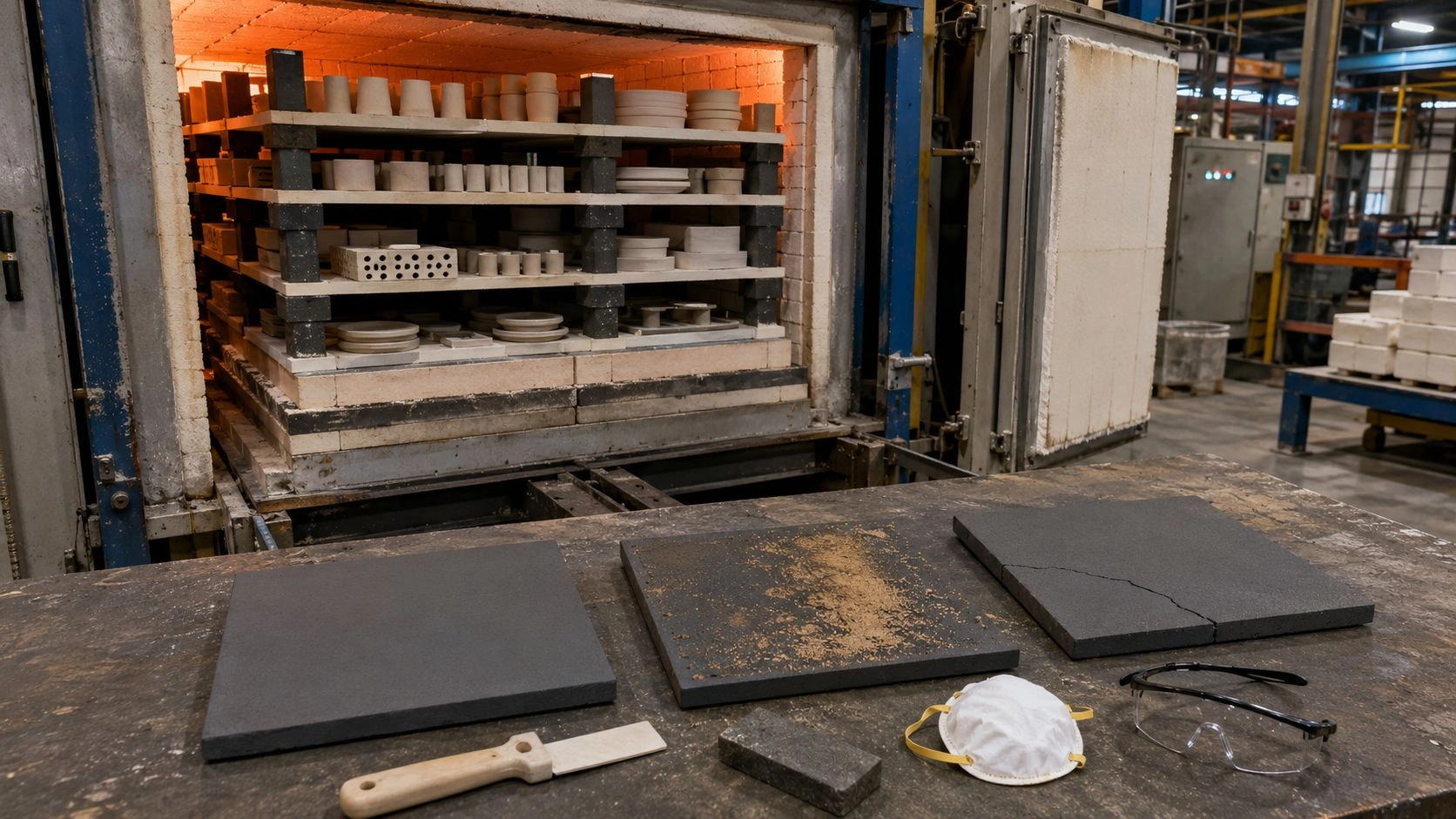
Oxidation vs thermal shock. A cracked or spalled surface layer on SiC can result from thermal shock — where rapid temperature change creates tensile stress in the ceramic — or from oxidation scale growth and subsequent scale cracking. The distinguishing evidence is in the crack pattern and location: thermal shock cracks typically penetrate the SiC body, while oxidation scale cracks are often confined to a thin surface layer with the ceramic body remaining intact. Atmosphere history and thermal cycle records are needed to separate the two causes.
Oxidation vs chemical corrosion. Surface attack by alkali vapors, reactive process gases, or fluxes can produce visual changes similar to oxidation scale formation. The difference is that chemical corrosion produces reaction products specific to the attacking species, while passive oxidation produces primarily silicon dioxide. Surface composition analysis — even simple visual examination of the deposit color and solubility — can help distinguish the two modes. In kiln applications, glaze vapors or flux species can sometimes interact with the existing silica scale rather than attacking the SiC directly.
Oxidation vs mechanical wear. Surface recession and dimensional loss can come from abrasive wear, particle erosion, or active oxidation. The diagnostic indicator for oxidation-driven recession is typically a combination of the atmosphere composition, temperature level, and surface morphology. Active oxidation recession tends to produce a smoother, more uniform surface loss than mechanical wear, which often leaves directional scratches, impact pits, or localized thinning corresponding to high-contact zones.
The SiC Oxidation Mode Matrix maps the four regime types:
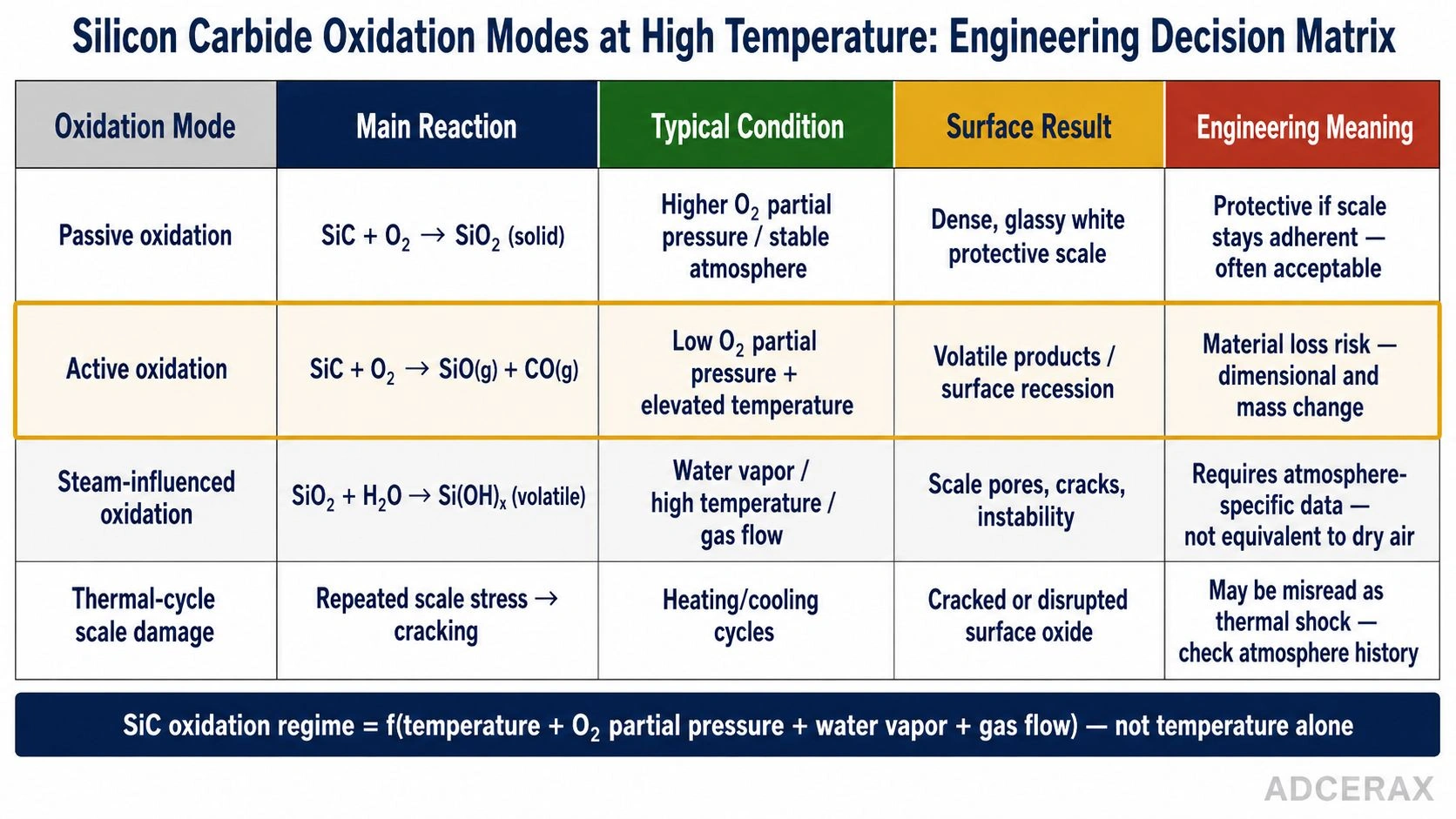
SiC oxidation behavior should be evaluated by oxidation mode rather than temperature alone: passive oxidation can form a protective SiO₂ scale, while active oxidation, steam-influenced oxidation, and thermal-cycle scale damage create different risks for surface recession, scale instability, or misdiagnosed cracking.
| Oxidation mode | Main reaction behavior | Typical condition driver | Surface result | Engineering meaning |
|---|---|---|---|---|
| Passive oxidation | SiO₂ scale formation | Higher oxygen potential, stable oxidizing atmosphere | Dense oxide barrier | Often protective if adherent and continuous |
| Active oxidation | Volatile SiO + CO formation | Lower oxygen potential and elevated temperature | Faster material recession | Higher risk for wall loss or dimensional change |
| Steam-influenced oxidation | Oxide growth plus possible silica volatility | Water vapor, high temperature, gas flow | Scale instability, pores, cracks | Requires atmosphere-specific data |
| Thermal-cycle scale damage | Repeated oxide stress and disruption | Heating/cooling cycles | Cracked or disrupted scale | May be misread as thermal shock |
Values indicative; verify per applicable high-temperature oxidation/TGA test plan with supplier-specific data.
What engineers should ask before specifying SiC for high-temperature oxidizing service
The practical specification for high-temperature SiC service should go well beyond a maximum temperature number. Atmosphere, thermal cycle, and component geometry all determine which oxidation regime applies and whether the service life target can be met.
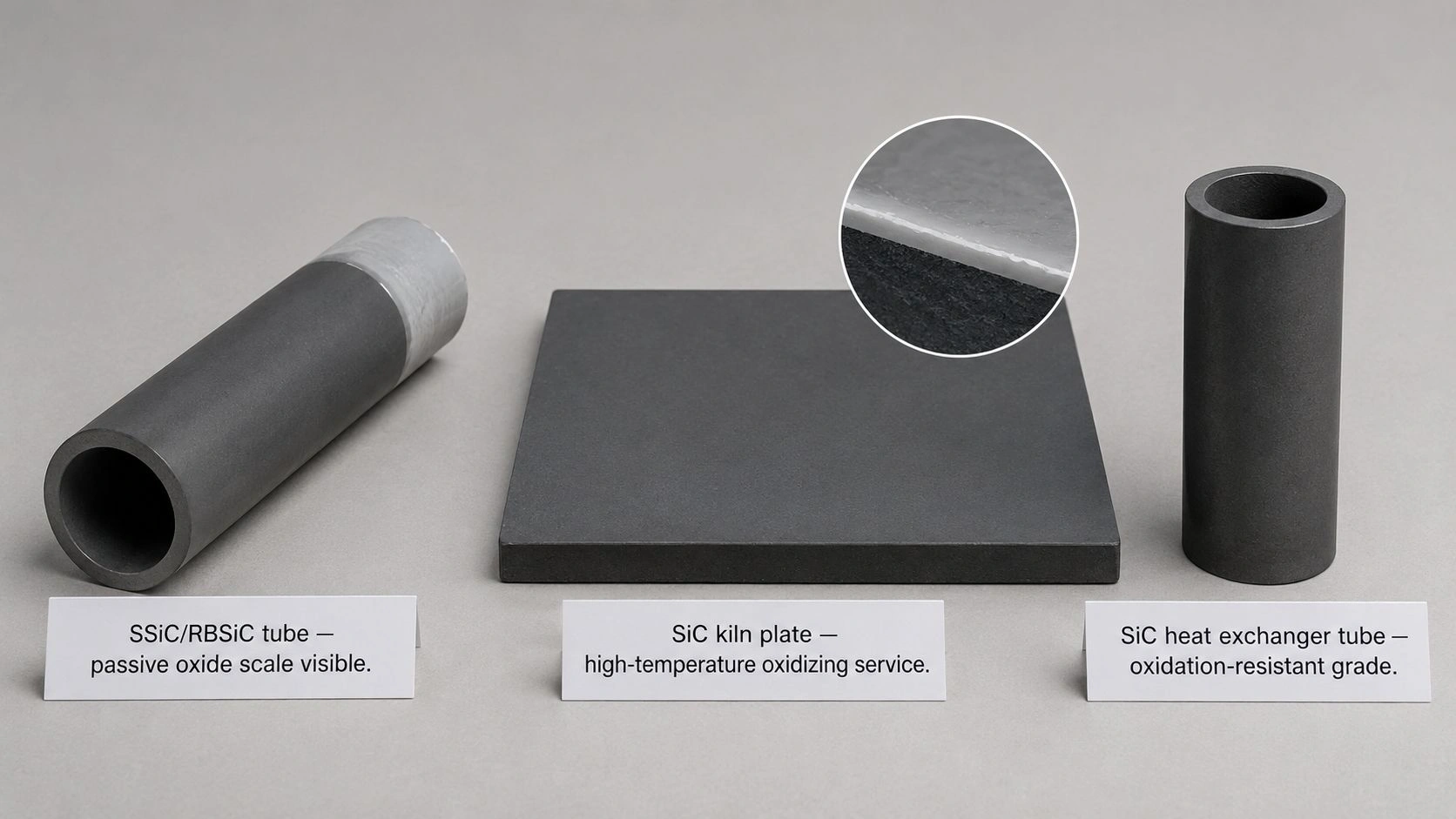
SiC components used in oxidizing high-temperature service — including tubes, kiln plates, and heat exchanger tubes — should be specified by grade, density, porosity, atmosphere, water vapor exposure, gas flow, geometry, and expected oxide-scale behavior rather than by maximum temperature alone.
The RFQ Data Checklist maps the required information:
| RFQ item | Why it matters | Supplier evidence to request |
|---|---|---|
| Operating temperature range | Oxidation kinetics are temperature-sensitive | Continuous and peak temperature limits |
| Atmosphere composition | Oxygen potential controls active/passive tendency | O₂, H₂O, combustion gas, reducing gas details |
| Steam/water vapor exposure | Can change silica scale stability | Prior application data or oxidation test data |
| Gas velocity | May affect volatilization and scale removal | Flow-rate assumptions |
| SiC grade | Density, free silicon, bonding phase, porosity affect behavior | SSiC/RBSiC/NBSiC grade confirmation |
| Geometry | Thin walls and sharp edges can amplify risk | Drawing review and tolerance confirmation |
| Inspection interval | Oxidation may be gradual before functional failure | Suggested inspection method and interval |
The key supplier question is not ""Can this SiC grade handle this temperature?"" A more useful question is: ""Will this SiC grade remain in passive oxidation conditions under my actual atmosphere, cycle, and gas flow — and what is the expected oxide scale behavior at my peak temperature?""
The silicon carbide tube page covers SSiC and RBSiC tube grades for kiln roller and heat exchanger applications in thermal and corrosive environments. The silicon carbide tubes and heat exchange components category provides the product routing for atmosphere-exposed SiC components. For comparison with alumina or zirconia tube options in less severe oxidizing conditions, the ceramic tubes and pipes page provides the broader ceramic tube context.
Specifying SiC for high-temperature oxidizing service? Share your operating temperature range, atmosphere composition, water vapor or steam exposure, gas flow, thermal cycling frequency, component drawing, SiC grade preference, and target service life. ADCERAX can review whether the grade and geometry are appropriate for the expected oxidation regime and confirm available oxidation data.
Frequently Asked Questions
Does silicon carbide oxidize at high temperature?
Yes. Silicon carbide oxidizes at high temperature, but the result depends on atmosphere. In passive oxidation, SiC forms a protective SiO₂ layer. In active oxidation, volatile SiO and CO form, increasing recession risk. NASA technical documentation confirms that the mode depends on both temperature and oxygen potential.
Is SiC oxidation always harmful?
No. A dense, adherent SiO₂ scale can protect SiC by slowing oxygen diffusion into the ceramic body. Oxidation becomes problematic when the scale cracks, becomes porous, volatilizes in steam-containing conditions, or is repeatedly disrupted by thermal cycling.
What is passive oxidation of SiC?
Passive oxidation is the formation of a protective silica layer on the SiC surface. This layer reduces further oxidation by acting as a diffusion barrier between the oxidizing atmosphere and the ceramic body.
What is active oxidation of SiC?
Active oxidation occurs when SiC forms volatile oxide species — primarily silicon monoxide along with carbon monoxide — which leave the surface without forming a protective barrier. NASA documentation describes active oxidation as producing more extensive SiC recession than passive film formation.
Does water vapor make SiC oxidation worse?
Water vapor can interact with the silica scale to form volatile silica hydroxide species, potentially reducing scale stability compared with dry oxidizing conditions. Engineering specification should treat steam and water-vapor-containing atmospheres as distinct from dry air rather than equivalent.
What should be included in an RFQ for SiC parts in oxidizing high-temperature service?
Include operating temperature, atmosphere composition, water vapor exposure, gas flow, thermal cycling frequency, expected service life, component geometry, SiC grade, density and porosity expectations, and any required oxidation test or post-exposure strength data from the supplier.
"