Silicon carbide kiln rollers are used in battery cathode roller hearth kilns because they combine high-temperature strength, low deflection under sagger loading, thermal shock resistance, chemical resistance to lithium-containing atmospheres, and dimensional stability across long continuous production runs. In cathode active material (CAM) calcination, rollers must carry ceramic saggers loaded with lithium-transition metal precursor powders through multiple heating zones while maintaining straightness and smooth rotation. Correct roller selection requires defining cathode chemistry, kiln temperature, atmosphere, roller span, diameter, wall thickness, load per roller, acceptable deflection limit, SiC grade, end interface design, and replacement strategy before ordering.
The SiC kiln rollers at ADCERAX — available in RBSiC and SiSiC grades for continuous roller hearth kiln operation, with straightness retention, thermal cycling stability, alkali resistance, and battery cathode calcination as specific application areas — provide the product context for the selection decisions described in this guide.
SiC kiln rollers for battery cathode roller hearth kilns must combine high-temperature flexural strength to resist sagger-load bending, straightness retention across long spans, and chemical resistance to lithium and alkali vapors — correct selection requires load calculation, span geometry, atmosphere chemistry, and material grade confirmation before ordering.
Why are SiC kiln rollers used in battery cathode roller hearth kilns?
Battery cathode roller hearth kilns impose a combination of demanding conditions that few ceramic roller materials can sustain simultaneously: long high-temperature operating cycles with heavy ceramic sagger loads, chemical exposure to lithium-containing vapors, thermal cycling during start-up and shut-down, and a precision transport requirement where roller straightness directly affects sagger tracking and heating uniformity.
[CITE: GlobalSpec and Saint-Gobain's published article on SiC rollers for cathode active material manufacturing confirms that in CAM calcination, saggers filled with lithium-transition metal precursors are transported through multiple heating zones on rotating rollers where reactions, diffusion, homogenization, and crystallization occur — and confirms that production trends toward higher RHK capacity, faster cycle times, wider kilns, and greater material throughput are increasing the sagger load and mechanical stress on ceramic rollers — while Saint-Gobain's published CAM production page explicitly states that SiC rollers are engineered to endure cyclical sagger loading at elevated temperatures in corrosive kiln environments and to maintain roller lifespan with minimal deflection, warning that improper material selection or construction can lead to roller failure, sagger misalignment, damage, and kiln downtime.]
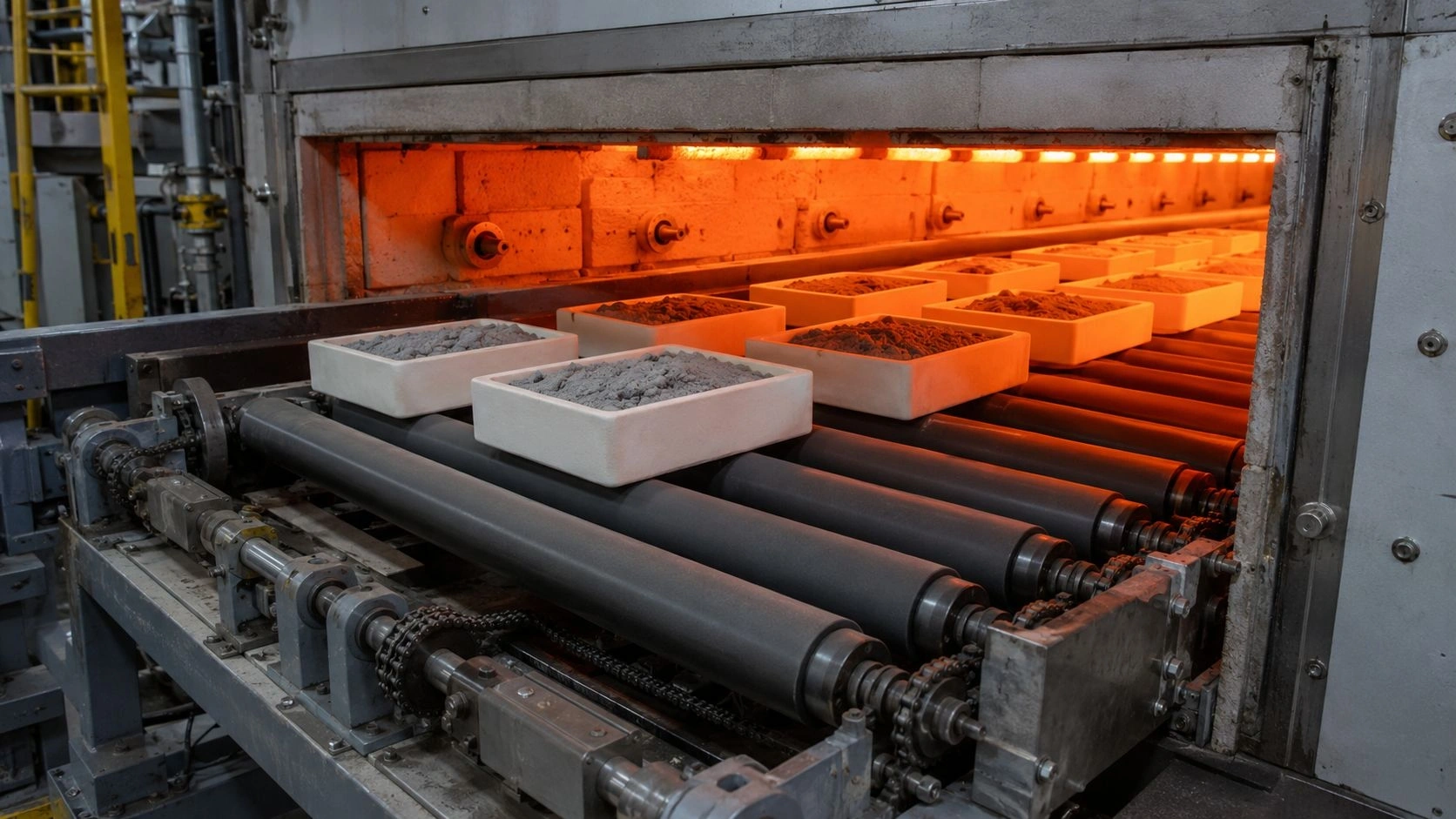
SiC rollers support saggers through continuous CAM calcination. A roller hearth kiln for CAM production operates as a continuous conveyor: saggers loaded with cathode precursor powder enter at one end, traverse through preheat, firing, and controlled-atmosphere zones, and exit as calcined cathode product. The rollers that carry the saggers are exposed continuously to the full kiln temperature in the hot zone — which for many NCM, NCA, and LFP chemistries is in the range of 700°C to over 1,000°C — while rotating to advance sagger transport and sustaining the weight of the loaded saggers across their unsupported span.
Roller straightness affects sagger tracking and heating consistency. A roller that bows mid-span does not present a flat transport surface. Saggers resting on bowed rollers shift toward the low point of each bow, creating a lateral drift that accumulates across multiple rollers and eventually causes sagger misalignment, contact between adjacent saggers, inconsistent gas flow through the powder bed, and localized temperature non-uniformity in the cathode charge. These product quality effects — not only the mechanical roller failure itself — are the reason straightness tolerance under load at operating temperature is a critical specification.
High-throughput cathode lines increase roller stress. Wide kilns accommodate more saggers per row but require longer rollers with greater unsupported spans. Heavier saggers loaded with more powder per firing cycle increase the load per roller. Both factors increase the bending moment at the roller mid-span. For many high-capacity CAM lines, the roller geometry and material grade selection must be matched specifically to the production throughput target rather than treated as a generic component choice.
What operating variables control SiC roller life?
After confirming SiC is appropriate for the kiln duty, the specific operating variables that determine roller life must be quantified before grade and geometry are selected.
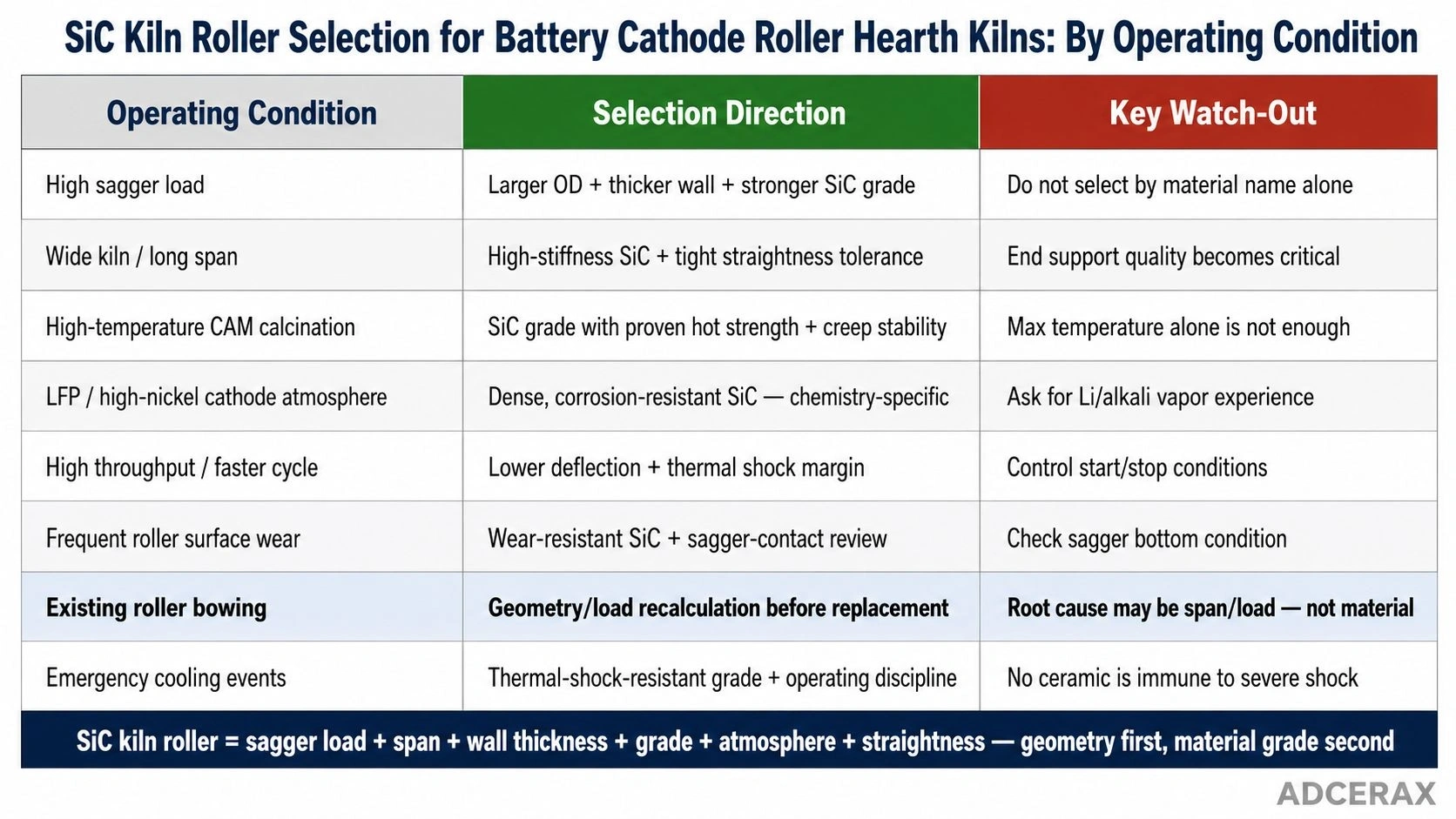
SiC kiln roller selection for battery cathode roller hearth kilns should begin with the operating condition: high sagger load, long span, CAM calcination temperature, lithium/alkali atmosphere, throughput, wear, existing bowing, and thermal-shock events all point to different geometry, grade, and support-design checks.
Roller span and diameter define bending risk. The unsupported hot span of the roller — the distance between the last support points inside the kiln — combined with the roller's outer diameter and wall thickness determines the bending stress at mid-span. For a hollow cylindrical beam under distributed load, bending stress increases rapidly with span length and decreases with outer diameter and wall thickness. Selecting a roller by OD alone, without confirming the span, sagger load distribution, and wall thickness, may result in a geometrically under-dimensioned roller even when the material grade is otherwise correct.
Wall thickness balances stiffness, thermal response, and cost. Thicker walls increase bending stiffness and reduce deflection, but also increase roller mass, thermal inertia, and cost. For kilns with rapid cycle times or frequent thermal transitions, excessively heavy rollers may create thermal-mass mismatches with sagger heating schedules. The wall thickness selection must balance mechanical stiffness requirements with the thermal characteristics of the cathode process.
Sagger weight and pitch define load per roller. Each roller in the kiln supports the portion of sagger weight spanning from the midpoint between itself and the previous roller to the midpoint between itself and the next roller. Sagger pitch — the center-to-center distance between adjacent rollers — determines how much total sagger weight sits on each roller simultaneously. Published cathode calcination analysis confirms that a multiphysics simulation approach — simultaneously solving fluid flow, heat transfer, mass transfer, chemical reaction, and oxygen concentration in the kiln cross-section — is needed to fully understand process conditions, which reinforces that the mechanical loading environment is complex and must be quantified for specific production parameters.
Atmosphere and corrosion add to the selection complexity. LFP calcination produces lithium-containing vapors in the kiln atmosphere. High-nickel NCM/NCA chemistries may require controlled oxygen atmospheres that interact differently with ceramic surfaces. Both types of atmosphere can attack roller surfaces through chemical reaction, surface roughening, or vapor deposition, depending on the SiC grade, porosity, and surface finish. Dense SiC grades generally resist corrosive atmosphere better than porous grades.
Which SiC roller grade should be selected?
After load and geometry are defined, the material grade decision can be made based on the combination of mechanical, thermal, and chemical requirements.
[CITE: Saint-Gobain's published Silit® ceramic roller product documentation describes SiSiC rollers for CAM powder calcination as providing mechanical strength, thermal stability, heat resistance, and chemical resistance for supporting and transporting sagger-contained cathode material through the furnace — and Saint-Gobain's Silit® roller product page specifically lists dense material, excellent chemical resistance, excellent wear resistance, available lengths up to 3,700 mm, minimized deflection, and application in roller hearth furnaces for lithium-ion powder mixes as the defining properties — while IPS Ceramics' published SiC roller technical page confirms that SiSiC/RBSiC, nitride-bonded SiC, and recrystallized SiC roller materials have clearly different typical maximum use temperatures, densities, porosities, strengths, and thermal conductivities, establishing that grade selection must be based on the specific combination of load, temperature, atmosphere, and cost requirements.]
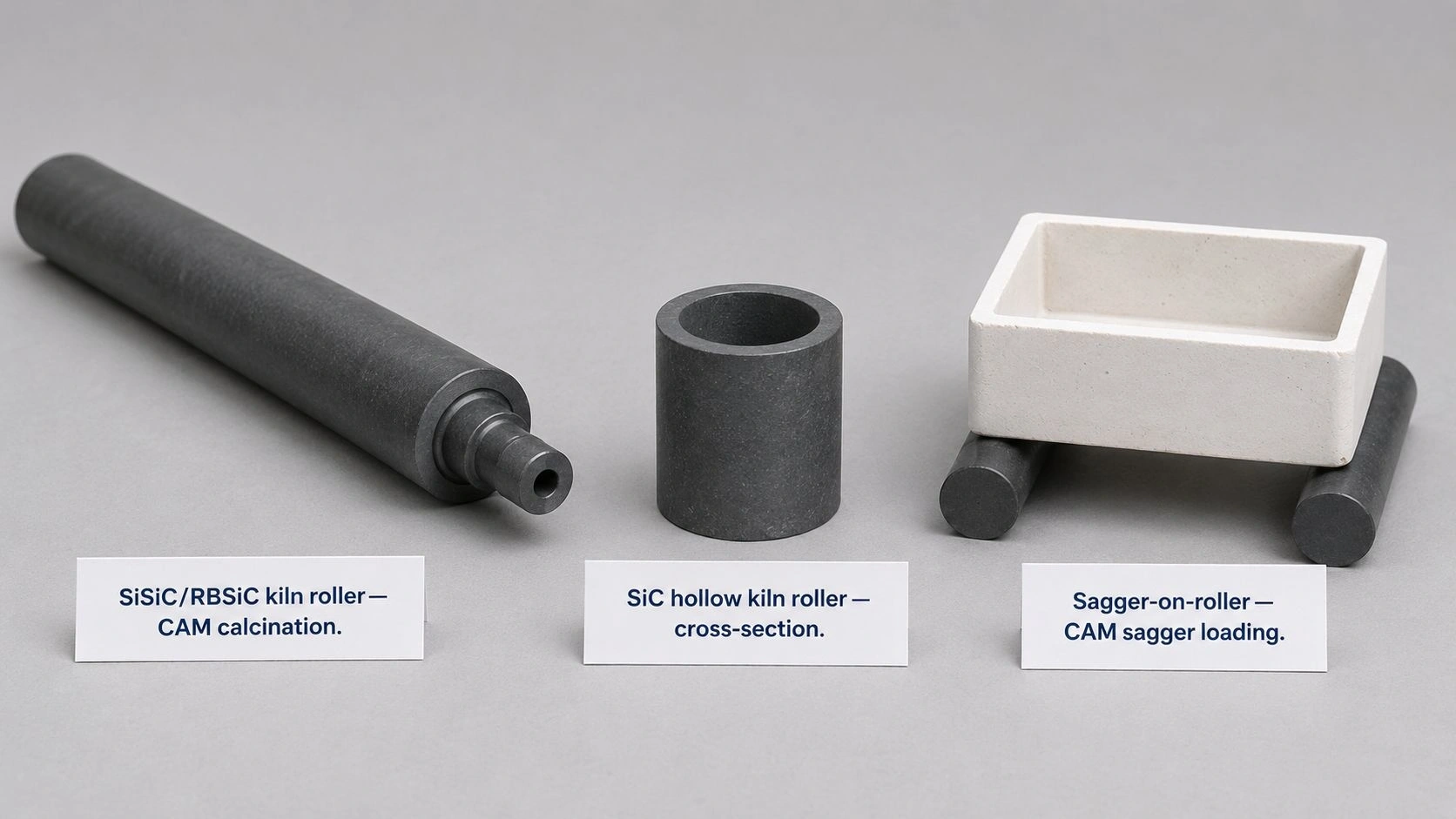
A SiC kiln roller specification must define OD, ID, wall thickness, hot span, end interface, and sagger loading condition; hollow cross-section geometry and sagger-on-roller contact determine deflection risk as much as the SiC grade itself.
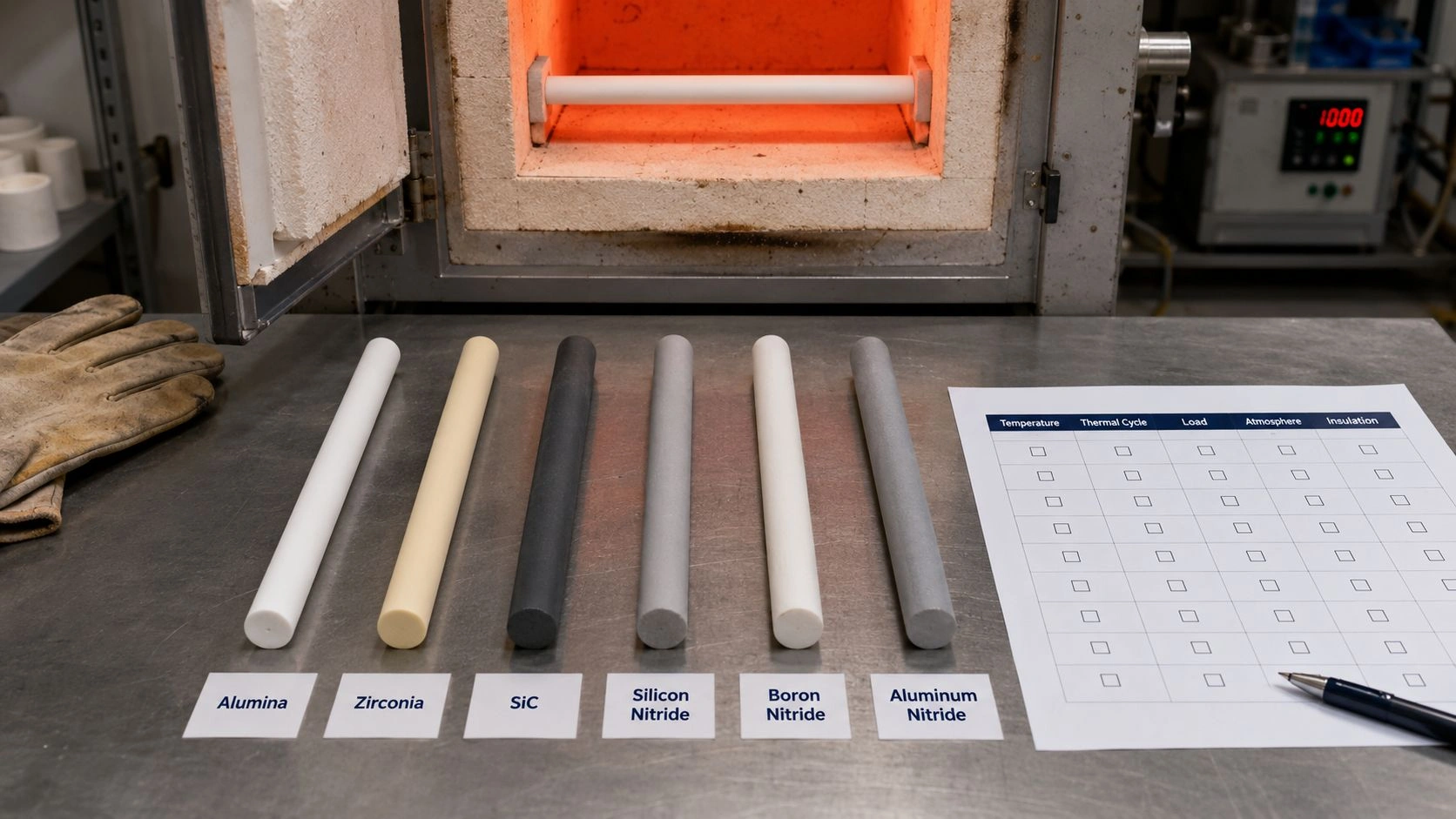
The SiC Roller Grade Comparison table maps the main options:
| Roller material family | Best fit | Main advantage | Main limitation |
|---|---|---|---|
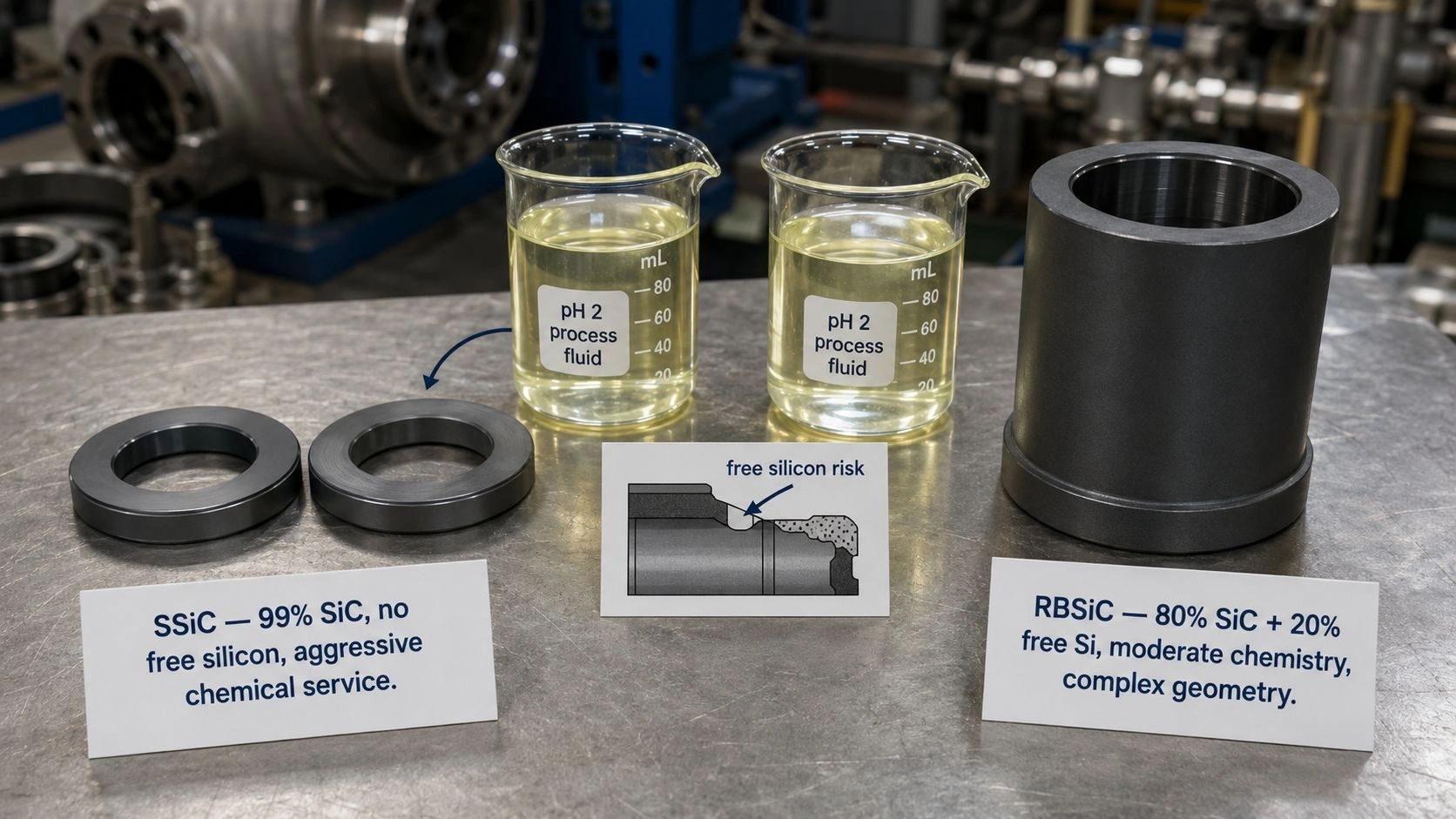
| SiSiC/RBSiC | High-strength roller hearth kiln rollers, dense structure, controlled deflection | High strength, low porosity, good thermal conductivity and chemical resistance | Residual silicon phase must be checked for specific chemistry |
| Dense sintered SiC | Severe-duty high-temperature and corrosion-resistant applications | Strong oxidation/corrosion resistance and mechanical reliability | Higher cost and supplier-specific availability |
| RSiC | High-temperature structural kiln components where porosity is acceptable | High service-temperature potential | Lower strength and higher porosity in many grades |
| NSiC/nitride-bonded SiC | Selected kiln roller duties where supplier data matches load and atmosphere | Good thermal-shock and high-temperature behavior in some systems | Porosity and chemical compatibility must be validated |
| Mullite/oxide rollers | Lower temperature or lower-load kiln zones | Lower cost and broad use | May deflect, wear, or corrode faster in severe CAM duty |
SiSiC/RBSiC for high strength, dense structure, and controlled deflection. For most battery cathode roller hearth kilns in the 700–1,100°C temperature range with significant sagger loading, SiSiC or RBSiC is the first grade to evaluate. The dense, low-porosity structure provides higher flexural strength than porous grades, better resistance to chemical attack by lithium-containing vapors, and lower creep under sustained high-temperature loading than many oxide ceramics. Therser UK's published battery material kiln article confirms that roller kilns use ceramic or silicon carbide rollers to convey saggers through the kiln, noting energy efficiency advantages over kiln-car systems.
Grade selection based on actual duty, not maximum temperature alone. The maximum temperature specification on a roller datasheet is not the selection criterion. A grade with a higher maximum temperature but lower room-temperature or hot flexural strength, or higher porosity, may perform worse in a high-load, long-span battery cathode kiln than a grade with a lower maximum temperature but superior strength and density. The selection matrix should be built from the actual sagger load, span, atmosphere, corrosion risk, and acceptable deflection — not from temperature specification alone.
The silicon carbide ceramics material hub at ADCERAX covers RBSiC, SSiC, and custom SiC component grades with property data. The custom ceramic parts page supports drawing-based roller orders with non-standard OD, length, or end interface requirements.
What failure modes occur when SiC kiln rollers are mis-specified?
Many SiC kiln roller failures in cathode production lines are system failures — roller geometry, loading, end support, or atmosphere management problems — rather than material quality failures.
Bowing and deflection from span and load mismatch. A roller that bows mid-span under sagger loading is not necessarily a defective roller — it may be a correctly manufactured roller installed in a span/load combination that exceeds its bending strength design. Roller bowing is the most common field complaint in high-throughput cathode kilns and is almost always accompanied by span, sagger load, or roller pitch parameters that exceed the roller's deflection limit for the operating temperature.
Corrosion and surface roughening from kiln atmosphere. Lithium-salt vapors, alkali species released during high-temperature calcination, and oxygen partial pressure variations can attack less-dense or less-chemically-stable roller surfaces over time. Surface roughening from chemical attack degrades sagger transport smoothness, increases mechanical contact stress between sagger bottoms and roller surfaces, and can introduce surface contamination into the cathode powder in worst-case scenarios.
Thermal shock from startup, shutdown, or emergency cooling. All ceramic materials are brittle and susceptible to fracture when subjected to rapid temperature change. SiC's inherent thermal conductivity and low thermal expansion make it more resistant to thermal shock than many oxide ceramics, but emergency cooling events, kiln upset conditions, or too-rapid startup heating programs can still crack rollers. Roller grade selection and kiln operating discipline must both account for thermal shock risk.
The Failure Diagnosis Matrix maps common field failure patterns:
| Observed problem | Common wrong diagnosis | Better engineering question |
|---|---|---|
| Roller bows at mid-span | ""SiC material is weak"" | Is span, OD, wall thickness, and sagger load within deflection limits? |
| Sagger tracking becomes unstable | ""Drive speed issue only"" | Is roller straightness or surface wear causing drift? |
| Roller cracks near end | ""Bad roller batch"" | Was bearing alignment, end support, or drive interface overstressed? |
| Surface roughens quickly | ""Need harder roller"" | Is lithium/alkali vapor or powder contamination attacking the surface? |
| Emergency kiln stop after roller break | ""Use thicker roller only"" | Was thermal shock, overload, support mismatch, or prior microcracking involved? |
| Product heating becomes uneven | ""Kiln temperature control problem"" | Are roller straightness and sagger contact creating transport instability? |
| Frequent replacement | ""SiC is not suitable"" | Is the selected SiC grade matched to CAM chemistry and load? |
What RFQ data should be sent for SiC kiln rollers in battery cathode lines?
The RFQ Checklist for SiC Kiln Rollers maps the required specification fields:
| Parameter | Why it matters | Required? |
|---|---|---|
| Cathode material type | LFP, NCM, NCA, LMFP affect atmosphere and corrosion | Yes |
| Kiln type/zone | New kiln, replacement, hot zone, preheat zone, cooling zone | Yes |
| Operating temperature | Confirms grade and thermal margin | Yes |
| Atmosphere | Air, oxygen, inert, moisture, lithium/alkali vapor | Yes |
| Roller OD/ID | Controls stiffness and fit | Yes |
| Total length/hot span | Controls bending and deflection | Yes |
| Wall thickness | Balances strength, heat transfer, weight, and cost | Yes |
| Roller pitch | Defines load sharing | Yes |
| Sagger size/weight | Determines load per roller | Yes |
| End design | Controls drive and bearing interface | Yes |
| Straightness tolerance | Critical for transport stability | Yes |
| Current failure mode | Guides grade and geometry correction | If replacement |
| Target lifetime | Helps supplier optimize grade and cost | Recommended |
| Quantity/packaging | Important for long, fragile ceramic parts | Yes |
For replacement orders, send photos of the failed roller — showing bend location, crack pattern, surface condition, and end interface — along with the old roller drawing and failure history. This is the most efficient path to confirming whether the replacement needs the same geometry and grade or a corrected specification.
Selecting SiC kiln rollers for a battery cathode roller hearth kiln? Share your cathode type, kiln temperature, atmosphere, roller OD/ID/wall thickness/length, hot span, roller pitch, sagger size and weight, end interface design, straightness tolerance, current failure mode, and quantity. ADCERAX can review whether RBSiC or SiSiC grade rollers in the required geometry fit the operating envelope and propose a specification with material data and straightness confirmation.
Frequently Asked Questions
Why are SiC kiln rollers used in battery cathode production?
SiC rollers are used because CAM roller hearth kilns require rollers that combine high-temperature flexural strength, low mid-span deflection under sagger loading, thermal shock resistance, and resistance to lithium-containing and alkali-rich kiln atmospheres. In RHK CAM calcination, saggers with lithium-transition metal precursors are transported through furnace zones on rotating rollers — any roller that bows, roughens, or fractures during this process directly affects sagger alignment, heating uniformity, and product quality.
What causes SiC kiln rollers to bend or sag?
Common causes include excessive roller span for the OD and wall thickness selected, too high a sagger load per roller, too wide a roller pitch, high-temperature creep that exceeds the material's hot strength, poor end support alignment, or a roller grade with insufficient hot modulus for the operating temperature. Bowing is almost always a geometry-plus-load problem rather than a pure material failure.
Which SiC roller grade is best for battery cathode kilns?
There is no universal answer. SiSiC/RBSiC is evaluated first for most high-load battery cathode roller hearth kilns because of its dense structure, high flexural strength, and chemical resistance. Dense sintered SiC may be preferred for the most severe corrosion conditions. RSiC and NSiC have different temperature and porosity profiles that may fit specific duty conditions. Grade selection requires comparing load, span, temperature, atmosphere, and cost — IPS Ceramics documents clear property differences among SiSiC/RBSiC, NSiC, and RSiC for this comparison.
How does cathode material chemistry affect roller selection?
LFP calcination produces lithium-containing vapors. High-nickel NCM/NCA requires controlled oxygen atmospheres. Both environments can attack roller surfaces through chemical reaction, vapor deposition, or selective corrosion of roller surface phases. Dense, low-porosity SiC grades generally resist these atmospheric interactions better than porous grades. The specific cathode chemistry should be confirmed with the roller supplier before grade finalization.
What is the most common mistake when ordering SiC kiln rollers?
Ordering by OD, length, and material name only, without providing load per roller, hot span, wall thickness, atmosphere type, straightness tolerance, and end interface design. A roller that is correctly manufactured in the ordered OD and length but installed in a span/load combination beyond its deflection limit will bow regardless of material grade.
What information should be sent for a SiC kiln roller RFQ?
Send roller drawing with OD, ID, wall thickness, total length, hot-zone span, and end interface dimensions. Also send kiln operating temperature, atmosphere type, cathode material type, sagger outer dimensions and weight, roller pitch, straightness tolerance required, quantity, and packaging requirement. For replacement projects, add photos and failure description of the current rollers.
"