Define furnace atmospheres by their effect on the heated material, then specify the gas, impurities, temperature stages, and control evidence.
Oxidizing, reducing, and inert furnace atmospheres describe how a gas environment influences reactions at the process temperature. An oxidizing atmosphere supplies oxidizing potential; a reducing atmosphere favors removal or prevention of selected oxides; an inert atmosphere is intended to limit chemical reaction. These labels are not determined by a cylinder name alone. Gas composition, residual oxygen and moisture, temperature, pressure, leaks, workpiece chemistry, furnace materials, and reaction products determine what the atmosphere actually does.
What Makes a Furnace Atmosphere Oxidizing, Reducing, or Inert?
A furnace atmosphere is oxidizing, reducing, or effectively inert only in relation to the material and reaction under consideration. Air, hydrogen, nitrogen, and argon are useful starting descriptions, but they do not complete the process specification. Water vapor, carbon dioxide, hydrocarbons, binder products, and furnace leakage can change the chemical condition surrounding the load. Temperature also changes equilibrium and reaction rate. Classification must therefore start with the required condition of the heated material.
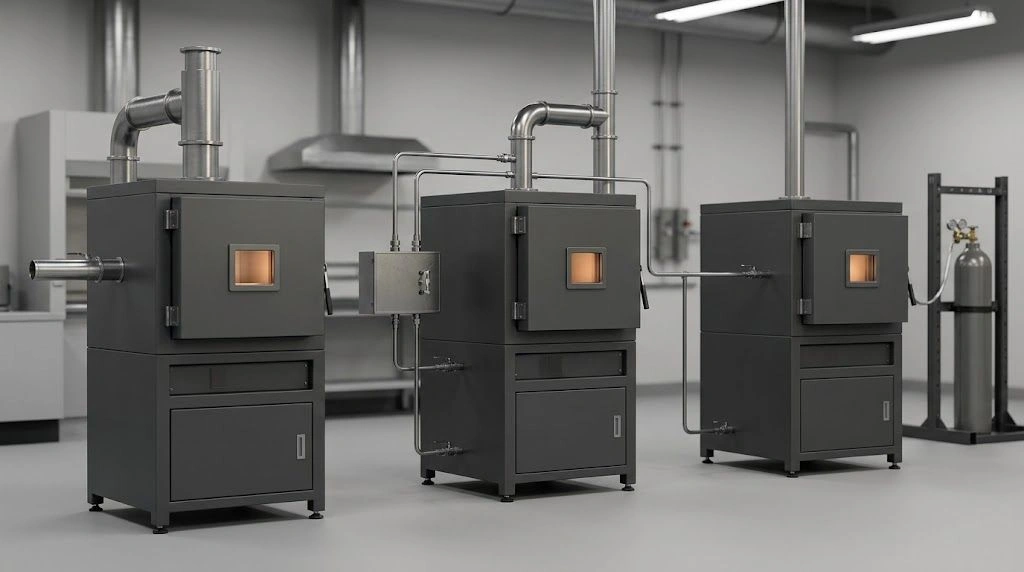
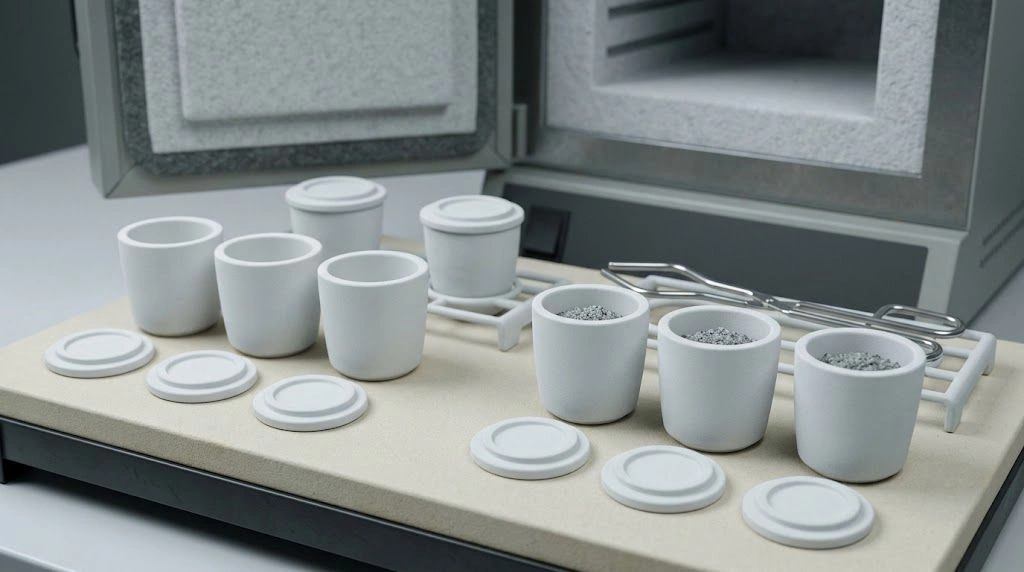
The three sealed furnace setups represent different atmosphere routes; the photograph does not establish gas composition, safety approval, or process results.
Oxidizing Potential and Surface Reactions
An oxidizing atmosphere promotes oxidation when its chemical potential is sufficient for a particular material at the operating temperature. Air and oxygen-rich mixtures are familiar examples. Water vapor and carbon dioxide may also participate in oxidation reactions under relevant conditions.
Oxidation can be intentional. Processes may use it to form an oxide, remove organic material, calcine a precursor, or establish a desired surface condition. The same atmosphere can also create excessive scale, unwanted phases, volatile oxides, contamination, or dimensional change. “Oxidizing” identifies a reaction direction; it does not define a universally acceptable oxygen level.
Reducing Potential and Gas Ratios
A reducing atmosphere favors reduction of selected oxides or maintains a sufficiently low oxidation potential for the intended material. Hydrogen-containing and carbon-monoxide-containing mixtures are common routes, but their reducing capacity depends on temperature, composition, and reaction products. The balance between hydrogen and water vapor or between carbon monoxide and carbon dioxide can be more informative than the fuel species alone.
A reducing atmosphere for one oxide may be insufficient for another. It may also alter carbon content, react with furnace components, or generate a different surface condition than intended. Process development must therefore identify the oxide or reaction being controlled and define measurable gas conditions.
Effective Inertness Is Material-Specific
An inert or protective atmosphere aims to limit reaction with the load. Argon is commonly selected where low chemical reactivity is required. Nitrogen protects many materials from oxidation, yet it can participate in nitriding or react with selected metals, ceramics, and compounds at elevated temperature.
Helium and other gas routes may also be used for particular equipment or heat-transfer needs. No gas is automatically inert toward every hot material. Effective inertness means that the actual atmosphere produces no unacceptable reaction during the specified thermal cycle.
| Atmosphere | Engineering meaning | Common routes | Typical objectives | Variables changing behavior |
|---|---|---|---|---|
| Oxidizing | Favors oxidation of the material or species considered | Air, oxygen-enriched gas, selected H₂O- or CO₂-containing conditions | Oxide formation, burnout, calcination | Temperature, oxygen potential, moisture, flow, material affinity |
| Reducing | Favors reduction of selected oxides or a low oxidation potential | H₂ mixtures, CO-containing mixtures, generated atmospheres | Oxide reduction, controlled surface chemistry | H₂/H₂O, CO/CO₂, temperature, leaks, reaction products |
| Inert or protective | Intended to minimize reaction with the load | Argon, helium, and conditionally nitrogen | Limit oxidation and contamination | Purity, oxygen, moisture, outgassing, leaks, nitrogen reactivity |
| Vacuum | Reduced total gas pressure rather than an inert-gas category | Defined vacuum range and pumping system | Reduce gas exposure, support degassing or selected thermal processes | Partial pressures, leaks, outgassing, backstreaming, evaporation |
How Should You Choose a Furnace Atmosphere?
Start with the required surface, phase, or chemical condition of the heated material. Use an oxidizing route when oxidation or organic removal is part of the process. Evaluate a reducing route when a selected oxide must be reduced or a lower oxidation potential is required. Use a protective or inert route when the objective is to limit reaction. Each preliminary choice must then be checked against temperature, impurities, outgassing, furnace compatibility, and safety requirements.
Start with the Required Process Outcome
Write down the reaction that is required and the reactions that are prohibited. “No visible scale,” “remove a specified oxide,” “burn out a binder,” “retain carbon,” and “avoid nitrogen pickup” are different objectives. They cannot be served by one default atmosphere.
Identify every material exposed in the hot zone: workpiece, powder, binder, crucible, setter, furnace tube, insulation, heating element, seal, and sensor sheath. A gas compatible with the product may still attack an element or transport contaminants from a fixture.
Match Gas Chemistry to Temperature and Material
Define the heating, soaking, and cooling stages. A mixture that is sufficiently reducing during a high-temperature soak may behave differently during heat-up or cooling. Reaction kinetics, equilibrium, condensation, and gas release also change with temperature.
Then specify gas purity, oxygen, moisture, and other relevant impurities. Dew point can help express moisture content under defined conditions, but it does not describe oxygen, hydrocarbons, carbon dioxide, nitrogen activity, or every process vapor.
Review the Complete Furnace System
Gas inlet and exhaust positions influence how the atmosphere reaches the load. Furnace pressure affects air ingress and gas release. Load size and fixture arrangement can create sheltered regions. Binders, lubricants, and adsorbed moisture may release more reactive species than the gas supply contains.
Use this decision sequence:
- Define the required material condition.
- List every exposed hot-zone material.
- Identify required and prohibited reactions.
- Define ramp, soak, and cooling conditions.
- Select a preliminary gas or vacuum route.
- Set measurable impurity and pressure requirements.
- Review outgassing, circulation, and exhaust.
- Confirm component and furnace compatibility.
- Complete the applicable equipment and site safety review.
- Establish qualification and monitoring evidence.
| Required outcome | Starting route | Questions before selection |
|---|---|---|
| Form or maintain an oxide | Oxidizing | Which oxide, thickness, or phase is required? Could excessive oxidation occur? |
| Remove a selected oxide | Reducing | Is reduction feasible at temperature? Which gas balance is required? |
| Prevent scale on a metal | Protective or reducing | Is the requirement appearance, chemistry, carbon control, or dimensions? |
| Burn out binder or organics | Controlled oxidizing process | Which gases evolve? Can rapid oxidation create soot, pressure, or gradients? |
| Avoid reaction during ceramic sintering | Route based on ceramic chemistry | Can nitrogen, carbon, oxygen, or hydrogen change stoichiometry? |
| Protect an oxidation-sensitive powder | High-integrity protective gas or vacuum | What residual oxygen and moisture can be tolerated at temperature? |
| Control carbon activity | Engineered reactive atmosphere | Which carbon potential and gas chemistry are required? |
Reducing, hydrogen-bearing, carbon-monoxide-bearing, combustible, toxic, and oxygen-deficient atmospheres require qualified equipment and safety review. ISO 13577-3:2016 addresses safety requirements for generating and using protective and reactive atmosphere gases in industrial thermoprocessing equipment. The version remains published but is marked for revision. In US projects, the applicable edition of NFPA 86 and site requirements should be established by the responsible furnace and safety specialists.
Why Can an “Inert” Furnace Atmosphere Still Cause Oxidation?
An inert-gas supply does not automatically create an inert hot zone. Residual air can remain after an incomplete purge, oxygen can enter through seals or fittings, and moisture can be released from insulation, fixtures, powders, and chamber walls. Binders and process materials may generate water vapor, carbon dioxide, hydrocarbons, or other reactive species. Gas flow may bypass part of the load. The supply certificate and hot-zone condition therefore answer different questions.
Residual Air, Leaks, and Poor Circulation
When a chamber closes, it initially contains air unless another condition has been established. A purge must replace that volume throughout the relevant spaces. Blind regions, tightly packed loads, or a direct inlet-to-exhaust path can leave local gas composition different from the bulk outlet reading.
Small leaks can admit oxygen or moisture, especially when furnace pressure and cooling conditions favor inward flow. Surface discoloration alone does not quantify a leak or identify its location. Compare furnace history, pressure, seal condition, purge sequence, sampling position, and measured trends.
Moisture and Product Outgassing
Water adsorbed on refractory insulation, fixtures, powders, and chamber walls can desorb during heating. Organic binders, oils, and residues may produce complex off-gases. These sources can change oxidation potential or deposit carbon even when the incoming argon or nitrogen meets its supply specification.
Dew point is useful only with its pressure basis, sampling method, and conditioning details. It reports moisture information at the sample location; it is not a complete description of every reactive species near the hot load.
Why Nitrogen Is Not Universally Inert
Nitrogen is a practical protective atmosphere for many thermal processes, but selected materials can react with it. A color or phase change in nitrogen does not automatically prove oxygen contamination. Oxygen and moisture should be checked, while nitrogen activity, temperature, surface condition, and material chemistry remain part of the investigation.
| Observation | Weak conclusion | Better review direction |
|---|---|---|
| Oxidation under argon | The argon cylinder was defective | Check residual air, purge, seals, moisture, outgassing, circulation, and sampling |
| Color change in nitrogen | Nitrogen must contain oxygen | Check impurities and evaluate nitrogen reaction, surface phases, and temperature |
| Incomplete reduction | Increase hydrogen concentration | Review temperature, gas balance, access, oxide stability, and safety limits |
| Carbon or soot appears | The furnace is dirty | Review binder, hydrocarbon decomposition, CO chemistry, cold zones, and exhaust |
| Batch results vary | Raw material is inconsistent | Compare loading, purge cycle, door opening, leaks, moisture, flow, and sampling |
| Ceramic tube cracks after purge | The gas attacked the ceramic | Check cold-gas impingement, ramp, supports, pressure transient, and prior damage |
Gas-supply specification is an input. Atmosphere at the heated load is the process condition that must be demonstrated.
How Do Furnace Atmospheres Affect Ceramic Tubes and Hot-Zone Components?
The workpiece is only one exposed material. Work tubes, thermocouple sheaths, crucibles, setters, seals, insulation, and heating elements can react, release contaminants, or change properties during service. Ceramic selection must use the full gas composition, temperature profile, impurities, deposits, thermal cycle, pressure, and contacting materials. No ceramic family is chemically inert under every furnace condition.
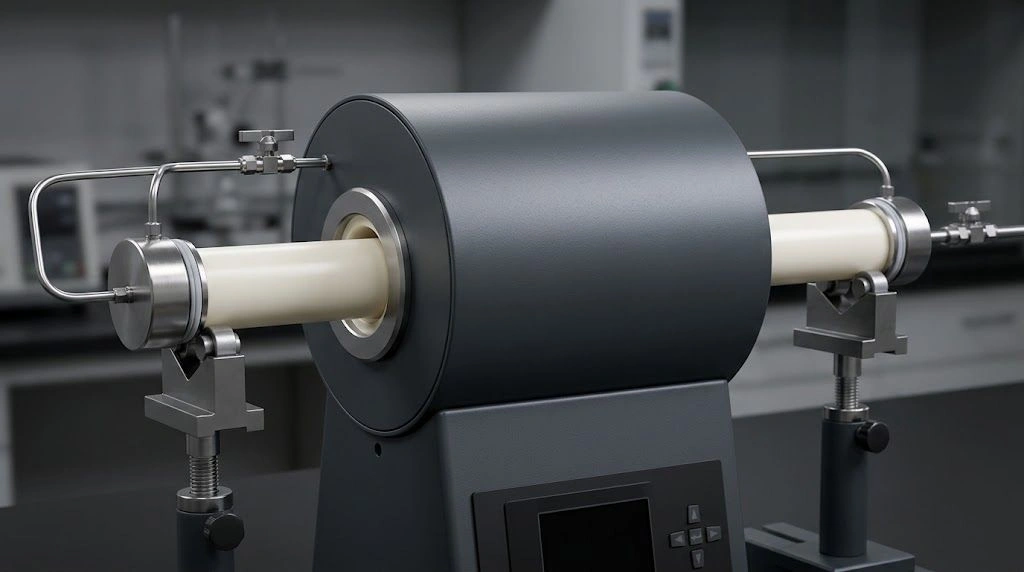
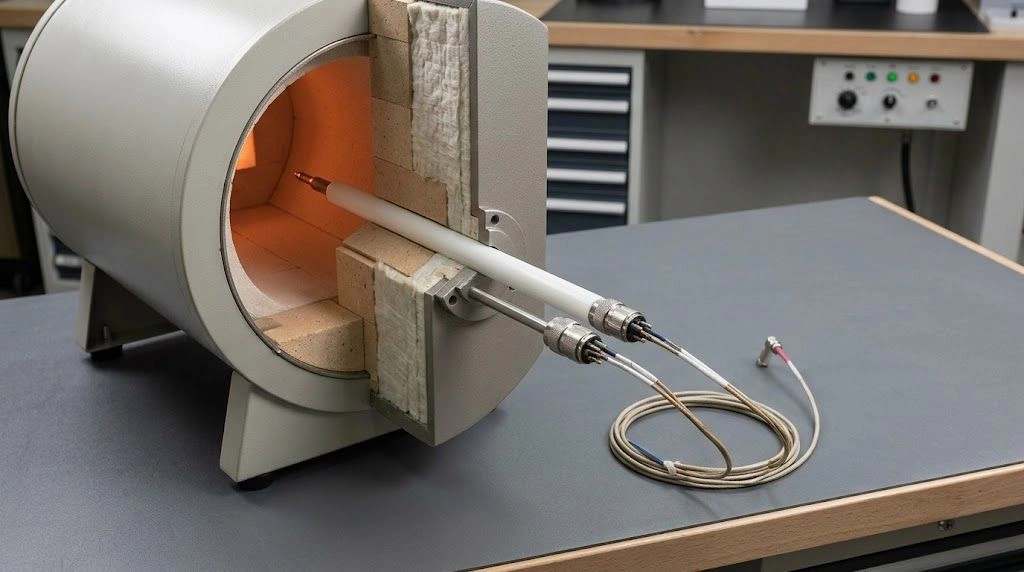
The work tube, end seals, gas connections, and supports form one atmosphere system; the image does not establish gas purity or operating capability.
Alumina Work Tubes in Controlled Atmospheres
High-purity alumina is widely considered where refractoriness, electrical insulation, and contamination control are important. Suitability still depends on temperature, gas species, carbon-bearing vapors, impurities, thermal gradients, and the materials placed inside the tube. Purity alone does not define atmosphere compatibility.
When insulation, cleanliness, and atmosphere compatibility point toward an alumina route, review available alumina ceramic tubes against the complete gas composition, temperature profile, tube geometry, orientation, sealing, and support conditions.
When SiC or Nitride Ceramics Need Separate Review
Silicon carbide behavior depends on grade, temperature, and oxygen potential. Some conditions support protective oxidation behavior, while other conditions can produce non-protective reactions or different degradation routes. Electrical conductivity and gas tightness also depend on the material route and grade.
Silicon nitride and Sialon components require their own chemistry review when oxygen activity, nitrogen activity, decomposition, deposits, or molten-material contact matter. Material-family names are screening categories rather than service guarantees.
Contamination and Thermal-Mechanical Effects
Seals, insulation, fixtures, samples, and cleaning residues may contribute more contamination than the main ceramic tube. Trace all exposed materials and expected off-gases before attributing batch contamination to one component.
Rapid purging can create local cooling. A cold gas jet directed at a hot ceramic surface can cause a steep thermal gradient. Increasing wall thickness may add mechanical section but can also increase internal temperature differences. Support points, alignment, end fittings, and differential expansion need review with the purge and thermal sequence.
| Symptom | Possible atmosphere contributor | Other factors | Review action |
|---|---|---|---|
| Deposits or discoloration | Vapor transport, carbon, condensed species | Sample contamination, handling, cleaning | Identify deposit chemistry before changing tube material |
| Pitting or recession | Reactive gas or volatile product | Local overheating and impingement | Review chemistry, temperature distribution, and grade |
| Hot-end cracking | Rapid atmosphere or temperature change | Tip thickness, prior damage, cold-gas jet | Review purge introduction and transient conditions |
| Crack at support | Differential expansion | Misalignment, hard clamping, point loading | Review clearance and compliant support |
| Loss of insulation | Conductive deposit or surface change | Moisture and damaged internal insulators | Measure insulation under defined conditions |
| Apparent leakage | Tube crack or seal degradation | End fitting, gasket, connection, method | Separate ceramic-body integrity from assembly sealing |
What Should a Furnace-Atmosphere Specification Include?
A furnace-atmosphere specification should describe the condition required at the load during heating, soaking, and cooling. State gas composition, allowable reactive impurities, measurement method, and sampling position. Define purge completion, circulation, chamber pressure, exhaust, expected off-gases, and acceptance records. For ceramic hardware, provide material requirements, complete tube geometry, heated zone, orientation, supports, seals, and thermal cycles.
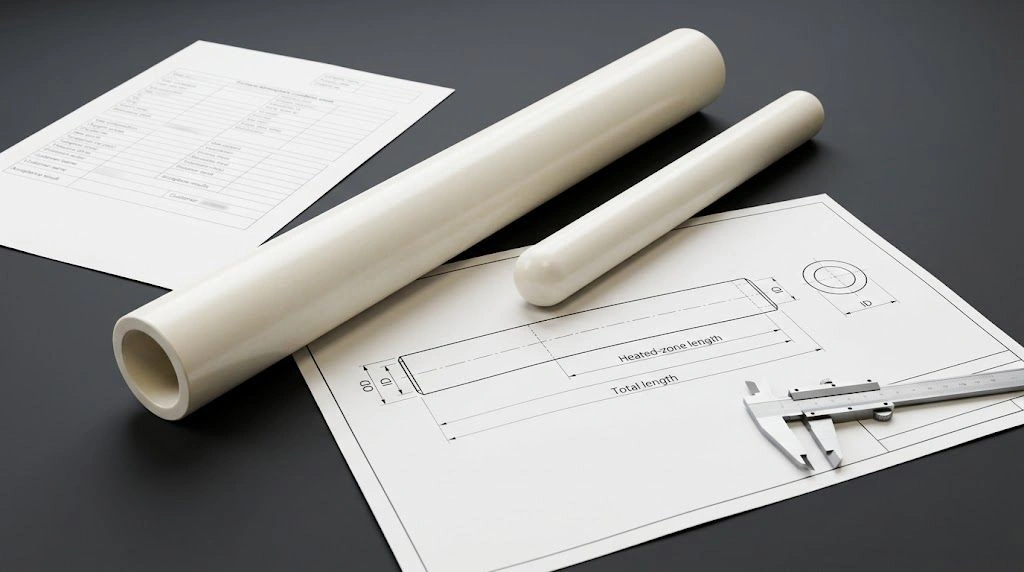
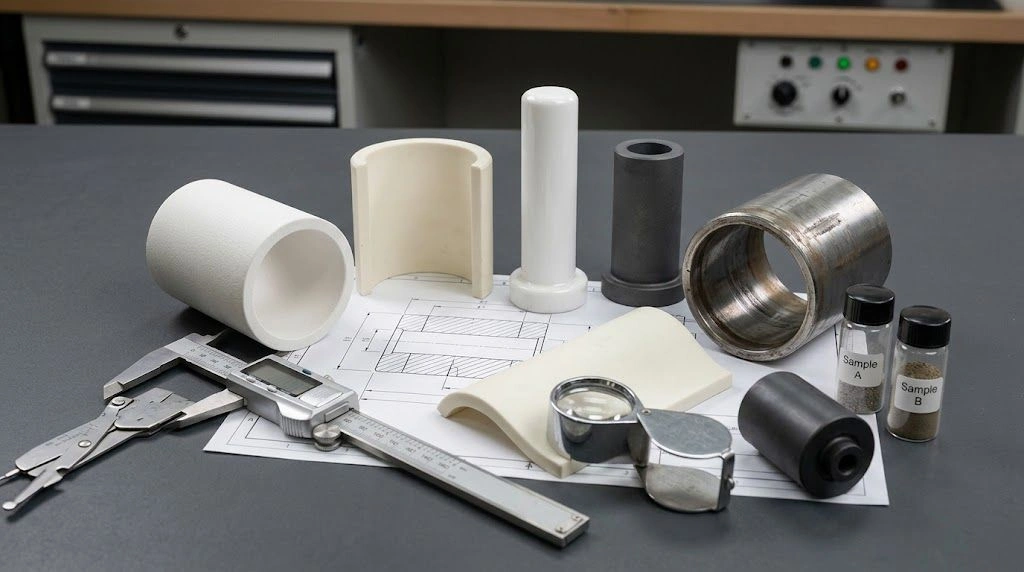
The parts, dimensional drawing, and atmosphere sheet illustrate an RFQ review without showing customer data, inspection results, or guaranteed limits.
Copyable Atmosphere Specification Note
Process atmosphere shall be defined at the load for each heating, soaking, and cooling stage. Specify nominal gas composition; allowable oxygen, moisture, and other reactive impurities; measurement method; sampling location; flow or circulation requirement; chamber pressure; purge completion criterion; expected process off-gases; and acceptance record. Compatibility shall be reviewed for the workpiece, furnace tube, heating elements, insulation, fixtures, seals, and temperature sensors. Flammable, toxic, or oxygen-deficient atmosphere operation requires a separate equipment and safety review under applicable regulations, standards, and site procedures.
Atmosphere Control Checklist
- Full gas composition and allowable mixture variation.
- Oxygen limit, analyzer method, and sampling position.
- Moisture or dew-point requirement, pressure basis, and sample conditioning.
- Other reactive impurities and expected process vapors.
- Gas flow or circulation range and measurement point.
- Furnace pressure range and reference pressure.
- Purge gas, sequence, and measurable completion criterion.
- Ramp, soak, and cooling stages.
- Expected off-gases and exhaust route.
- Supply, chamber, exhaust, or near-load sampling location.
- Continuous trend, batch record, or qualification evidence.
- Safe shutdown state and responsible equipment controls.
Furnace-Tube RFQ Checklist
- Workpiece, powder, binder, and process type.
- Required and prohibited reactions.
- Nominal gas composition and mixture range.
- Oxygen, moisture, and other impurity requirements.
- Continuous, peak, and transient temperature profile.
- Ramp rate, soak duration, and cooling atmosphere.
- Batch or continuous operation.
- Chamber pressure or vacuum range.
- Gas inlet, circulation, purge, and exhaust arrangement.
- Tube orientation and heated-zone length.
- OD, ID, wall thickness, total length, and end geometry.
- Unsupported span and support locations.
- Seal, flange, and end-fitting arrangement.
- Required ceramic grade or request for material review.
- Electrical-insulation and contamination requirements.
- Thermal-cycle frequency and expected maintenance conditions.
- Existing tube photographs, deposit analysis, or failure location.
- Tolerances, straightness, inspection documents, quantity, and project stage.
- Applicable equipment and safety standards.
A ceramic-component quotation does not replace gas-system design, combustion controls, hazard analysis, interlocks, ventilation, or site operating procedures. Assign these responsibilities to the qualified furnace, process, and safety teams.
Send ADCERAX the furnace-tube drawing or existing-part information with the material preference, quantities, complete atmosphere, temperature profile, pressure, purge arrangement, supports, seals, and contamination requirements at info@adcerax.com for material and manufacturability review.
FAQ
What is the difference between oxidizing and reducing furnace atmospheres?
An oxidizing atmosphere favors oxidation of the material or species being considered. A reducing atmosphere favors reduction of selected oxides or maintains a lower oxidation potential. The result depends on temperature, gas ratios, impurities, and material chemistry; the category name does not guarantee a particular reaction.
Is nitrogen always an inert furnace atmosphere?
No. Nitrogen is a useful protective gas in many furnaces, but selected metals, ceramics, and compounds can react with it at elevated temperature. Residual oxygen, moisture, and process off-gases can also make a nominal nitrogen atmosphere chemically active.
Why can parts oxidize in an argon furnace?
Possible contributors include residual air, insufficient purging, seal leakage, oxygen or moisture contamination, adsorbed water, product outgassing, and poor circulation. The gas-supply certificate does not necessarily describe the condition surrounding the heated load throughout the cycle.
Is vacuum an inert atmosphere?
Vacuum is better treated as a separate processing condition. Lower total pressure reduces the quantity of gas, but residual oxygen, water vapor, hydrocarbons, leaks, outgassing, and pump backstreaming may remain relevant. Vacuum may also promote evaporation or decomposition depending on material and temperature.
Which furnace atmosphere is suitable for alumina tubes?
Alumina is used in many air and controlled-atmosphere furnace systems, but suitability depends on grade, temperature, impurities, reducing species, carbon exposure, pressure, thermal cycling, supports, seals, and the materials inside the tube. Specify the complete atmosphere rather than only “inert” or “reducing.”