Crucibles are heated to constant weight to establish a stable container mass before a quantitative measurement. Without this conditioning step, moisture, volatile residue, handling contamination, or changes in the crucible itself could be mistaken for a change in the sample.
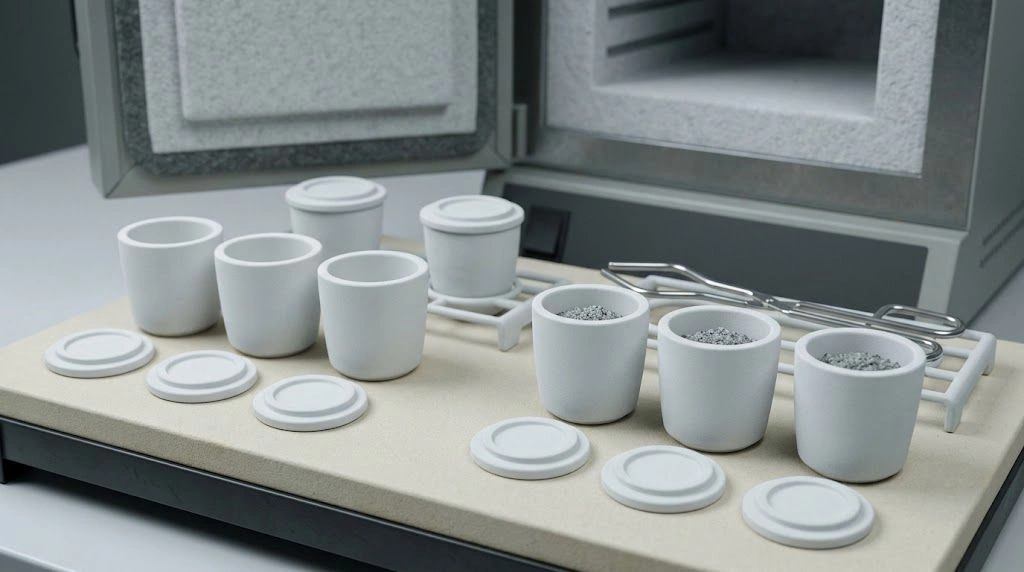
In practice, the crucible is heated under prescribed conditions, cooled in a desiccator, weighed, and reheated until successive accepted measurements satisfy the method’s criterion. The same cycle may later be applied to a crucible containing a dried or ignited residue. These two stages look similar, but they serve different analytical purposes.
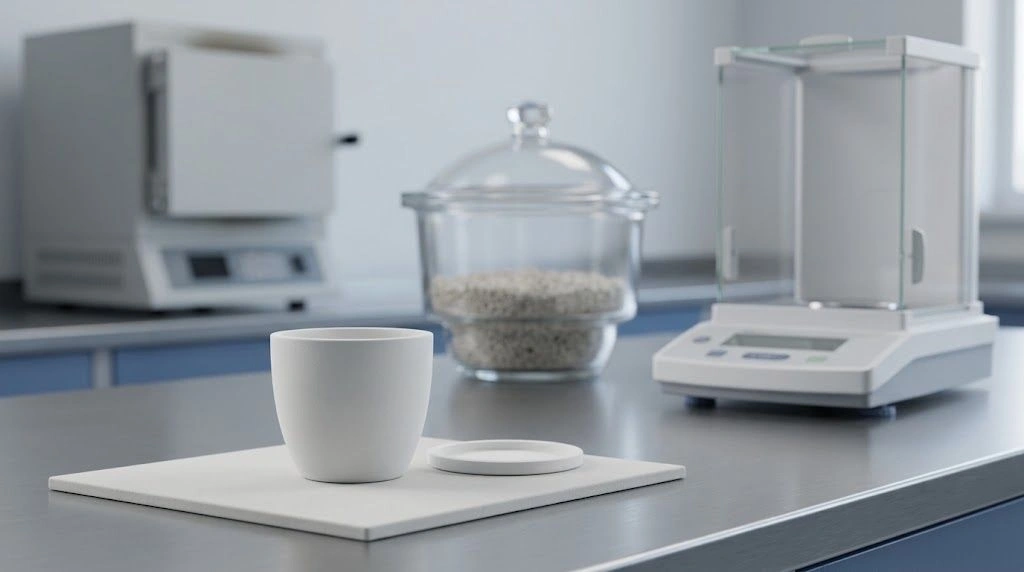
A controlled heat–cool–weigh cycle separates crucible tare changes from sample mass changes.
What Does “Constant Weight” Mean in Crucible Work?
“Constant weight,” more precisely called constant mass, means that successive measurements agree within the acceptance limit defined by the applicable analytical method or validated laboratory procedure. It does not mean that the balance must display an eternally identical number.
Every measurement has finite resolution and uncertainty. The crucible or residue can also exchange moisture or contamination with its surroundings during cooling and transfer. A method therefore defines when the remaining difference is small enough to accept. Depending on the procedure, this may be an absolute mass difference, a percentage difference, or a combined rule.
The balance readability is not automatically the constant-mass criterion. A balance that displays 0.1 mg increments tells the analyst how finely the instrument reports mass; it does not decide how much change the analytical method permits.
It is equally important to identify what is being brought to constant mass:
| Object being conditioned | Purpose | Meaning of accepted stability | Calculation role |
|---|---|---|---|
| Clean, empty crucible, with its lid if required | Establish a stable tare | The vessel is sufficiently stable under the prescribed blank cycle | Baseline subtracted from later measurements |
| Crucible plus dried sample or residue | Reach a drying endpoint | Remaining change is within the method’s drying criterion | Used for dried residue, moisture, or solids calculations |
| Crucible plus ignited residue | Reach an ignition endpoint | Remaining change is within the method’s ignition criterion | Used for ash, fixed solids, or loss-on-ignition calculations |
Published numbers illustrate why the criterion cannot be borrowed casually. A CSU/LibreTexts teaching procedure uses agreement within 0.2 mg for its classroom exercise. EPA Method 1684, issued as a draft in January 2001, specifies repeated drying or ignition until the change is below 4% or 50 mg, whichever is less, for its stated solids procedure. These values belong to different contexts and are not interchangeable.
The analytical method—not the crucible supplier and not a generic laboratory rule—determines the acceptable mass difference.
Why Is an Empty Crucible Heated to Constant Weight?
The empty crucible is heated to constant weight so that its own mass becomes a dependable baseline. A crucible exposed to laboratory air may carry adsorbed moisture, cleaning residue, dust, or other volatile material. The first heating cycle may remove some of these contributions, but one heating does not demonstrate that the tare is stable. Reheating and reweighing provide that evidence under the selected blank-conditioning conditions.
Gravimetric calculations depend on mass differences. A basic residue calculation is:
[
m{\text{residue}} = m{\text{crucible + residue}} - m_{\text{conditioned empty crucible}}
]
where:
- (m_{\text{residue}}) is the calculated residue mass;
- (m_{\text{crucible + residue}}) is the accepted final combined mass; and
- (m_{\text{conditioned empty crucible}}) is the accepted tare.
If the crucible tare changes by (\Delta m_c) after the tare is recorded and that change is ignored, the calculated residue inherits a corresponding bias. The direction depends on whether the crucible gained or lost mass. A fingerprint or absorbed moisture before final weighing may increase the apparent residue; loss of crucible material may decrease it.
| Condition before sample loading | Likely consequence | Appropriate response |
|---|---|---|
| Successive tare measurements meet the method criterion | Tare may be accepted, subject to other controls | Record the accepted mass and proceed |
| Tare decreases steadily | Moisture, residue, volatilization, or crucible loss may continue | Review cleaning and conditioning; do not automatically exceed the method |
| Tare increases after room-air exposure | Moisture uptake or contamination is possible | Check desiccator condition, transfer time, and handling |
| Tare alternates irregularly | Temperature mismatch, drafts, static, vibration, or inconsistent handling may be involved | Stabilize the weighing process before blaming the material |
| Empty crucible is stable but loaded crucible is not | Sample transformation or sample–crucible interaction becomes more likely | Review chemistry, atmosphere, and material compatibility |
A stable empty-crucible mass demonstrates stability only under the selected blank cycle. It does not prove sample compatibility, absence of trace contamination, complete sample reaction, residue purity, or compliance with another test method.
Why Can a Crucible or Residue Fail to Reach Constant Weight?
A changing mass does not always mean the crucible needs more furnace time. The cause may occur during heating, cooling, transfer, or weighing.
A hygroscopic residue can absorb water between the desiccator and the balance. A warm crucible can produce temperature gradients and convection around the balance pan, causing an unstable apparent mass. Fingerprints, dust, or particles from dirty tongs can add material.
The sample may also be changing chemically. Oxidation can produce a mass gain, while decomposition, volatilization, incomplete drying, spalling, or material loss can produce a decrease. Some residues retain bound or occluded water. Some sample–crucible combinations react at the selected temperature and atmosphere. Additional heating is therefore not neutral: it may remove something the method intends to measure or accelerate an unwanted reaction.
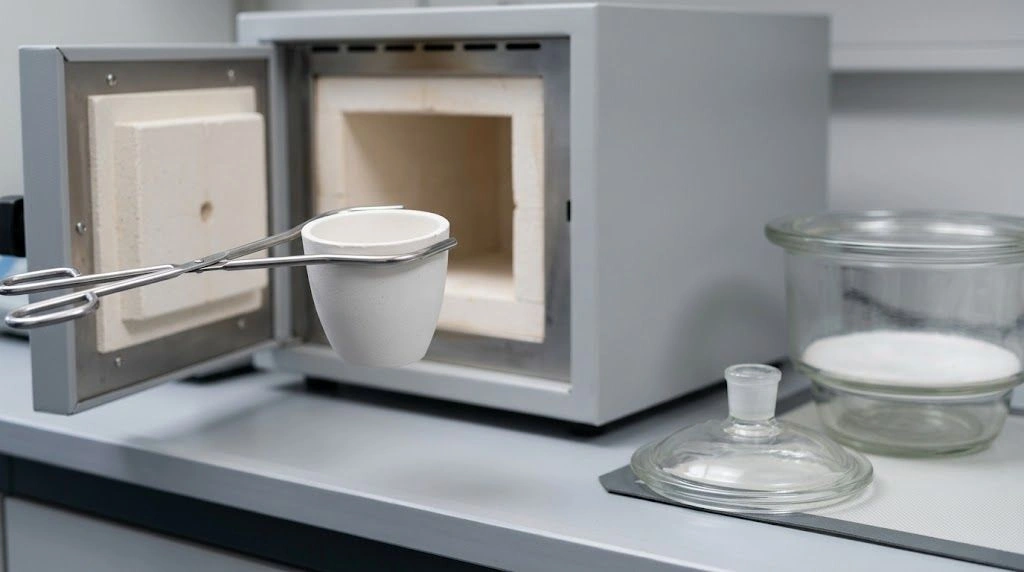
Clean transfer and controlled cooling are part of the measurement, not merely handling details.
| Observed pattern | Possible causes | Checks |
|---|---|---|
| Mass decreases after every cycle | Continuing drying, volatile residue, decomposition, volatilization, spalling, or sample loss | Inspect the crucible; verify time, temperature, and atmosphere; compare with a blank |
| Mass increases after every cycle | Oxidation, furnace deposits, handling contamination, or moisture uptake | Check atmosphere, furnace cleanliness, cooling, and chemistry |
| Reading drifts on the balance | Temperature mismatch, convection, drafts, static, or vibration | Allow controlled equilibration and check the balance environment |
| Mass changes after desiccator removal | Hygroscopic residue, weak desiccant, long transfer time, or exposed warm surfaces | Verify desiccator performance and standardize transfer time |
| Replicates behave differently | Unequal loading, inconsistent position, different crucible condition, or handling contamination | Standardize loading, furnace location, identification, and handling |
| Blank is stable but sample is not | Sample conversion, retained volatiles, or sample–crucible reaction | Return to the governing method and compatibility review |
| Surface changes color, glaze, or texture | Reaction, contamination, overheating, or degradation | Stop and inspect; stable mass alone would not prove suitability |
Troubleshooting should start with the direction and timing of the change. A stable blank, a method blank, replicate behavior, and complete cycle records are more informative than simply adding another heating period.
How Should the Heat–Cool–Weigh Cycle Be Controlled?
The reliable procedure is a controlled sequence rather than an isolated furnace step:
- Confirm the governing method and its endpoint criterion.
- Clean and uniquely identify the crucible without introducing an unstable marking.
- Include the lid only when required, and keep it paired with the same crucible.
- Heat at the prescribed temperature, duration, and atmosphere.
- Transfer with clean, suitable tongs or a compatible holder.
- Cool in a functioning desiccator according to the laboratory procedure.
- Allow the crucible to reach the required weighing condition.
- Weigh it on the designated balance.
- Record the mass and relevant cycle conditions.
- Repeat the prescribed cycle and compare successive accepted measurements.
- If the criterion is not met, investigate before changing the method.
Cooling is integral to the result. A desiccator limits uncontrolled moisture exposure, but only if its seal and desiccant are effective and the lid is not left open unnecessarily. The crucible must also reach the temperature condition required by the balance procedure. Weighing a warm crucible can generate convection effects, while inconsistent cooling periods allow different amounts of environmental exposure.
| Step | What it controls | Common mistake |
|---|---|---|
| Cleaning | Surface residue and contamination | Assuming visible cleanliness equals mass stability |
| Identification | Traceability between cycles | Using a marking that changes during heating |
| Prescribed heating | Defined drying or ignition conditions | Substituting a convenient temperature |
| Clean transfer | Fingerprints and foreign particles | Touching the crucible or using contaminated tongs |
| Desiccator cooling | Moisture uptake and uncontrolled exposure | Using exhausted desiccant or leaving the lid open |
| Temperature equilibration | Convection and balance instability | Weighing while warm |
| Consistent weighing | Comparability between cycles | Changing balances or conditions without documenting it |
| Cycle recording | Traceability and diagnosis | Keeping only the final reading |
| Method endpoint | A defensible stopping decision | Copying a tolerance from another procedure |
Copyable Mass Record
| Crucible ID | Cycle | Heating condition | Cooling start | Weighing time | Recorded mass | Change from previous cycle | Criterion met? | Observation |
|---|---|---|---|---|---|---|---|---|
| 1 | N/A | No | ||||||
| 2 | ||||||||
| 3 |
Crucible material selection remains a separate engineering decision. When the governing method and sample chemistry indicate an alumina route, review alumina crucibles by capacity, geometry, purity, lid configuration, temperature, and atmosphere.
Product selection can support the workflow, but analytical acceptance criteria and method validation remain the responsibility of the laboratory.
Expert Insight
Constant mass is a controlled decision rule, not a material property of the crucible. It becomes meaningful only when heating, cooling, handling, and weighing conditions are sufficiently repeatable. Measurements that happen to agree after inconsistent cooling periods may reflect offsetting errors rather than a stable system.
Separate three questions during method development or troubleshooting. First, is the clean empty crucible stable under the prescribed blank cycle? Second, does the loaded crucible behave differently because of the sample, flux, reagent, or atmosphere? Third, does the final residue meet the endpoint defined by the method? Combining the questions makes it difficult to determine whether a mass change belongs to the vessel, sample, or measurement environment.
EPA’s draft Method 1684 warns that heating time and temperature affect results through mechanisms including volatilization, decomposition, oxidation, retained water, and moisture uptake. This is why “heat it longer” is not a generally safe correction. Controlled cooling also matters: the CSU/LibreTexts teaching procedure demonstrates how a crucible at a different temperature from the balance compartment can produce convection-related apparent-mass error. Its 0.2 mg limit is an educational example, not a universal specification.
What Should Be Specified When Selecting a Crucible for Gravimetric Work?
A useful crucible RFQ describes the analytical process, not only nominal capacity and maximum furnace temperature. Sample and reagent chemistry, working and peak temperatures, heating profile, atmosphere, and cycle frequency help screen for chemical interaction, contamination, and thermal-cycling risks.
Geometry matters too. Capacity should provide adequate headspace for foaming, combustion, or gas evolution. Wall thickness, base shape, and total mass affect heating and cooling behavior. A lid may control splashing or airflow in some methods, but it should not be added automatically. Define required purity, restricted contaminants, dimensional limits, identification, and documentation.
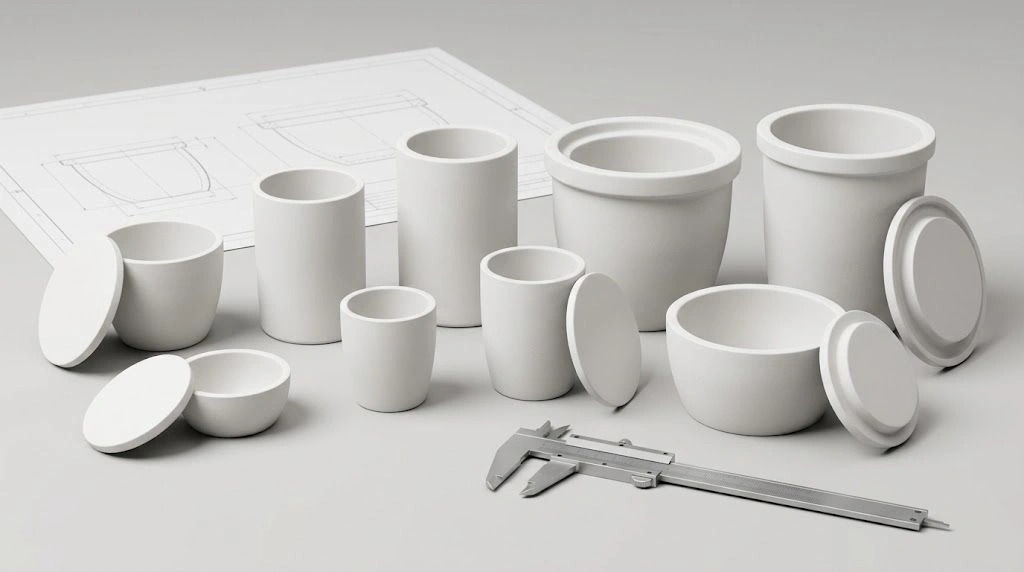
A complete RFQ connects crucible geometry and material requirements to the actual analytical process.
| RFQ category | Information to provide | Why it matters |
|---|---|---|
| Governing method | Method name, revision, and relevant step | Defines actual heating and weighing conditions |
| Sample chemistry | Compounds, salts, metals, fluxes, acids, or alkalis | Screens possible interaction |
| Process purpose | Drying, ignition, ashing, calcination, or melting | Keeps unlike thermal processes distinct |
| Temperature | Working and peak temperature | Supports material and design screening |
| Heating profile | Ramp, hold, cooling, and cycle frequency | Indicates thermal-cycling severity |
| Atmosphere | Air, oxygen, inert gas, vacuum, or another environment | Atmosphere can change chemistry |
| Capacity and load | Sample mass, bulk volume, and expected expansion | Determines usable headspace |
| Geometry | OD, ID, height, wall, base, and tolerances | Ensures furnace, holder, and balance fit |
| Lid | Required, loose, vented, or not required | Affects containment and gas exchange |
| Purity and contaminants | Required grade and restricted elements | Supports contamination control |
| Handling | Manual tongs, holder, or automation | Influences rim and exterior design |
| Documentation | Drawing, declaration, certificate, or inspection needs | Prevents quotation assumptions |
Copyable RFQ Note
Application: Gravimetric analysis / ash determination / other:
Governing method and revision:
Sample and reagent chemistry:
Process purpose:
Working temperature:
Peak temperature:
Heating and cooling profile:
Furnace atmosphere:
Sample mass and approximate volume:
Required crucible capacity:
Required dimensions and tolerances:
Lid requirement:
Preferred ceramic material or purity:
Restricted contaminants:
Expected thermal cycles:
Cleaning procedure:
Handling or fixture constraints:
Required documentation:
Prototype quantity:
Annual quantity:
Drawing or reference-part photograph attached: Yes / No
Frequently Asked Questions
What is meant by heating a crucible to constant weight?
It means repeating the prescribed heat–cool–weigh cycle until successive accepted measurements agree within the applicable method’s limit. Exactly identical displayed values are not always required.
Why is the empty crucible weighed before adding the sample?
Its conditioned empty mass is the tare subtracted from the later combined mass. Otherwise, a change in the vessel can be incorrectly attributed to the sample.
Does constant weight mean all moisture has been removed?
Not necessarily. It means the observed change satisfies the method’s endpoint. Bound water, oxidation, decomposition, and volatilization may also affect mass.
How many heating cycles are needed?
There is no universal number. Successive measurements must be compared, and further cycles depend on the governing method and observed pattern.
Why is a crucible cooled in a desiccator?
The desiccator provides a controlled, low-moisture cooling environment. Its seal and desiccant must be maintained, and transfer time should be consistent.
Why should a hot crucible not be weighed?
A temperature difference can create convection around the balance pan and cause an unstable or biased apparent mass. Heat may also be inappropriate for the balance.
Does a stable empty-crucible mass prove sample compatibility?
No. Blank stability describes the empty vessel under one conditioning cycle. The sample, reagent, flux, and atmosphere can introduce new interactions.
Is alumina suitable for every gravimetric analysis?
No. Suitability depends on chemistry, temperature, atmosphere, contamination limits, geometry, and method requirements. Review the specific application before selection.
Conclusion
Crucibles are heated to constant weight to establish a stable tare and prevent vessel changes from being reported as sample changes. The result depends on a controlled sequence of heating, desiccator cooling, temperature equilibration, weighing, and comparison against a method-specific acceptance criterion.
If the mass continues to change, investigate handling, moisture exposure, balance conditions, sample chemistry, atmosphere, and crucible interaction. Do not assume that more heating is harmless. For purchasing, start with the governing method, chemistry, temperature profile, atmosphere, geometry, purity, and documentation needs, then validate the analytical procedure independently.
Technical References
- U.S. EPA, Method 1684: Total, Fixed, and Volatile Solids in Water, Solids, and Biosolids, Draft, January 2001: https://www.epa.gov/sites/default/files/2015-10/documents/method_1684_draft_2001.pdf
- CSU Dominguez Hills / Chemistry LibreTexts, Heating a Crucible to Constant Weight: https://chem.libretexts.org/Ancillary_Materials/Demos_Techniques_and_Experiments/General_Lab_Techniques/Heating_a_Crucible_to_Constant_Weight