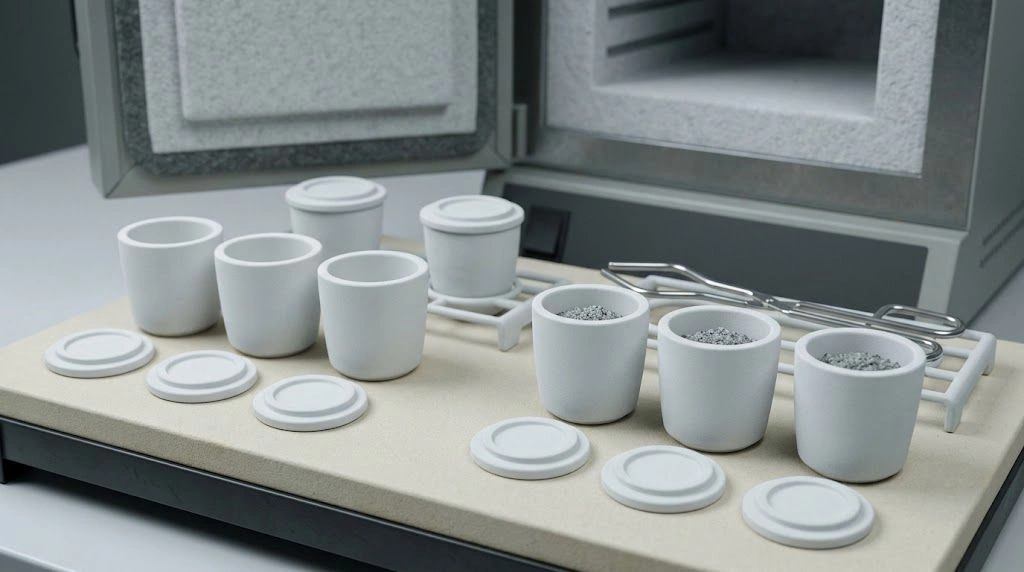
Samples stick to alumina crucibles when the heated material wets, reacts with or penetrates the ceramic surface. A powder or pellet can also form sintering bonds without visibly melting, while a solidified melt can become mechanically locked by pores, surface roughness or crucible geometry.
The controlling variables are the complete sample composition, minor additives, temperature, hold time, atmosphere and crucible condition. A flux can create a liquid phase below the main material’s melting point.
The remedy must match the mechanism. Higher-purity alumina, a coating or a powder bed is not universally effective.
Is the Sample Chemically Bonded or Mechanically Trapped?
“Stuck” describes the result, not the interface. First establish whether the material remained solid, partially melted or became fully molten during the cycle.
Loose residue
Fine powder can remain in shallow pores or grinding marks without forming a strong chemical bond. Static attraction before firing, binder residue and surface roughness can all contribute.
If an approved light cleaning removes the residue without changing the surface, the mechanism may be primarily mechanical retention. This does not prove that the next cycle will behave the same way, especially if temperature or chemistry changes.
Sintered contact
A powder compact can bond at individual contact points while remaining below its bulk melting temperature. Diffusion and neck growth increase the real bonded area between the sample and crucible.
This mechanism is particularly plausible for fine, reactive powders or compositions similar to alumina. Saint-Gobain’s description of ceramic sintering likewise defines it as particle bonding below the melting point; that principle explains why the absence of a visible melt does not rule out adhesion. Ceramic sintering overview
Frozen melt adhesion
A partial or complete melt may spread over the bottom, enter surface features and solidify in intimate contact. The frozen material can be retained by wetting, reaction products, pore penetration or contraction around surface irregularities.
A sample can also become trapped beneath a narrower opening. High removal force does not necessarily prove a chemical bond.
Reaction layer
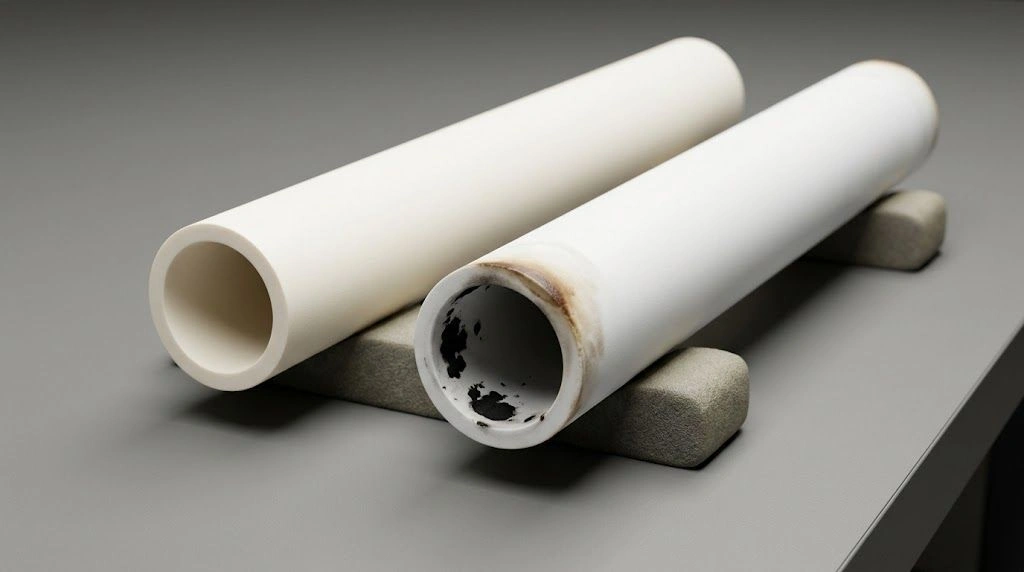
The sample and crucible may form a new interfacial phase or the melt may dissolve part of the alumina. Possible evidence includes glaze, pitting, wall loss, a composition gradient or alumina-derived elements in the recovered sample.
These observations require more than a surface photograph to interpret. A section can distinguish a superficial film from penetration or loss of the original wall.
Cooling-induced locking
The sample and crucible normally contract differently. After solidification, the sample may press against a sidewall, clamp around a feature or load the bottom. The assembly may therefore seem free at high temperature but be immovable when cold.
| Observed condition | First mechanism to examine |
|---|---|
| Loose dry powder | Surface retention |
| Pellet attached at isolated points | Solid-state sintering |
| Smooth, spread film | Wetting and liquid-phase formation |
| Glaze or pitting | Chemical reaction or dissolution |
| Material inside pores | Liquid penetration |
| Solid below a narrower opening | Geometric locking |
| Crack formed during cooling | Contraction mismatch or restraint |
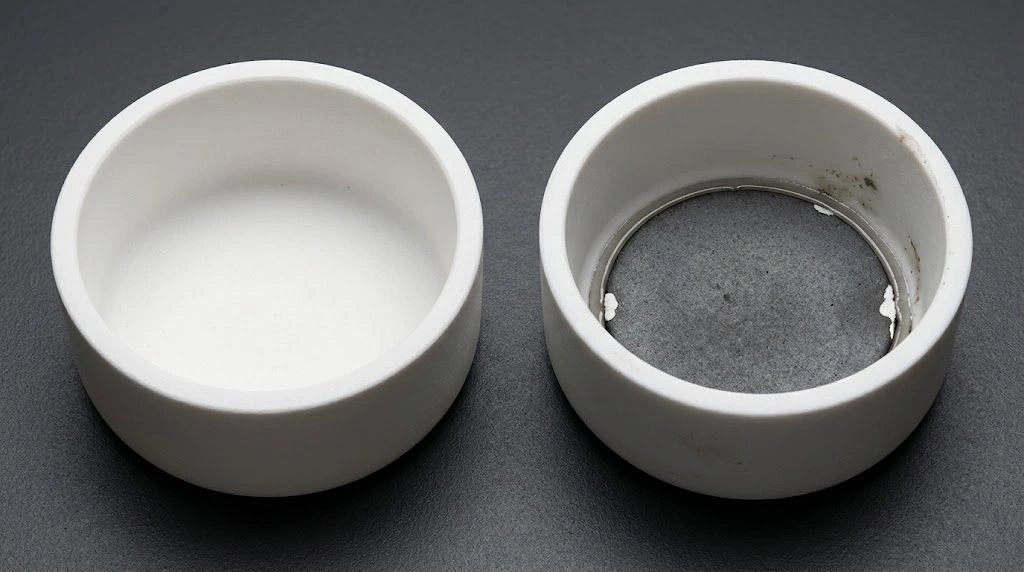
The visible residue pattern is a starting point; it does not identify the adhesion mechanism by itself.
Why Do Samples Stick to Alumina Crucibles?
Wetting increases intimate contact
Wetting describes the ability of a liquid to spread on a solid. Contact angle is one way to compare this behavior under controlled conditions: a spreading liquid has more contact with the surface than a rounded droplet. Linseis contact-angle explanation
For a high-temperature sample, wetting depends on the liquid composition, ceramic grade, surface condition, atmosphere, oxygen activity, temperature and time. A published value from a different melt or atmosphere is not a universal property of “alumina.”
Better wetting can promote capillary entry, dissolution and reaction. A NASA study of molten lunar-regolith simulant found strong wetting and reaction with the oxide ceramics tested. That specific system cannot predict another sample, but it demonstrates why oxide-on-oxide contact should not automatically be treated as inert. NASA containment study
Minor constituents can create a liquid phase
A nominally solid powder mixture can form a transient or persistent liquid during heating. Fluxes, binder ash, impurities and reaction products may lower the local liquid-formation temperature.
Possible contributors include alkali compounds, alkaline-earth compounds, borates, phosphates, silicates, fluorides and selected metal oxides. Their effects depend on the complete formulation, so this list is not a compatibility chart.
Once a liquid forms, it can spread, dissolve alumina, carry species into the wall and freeze as a bonded glassy film. The melting point of the principal component is therefore insufficient for crucible selection.
Chemical reaction changes the interface
Alumina is chemically resistant in many applications, but it is not inert to every material at every temperature. It can dissolve into some oxide melts or participate in aluminate and aluminosilicate formation.
Atmosphere matters because it changes oxidation states, volatile species and reactions among the sample, additives and crucible. Compatibility at room temperature cannot establish compatibility during a high-temperature hold.
A new phase can strengthen adhesion even when liquid penetration is shallow. Conversely, penetration may occur without a thick, easily visible reaction layer. Phase identification and a cross-section may both be needed.
Pores and damage create anchors
Dense alumina still has microscopic surface features. A wetting liquid may enter open pores, grain-boundary recesses, pits, scratches or cracks left by earlier cycles. After cooling, these become mechanical anchors.
Higher density and lower open porosity can reduce one route of penetration. They cannot stop a favorable chemical reaction or guarantee non-wetting behavior.
Repeated use may make adhesion worse by leaving glaze, embedded flux, metal particles or rough pullout sites. A clean first cycle followed by sticking is often a reason to inspect the evolving surface rather than only the latest sample.
Solid-state sintering bonds unmelted material
Temperature, time, particle size, green density and contact pressure influence sintering at the interface. A transient liquid can accelerate bonding even if the sample later appears fully solid.
An alumina-rich sample can be particularly difficult to separate from an alumina surface because the interface may resemble the intended sintering contacts within the sample. A compatible sacrificial layer must interrupt that contact without itself joining or contaminating the material.
Shape changes and cooling complete the lock
Samples may shrink, expand, foam, warp, flow or overflow. A melt that climbs a wall increases contact area; an expanded pellet may press against the crucible. Overfilled material can solidify around the rim.
Crucible deformation also matters. Thin walls, high load, long holds and uneven support can change geometry. After cooling, differential contraction may add radial pressure or tensile stress.
| Observation | Likely direction for investigation |
|---|---|
| Glassy ring around the sample | Flux or other liquid phase |
| Sample spread up the wall | Wetting, overfilling or foaming |
| Rough crater after separation | Dissolution, penetration or ceramic pullout |
| White grains on sample underside | Fracture within the ceramic surface |
| Sticking increases with hold time | Reaction, penetration or sintering |
| Sticking begins after reuse | Contamination or accumulated surface damage |
What Does the Stuck Interface Reveal?
Document the condition before attempting removal. Record the sample orientation, crucible batch, loading level, hot-zone position and any material near the rim.
Read both sides of a separation
A clean surface with loose residue points toward limited retention. White fragments on the sample may indicate fracture within the crucible surface.
A glossy film suggests liquid-phase participation but does not identify its chemistry. Pits, channels or measurable wall loss indicate more than simple sticking.
Color change can reflect metal ions, carbon, vapor deposition or reaction products. It is not a compound identification method.
Use a controlled investigation sequence
- Record every major and minor sample constituent, including binder and flux.
- Record peak temperature, hold, ramps and atmosphere.
- Photograph the undisturbed assembly.
- Compare the bottom, sidewall and rim.
- Compare with an unused crucible from the same grade and batch.
- Examine both fracture surfaces if separation occurs.
- Use a sacrificial coupon or small crucible for the next controlled trial.
- Analyze the interface when purity or material selection is important.
Choose analysis to answer the uncertainty
| Method | What it can show | Important limitation |
|---|---|---|
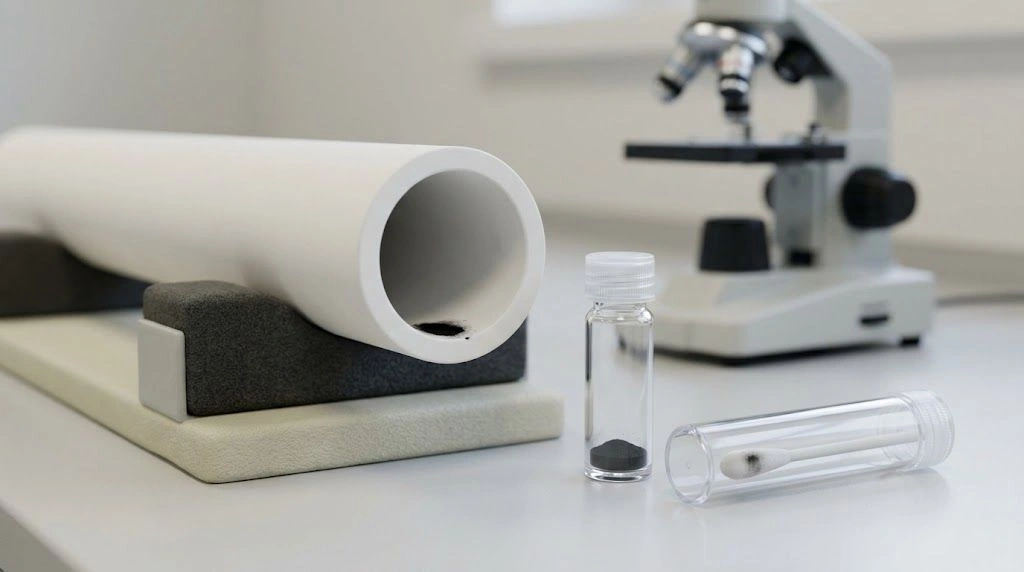
| Optical microscopy | Glaze, pits, cracks and residue distribution | Limited chemical identification |
| SEM-EDS | Morphology and elemental distribution | Elements do not uniquely identify phases |
| XRD | Crystalline reaction products | Thin or amorphous layers may be difficult to detect |
| ICP-OES or ICP-MS | Selected elements in recovered material | Requires suitable sampling and controls |
| Raman spectroscopy | Carbon and selected phases | Mixed phases and fluorescence can interfere |
| Cross-section microscopy | Penetration and reaction-layer depth | Destructive preparation |
| High-temperature contact-angle test | Comparative wetting in a controlled system | Results depend on atmosphere and surface preparation |
| Mass comparison | Gross gain or loss | Small changes may be below measurement capability |
High-temperature refractory research shows that temperature, composition, surface condition and hold time can change wetting and penetration. For example, a study of molten slag on dolomitic refractory reported decreasing contact angle with temperature and greater penetration with longer holds. Because that substrate is not alumina, the result supports an experimental approach—not a numerical prediction for an alumina crucible. Warwick research record
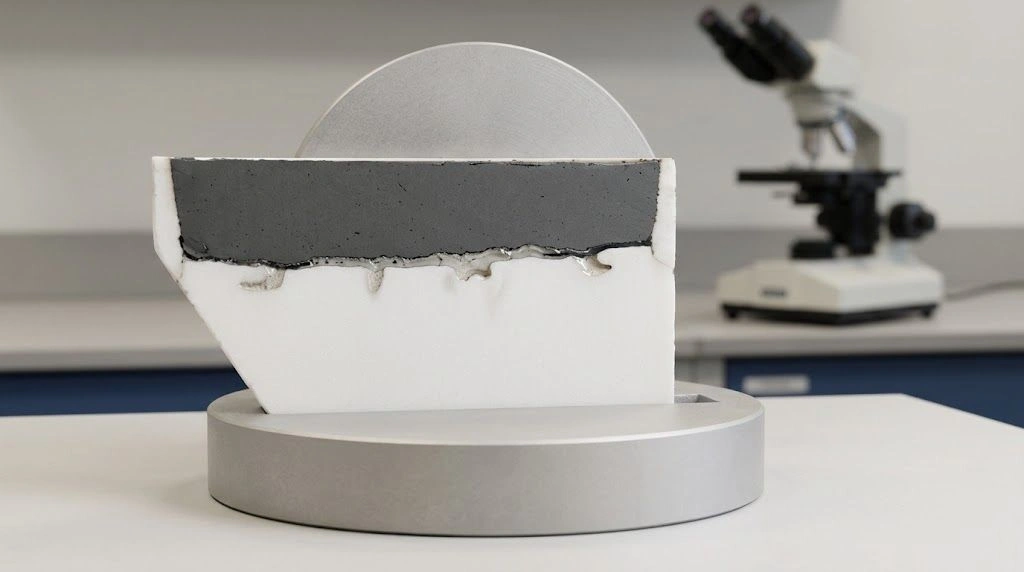
A prepared cross-section can reveal whether the deposit is superficial or extends into the crucible surface.
Can the Sample Be Removed and the Crucible Reused?
Start by deciding whether preserving the sample, the crucible or the evidence has priority. These objectives may require different actions.
Do not improvise a hazardous release method
Do not chisel, quench, reheat or chemically dissolve an unknown stuck sample. Those actions can fracture the crucible, eject material, accelerate reaction or release hazardous gas and dust.
Allow the assembly to cool through the approved cycle. Establish the sample chemistry, inspect for cracks and review the laboratory procedure before disturbing it.
Gentle mechanical separation may be considered only for a cool, identified, nonhazardous material when adhesion appears limited and the procedure permits it. Stop if substantial force is required. Avoid impact, twisting thin walls and using the rim as a pry point.
Treat chemical or thermal recovery as a process
A reagent selected to dissolve the sample can also attack secondary phases in the alumina, enter porosity or leave contamination. Reaction heat, gas generation and waste handling require evaluation.
Reheating may soften a frozen phase, but it can also increase wetting, reaction and penetration. It is appropriate only under a validated process with controlled containment and exhaust.
There is no universal chemical or thermal release procedure.
Inspect before reuse
A crucible may qualify for restricted reuse only when the original surface remains intact, dimensions remain acceptable and the next process tolerates the verified contamination risk.
Quarantine or replace it when there is a crack, ceramic pullout, pitting, wall thinning, persistent glaze, deformation, unknown residue or unstable mass. A visually intact crucible can still be unsuitable for trace analysis or a high-purity process.
| Condition | First decision |
|---|---|
| Loose known residue; intact surface | Approved cleaning and inspection |
| Limited sintered contact; clean separation | Inspect before restricted reuse |
| Persistent glassy film | Quarantine or replace |
| Pitting or ceramic pullout | Replace |
| Through-wall crack | Remove from service |
| Unknown residue | Quarantine pending identification |
| High-purity analytical work | Use new or validated equipment |
| Recurring adhesion | Redesign the interface before another run |
Do not reuse a damaged crucible merely because it still holds material. Mechanical integrity and contamination acceptance are separate requirements.
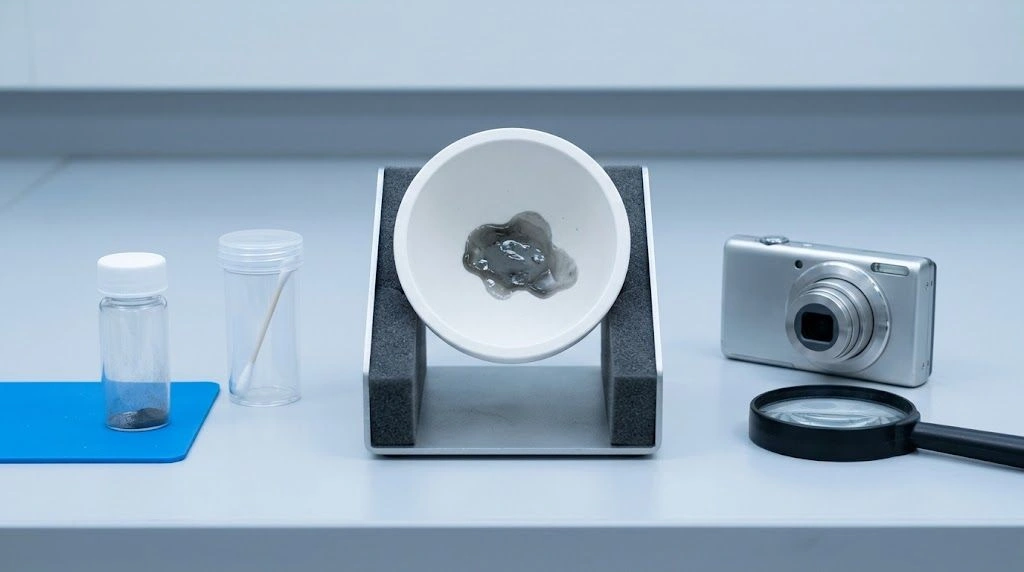
Document and contain residue before choosing a removal, cleaning or reuse procedure.
How Can Sample Sticking Be Prevented?
Start with the complete chemistry
Review the sample after decomposition or melting, not only the starting powder. Include binders, lubricants, dopants, fluxes, impurities and expected volatile species.
Where the process allows, lower unnecessary superheat or shorten an excessive hold. Separate binder removal from high-temperature treatment if this improves control without compromising the required material transformation.
Run a small compatibility test using the intended atmosphere, crucible grade, loading and cycle. Examine the interface and recovered sample before scaling.
Select grade and surface condition deliberately
Lower open porosity can reduce liquid penetration. Higher-purity alumina may reduce reactions involving glassy secondary phases, but it cannot prevent alumina dissolution, aluminate formation or solid-state bonding in every system.
Use a clean, undamaged interior. Scratches, pullout and old glaze create new anchors and contamination sources. Do not polish a crucible unless the resulting wall thickness, surface integrity and introduced contamination are controlled.
Evaluate sacrificial interfaces as new materials
A powder bed can reduce direct contact, but it may sinter to the sample, alter heat transfer or add trace elements. Candidate beds include composition-matched powder and selected refractory oxides; each requires application testing.
A ceramic insert, setter, foil or coating similarly becomes part of the chemical system. Graphite-based separators may conflict with oxidizing atmospheres or carbon-sensitive samples.
Boron nitride can provide release behavior in selected applications, especially some molten-metal systems. It is not a universal crucible coating. Review atmosphere, coating binder, peak temperature, shedding and whether boron or nitrogen contamination is acceptable.
Control loading and geometry
Keep material below the qualified fill level and off the rim. Allow for foaming, expansion and gas release. Avoid compacting powder tightly against sidewalls unless required by a validated process.
For a material that solidifies as one mass, favor a removal-compatible internal taper and avoid undercuts. Center pellets away from the wall where the process permits.
A lid can reduce vapor loss but may retain volatile species or alter atmosphere locally. It is not inherently an anti-sticking device.
Provide a complete replacement-crucible RFQ
| Information group | Details to provide |
|---|---|
| Crucible | Grade, alumina purity, density or open porosity, ID, OD, height, wall, bottom and rim |
| Geometry | Capacity, internal taper, surface requirement, lid and dimensional tolerances |
| Sample | Complete composition, additives, binder, flux, particle size, mass and green density |
| Thermal process | Normal and maximum temperature, hold, ramps, cycles and support arrangement |
| Environment | Atmosphere, gas flow, vacuum or pressure condition and nearby volatile sources |
| Behavior | Solid, partially molten or molten; shrinkage, expansion, foaming and prior adhesion evidence |
| Quality | Contamination limits, trace-element restrictions, traceability, cleaning and packaging |
| Use model | Single use, validated reuse or sacrificial compatibility testing |
When standard grade or geometry does not adequately control the interface, custom alumina crucibles should be reviewed using the complete chemistry and thermal cycle.
Frequently asked questions
Does sticking mean the alumina crucible melted?
Usually not. A sample-derived liquid may wet, penetrate or react with solid alumina.
Can a powder stick without melting?
Yes. Solid-state sintering can create interfacial necks below the melting point.
Will 99.7% alumina prevent sticking?
Not universally. Purity can reduce some secondary-phase effects but does not eliminate every reaction or wetting condition.
Can alumina powder act as a release layer?
Sometimes, but it may join an alumina-rich sample or contaminate another composition. Test it as part of the process.
Why did the first cycle work but later cycles stick?
Earlier cycles may have left glaze, embedded flux, roughness or reaction damage that changed the next interface.
Diagnose the interface before changing it
Samples stick through wetting, reaction, penetration, sintering or mechanical locking—often through more than one mechanism. Identify the dominant cause, then choose a crucible grade, geometry or sacrificial interface that interrupts it without introducing an unacceptable contamination or safety risk.